Thrombotic events are important complications in children after staged surgery for palliation of patients with functionally univentricular hearts.Reference Odegard, McGowan and Zurakowski1–Reference Jahangiri, Shore, Kakkar, Lincoln and Shinebourne4 Abnormalities in coagulation factors in the plasma have been described after the Glenn operation, and subsequent to completion of the Fontan circulation, in patients with functionally univentricular physiology,Reference Odegard, McGowan and Zurakowski1, Reference Jahangiri, Shore, Kakkar, Lincoln and Shinebourne4, Reference Odegard, McGowan and Zurakowski5 and have been documented as risk factors for thrombosis in such children.Reference Cholette, Rubenstein and Alfieris6
It was recently suggested that abnormalities in the factors responsible for coagulation may be congenitaly determined, and may be present in neonates with functionally univentricular physiology even prior to any surgical palliation.Reference Odegard, McGowan and Zurakowski1 The early identification of subsets of patients who are at increased risk of thrombosis is important if we are to predict risk with greater accuracy. Such findings will also increase the scope for targeted prevention. To the best of our knowledge, no studies have yet been performed to compare factors responsible for coagulation of the blood in neonates with functionally univentricular physiology compared to healthy controls. The primary aim of our study, therefore, was to determine if abnormalities in such are already present in newborns with functionally univentricular physiology prior to the first stage of surgical reconstruction. Our secondary aim was to assess if markers of thrombosis in the plasma are associated with any discovered disturbances of coagulation.
Patients and methods
Patients
The population consisted of newborns with functionally univentricular physiology admitted to the Children’s Cardiac Centre between April, 2006, and March, 2007. We included all patients aged between 1 and 30 days with functionally univentricular physiology, providing the authorized representative of the patient was able to understand and sign informed consent.
We excluded any patient receiving transfusion of blood, or blood products, 3 days or less before obtaining the blood sample required for analysis, and any receiving anticoagulants 3 days or less before taking the blood sample.
We calculated that 40 subjects would be required to provide 80% power for comparison of concentrations of coagulation factors and thrombolytic markers between the patients and their controls. In choosing these healthy controls, we took advantage of those patients in whom the primary reason for the blood test had been checking the level of bilirubin, the test having been requested by the caring paediatrician. The parents, or an authorized representative, then gave informed consent for the newborns to be included in the study, and tests of haemocoagulation were performed. We included only those neonates with normal levels of bilirubin as healthy age-matched controls.
Methods
We included 20 patients, and 20 healthy age-matched controls, in the study. Both the patients with functionally univentricular physiology, and the healthy newborns, received an injection of Vitamin K either after delivery, or after admission to the Cardiac Centre.
Demographic data, and verification of the infusion of Vitamin K, was collected from the medical records. We used echocardiography to assess cardiac morphology. Blood samples were taken for haematological, biochemical, and coagulation testing. A total of 4 ml was taken from each patient and the controls after placement of an intravenous line, and collected into citrated plasma. The samples from the control patients were taken during indicated blood tests. Samples were immediately centrifuged at 13,000 rpm for 5 minutes, and the plasma was stored at −70°C for subsequent batch analysis. Biochemical tests included alanine transaminase, aspartate transaminase, total bilirubin, albumin, and C reactive protein. We also requested a complete blood count.
In terms of coagulative factors, we measured concentrations of Factor II, V, VII, VIII, Protein C, Protein S and antithrombin, comparing the results between the two groups, and also with age-matched reference values.Reference Monagle, Barnes and Ignjatovic7
For markers in the plasma of thrombosis or an increased risk of bleeding, we assayed plasminogen, fibrin degradation products, D-dimer, prothrombin time, and activated partial thromboplastin time. Values were again compared between the two groups.
We used the Sysmex SF 3000 (Dade Behring, Marburg, Germany) automated haematology analyzer to determine the level of haemoglobin, the haematocrit, and the platelet count. The CA 1500 (Dade Behring, Marburg, Germany) was used to test individual procoagulant and anticoagulant factors. Functional clotting assays (Dade Behring, Marburg, Germany) were used to measure activity of both Protein C and Protein S. Latex-aglutination quantitative test (Dade Behring, Marburg, Germany) was used to measure concentrations of D-dimer.
Statistical methods
Data are expressed as medians with standard deviation. Comparison of the baseline, predictive and outcome variables between the two groups was performed using Student’s t test with Bonferroni-corrected α level of 0.05 in case of continuous variables, and the Chi-square test of Fisher’s exact test in the case of discrete baseline variables. Statistical analysis was performed with JMP software package.
The study was approved by our institutional review board, and the parents, or authorized representatives, signed informed consent for the children to be included in the study.
Results
Demographic characteristics: There were no statistically significant differences in demographic characteristics between the two groups. The mean age of 20 newborns with functionally univentricular physiology, of whom 7 were boys, was 10.8 ± 9.9 days. Their mean gestational age was 39 ± 2 weeks, and the mean weight was 3114 ± 553 g. The control group consisted of 20 healthy newborns, of whom 9 were boys, with a mean age of 11.8 ± 8.9 days, mean gestational age of 39 ± 2 weeks, and mean weight of 3214 ± 560 g.
Morphological variables: Of the 20 newborns with functionally univentricular physiology, 13 had dominant right ventricles, 7 patients having hypoplastic left heart syndrome, 5 with double outlet and double inlet right ventricle, and one patient with atrioventricular septal defect with common atrioventricular junction and right ventricular dominance. The remaining 7 had dominant left ventricles, 2 with double inlet left ventricle, 4 with pulmonary atresia and intact ventricular septum with rudimentary second ventricle, and one with atrioventricular septal defect with common atrioventricular junction and left ventricular dominance.
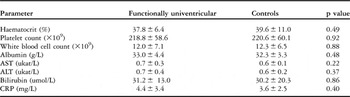
Baseline variables: Haematological variables, liver enzymes, and concentrations of albumin in the serum are summarized in Table 1. Those with functionally univentricular physiology did not differ significantly from the healthy controls.
Haematological and biochemical characteristics of the 20 patients with functionally univentricular physiology and the 20 controls.

AST: aspartataminotransferasis; ALT: alaninaminotransferasis; CRP: C reactive protein.
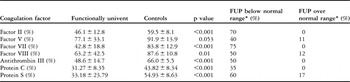
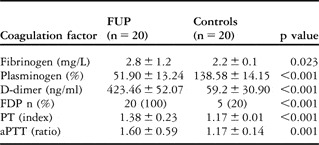
Studied variables: Comparison of coagulation factors between those with functionally univentricular physiology and the controls is summarized in Table 2. Procoagulation factors II, VII, and VIII were all present at significantly lower levels in those with functionally univentricular physiology. Protein C, Protein S and Antithrombin III were also significantly lower in the newborns with functionally univentricular physiology. Of the total group of patients, 59 ± 14% had procoagulation factors under the lower limit for age,Reference Monagle, Barnes and Ignjatovic7 and 48 ± 10% had average values of anticoagulation factors under the low limit for age.Reference Monagle, Barnes and Ignjatovic7 The levels of coagulation factors all remained above the lower limit for age for the control subjects. Comparison of thrombotic markers in the plasma, and markers for an increased risk of bleeding is summarized in Table 3. Newborns with functionally univentricular pathology had significantly higher levels of D- dimer (p < 0.0001) and fibrin degradation products (p < 0.0001), and significantly lower levels of plasminogen (p < 0.0001). The partial thromboplastin time (p < 0.0012), and the prothrombin. time (p < 0.0001) were both significantly prolonged in those with functionally univentricular physiology.
Variable coagulation factors in 20 newborns with functionally univentricular physiology and 20 healthy controls.

FUP: functionally univentricular patients; *: Reference no. 7.
Thrombotic plasma markers and bleeding risk markers in newborns with functionally univentricular physiology and healthy controls.

FUP: Functionally univentricular patients; PT: protrombin time; aPTT: Activated Partial Thromboplastin Time, FDP: Fibrin Degradation Products.
Of those with functionally univentricular arrangements, 80% had unbalanced levels of pro- and anticoagulative factors. Low levels of both protein C and protein S, in combination with normal level of procoagulation factors II and V, was always associated with positive markers of thrombosis in those with functionally univentricular physiology.
Discussion
Our study has shown that abnormalities in the levels of coagulation factors in the plasma are found in newborns with functionally univentricular physiology prior to any attempted reconstructive surgery. Such abnormalities have been described previously in patients with the functionally univentricular arrangement.Reference Jahangiri, Shore, Kakkar, Lincoln and Shinebourne4, Reference Cromme-Dijkhuis, Henkens, Bijleveld, Hillege, Bom and van der Meer8 Following the concept of developmental haemostasis,Reference Monagle, Barnes and Ignjatovic7, Reference Andrew, Vegh, Johnston, Bowker, Ofosu and Mitchell9, Reference Andrew, Paes and Milner10 however, the reference ranges used by these investigators were not age-appropriate.Reference Sluysmans, Ovaert, d’Udekem and Barrea11 In our study, we used the age-appropriate reference ranges, as well as using healthy neonates as age-matched controls.
Studies assessing patients with functionally univentricular physiology after the second stage of surgical reconstruction showed that concentrations of protein C, factors II, V, VII, IX, and X, plasminogen, fibrinogen, and antithrombin III were all significantly lower than in age-matched controls.Reference Odegard, McGowan and Zurakowski5 Only sparse data has been available previously, however, which evaluated coagulation factors in newborns with functionally univentricular physiology. Assessing the newborns with functionally univentricular physiology, Cholette and colleaguesReference Cholette, Rubenstein and Alfieris6 found that factors II, V, VII, VIII, X, antithrombin, protein C were significantly lower, and the prothrombin time and partial thromboplastin time were significantly higher than age-matched references. Markers of inflammation were increased, however, in the studied population. It is known that inflammation has a significant impact on the extrinsic pathways for coagulation.Reference Miller, Ireland and Cooper12 In our series, factor V was similar in the patients and their controls, with the level in the reference range for age. Factor II, VII and VIII together with Protein S and Protein C were lower in patients compared to controls, as found by Cholette and associates,Reference Cholette, Rubenstein and Alfieris6 albeit that our patients did not have increased markers of inflammatory activity before surgery.
The levels of haemocoagulative factors may be low either because of decreased synthesis in the liver, or because of increased consumption after the initiation of thrombosis and subsequent thrombolysis.Reference Procelewska, Kolcz, Januszewska, Mroczek and Malec13 There were no signs of hepatic dysfunction as assessed on the basis of reduced albumin or increased levels of bilirubin or transaminases in our patients. All our patients had normal counts for platelets, and we ruled out any deficiency of Vitamin K. Impaired circulation, in association with hepatic congestion, nonetheless, may lead to hepatic dysfunction, even if not seen in laboratory tests. Another cause for abnormalities of coagulation may be endothelial dysfunction and hypoxia, known to be present in neonates with functionally univentricular physiology.
Significantly increased levels of factor VIII have been found in patients undergoing the third stage of functionally univentricular repair, and considered the reason for a prothrombotic state.Reference Cromme-Dijkhuis, Henkens, Bijleveld, Hillege, Bom and van der Meer8 In our study, we observed significantly lower concentrations of factor VIII in our newborns with functionally univentricular physiology when compared to their controls. The onset of an increase in factor VIII, therefore, must be after the first stage of the functionally univentricular reconstruction. Prospective evaluation of the development of coagulation factors is needed to establish the evolution of its elevation.
Impaired levels of coagulation factors were associated with laboratory signs of thrombosis, such as positive fibrin degradation products, high levels of D-dimer, and decreased levels of plasminogen. This suggested the initiation of coagulation, and a subsequent thrombolytic process. There was also an increased risk of bleeding, probably as a result of consumption of coagulation factors. This suggests a complex mechanism of disturbed coagulative balance in those with functionally univentricular physiology. Our study has its limitations, in that it was designed as a pilot study, and included only small samples with a narrow age window. The results, however, justify a larger study to confirm or disprove our findings.
Our early identification of abnormalities of coagulation in patients with functionally univentricular physiology suggests that targeted prevention could be possible against thrombotic events. The observed abnormalities in the coagulation factors were associated with markers of thrombosis in the plasma, and an increased risk of bleeding, suggestive of the activation of haemostasis and thrombosis. A prospective longitudinal study of coagulation factors and the haemostatic state is now required to clarify the evolution of haemostasis of newborns with functionally univentricular physiology, and to answer the question whether the observed abnormalities in newborns are predictive of similar abnormalities, along with thrombotic and bleeding events, both before and after the various stages of surgical reconstruction.
Acknowledgment
We thank Dr Ljuba Bacharova and Dr Galen Wagner for outstanding “problem oriented” education in clinical research work, and members of Cardiac Intensive Care Unit at the Children’s Cardiac Centre, Slovakia, for their enthusiasm, and cooperation in obtaining the blood samples. The study was supported by Grant UK 41/2007.