INTRODUCTION
During the last two decades, corporate governance research into family firms has increased exponentially due to the growing awareness that governance in family firms differs significantly from governance in non-family firms (Carney, Reference Carney2005). Indeed, corporate governance systems in family firms are strongly influenced by the specific relationship between the family and the business system (Neubauer & Alden, Reference Neubauer and Alden1998; Sacristan-Navarro & Gómez Ansón, Reference Sacristan-Navarro and Gómez Ansón2009), which may lead to different board configurations (Voordeckers, Van Gils, & Van den Heuvel, Reference Voordeckers, Van Gils and Van den Heuvel2007) and a different set of board roles (Ng & Roberts, Reference Ng and Roberts2007; Bammens, Voordeckers, & Van Gils, Reference Bammens, Voordeckers and Van Gils2008). These relationships are often characterized by a high concentration of family ownership (Schulze, Lubatkin, Dino, & Buchholtz, Reference Schulze, Lubatkin, Dino and Buchholtz2001), the common existence of social ties between managers and directors (Jones, Makri, & Gόmez-Mejia, Reference Jones, Makri and Gόmez-Mejia2008) and the importance of socioemotional objectives (Gόmez-Mejia, Haynes, Nunez-Nickel, Jacobson, & Moyano-Fuentes, Reference Gόmez-Mejia, Haynes, Nunez-Nickel, Jacobson and Moyano-Fuentes2007).
An intriguing but still unresolved question in the debate is how boards of directors affect firm performance. Mainstream board research has traditionally addressed this question by focusing on the direct relationship between board composition and firm performance (‘board demographic approach’). However, this approach has largely yielded inconclusive results (for a general overview see Dalton, Daily, Ellstrand, & Johnson, Reference Dalton, Daily, Ellstrand and Johnson1998), and is a research stream based on the implicit assumption that board demographic features are feasible proxies for intervening board processes and behavior (Forbes & Milliken, Reference Forbes and Milliken1999; Gabrielsson, Reference Gabrielsson2007). A second alternative research stream (also referred to as the ‘board behavioral approach’; Gabrielsson, Reference Gabrielsson2007) criticizes this approach by arguing that directly linking board demographic variables to firm performance neglects the importance of group-level processes and the boards’ ability to perform board tasks effectively, which may explain the inconclusive evidence regarding the board demography–performance relationship (Forbes & Milliken, Reference Forbes and Milliken1999; Huse, Reference Huse2005; Gabrielsson, Reference Gabrielsson2007). For instance, several studies have investigated the effects of behavioral variables as well as demographic variables on board-related outcome variables, such as strategic decision-making (e.g., Pugliese & Wenstøp, Reference Pugliese and Wenstøp2007; Machold, Huse, Minichilli, & Nordqvist, Reference Machold, Huse, Minichilli and Nordqvist2011), discussion of entrepreneurial issues (e.g., Tuggle, Schnatterly, & Johnson, Reference Tuggle, Schnatterly and Johnson2010), and board effectiveness measures (e.g., Gabrielsson & Winlund, Reference Gabrielsson and Winlund2000; Zona & Zattoni, Reference Zona and Zattoni2007; Minichilli, Zattoni, & Zona, Reference Minichilli, Zattoni and Zona2009).
Despite the progress made by the board behavioral approach (for an overview of these studies, see Van Ees, Gabrielsson, & Huse, Reference Van Ees, Gabrielsson and Huse2009), many questions remain unanswered. First, the majority of studies following the behavioral approach focused on board-related outcome variables (team level) but do not examine the firm performance implications (firm level) of board behavioral variablesFootnote 1. This is remarkable as most conceptual models of boards of directors depict firm performance as the ultimate firm outcome that needs to be explained (Forbes & Milliken, Reference Forbes and Milliken1999; Corbetta & Salvato, Reference Corbetta and Salvato2004; Finkelstein, Hambrick, & Cannella, Reference Finkelstein, Hambrick and Cannella2009). Second, although this board debate is already a well-established topic in the field of governance, it is just emerging in the family business field. Prior studies investigating boards in family firms mainly focused on board demographic characteristics and the relationship with firm performance for publicly listed (e.g., Schulze et al., Reference Schulze, Lubatkin, Dino and Buchholtz2001; Anderson & Reeb, Reference Anderson and Reeb2004; Klein, Shapiro, & Young, Reference Klein, Shapiro and Young2005) as well as unlisted family firms (e.g., Arosa, Iturralde, & Maseda, Reference Arosa, Iturralde and Maseda2010) with the exception of Bettinelli (Reference Bettinelli2011) and Zattoni, Gnan, and Huse (Reference Zattoni, Gnan and Huse2013) who investigated board processes in family firms.
Given the abovementioned observations, the aim of this paper is to put the board demographic and the board behavioral approach together to a test for a sample of private family firms. We will examine simultaneously the effect of outside director representation (demographic variable) and board role performance (behavioral variable) on firm performance. In order to build our theoretical arguments, we extend the traditional theoretical governance debates to incorporate the socioemotional wealthFootnote 2 concept (Gόmez-Mejia et al., Reference Gόmez-Mejia, Haynes, Nunez-Nickel, Jacobson and Moyano-Fuentes2007; Berrone, Cruz, & Gόmez-Mejia, Reference Berrone, Cruz and Gόmez-Mejia2012) and develop new hypotheses in both rivaling board research streams in a family firm context.
More specifically, regarding the demographic approach, we examine whether factional (inside–outside director) demographic demarcations (‘faultlines’; Lau & Murnighan, Reference Lau and Murnighan1998; Li & Hambrick, Reference Li and Hambrick2005) apply within a private family firm board and whether socioemotional wealth considerations have an impact on the optimal proportion of outside directors. With regards to the behavioral approach, we focus our attention on the boards’ ability to perform board roles effectively. Following the results of Basco and Pérez Rodriguez (Reference Basco and Pérez Rodriguez2009), we will extend the traditional classification (control and service; Huse, Reference Huse2000; Adams, Hermalin, & Weisbach, Reference Adams, Hermalin and Weisbach2010; Bammens, Voordeckers, & Van Gils, Reference Bammens, Voordeckers and Van Gils2011) by considering the business–family overlap. As such, we will classify board roles in business-oriented and family-oriented board roles, which both comprise multiple sets of board activities. For example, boards may develop service activities from a business-oriented (e.g., advising management on strategic issues) as well as family-oriented perspective (e.g., anticipating and settling potential family conflicts such as succession planning), which are different in nature from one another and require different approaches (Ng & Roberts, Reference Ng and Roberts2007; Thomas, Reference Thomas2009; Gόmez-Mejia, Cruz, Berrone, & De Castro, Reference Gόmez-Mejia, Cruz, Berrone and De Castro2011). Therefore, we make a clear distinction between business- and family-oriented board roles and examine their relationships with firm performance. We test our hypotheses in the Spanish context. This is an interesting environment to contextualize theories (Whetten, Reference Whetten2009) because formal institutions such as the weak legal system in protecting minority shareholders (Gutierrez & Surroca, Reference Gutierrez and Surroca2014) and informal institutions such as the high overlap between family and business (Gupta & Levenburg, Reference Gupta and Levenburg2010) may affect the board of directors.
The empirical data presented in this paper are derived from a large cross-sectional study of privately owned Spanish family firms. We followed the involvement approach to define family firm by considering the criteria ‘family involvement in business’ (ownership, board of director, and/or management). This parameter was applied to Sistema de Análisis de Balances Ibéricos (SABI) and Dun & Bradstreet (DUN) providing a sampling frame of 4,450 family firms (the firm size ranges from 50 to 500 employees). A total of 567 completed questionnaires were used in this study.
Our study contributes to the corporate governance literature by addressing calls for the empirical testing of both demographic and behavioral approaches (Gabrielsson, Reference Gabrielsson2007), and by providing evidence regarding the link between board-level outcomes, such as board role performance, and firm-level outcomes, which has seldom been empirically tested (Forbes & Milliken, Reference Forbes and Milliken1999; Huse, Reference Huse2000). Furthermore, we contribute by contextualizing theories (Whetten, Reference Whetten2009) in Continental European family firms. In addition, this paper makes two specific contributions to the family business field. First, the article adds to our understanding of family business governance by addressing the calls by Bammens, Voordeckers, and Van Gils (Reference Bammens, Voordeckers and Van Gils2011) and Gόmez-Mejia et al. (Reference Gόmez-Mejia, Cruz, Berrone and De Castro2011) to examine the family-related aspects of corporate governance that affect firm performance. Second, this paper contributes to the general debate within the family firm literature regarding the manner in which family can affect firm behavior and firm performance (Gόmez-Mejia et al., Reference Gόmez-Mejia, Cruz, Berrone and De Castro2011).
The paper is structured as follows. In order to present our theoretical arguments and hypotheses, we have divided the theoretical section into two parts: the board demographic approach and the board behavioral approach. The empirical methodology, sample selection, and variables are then discussed, followed by the results section. Finally, the conclusions and a discussion of our findings are presented, along with the theoretical and practical implications, the limitations of the study, and future lines of research.
Theoretical Framework
The board demographic approach
Previously, board research has been predominantly characterized by studies investigating the direct relationship between board composition and firm performance (Johnson, Daily, & Ellstrand, Reference Johnson, Daily and Ellstrand1996). The main premise behind this research stream is that the essential intermediary behavioral processes among directors in reaching board effectiveness occur naturally. As such, board composition characteristics are considered as proxies for these intervening process phenomena, an assumption used by researchers as a justification for the exploration of a direct link between board composition and firm performance (Forbes & Milliken, Reference Forbes and Milliken1999; Gabrielsson, Reference Gabrielsson2007).
Board composition usually refers to the association of each director with the firm (Huse, Reference Huse2005; Finkelstein, Hambrick, & Cannella, Reference Finkelstein, Hambrick and Cannella2009). Although other affiliations have also been described in the literature (see e.g., Hillman, Cannella, & Paetzold, Reference Hillman, Cannella and Paetzold2000; Finkelstein, Hambrick, & Cannella, Reference Finkelstein, Hambrick and Cannella2009), boards of directors are typically composed of a mixture of inside and outside board members. Outside board members may contribute to board effectiveness by monitoring management (Fama & Jensen, Reference Fama and Jensen1983) or complementing the management team with their professional competencies, knowledge, skills, and experience, potentially providing valuable advice to the board (Gabrielsson & Huse, Reference Gabrielsson and Huse2005; Bammens, Voordeckers, & Van Gils, Reference Bammens, Voordeckers and Van Gils2011; Lai, Chen, & Chen, Reference Lai, Chen and Chen2014). In the case of private family firms, outside directors are often recognized as good mediators in family conflicts involving succession and strategic issues (Johannisson & Huse, Reference Johannisson and Huse2000; Lane, Astrachan, Keyt, & McMillan, Reference Lane, Astrachan, Keyt and McMillan2006; Voordeckers, Van Gils, & Van den Heuvel, Reference Voordeckers, Van Gils and Van den Heuvel2007), and they may play a vital role in protecting the sustainability of the family firm from the damaging aspects of family altruism (Ng & Roberts, Reference Ng and Roberts2007; Bammens, Voordeckers, & Van Gils, Reference Bammens, Voordeckers and Van Gils2011). In summary, a board of directors with experienced outside board members may be regarded as a unique bundle of strategic resources addressing the idiosyncratic governance needs of a family firm, which may, consequently, contribute significantly to firm performance.
Empirical evidence from previous studies investigating the direct linear relationship between outside directors and firm performance in publicly listed as well as private (family) firms has largely yielded inconclusive results (e.g., Dalton et al., Reference Dalton, Daily, Ellstrand and Johnson1998; Schulze et al., Reference Schulze, Lubatkin, Dino and Buchholtz2001; Anderson & Reeb, Reference Anderson and Reeb2004; Klein, Shapiro, & Young, Reference Klein, Shapiro and Young2005; Arosa, Iturralde, & Maseda, Reference Arosa, Iturralde and Maseda2010). As a consequence, a prominent question within the demographic approach stream is whether an ideal proportion of outside directors for optimal board effectiveness, and thus enhanced firm performance, exists (i.e., a curvilinear relationship). Previous papers investigating this question for publicly listed family firms (e.g., Anderson & Reeb, Reference Anderson and Reeb2004) have found evidence for a curvilinear relationshipFootnote 3. In this paper, we begin to address this question with regard to private family firms. In building our argument, we draw on the demographic diversity and ‘faultlines’ literature (Lau & Murnighan, Reference Lau and Murnighan1998) and reconcile it with the socioemotional wealth concept, which is increasingly regarded as the dominant paradigm in the family business field (Gόmez-Mejia et al., Reference Gόmez-Mejia, Cruz, Berrone and De Castro2011; Berrone, Cruz, & Gόmez-Mejia, Reference Berrone, Cruz and Gόmez-Mejia2012).
Optimal board composition in private family firms
The demographic diversity literature focuses on the impact of diversity on organizational outcomes and argues that ‘diversity offers both a great opportunity for organizations as well as an enormous challenge’ (Kotlar & De Massis, Reference Kotlar and De Massis2012: 403). The positive aspects of diversity in a board context, such as diversity in functional, industrial, and educational background (job-related diversity), includes the enhancement of functional area knowledge and skills on the board, the stimulation of cognitive conflict (task-oriented differences in judgment among board members; Forbes & Milliken, Reference Forbes and Milliken1999; Jehn & Mannix, Reference Jehn and Mannix2001), and increasing creativity (Lau & Murnighan, Reference Lau and Murnighan1998; Tuggle, Schnatterly, & Johnson, Reference Tuggle, Schnatterly and Johnson2010). In addition, board diversity enlarges the potential information pool and the availability of complementary information within the board (Williams & O`Reilly, Reference Williams and O`Reilly1998; Pugliese & Wenstøp, Reference Pugliese and Wenstøp2007; Zhang, Voordeckers, Gabrielsson, & Huse, Reference Zhang, Voordeckers, Gabrielsson and Huse2009), has a positive effect on board strategic performance (Pugliese & Wenstøp, Reference Pugliese and Wenstøp2007), and leads to a better information collection process (Zhang et al., Reference Zhang, Voordeckers, Gabrielsson and Huse2009). Finally, job-related diversity is an important antecedent of shared leadership (a dynamic and interactive influence process among individuals in groups in order to reach the organizational goals; Vandewaerde, Voordeckers, Lambrechts, & Bammens, Reference Vandewaerde, Voordeckers, Lambrechts and Bammens2011). Therefore, having more outside directors on the board usually leads to stronger board diversity and will ultimately lead to a positive effect on firm performance.
Nevertheless, researchers have also pointed to a darker side of diversity. For example, Lau and Murnighan (Reference Lau and Murnighan1998) argue that the concept of diversity not only consists of heterogeneity of individual attributes but also of group ‘divides’ that may hamper communication, cohesion and trust, contribute to subgroup conflict and behavioral disintegration, and consequently harming firm performance (Jehn, Reference Jehn1995; Li & Hambrick, Reference Li and Hambrick2005; Mathieu, DeShon, & Bergh, Reference Mathieu, DeShon and Bergh2008). Indeed, the alignment of one or more attributes of a group may lead to the creation of factions, which Lau and Murnighan label as group ‘faultlines’ (‘hypothetical dividing lines that may split a group into subgroups based on one or more attributes’ [Reference Lau and Murnighan1998: 328]). Group faultlines may be the result of demographic characteristics such as ethnicity, gender, education or age, and are stronger when multiple attributes are highly correlated. Nevertheless, faultlines can also be pre-established by a small number of pre-existing factional groups such as, for example, the formation of a new management team of a joint venture consisting of managers of the parent companies (Li & Hambrick, Reference Li and Hambrick2005). In such a case, factional faultlines occur when members are representatives of their pre-existing faction and are aware of their delegate status. An obvious first-order demographic demarcation leading to factional faultlines within a board of directors is the inside versus outside board member distinction (Kaczmarek, Kimino, & Pye, Reference Kaczmarek, Kimino and Pye2012). Moreover, both inside and outside directors have a distinct role on the board and are evidently aware of this position, which is a prerequisite for the existence of factional faultlines (Li & Hambrick, Reference Li and Hambrick2005). For example, inside directors initiate investment and strategic proposals for the board, provide the necessary information to the outside directors and fulfill the communication function between board and top management team, whereas outside directors predominantly perform advising and monitoring functions on the board (Voordeckers, Van Gils, & Van den Heuvel, Reference Voordeckers, Van Gils and Van den Heuvel2007). A similar pre-existing demarcation is then expected to occur in the boards of private family firms between outside and inside directors, which may activate a factional faultline.
To facilitate our discussion of the potential effects of diversity and faultlines on the optimal proportion of outside directors on the board, we use five hypothetical points on the proportion of outside directors continuum between 0 and 100%, namely 0, 25, 50, 75 and 100% outside directors on the board. Starting with the case of 0% outside directors, we argue that a private family firm board without this category of directors will be less optimal than a board with outside directors. Indeed, we infer from the diversity discussion above that outside directors may contribute significantly to the family business board through their ability to give valuable advice, their vital role in avoiding damaging aspects of family altruism, their arbitrating role in family conflicts, and their linking role with the environment. Accordingly, as the 0% outsider board members case is not optimal, it is rational to postulate that the overwhelming majority of private family firms could potentially benefit by appointing outside directors. Considering the hypothetical case where 25% of the board members are outsiders, it is likely that the mix of inside and outside directors will be beneficial for the firm. Moreover, the minority faction of outside directors are often considered as unofficial advisors to the family, having less formal power to dispute decisions (Ng & Roberts, Reference Ng and Roberts2007), which lowers the risk of subgroup polarization and detrimental factional faultline effects (Li & Hambrick, Reference Li and Hambrick2005; Minichilli, Corbetta, & MacMillan, Reference Minichilli, Corbetta and MacMillan2010). This does not mean that the minority faction of outside directors is truly powerless. A relationship characterized by reciprocal trust between inside and outside directors facilitates ‘an “open and frank dialogue”, …, rather than merely to “advise” the family privately’ (Ng & Roberts, Reference Ng and Roberts2007: 298), which substantially extends the outside directors’ capacity to exert influence over all manner of topics including the negative aspects associated with, for example, self-serving behavior on the part of the family or appointing a less qualified family member as a result of nepotism (Kellermanns, Eddleston, & Zellweger, Reference Kellermanns, Eddleston and Zellweger2012), and can be described as a much more subtle form of monitoring (‘helping the family’; Ng & Roberts, Reference Ng and Roberts2007).
Bringing a higher proportion of outside directors to the board (e.g., 50% of the board are outside directors) risks a split into subgroups of comparable power, which may engender the risk of factional faultlines and their resulting behavioral disintegration (Lau & Murnighan, Reference Lau and Murnighan1998; Li & Hambrick, Reference Li and Hambrick2005). This subgroup risk decreases when a family firm moves to a 75% outside director proportion, however, another effect may come into play in a family firm with such a board composition. To date, it is generally accepted that decision making in family firms is driven by economic as well as non-economic motives (for an overview, see Gόmez-Mejia et al., Reference Gόmez-Mejia, Cruz, Berrone and De Castro2011). For example, the desire to keep control and influence over the family firm is one of the most important non-economic objectives. The utility that family firms derive from these non-economic motives has been labeled as the family’s socioemotional wealth and is said to be the family’s primary frame of reference (Gόmez-Mejia et al., Reference Gόmez-Mejia, Haynes, Nunez-Nickel, Jacobson and Moyano-Fuentes2007; Gόmez-Mejia et al., Reference Gόmez-Mejia, Cruz, Berrone and De Castro2011). An overrepresentation of outside directors (e.g., 75% outside directors on a board) engenders the risk that the board may become a formal monitoring body challenging the family’s sense of controlFootnote 4 and taking strategic decisions that may be in conflict with the family’s objectives and preferences, harming the family’s socioemotional wealth (Jones, Makri, & Gόmez-Mejia, Reference Jones, Makri and Gόmez-Mejia2008; Gόmez-Mejia et al., Reference Gόmez-Mejia, Cruz, Berrone and De Castro2011). Consequently, balancing the objectives of the family and the business system will be more of a challenge for a board composed of a majority of outside directors. Accordingly, the potential for harmful conflicts between the board and family owners is expected to increase, which may finally lead to a detrimental effect on financial firm performance (Jehn & Mannix, Reference Jehn and Mannix2001).
In addition, high proportions of outside directors ‘may prompt unproductive political activity by insiders or families that counteract the objectivity of the independentFootnote 5 directors and also reduce cooperative interaction between families and directors’ (Anderson & Reeb, Reference Anderson and Reeb2004: 215). Clearly, these socioemotional wealth and board team effects will be even stronger in the case where 100% of the board is composed of outside directors.
The above arguments suggest that the optimal proportion of outside directions within a board may follow an inverted U-shaped relationship, with significant but lower levels of outsider representation (<50%) being the optimal solution. Such a board composition exactly balances the needs of the business (e.g., attracting outside expertise and coping with the negative aspects of the family’s socioemotional wealth such as nepotism), as well as the family subsystem (e.g., preserving the beneficial side of the family’s socioemotional wealth such as a long-term horizon and commitment), without activating the potential negative effects of factional faultlines and unproductive political activity by insiders. Therefore, we postulate:
Hypothesis 1: The relationship between the proportion of outside directors and firm performance in private family firms follows an inverted U-shaped pattern.
The board behavioral approach
The behavioral approach to describing optimal board dynamics emerged as a way of overcoming the criticisms leveled at the demographic approach (Daily, Dalton, & Cannella, Reference Daily, Dalton and Cannella2003; Bammens, Voordeckers, & Van Gils, Reference Bammens, Voordeckers and Van Gils2011). Critics of the demographic approach point out that contradicting results could be attributed to the implicit assumption that board behavior can be inferred from demographic characteristics (Gabrielsson & Huse, Reference Gabrielsson and Huse2004), which are thought to be more reliable and valid because they are directly observable (Pfeffer, Reference Pfeffer1983). The behavioral perspective (Cyert & March, Reference Cyert and March1963) emphasizes that a firm is a nexus of coalitions of stakeholders where organizational goals focus on how coalitions of individuals bargain to determine the goals of the greater organization. In this sense, family firms could be seen as an integrated system through which different actors (banks, customers, and suppliers among others) exert their influences, but where owner-families may represent the most dominant group (Zellweger & Nason, Reference Zellweger and Nason2008). This leads to the recognition of a variety of goals based on business and family demands (Brundin, Florin Samuelsson, & Melin, Reference Brundin, Florin Samuelsson and Melin2014). Thus, focusing on board roles is an important aspect that should be taken into account, in addition to characterizing the board composition, in order to better understand how boards of directors affect firm performance.
The main underlying assumption of the behavioral research stream is that boards face a multitude of tasks (Gabrielsson, Reference Gabrielsson2007). In this paper, we define board task performance as the degree to which boards actually succeed in fulfilling their tasks, i.e., the board’s ability to carry out its responsibilities successfully (Forbes & Milliken, Reference Forbes and Milliken1999). The tasks that boards perform can be grouped into two broad categories; service and control (Huse, Reference Huse2005; Adams, Hermalin, & Weisbach, Reference Adams, Hermalin and Weisbach2010; Bammens, Voordeckers, & Van Gils, Reference Bammens, Voordeckers and Van Gils2011). However, this classification does not take into account the family’s force in creating the logic behind the internal governance mechanisms (Gόmez-Mejia et al., Reference Gόmez-Mejia, Cruz, Berrone and De Castro2011). Therefore, due to the family–business relationship, control and service board tasks should be interpreted in the light of the business orientation as well as the family orientation of board role performance (Basco & Pérez Rodriguez, Reference Basco and Pérez Rodriguez2009).
Business-oriented board role performance is defined, at an aggregate level, as the set of business-oriented activities that boards fulfill in practice, such as control (evaluating firm results and performance of key management positions; Fama & Jensen, Reference Fama and Jensen1983), and service tasks (defining long-term strategy, values and philosophy of the firm, and establishing external relationship and contacts to obtain critical resources; Zahra & Pearce, Reference Zahra and Pearce1989). On the other hand, following existing research that identified specific board task activities related with the family (Schwartz & Barnes, Reference Schwartz and Barnes1991; Corbetta & Tomaselli, Reference Corbetta and Tomaselli1996; Van den Berghe & Carchon, Reference Van den Berghe and Carchon2002; Van den Heuvel, Van Gils, & Voordeckers, Reference Van den Heuvel, Van Gils and Voordeckers2006; Bammens, Voordeckers, & Van Gils, Reference Bammens, Voordeckers and Van Gils2008), we define family-oriented board role performance as the aggregate set of family-oriented activities that boards fulfill in practice. These include control (e.g., controlling the family interest in the firm and drawing up the protocol) and service tasks (e.g., reviewing the protocol through time, advising on family topics affecting the firm, and deciding on the entry of new family members and defining succession planning; Basco & Pérez Rodriguez, Reference Basco and Pérez Rodriguez2009).
Next, by using the behavioral perspective as a theoretical umbrella, we analyze in-depth the relationship between board roles performance (business-oriented and family-oriented) and firm performance.
Business-oriented board role performance and firm performance
In this section, we argue that when a board fulfills its control and service tasks, a family firm will perform better, by recognizing that business board role performance integrates a set of tasks supported by different theories (e.g., agency theory, stewardship theory, and resource dependency theory).
First, in firms where shareholder rights and managerial responsibilities reside in the same person, the control function may not be understood in the conventional sense (Forbes & Milliken, Reference Forbes and Milliken1999). For instance, family ownership is often strongly concentrated in family hands, leading researchers to consider the control role as less prominent (Van den Heuvel, Van Gils, & Voordeckers, Reference Van den Heuvel, Van Gils and Voordeckers2006). Nevertheless, agency problems do not disappear, and new agency problems arise. Agency theory postulates that in family firms, the family’s economic self-interest may lead to the traditional agency problem of extraction of private benefits at the expense of non-family minority shareholders, whereas the risk of the owning-family stressing non-economic interests above economic objectives is more omnipresent in private family firms (Westhead & Howorth, Reference Westhead and Howorth2006). Therefore, control tasks, such as evaluating firm results and performance of key management positions, may also be interpreted as creating a balance between collective interests (Ng & Roberts, Reference Ng and Roberts2007), and protecting minority shareholders from large shareholders (Morck & Yeung, Reference Morck and Yeung2003).
Second, stewardship theory (Davis, Schoorman, & Donaldson, Reference Davis, Schoorman and Donaldson1997) shifts the board role away from exerting control toward advice giving, assuming a different model of man based on pro-organizational and collectivistic behavior. Family firm scholars have considered stewardship theory as potentially being applicable to the family business context (Bammens, Voordeckers, & Van Gils, Reference Bammens, Voordeckers and Van Gils2011), because the existence of kinship relationship ties enhances stewardship behavior, letting boards develop different types of roles beyond control (Jaskiewicz & Klein, Reference Jaskiewicz and Klein2007). According to this theory, the main role of the board of directors is to advise and support management (Hillman & Dalziel, Reference Hillman and Dalziel2003), by compensating for deficiencies due to a lack of experience and competences of top management (Schulze et al., Reference Schulze, Lubatkin, Dino and Buchholtz2001; Schulze, Lubatkin, & Dino, Reference Schulze, Lubatkin and Dino2003a) and to create a community environment in the firm (Miller, Le Breton-Miller, & Scholnick, Reference Miller, Le Breton-Miller and Scholnick2008).
Finally, resource dependency theory is grounded in the assumption that a firm is an open system that interacts with its environment (Pfeffer & Salancik, Reference Pfeffer and Salancik1978), by considering that the success of the firm depends on its ability to control critical environmental resources (Hillman, Cannella, & Paetzold, Reference Hillman, Cannella and Paetzold2000). In the family business context, resource provision could represent an important way to mitigate stagnation problems that family businesses may suffer (lacking of resources and conservative behavior; Miller, Le Breton-Miller, & Scholnick, Reference Miller, Le Breton-Miller and Scholnick2008). For example, Johannisson and Huse (Reference Johannisson and Huse2000) argue that board members are providers of resources and external relationships due to their social and professional networks outside the firm. In this sense, it is expected that boards of directors perform a resource task, linking the organization, bringing human capital (such as experience, expertise, and reputation) and relational resources to the board (Hillman & Dalziel, Reference Hillman and Dalziel2003), which help the firm to reduce environmental uncertainty and enhance the reputation, and increase the credibility, of the organization (Hillman, Cannella, & Paetzold, Reference Hillman, Cannella and Paetzold2000).
In summary, boards in practice fulfill several business-oriented tasks simultaneously (Hillman & Dalziel, Reference Hillman and Dalziel2003). The set of these activities, on an aggregate level, contribute to the organizational value-creation process by reducing agency problems through control activities, by helping top managers through collaboration and mentoring (Núñez-Cacho Utrilla & Grande Torraleja, Reference Núñez-Cacho Utrilla and Grande Torraleja2013), and by attracting resources linking the organization within their environment. Therefore, we postulate:
Hypothesis 2: Business-oriented board role performance is positively related to firm performance in private family firms.
Family-oriented board role performance and firm performance
Family firms show some complex corporate governance mechanisms because the board of directors plays a central role between family and business systems, by performing a salient set of practices that account for family-oriented control and service tasks (Corbetta & Tomaselli, Reference Corbetta and Tomaselli1996). In this section, we argue that when a board fulfills its family-oriented control and service tasks (i.e., the firm is able to recognize the family participation and explicitly creates the mechanisms for this participation), firm performance will increase.
Agency theory suggests that intra- and inter-family agency problems are created by the family–business relationship. For instance, parental altruism may result in self-control problems such as spoiling children with excessive privileges, a divergence in interests that become more pronounced when the firm is passed on to later generations, and the family’s non-economic interest, which may create economic inefficiencies (e.g., hiring incompetent relatives into management positions). These intra-family agency problems are not in the long-term interests of the firm or the family (Schulze et al., Reference Schulze, Lubatkin, Dino and Buchholtz2001; Schulze, Lubatkin, & Dino, Reference Schulze, Lubatkin and Dino2003b; Chrisman, Chua, & Litz, Reference Chrisman, Chua and Litz2004). In order to mitigate new agency problems, some activities can be useful, such as controlling the family interest in the firm, and drawing up and reviewing the protocol, among others. Therefore, and in contrast to traditional agency ideas, a board performing family-oriented control tasks may add value to the firm and positively affect firm performance, even when ownership is concentrated, by keeping both systems (family and business) in balance (Ng & Roberts, Reference Ng and Roberts2007), avoiding family altruism problems (Goel, Voordeckers, van Gils, & van den Heuvel, Reference Goel, Voordeckers, van Gils and van den Heuvel2012), and restricting the discretion of owner-managers (Chrisman, Chua, & Litz, Reference Chrisman, Chua and Litz2004).
From stewardship theory, Corbetta and Salvato (Reference Corbetta and Salvato2004) consider that the situational factor of the family may create stewardship behavior by affecting the degree of altruism, trust, and emotion. However, the stewardship behavior cannot be taken for granted, because it could be altered by intra-family dynamics. The optimal positive impact of family involvement is achieved when it is properly managed and cultivated (Eddleston & Kellermanns, Reference Eddleston and Kellermanns2007) and, thus, mechanisms must be implemented in order to facilitate the family–business relationship (Lane et al., Reference Lane, Astrachan, Keyt and McMillan2006). In this sense, the board arena could be a place to resolve conflicts between family members that could harm the firm if left unresolved (Ward, Reference Ward1988; Ward & Handy, Reference Ward and Handy1988; Bammens, Voordeckers, & Van Gils, Reference Bammens, Voordeckers and Van Gils2008) by controlling altruism and ensuring unity among shareholders (Lane et al., Reference Lane, Astrachan, Keyt and McMillan2006), which affects the firm’s goals and continuity in strategic behavior (Miller, Le Breton-Miller, & Scholnick, Reference Miller, Le Breton-Miller and Scholnick2008). In order to achieve this, a set of activities, such as reviewing the protocol through time and advising on family topics affecting the firm, could be important (Basco & Pérez Rodriguez, Reference Basco and Pérez Rodriguez2009).
In the context of family business, resource theories are a useful lens for identifying critical resources controlled by stakeholder groups (Pfeffer & Salancik, Reference Pfeffer and Salancik1978), because the family may provide a bundle of unique resources called ‘familiness’ (Habbershon & Williams, Reference Habbershon and Williams1999). For example, social capital is embedded in the relationship that exists among family members (Mustakallio, Autio, & Zahra, Reference Mustakallio, Autio and Zahra2002; Arregle, Hitt, Sirmon, & Very, Reference Arregle, Hitt, Sirmon and Very2007), family capital (Hoffman, Hoelscher, & Sorenson, Reference Hoffman, Hoelscher and Sorenson2006) and community-level social capital (Lester & Cannella, Reference Lester and Cannella2006). But the mere interaction between family and business systems does not provide a competitive advantage, and the appropriate internal processes must be implemented (Sirmon & Hitt, Reference Sirmon and Hitt2003) by focusing on processes and behavior of people who control the firm and by generating trans-generational vision (Zellweger, Eddleston, & Kellermanns, Reference Zellweger, Eddleston and Kellermanns2010). Therefore, family-oriented board roles (concerning resource provision aspects) can help to create, maintain and develop rare, unique, valuable, and imperfect imitable assets (Barney, Reference Barney1991). Thus, family firms must develop a set of activities to promote the link between the family and the business, such as deciding on the entry of new family members and defining succession planning, among others (Basco & Pérez Rodriguez, Reference Basco and Pérez Rodriguez2009; Basco, Reference Basco2010).
In summary, family-oriented board role performance integrates a set of activities, on an aggregate level, to balance the relationship between family and business systems with the aim of creating firm value. Therefore, we postulate:
Hypothesis 3: Family-oriented board role performance is positively related to firm performance in private family firms.
Methods and Data
Data sample
The Spanish context has been used to test the proposed model. Spain could be considered as a representative Continental European Latin civil-law country. Because the Spanish legal system is weak in protecting minority shareholders and debtholders, it is reasonable to find a high ownership concentration in firms (Gutierrez & Surroca, Reference Gutierrez and Surroca2014). On the other hand, because of the importance of informal institutions in a Latin culture (Gupta & Levenburg, Reference Gupta and Levenburg2010) it is reasonable to find a high overlap between family and business. This particular situation affects the way firms behave and compete and, specifically, it affects the board of directors. In this sense, several organizations such as Spanish Family Firm Institute and Institute of boards have developed some practical recommendations for good corporate governance (Igartua Arregui & García, Reference Igartua Arregui and García2006; Quintana, Reference Quintana2012), especially for non-listed family firms. The empirical data presented in this paper are derived from a large cross-sectional study of privately owned Spanish family firms. The absence of a family firm directory in Spain leads us to use the existing demographic parameters (Shanker & Astrachan, Reference Shanker and Astrachan1996), through which we identify, ex-post (Claver, Rienda, & Quer, Reference Claver, Rienda and Quer2009) family firms from non-family firms. By considering the criteria ‘family involvement in business,’ two main demographic parameters have been used to operationalize the concept of family firms in this paper: family owned and family managed. Therefore, we arrive at an operational definition based on two characteristics that firms must fulfill to be considered as a family business: (1) at least 51% of the ownership is in hands of members of the same family and/or (2) more than one family member working on the board or in management positions. This definition is in line with prior family firm definitions following the involvement approach (Chua, Chrisman, & Sharma, Reference Chua, Chrisman and Sharma1999; Chrisman, Chua, & Sharma, Reference Chrisman, Chua and Sharma2005). The size of the firms ranges from 50 to 500 employees.
The above parameters were applied to two databases: Sistema de Análisis de Balances Ibéricos (SABI) and Dun & Bradstreet (DUN). From an original database of 16,000 Spanish firms that fell within the size parameters set, 4,450 firms met the family criteria. A stratified random sample was used, with stratification variables comprising the sector of economic activity and the autonomous community (first-level political division of Spain).
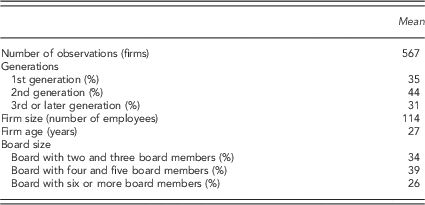
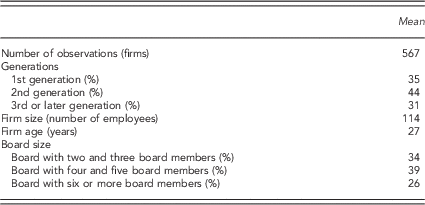
In total, 732 firms responded to the survey between July and October 2004. χ2 analyses and Student’s t-tests confirmed that there were no significant differences between the sample and the population in relation to the legal format, the sector of economic activity, the location of the enterprise, and the number of employees. We excluded 165 firms due to the lack of information regarding the association of each director with the firm (inside vs. outside director), which is one of the key variables in our study. Because of this, a total of 567 firms remain for analysis. Seventeen Spanish autonomous communities and 23 sectors of economic activity are represented, as classified in the National Classification of Economic Activities code. The average business was 27 years old. The respondent firms have on average 114 employees. Approximately 35% of the firms are run by the first generation of the family, 44% by the second generation, and 21% by the third generation or later. Regarding board size, 34% of the firms have between two or three board members, 39% of the firms have four or five board members, while 26% have six or more. Table 1 summarizes the descriptive statistics for the sample firms.
Descriptive statistics for the sample firms
Measures
Independent variables
The proposed model involves three main independent variables: proportion of outside board members, business task performance, and family task performance. For the purpose of our research, we define an outside board member as an external member who is not part of the management team. The outside board members were measured as a ratio: number of outside board members divided by the total number of directors on the board (e.g., Bettinelli, Reference Bettinelli2011).
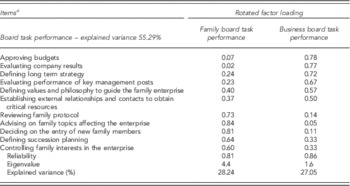
Board role performance was measured using the scale of Basco and Pérez Rodríguez (2009, Reference Basco and Pérez Rodríguez2011). The aim of this scale is to capture the family and business direction of board role performance by defining those internal activities developed by the board of directors. Items were selected through an exhaustive analysis of the literature, and stemmed from different sources (e.g., Ford, Reference Ford1988; Ward & Handy, Reference Ward and Handy1988; Schwartz & Barnes, Reference Schwartz and Barnes1991; Gabrielsson & Winlund, Reference Gabrielsson and Winlund2000; Van den Heuvel, Van Gils, & Voordeckers, Reference Van den Heuvel, Van Gils and Voordeckers2006). Before testing the hypotheses, an exploratory factor analysis was carried out to construct factors that describe business and family-oriented board tasks. Principal components analysis was used to define the factors (Hair, Black, Babin, & Anderson, Reference Hair, Black, Babin and Anderson2010). Items that loaded on a factor at ∼0.50 or above were subjected to a reliability analysis. Both factors had Cronbach’s α coefficients above 0.80, which can be considered as ‘very good’ according to generally accepted standards (Hair et al., Reference Hair, Black, Babin and Anderson2010). Table 2 gives information about items included in the questionnaire, and statistical information on the factor analysis.
Statistical factorial analysis information

a Each item utilized a 5-point Likert-type scale anchored by ‘not used’ to ‘widely used’.
We used a confirmatory factor analysis to assess the business and family board role performance dimensions by using AMOS 18. By taking into account the relevant goodness of fit indices compared with the threshold values (Kline, Reference Kline2005; χ2 (43)=281.47 (p<.001), CFI=0.89, RMSEA=0.08, GFI=0.91), the model fit was deemed acceptable. Therefore, the results indicate an acceptable overall fit between the model and the observed data. In order to analyze the ‘construct validity’ (the extent to which a set of measured items actually reflects the theoretical latent construct; Hair et al., Reference Hair, Black, Babin and Anderson2010), we focus on the convergent validity and the discriminant validity. First, all items were significantly associated with their factors at the p<.001 level. Second, all standardized coefficients are higher than the recommended cut-off value of 0.5. Third, both construct reliability values are higher than the suggested threshold of 0.70 (0.81 for business board role and 0.82 for family board role). Fourth, the average variance extracted values for business and family board role performance are 0.44 and 0.48, respectively. Even though both average variance extracted values only just fall below the suggested level of 0.50, based on the novelty of these measurements and the adequate levels of the other indicators, these values are acceptable (Craig, Dibrell, & Davis, Reference Craig, Dibrell and Davis2008; Hair et al., Reference Hair, Black, Babin and Anderson2010). Consequently, taking together the above evidence, we can conclude that the measurement model exhibits acceptable convergent validity. Finally, in all cases the average variance extracted values were greater than the corresponding squared inter-construct correlation value, which provides evidence of acceptable discriminant validity (Fornell & Larcker, Reference Fornell and Larcker1981).
Dependent variable
In this study, the dependent variable is firm performance. Considering that our aim is to focus on privately owned family firms, subjective measures are consistent with our objective. First, it is difficult to obtain reliable objective performance measures from privately held firms as their financial statements are not usually audited (Berger & Udell, Reference Berger and Udell1998). Second, there are also downsides associated with objective financial data, as these figures may be biased due to creative accounting procedures (Dess & Robinson, Reference Dess and Robinson1984), which are more common in private firms than in publicly listed firms (Burgstahler, Hail, & Leuz, Reference Burgstahler, Hail and Leuz2006), and compensation strategies by owners and family owners can alter financial statement data (Westhead & Howorth, Reference Westhead and Howorth2006). Moreover, subjective financial performance is appropriate when small- and medium-sized firms are under investigation (Dess & Robinson, Reference Dess and Robinson1984; Venkatraman & Ramanujam, Reference Venkatraman and Ramanujam1987), reflecting a broader concept of the firm’s performance (Wallace, Little, Hill, & Ridge, Reference Wallace, Little, Hill and Ridge2010).
Therefore, we use the subjective performance scale of Gupta and Govindarajan (Reference Gupta and Govindarajan1984, Reference Gupta and Govindarajan1986), which is also widely used in the family business field. Thus, 14 items were used to measure business performance by capturing the three sources of dimensionality (stakeholders, internal and external context, and persistence of performance) as defined by Richard, Devinney, Yip, and Johnson (Reference Richard, Devinney, Yip and Johnson2009): sales growth, market share, net profit, cash flow, profit sales ratio, return on investment, product development, market development, adapting to client needs, reduction of costs, staff development, environmental protection, customer satisfaction, and service quality. In addition, and building on the ideas of Mahto, Davis, Pearce II, and Robinson Jr. (Reference Mahto, Davis, Pearce and Robinson2010) that the satisfaction with firm performance is a better measure of performance in family firms, we add the level of satisfaction as an important extra dimension to our subjective performance measure. Therefore, business performance for each firm can be considered as a formative construct and was calculated as a weighted average performance score based on the importance of each objective for respondents (scale ranging from 1=‘very little importance’ to 5=‘extremely important’) and the level of satisfaction with each goal (scale ranging from 1=‘highly dissatisfied’ to 5=‘highly satisfied’). The reliability of this scale was high, with a Cronbach’s α of 0.89. Even though several papers have reported that subjective performance measures correlate significantly with objective performance measures (Dess & Robinson, Reference Dess and Robinson1984; Ling & Kellermanns, Reference Ling and Kellermanns2010), we further tested the validity of our subjective measure, by using the financial data of the SABI database to calculate the return on assets (ROA) and the return on equity (ROE) and correlating these measures with our subjective measure. The correlations are r=0.116 (p<.05; ROE) and r=0.096 (p<.05; ROA), which provide some additional evidence of the convergent validity of our subjective performance measure.
Control variable
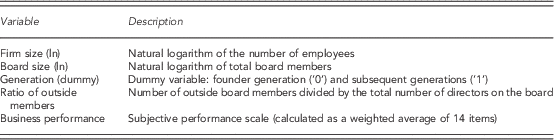
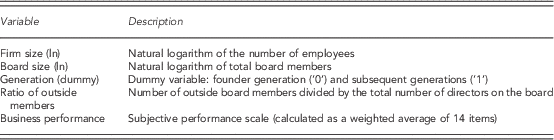
We used three control variables in our analysis to capture family and business effects that can potentially affect the relationships under study. First, regarding the family control variable, we used ‘generation.’ Generation has often been included as an important control variable in the field of family business performance because its potential direct and indirect effects such as through entrepreneurial orientation (Kellermanns, Eddleston, Barnett, & Pearson, Reference Kellermanns, Eddleston, Barnett and Pearson2008) and through financing and growth behavior (Molly, Laveren, & Jorissen, Reference Molly, Laveren and Jorissen2012). Generation is a dummy variable that describes the generation currently managing the firm by distinguishing between the founder generation (‘0’ value) and subsequent generations (‘1’ value). Second, the control variable used to measure firm-level effects is ‘firm size.’ To minimize skewness, the firm size variable was measured as the natural logarithm of the number of employees (Fiegener, Brown, Dreux, & Dennis, Reference Fiegener, Brown, Dreux and Dennis2000). Finally, we included board size as a control variable, measured by using the natural logarithm of total board members. Table 3 summarizes the description for all the variables.
Variable definitions
Analysis
Common method bias is a potential problem when the predictor and criterion variables are obtained from the same source, as is the case for our database (Podsakoff, MacKenzie, Lee, & Podsakoff, Reference Podsakoff, MacKenzie, Lee and Podsakoff2003; Podsakoff, MacKenzie, & Podsakoff, Reference Podsakoff, MacKenzie and Podsakoff2012). Therefore, we first tried to control for method bias through procedural remedies, specifically when the questionnaires were prepared and during the collection of the dataFootnote 6. In addition to these procedural remedies, we used two statistical procedures to control for potential common method biases following the suggestions of Podsakoff et al. (Reference Podsakoff, MacKenzie, Lee and Podsakoff2003). First we ran a factorial analysis (Harman’s single-factor test) by introducing all variables (independent, dependent, and control variables). A method factor did not emerge, thus we conclude that common method bias is not a problem in this study; i.e., there is no single factor that accounts for the majority of the variance and there is no single general factor that accounts for the majority of the variance among variables. Additionally, following Bagozzi (Reference Bagozzi2011), Podsakoff et al. (Reference Podsakoff, MacKenzie, Lee and Podsakoff2003) and Podsakoff, MacKenzie, and Podsakoff (Reference Podsakoff, MacKenzie and Podsakoff2012), we conducted a test with an unmeasured latent methods factor where items are allowed to load on their theoretical constructs as well as on a latent common methods variance factor. Due to the specification of the model, and following Herath and Rao (Reference Herath and Rao2009), the firm performance index was modeled as two different reflective factors: financial (items such as profit sale ratio, return on investment, net profit, and so on) and non-financial (items such as staff development, environmental protection, customer satisfaction, and so on). Therefore, we created four models by combining the relationship between business and family board role performance and financial and non-financial firm performance. The aim of the procedure is to analyze the structural relationship before and after the introduction of latent common method variance factor in each model. The results, based on the comparison of goodness of fit between both models (with and without the method factor), showed a slight improvement, indicating the presence of common method bias. After checking for possible ambiguous or invalid empirical outcomes that can influence this procedure because of the possibility of overfitting the model to the data (Bagozzi, Reference Bagozzi2011), we analyzed the individual path (structural model) between independent and dependent dimensions and we found that paths do not gain or lose statistical significance and do not change sign. Based on this information, we can conclude that common method bias is not a real concern because the main relationships between dependent and independent variables remain invariable.
We tested the proposed hypotheses by using ordinary least squares method. Results of the White’s test did not show heteroskedasticity problems. All variance inflation factor values for our variables were below the suggested cut-off (variance inflation factorvariance inflation factor <10) suggested by Hair et al. (Reference Hair, Black, Babin and Anderson2010). Therefore, we conclude that multicollinearity is not a concern.
Results
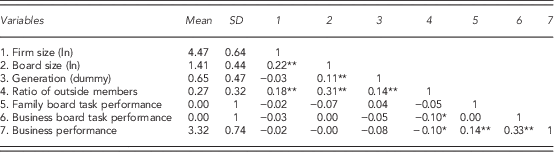
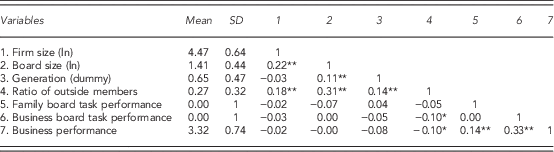
Descriptive statistics and correlations for the variables are presented in Table 4. The mean ratio for the proportion of the board made up of outside directors is 0.26, with a maximum value of 1 (100%) and a minimum value of 0 (0%). The correlation between business and family board role performance and business performance is strongly positive and significant, which provides preliminary evidence to support both Hypotheses 2 and 3.
Correlation analysis
Note. **p<.01 (bilateral); *p<.05 (bilateral).
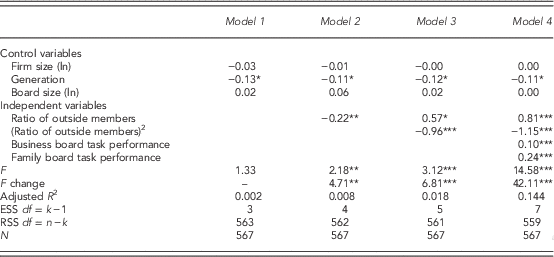
Results of the regression analyses are presented in Table 5. Model 1 includes only the control variables, whereas Model 2 incorporates the proportion of outside board members, and Model 3 adds the square of this variable. The last model incorporates both variables related with board role performance (business and family board role performance). Overall, the full regression model explains a modest amount of the variance in our dependent variable, i.e., firm performance (adjusted R 2=0.144).
Regression analysesFootnote a
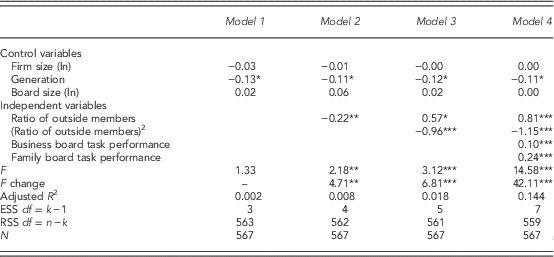
Notes. *p<.1; **p<.05; ***p<.01.
a Dependent variable: firm performance.
ESS=explained sum of squares; RSS=residual sum of squares; k=number of parameters in the model including the intercept term; n=number of observation.
The results from Model 1 suggest that generation is the only control variable with a significant influence on firm performance (p<.1), and with a negative relationship, i.e., when a firm goes beyond the first generation results are poor. In Model 2, the results show that the proportion of outside directors has a negative and significant relationship with firm performance (p<.05). In Model 3, both the proportion of outside directors and the square of this value are significant. The former has a significant positive relationship with firm performance, whereas the latter has a significant negative relationship with firm performance. Therefore, Hypothesis 1 is supported. Due to the fact that the significance of the quadratic term is a weak criteria to determine the existence of a nonlinear relationship, we carried out a Sasabuchi test (Lind & Mehlum, Reference Lind and Mehlum2010) to check the robustness of this relationship by considering two additional conditions: (1) the threshold is within the data-range and (2) different slopes exist on each side of the turning point. The test confirms the existence of an inverse U-shaped relationship (p=.04).
In Model 4, both business and family board role performance show a significant positive relationship with firm performance. Therefore, both Hypotheses 2 and 3 are supported. It is also worth highlighting that the adjusted R 2 values increase from 0.018 to 0.144 between Model 3 and 4, suggesting that the added behavioral variables (business and family board role performance) in Model 4 explain a much larger proportion of the variance in the dependent variable than the demographic variables in Model 3.
We also performed additional ad hoc tests as alternative models, to the direct effects model we hypothesize in our article, to explain the way boards create value. For example, several authors proposed that the board process variables may mediate the board demographic–firm performance relationship (Pettigrew, Reference Pettigrew1992; Forbes & Milliken, Reference Forbes and Milliken1999; Huse, Reference Huse2000; Corbetta & Salvato, Reference Corbetta and Salvato2004). Therefore, we also tested additional mediation relationships (Baron & Kenny, Reference Baron and Kenny1986), in which we considered business-oriented and family-oriented board performance as mediating variables in the demographic–firm performance relationship (results not reported). However, we did not find any significant results showing that the board role performance variables mediate the demography–performance relationshipFootnote 7.
Robustness tests: Endogeneity
Because our research relies on cross-sectional data, it is possible that reverse causality may lead to biased and inconsistent parameter estimates. Indeed, firm performance may affect board composition, for instance when poor performance pushes a firm to change its board of directors. To address this potential problem, we used a two-stage least squared estimation procedure with instrumental variables (Wooldridge, Reference Wooldridge2012). A good instrumental variable is correlated with the suspect endogenous variables (in our model ratio of outside members, business board task performance and family board task performance) but uncorrelated with the error term. We selected four candidate instrumental variables: top management team size, ownership concentration of the largest family, firm age, and existence of a succession plan. Because we cannot exclude from a theoretical point of view that all our instruments are endogenous themselves, we performed a Sargan test. This test requires that not all instruments share a common rationale for being a valid instrument (Murray, Reference Murray2006), which seems to be fulfilled. For example, the existence of a succession plan depends largely on biological (the age of the current family CEO, the existence and the age of children who are potentially interested in the firm) and awareness facts (the awareness of the CEO of the importance of a succession plan) that are unlikely to have a relationship with firm performance. Further, a board usually plays an important role in the succession process and the existence of a succession plan may be an indication of a higher task performance of the board. This rationale is theoretically different from the firm age variable, which is expected to be related to board variables because of increasing firm complexity and advising needs (e.g., Linck, Netter, & Yang, Reference Linck, Netter and Yang2008). Based on the Sargan statistic (p-value of .656), we cannot reject the null hypothesis that our instrumental variables were endogenous, a necessary condition to continue with our analysis. The Wu-Hausman test, which tests whether the null hypothesis that our suspect endogenous regressors can be treated as exogenous, is not significant. Therefore, we cannot reject the null hypothesis of exogeneity. These tests suggest that endogeneity is not a significant concern and support the robustness of our ordinary least squares results.
Conclusion and Discussion
Discussion of results
The primary purpose of this paper was to address the following research question: ‘how do boards of directors affect firm performance in private family firms?’ In general, two main research streams compete to tackle this question. While the demographic approach investigates the direct relationship between board composition and performance (Johnson, Daily, & Ellstrand, Reference Johnson, Daily and Ellstrand1996) by assuming that board composition reflects the internal behavioral processes, the behavioral approach focuses on the board’s actual behavior to understand the performance implications of the board (Pettigrew, Reference Pettigrew1992; Forbes & Milliken, Reference Forbes and Milliken1999; Gabrielsson, Reference Gabrielsson2007). Despite the progress made by the demographic as well as the behavioral approach in explaining the board–firm performance relationship, the performance implications of both approaches have been seldom tested together before. Following calls to compare both approaches (e.g., Gabrielsson, Reference Gabrielsson2007), we aim in this paper to put the board demographic approach and the board behavioral approach to the test in the family–business context within the same study, and thus develop new hypotheses for each approach.
Our findings suggest that both a demographic and a behavioral approach can explain a board of directors’ contribution to family firm performance. However, this conclusion must be put into perspective. Although we found empirical evidence to support arguments from both approaches, the behavioral approach explains a much higher proportion of the variation in a family firm’s performance (R 2 value of 0.018 vs. 0.144). This finding suggests that the behavioral approach is a much more promising method for understanding how boards of directors create value (Huse, Reference Huse2005; Gabrielsson, Reference Gabrielsson2007). Accordingly, the implicit assumption of the board demographic approach that board composition can serve as a proxy for the intervening process phenomena in reaching board effectiveness must be nuanced. However, the fact that board demographic variables still have a significant effect when behavioral variables are also included in the econometric model, suggests that an optimal proportion of outside directors does exist and contributes to firm performance. Our finding is also consistent with the argument of Gόmez-Mejia et al. (Reference Gόmez-Mejia, Cruz, Berrone and De Castro2011) that a board of directors in a family firm bears additional weight as it may provide significant assistance in the quest for legitimacy from the external environment. For example, a board with outside directors may serve as a credible signal to important external stakeholders such as financial institutions. Indeed, these outside directors may alleviate the possible concerns of financial institutions that the negative effects of parental altruism, such as succession by an incompetent child (Schulze et al., Reference Schulze, Lubatkin and Dino2003b), will dominate and reduce the likelihood of the family firm repaying loans. Hence, a well-composed board may also ease the agency costs of debt associated with private family ownership (Steijvers & Voordeckers, Reference Steijvers and Voordeckers2009).
In addition to the above discussion, we also examined our results in the context of the theoretical framework of the demographic approach and the behavioral approach. Regarding the demographic approach, we hypothesized, building on board diversity, faultlines, and socioemotional wealth arguments, that an inverted U-shaped relationship exists between the proportion of outside directors and firm performance (Hypothesis 1) and found empirical support for it. Indeed, the optimal point (where firm performance is the highest) is reached when 29% (Model 3) to 35% (Model 4)Footnote 8 of the board are composed of outside directors (Table 5). This is in line with our theoretical argument about the existence of an optimal proportion of outside directors in private family firms, which must be situated around a significant, but <50%, outsider ratio. Indeed, the adoption of outside directors enhances the job-related diversity and the potential information pool in the board likely leading to positive performance effects (Pugliese & Wenstøp, Reference Pugliese and Wenstøp2007). However, a negative consequence of diversity in the boardroom is that the inside–outside director distinction may represent a first-order demographic demarcation, generating factional faultlines within a board of directors when subgroups exist of equal power (Li & Hambrick, Reference Li and Hambrick2005; Kaczmarek, Kimino, & Pye, Reference Kaczmarek, Kimino and Pye2012). Consequently, a board composed of 50% outside directors may engender the risk of factional faultlines and behavioral disintegration and is assumed to be the least optimal board composition (Lau & Murnighan, Reference Lau and Murnighan1998). However, we argued that in the specific context of private family firms an overrepresentation of outside directors may be harmful for the beneficial aspects of the family’s socioemotional wealth such as the perpetuation of family values through the business. In summary, when reconciling diversity, faultlines and socioemotional wealth arguments, and considering our empirical findings, we conclude that the optimal proportion of outside directors on the boards of private family firms must be situated around a proportion of one third outside directors.
Our results complement those presented by Mazzola, Sciascia, and Kellermanns (Reference Mazzola, Sciascia and Kellermanns2013), where it appears that diversity aspects and faultline problems are more prominent when an outside–inside board ratio is taken into account as opposed to a family–non-family board ratio. A possible explanation could be that the family–non-family board ratio is not a good demarcation of diversity. Additionally, future research should regard family board members not as a homogenous group as diversity advantages and faultline disadvantages could also emerge within this group. For instance, between family board members who work in the firm and those who do not work in the firm.
Regarding the behavioral approach, which recognizes the multifaceted tasks that boards perform (Gabrielsson, Reference Gabrielsson2007), we classified board task activities (control and service) based on whether they are business- or family-oriented. Family-oriented board role performance comprises the board’s performance on a set of activities that balance the relationship between the family and business subsystems. In addition to traditional corporate governance models that predict a positive relationship between the business-oriented board role (Hypothesis 2) and firm performance (Forbes & Milliken, Reference Forbes and Milliken1999; Huse, Reference Huse2005), we posit that a board’s involvement in family-oriented aspects is even more crucial in attaining a positive firm performance in private family firms (Hypothesis 3). For example, the degree to which the family is embedded in the firm may create idiosyncratic agency problems of self-control and altruism, such as hiring incompetent relatives or spoiling children with excessive privileges, which may demand stronger vigilance by the board (Schulze et al., Reference Schulze, Lubatkin, Dino and Buchholtz2001; Lubatkin, Schulze, Ling, & Dino, Reference Lubatkin, Schulze, Ling and Dino2005; Ng & Roberts, Reference Ng and Roberts2007). In addition, the board may contribute significantly by advising on family topics that affect the enterprise or reviewing the family protocol over time.
Finally, the fact that we do not find a significant mediation effect between the ratio of outside directors, board role performance, and firm performance in a post hoc test, may seem surprising. We propose two possible explanations for this finding. First, Forbes and Milliken (Reference Forbes and Milliken1999) argue that there are two criteria for board effectiveness: (1) board task performance (‘task criterion’) and (2) board cohesiveness (‘maintenance criterion’). Concerning this second criterion, Bettinelli (Reference Bettinelli2011) found that in the context of private family firms outside directors do indeed have a significant effect on board cohesiveness. The faultlines argument that we used for the curvilinear relationship between the proportion of outside directors and firm performance is more related to this ‘maintenance’ dimension and board cohesiveness. We hypothesize that there may be a possible mediation effect through board cohesiveness, a variable that is not available in our database. Therefore, it would be interesting for future research to examine the mediating effect of this variable.
A second possible explanation may be that board role performance measures fail to capture an important but neglected aspect of the task dimension of board effectiveness. Indeed, Bammens, Voordeckers, and Van Gils (Reference Bammens, Voordeckers and Van Gils2011: 146) argue, building on the ideas of Siggelkow and Rivkin (Reference Siggelkow and Rivkin2009), that ‘gaining deeper insights into the performance implications of boards requires the study not only of processes inside the boardroom, but also of “coupled search processes” within the organization.’ Such search processes appear when the upper echelons in an organization, such as the board of directors, make high-level choices that shape lower-level operational choices that may have a direct impact on firm performance (Siggelkow & Rivkin, Reference Siggelkow and Rivkin2009). We speculate that outside directors in private family firms may have a significant impact on the board’s effectiveness in translating high-level board decisions into day-to-day operational choices. Therefore, it would be interesting for future research to examine the role of outside directors in these ‘coupled search processes’ and include it as an essential element of board effectiveness.
Research implications
Our study contributes to the corporate governance literature in general and to the family business field in particular. Following Pérez Rodríguez and Basco’s (Reference Pérez Rodríguez and Basco2011) theory-building discussion in the family business field and Whetten’s (Reference Whetten2009) debate about contextualizing theory, we make three important contributions to corporate governance literature in general. First, our study addresses calls for empirical testing of demographic and behavioral approaches (Gabrielsson, Reference Gabrielsson2007). We aim to broaden the understanding of the board–performance relationship by extending the existing scant literature that directly compares both demographic and behavioral research streams in the field of governance. By doing this, the paper also contributes to each theoretical approach by developing a set of new hypotheses in the family firm context. Second, our study contributes to contextualize demographic and behavioral approaches by applying them into Continental European family firms extending previous research mainly focused on non-family businesses or on Nordic Europe culture (e.g., Gabrielsson, Reference Gabrielsson2007). Third, our study provides some evidence for the link between board-level outcomes, such as board role performance and firm-level outcomes, which has often been theoretically modeled (Forbes & Milliken, Reference Forbes and Milliken1999; Huse, Reference Huse2000) but seldom empirically tested.
In addition, this research makes two main contributions to the field of family business. First, in general, the article contributes to the family business governance knowledge by addressing the call of Bammens, Voordeckers, and Van Gils (Reference Bammens, Voordeckers and Van Gils2011) and Gόmez-Mejia et al. (Reference Gόmez-Mejia, Cruz, Berrone and De Castro2011) to examine the family dynamics of corporate governance that affect firm performance. We move the theoretical and empirical debate of board role performance forward by adding the family dimension to the traditional control and service roles. Second, we extend existing research dealing with traditional control and service task performance in a family firm context (Van den Heuvel, Van Gils, & Voordeckers, Reference Van den Heuvel, Van Gils and Voordeckers2006; Zattoni, Gnan, & Huse, Reference Zattoni, Gnan and Huse2013), by suggesting that business- and family-oriented board role performance positively affect firm performance. By doing this, we provide empirical evidence that the family affects the way an organization is governed (Gόmez-Mejia et al., Reference Gόmez-Mejia, Cruz, Berrone and De Castro2011).
Practical implications
Our results also have important implications for practitioners, consultants and policy makers mainly in Continental Europe. Family owners should be aware that an optimal mix of outside and inside directors is a condition through which boards of directors affect firm performance. While outside directors, in addition to inside directors, bring different valuable resources to the board that increase its effectiveness in a set of board activities (related to the business as well as the family dimension), a balance between insiders and outsiders seems to be important to avoid internal schisms, which may hamper the well functioning of the board of directors.
However, although our results suggest that a well-chosen mix of outside and inside board members may contribute to firm performance, it is not the sole condition for enhancing task effectiveness of the board of directors. What the board actually does is an important condition to make the board of director a real driver of firm performance. Therefore, our suggestion for family business owners is that there should not only be a balanced ratio between internal and external members, that does not threaten the economic, social, and emotional wealth of the family, but also owner-managers and consultants should encourage internal practices that account for a set of tasks to help board members to perform its responsibility.
The latter finding is also important for policy makers. Merely recommending specific board composition for family business boards from the demographic perspective (as is often recommended by corporate governance codes) does not seem to have a strong impact on firm performance. On the contrary, the internal functioning of the board of directors seems to be the key factor in improving the competitiveness of family firms and creating value. Moreover, it should be stressed that stimulating the adoption of outside directors is not the only worthwhile element in creating successful family firm boards, as the empowerment of the board, even those without external directors, is also important (Lane et al., Reference Lane, Astrachan, Keyt and McMillan2006). That is, policy makers should concentrate on ways to create the natural conditions in which the internal activities of boards of directors in a family business context can develop. In this regard, it could be more effective to develop an encompassing strategy to professionalize family firms by setting-up programs to increase the awareness of the added value of a working board of directors in private family firms, throughout, for example, professional organizations and chambers of commerce.
Limitations and suggestions for future research
This work is not without limitations, but these can be regarded as important challenges for future research. First, we have only included the distinction between outside and inside affiliations of directors. However, other and more detailed affiliations exist, which would be interesting to analyze, such as, for example, the distinction between outside and affiliate directors (those who maintain a business relationship with the firm; e.g., Jones, Makri, & Gόmez-Mejia, Reference Jones, Makri and Gόmez-Mejia2008; Arosa, Iturralde, & Maseda, Reference Arosa, Iturralde and Maseda2010).
Second, we developed hypotheses building on faultlines and socioemotional wealth arguments. Future studies should explore in-depth the impact of factional faultlines between groups of directors on board dynamics and board effectiveness. The debate could be also extended toward other potential factional faultlines, such as, for example, the potential divides between family directors of different family branches, or generations represented on a board that is solely composed of family members. In addition, the suggested items of the socioemotional wealth construct developed by Berrone, Cruz, and Gόmez-Mejia (Reference Berrone, Cruz and Gόmez-Mejia2012) may provide an interesting opportunity to develop a scale and, thus, directly test the impact of socioemotional wealth on the optimal ratio of outside directors on a board.
Finally, due to the difficulty in obtaining information regarding board tasks, we used a single respondent to measure business and family board role performance. We are aware that relying on a single respondent is an important limitation to this study, and future research should try to extend our results and add additional information by considering multiple respondents from the same board.
Acknowledgement
We would like to thank Walter Hendrikx for helpful comments on earlier versions of the paper. We also benefited for the helpful advice and comments from the participants of research seminar at ISM University of Management and Economics (Lithuania).