INTRODUCTION
The cyst-forming coccidia within the family Sarcocystidae Poche, 1913 are characterized by an isosporoid oocyst – bisporocystic oocysts and tetrazoic sporocysts, with the sporocyst wall composed of 4 plates joined by sutures (Jirku et al. Reference Jirku, Modry, Šlapeta, Koudela and Lukes2002). The life cycle of known members of this family is monoxenous or complex. Stages that would be inside the erythrocytes are not known for any named species in the family Sarcocystidae.
Two intraerythrocytic parasites were found, one in the southern mouse opossum (Thylamys elegans) from Chile and another in the yellow-bellied glider (Petaurus australis) from Australia (Merino et al. Reference Merino, Vásquez, Martínez, Celis-Diez, Martínez-De La Puente, Marín-Vial, Sánchez-Monsalvez and Peirce2008; Zhu et al. Reference Zhu, Hartigan, Reppas, Higgins, Canfield and Šlapeta2009). Morphologically both parasites resemble Hepatozoon species. However, independent DNA sequencing and phylogenetic analyses placed both species within the cyst-forming coccidia, specifically Clade A, including parasites under the genera Toxoplasma, Neospora, Hammondia, Isospora and Besnoitia (Šlapeta et al. Reference Šlapeta, Modry, Votypka, Jirku, Lukes and Koudela2003). Here, we compared and reconstructed a phylogeny for both species using SSU rDNA and partial LSU rDNA.
MATERIALS AND METHODS
The DNA from 4 southern mouse opossum (Thylamys elegans) individuals from South America originated from a previous study (Merino et al. Reference Merino, Vásquez, Martínez, Celis-Diez, Martínez-De La Puente, Marín-Vial, Sánchez-Monsalvez and Peirce2008). The hypervariable D2 domain of LSU rDNA (D2 LSU rDNA) was amplified from all 4 individuals using CR-1 (CTG AAA TTG CTG AAA AGG AA) and CR-2 (CCA GCT ACT AGA TGG TTC GA) primers employing the same amplification conditions (Ellis et al. Reference Ellis, Morrison, Liddell, Jenkins, Mohammed, Ryce and Dubey1999; Šlapeta et al. Reference Šlapeta, Modry, Votypka, Jirku, Lukes and Koudela2003). All 4 PCR reactions with DNA from southern mouse opossums revealed an ~600 bp amplified product. Each PCR reaction product was purified and directly sequenced using both CR1 and CR2 primers (Applied Biosystems ABI 3130 automated sequencer, University of Alcalá, Madrid, Spain).
Both SSU rDNA and D2 LSU rDNA sequences of the intraerythrocytic parasites (Merino et al. Reference Merino, Vásquez, Martínez, Celis-Diez, Martínez-De La Puente, Marín-Vial, Sánchez-Monsalvez and Peirce2008; Zhu et al. Reference Zhu, Hartigan, Reppas, Higgins, Canfield and Šlapeta2009) were compared with one another and with those of the Apicomplexa available in the GenBank using blastn as implemented in MEGA 4.0 (Tamura et al. Reference Tamura, Dudley, Nei and Kumar2007). Database querying revealed a high number of SSU rDNA sequences for the genus Besnoitia (n=8) and Cystoisospora (n=27), however, the average pairwise distances for all Besnoitia and Cystoisospora SSU rDNA was 0·33% and 0·37%, respectively. We have restricted our analysis to 5 representative sequences (B. besnoiti, B. jellisoni, C. suis, C. felis and C. belli), because these sequences exhibited high sequence identity and formed highly supported genus-specific monophyletic groups in preliminary analyses. The alignments were constructed using ClustalW algorithm implemented in MEGA 4.0. Initially we used the following penalties: gap opening=8 and gap extension=2 for both pairwise and multiple alignment. To refine hypervariable regions we lowered the penalties for multiple alignment to gap opening=4 and gap extension=1 and manually edited. An alignment that included all available residues (complete alignment) was analysed, as well as an alignment where all gapped residues were excluded (restricted alignment) to minimize the artefacts caused by problematic regions. An additional alignment (secondary structure alignment) of the apicomplexan SSU rDNA sequences was downloaded from The European rRNA Database, where sequences are aligned according to the secondary structure (Wuyts et al. Reference Wuyts, Perriere and Van De Peer2004). Sequences of the intraerythrocytic parasites were aligned using the profile mode in the program Clustal W (Chenna et al. Reference Chenna, Sugawara, Koike, Lopez, Gibson, Higgins and Thompson2003). Use of secondary structure pre-aligned sequences is a favourable conservative approximation for the construction of an alignment, since the sequence alignment strategy is known to have important impact on phylogenetic inference (Morrison and Ellis, Reference Morrison and Ellis1997; Hickson et al. Reference Hickson, Simon and Perrey2000). The multiple sequence alignments are available from the authors upon request or at http://www.vetsci.usyd.edu.au/staff/JanSlapeta/msalign/2009_1.rar.
The nucleotide sequence alignment was analysed using maximum likelihood using PAUP* 4b10 (D.L. Swofford, 2004, PAUP*, Sunderland, MA: Sinauer Associates) and Bayesian inference using MrBayes v3.1.2 (Ronquist and Huelsenbeck, Reference Ronquist and Huelsenbeck2003). The robustness of the maximum likelihood tree was evaluated by the bootstrapping method with 100 replicates. We used AIC implemented in ModelTest 3.7 (Posada and Crandall, Reference Posada and Crandall1998) that selected likelihood settings from a best-fit model for our maximum likelihood analysis. MrBayes v3.1.2 (Ronquist and Huelsenbeck, Reference Ronquist and Huelsenbeck2003) using settings for the GTR+I+G model were used for Metropolis-coupled Markov chain Monte Carlo (MCMCMC) analyses run for 2 000 000 generations and sampled every 200 generations, and 2 independent runs from a random starting tree per dataset. For the secondary structure alignment the GTR+Γ+I and covarion model was used, this model takes into account rate variation among sites known to be unequal for coccidian alignment based on secondary structure of SSU rDNA (Huelsenbeck, Reference Huelsenbeck2002; Morrison et al. Reference Morrison, Bornstein, Thebo, Wernery, Kinne and Mattsson2004). We set the burn-in period to 20% where the chains reached stationary phase.
To evaluate the position of the intraerythrocytic clade we enforced alternative tree topologies and calculated a maximum likelihood tree in PAUP*. Site likelihoods for the unconstrained and individual constrained trees were calculated using PAUP* and these were used for the Approximately Unbiased (AU) test (Shimodaira, Reference Shimodaira2002), both implemented in CONSEL 0·1i (Shimodaira and Hasegawa, Reference Shimodaira and Hasegawa2001). A value of P<0·05 was considered statistically significant to reject the hypothesis that the two trees were significantly different.
RESULTS AND DISCUSSION
Independent molecular analysis of intraerythrocytic parasites of marsupials in South America and Australia provided the first evidence of a novel group within the cyst-forming coccidia of Apicomplexa (Sarcocystidae). Both intraerythrocytic parasites were characterized using SSU rDNA (Merino et al. Reference Merino, Vásquez, Martínez, Celis-Diez, Martínez-De La Puente, Marín-Vial, Sánchez-Monsalvez and Peirce2008; Zhu et al. Reference Zhu, Hartigan, Reppas, Higgins, Canfield and Šlapeta2009). Pairwise comparison of the southern mouse opossum SSU rDNA (EU443095) revealed 93% identity to the yellow-bellied glider sequence (FJ012144). To extend the comparison to 2 loci, we first amplified the D2 LSU rDNA from 4 southern mouse opossum individuals from South America (Merino et al. Reference Merino, Vásquez, Martínez, Celis-Diez, Martínez-De La Puente, Marín-Vial, Sánchez-Monsalvez and Peirce2008). All 4 PCR reactions with DNA from southern mouse opossums revealed an ~600 bp amplified product. Sequences from all 4 individuals were identical to each other, and a 631 nt sequence was deposited to GenBank (FJ817087). The D2 LSU rDNA fragment of the intraerythrocytic parasite of the southern mouse opossum from Chile is 76% identical to the homologous D2 LSU rDNA fragment (645 bp) from the yellow-bellied glider from Australia (Zhu et al. Reference Zhu, Hartigan, Reppas, Higgins, Canfield and Šlapeta2009).
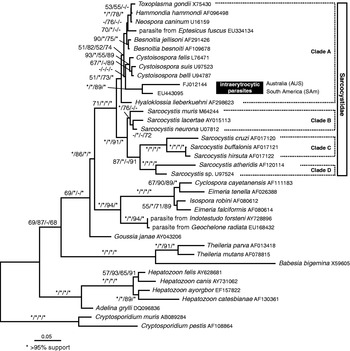
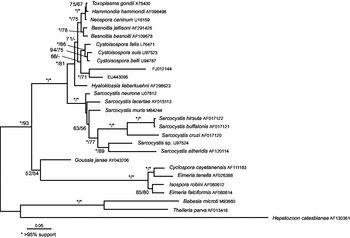
The complete alignment of the SSU rDNA sequences consisted of 1845 aligned positions (1027 constant and 556 parsimony-informative sites). We then excluded the 410 positions that contained gaps resulting in a restricted alignment that consisted of 1435 positions (966 constant and 319 parsimony-informative sites). For both alignments, the AIC implemented in ModelTest selected GTR+Γ+I likelihood settings from a best-fit model for our maximum likelihood analyses. The maximum likelihood trees were reconstructed using a heuristic search with the NNI swap algorithm in PAUP* and bayesian method in MrBayes using GTR+Γ+I. The monophyly of the 2 sequences of intraerythrocytic parasites is strongly supported (Fig. 1). The monophyly of Clade A, together with intraerythrocytic parasites, is moderate – PAUP*: 73% bootstrap support/MrBayes: 99% posterior probability for the restricted alignment and PAUP*: 51% bootstrap support/MrBayes: 100% posterior probability for the complete alignment. The Clade A consists of isosporoid coccidia including genera Cystoisospora and Hyaloklossia (Modry et al. Reference Modry, Šlapeta, Jirku, Obornik, Lukes and Koudela2001; Šlapeta et al. Reference Šlapeta, Modry, Votypka, Jirku, Lukes and Koudela2003). The secondary structure alignment of the SSU rDNA sequences consisted of 1940 aligned positions (1270 constant and 415 parsimony-informative sites). The most appropriate mathematical model for DNA evolution of Coccidia allows the rate at a site to vary over evolutionary time (Morrison et al. Reference Morrison, Bornstein, Thebo, Wernery, Kinne and Mattsson2004). This co-varion model has been used in conjunction with GTR+Γ+I model as implemented in MrBayes (Ronquist and Huelsenbeck, Reference Ronquist and Huelsenbeck2003). The Bayesian analysis using GTR+Γ+I with co-varion nucleotide model supported monophyly of the intraerythrocytic parasites within the Clade A of Sarcocystidae by 98% posterior probability (Fig. 2). For the secondary structure alignment, the AIC implemented in ModelTest selected GTR+Γ+I likelihood settings from a best-fit model for our maximum likelihood analyses. The maximum likelihood tree in PAUP* had identical branching order to the tree reconstructed using MrBayes, although the bootstrap support was only 71% (Fig. 2). While posterior probabilities in Bayesian analysis (MrBayes) indicate higher support over bootstrap values in maximum likelihood (PAUP*), it is challenging to directly use posterior probabilities for branch support (Cummings et al. Reference Cummings, Handley, Myers, Reed, Rokas and Winka2003; Simmons et al. Reference Simmons, Pickett and Miya2004). However, Simmons et al. (Reference Simmons, Pickett and Miya2004) found that the Bayesian method consistently overestimated support, thus they advocate the use of the relatively conservative bootstrap to estimate branch support rather than the more extreme overestimates provided by Bayesian methods.
Phylogenetic inference of the intraerythrocytic parasites in South American and Australian marsupials. Maximum-likelihood tree based on the SSU rDNA sequences of Apicomplexa rooted using Cryptosporidium spp. was based on the SSU rDNA complete alignment. To the right the taxonomic affiliation and Clades A-D are presented. Bootstrap and posterior probability support is presented for nodes with >50% support – complete alignment PAUP*/complete alignment MrBayes/restricted alignment (i.e. excluded gapped positions) PAUP*/restricted alignment MrBayes.

Bayesian tree based on the SSU rDNA sequences of Apicomplexa rooted using Hepatozoon, Babesia and Theileria sequences was based on the SSU rDNA secondary structure aided alignment and GTR+Γ+I and co-varion nucleotide model implemented in MrBayes. Bootstrap and posterior probability support is presented for nodes with >50% support – MrBayes/PAUP*. For the taxonomic affiliation and abbreviations see Fig. 1.

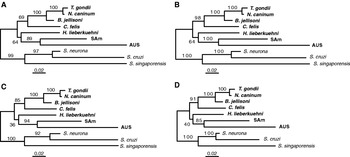
The SSU rDNA alignment analyses did not resolve the exact position of the intraerythrocytic parasites. The monophyly of the intraerythrocytic parasites with Cystoisospora species was revealed in PAUP* using either complete, restricted or secondary structure alignment, as well as, in MrBayes using the secondary structure alignment (Fig. 2). However, the sister relationship with Toxoplasma, Neospora, Hammondia, Besnoitia and Cystoisospora was reconstructed in MrBayes using both complete and restricted alignments. In an attempt to improve the resolution within the Clade A and position of the intraerythrocytic parasites, the new D2 LSU rDNA sequence was aligned with available sequences and concatenated with corresponding SSU rDNA sequences. The concatenated analysis supported the closer relationship with H. lieberkuehni and their plausible common ancestry, despite <50% bootstrap support. The complete alignment consisted of 1745 aligned positions for SSU rDNA and 765 positions for D2 LSU rDNA, and was analysed as described above (Fig. 3 A, B). Using this alignment (1882 constant and 303 parsimony-informative sites) the intraerythrocytic parasites were monophyletic with H. lieberkuehni, however, the bootstrap value using PAUP* (64%, Fig. 3 A) and the posterior probability in MrBayes (64%, Fig. 3 B). We then restricted the analysis to 2040 conserved residues in the ‘restricted alignment’ (1606 constant, 178 parsimony-uninformative and 256 parsimony-informative sites) by removing all ambiguous and gapped positions (Fig. 3 C, D). Re-analysis using PAUP* show the monophyly with H. lieberkuehni supported by only 36% bootstrap support (Fig. 3 C) and 40% posterior probability in MrBayes (Fig. 3 D).
Maximum-likelihood tree based on the concatenated SSU and D2 LSU rDNA sequences of Sarcocystidae rooted using Sarcocystis spp. The complete alignment (A, B) and restricted alignment (C, D) were used to reconstruct the trees. The trees and bootstraps were reconstructed using PAUP* (A, C) and MrBayes (B, D). Bootstrap (A, C) support and posterior probability support (B, D) is presented for nodes with >50% support. For the taxonomic affiliation and abbreviations see Fig. 1. Sequences used for tree reconstruction: (Tg) Toxoplasma gondii – X75430, AF076901; (Nc) Neospora caninum – U16159, AF001946; (Bj) Besnoitia jellisoni – AF291426, AF076868; (Cf) Cystoisospora felis – L76471, U85705; (Hl) Hyaloklossia lieberkuehni – AF298623, AF513499; (Sn) Sarcocystis neurona – U07812, AF092927; (Sc) Sarcocystis cruzi – AF017120, AF076903; (Ss) Sarcocystis singaporensis – AF434051, AF237617; (AUS) Glider parasites – FJ012144, FJ012145; (SAm) Opossum parasite – EU443095, FJ817087.

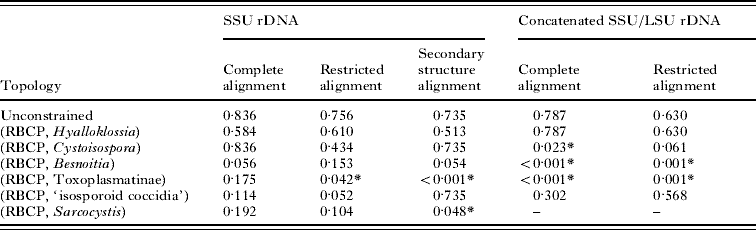
The maximum likelihood method was used to further characterize the phylogenetic relationship by testing alternative (constrained) trees. We used all 3 alignments SSU rDNA and 2 concatenated SSU/LSU rDNA alignments and inferred constrained trees and calculated site likelihoods in PAUP* for AU-test to determine whether the constrained trees were significantly better than our best unconstrained tree (Table 1). Because the relationship of the intraerythrocytic parasites has not been fully resolved in the unconstrained trees, we tested whether an alternative branching of Clade A lineages would be rejected if compared to the unconstrained topology (Figs 1–3). Using SSU rDNA, the AU-test could not reject monophyly of the intraerythrocytic parasites for all alternative topologies, but monophyly with Toxoplasma, Neospora, Hammondia, Besnoitia spp. for restricted and secondary structure alignments indicating absence of a robust phylogenetic signal. Constraining the intraerythrocytic parasites with Sarcocystis spp. indicates that such alternative topology could be only rejected for the secondary structure alignment with P-value of 0·048 (Table 1). Next we tested the concatenated alignments that rejected the monophyly of the intraerythrocytic parasites with Besnoitia spp. and monophyly with Toxoplasma, Neospora, Hammondia, Besnoitia spp. The monophyly with Cystoisospora spp. was either rejected (P-value of 0·023) or marginally not rejected (P-value of 0·061). This analysis supported the 2 most likely hypotheses, either the monophyly with H. lieberkuehni or the sister relationship with the isosporoid coccidian (Clade A). This ambiguity within our alignments could be further resolved by sequencing complete additional genes. For cyst-forming coccidia the only other addition markers with sufficient taxon sampling are complete LSU rDNA and partial plastid rDNA. The complete LSU rDNA (~3·5 kbp) was used to resolve the phylogeny of cyst-forming coccidia (Mugridge et al. Reference Mugridge, Morrison, Jakel, Heckeroth, Tenter and Johnson2000) and the plastid rDNA improved the phylogenetic placement of H. lieberkuehni (Obornik et al. Reference Obornik, Jirku, Šlapeta, Modry, Koudela and Lukes2002).
Confidence values from the Approximately Unbiased (AU) test for alternative topologies
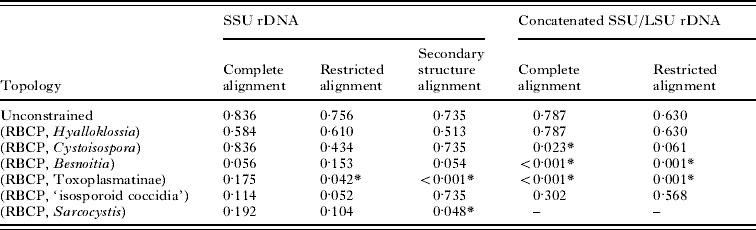
* P-value <0·05 suggested that the constrained tree is significantly different from the unconstrained topology; RBCP – intraerytrorocystic parasites; -‘isosporoid coccidia’ – Hyalloklossia, Cystoisospora, Besnoitia, Hammondia, Toxoplasma, Neospora (Clade A); Toxoplasmatinae – Toxoplasma, Neospora, Hammondia. Site maximum likelihoods calculated in PAUP* 4b10. Approximately Unbiased (AU) tests performed using CONSEL v0.1i. Restricted alignment – all gapped positions eliminated from the complete alignment.
The phylogenetic analysis supported the placement of the intraerythrocytic parasites within the cyst-forming coccidia (Carreno et al. Reference Carreno, Schnitzler, Jeffries, Tenter, Johnson and Barta1998). It now remains to be investigated whether these marsupial parasites have environmentally resistant bisporocystic oocysts and tetrazoic sporocysts, which typify cyst-forming coccidia. As discussed by Merino et al. (Reference Merino, Vásquez, Martínez, Celis-Diez, Martínez-De La Puente, Marín-Vial, Sánchez-Monsalvez and Peirce2008) and Zhu et al. (Reference Zhu, Hartigan, Reppas, Higgins, Canfield and Šlapeta2009), a molecular identification of an enigmatic parasite named Elleipsisoma thomsoni from European moles could resolve the suspected relationship with our marsupial intraerythrocytic parasites. The field of molecular phylogenetics has a major impact on the recent improved nomenclature of apicomplexan parasites (Morrison, Reference Morrison2008). For example, it has provided the critical evidence for the distinct origin of avian Isospora species from Cystoisospora species, linked Atoxoplasma species with avian Isospora species, supported the position of Lankesterella and Caryospora species within eimerid coccidia and has been used to link yet unknown intranuclear parasites within coccidia (Carreno and Barta, Reference Carreno and Barta1999; Merino et al. Reference Merino, Martínez, Martínez-De La Puente, Criado-Fornelio, Tomás, Morales, Lobato and García-Fraile2006; Innis et al. Reference Innis, Garner, Johnson, Wellehan, Tabaka, Marschang, Nordhausen and Jacobson2007; Schmidt et al. Reference Schmidt, Dyachenko, Aupperle, Pees, Krautwald-Junghanns and Daugschies2008). Continuous improvement of taxon sampling at SSU rDNA will be essential in modern diagnostic efforts and will ultimately lead to improved nomenclature of the Apicomplexa.
In conclusion, we show that the two intraerythrocytic parasites found in South American and Australian marsupials share a common ancestor and suggest co-evolution with the vertebrate host. Therefore Australian and South American marsupials appear to share similar parasites in spite of the time since separation of both continents. Molecular phylogenetics unambiguously placed these sequences within the family Sarcocystidae. It now remains to be discovered whether the isosporoid oocysts, which typify the family Sarcocystidae, exist within the life cycle of this yet unnamed genus.
We thank Josué Martínez de la Puente for his constructive comments on a previous version of the manuscript. This study has been partially financed by Fundación BBVA project BIOCON06/109. This study forms part of the research activities of the Institute of Ecology and Biodiversity (ICM-P05-002, PFB-23-CONICYT-Chile, and FONDECYT 1060186 to RAV). The support towards the preparation of this manuscript from the Dorothy Minchin Bequest (Faculty of Veterinary Science, University of Sydney) to J.S. is acknowledged.