Adolescence is a period of enormous adjustment for both teenagers and families. As children transition from childhood to adulthood, they go through many physical, emotional and behavioural changes. Not surprisingly, many parents describe adolescence as the most difficult and anxiety-provoking period of their children's life (Buchanan et al., Reference Buchanan, Eccles, Flanagan, Midgley, Feldlaufer and Harold1990). Parents’ concerns are well justified, considering the high prevalence of emotional and behavioural problems during adolescence (Costello, Mustillo, Erkanli, Keeler, & Angold, Reference Costello, Mustillo, Erkanli, Keeler and Angold2003). This highlights the importance of prevention and treatment efforts to address emotional and behavioural problems during this developmental stage.
Family risk factors such as inadequate parental monitoring and family conflict are among potentially modifiable risk factors that can be targeted in order to reduce the rate of emotional and behavioural problems in adolescents (Dekovic, Janssens, & Van As, Reference Dekovic, Janssens and As2003). Although studies on parenting programs for parents of teenagers are far less extensive compared to studies of children (Kazdin, Reference Kazdin2005), they show parent training programs to be effective prevention and intervention strategies to promote positive development in adolescents. These programs reduce the risk of developing and maintaining substance abuse, delinquent behaviour and other externalising problems (Connell, Dishion, Yasui, & Kavanagh, Reference Connell, Dishion, Yasui and Kavanagh2007; Mason, Kosterman, Hawkins, Haggerty, & Spoth, Reference Mason, Kosterman, Hawkins, Haggerty and Spoth2003). They also improve parent-adolescent communication and reduce family conflict (Barkley, Edwards, Laneri, Fletcher, & Metevia, Reference Barkley, Edwards, Laneri, Fletcher and Metevia2001; Dishion & Andrews, Reference Dishion and Andrews1995). Participating parents feel more confident and use more effective parenting strategies (Spoth, Redmond, & Shin, Reference Spoth, Redmond and Shin1998). In several studies, these positive changes are maintained over time; in some examples, up to 4 to 10 years (Spoth, Trudeau, Shin, & Redmond, Reference Spoth, Trudeau, Shin and Redmond2008).
Most parenting programs for parents of teenagers have been designed and evaluated either as universal and selective prevention strategies (e.g., Preparing for the Drug-Free Years; Hawkins, Catalano, & Kent, Reference Hawkins, Catalano, Kent, Donohew, Sypher and Bukoski1991) or as part of a treatment package for severely disturbed juvenile delinquents (e.g., Multisystemic Therapy; Henggeler, Schoenwald, Borduin, Rowland, & Cunningham, Reference Henggeler, Schoenwald, Borduin, Rowland and Cunningham2009). There is limited evidence on the efficacy of parenting programs for adolescents who are currently showing serious difficulties, but have not come in contact with the justice system. Moreover, most programs are delivered in group formats, which may not be suitable for some families. Some parents might refuse treatment in a group format because of the anxiety about sharing problems with others, social anxiety or lack of personal attention. Parents who are not able or willing to examine their interpersonal behaviours, to disclose themselves, and to give and receive feedback are not suitable for brief and time-limited group programs (Yalom & Leszcz, Reference Yalom and Leszcz2005). Other parents may find the group format inconvenient for practical reasons. Due to unpredictable working hours, certain parents may not be able to commit to a regular schedule of sessions as required for group programs. There may also be logistical problems in setting up groups, and parents may have to wait for treatment until there are a sufficient number of parents to begin a group.
The current study is an evaluation of Standard Teen Triple P (STTP). Triple P is a multi-level behavioural family intervention, based on social learning principles (e.g., Patterson, Reference Patterson1982), which aims to prevent and treat behavioural, emotional and developmental problems in children and adolescents by enhancing the knowledge, skills and confidence of parents (Sanders, Reference Sanders1999). Teen Triple P is specifically designed to meet the needs of parents of adolescents. The self-directed and group versions of this program have already been evaluated and found to be effective in reducing parent-adolescent conflict, dysfunctional parenting (laxness, over-reactivity) and disagreements over parenting issues, as well as adolescent behavioural problems (Ralph & Sanders, Reference Ralph and Sanders2003; Stallman & Ralph, Reference Stallman and Ralph2007). STTP is an individual face-to-face version of Teen Triple P.
The purpose of this study was to trial the efficacy of STTP. Specifically, it was hypothesised that compared to parents in a waitlist control condition, parents who received STTP would report: (a) decreased disruptive problem behaviours in their teenagers; (b) decreased levels of parent-teenager conflict; (c) decreased use of dysfunctional parenting practices; (d) decreased level of disagreements over child rearing issues; (e) increased level of relationship satisfaction; and (f) decreased levels of negative affect (e.g., anxiety, depression).
Method
Recruitment
Participants were recruited through school newsletter advertisements in the Brisbane area, Australia, from April 2007 to August 2008. The notice targeted parents of teenagers (‘Are you concerned about your teenager's behaviour?’), offering them a free individual parenting program. Interested families were directed to visit a website or contact the project coordinator for more information. The intervention was delivered at either the Parenting and Family Support Centre or the Psychology Clinic at The University of Queensland.
A two-stage approach was employed to assess families’ eligibility to participate in the study. In the first stage, a short standardised telephone interview by the author was used to assess families’ suitability for the program and also to inform parents of the program details and participation requirements. Families were eligible to participate if: (a) the target child was aged between 11 and 16 years of age, (b) at least one parent reported that they were concerned about their child's behaviour, and (c) the child was not currently having regular contact with another professional or agency for emotional or behavioural problems. Families were excluded from the project if the target child did not live with the interested parent for at least 2 days each week, or there was evidence of a severe developmental disorder or significant health impairment. If the eligibility criteria were met, the parent(s) were sent the package of questionnaires or were directed to complete them online, depending on their preference. Before completing the questionnaires, parents were requested to read the information sheet and consent to participating in the research, which included being videotaped during the sessions. In the second stage, parents’ responses to the questionnaires were examined. For inclusion in the study, the target child was required to score in the elevated range (i.e., borderline or abnormal range) on the parent version of the Strengths and Difficulties Questionnaire (SDQ; Goodman, Reference Goodman1997, Reference Goodman1999). When both parents completed the questionnaires, the family was considered eligible if at least one of the parents indicated that the target child scored in the elevated range on the SDQ.
Participants
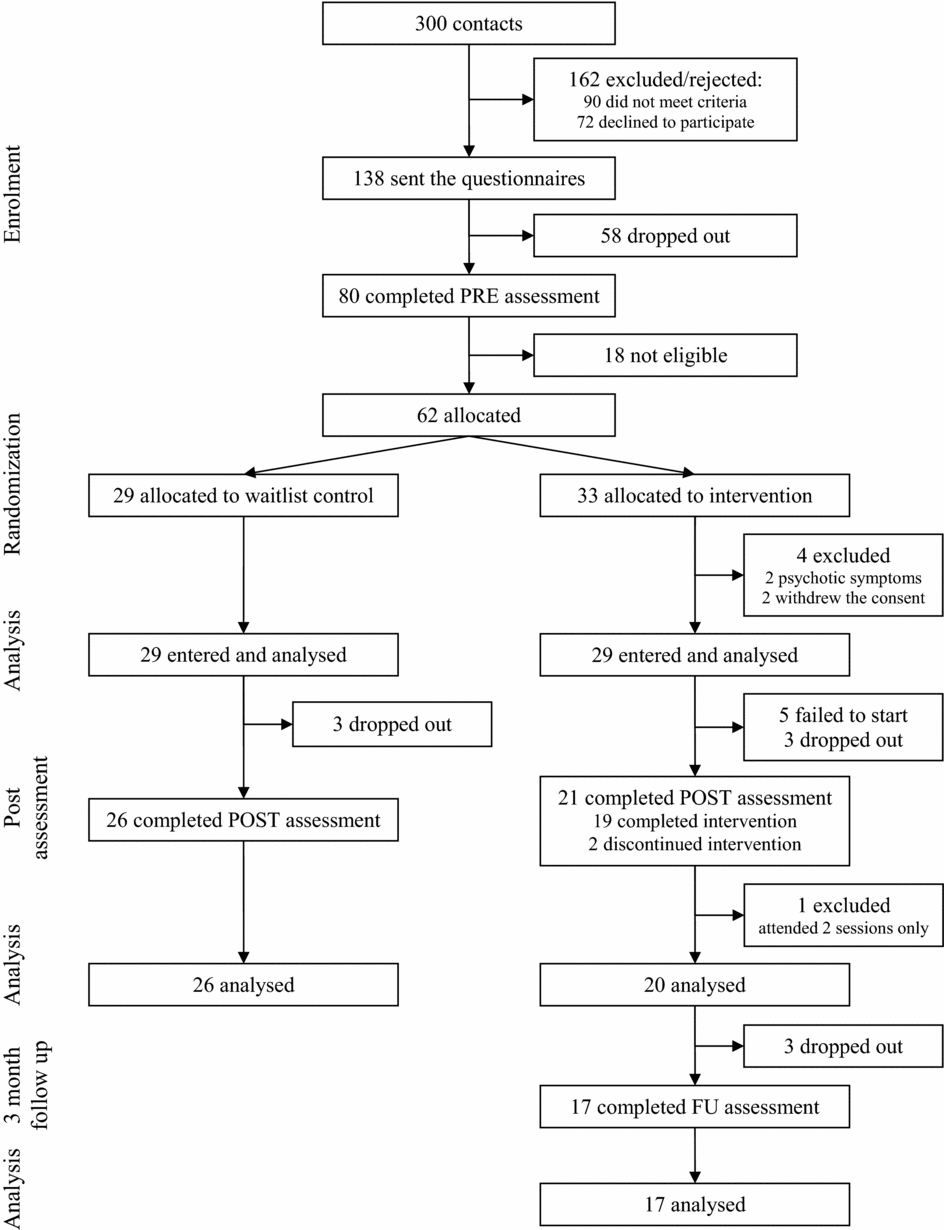
Figure 1 shows the flow of participants throughout the study. A total of 300 parents responded to the campaign, contacting the project coordinator by email (87) or phone (213). Ninety families were excluded from the study because they did not meet the eligibility criteria (i.e., 13 children were not in the age range, 53 parents were not concerned about their child's behaviour, 4 children were in contact with another mental health professional on a regular basis, 15 parents were unable to attend the program because of the location or length of the program, 3 children lived with the interested parents less than 2 days a week, and 2 children had a severe developmental disorder). A further 65 parents declined to participate. Contact was not possible with seven parents. Therefore, 138 families received the questionnaires by post (86) or were provided with online access to the questionnaires (52). Eighty families (60%) returned the questionnaires. Of these, 18 families (22.5%) were excluded because neither parent reported serious problem behaviours in the child (the target child did not score in the borderline or clinical range on the SDQ Total; borderline range = 14 to 16 and clinical range = 17 and over). The remaining 62 families were allocated to one of the two conditions.
Flow of participants throughout the study (see Results section for attrition reasons).

Comparison of the waitlist and intervention conditions using a series of one-way between groups analyses of variance (ANOVAs) or chi-square tests revealed no significant differences on sociodemographic variables except for child sex. Only 30.3% of adolescents in the intervention condition were females, compared to 62.1% of adolescents in the waitlist control condition χ2(1, N = 62) = 6.29, p = .012. In the total sample, children ranged in age from 11 to 16 years (M = 12.92, SD = 1.18), and there were more boys (54.8%) than girls (45.2%). Based on parents’ reports, the children were predominantly identified as Australians or Europeans (93.5%). Parents who initiated the contact were mainly mothers (91.9%) aged between 27 and 52 years (M = 42.08, SD = 5.12). Most families were two-parent families (75.8%), with an average of two children living at home (M = 2.45, SD = 1.14). The majority of parents had some type of tertiary education (75.8% of mothers and 79.2% of fathers) and were employed outside the home (80.6% of mothers and 97.9% of fathers). More than half of the families (53.1%) had an annual income of more than AUD$75,000.
Measures
Teenager problem behaviour
Parents’ perception of prosocial and difficult behaviours in their teenagers was assessed using the Strengths and Difficulties Questionnaire — extended Version (SDQ; Goodman, Reference Goodman1997, Reference Goodman and Scott1999). The SDQ is a behavioural screening questionnaire for children aged from 3 to 16 years. It consists of 25 statements with five subscales (Pro-social, Hyperactivity, Peer problems, Emotional symptoms and Conduct problems). Each item is rated on a 3-point scale from 0 (not true) to 2 (certainly true). The extended version assesses whether the respondent thinks the child has a problem, and if so, the perceived impact on the child and burden on the family. The SDQ has good internal consistency, test–retest reliability and discriminant validity (Goodman, Reference Goodman2001; Goodman & Scott, Reference Goodman and Scott1999).
Conflict with teenager
Perceived communication and conflict in the parent-adolescent relationship was assessed using the short version of the Conflict Behavior Questionnaire (CBQ-20; Robin & Foster, Reference Robin and Foster1989). Parents were asked to indicate whether each statement is true or false. The CBQ has been found to successfully discriminate between distressed and non-distressed families. The 20-item CBQ has a correlation of .96 with the 75-item scale which has adequate validity and reliability (Robin & Foster, Reference Robin and Foster1989).
Parenting style
Parenting Scale — Adolescent version (PSA; Irvine, Biglan, Smolkowski, & Ary, Reference Irvine, Biglan, Smolkowski and Ary1999) is an adaptation of the Parenting Scale (Arnold, O'Leary, Wolff, & Acker, Reference Arnold, O'Leary, Wolff and Acker1993) and retains 13 items from the original 30. The scale measures two dysfunctional discipline styles in parents: Laxness (permissive discipline) and Over-reactivity (authoritarian discipline). For each item, parents are asked to rate how they would react to a given behaviour problem by choosing between an effective or ineffective strategy on a 7-point scale. The revised scale has adequate internal consistency for the Total score (α = .84), Laxness (α = .82), and Over-reactivity (α = .83) scales as well as good test–retest reliability (r = .86, .82, and .82 respectively; Irvine et al., Reference Irvine, Biglan, Smolkowski and Ary1999). The scale has been found to discriminate between parents of clinic and non-clinic children.
Conflict over parenting
The Parent Problem Checklist (PPC), by Dadds and Powell (Reference Dadds and Powell1991), is a 16-item questionnaire that measures interparental conflict over child rearing. It rates parents’ ability to cooperate and work together in family management including the extent to which parents disagree over rules and discipline for child misbehaviour, the amount of open conflict over child-rearing issues, and the extent to which parents undermine each other's relationship with their children. The PPC has moderately high internal consistency (α = .70) and high test–retest reliability (r = .90; Dadds & Powell, Reference Dadds and Powell1991).
Relationship satisfaction
Parents’ relationship satisfaction was measured using the Relationship Quality Index (RQI; Norton, Reference Norton1983). The RQI is a six-item index of marital or relationship quality and satisfaction. It has adequate internal consistency; with inter-item correlations ranging from .68 to .86 (Norton, Reference Norton1983), excellent reliability (α = .97) and discriminant validity (Heyman, Sayers, & Bellack, Reference Heyman, Sayers and Bellack1994).
Parental adjustment
Parents’ adjustment was assessed using the Depression Anxiety Stress Scales-21 (DASS-21; Lovibond & Lovibond, Reference Lovibond and Lovibond1995). This is a 21-item questionnaire assessing symptoms of depression, anxiety, and stress in adults. Each item is rated on a 4-point scale from 0 (did not apply to me) to 3 (applied to me very much, or most of the time). The DASS-21 has high internal consistency for each of the depression, anxiety, and stress scales (α = .91, .84 and .90, respectively) and good discriminant and concurrent validity (Antony, Bieling, Cox, Enns, & Swinson, Reference Antony, Bieling, Cox, Enns and Swinson1998; Henry & Crawford, Reference Henry and Crawford2005).
Client satisfaction
The Client Satisfaction Questionnaire (CSQ; Sanders & Ralph, Reference Sanders and Ralph2002) addresses the quality of service provided; how well the program met the parents’ needs, increased the parents’ skills, and decreased the child's problem behaviours; and whether the parent would recommend the program to others. The scale has high internal consistency (α = .96), an item-total correlation of .66 and inter-item correlations of .30 to .87 (Sanders, Markie-Dadds, Tully, & Bor, Reference Sanders and Ralph2000).
Design
In this study, a quasi-randomised group comparison design was used with two conditions: waitlist control and intervention; and two time periods: pre-intervention (PRE) and post-intervention (POST). Families in the intervention condition were also assessed at 3 months post-intervention (FU).
Procedure
Randomisation and allocation
Using standard methods of randomisation was not practical in this study. When the study started in April 2007, response to the recruitment was slow. Interns who were trained to deliver the intervention were finishing their internship at the end of year and were unable to start working with families later than August. Therefore, it was decided to assign all eligible families recruited until the end of August to the intervention condition and allocate eligible families recruited after this period to the waitlist condition. This would allow enough time to recruit and train new interns to continue the program.
The recruitment was recessed during December 2007 to May 2008 and the program was not advertised actively during this time because there were not enough qualified practitioners to take on new families. Despite this, families who initiated contact during this time were assessed for their eligibility criteria and if eligible were assigned to the waitlist control condition. The recruitment started again in June 2008. In this round, the eligible families were randomly allocated to each condition at point of entry. A series of one-way between groups analyses of variance (ANOVAs) or chi-square tests revealed no differences on sociodemographic variables for the families recruited in the first and second round.
Assessment
All families completed the initial assessment (PRE) as part of the requirements of participating in STTP. Parents were given the option to either receive a hard copy of the questionnaires via post or complete an online version. The parent who agreed to attend the program was asked to complete the assessment. The second parent (when applicable) was given the opportunity to complete the questionnaires and attend the intervention, if interested. Identical assessments were carried out at the subsequent times (i.e., POST, FU). The post-assessment data for the waitlist control group were collected 3 months after the initial assessment. These families were then offered the intervention.
Data collection was undertaken with the approval of The University of Queensland School of Psychology Ethics Review Officer.
Intervention
Session structure
STTP is a 10-session program that provides parents with information and practical strategies to promote healthy development and manage problem behaviours in their teenagers. Both parents (where applicable) are invited to attend the sessions. Teenagers are encouraged to attend some of the sessions (sessions 2, 5, 7 and 9), though their attendance is not necessary. Sessions are delivered individually and can last up to 90 minutes. Active skill training methods are utilised to help parents learn new knowledge and skills. These methods include video demonstration, modelling, behavioural rehearsal, feedback, and homework tasks. Each family receives a workbook that contains all of the information and strategies presented in the sessions, as well as homework to be completed between sessions. A self-regulatory framework is employed throughout the program; parents are encouraged to set their own goals for change and monitor their progress.
Session content
STTP involves five modules, comprising three sessions for assessment, two sessions on positive parenting skills, two sessions on managing problem behaviours, two sessions on dealing with risky behaviour, and a closure session. In the first session, parents are interviewed to obtain information regarding the presenting problem, the teenager's developmental history and family history. The teenager is invited to attend the second session for a short interview. During this session, a task is set up to observe a parent-teenager interaction. In the third session, the practitioner shares the assessment results and introduces the possible influences on teenagers’ behaviour. To help parents achieve their goals, a range of strategies is presented and practised during the next six sessions. Each session of active training (sessions 4, 6, and 8) is followed by a practice session, where both parents and the teenager are encouraged to attend in order to provide parents with an opportunity to practise using the strategies learnt in the previous session. If the teenager refuses to attend, parents report on how they used the strategies at home. They are then encouraged to practise using the strategies through role-play. In both scenarios, parents receive some feedback from the practitioner, refine their goals and revise their parenting plan accordingly. The final session covers additional skills to facilitate generalisation and maintenance of treatment gains.
Intervention delivery
Twenty-three postgraduate students in psychology (21 females, two males) conducted the intervention, each working with two families on average. All practitioners were trained in STTP and received clinical supervision for delivering the intervention from an experienced clinical psychologist (preliminarily from the first author of the STTP materials). Families were assigned to practitioners on the basis of scheduling needs (e.g., case flow) in each condition. All practitioners received a detailed written manual that specifies the content of each session, in-session exercises to complete, and homework tasks to be assigned.
Data Analysis
The efficacy of the intervention was analysed using both the statistical and clinical significance of change. Short-term intervention effects were tested using a series of 2 (condition: STTP, waitlist) × 2 (time: PRE vs. POST) repeated measures ANOVAs (for individual scale comparison) or MANOVAs (for measures having multiple subscales). Where a significant interaction occurred between condition and time, time effects were examined within each condition using one-way repeated measures (PRE vs. POST) ANOVAs and MANOVAs. Maintenance of short-term intervention effects was analysed using a series of one-way (time) repeated measures (PRE vs. FU) ANOVAs or MANOVAs in the intervention condition. The clinical significance of change from PRE to POST was estimated by the reliable change index (Jacobson & Truax, Reference Jacobson and Truax1991).
The final test was a series of supplementary analyses. An intention to treat analysis was performed to account for participant attrition. Missing data were imputed using the last-value-carried-forward method (Kendall, Flannery-Schroeder, & Ford, Reference Kendall, Flannery-Schroeder, Ford, Kendall, Butcher and Holmbeck1999).
Results
When both parents (in two-parent families) had completed the assessment, the data for the parent who had initiated the contact was used in data analysis regardless of their SDQ score. Twelve mothers (eight of them in the intervention) who had initiated the contact, scored in the normal range of the SDQ Total while their partner (teen's father or stepfather) scored in the elevated range. Nevertheless, the mothers’ scores were used in the data analysis. This is a conservative approach that reduces the chance of finding significant results, as participants who are in the normal range to begin with do not have much room to change.
Preliminary Analysis
Adequate randomisation
A series of one-way (condition) between groups (intervention vs. waitlist) ANOVAs and MANOVAs was performed to check for differences between the two conditions in child and family functioning at pre-assessment. Only two significant differences were observed: compared to parents in the intervention condition, parents in the waitlist condition reported a lower level of burden on their family due to their teenager's difficulties on the SDQ, F(1,60) = 7.45, p < .05; and a higher level of laxness on PS, F(1,60) = 7.25, p < .05. Given the number of analyses performed, it is possible that these findings were due to chance. Nevertheless, any differences at pre-intervention were controlled by using repeated measures ANOVAs and MANOVAs for analysing the data.
Attrition
Two families who had been assigned to the intervention condition were excluded from the study due to subsequent evidence of psychotic symptoms in the target child; they were referred for appropriate clinical services outside of the study setting. Another two families withdrew the consent for the sessions to be videotaped and consequently were no longer eligible to participate in the study. These four families were excluded from all subsequent analyses, including comparison of families with and without post-assessment data and intention to treat analysis. Therefore, the sample size for the intervention condition was reduced to 29.
From 29 families in the intervention condition, five families failed to start the intervention (17.2%). Reasons for withdrawal were a lack of time (n = 4) and seeking individual help for the teenager's behaviour where the teenager attended the intervention instead of the parents (n = 1). Of 24 families who started the intervention, two families dropped out after the first session without completing the post-assessment and another family completed the program, but did not return the post-questionnaires. Therefore, post-assessment data were available for 21 families. Of these, 19 families completed the intervention and 2 did not; one family had a teenager with extreme difficulties and decided to take her for individual treatment where she was the direct target of the intervention, and in the other family, the teenager moved out of home. The first family had completed session 5 of the program before dropping out and thus was considered to have been exposed to active elements of the intervention and was included in the analyses. The second family had attended only two sessions (assessment sessions) and as such was excluded from the analyses. The rate of attrition from pre- to post-assessment was 27.6% (8 out of 29). The intervention attrition rate (families who did not complete the program) was 31% (9 out of 29) for the total group and 16.7% (4 out of 24) for families who started the intervention.
A series of one-way ANOVAs and MANOVAs and chi-square tests was used to compare completers versus non-completers across all sociodemographic characteristics, and child and family functioning. The family that had attended five sessions of the intervention and was included in the analysis of the intervention effects, was considered as a completer here. There were three significant differences between families who completed and families who did not complete the intervention. Both mothers and fathers in the families who did not complete the intervention were less likely to have some kind of tertiary education compared to those who completed the intervention; χ2(1, N = 29) = 4.49, p = .034 for mother's education (55.6% of non-completers vs. 90% of completers) and χ2(1, N = 24) = 4.89, p = .027 for father's education (57.1% of non-completers vs. 94.1% of completers). Furthermore, mothers who did not complete the intervention were significantly younger than mothers who completed the intervention; F(1, 29) = 4.66, p = .040 (M = 38.56 vs. M = 43.25). There were no other significant differences between the two groups.
In the waitlist control condition, three of the 29 families did not complete the post assessment (10.3%). In one family, the teenager had moved out and the other two families provided no reason for not completing the questionnaires. A chi-square test demonstrated no significant differences in attrition rate between the intervention and waitlist control conditions. From pre- to post-assessment, the overall attrition rate (for both the intervention and the waitlist control condition) was 19%. A series of one-way (attrition) between groups (POST completed vs. POST not completed) ANOVAs and MANOVAs and chi-square tests demonstrated no significant differences in the sociodemographic characteristics and child and family functioning of families who completed and did not complete post assessment. The attrition rate from pre-assessment to follow-up (for the intervention condition only) was 34.6% (families who withdrew from the study were not invited to subsequent assessments).
Intervention Quality
Client satisfaction
Satisfaction with the program is reported for all families who participated in the program and completed the Client Satisfaction Questionnaire, even if they did not complete the program (n = 21). Parents who participated in the intervention reported high levels of satisfaction with the program and the amount of help they received; 95.2% being satisfied to very satisfied. All parents (100%) rated the quality of the service they received as good to excellent. The majority of parents reported that the program had met most of their teenager's needs (61.9%), and their own needs (81%). Most parents (90.5%) stated the program had helped them to deal more effectively both with problems that arose in their family and with the teenager's behaviours; 90.5% reported improvements in their teenager's behaviour, and 76.2% said they were satisfied with their teenager's progress.
Protocol adherence
Session Summary Checklists (SSC) list the key content areas that should be covered in each session (e.g., ‘Outline the purpose of discussing influences on teenagers’ behaviour’, ‘Explain tasks to be completed between sessions’). It was developed to guide practitioners in delivering the intervention and also to check protocol adherence. Practitioners completed the checklists after conducting each session. Analyses of the SSC indicated 97.8% self-reported compliance to the program content.
Short-Term Intervention Effects
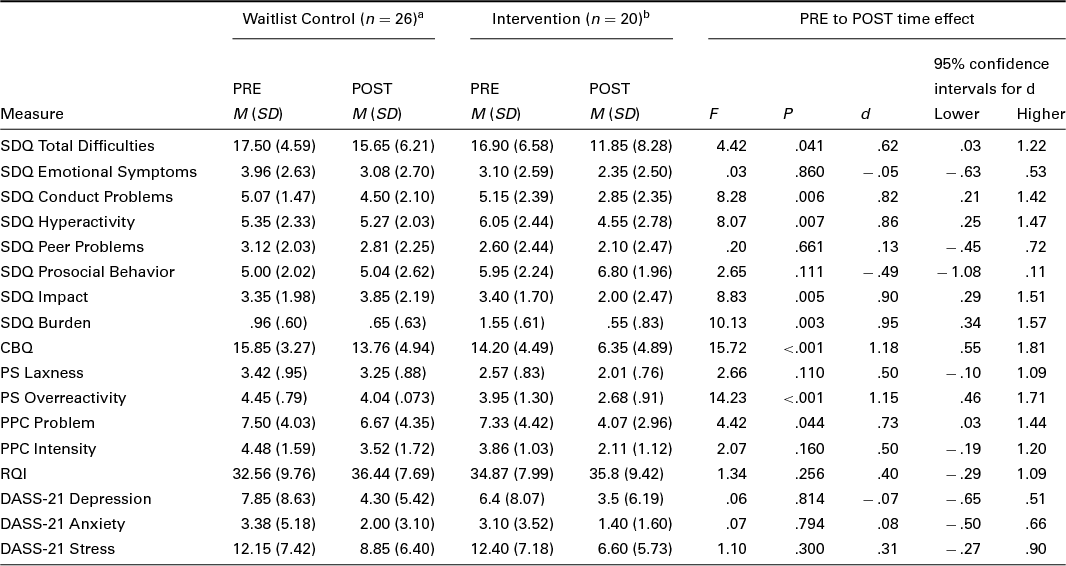
The results of the two-way (condition by time) and one-way (time) repeated measures, (PRE vs. POST) ANOVAs and MANOVAs on adolescent and parent outcomes are described below. Table 1 shows means, standard deviations, F values, levels of significance, effect sizes and their 95% confidence intervals for the univariate condition by time interaction.
Short-Term Intervention Effects: Descriptive Statistics, F values and Effect Sizes for the Univariate Condition by Time Interactions
Note: PRE = pre-intervention assessment, POST = post-intervention assessment, SDQ = Strengths and Difficulties Questionnaire, CBQ = Conflict Behavior Questionnaire, PS = Parenting Scale, PPC = Parent Problem Checklist, RQI = Relationship Quality Index, DASS-21 = short version of the Depression Anxiety Stress Scales; an = 18 for PPC Problem, PPC Intensity, RQI (18 sole parents). bn = 15 for PPC Problem, PPC Intensity, RQI (15 sole parents, 1 missing datum and 1 parent separating from her partner during the intervention course. She did not complete these questionnaires at post-assessment and her data was excluded when calculating the means and standard deviations for the pre-assessment too).
Adolescent outcomes
From pre- to post-assessment for the SDQ Total score, the two-way ANOVA revealed a significant condition by time interaction, F(1, 44) = 4.42, P = .041. In the one-way ANOVA for the SDQ Total, there was a significant time effect for the intervention condition only, F(1, 19) = 19.74, p < .001. Therefore, an overall reduction in teen problem behaviours was observed for the intervention group, but not for the waitlist control condition. The effect size for teen overall problem behaviours was medium (d = .62).
From pre- to post-assessment for all the SDQ subscales, the MANOVA revealed a significant condition by time interaction, F(1, 44) = 4.42, p = .043. However, the univariate condition by time interaction was only significant at the Bonferroni-corrected level of significance (p < .01) for the Conduct Problems and Hyperactivity scales, F(1, 44) = 8.27, p = .006, and F(1, 44) = 8.07, p = .007, respectively. The univariate condition by time interaction for all other three subscales of the SDQ was non-significant. In the one-way MANOVAs, there was a significant multivariate time effect for the intervention condition only, F(1, 19) = 18.08, p < .001. In the intervention condition, the univariate time effect was significant for both Conduct Problems, F(1, 19) = 14.98, p = .001; and Hyperactivity, F(1, 19) = 27.58, p = .001. This indicates that from pre- to post-assessment, behavioural problems remained stable in the waitlist condition, but decreased significantly in the intervention condition. These changes were associated with large effect sizes (d > .80). There was no significant change in the social or emotional problems.
For the SDQ impact supplement measures, the MANOVA revealed a significant condition by time interaction, F(1, 44) = 6.54, p = .003. The univariate condition by time interaction was significant at the Bonferroni-corrected level of significance (p < .025) for both the SDQ Impact, F(1, 44) = 8.83, p = .005; and the SDQ Burden, F(1, 44) = 10.13 p = .003. In the one-way MANOVAs there was a significant multivariate time effect for both the intervention and waitlist control condition, F(1, 19) = 18.04, p < .001, and F(1, 25) = 4.07, p = .03, respectively. However, the univariate time effect for the SDQ Impact and the SDQ Burden was significant at the Bonferroni-corrected level of significance (p < .025) for the intervention condition only; F(1, 19) = 12.25 p = .002; and F(1, 19) = 38.00, p < .001, respectively. As shown in Table 1, while in the intervention condition both the SDQ Impact and the SDQ Burden decreased from pre- to post-assessment, in the waitlist control condition there was an increase in the SDQ Impact and a reduction in the SDQ Burden. This result indicates that the general negative impact of the teenager's difficulty decreased for the families in the intervention condition and increased for the families in the waitlist control condition. These changes were associated with large effect sizes (d > .89).
From pre- to post-assessment for the CBQ, the two-way ANOVA revealed a significant condition by time interaction, F(1, 44) = 15.72, p < .001. In the one-way ANOVA for the CBQ there was a significant time effect for both the intervention condition, F(1, 19) = 50.63, p < .001, and the waitlist condition, F(1, 25) = 4.74, p = .039. This demonstrates an overall reduction of conflict in adolescent-parent relationship for both conditions, but the reduction was significantly greater for the intervention condition compared to the waitlist condition. This change was associated with a very large effect size (d = 1.18).
Parent outcomes
From pre- to post-assessment for two measures of parenting style, the MANOVAs revealed significant condition by time interactions, F(1, 44) = 6.97, p = .002. The univariate condition by time interaction was significant at the Bonferroni-corrected level of significance (p < .025) for the PS Overreactivity, F(1, 44) = 14.23, p < .001; but not for the PS Laxness. This indicates that the change in coercive parenting style from pre- to post-assessment was different for the two conditions. The one-way ANOVAs revealed significant time effects for both the intervention condition, F(1, 19) = 33.36, p < .001, and the waitlist condition, F(1, 26) = 14.35, p < .004. This indicates that parents’ use of coercive parenting practice decreased in both conditions, but the reduction was significantly greater in the intervention condition compared to the waitlist condition. The effect size for Overreactivity was very large (d = 1.15).
From pre- to post-assessment for the PPC Problems, the two-way ANOVA revealed a significant condition by time interaction, F(1, 31) = 4.24, p = .044. In the one-way ANOVA for the PPC Problem, there was a significant time effect for the intervention condition only, F(1, 14) = 12.81, p = .003. This demonstrates that the amount of open conflict over childrearing issues significantly decreased for parents in the intervention condition, but did not change for parents in the waitlist control condition. This change was associated with a medium effect size (d = .73). For the other two-parent outcomes (RQI and the DASS subscales), the two-way ANOVA revealed no significant condition by time interaction.
Supplementary analysis
Because gender distribution was different between the two conditions, the data were also analysed using gender as a covariate. The results for the two-way (condition by time) repeated measures (PRE vs. POST) ANOVA and MANOVAs were very similar to the original two-way ANOVA and MANOVAs, indicating that findings were not impacted by the difference in gender distribution between the two conditions. In addition, an intention to treat analysis that included all original 58 families regardless of whether they withdrew early from the study revealed similar results with two exceptions. The two-way MANOVA for the SDQ subscales and the two-way ANOVA for the PPC Problem were no longer significant. A trend similar to the results of the main analyses was observable for these measures.
Clinical significance
The clinical significance of change was estimated for the eight measures, with significant short-term intervention effects. For adolescent outcomes, significant differences were observed between the distribution of positive and negative changes in the two conditions for the SDQ Conduct Problems, χ2(1, 46) = 10.73, p < .001, the SDQ Burden, χ2(1, 46) = 4.46, p = .035, and the CBQ, χ2(1, 46) = 19.31, p < .001. In the intervention condition, 35% and 25% of families showed reliable positive change for the SDQ Conduct Problems and the SDQ Burden, respectively. In the waitlist control condition, no reliable change was observed for the SDQ Conduct Problems and only 3.8% positive reliable change was observed for the SDQ Burden. Therefore, from pre- to post-assessment, families participating in the intervention were more likely to show reliable decreases in teen conduct problems and in the burden of teen's difficulties on the family. For the CBQ, 80% of families in the intervention condition showed reliable positive changes, compared to only 15.4% of families in the waitlist condition, indicating that families participating in the intervention were more likely to report reliable improvements in the parent-adolescent relationship from pre- to post-assessment. The distribution of positive and negative reliable change did not differ between the conditions for SDQ Total, SDQ Hyperactivity or SDQ Impact.
For parent outcomes, significant differences were observed between the distribution of positive and negative changes in the two conditions for the PS Overreactivity, χ2(1, 46) = 7.64, p = .006. In the intervention condition, 35% of parents showed reliable positive change in this measure compared to only 3.8% in the waitlist control condition. This indicates that parents participating in the intervention were more likely to show reliable decreases in their use of coercive parenting practices from pre- to post-assessment. For the PPC Problem, the distribution of positive and negative reliable change did not differ between the conditions.
Follow-Up Effects
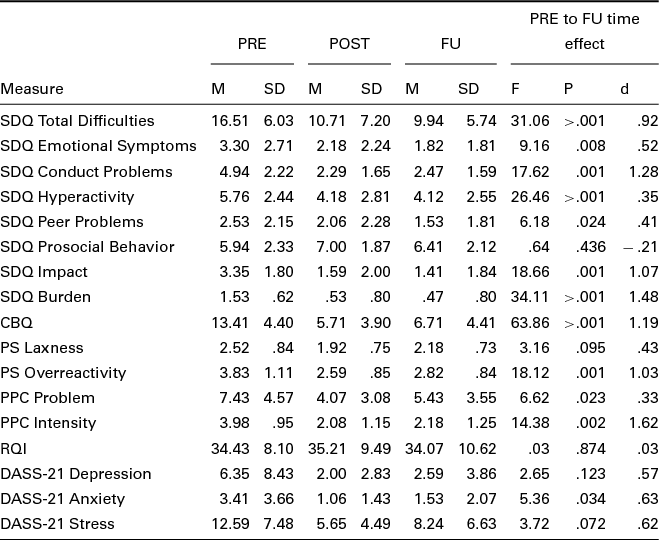
The one-way (time) repeated measures (PRE vs. FU) ANOVAs and MANOVAs on adolescent and parent outcomes confirmed maintenance of all treatment gains. Table 2 shows means and standard deviations for the adolescent and parent measures at PRE, POST and FU for the intervention condition. It also presents F values, levels of significance and effect sizes for the univariate time effects from pre- to follow up assessment.
Follow-Up Effects: Descriptive Statistics and Effect Sizes for the Univariate Time Effects (Intervention Condition Only, n = 17)a
Note: Effect sizes were provided for PRE versus FOLLOW-UP. PRE = pre-intervention assessment, POST = post-intervention assessment, FOLLOW-UP = 3-month follow-up assessment, SDQ = Strengths and Difficulties Questionnaire, CBQ = Conflict Behavior Questionnaire, PS = Parenting Scale, PPC = Parent Problem Checklist, RQI = Relationship Quality Index, DASS-21 = short version of the Depression Anxiety Stress Scales. an = 14 for PPC Problem, PPC Intensity, RQI (2 sole parents, 1 missing datum).
Discussion
The current study evaluated the effects of STTP, a behavioural family intervention for parents of adolescents, on several adolescent and parent outcomes. The intervention aimed to reduce adolescent problem behaviours by reducing parents’ use of ineffective parenting strategies. As predicted, compared to parents in the waitlist control condition, parents in the STTP group reported decreased teen disruptive problem behaviours, reduction in the negative impacts associated with teen difficulties, and greater improvement in the parent-child relationships. The intervention was also associated with a greater reduction in using coercive parenting strategies, as well as decreased disagreement over child-rearing issues in dual-parent families. No change was observed in parent marital relationship or personal adjustment.
The results of the current study are consistent with the results of other studies evaluating Triple P in general. These studies found Triple P to be consistently associated with a reduction in child behavioural problems and parental use of ineffective parenting practices, but not necessarily related to improvements in parent marital relationship or parental adjustment (e.g., Bor, Sanders, & Markie-Dadds, Reference Bor, Sanders and Markie-Dadds2002; Hoath & Sanders, Reference Hoath and Sanders2002; Ireland, Sanders, & Markie-Dadds, Reference Ireland, Sanders and Markie-Dadds2003; Martin & Sanders, Reference Martin and Sanders2003; Matsumoto, Sofronoff, & Sanders, Reference Matsumoto, Sofronoff and Sanders2007). The results are also consistent with the outcomes of previous studies on other variants of Teen Triple P in finding the program to be effective in reducing teen problems, parent-child conflict and dysfunctional parenting (Ralph & Sanders, Reference Ralph and Sanders2003; Stallman & Ralph, Reference Stallman and Ralph2007).
Improvements in parenting practices are in line with other studies on parenting programs for parents of teenagers, which show these programs are effective in increasing parents’ use of positive strategies (e.g., Hawkins et al., Reference Hawkins, Catalano, Kent, Donohew, Sypher and Bukoski1991). However, previous studies have mostly focused on changes in parental monitoring (Dishion, Nelson, & Kavanagh, Reference Dishion, Nelson and Kavanagh2003). This study is one of the first attempts to measure the effects of parenting programs on more general parenting practices. Positive changes in adolescent behaviour and parent-adolescent relationships have also been observed in other studies. Parenting programs have been shown to be effective in improving parent-adolescent relationships and reducing the risk of substance abuse and delinquent behaviour in teenagers (Barkley et al., Reference Barkley, Edwards, Laneri, Fletcher and Metevia2001; Dishion & Andrews, Reference Dishion and Andrews1995; Kosterman, Hawkins, Spoth, Haggerty, & Zhu, Reference Kosterman, Hawkins, Spoth, Haggerty and Zhu1997). In addition, the current study shows that parenting programs not only improve parenting skills and adolescent behaviour, but also increase parents’ agreement over child-rearing issues.
In this study, the overall rate of attrition in the intervention condition was 34.4% (including families who failed to start the intervention, families who attended at least one session but did not complete the program, and the family who completed the intervention but did not return the post-assessment questionnaires). These rates are similar to attrition rates cited in other parent training and child and adolescent treatment studies (Boggs et al., Reference Boggs, Eyberg, Edwards, Rayfield, Jacobs, Bagner and Hood2004; Cottrell et al., Reference Cottrell, Hill, Walk, Dearnaley and Ierotheou1988; Gross & Grady, Reference Gross and Grady2002; Hoare, Norton, Chisholm, & Parry-Jones, Reference Hoare, Norton, Chisholm and Parry-Jones1996). In a meta-analysis, the average rate of terminating the treatment prematurely was estimated to be between 40 to 60% for studies on child psychotherapy (Wierzbicki & Pekarik, Reference Wierzbicki and Pekarik1993).
Comparisons of families who completed the program and those who failed to start or who dropped out early revealed that dropout mothers were less educated and younger compared to completer mothers. These are among the most common differences found between child treatment dropouts and completers (Kazdin, Reference Kazdin1990; Kazdin, Mazurick, & Bass, Reference Kazdin, Mazurick and Bass1993; Wierzbicki & Pekarik, Reference Wierzbicki and Pekarik1993). Younger mothers are more likely to experience higher levels of stress, which can interfere with their attendance in child treatment (Kazdin et al., Reference Kazdin, Mazurick and Bass1993). Similarly, lower educational attainment is related to lower socioeconomic status and higher levels of life stress and may hinder parents’ ability to cope with treatment demands (Kazdin, Reference Kazdin1990).
Limitations
This study has several limitations that warrant comment. To begin with, intervention outcomes were assessed through self-report measures only. This presents a potential limitation because parents participating in the intervention are more likely to be aware of socially desirable responses that may specifically affect their ratings of their own parenting behaviours despite no change in the real behaviour (Spoth, Redmond, Haggerty, & Ward, Reference Spoth, Redmond, Haggerty and Ward1995). Observational measures of parent adolescent interaction would have been useful, but were not carried out due to financial and time constraints.
Second, the small sample size did not allow examination of moderators and mediators of intervention effects. Factors contributing to the intervention outcomes, such as characteristics of families who respond well and did not respond so well, could not be examined due to the small sample size. In addition, improvements in other measures such as permissive parenting may have reached significance if the sample size had been larger. Nevertheless, the study yielded significant results in several adolescent and parent outcome measures, implying the robustness of the intervention in reducing family risk factors for adolescent problem behaviours. This was achieved even in spite of the conservative approach adopted in choosing which parents’ data would be included in the analysis in cases where more than one parent per family had completed the questionnaires.
Another limitation was the lack of a control group at the follow-up assessment. Although families in the intervention condition showed significant improvement over families in the waitlist control condition and had maintained most of the treatment gains at follow-up, the positive changes from baseline to follow-up cannot confidently be attributed to the intervention in the absence of a long-term control group. Factors unrelated to the intervention, such as maturation, regression to the mean, or contemporaneous events may have accounted for changes observed from pre- to follow-up assessment. For ethical reasons, research participants who were experiencing high levels of difficulties at baseline (as was the case in this study), could not be deprived from receiving intervention for a long period. The alternative approach would have been to compare the intervention with treatment as usual, which allows for long-term follow-ups. However, treatment as usual could not be used as a comparison condition in the current study, because the study was carried out in a university clinic where Triple P was the predominant treatment of choice.
It is also worth mentioning that recruitment of families into this study was difficult. The recruitment rate could not be estimated, because the number of eligible families reached through program advertisement was unknown. Nevertheless, the response rate to the recruitment was slower than expected and thus some families were assigned to the intervention or waitlist control condition based on the availability of practitioners (see method section for more details). Even though families in the intervention condition did not differ from families in the waitlist control condition in most socioeconomic variables and child and family functioning measures, caution is warranted in generalisation of the findings. There is some evidence that suggests prevalence of emotional and behavioural problems in children and adolescents (Carskadon & Acebo, Reference Carskadon and Acebo1993; Sourander, Koskelainen, & Helenius, Reference Sourander, Koskelainen and Helenius1999) as well as patterns of parent-child involvement (Crouter & McHale, Reference Crouter and McHale1993) might vary according to the time of year. Therefore, families who responded to the advertisement between April and August might be different from families who initiated contact later during the year.
Implications for Research, Policy, and Practice
Despite the limitations, this research demonstrated that STTP is an effective intervention in reducing parents’ use of coercive and punitive parenting practices and adolescent disruptive behaviours, as well as improving the parent-adolescent relationships and parents’ communication about parenting issues. The intervention is directed at parents and includes minimal therapeutic contact with adolescents. Adolescents are encouraged to participate, but their participation is not necessary. This allows all parents of teenagers to receive the program, even those whose teenager is not willing to attend the sessions.
Nevertheless, the program should be compared to treatment as usual in an effectiveness trial. This design allows for examination of the long-term intervention effects. Families in the intervention condition can be compared to families in the treatment-as-usual condition for up to several years, without compromising the ethical issue of depriving families of receiving appropriate intervention. Moreover, a program that is demonstrated to be more effective than the services currently available justifies the efforts and costs associated with incorporating a new program into the existing system.
In conclusion, STTP is a promising parenting intervention for tackling adolescent externalising problems. Future trials will benefit from the inclusion of observational measures of change, a larger sample size and establishing the long-term efficacy of the intervention.
Author Note
Raziye Salari now works at the Department of Women's and Children's Health, Uppsala University, Samariterhemmets Hospital, Box 609, 751 25 Uppsala, Sweden.
Acknowledgments
The first author would like to thank Alina Morawska for thoughtful discussions and Cassandra Tellegen for her helpful comments on an earlier draft of the manuscript. This paper is drawn from a doctoral dissertation by the first author which was supervised by the second and third authors.