Introduction
Social scientists working from a variety of disciplines and intellectual traditions have identified a strong correlation between inequality and religion. Societies marked by high levels of inequality are significantly more religious than those with more egalitarian distributions of income. This correlation exists across a wide range of countries from different religious traditions and varying levels of economic and political development. Whether considering the wealthy democracies of the West (Norris and Inglehart, Reference Norris and Inglehart2004) or larger samples including developing countries (Barber, Reference Barber2013), the correlation between national religiosity and inequality proves robust to a wide variety of controls (Ruiter and Van Tubergen, Reference Ruiter and Van Tubergen2009).
Interest in the correlation between inequality and religion comes largely from scholars concerned with explaining cross-national variations in religious belief and practice. Insecurity theory identifies inequality as a crucial factor in accounting for the persistence of religion across many societies in the face of significant pressures for secularization (Norris and Inglehart, Reference Norris and Inglehart2004; Barber, Reference Barber2013; Immerzeel and Van Tubergen, Reference Immerzeel and Van Tubergen2013). From this perspective, high inequality generates economic insecurity, leading the poor to seek shelter in religion and religious institutions for both psychological and material comfort. Alternatively, more egalitarian societies ease economic uncertainty among the poor and working classes, reducing demand for religious goods and services.
Though demonstrating a consistent and robust correlation between inequality and religiosity, the growing body of literature on insecurity theory largely fails to consider the possibility of reverse causality; yet, there are a number of reasons to suspect that religion may have a powerful influence on income inequality. First, religion poses a significant electoral challenge to left-wing political parties committed to the construction of generous welfare states designed to minimize income inequalities. In highly religious societies, large segments of poor and working class voters may prioritize the protection of traditional social and religious values over their economic self-interests. By undermining the electoral base of social democratic parties, high levels of religiosity may promote more conservative economic policies that result in higher levels of income inequality.
Beyond contributing to a more conservative electorate, religious institutions and social movements may play an important role as political actors opposed to the development of the welfare state. Across much of the West, religious institutions frequently operated as important sources of resistance to the centralization of state authority implied by the expansion of welfare policies. In those countries where intense conflicts between church and state emerged, religious leaders and parties of religious defense often sought to defend the traditional role of the churches in the provision of social services for the poor. Through their influence on the size and structure of the welfare state, these conflicts between church and state constrained state-led efforts to provide social protection, resulting in higher levels of income inequality.
This paper poses a potentially significant challenge to the claims of insecurity theory by demonstrating the strong possibility of reverse causality. The following section reviews the theoretical and empirical literature on insecurity theory, which sees inequality as an important factor in determining levels of religiosity. The next two sections offer an alternative perspective that sees religion as playing a central role in shaping the political economy of Western societies. The second section demonstrates a link between religiosity and the mobilization and political power of the working classes. An examination of the historical strength of left-wing political parties across Western democracies suggests that religion undermines political support for generous social policy institutions that might reduce income inequality. The third section extends the analysis of religion and the development of social policy by placing the historic conflicts between church and state at the center of welfare politics. This discussion demonstrates that religious institutions and parties helped to define the size and structure of welfare institutions, with important consequences for levels of income inequality. This analysis demonstrates that the correlation between religiosity and inequality is not robust to the consideration of the influence of religion on welfare regime type, undermining the claim that variations in levels of inequality explain cross-national differences in religiosity. The paper concludes with a discussion of the implications of this research for our understanding of the relationship between religion and inequality identified by insecurity theory.
Inequality, insecurity and religiosity
The argument that high inequality increases religiosity traces its roots to secularization theory, which itself grows out of the intellectual tradition of modernization theory. According to secularization theory, the forces of modernization unleashed by the Industrial Revolution would inevitably sweep away religious belief and practice. Urbanization, mass education, democratization, reduced levels of material insecurity, and increased social and structural differentiation of labor were thought incompatible with a religious worldview built upon superstition and tradition. By promoting individualism, egalitarianism, scientific reasoning, and moral relativism, modernization undermines traditional religious beliefs and institutions (Bruce, Reference Bruce2002; Dobbelaere, Reference Dobbelaere2004).
Despite the early consensus on the inevitable decline of religion, secularization theory has come under increasing pressure as religion has proved remarkably resilient to the forces of modernization in and outside of Europe (Berger, Reference Berger1999). Moreover, religious belief has remained remarkably strong in many Western societies (Stark and Finke, Reference Stark and Finke2000) while recent years have even seen signs of a religious reawakening in a number of European countries (Greeley, Reference Greeley2004). The resilience of religion to the forces of modernization caused many scholars to call for abandoning the assumption of secularization theory of an inevitable and uniform decline in religious belief and practice (Stark and Finke, Reference Stark and Finke2000). Norris and Inglehart (Reference Norris and Inglehart2004) develop an alternative approach that incorporates an explanation for the continued cross-national variation in religiosity into the broader framework of secularization theory. Following modernization theory, Norris and Inglehart understand individual religious belief as a response to concerns over ‘existential security’. Insecurity theory sees religious belief and practice as a coping mechanism that protects individuals from an often-uncertain world. From this perspective, religion acts as a psychological and social response to seemingly unpredictable threats to life and livelihood that appear largely beyond individual control. As Immerzeel and Van Tubergen (Reference Immerzeel and Van Tubergen2013: 359) state, ‘religious ideologies provide people with predictable rules to help them cope with dangers and immediate problems: a supernatural force or god ensures that in the end everything will turn out well’.
As with secularization theory, insecurity theory argues that economic development and democratization undermine religious belief by alleviating common existential threats, such as, famine and disease (Norris and Inglehart, Reference Norris and Inglehart2004). The coinciding development of social welfare programs also helps to insure the poor against the worst risks of destitution, insulating them from market insecurities (Gill and Lundsgaarde, Reference Gill and Lundsgaarde2004). The theoretical innovation of insecurity theory over traditional accounts of secularization lies in the claim that inequality influences levels of insecurity in ways that explain the persistence of religion in many highly developed societies. Norris and Inglehart (Reference Norris and Inglehart2004) argue that the distribution of wealth has important consequences for the levels of insecurity felt by the poor even in advanced industrial societies where direct and immediate threats to survival are less pressing. High inequality produces greater economic vulnerability and insecurity among the poor and those most at risk of slipping through the holes in the social safety net. As inequality increases, religion functions as an increasingly important form of both psychological and material insurance against deprivation (Ruiter and Van Tubergen, Reference Ruiter and Van Tubergen2009; Karakoç and Baskan, Reference Karakoç and Baskan2012; Barber, Reference Barber2013).
Empirical testing of insecurity theory largely focuses on the strong positive correlation between inequality and religiosity. The correlation between inequality and religiosity appears robust to a wide variety of controls including levels of economic development (Ruiter and Van Tubergen, Reference Ruiter and Van Tubergen2009). The correlation can be found among the advanced capitalist democracies of the West (Norris and Inglehart, Reference Norris and Inglehart2004) and within developing countries (Karakoç and Baskan, Reference Karakoç and Baskan2012; Barber, Reference Barber2013). Gill and Lundsgaarde (Reference Gill and Lundsgaarde2004) also document a significant negative correlation between social spending and religiosity, consistent with the notion that a broader social safety net reduces the demand for religious goods. Finally, multi-level analysis confirms that the effects of inequality are independent of compositional effects and that individual-level religiosity is determined by both national and individual-level insecurities (Ruiter and Van Tubergen, Reference Ruiter and Van Tubergen2009; Immerzeel and Van Tubergen, Reference Immerzeel and Van Tubergen2013).
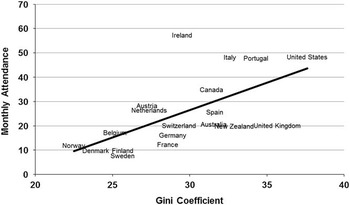
Figure 1 visually represents the relationship between inequality and religiosity across 19 Western democracies.Footnote 1 Using World Values Survey data, religiosity was measured as the percent of the population reporting monthly attendance at religious services.Footnote 2 Inequality data were drawn from version 4 of the Standardized World Income Inequality Database (SWIID). The SWIID standardizes inequality data from a variety of sources to produce reliable and comparable estimates of the Gini coefficient across a broad range of countries and time (Solt, Reference Solt2009). Consistent with existing research, there exists a strong correlation between religiosity and inequality (r=0.61; P=0.006) even in this small sample of countries. A visual examination of the data reveals a remarkable degree of conformity to the general pattern connecting inequality to religiosity, with only Ireland (discussed below), and to a lesser degree the United Kingdom, falling a significant distance from the trend line.
Inequality and religiosity across the west.

The correlation between inequality and religiosity is consistent with the expectations of insecurity theory; however, by itself, this correlation is insufficient to prove causation. Given its central concern for explaining varying patterns of secularization, research on insecurity theory ignores the possibility of reverse causality. Research on insecurity theory largely assumes that cross-national variations in inequality are exogenously given. Such an approach ignores the fact that variations in the levels of inequality across countries are not a priori given, but rather reflect the interactions between a host of political and economic variables. Chief among the factors influencing cross-national variations in inequality is the size and structure of welfare state institutions. If levels of inequality reflect the political conflicts surrounding the welfare state, then it is necessary to examine the possibility that religion influences welfare politics and policy.
The following sections make a strong argument for the causal importance of religion and religiosity for the development of the welfare state. The next section demonstrates that religious belief and practice weakens support for left-wing political parties and the redistributive social policies with which they are associated. By undermining support for social democratic parties, high levels of religiosity may yield higher levels of income inequality. This discussion is followed by an analysis of the role that past periods of church-state conflict played in defining distinctive patterns of welfare state development across the West. This analysis reveals strong evidence that religion has played a central role in determining cross-national variations in levels of inequality. Taken together, these two related but distinct lines of argument challenge the causal assumptions of insecurity theory.
Religion and socialist mobilization
The most immediate and direct effect of religious belief on inequality derives from the influence of religion on support for left-wing political parties and redistributive social policies. Beginning with Marx’s proclamation that ‘religion is the opiate of the masses’, socialist scholars and political organizers viewed religious institutions and belief as significant obstacles to the mobilization of the poor and working classes. Highly religious voters may reject the appeal of socialist parties for the establishment of a generous social welfare state for a variety of reasons. First, religious voters may prioritize their social and religious values over economic concerns. If religious values trump economic self-interests, the religious poor may form conservative, anti-socialist coalitions with the wealthy, based on the support of traditional social values (Huber et al., Reference Huber, Ragin and Stephens1993; Huber and Stephens, Reference Huber and Stephens2001). Second, the religious poor may prefer religious institutions as a source of poor relief, resisting efforts to expand secular, state-run alternatives (Elgin et al., Reference Elgin, Goksel, Gurdal and Orman2013). Finally, the often explicitly anti-clerical rhetoric adopted by socialist parties may have further alienated pious voters by presenting a stark choice between their economic interests and their religious identity (Manow, Reference Manow2013). Ironically, the Marxist position on religion likely generated a self-fulfilling prophecy by driving a deeper wedge between the secular and religious poor. The powerful conflicts between socialist political parties and religious institutions suggest that religion may operate as a cross-cutting cleavage that constrains working class mobilization. By generating a more conservative electorate, high religiosity may undermine support for left-wing political parties, hampering the development of generous social policy institutions.
Analysis of voting behavior and social policy preferences provides evidence that religion constrains class mobilization. De La O and Rodden (Reference De La O and Rodden2008) demonstrate that religious belief is a significantly more powerful predictor of vote choice than class (see also Minkenberg, Reference Minkenberg2010) with the religious poor significantly less likely to support parties of the left than their secular counterparts. Examining social policy preferences rather than voting, Scheve and Stasavage (Reference Scheve and Stasavage2006) show that religious belief is associated with less support for income redistribution, suggesting that highly religious societies are significantly less supportive of generous and highly redistributive social programs.
The evidence cited above documents that religion weakens support for left-wing political parties and redistributive social policies, but do the attitudinal effects of religion at the individual-level translate into a decline in the political prospects of left-wing political parties in highly religious societies? To investigate this question, I introduced measures of national-level religiosity into a model predicting the average vote share of left-wing parties in the 19 Western democracies. In the voting model, the dependent variable is the average vote share of social democratic and communist parties from 1950 to 2006, as defined by Swank (Reference Swank2006). The classification of parties utilized by Swank, are based on those of Huber and Stephens (Reference Huber and Stephens2001), which have become the standard for quantitative welfare state research.
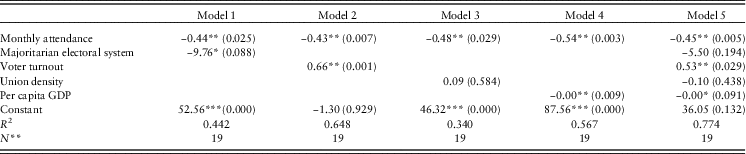
For the results presented in Table 1, national-level religiosity was measured as the monthly attendance rate at religious services, calculated using the latest available round of World Values Survey data.Footnote 3 The voting model includes a number of controls for factors known to influence cross-national variations in support for left-wing parties. The median unionization rate from 1960 to 2006 serves as an indicator of the organizational strength and capacity of the working classes. Average voter turnout from 1945 to 2006 controls for the possibility that higher levels of electoral turnout favor left-wing parties by increasing the participation of the poor and working classes (Pontusson and Rueda, Reference Pontusson and Rueda2010). Per capita GDP is included as a measure of the level of economic development, which may influence socialist mobilization. Finally, an indicator of whether countries have typically used majoritarian or proportional electoral rules controls for the possibility that proportional representation may favor socialist political parties (Iversen and Soskice, Reference Iversen and Soskice2006).
Religion and left party voting

Results from OLS regression predicting the average vote share for left parties from 1945 to 2006.
P-values are in parentheses.
*P<0.1; **P<0.05; ***P<0.001.
In the sample of 19 Western democracies, a strong bivariate correlation (r=−0.57; P=0.011) exists between national-level religiosity and the average vote share of left-wing political parties in the post-war period. Table 1 presents the results of regression analysis controlling for the influence of other potential determinants of left-wing voting. The limited number of cases imposed by the absence of reliable time series data on religiosity necessarily demands caution in interpreting the data; however, the results are consistent with the suggestion that high religiosity significantly weakens the electoral strength of left-wing parties. The correlation between religion and the average left-party vote share is robust to the inclusion of all controls either individually (Models 1–4) or collectively (Model 5). In the full model including all controls (Model 5), the expected average left-party vote share falls by ∼14 percentage points when moving from one standard deviation above to one standard deviation below the mean of religious attendance.
Combined with the findings on preferences and voting behavior cited above, the models of left-wing vote share demonstrate that high religiosity produces a more conservative electorate and impedes the electoral success of socialist parties. Given the significant evidence linking the political power of left-wing political parties to the development of large and generous social welfare states (Stephens, Reference Stephens1980; Huber and Stephens, Reference Huber and Stephens2001; Korpi and Palme, Reference Korpi and Palme2003), there is significant reason to believe that high religiosity produces greater inequality by inhibiting socialist political mobilization. This may also help to explain the findings of Gill and Lundsgaarde (Reference Gill and Lundsgaarde2004), which document a correlation between religiosity and social spending. As will be discussed at length below, it was of significant importance for the evolution of the welfare state whether Christian Democratic or more business-oriented Conservative parties benefited from the weakness of socialist parties (Huber et al., Reference Huber, Ragin and Stephens1993); however, in either case, the reduced strength of socialist parties resulted in higher levels of inequality.
The strong connection between religiosity and support for socialist political parties provides evidence of one alternative explanation for the link between religiosity and inequality to that suggested by insecurity theory. As with insecurity theory, this approach treats religion as an individual-level variable, ignoring the role that religious institutions might play as political actors in their own right. The section that follows identifies a third explanation for the link between religion and inequality, which while consistent with the effects of religion on socialist mobilization, emphasizes the effects of historical church-state conflicts on the evolution of distinctive models of welfare provision.
Church-state conflict and the evolution of the welfare state
The research on the consequences of religion for welfare politics largely assumes that the primary effects of religion derive from its effects on the attitudes and political behavior of individual voters. By treating religion as a purely cultural variable, this approach fails to account for the fact that religious institutions are themselves political actors that directly pursue their own perceived self-interests (Fink, Reference Fink2009). Though traditional models of welfare politics frequently center around class-conflict, both inter-denominational and broader church-state conflicts have played a central role in defining both the structure of party systems and the politics of welfare provision (Manow, Reference Manow2009; Van Kersbergen and Manow, Reference Mavrogordatos2009). Religious institutions served as the primary sources of social welfare provision and poor relief in Western societies prior to the evolution of the modern welfare state (Brodman, Reference Brodman2009). The expansion of increasingly powerful bureaucracies into the realm of social policy frequently brought the state into direct conflict with religious institutions, who sought to defend their traditional control over these policy areas. The nature and outcomes of these church-state conflicts had important consequences for the evolution of the welfare state.
This section demonstrates the importance of religion to the development of the welfare state by documenting common patterns of church-state conflict among countries sharing similar models of welfare provision. In his seminal work on the structural characteristics of welfare states, Esping-Andersen (Reference Esping-Andersen1990) identified three distinctive welfare regime types among the capitalist democracies of the West. The Social Democratic regime type, found in the Scandinavian countries of Northern Europe, offers the most generous system of social protection built upon principles of universalism, employment promotion, and social service provision. The Conservative welfare regime, found throughout most of continental Europe, is based on semi-private social insurance funds segmented by class status and funded by employer and employee contributions. This Conservative model of welfare provision protects workers from market insecurities, while avoiding the significant leveling of economic inequalities produced by the more universal welfare states preferred by Social Democrats. The Liberal welfare regime, common to the English speaking countries of the West, provides the most limited form of social protection. Liberal welfare states combine low levels of social spending with a strong market orientation, minimizing the impact of the state on inequality and poverty. Finally, following Esping-Andersen, scholars have identified a fourth distinctive model of the welfare state (Ferrera, Reference Ferrera1996). The Southern welfare state combines highly segmented social insurance programs with extremely limited anti-poverty measures, producing significant gaps in the social safety net. This structure results in high levels of inequality and poverty as the resources of the welfare state are funneled to pensioners, state workers, and politically powerful sectors of the working class (Gal, Reference Gal2010).
Traditionally, efforts to explain the clustering of countries into distinctive welfare regime types have emphasized differences in the power and organizational capacity of working class movements and institutional factors. More recently, scholars have begun to draw attention to the effect of religious factors in shaping the development of distinctive welfare regime types (Manow, Reference Manow2004, Reference Manow2009; Van Oorschot, Reference Van Oorschot2007; Van Kersbergen and Manow, Reference Mavrogordatos2009). Drawing on this new body of research, it is possible to identify patterns of state-church conflict unique to each of the four welfare regime types and by extension, to current levels of income inequality.
The most obvious and direct link between religion and welfare regime type can be found in the Conservative welfare states of Continental Europe. Esping-Andersen (Reference Esping-Andersen1990) first identified Christian Democratic parties and Catholic social doctrine as essential elements in defining the Conservative regime type. Across Continental Europe, Christian Democratic parties emerged out of the intense church-state conflicts of the last half of the 19th century (Van Kersbergen and Manow, Reference Mavrogordatos2009). In these countries, social policy often lay at the center of the competition between religious leaders and new nationalist elites seeking to centralize power in secular state institutions. Christian Democratic parties organized to protect traditional religious authority over education and poor relief from the encroachment of increasingly powerful state bureaucracies.
Politically, Christian Democratic parties constructed cross-class coalitions that sought to undermine Social Democratic efforts to unify the working classes. Christian Democrats attracted working class voters through a critique of capitalism founded on the promotion of social harmony and the protection of traditional family and religious values, rather than socialist demands for a more egalitarian distribution of income (Kalyvas and Van Kersbergen, Reference Kalyvas and Van Kersbergen2010). These parties promoted the principle of subsidiarity, which limited the role of the state to the promotion of cooperation between large social groups, supporting the evolution of the corporatist welfare model characteristic of Conservative welfare states.
In the post-War period, Christian Democratic parties became a dominant feature of the party systems of most of Continental Europe (Manow, Reference Manow2009). Despite their strong electoral position, the presence of consensus-style institutions across much of Continental Europe prevented single party majorities and forced Christian Democrats to compromise with Social Democratic parties (Van Kersbergen and Manow, Reference Mavrogordatos2009).Footnote 4 These ‘red-black ’ coalitions resulted in policies that ensured a just wage for the working classes, while limiting the redistributive potential of the welfare state. Thus, in much of Continental Europe, the conflict between Christian and Social Democratic parties yielded a compromised version of the welfare state that reduced the redistributive potential of generous social policy programs.
Within the countries of what has been described as the Southern world of welfare capitalism, a similar, but more extreme, pattern of religious-state conflict emerged. As in Continental Europe, the countries of Southern Europe (Italy, Portugal, and Spain) were also characterized by intense conflicts between state and church; however, in these countries, political Catholicism took on a distinctly more reactionary form.Footnote 5 Italy, Spain, and Portugal were among the first regions of Europe to be Christianized, and, following the Counter Reformation, Catholicism secured its monopoly position in society, becoming a defining feature of national identity in the early years of state formation. As a result, these countries frequently exhibit extremely high levels of religious participation (see Table 2) with Catholic identification nearly universal even among the non-religious.
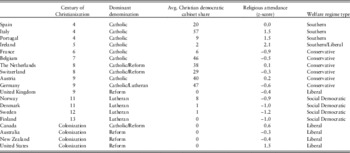
Welfare regime type and the history of religion and religious conflict

Throughout the 19th century, the Catholic Church became a target of new liberal elites as a part of their broader assault on the ancient régime (Ferrera, Reference Ferrera1996; Lynch, Reference Lynch2009; Manow, Reference Manow2013). The Catholic Church reacted by allying with the anti-liberal and anti-modernist forces of the ruling regimes against the new republican elites and the burgeoning socialist left. The divide between the left and the Catholic Church deepened in the early part of the 20th century when the Church became closely associated with the fascist regimes and their violent repression of socialist political parties and unions. The result was a significantly deeper religious division between right and left in the Southern countries compared with that seen across much of Continental Europe. In the countries of the Conservative welfare cluster, greater religious diversity (e.g. Germany, Switzerland) and a significantly weaker position in society (e.g. France) forced political Catholicism to moderate its position and adopt a more centrist and conciliatory tone (Manow, Reference Manow2013). In the South, the monopoly position of the Catholicism combined with very high levels of religious participation placed the Church in a much more powerful position, allowing it to adopt a much more aggressive and reactionary form of resistance to socialist movements.
The dominance of the Catholic Church combined with the intensity of religious conflict in the Southern countries had a number of significant consequences for the development of the welfare state. First, as in the countries of Continental Europe, liberal and socialist parties in Southern Europe frequently sought to use welfare expansion as a tool to reduce the political and cultural power of the Catholic Church (Mujal‐León, Reference Mujal‐León1982; Lynch, Reference Lynch2009). Despite these efforts, high rates of religious participation and near universal identification of the public with Catholicism, placed the Church in a significantly better position to defend its autonomy by defending its traditional control over education and poor relief from state intrusion (Gal, Reference Gal2010). Second, the strong position of the Catholic Church and its association with the authoritarian past, created cross-pressures on the political left that generated a fissure between intensely anti-clerical communist parties and more accommodationist Social Democrats (Manow, Reference Manow2013). Throughout much of the post-War period, the communist parties saw significant electoral success across Southern Europe; however, their strong anti-clerical and anti-system leanings rendered them untenable alliance partners. This split within the left further strengthened the hand of Conservative and Christian Democratic parties in the South, weakening the prospects for substantial welfare state development.
Though the importance of Catholicism and Christian Democratic parties for welfare politics has long been understood, the role of religion in defining welfare state development outside of the Conservative and Southern regimes of Continental Europe has received significantly less attention. Recently, Manow (Reference Manow2009) has identified the unique development of religious institutions in the Scandinavian countries as an important element in explaining the development of the Social Democratic regime type. In Northern Europe, Lutheran state churches prevented the emergence of religious political cleavages and largely avoided the powerful church-state conflicts that characterized much of the West (Manow, Reference Manow2004; Anderson, Reference Anderson2009; Van Kersbergen and Manow, Reference Mavrogordatos2009). Where in the South, the rise of the liberal state was seen as a significant and direct challenge to the authority of the Catholic Church, the monopoly position granted to the Lutheran church meant that the expansion of state power implied by the growth of the welfare state did not fundamentally threaten church authority. As a result, state churches posed little institutional resistance to social policy reform and parties of religious defense did not organize to protect the independence or autonomy of religious authorities.
In addition to limiting the direct political confrontation between church and state, the imposition of a state religion may have weakened the appeal of Christianity as a mass movement in these countries (Fox and Tabory, Reference Fox and Tabory2008). Stark and Finke (Reference Stark and Finke2000) argue that, from the beginning, Christianization was largely an elite-level affair throughout Scandinavia with the conversion to Catholicism and later Protestantism largely imposed from above. With state power ensuring the monopoly position and financial health of the church, religious leaders had little incentive to expand membership or extend the reach of the church deeper into society (Fox and Tabory, Reference Fox and Tabory2008). Estimates of religious participation at the beginning of the 20th century, further suggest levels of religious attendance well below that of other Western states even before the establishment of generous social welfare programs that would have minimized income inequalities (McLeod, Reference Mcleod1981; Iannaccone, Reference Iannaccone2003). The Lutheran state churches, thus, may have simultaneously reflected and promoted the widespread secularization of Scandinavian societies, reflected in the extremely low levels of religious belief and participation across Northern Europe.
Taken together, these factors suggest that the presence of Lutheran state churches effectively removed the religious political cleavage seen across much of Continental Europe, allowing politics to be defined exclusively by class conflict. This, combined with highly proportional electoral rules, created favorable conditions for the emergence of ‘red-green’ coalitions between Social Democratic and agrarian parties committed to the development of generous social welfare systems (Manow, Reference Manow2009; Van Kersbergen and Manow, Reference Mavrogordatos2009). By removing religion as a source of political conflict, Lutheran state churches thus paved the way for the highly redistributive Social Democratic welfare state.
Religion played a somewhat more complex role in the evolution of the Liberal welfare regime. In the Anglo-American countries, a combination of majoritarian political institutions and the cultural influence of Reform Protestantism created conditions highly unfavorable to the welfare state. In contrast to the experience of Northern Europe, in Britain and its settler colonies, the Reformation broke the religious monopolies of the past, generating a host of new and competing religious movements. Fearing state repression, Protestant free churches were often highly suspicious of centralized authority and resisted efforts to expand state control over education and charitable poor relief (Manow, Reference Manow2004). In this respect, Protestant free churches served as a check on state power similar to that of the Catholic Church; however, ideologically, the Protestant Reform movements adopted a very different approach to the question of poverty and inequality. Protestant social reformers rejected Catholic charity efforts, challenging the moral value of redistribution and placing a powerful emphasis on the responsibility of the poor to engage in self-help (Kahl, Reference Kahl2005, Reference Kahl2009).
Electoral institutions in the Anglo-American countries interacted with high religious diversity and the anti-statist positions of the free churches to further limit welfare development. Majoritarian electoral rules constrained the (effective) number of political parties, unifying the opposition to socialism and weakening the power of social democratic parties (Iversen and Soskice, Reference Iversen and Soskice2006). The two-party system constrained the Social Democratic project by limiting the capacity of the working classes to find political allies in the middle class or among rural farmers, as seen in Northern Europe. At the same time, religious diversity and the two-party system prevented the emergence of coherent parties of religious defense (Wilcox and Jelen, Reference Wilcox and Jelen2002). Further, the demands for creating winning majorities required parties of both the left and right to compete for religious voters. In Britain, for example, after the dramatic collapse in support for the Liberal Party at the end of the 19th century, Nonconformism became highly influential within the Labour Party and tempered its socialist aspirations with an appeal to individual responsibility (Catterall, Reference Catterall1993). The combination of the two-party system with the cultural influence of Reform Protestantism created a political environment hostile to the development of the welfare state. The resultant Liberal welfare model emphasized individual responsibility and severely limited state intervention into the market. The Liberal regime’s rejection of large and redistributive social programs yielded high levels of poverty and inequality comparable to those found in the countries of Southern Europe.
On its face, Ireland appears to stand out as an exception to the general expectations of the link between religion and welfare regime type, described above. Following Esping-Andersen, welfare scholars typically classify Ireland as a Liberal welfare state, making it the only Catholic country among this group. In addition, the electoral institutions of Ireland are semi-majoritarian, favoring large parties, but also frequently producing multi-party governments. The differences between Ireland and the other countries in the Liberal welfare cluster may result from the inaccurate classification of Ireland as a Liberal welfare state. Using factor analysis, Obinger and Wagschal (Reference Obinger and Wagschal2001) demonstrate that Ireland exists at the margins of the Southern and Liberal categories, with its proper placement depending upon the specific policy field under consideration. Cousins (Reference Cousins1997) argues that Ireland fits uneasily in the Liberal camp because its development was influenced by late economic development and the powerful tie between Catholicism and national identity, features which it shares with the states of Southern Europe. Despite these similarities, church state conflict in Ireland followed a decidedly different path than that of the other countries of Southern Europe. In Ireland, the Catholic Church served as a unifying force during the national struggle against British colonialism, creating a strong link between Catholic and national identity. As a result, the antagonisms between the Church and new state elites did not develop in the same way as in the other predominantly Catholic countries of Southern Europe. The strong encoding of religion onto the left-right spectrum was much less pronounced in Ireland than in the South, mirroring more closely the patterns seen across the Liberal countries, in which high religiosity played a role in moderating the positions of parties across the political spectrum. The extremely high levels of religiosity and identification with the Catholic Church have undoubtedly influenced the party system and welfare policy development of Ireland; producing a marginal case caught between the Southern and Liberal regime types.
To summarize, religion has played an important role in defining the character of welfare state development and, by extension, patterns of inequality. By synthesizing available research on both welfare politics and religion, the discussion above suggests the presence of distinctive patterns of church-state conflict across the four welfare regime types. The impact of religion on welfare politics was not uniform, but instead, depended upon the nature of church-state relations, the degree of religiosity, and how electoral institutions filtered religious conflicts into the party system. In the Social Democratic states, Lutheran state churches limited conflicts between religious and secular institutions while ironically contributing to a more secular society. The effective absence of religion from politics in these countries opened up the possibility for the formation of large and generous welfare states yielding low levels of income inequality. In the Conservative countries of Continental Europe, conflicts between church and state became a defining feature of the party system, where proportional representation allowed for the formation of distinctive parties of religious defense. At the same time, proportional representation prevented Christian Democratic from capturing complete control over the political system, forcing them to compromise with Social Democratic parties. The resulting Conservative welfare states produced medium levels of income inequality.
In both the Southern and Liberal regime types, religion contributed to a more limited welfare state, resulting in much higher levels of income inequality in these countries. Where in Scandinavia, Lutheran state churches removed the religious cleavage from politics by significantly weakening the role of the church, in Southern Europe, the dominance of the Catholic Church and its historical association with anti-liberal elites resulted in often intense religious conflicts, generating a fissure in the political left between radical anti-clerical communist parties and more moderate Social Democratic parties. The strong position of the Catholic Church and the subsequent weakness of the left posed a significant obstacle to state intrusion into the social policy realm, contributing to the development of a highly segmented welfare state with limited capacity to reduce income inequalities. Finally, the powerful cultural and political influences of Reform Protestantism and free church movements across most of the English speaking countries produced an environment highly resistant to large and redistributive welfare state programs, resulting in a Liberal welfare state model that does little to alleviate poverty or income inequality.
The analysis above reveals evidence of the influence of religious traditions and institutions on the evolution of the welfare state. Table 2 summarizes these complex historical relationships by comparing a number of indicators of religious tradition and political organization across the four welfare regime types. The table includes the dominant denominational pattern across countries, noting those countries at the boundaries of the Protestant Reformation where intense conflicts developed between Catholics and Protestants. The power of Christian Democracy is measured as the average share of cabinet seats controlled by Christian Democratic parties from 1950 to 2006. as defined by Swank (Reference Swank2006). Finally, the table includes a measure of the 1st century of Christianization for the 14 countries of Western Europe. Drawing on Stark and Finke (Reference Stark and Finke2000), the century of Christianization acts as a proxy for the cultural depth of Christianity under the hypothesis that later periods of Christianization were more likely to involve elite-level conversions that weakened the popular appeal of Christianity. Unfortunately, the initial date of Christianization has limited meaning for the British settler colonies of Australia, Canada, New Zealand, and the United States. Because the modern incarnations of these states were created after colonization by unique sectors of British society (e.g. the Puritan settlers in the United States), the date of Christianization does not serve as a proxy for the depth of Christianization in these countries.
Table 2 reveals a clear relationship between religion and the structure of the welfare state. The Southern welfare states, along with Ireland (discussed above), share a common religious history of very early Christianization combined with the limited influence of the Protestant Reformation. The Conservative countries lie in the intermediate range of Christianization and often lay at the fault lines of the Protestant Reformation. The Social Democratic countries all contained Lutheran state churches and were Christianized in the 11th century or later. Finally, with the exception of Ireland, the Liberal countries share a common heritage of high religious diversity linked to the Reform Protestant tradition.
Consistent with the work of power resource scholars (Huber et al., Reference Huber, Ragin and Stephens1993; Huber and Stephens, Reference Huber and Stephens2001), a clear relationship exists between Christian Democracy and the organization of the welfare state. With the sole exception of France, Christian Democracy played a significant and often dominant political role in the Conservative countries. In France, the presence of majoritarian institutions encouraged the development of a two party system that incorporated Christian Democratic voters into a larger conservative block (Manow, Reference Manow2009; Manow and Palier, Reference Manow and Palier2009). Outside of the Conservative countries, Christian Democracy proved much less successful, with the obvious exception of Italy, where the Christian Democrats dominated post-War politics until the dramatic collapse of the party system in 1992. In both the Liberal and Social Democratic countries, Christian Democratic parties either failed to organize or played only a marginal role in post-War coalition governments.
Along with demonstrating consistent patterns of historical religious conflict within the four distinctive welfare regime types, the data from Table 2 also reveal a much weaker correlation between religious tradition, regime type, and contemporary measures of religiosity. Column 5 of Table 2 presents the monthly attendance rate z-scored across the sample of countries in order facilitate cross-national comparisons. For the Southern countries and Ireland, where Catholicism played a central role in the construction of national identity, religiosity remains remarkably high. Spain exists as the only partial exception with a level of monthly attendance only slightly above the mean, reflecting the dramatic decline in church attendance in the years following the end of the Franco era (Pérez-Agote, Reference Pérez-Agote2010). The Conservative countries all fall within one standard deviation of the mean for Western countries. Only France, in which the project of nationalism was most clearly directed against the Catholic Church, stands out as a potentially extreme case of secularization. As a group, the Social Democratic countries are the most clearly and consistently secular of all countries, falling around or below one standard deviation from the mean. This is consistent with the claims of Stark and Finke, cited above, that Lutheran state churches had limited mass appeal.
The Liberal countries have the highest level of variation in their contemporary levels of religiosity. Australia, Britain, and New Zealand all demonstrate a relatively high degree of secularization, while Canada and the United States remain highly religious by Western standards. The exceptional nature of the United States has been a point of extensive debate and discussion among scholars of comparative religion (Stark and Finke, Reference Stark and Finke2000; Bruce, Reference Bruce2002). Religiously, the United States has long stood out from the rest of Europe due to its early disestablishment, high religious diversity, and long history of settlement by religious sects fleeing persecution from Europe. For Canada, high religiosity likely results from similar dynamics of settlement to that of the United States combined with the strong link between Catholicism and French Canadian national identity (Rawlyk, Reference Rawlyk1995).
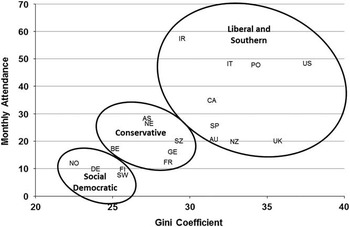
Figure 2 offers a visual representation of how welfare regime type maps onto contemporary measures of inequality and religiosity. The picture highlights the tight concentration of Scandinavian countries into the left-hand corner of low inequality and religiosity. Slightly above these countries in terms of both religiosity and inequality are clustered the Conservative welfare states of Continental Europe. The Southern and Liberal welfare states lie at the higher end of the inequality scale, but they are mixed together and contain much greater variability in terms of religiosity. Though many of the Liberal and Southern states have relatively high levels of religiosity, Britain, Australia, and New Zealand all fall slightly below the Western average.
Inequality and religiosity across the west.

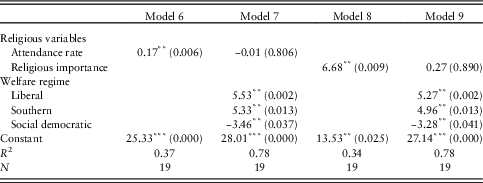
Though the correlation between regime type and measures of religiosity in the current period is imperfect due to the high variation among Liberal countries, the broad connection between contemporary belief and historical patterns of religious conflict on one hand and inequality and welfare state structure on the other may explain the contemporary correlation between inequality and religiosity. Regression analysis (Table 3) confirms that the correlation between inequality and religiosity is not robust to the inclusion of controls for welfare regime type.Footnote 6 The strong correlation between the monthly attendance rate and inequality documented above, is completely eliminated by consideration of welfare regime type. To ensure the results were not influenced by the possible distinction between ‘believing ’ and ‘belonging ’ suggested by Davie (Reference Davie1990), Models 8 and 9 employed an additional measure of religiosity, the average importance individuals attribute to religion (see footnote 2). As with religious attendance, the correlation between inequality and religiosity failed to stand up to the incorporation of welfare regime type. The sensitivity of the correlation between inequality and religiosity to the consideration of welfare regimes is consistent with the claim that the correlation between contemporary levels of religiosity and inequality are, in fact, the spurious result of the influence of historical patterns of religiosity and religious conflict on both present day levels of religiosity and the size and structure of the welfare state. Such a finding suggests that religion influences inequality through its effects on the politics of the welfare state.
Religion and welfare regime type as determinants of inequality

Results from OLS regression predicting the Gini coefficient in the most recent time period.
P-values are in parentheses.
**P<0.05; ***P<0.001.
The evidence above, provides strong evidence in favor of the contention that religion plays an important role in shaping the structure of modern welfare states and, by extension, patterns of inequality, but is it possible that the levels of religiosity are influenced by the structure of the welfare state? If welfare regime type determines levels of market insecurity, then it may also affect religiosity (Gill and Lundsgaarde, Reference Gill and Lundsgaarde2004). For example, the absence of generous social provision in Liberal and Southern welfare states may induce the poor and economically vulnerable to turn to religion for psychological and material comfort in those countries.
Table 2 provides some evidence against the proposition that welfare regime type determines religiosity. The summary data offers much clearer evidence for a link between existing welfare institutions and historical religious factors, than for a correlation between regime type and more recent indicators of religiosity. The in-group variations in religiosity within the Liberal and Southern clusters challenge the contention that the insecurity produced by these regimes induces greater religiosity. In particular, the internal variation among the Liberal countries is compatible with the claim that past patterns of religious conflict-shaped patterns of inequality, rather than current levels of religious belief; however, it is more difficult to explain from the perspective of insecurity theory. Similarly, the dramatic secularization of Spanish society, noted above, runs counter to the proposition that the limited social protection provided by the Spanish welfare state raises religious participation; however, it does not challenge the contention that the current structure of the Spanish welfare state reflects the past patterns of Church state conflict. If welfare regime type determined religiosity, we would expect to see much less in-group variation in religiosity in those countries with the lowest levels of social protection.
To summarize, the evidence presented above strongly suggests that variations in the history of religious conflict shape current patterns of inequality across the West. The analysis identified unique patterns of religious conflict within each of the four welfare regime types that predate the evolution of the modern welfare state. This connection between current variations in welfare state structure and historical church-state conflicts may explain the correlation between inequality and religiosity in the present described by insecurity theory. The contemporary correlation between inequality and religiosity is driven by the fact that measures of religiosity and levels of inequality at the beginning of the 21st century are both strongly determined by historical levels of religiosity and the patterns of state-church conflict with which they are intertwined. Measures of religiosity today are imperfect reflections of previous periods of religiosity and church-state conflict that helped determine the size and structure of welfare institutions. For example, low religiosity in Scandinavia today reflects the combination of late Christianization and the presence of state churches that had little incentive to build deeper roots in society. These same factors help to explain the absence of religion as a significant obstacle to welfare state development in these countries. Alternatively, in Southern Europe, contemporary religiosity is high today as the result of early Christianization and the strong link between Catholicism and national identity, factors that contributed to the development of the particular patterns of Church state conflict that produced the Southern regime type. More simply put, inequality and religiosity appear correlated today because they are both partially determined by the same historical patterns of religiosity and religious conflict. The correlation between contemporary measures of inequality and religiosity are thus the spurious byproduct of the relationship between historical levels of religiosity and present-day levels of inequality and religiosity. In combination with the demonstration that high levels of religiosity reduces the political power of left-wing parties, this historical narrative presents a significant challenge to the claims of insecurity theory that contemporary patterns of inequality are responsible for the variations in religiosity seen across the West.
Conclusions
The growing body of literature on insecurity theory demonstrates a strong correlation between religiosity and inequality. To date, scholars have attributed this correlation to the response of the economically vulnerable to income inequality. From the perspective of insecurity theory, the poor turn to religion for comfort in the face of rising inequalities. The research presented above offers an alternative explanation that traces the correlation between religion and inequality to the consequences of religion for the politics of redistribution. The analysis demonstrated two related, but distinct, pathways connecting religion to levels of inequality. First, following traditional Marxist logic, the analysis demonstrated that high levels of religiosity weaken the electoral strength of left-wing political parties. By producing a more conservative electorate, religion might slow the development of the welfare state and other policies designed to minimize income inequality. Second, analysis of historical patterns of church-state conflict across the West reveals that religious institutions, beliefs, and parties shaped the politics of the welfare state. The historical record and comparisons of contemporary statistical data provide compelling evidence that religion played a significant role in the clustering of countries into distinctive welfare regime types, which in turn, powerfully shaped levels of income inequality.
The arguments and evidence presented above present a significant challenge to the claims of insecurity theory by suggesting the real possibility of reverse causality. The historical account suggests that current measures of inequality and religiosity reflect much earlier patterns of church-state conflict, which predate both the evolution of the modern welfare state and contemporary patterns of both secularization and inequality. The presence of these longer-term relationships between religion and social policy institutions strongly challenges the claims of insecurity theory, which propose a more direct and immediate effect of inequality on religion.
In the end, providing definitive and conclusive evidence for the direction of causality between inequality and religiosity is a difficult task. Determining the final direction of causation is made difficult by the real possibility of complex processes of endogeneity in which religious beliefs and actors influence social policy development, which in turn, has consequences for the future of religious participation and belief. Indeed, those political actors, both secular and religious, who saw conflicts over social policy as central to broader struggles over the relative power of religious and secular institutions appear to have assumed such endogeneity. In such a situation, the relationship between religiosity and inequality may involve complex and circular processes of causality similar to those of other areas of welfare politics, such as, the recursive effects found between social policy institutions and public support for the welfare state (Pierson, Reference Pierson1993). Future research is needed to more carefully untangle this potentially complex web of causation. Despite the clear need for further study, the historical and statistical evidence presented here counsels against the easy acceptance of the claim that contemporary correlations between inequality and religiosity reflect the responsiveness of individual religious belief to market insecurities.
Acknowledgments
The author would like to acknowledge Drew University and the Center for European and Mediterranean Studies at New York University for their generous support during the research and writing process.