


Introduction: The Manuscript
Chi jiu zhi ji Tang zhi wu 赤鳩Footnote 1 之集湯之屋 ([When] Red Doves Gathered on Tang’s House) is a Warring States period (c. 453–211 bce) manuscript text centering on Yi Yin 伊尹 found in the Tsinghua University collection.Footnote 2 The text is written on fifteen slips in Chu script. All the slips are originally numbered, with the title Chi jiu zhi ji Tang zhi wu written on the verso of the last slip.
The text is an untransmitted story with folklore elements, especially supernatural elements, and four well-known early Chinese figures appear in it. They are Tang 湯, the founder of the Shang dynasty (c. 1600–1046 bce), celebrated in ancient literature as a sage ruler; Tang’s wife, named Ren Huang 紝巟; Tang’s future minister Yi Yin 伊尹, still a xiaochen 小臣 (“minor servant”) in the text; and the last ruler of the Xia dynasty (c. 2070–1600 bce), Jie 桀, here called the Xia lord (Xia hou 夏后). The tale is primarily concerned with Yi Yin, who is cursed by Tang but rescued by a talking Wu-raven (wuwu 巫烏) and, in the end, uses his knowledge to help cure Jie’s illness.Footnote 3
Chi jiu zhi ji Tang zhi wu (hereafter abbreviated as Chi jiu) is a fascinating tale that portrays important figures of early Chinese literature in a supernatural narrative. Unlike many other early Chinese tales concerning Yi Yin, the tale is not a didactic text, and no explicit political or philosophical concerns are expressed.Footnote 4 The nature and the meaning of Chi jiu are the subjects of a series of scholarly works, with most of the arguments focusing on the elements of “shamanism” depicted in the tale, or classifying the text as belonging to the xiaoshuo 小説 (“small tales”) genre.Footnote 5 Sarah Allan has suggested that the text can be understood as a “historiola,” a folkloric or mythical narration that employs well-known figures to explain or legitimize ritual acts.Footnote 6
Eschewing those assumptions, this paper aims to offer a reexamination of Chi jiu. By recontextualizing Chi jiu as part of the original three-text manuscript as well as considering how its languages relate to that of the other early textual traditions, the paper reveals how early compilers used a chronological sequence to frame an overarching plotline in a heterogeneous compilation. Such a process further generates a unique narrative regarding the status of extraordinary ministers in early literature. In its conclusion, the paper not only draws attention to potential alternative narratives about Yi Yin and the minister–ruler relationship in early China, but also places Chi jiu in the context of early compilation practices. Additionally, it also illustrates parallels between the Chi jiu story and two of the Grimms’ Tales.
The Text and Translation
The translation of Chi jiu below is based on the transcriptions of the original text provided by the modern Tsinghua editors, supplemented with more recent scholarship on the text.Footnote 7 My readings generally agree with those of the Tsinghua editors, with certain key characters altered in cases where transcriptional and interpretative decisions are problematic. For reference, the original slip numbers are given in the lenticular brackets at the end of each slip.
曰古有Footnote 8 赤鳩,集于湯之屋。湯射之,獲之。乃命小臣曰:「脂羹之,我其享之。」
湯往□。【1】小臣旣羹之,湯后妻紝巟謂小臣曰:「嘗我於而羹。」小臣弗敢嘗,曰:「后其殺【2】我。」紝巟謂小臣曰:「尔不我嘗,吾不亦殺尔?」
小臣自堂下授紝巟羹。紝巟受小臣而【3】嘗之,乃昭然,四荒之外,亡不見也。
小臣受其餘而嘗之,亦昭然,四海之外,亡不見也。【4】
It is said that in antiquity there were red doves gathering on Tang’s house. Tang shot at them [with bow and arrow] and caught them. He then ordered Xiaochen [Yi Yin]: “Make a fine thick soup and I will relish it.”
Tang went to [place name]. 【1】When Xiaochen had made the soup; Tang’s wife, Ren Huang, said to Xiaochen, “Let me taste your soup.” Xiaochen did not dare to [let her] taste it, and said, “The lord will kill【2】 me.” Ren Huang said to Xiaochen, “If you do not let me taste it, will I not also kill you?”
Xiaochen handed the soup to Ren Huang from below the hall. Ren Huang took it from Xiaochen and【3】 tasted it. She was brightened; there was nothing she could not see even beyond the Four Wildernesses.
Xiaochen received the remaining soup and tasted it. He was also brightened; there was nothing he could not see even beyond the Four Seas.【4】
湯返廷,小臣饋。湯怒曰:「孰洀Footnote 9 吾羹?」小臣懼,乃逃于夏。
湯乃 Footnote
10
之。小臣乃寐Footnote
11
而寢【5】於路,視而不能言。眾烏將食之。
Tang returned to the court, and Xiaochen served the soup to him. Tang said angrily: “Who took my soup?” Xiaochen was afraid and fled toward Xia.
Tang then cursed him. Xiaochen thus became weary, and lay down on【5】 the road, and he could see but was unable to speak. A group of ravens was about to eat him.
巫烏曰:「是小臣也,不可食也。夏后有疾,將撫楚。于食【6】其祭。」
眾烏乃訊巫烏曰:「夏后之疾如何?」
巫烏乃言曰:「帝命二黃蛇與二白兔,居后之寢【7】之棟。其下舍后疾,是使后疾疾而不知人。帝命后土爲二陵屯,共居后之牀下。其【8】上刺后之體,是使后之身疴 Footnote
12
,不可極于席。」Footnote
13
眾烏乃往。
巫Footnote 14 烏乃歝Footnote 15 小臣之喉胃。【9】小臣乃起而行,至于夏后。
A Wu-raven [among the ravens] said: “This is Xiaochen, who cannot be eaten. The Xia lord [King Jie of Xia] is suffering from an illness, and will perform a ritual to ease the pain. Eat【6】 his offerings instead.”
The ravens then questioned the Wu-raven; “What is [the cause of] Xia lord’s illness?”
The Wu-raven then said, “The Di [the highest heavenly deity] ordered two yellow snakes and two white rabbits, to live in the beams of the bedroom【7】 of the Lord. They sent down illness to the Lord, caused the Lord to fall ill, so that he cannot recognize people. The Di ordered Hou Tu [the earth deity] to create two mounds, place both together under the Lord’s bed. They【8】 irritated the Lord’s body above, caused the Lord to feel itching and pricking, so that he cannot rest comfortably on the mat.”
The ravens then left [for the offerings].
The Wu-raven then cleared up [relieved, healed] Xiaochen’s throat and stomach. 【9】Xiaochen then arose and went ahead, reaching the Xia lord’s place.
夏后曰:「尔惟誰?」小臣曰:「我天巫。」
夏后乃訊小臣曰:「如尔天巫,【10】而知朕疾。」小臣曰:「我知之。」
夏后曰:「朕疾如何?」
小臣曰:「帝命二黃蛇與二白兔,居后之寢【11】室之棟。其下舍后疾,是使后棼棼眩眩而不知人。帝命后土爲二陵屯,共居后之牀下。【12】其上刺后之身,是使后昏亂甘心。后如撤屋,殺黃蛇與白兔,發地斬陵,后疾其瘳。」【13】
The Xia lord said: “Who are you?” Xiaochen said: “I am a heavenly Wu.”
The Xia lord then asked Xiaochen: “If you are a heavenly Wu, 【10】then you should know the reason for my illness.” Xiaochen said, “I do know [the reason].”
The Xia lord said, “What is [the cause of] my illness?”
Xiaochen said: “The Di ordered two yellow snakes and two white rabbits, to live in the beams of the bedroom【11】 of my lord. They sent down illness to my lord, caused my lord to become dim, so that my lord cannot recognize people. The Di ordered Hou Tu to create two mounds and to place them together under my lord’s bed. 【12】They irritated my lord’s body above, causing the my lord’s mind to become dizzy and disordered. My lord, if you demolish the roof, kill the yellow snakes and white rabbits, open the ground and raze the mounds, your illness will be healed.”【13】
夏后乃從小臣之言,撤屋,殺二黃蛇與一白兔。乃發地,有二陵屯,乃斬之。
其一白兔【14】不得。是始爲陴,覆Footnote 16 諸屋,以御白兔。【15】
The Xia lord then did as Xiaochen had told him, demolished the roof, and killed the two yellow snakes and one of the white rabbits. He then dug the ground. There were indeed two mounds, and he razed them.
One of the two rabbits【14】 was not caught. This was the beginning of constructing parapets [a small wall on top of a city wall or roof] to cover the houses, in order to keep out the white rabbit.【15】
Textual Context and the Three-text Manuscript
Although mainly concerned with the deeds of Yi Yin, the Chi jiu story abruptly changed focus at its conclusion to explain why people would build parapets on top of the houses. Based on this feature, Sarah Allan suggested that the text may have been similar to a “historiola,” as it serves to explain and mythicize the practice of building parapets as an exorcism ritual.Footnote 17 This was likely the case, especially considering many other ritual-explaining texts that invoke important historical figures exist in early and early medieval Chinese literature.Footnote 18
On the other hand, Chi jiu was not a standalone text. In addition to Chi jiu, there are two other Tsinghua texts in which Yi Yin is the central figure, *Yin zhi 尹至 (The Arrival of Yi Yin) and *Yin gao 尹誥 (The Announcement of Yi Yin).Footnote 19 *Yin zhi records a short narrative and a dialogue between Yi Yin and Tang: Yi Yin returns to Tang from Xia, talks about what he saw during his stay, and concludes that the rule of Xia is failing. Tang decides to leverage the situation, campaigns against Xia and defeats them.Footnote 20 *Yin gao records a speech given by Yi Yin, talking about Xia’s recent defeat and Tang’s new overlord status.Footnote 21 Together with Chi jiu, they are known as the “three Yi Yin texts” 伊尹三篇.Footnote 22
Most importantly for the establishment of textual sequence, the bamboo slips of Chi jiu, *Yin zhi, and *Yin gao, similar to many other manuscripts in the Tsinghua collection, are all marked by an oblique line that is cut on the verso of the slips, which runs from the upper left to lower right. They are in fact part of a single line: the line cut on the verso of Chi jiu continues to the verso of *Yin zhi, and the line cut on the verso of *Yin zhi continues to the verso of *Yin gao. This important discovery indicates that the three Yi Yin texts had initially been written on the same set of bamboo slips and bound together as a single manuscript, with Chi jiu at the beginning, followed by *Yin zhi, and then *Yin gao.Footnote 23 In addition, a careful epigraphic study reveals that all three Yi Yin texts were written in the same hand.Footnote 24
Despite the consistency in the material features of the three texts, Chi jiu is very different from *Yin zhi and *Yin gao. Chi jiu is written in a lively language, with unique grammar and many repetitions. The style of *Yin zhi and *Yin gao is more refined and archaic; their vocabulary closely resembles the archaic chapters of Shang shu 尚書.Footnote 25 *Yin zhi and *Yin gao are also both much shorter than Chi jiu; Chi jiu extends across fifteen bamboo slips, *Yin zhi is only five slips long and *Yin gao is only four. Yet, the three were bound together and formed a single manuscript. This combination is very likely deliberately assembled by the original manuscript compiler. As Xiao Yunxiao pointed out, the Chi jiu-*Yin Zhi-*Yin Gao sequence is both chronological and causal.Footnote 26 In Chi jiu, Yi Yin flees from Tang’s court into Xia. Next, in *Yin zhi, Yi Yin returns from Xia to Tang’s court with intelligence gathered in Xia, then helps Tang to defeat Xia. Finally, in *Yin gao, Yi Yin talks about an already defeated Xia, and how Tang could learn from this lesson. Such a sequence generates an overarching narrative about Yi Yin across three heterogeneous texts.
Narratives concerning Yi Yin’s deeds between Shang and Xia also exist in the transmitted literature; they usually describe Yi Yin’s dealing in Xia as spying on Xia for Tang. The military treatise Sunzi bingfa 孫子兵法 has a chapter dedicated to spying (yong jian 用間), in which the author applauds that “the rise of the Yin 殷 [another name for Shang] was due to Yi Zhi [another name for Yi Yin] serving under the Xia” 昔殷之興也,伊摯在夏.Footnote 27 The Lüshi chunqiu chapter “Shen da” 慎大 also provides a detailed account of Yi Yin’s dealings as Tang’s spy.Footnote 28 “Shen da” states that Tang personally shot Yi Yin with a bow and arrow, as the Xia lord might otherwise not believe that Yi Yin was fleeing from Tang; in Chi jiu, Xiaochen also fled from Tang to Xia, as he was afraid of Tang’s punishment. Moreover, the Tsinghua editors have observed that part of the narrative and style of “Shen da” also closely resembles that of *Yin zhi.Footnote 29 Both texts essentially tell the same story of Yi Yin’s return to Tang, beginning with a line saying that Yi Yin “returned from Xia” to Tang’s court, as well as including a nearly identical line in which Tang asks Yi Yin to relate what he has seen in Xia.Footnote 30 The three-text manuscript possibly belonged to this tradition about Yi Yin, with Yi Yin seemingly fleeing from Shang to Xia, only to serve as a secret agent in Xia, and assisting Tang’s anti-Xia campaign afterward.
Considering the varied nature of the three texts, the Yi Yin manuscript is a heterogeneous compilation, constructed from individual texts in different genres, a feature commonly seen in many other early Chinese manuscripts and also transmitted materials.Footnote 31 Such collections often employed different/various strategies to glue, shape, and package their heterogeneous contents together, offering a glimpse into how the earlier compilers processed their textual materials.Footnote 32 Again, the compilation strategy of the three-text Yi Yin manuscript is not an isolated case. The manuscript arranges its constituent texts based on the successive sequence of Yi Yin’s deeds and keeps the three texts in their place within a chronological order. One of the silk manuscript texts excavated from the Mawangdui 馬王堆 Han dynasty tombs, Shiliu jing 十六經, also has a series of chapters whose narrative elements reflect a chronological sequence.Footnote 33 These narrative elements function as paratextual features to further unite the different materials collected in Shiliu jing into a whole under the name of the Yellow Emperor. The three-text Yi Yin manuscript, arguably, used a similar guideline tool—the causational sequence of Yi Yin’s deeds—to unite its texts into a chronological framework, albeit on a much smaller scale. Chi jiu narrates why Yi Yin moved to Xia, with *Yin zhi and *Yin gao following afterward, and discussing what happened to Yi Yin after Chi jiu, which is almost like an “add-on” or “sequel” to the Chi jiu story. Both are much shorter than Chi jiu as well.
From these observations, the three-text Yi Yin manuscript not only follows the broader narrative traditions of Yi Yin, but also echoes the broader compilation traditions. Notably, despite Chi jiu concluding with a historiola-style explanation and shifting the focus away from Xiaochen, the original manuscript compiler still arranged the text into an overarching story about Yi Yin. Instead of limiting the message to why people should build parapets on their roofs, the compiler repurposed Chi jiu for the Yi Yin manuscript. While studies focusing on Chi jiu as a standalone text speak to the intentions of the original text or its source materials, Chi jiu also existed in the form of part of a compilation; the manuscript compiler’s intentions should be taken into account as well. This article will analyze Chi jiu within this three-text framing of the original manuscript in the later sections.
The “Shamanism” Interpretation
From the discussion above, we can safely assume that the Chi jiu text belongs to the wider tradition of Yi Yin-related tales. Nevertheless, the text also has various literary elements that are not usually connected with the common tradition of Yi Yin narratives, which are worth analyzing.
Some scholars read the text as having “shamanic elements,” which may require further reexamination. Chi jiu describes the anthropomorphic raven that saved Yi Yin as “Wu-raven” 巫烏. The term wu 巫 in the early Chinese context is often translated as “shaman,” although it has a broader meaning, including “sorcerer,” “priest,” “diviner,” or “magician.” Figures identified as wu usually have religious, occult, and medical knowledge, and can communicate with deities or act as a healer. The presence of 巫 in the text caused scholars to assume the Wu-raven had a “shamanic” role. Furthermore, when portraying the effect of Tang’s curse and the Wu-raven saving Yi Yin when he lay on the road, Chi jiu states the following:
湯乃之。小臣乃寐而寢於路,視而不能言。
… 巫烏乃歝小臣之喉胃。小臣乃起而行,至于夏后。
Tang then cursed him. Xiaochen thus became dizzy, lay down on the road, able to see but could not speak.
… The Wu-raven then [歝] Xiaochen’s throat and stomach. Xiaochen then arose and went ahead, reaching the Xia lord’s place.
The Tsinghua editors read the 睪 (*lak > ze) component of the character 歝 (*lâkh > yi) as standing for the partially homophonous verb 宅 (*drâk > zhai), meaning “live” or “stay.”Footnote 34 Su Jianzhou suggests a different transcription of the graph, rendering it as 奰 (*brɘ(k)h > bi) and suggesting that it stands for fu 伏 “lay hidden.”Footnote 35 Both readings suggest that the Wu-raven stayed in Yi Yin’s throat, implying that the raven possessed him like a spirit possessed a shaman. On the other hand, Huang Dekuan suggests 歝 stands for the verb 釋 (*lhak > shi), meaning “release” or “clear,” as the characters for both words share the same phonetic component and accordingly similar pronunciation.Footnote 36 Wang Ning also suggests the graph stands for a word meaning “release” or “clear,” although his reading is different: he renders 歝 (*lâkh) as the near-homophonous 渡 (*dâkh > du).Footnote 37 If read as shi, the Wu-raven was “clearing up” Yi Yin’s throat to release him from the condition of “being unable to speak,” which is narratively consistent, as Yi Yin did talk to the Xia lord later.
In the following dialogue between Yi Yin and the Xia lord, Yi Yin largely repeated the Wu-raven’s words, as if the latter were speaking through him. Many scholars therefore followed the Tsinghua editors’ reading, understanding the character 歝 as “stay,” and attached the ability of shamanic possession to the Wu-raven. Since the Wu-raven “stayed” in Yi Yin’s throat, the bodily location of the vocal organ that controls speech, it could possibly control Yi Yin’s speech as well. As a result, scholars further interpret the conversation between Yi Yin and the Xia lord as actually a conversation between the Yi Yin-possessing Wu-raven and the Xia lord.Footnote 38 Allan further translates Wu-raven as the “spirit-medium raven” and argues that Yi Yin in the text has shamanistic abilities.
Although prior interpretations found the “stay” reading able to account for the repetition element of the story, reading 歝 as zhai “stay” is questionable. The original graph is written as  (罒+大+欠). The left part of the graph (
 ) is a variation of the graph
 or 㚖, which stands for character ze 睪 or du 斁 in oracle bones and bronze inscriptions instead of bi 奰.Footnote
39
The left part also closely resembles the simplified 睪 component of shi 釋 written in other Chu manuscripts, such as
 (睪+心) in the Guodian manuscript Laozi A 老子甲, or
 (睪+又) in Qiong da yi shi 窮達以時, which supports reading it as shi “release.”Footnote
40
In addition, although ze 睪 (*lak) and zhai 宅 (*drâk) have similar phonetic values, reading it as shi 釋 (*lhak) is also phonetically possible. Both the Old Chinese pronunciations of 睪 (*lak) and 釋 (*lhak) have a liquid initial (l), whereas 宅 (*drâk) has a dental stop (d) preceding a liquid (r). The component 睪 in other Chu manuscript characters also commonly stands for a word written with the same phonetic component today (such as examples of 釋 in Guodian manuscripts), rather than acting as a loan graph for a word of another phonetic series, as the Tsinghua editors suggested. Furthermore, the right part of the graph in question is 欠, a hieroglyph of someone opening their mouth, which is a component that usually stands for “eating,” “drinking,” or “voicing” in Chinese characters, rather than something “stay” in the throat.Footnote
41
Finally, the reading of 歝 as “stay” would render the text as “Wu-raven stayed in Xiaochen’s throat and stomach.” It would be hard to explain how a single raven can “stay” in one’s throat and stomach simultaneously. We also do not know if the early Chinese had conceptualized that a spirit or animal would occupy the medium’s throat and stomach during a possession, or whether something staying in someone’s throat and stomach implies a possession is happening in an early Chinese context.
It is therefore implausible that yi 歝 is a loan graph for the near-homophonous zhai 宅 “stay,” and understanding Chi jiu as a tale about animal possession with spirit-medium would be overemphasizing this particular reading of one character. The sentence in question (巫烏乃歝小臣之喉胃) would be better translated as “the Wu-raven then cleared Xiaochen’s throat [to relieve him from the condition of being unable to speak].” Afterward, Yi Yin talked to the Xia lord out of volition and in his own voice rather than being possessed. In light of this emendation, we could further interpret Chi jiu following the direction of it being a story concerning Yi Yin’s actions. Yi Yin should be the protagonist of this story.
Understanding Animal Speech and Grimms’ Tales Parallel
Ruling out the possibility of Yi Yin being possessed by the Wu-raven can bring out a new meaning of the Chi jiu narrative: animal speech. In the text, the Wu-raven only speaks to the other ravens about the Xia lord’s illness, not directly to Yi Yin. However, when Yi Yin talks about the Xia lord’s illness and how to cure it, he directly quotes Wu-raven’s speech, repeating it nearly word for word. The Wu-raven was addressing other ravens, not Yi Yin, yet Yi Yin could understand the communication of the ravens.
The motif of “understanding animal speech” is very rare in early Chinese literature. To be sure, we do have literary accounts about animals capable of human speech, albeit only parrots and apes.Footnote 42 The technicality of whether the animal speaks in human speech or the human can somehow understand animal speech is typically not considered important enough to be addressed. Moreover, “speaking animals” were still considered ominous even in the Six Dynasties (220–589 ce).Footnote 43 The Chi jiu ravens largely talk among themselves, not with humans, and a special ability would be required to understand the language spoken by the ravens in such a context.
However, figures with the extraordinary ability to understand animals are also relatively uncommon in early literature. To begin with, traditional narratives about Yi Yin did not have such a motif. Roel Sterckx collects eight stories or entries from early Chinese literature about those who were supposedly able to comprehend communications between animals.Footnote 44 Nevertheless, upon further inspection, most of those cases lack supernatural dimensions, unlike Chi jiu. For example, consider the case of Ge Lu 葛盧, the leader of a small Eastern Yi 東夷 nation named Jie 介: According to Zuo zhuan, he was able to understand the crying of a cow.Footnote 45 However, as a leader of an Eastern Yi nation, Ge Lu would be a “barbarian” within the early Chinese political order. In early texts such as Zhou li 周禮, barbarians naturally understand animal language, since in the early Chinese view, barbarians were closer to animals than civilized humans.Footnote 46 Likewise, those who oversaw livestock were usually believed to be able to communicate with animals; one such figure was Bo Yi 伯益, a legendary minister in charge of animal husbandry, forestry, and hunting under the sage king Shun 舜, who could talk with birds and beasts. Chi jiu’s Yi Yin is, however, very much unrelated to these figures.
In general, figures with the ability to understand animal speech in early Chinese literature are scarce and unusual. Chi jiu’s Yi Yin is an exciting but isolated case of such a motif, a detailed narrative that has almost no existing parallel in either transmitted or excavated early Chinese texts. On the other hand, far outside China, two German folktales collected by the Grimm Brothers in the Grimms’ Tales, first published in 1812, share striking similarities with the theme, elements, and even the narrative structure of Chi jiu.Footnote 47
The first story is “The White Snake,” (“Die weiße Schlange”) labeled as KHM 17. In this story, a servant took a bite of the king’s meal—a dish of cooked white snake—despite having received a warning against doing so. The servant was granted the ability to understand the animals’ speech upon taking the bite. After being accused of stealing the queen’s ring, he left the court and traveled around the country, using this ability to hear what animals around him were talking about. The servant then saved several animals from trouble, and the animals in turn helped him to complete Herculean tasks put before him by a princess. With all the challenges completed, the princess finally fell in love with him and married him.Footnote 48
The other story is “The Crows” (“Die Krähen,” sometimes translated as “The Ravens”).Footnote 49 In this story, a retired soldier was robbed by two of his comrades; they beat him, gouged out his eyes, and left him tied to the gallows. Later that night, the wounded soldier overheard a flock of crows landing on the gallows, chatting about a princess’s illness and how to heal it. After the crows flew away, the soldier was able to escape. He used the knowledge he had gained to heal himself, then relieved the princess from illness using the same remedy. The two comrades noted the retired soldier’s success and tried to repeat it, only to be killed by the angry crows who discovered that someone had eavesdropped on their conversation.Footnote 50
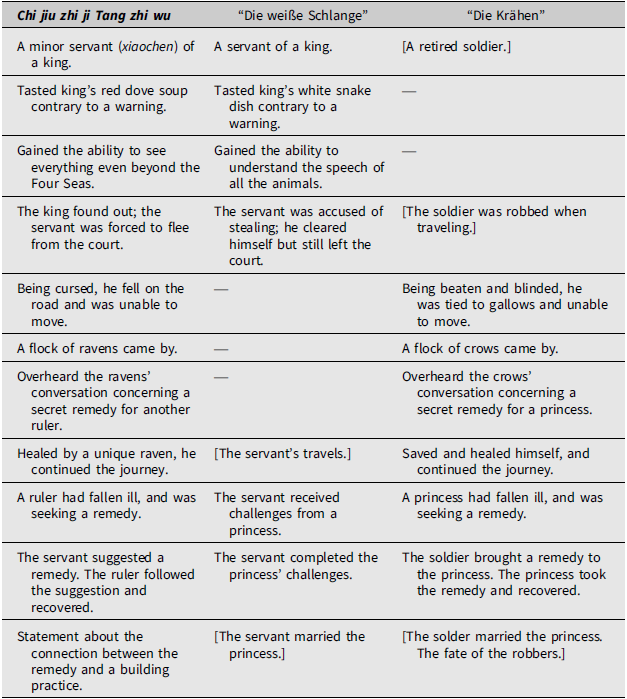
The similarities between these two recorded European folktales and Chi jiu, an untransmitted early Chinese story, are remarkable. Yi Yin also tasted a dish made of unusual animals, overheard the chatting of animals (also ravens), and relieved a noble from illness using what he had overheard. An elaborated comparison between all three texts, with Chi jiu as the basis for comparison is found in Table 1.
Comparison of Chi jiu zhi ji Tang zhi wu with two Grimm tales

Judging from the comparison, Chi jiu’s entire narrative structure is conspicuously in parallel with different sections of the two German folktales, almost like a combination of both. Furthermore, all three protagonists used a combination of luck and wit to solve the problems they were facing. The most notable narrative difference between Chi jiu and the two folktales is that it does not end with a typical “happy ending,” (although the reader would presumably be aware that Yi Yin will eventually become a well-known figure of great importance), but instead abruptly cuts to an explanation of a ritual practice.Footnote 51
Both “The White Snake” and “The Crows” share their motifs and narrative elements with broader European folkloric traditions. “The White Snake” was classified in the ATU Tale Type Index as ATU 673, “someone comes to know the language of animals through the help of/eating a snake/salmon,” a folktale type well-known in Europe and the Middle East, which exists in numerous cultural traditions.Footnote 52 For “The Crows,” its central plot of “blind man overhears secret remedy under tree or gallows and recovers his sight” is of ATU 613, also very common among European folktales.Footnote 53 Additionally, the motif of “overhearing a secret remedy from the conversation of animals or witches,” cataloged as N452 in the Thompson Motif Index, is a widespread motif that appears in folktales from Europe to Africa to Japan, and even in Miao 苗 folklore.Footnote 54 Chi jiu, unlike the two tales, is a unique, isolated case, and does not have any parallels within the early Chinese literary tradition. The two tales are also well transmitted in German and other European traditions, while the Chi jiu story was not transmitted in the Chinese tradition.
The two Grimm tales and Chi jiu may all be variants developed from shared themes and motifs, and the Chi jiu story might be the earliest known variant of the ATU 673 and N452 tale-types, an important discovery for folklore studies.Footnote 55 It is worth noting that since Chu manuscripts and Grimms’ Tales originated in entirely different cultures and periods and are concerned with different stock figures, it would be implausible for a direct cross-cultural influence to have taken place. It is more probable that narrative and plot commonalities could develop in separate cultures, and certain tale-types might be more ancient and internationally common than we thought, rather than limited to European and Near Eastern storytelling traditions. The study of the “Chinese Cinderella” tale offers a similar example, a discovery that also expanded the geographical and cultural scope of a particular tale-type.Footnote 56
In general, cross-cultural comparison can offer clues to how the motifs might best be understood within the overall context of the stories. For instance, the overall parallel of the plot across the three tales further suggests that Yi Yin very likely proposed the remedy out of his own volition, rather than being possessed by the Wu-raven. The importance and the power of the red dove soup within the plot is further emphasized as well. This new interpretation of the Chi jiu narrative would serve as an essential context for the following examination of the power of the red dove soup and how it is described in the text.
Red Dove Soup and “Beyond the Four Seas”
As demonstrated above, the adoption of the 釋 (*lhak > shi, “clear”) reading allows us to put forth an entirely different interpretation of the text, as well as finding valuable tale-type parallels across different cultures. Most importantly, we are able to better link Yi Yin’s understanding of raven speech back to the initial consuming of the red dove soup that puts the whole story into motion in the first place.
All ATU 673 tales feature the protagonist gaining an extraordinary ability to understand animal speech through consuming an unusual dish, usually made of snakes. In Chi jiu, Yi Yin consumed the unusual red dove soup and seemingly had no problem understanding the conversation of the ravens. The text is explicit in ascribing miraculous power to the red dove soup. Both Ren Huang and Yi Yin attained clairvoyance after consuming the soup: “there was nothing [s/he] could not see [even] beyond the Four Seas” 四海之外無不見也. While the text does not directly elaborate on what this “nothing he could not see” would do for Yi Yin, in terms of the sequence of the storyline, it was after tasting the soup that Yi Yin gained the ability to understand the communication between the ravens.
Among its various supernatural features, Chi jiu puts the red dove soup at the center of the narrative. It was the very source of the dynamic driving the entire plot; most of the events in the story happened due to Yi Yin’s cooking and tasting of the soup. Tang initially procured the ingredients for the soup, and the soup was cooked for Tang to consume. Since even Yi Yin, then a minor servant, could also receive powers from the soup, we can safely hypothesize that if Tang had tasted the soup as planned, he would also have obtained the power of seeing all. Tang, whether as a historical or literary figure, was renowned as a wise ruler and the founder of a dynasty. He would have become a ruler with all-seeing power if he had consumed the soup.
On the other hand, the notion of “a wise ruler with all-seeing power” is a prevalent portrayal of an ideal ruler in transmitted early Chinese texts. For example, the Shi ji describes Shun, the sage king of antiquity, as someone who “opened the four gates, illuminating and opening up eyes and ears to the four [cardinal] directions” 闢四門,明通四方耳目 when on the throne.Footnote 57 Qianfu lun 潛夫論 and Shuo yuan 說苑 employed a similar expression to describe Yao’s 堯 or Shun’s actions: “opening the four gates, illuminating the four eyes, reaching the four ears” 闢四門,明四目,達四聰.Footnote 58 Besides the descriptions that focus on sifang 四方 (Four [cardinal] Directions), several texts have another expression using tianxia 天下, “knowing all-under-heaven without going out the door” 不出戶知天下.Footnote 59 In these cases, the ability of “all-seeing” is generally equivalent to “all-knowing,” and sometimes includes the sense of “all-hearing” as well. The ability to perceive a considerable amount of external information about the realm through sensory input, no matter whether seeing or hearing, is considered an essential characteristic of ideal rulership.
Besides transmitted texts, excavated texts talk about an all-knowing power as well. Another Chu manuscript in the Tsinghua collection, titled by editors as *Zhi zheng zhi dao 治政之道 (The Way of Governing), has a sentence describing Huang Di 黃帝—the mythical ruler of high antiquity and usual stand-in for the deified ruler—as a monarch with extraordinary all-knowing power:
夫昔之(言)曰:「昔黃帝方四面。」夫豈面是謂,四佐是謂。黃帝不出門檐,以知四海之外。Footnote 60
The ancient saying goes: “In the past, Huang Di had four faces.”Footnote 61 How can this refer to faces? It refers to four aides [assistants/ministers]. Huang Di did not go outside the door awnings, and [yet he] knew [what happened] beyond the Four Seas.
Here, when portraying the omniscience of Huang Di, *Zhi zheng zhi dao uses the phrase si hai zhi wai 四海之外, “beyond the Four Seas.” The same expression can also be seen in the Li ji 禮記, where the ruler “illuminates” (ming 明) the Four Seas:
天子者,與天地參。故德配天地,兼利萬物,與日月并明,明照四海而不遺微小。Footnote 62
The Son of Heaven is comparable to Heaven and Earth. Hence, his power matches Heaven and Earth, his benefits extend impartially to a myriad of things, he is as bright as the sun and moon, brightly illuminating the Four Seas and without leaving out even the smallest of things.
Likewise, Han Feizi also connects an ideal, omniscient ruler with the concept of “Four Seas,” just replacing “beyond” with “within”:
故身在深宫之中,而明照四海之内,而天下弗能蔽、弗能欺者,何也?Footnote 63
Hence, though his body is confined in the innermost court, he still brightly illuminates everything within the Four Seas, and nobody under Heaven could delude or deceive him; why is that?
Continuing along these lines, Chi jiu’s description of the dove soup’s effects becomes particularly interesting:
Xiaochen handed the soup to Ren Huang from below the hall. Ren Huang received it from Xiaochen and tasted it. She was brightened; there was nothing she could not see even beyond the Four Wildernesses.
Xiaochen received the leftover and tasted it. He was also brightened; there was nothing he could not see even beyond the Four Seas.
Both Chi jiu and *Zhi zheng zhi dao use the identical phrase “beyond the Four Seas” to describe the all-seeingness (Chi jiu adds a parallel phrase si huang zhi wai 四荒之外 “beyond the Four Wildernesses” as well). Chi jiu’s word choice for describing how one’s omniscience covers the realm within or beyond the Four Seas is also close to other transmitted sources. Chi jiu uses zhaoran 昭然 “brightened,” while transmitted texts has ming 明; both zhao and ming refer to “bright” or “radiant” in early Chinese.
“Four Seas,” “within the Four Seas,” and “beyond the Four Seas” are undoubtedly established figures of speech referring to the omniscient power of an ideal ruler. Furthermore, we have two Chu manuscripts from the same collection, use the exact stock phrase to describe nearly the same extraordinary power of all-seeing/all-knowing. The usage of this common phrase is difficult to overlook, especially as specific political rhetoric about an ideal ruler. The “beyond the Four Seas” in Chi jiu plausibly shares the same connotation as in *Zhi zheng zhi dao and belongs to the broader tradition of portraying an all-seeing power in other early Chinese sources.
We can assume that “beyond the Four Seas” is an exceptional phrase in early Chinese texts, usually used only in political contexts, that employs a spatial notion of how kingly power would project to the corners of the realm to describe the power of an ideal monarch—an extraordinary omniscience. Chi jiu’s usage of “beyond the Four Seas” could also mean “all-knowingness,” instead of merely “all-seeingness.” If so, it could explain the question of why Yi Yin was able to understand the raven’s speech after tasting the soup: If the soup’s effect were not only all-seeing but also all-knowing, Yi Yin would have gained the extraordinary power to know the language of the animals as well. Besides, the dove soup was initially destined for Tang, who ought to have an all-knowing power as an ideal ruler. It is possible to understand “beyond the Four Seas” as “kingly all-knowingness” in Chi jiu’s context as well. Together with the framing of the three-text compilation, the red dove soup becomes a symbol of kingly power.
A Different Yi Yin
Establishing “beyond the Four Seas” as a phrase for expressing the all-knowing power of an ideal ruler leads to an interesting reflection. Chi jiu uses the phrase to illustrate Yi Yin’s power, but Yi Yin was not a ruler; he was a founding minister. No matter what an extraordinary figure he might have been, he cannot serve as a stand-in for an ideal ruler. Then did Chi jiu employ “beyond the Four Seas” out of its original, regal context? This is also unlikely, as the text opens with how the red doves gathered at Tang’s place and how Tang ordered the soup to be made. The narrative suggested that the red dove soup, the supernatural object that could bring the all-knowing power to whoever tasted it, was initially destined for Tang’s consumption.
However, rather than Tang enjoying the soup alone, the plot turns to Ren Huang’s intervention, which caused the power of the red dove soup—the power reserved to an ideal ruler—to fall to Yi Yin, a founding minister, and also to Ren Huang, the wife of a founding king, owing to their consumption of the soup. Here, the narrative suggests that a future minister had now been given the kingly power of knowing every corner of the world as well.Footnote 64 The text then describes Tang’s reaction as visibly furious; he wanted to punish or kill Yi Yin no matter how far away he fled, for he had, as a minor household servant, dared to take a share of Tang’s kingly power.
The story does have a good ending. In the other two texts of the same manuscript and following Chi jiu, Yi Yin would eventually assist Tang in fulfilling his destiny and establishing a new dynasty; he would himself become a founding minister and serve under the wise king Tang. Nevertheless, the presence of the kingly power of Yi Yin is still an intended aspect of the whole three-text manuscript. Chi jiu, the first and the longest text in the manuscript, explains why a minor kitchen servant could turn into a great founding minister: He tasted the soup and thus obtained an extraordinary power. The following *Yin zhi then portrays the achievements of Yi Yin, stressing his role in the rise of Shang power. Finally, Yi Yin eventually became a great minister for Shang in *Yin gao, in which he instructed Tang to reflect on history and become a worthy ruler.
The three Yi Yin texts constitute an overarching story arc about Yi Yin’s rise to power, and eventually he became the founding minister of Shang at the end of the narrative. The theme of “founding minister” who helped the first kings establish their rule was relatively popular in the Warring States period, particularly when the shi 士 class gained in power, enjoying much better employment opportunities in the various regional states, and advocated for meritocracy.Footnote 65 In stories celebrating the principle of meritocracy, the ministers are often described as having “unique talents,” but living in obscurity or poverty before meeting their ruler. The wise ruler recognizes their ability and raises them out of low status, and the ministers then aid the ruler to found a new dynasty. Such a theme is repeated in the stories about the founding of the Shang and Zhou dynasties and the character of the founding ministers; the conventional Yi Yin stories are part of this tradition as well.Footnote 66 Accordingly, the theme of the founding minister often expresses both the integrity of the founding minister and the insight of the first king—the minister must be a good minister, just as the king must be an ideal king. The conventional Yi Yin stories express a similar idea: Yi Yin was initially a minor servant or cook, then Tang promoted Yi Yin from low status, and Yi Yin helped Tang as a minister in return.Footnote 67 These stories praise the virtue and ability of both Yi Yin and Tang, both the minister and the ruler, and how each could serve as a helping hand to the other.
Compared to this conventional theme, the narrative of Chi jiu and the overarching narrative of the entire manuscript employs a very different configuration of Yi Yin. The three Yi Yin texts indeed deal with how Yi Yin rose from the position of a minor cook to a worthy minister, employing common elements from the “founding minister” theme. However, instead of covering the virtue of the king, they aim to explain why the minister is extraordinary. *Yin zhi and *Yin gao are texts that stress the importance of Yi Yin in the founding of Shang, portraying how his espionage helped Tang’s campaign. Chi jiu, in particular, becomes a potent demonstration of Yi Yin’s extraordinariness and worthiness, at the expense of Tang and Tang’s soup.
In Chi jiu, Tang did not appoint Yi Yin—then still a minor servant—as a minister, which would display Tang’s virtue in recognizing talents. It was Yi Yin himself who consumed the soup in Tang’s absence, as a forced accomplice to Ren Huang. Although this very act landed Yi Yin in trouble—being pursued by an angry king and nearly being eaten alive—he was lucky enough to be saved by another bird with supernatural power, and further took the chance to raise his worthiness in the eyes of another ruler, the Xia lord. The actual king, Tang, not only had his role downplayed but also could not monopolize his kingly power anymore, as it had already been shared by Yi Yin and Ren Huang.
The three-text manuscript, overall, becomes not only three related stories sequenced in chronological order, but a narration about Yi Yin’s personal rise as a worthy minister. His ministerial power did not come in the form of royal patronage or authorization. Rather, it was from an illicit taste of a culinary source of the royal power, a supernatural helping hand, and by turning an unfavorable situation to a favorable one in Chi jiu; and also, by working his way back to Tang’s court and eventually becoming Tang’s ally in *Yin zhi and *Yin gao. The supernatural forces present in the full arc of the story, which always worked in Yi Yin’s favor, also created a sense of fate, that Yi Yin was destined to rise higher. At this point, the manuscript departs significantly from the traditional narrative about Yi Yin the worthy minister.
Minister at the Expense of the Ruler
There are two possible reasons for why the three-text manuscript’s narrative differs greatly from the tradition Yi Yin narrative. For one, there existed a new conception regarding the status of ministers developed in Warring State China, that is, they were political actors independent of the sovereign, rather than merely servants.Footnote 68 Thanks to the employment market that spread across the numerous regional courts, officeholders and retainers working for one court could move to another one when opportunity arises, or when the situation becomes dire. Literary and philosophical works produced in this time period often advocate such mobility and praise the independent status of shi ministers. Mengzi 孟子, in particular, often employs Yi Yin as an example of such a political actor, and even hails Yi Yin’s independence from both Tang’s court and Jie’s court in the form of moving between the two courts: “Yi Yin was the one who approached Tang five times and approached Jie five times” 五就湯,五就桀者,伊尹也.Footnote 69 Similarly, the three-text manuscript produced an overarching plotline in which Yi Yin acted independently between Tang and Jie. In this narrative, Yi Yin the minor servant was driven out from the Tang’s court due to misconduct yet leveraged the situation to gain the trust of Jie, an adversary of his former master. He then returned to Tang with information gathered at Jie’s court, helped Tang’s cause, and again earned a respected position in Tang’s court. In short, “founding minister” and “defecting minister” are the two sides of the same coin, two reflections of the same “independent minister” ideology. The original compiler presumably repurposed Chi jiu within this particular pro-ministerial context.
A second, and related, possibility is that the three-text manuscript also aligns with an existing but unconventional narrative, Yi Yin the minister-usurper. This narrative exists in both transmitted literature such as Shi ji, Mengzi (which is employed in conjunction with Yi Yin the independent minister) and manuscript texts such as the Bamboo Annals 竹書紀年. According to these sources, after Tang passed away, Yi Yin once acted as a regent for Tang’s unenlightened grandson and successor, Tai Jia 太甲. Unlike similar regent figures such as Shun or the Duke of Zhou 周公 (fl. eleventh century bce) who hold the supreme administrative power while still respect their kings, Yi Yin banished Tai Jia from the court for three or seven years on the grounds of incompetence. Only when Tai Jia fully repented and redeemed himself did Yi Yin welcome him back.Footnote 70 In the Bamboo Annals’ version of the story, Yi Yin even directly usurped the throne and claimed it for himself until a returning Tai Jia murdered him. Whether Yi Yin directly usurped the throne or not, the narrative implies that Yi Yin’s extraordinary ability and rulership was on par with that of wise rulers, and he was more of a ruler than a minister in both versions. In this narrative, Yi Yin was not merely a minister for Shang, but someone with a more profound status. Whether this minister-usurper narrative reflected historical truth about early Shang politics or was just a political fable produced by proponents of ministerial power in the Warring States period is still a matter of debate, though some accounts do suggest that Yi Yin was closely related to the Shang royal house.Footnote 71 Chi jiu’s narrative about Yi Yin receiving kingly power possibly reflects such an unconventional tradition, which could also connect back to the portrayal of Yi Yin as an independent minister within the three-text context via emphasizing Yi Yin’s powerful status.
In either case, the manuscript could only construct this unique plotline about Yi Yin’s rise through compilation efforts. Without *Yin zhi and *Yin gao, Chi jiu remains a historiola in function; without Chi jiu, *Yin zhi and *Yin gao are still two Shang shu-style texts that seem to follow the conventional Yi Yin narrative. After compiling the three texts into one manuscript, the texts gained new layers of interpretative possibility within the new chronological-sequential structure. *Yin zhi and *Yin gao frame the figure of Yi Yin in Chi jiu as an extraordinary minister-to-be; Chi jiu, in turn, mythologizes what makes Yi Yin a wise minister, offers a mythical foundation for the plot, and refutes the conventional narrative that Yi Yin’s power came from royal patronage. The three-text Yi Yin manuscript also demonstrates the importance of compilation in the textual production process; the manuscript only went through the most basic compilation practices—the compiler had no interest in editing the historiola parts of Chi jiu—yet the compilation nonetheless inscribes the individual texts with new meanings in an overarching plot.
Overall, the three-text manuscript generates a unique story arc about Yi Yin, glorifies Yi Yin with a mythical explanation of his rise, and describes him as bestowed with kingly powers, while overshadowing Tang’s role. Yi Yin is now an extraordinary minister with independent agency and could be on par with the famous sage king. The manuscript is also a compiling enterprise, recontextualizing the supernatural elements of Chi jiu into the historical narrative about Yi Yin and creating a unique political narrative regarding the founding of Shang, in which Yi Yin’s extraordinariness, instead of Tang’s virtue, took the central role. We may also speculate that the compiler of the three texts belonged to the shi class, whose members had an interest in foregrounding the roles ministers played and in promoting their importance.Footnote 72
Conclusion
Scholars working on Chi jiu commonly agree that no explicit political or philosophical messages are expressed in the text. Chinese scholars also generally assume that the text could be an early example of xiaoshuo 小説.Footnote 73 Xiaoshuo in early China usually means “small tales,” a lesser form of narrative literature used to express ideas “smaller” than a refined discourse; it also connects with yeshi (野史, literally “folk history”), or a story different from the official historical records. Chi jiu mostly matches these two definitions, although xiaoshuo is not an entirely meaningful category that can be defined well enough for early Chinese literature, due to the lack of existing xiaoshuo examples. The text clearly concludes with an explanation of why people put parapets on the house, which also makes it a “historiola.”Footnote 74 The comparison between Chi jiu and two of the Grimms’ Tales also suggests the story might represent one of the earliest developments in the folkloric traditions.
On the other hand, the Chi jiu text was bound together with two other archaic, Shang shu-style texts. The three texts were even further connected by their contents, producing a story arc about Yi Yin and the founding of Shang with proper chronological, sequential, and historical sequences. Chi jiu might have been a historiola initially, while the compiler of the manuscript probably viewed Chi jiu as of historical or political value, or at least as a text providing necessary historical and narrative background for the other two texts in the same manuscript. The three-text manuscript, overall, serves as an example of constructing a new narrative plotline though the use of existing materials. In light of this, we might also contextualize Chi jiu and the manuscript within the textual production practices of early China.
Furthermore, the manuscript brings forth a unique political narrative of Yi Yin as a founding minister by portraying Yi Yin as having kingly all-knowing power. As a newly discovered manuscript that contains traces of an alternative narrative that was not transmitted, Chi jiu also shows that excavated manuscripts as such can make our understanding of early China more complete by showing what was lost in the selective transmission process. In this case, what was lost is an alternative narrative about the minister-monarch relationship, in which the minister’s importance outweighs the king’s. This political interpretation may also shed new light on our understanding of the flexibility of historical figures and motifs, as well as the making of cultural memory regarding ministers in early China.
 , known as “reversed shan” 倒山 graph. Guo Yongbing 郭永秉 reads the graph as fu 覆 “cover up,” a reading followed by most of the scholars; see Guo Yongbing, “Shi Qinghua jian zhong daoshanxing de ‘fu’ zi” 釋清華簡中倒山形的“覆”字, in Guwenzi yu guwenxian lunji xubian 古文字與古文獻論集續編 (Shanghai: Shanghai guji, 2015), 262–72.