INTRODUCTION
In the United States, nearly 50,000 children die annually while 500,000 others cope with life-threatening conditions. (Himelstein et al., Reference Himelstein and Hilden2004). The American Academy of Pediatrics (AAP) has outlined principles of palliative care that should be addressed when caring for children with life threatening and terminal conditions. These principles include: respect for the dignity of patients and families, access to competent and compassionate palliative care, support for the caregivers, improved professional and social support for palliative care, and continued improvement of pediatric palliative care through research and education. The AAP also highlights the importance of respect and empathy while maintaining meaningful communication with pediatric patients and their families (AAP, 2000).
Communication is a key element for implementing effective palliative care. For example, early discussions surrounding advanced directives in order to avoid futile and burdensome treatments may be comforting to patients and their parents. Meyer et al. (Reference Meyer and Ritholz2006) found that parents' confidence and trust in care was diminished when there was poorly coordinated communication among health care professionals, while others have found that parents were more satisfied when physicians were honest, available, and showed empathy during discussions about death and dying (Meert et al., Reference Meert and Eggly2008).
Communication with children requires familiarity with their normal emotional and spiritual development (Himelstein et al., Reference Himelstein and Hilden2004). Although the AAP stresses the importance of education in palliative care, there are limited resources for education. On the other hand, most pediatricians deal with an average of less than three dying patients per year, and therefore, have little opportunity to gain significant experience (Yazdani et al., Reference Yazdani and Evan2010).
Bagatell et al. (Reference Bagatell and Meyer2002) demonstrated that pediatric residents who completed a pediatric palliative care seminar series, were significantly more comfortable handling logistic issues regarding death and more comfortable with symptom management, discussing death and limitation of medical care with families, discussing end-of-life care with colleagues and families, as well as guiding developmentally appropriate discussions of death.
Different disciplines within a health care team each appear to take on a different role discussing death and dying with families. Sulmasy et al. (Reference Sulmasy and He2008) found attendings and house staff to be more reluctant to discuss Do Not Resuscitate (DNR) orders than medical procedures. They also found that nurses were least likely to talk to patients about DNR, and more likely than others to view resuscitation discussions as a more rewarding assignment.
Many hospitals have implemented palliative care consultants or consultation teams to facilitate this communication barrier. Pierucci et al. (Reference Pierucci, Kirby and Leuthner2001) found that after implementing a palliative care consultation service, patients had less invasive procedures done while support services such as chaplains and social workers were consulted earlier. With the initiation of a palliative care consultation team, there were more discussions about withdrawing and withholding support. Pierucci's study highlights the importance of a consultation service facilitating better communication about death and dying.
The current study was conducted to better understand communication among health care professionals regarding death and dying in children. We hypothesized that hospital staff (physicians of all disciplines, nurses, and psychosocial clinicians) that felt more comfortable consulting colleagues regarding issues related to death and dying would also be more likely to feel comfortable communicating about death and dying in children. Our second hypothesis was that hospital staff with some previous formal end-of-life training would be more comfortable communicating about this subject in children. Our third hypothesis is that different disciplines of health care providers will demonstrate different comfort levels in diverse areas of communication about death and dying in pediatrics.
MATERIALS AND METHODS
The current study was part of the needs-assessment component of a larger initiative to develop a Children's Comfort Care Program at Mattel's Children's Hospital, UCLA. The study sample included physicians from different pediatric subspecialties, psychosocial clinicians (child life specialists, social workers, spiritual care providers, and psychologists), and nurses working at Mattel Children's Hospital UCLA. Institutional review board approval was obtained. Survey administrators read scripts describing the purpose of the research to participants. Informed consent was obtained. Surveys were completed voluntarily and then deposited into a box in the UCLA Children's Comfort Care Program office.
The surveys varied slightly for each discipline, but included a standard subset of questions that were asked across all three categories of disciplines. Physician surveys consisted of 24 items, nursing surveys included 27 items, and surveys geared for psychosocial clinicians consisted of 56 items. Examples of common items questioned across disciplines are shown in Figure 1. A Spearman's correlation was implemented to evaluate if hospital staff that utilize consultation services or practices are more likely to feel comfortable in discussing death and dying in pediatrics. A Multivariate Analysis of Variance (MANOVA) and Analysis of Variance (ANOVA) were used to determine whether training had a role in the comfort level of communication and if there were differences among the health care professionals' comfort level in different areas of communication about death and dying.
Common item questions.

RESULTS
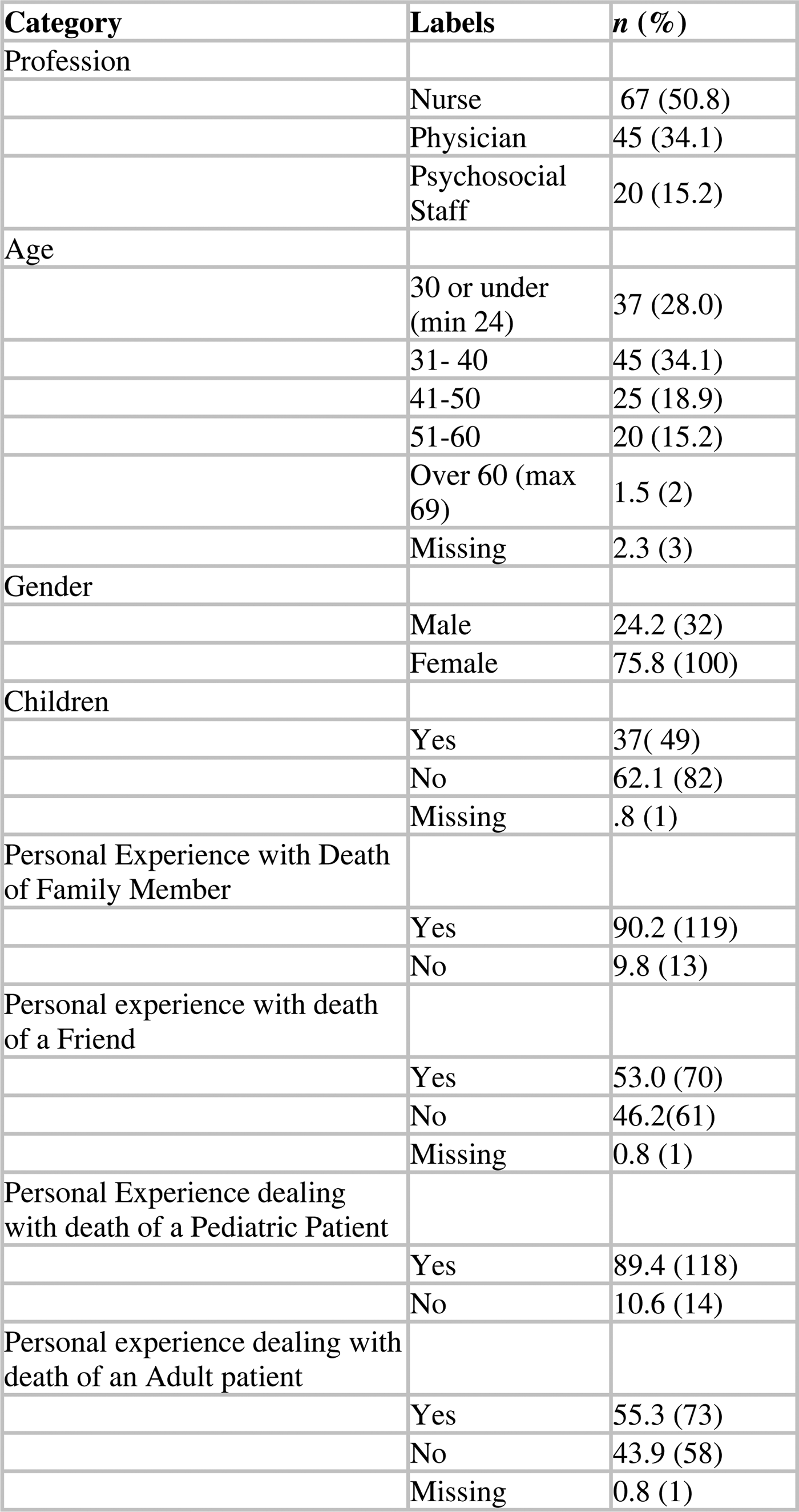
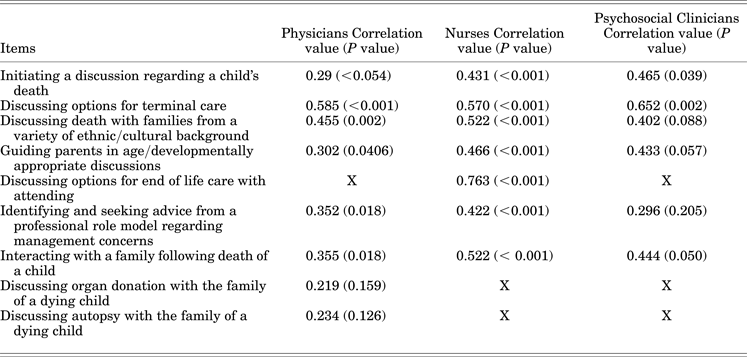
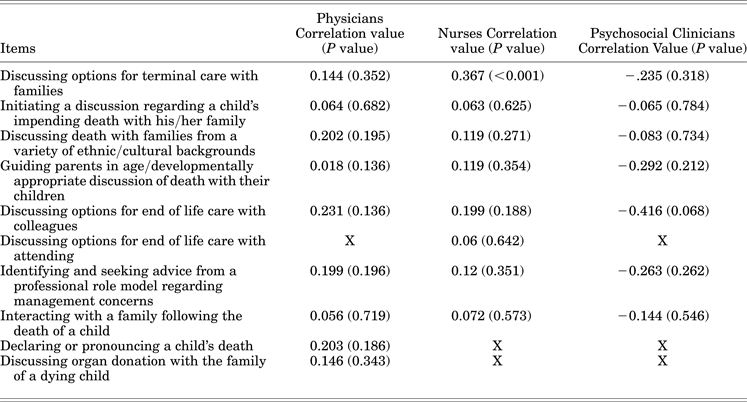
Demographics: 133 surveys were completed. A total of 67 nurses, 45 physicians, and 20 psychosocial clinicians completed the surveys. Participants' age ranged between 31 and 45 years. There were 32 males and 100 females (24% and 75%). Nearly 90 percent of the participants expressed that they had a personal experience with death of a family member, and 53% had a personal experience with death of a friend. See Figure 2 for a complete demographic description of the sample. Tables 1 and 2 describe the correlations among nurses, physicians, and psychosocial clinicians.
Demographics.
Hospital staffs that were more likely to discuss options for end of life care with colleagues felt more comfortable (X = item not asked)
Hospital staff asking for palliative consultation was also more likely to: (X = item not asked)
Training and Comfort level: There were no significant differences among comfort training items. Staff that received formal grief and bereavement training was not more comfortable discussing death and dying.
Different Disciplines
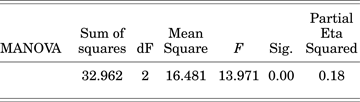
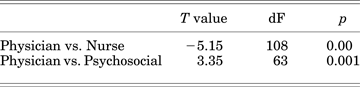
Among all different disciplines, physicians were more comfortable than other staff in discussing a child's impending death (F = 13.07, p < 0.05). Comfort level initiating discussions regarding child's impending death. Scale 1–5: 1= least comfortable and 5 = most comfortable (Means):

DISCUSSION
In our study, the tendency of the staff to request consultation and support from their colleagues directly correlated with their comfort level in discussing death and dying with a child's family. Our findings emphasize the importance of communication among colleagues. A study conducted by Dhillon et al. (2008) emphasizes that having a consultation team and dedicated unit for palliative care, provides better medical care. Having a consultation service may facilitate the discussion of issues regarding death and dying such as symptom management, comfort measures, and patient discharge-planning. Furthermore, Pierucci et al. (Reference Pierucci, Kirby and Leuthner2001) found that offering palliative care consultants provides more supportive services and less invasive medical procedures. Results of our survey study further support that offering consultation services could enhance communication among disciplines and provide more comfort to healthcare providers. Although enhanced communication and increased comfort may lead to increased patient and parent satisfaction, this cannot be directly concluded from our results. In Meyer et al.'s (Reference Meyer and Ritholz2006) study, parents identified six priorities for end-of-life care and communication that included: honest and complete information, ready access to staff, communication and care coordination, emotional expression and support by staff, preservation of the integrity of the parent-child relationship and faith. Communication with children requires familiarity with their normal emotional and spiritual development (Himelstein et al., Reference Himelstein and Hilden2004). In a similar study, both parents and children afflicted with an advanced disease identified the following as the most important elements in their communication with the health care workers: relationship building, demonstration of effort and competence, information exchange, availability, and appropriate level of child, and parent involvement (Hsiao et al., Reference Hsiao and Evan2007).
As for our second hypothesis that different disciplines will have different comfort levels in diverse areas of communication with death and dying, we found that physicians were more comfortable in initiating discussions regarding a child's impending death compared to other staff. This is important because often times initiation of discussions are delayed and should be implemented earlier in the care of the patients. Future studies could examine the timing in which each discipline introduces the topic of death and dying and evaluate if staff that are more comfortable are more likely to introduce the topic earlier.
The literature has shown that training is useful and can be implemented in a variety of ways. Furthermore, the amount of years that one has practiced medicine can impact their comfort level and therefore can be considered training. However, in our questionnaire, we only asked about formal palliative care training and did not have the participants elaborate more on the length of their experience. Training can be at the bedside, formal lectures, seminars, or simply talking with colleagues. However, training, either formal or informal, has a positive impact on the staffs' comfort in discussing death and dying. Bagatell et al. (Reference Bagatell and Meyer2002) implemented a small group session seminar at the University of Arizona and found that residents were more comfortable discussing death and end-of-life care with colleagues and families after participating in the seminar. Training can be implemented in a formal venue such as a seminar, lectures, or also on the job. Future evaluation would require inquiry regarding specific elements of training (e.g., lectures, forums, conferences) to further explore this hypothesis. From this information, we would then examine the most effective educational strategies that facilitate communication.
Although the current study has provided us with some evidence of the importance of consultation and communication regarding death and dying, there were some limitations. Specifically, there was a selection bias where participants had the option to participate and thus, they were more likely to be interested in this topic. Survey results that are self-reported, such as in the current study can create a recall bias and may affect how one perceives their comfort level regarding past experiences. Including the parents' perspective could be a valuable addition as another informant on how communication takes place and whether they are satisfied with their discussions with clinicians who rate themselves as more comfortable in discussing difficult issues. Another limitation of this study was the wording for “previous training.” The definition of previous training should have been more explicit and included information about years worked in the health care profession.
CONCLUSIONS
Our results demonstrate the importance of consultation and discussion regarding death and dying in pediatrics. Evaluating the parents' perspectives in order to examine the relationship between comfort and the actual effectiveness of communication would be an important topic to pursue. Furthermore, the study demonstrates the importance of all team members participating in these discussions and how one can learn from one another about this difficult topic. The current study raises awareness regarding the importance of physicians initiating discussions and whether in future studies one could determine if physicians that are more comfortable, are also more likely to discuss difficult topics earlier than those physicians that are not as comfortable with these difficult topics of communication. Another interesting question to pose to the staff would be how can we learn from each discipline and work as a team. Overall, the study did demonstrate that communication allows staff to be more comfortable addressing death and dying.