

Providers of initial teacher education (ITE) have a fundamental role to play in the production of a high-quality teaching workforce. This primary outcome of preservice teacher preparation is recognised internationally (Burn, Mutton, & Hagger, Reference Burn, Mutton, Hagger, Peters, Cowie and Menter2017) and in the Australian context, where the classroom readiness of graduate teachers has recently come under increased national scrutiny (Teacher Education Ministerial Advisory Group [TEMAG], 2014, p. viii). One vital feature of readiness for 21st century mainstream classrooms includes understanding teachers’ legislative responsibilities for the inclusion of students with special needs. In Australia, these obligations are made explicit in the Disability Standards for Education 2005 (Commonwealth of Australia, 2006). The provisions of this legislation effectively mean that classroom-ready graduate teachers must be equipped with practical skills for managing and responding to the learning needs of the diverse range of typical and exceptional learners who present in contemporary, mainstream classrooms (Bannister-Tyrrell et al., Reference Bannister-Tyrrell, Mavropoulou, Jones, Bailey, O’Donnell-Ostini and Dorji2018).
In this paper we report on a study of 18 preservice teachers from one regional Australian university and their experiences of learning how to teach in these complex environments during their practical placements. The emphasis on these school-based experiences is deliberate and important given the current government conceptualisations of ‘classroom readiness’ that underpin the accreditation of Australian ITE programs. The authors sought a deeper understanding of preservice teachers’ experiences of inclusive education practices and the ways in which these experiences affected their values, attitudes, and preparedness to teach in mainstream school settings that include students with special needs. Two related research questions were developed to facilitate these aims:
-
How do preservice teachers in undergraduate ITE courses at a regional Australian university describe their observations and experiences of working with students with special needs in mainstream class settings during their school placements?
-
How do these observations and experiences affect the perspectives that these preservice teachers hold in relation to inclusive education practices and their preparedness to teach in mainstream classes that include students with special needs?
A review of the literature reveals widespread agreement that the attitudes of classroom teachers are pivotal to the success of inclusive education (Arthur-Kelly, Sutherland, Lyons, Macfarlane, & Foreman, Reference Arthur-Kelly, Sutherland, Lyons, Macfarlane and Foreman2013; Bannister-Tyrrell et al., Reference Bannister-Tyrrell, Mavropoulou, Jones, Bailey, O’Donnell-Ostini and Dorji2018; Forlin, Loreman, Sharma, & Earle, Reference Forlin, Loreman, Sharma and Earle2009; Hemmings & Woodcock, Reference Hemmings and Woodcock2011; Peebles & Mendaglio, Reference Peebles and Mendaglio2014). Despite this acknowledgement, studies into graduate teachers’ perceptions of their readiness for teaching have shown that they feel apprehensive and ill-prepared for the demands of inclusive classrooms, especially when challenged with teaching students with exceptional needs (Hemmings & Woodcock, Reference Hemmings and Woodcock2011; Hoskin, Boyle, & Anderson, Reference Hoskin, Boyle and Anderson2015; Jobling & Moni, Reference Jobling and Moni2004; Peebles & Mendaglio, Reference Peebles and Mendaglio2014). Furthermore, these graduate teachers attribute blame for their lack of preparedness to inadequacies in the coursework and practical experiences afforded to them in their teacher education programs (Mergler, Carrington, Kimber, & Bland, Reference Mergler, Carrington, Kimber and Bland2016; Tangen & Beutel, Reference Tangen and Beutel2017; Varcoe & Boyle, Reference Varcoe and Boyle2014).
Practical teaching placements (commonly called ‘professional experience’ in Australia) comprise one component of ITE that is likely to expose preservice teachers to student diversity and inclusive practices (Hamman, Lechtenberger, Griffin-Shirley, & Zhou, Reference Hamman, Lechtenberger, Griffin-Shirley and Zhou2013). These placements (generally scheduled to occur at least once per year throughout an undergraduate teacher education program) can potentially satisfy preservice teachers’ demands for more time and experience in developing their knowledge, understanding, and skills for inclusive teaching (Hemmings & Woodcock, Reference Hemmings and Woodcock2011; Jobling & Moni, Reference Jobling and Moni2004). However, research into the practices that preservice teachers observe and are encouraged to implement when catering for students with exceptional needs in mainstream classroom settings is limited (Hamman et al., Reference Hamman, Lechtenberger, Griffin-Shirley and Zhou2013).
Policy for Inclusive Education in the Australian Context
Perhaps the most influential stimulus for the development of inclusive education policy, both internationally and in Australia, was The Salamanca Statement and Framework for Action on Special Needs Education (United Nations Educational, Scientific and Cultural Organization [UNESCO], 1994). The Salamanca Statement advocated for ‘Education for All, recognizing the necessity and urgency of providing education for children, youth and adults with special educational needs within the regular education system’ (UNESCO, 1994, p. viii).
As a signatory to the declaration, Australia’s commitment is made explicit in the overarching national framework for education policy, the Melbourne Declaration on Educational Goals for Young Australians (Ministerial Council on Education, Employment, Training and Youth Affairs, [MCEETYA], 2008). Developed in collaboration with ministers for education from all Australian states and territories, the Melbourne Declaration articulates goals for the design and implementation of an equitable education system that is free from discrimination for students of all backgrounds or abilities (MCEETYA, 2008). These goals established the groundwork for the development and implementation of two key policy documents that guide the practices of the nation’s teachers: the Australian Curriculum and the Australian Professional Standards for Teachers (MCEETYA, 2008).
The Australian Curriculum embraces inclusion principles by recognising the impact of diversity in a wide range of disparate forms on students’ learning outcomes and engagement in schooling (Australian Curriculum, Assessment and Reporting Authority [ACARA], 2019). With respect to students with disability or exceptional learning needs, the curriculum provides advice that ensures schools and teachers meet their obligations under the Disability Standards for Education 2005 (Commonwealth of Australia, 2006). This advice specifies the use of strategies for adapting, modifying, and personalising curriculum content and delivery to cater for the individual needs of these students and engaging them in age-appropriate learning along with their peers (ACARA, 2019). Consequently, the idea of ‘accepting, celebrating and accommodating students with diverse educational needs is at the heart of current Australian educational policy’ (Woodcock & Reupert, Reference Woodcock, Reupert, Garvis and Pendergast2016, p. 87).
The Australian Professional Standards for Teachers (The Standards) were published by the Australian Institute for Teaching and School Leadership (AITSL), a statutory body charged with responsibility for promoting excellence in teaching and school leadership across the nation (AITSL, 2011). The Standards ‘define the work of teachers and make explicit the elements of high-quality, effective teaching in 21st century schools’ (AITSL, 2011, p. 3). In relation to graduate teachers, The Standards describe benchmark practices that evidence their readiness for inclusive classrooms. Specifically, graduates must be conversant with their legislative and systemic responsibilities and be able to apply a broad range of practical strategies that are responsive to the learning needs of students across the full range of abilities (including students with disability; AITSL, 2011).
Preparation for Teaching in Inclusive Settings
Australia’s national policies and legislation for inclusive education inevitably influence the design and delivery of ITE curricula (Carrington et al., Reference Carrington, MacArthur, Kearney, Kimber, Mercer, Morton, Rutherford, Carrington and MacArthur2012). A common response to the policy landscape is an emphasis on the formation of positive attitudes towards inclusion in ITE coursework (Mergler et al., Reference Mergler, Carrington, Kimber and Bland2016). However, this emphasis neglects attention to practical strategies that effectively prepare graduates for the realities of teaching in inclusive classrooms (Hoskin et al., Reference Hoskin, Boyle and Anderson2015; Peebles & Mendaglio, Reference Peebles and Mendaglio2014). Gigante and Gilmore (Reference Gigante and Gilmore2018) claim that inclusive practice cannot be achieved simply through exposure to information about various disabilities or instructional strategies during an ITE program. They propose that effective learning for preservice teachers is characterised by meaningful contact with students with diverse learning needs and successful experiences in planning and implementing responsive curriculum for these students in real classroom settings (Gigante & Gilmore, Reference Gigante and Gilmore2018). Woodcock and Vialle (Reference Woodcock and Vialle2016) support this view, claiming that the practices modelled to preservice teachers, and their perceived success of these practices in supporting the inclusion of students with special needs, are salient factors in the formation of their identities as inclusive practitioners.
Key features of practical experiences that are conducive to shaping the positive attitudes and skills of preservice teachers for implementing inclusion can be identified in the literature. First, placements produce effective outcomes when supervising teachers model positive attitudes towards students with diverse needs and hold high aspirations for their learning (Woodcock & Reupert, Reference Woodcock, Reupert, Garvis and Pendergast2016). Second, preservice teachers’ skills are enhanced when their supervising teachers adopt an active pedagogical role in developing their understandings of student needs and inclusive practices (Hamman et al., Reference Hamman, Lechtenberger, Griffin-Shirley and Zhou2013). Third, positive attitudes, knowledge, and skill development are enriched when opportunities are created for preservice teachers to collaborate with special educators and paraprofessionals to support the engagement, learning, and wellbeing of students with special needs (Arthur-Kelly et al., Reference Arthur-Kelly, Sutherland, Lyons, Macfarlane and Foreman2013; Hemmings & Woodcock, Reference Hemmings and Woodcock2011). Arthur-Kelly et al. (Reference Arthur-Kelly, Sutherland, Lyons, Macfarlane and Foreman2013) suggest that the presence or absence of these features inevitably impacts the dispositions and preparedness for implementing inclusion that preservice teachers acquire while learning to teach in their placement classrooms. Hence, investigation into the practices that preservice teachers observe and are encouraged to adopt during structured professional experience placements is vital. This focus for inquiry potentially provides important insights for teacher educators and their endeavours for scaffolding the knowledge, understanding, and skills that graduates need to implement effective inclusion.
Methodology
Participants
In this study, the authors recruited preservice teachers from a regional Australian university to investigate their experiences of inclusive teaching practice and contact with students with diverse learning needs during their professional experience placements. These preservice teachers were enrolled in undergraduate teacher education courses with either a primary or secondary specialisation and were all full-time students completing their studies in face-to-face mode at their local regional campus. Potential participants for the research were identified based on submitting an expression of interest for involvement in a voluntary school-based work experience program that was supplementary to their set course structure and mandatory placement schedule.
The supplementary program was offered to preservice teachers as a partnership between the university and a large state school in the local area. The impetus for its development came from a staff survey conducted by the school’s administration team. The survey targeted beginning teachers on staff with the aim of determining their professional development and mentoring needs for the 2018 school year. The results showed that these recent graduates struggled with managing, planning, and implementing instruction in mainstream classes that included students with special needs. In addition to addressing these needs at the school level, the survey findings prompted the idea of developing a work experience program for preservice teachers with the goal of building their skills for inclusive education prior to graduation and subsequent employment. The program design involved the preservice teachers attending the school one day per week for a full school term to observe and work alongside experienced teachers with the aim of building their understandings of practical strategies for implementing inclusion. Importantly, these voluntary experiences were planned to take place without the performance pressures usually associated with formal, assessable placements. In addition to these mentoring experiences, the program included opportunities for the preservice teachers to attend a weekly meeting modelled on the idea of a community of practice (Wenger, Reference Wenger1998). It was envisaged that these meetings would provide opportunities for the preservice teachers to participate in collaborative professional learning activities where they could share their observations and clarify their knowledge and understandings of inclusive practices in discussion with their more experienced mentors.
Ethical clearance was obtained from the university’s human research ethics committee (approval no. 20956) to conduct semistructured interviews with prospective program participants. The purpose of these interviews was to collect information about the environments and practices commonly experienced by preservice teachers during their placements as input for planning the program activities. In all, 18 preservice teachers provided written consent to participate in these interviews. The sample included five male and 13 female preservice teachers from both primary (n = 11) and secondary (n = 7) ITE programs. Sixteen of the 18 interviewees had completed at least two placements in different mainstream schools and all participants had completed university-based coursework and assessment that developed their knowledge and understanding of legislation and the principles underpinning inclusive education.
Data Collection
Data collection for this study comprised semistructured interviews (Freebody, Reference Freebody2003). These interviews, conducted by the first author between August 2018 and March 2019, sought participants’ accounts of the practices they had observed and enacted during their professional experience placements to support the learning and participation of students with special needs. Participants responded to a series of core questions and were encouraged to elaborate on experiences that they felt influenced their teaching practices or understandings of inclusion throughout the interview. The interviews were audiotaped, and the data were transcribed verbatim to preserve the accuracy of the words that participants used to describe their experiences and perspectives (Liamputtong & Ezzy, Reference Liamputtong and Ezzy2005). Core questions that were asked of all participants included:
1. Please describe any contact you have had with students with special needs during your professional experience placements.
2. What did you and the teachers you observed typically do to ensure these students were included in the learning activities prepared for the class?
3. What guidance or assistance did you receive to effectively plan for and teach students across the full range of abilities, including students with special needs?
Data Analysis
Analysis of the interview data encompassed a two-stage process. To address the first research question, the interview transcripts were examined to identify the practices that preservice teachers described about working with students with special needs in mainstream classes during their placements. The inductive process of categorical analysis (Coffey & Atkinson, Reference Coffey and Atkinson1996) was applied to these data to group common practices.
Collaborative work was undertaken by the researchers to ensure that data interpretations were not biased (Brantlinger, Jimenez, Klingner, Pugach, & Richardson, Reference Brantlinger, Jimenez, Klingner, Pugach and Richardson2005). The analysis began with a process of reading and re-reading the transcribed interviews to become familiar with the data. The first author created draft codes that were applied to the data to describe the distinct practices and experiences that participants recounted. Pseudonyms were applied to all data items to protect participants’ anonymity and the initial codes were refined and adjusted through an iterative process until six distinct categories were identified, named, and described. Applying a process of iterative questioning of the data (Guba & Lincoln, Reference Guba, Lincoln, Denzin and Lincoln1994), the second author independently interrogated the analysis to ensure that the categories illustrated a credible account of all participants’ responses. Joint coding of the data produced an interrater reliability coefficient of .91. As a result, the definitions for some categories were adjusted to be inclusive of all coded data. For example, instances where preservice teachers described the removal of students with special needs from their lessons by supervising teachers were not initially categorised as ‘withdrawal’ practices. Following further discussion, agreement was reached that these practices effectively captured the concept of ‘withdrawal’ from the perspective of preservice teachers and the definition of this category was expanded to be inclusive of these perspectives. As a further measure to ensure the credibility of the analysis, the findings of this first analytic stage were shared with participants through a one-page summary of results and a face-to-face presentation in class tutorial time.
The second analytic stage involved working with the coded data to identify themes or patterns in the responses that addressed the second research question: how these experiences affected preservice teachers’ perspectives on the inclusion of students with special needs. Braun and Clarke (Reference Braun and Clarke2006) describe this approach as a ‘“contextualist” method’ (p. 81) that pays attention to the subjective meanings that individuals attach to their experience and the influence of social contexts and the characteristics of immediate settings on the formation of these meanings. This ‘interpretative work’ (Braun & Clarke, Reference Braun and Clarke2006, p. 84) was undertaken independently by the first and second author, and the results of the coding process were compared. Codes were refined and ideas for ‘candidate themes’ (Braun & Clarke, Reference Braun and Clarke2006, p. 90) were discussed collaboratively until four themes that described the interview data were named. These themes were (a) contact with students with special needs, (b) modelled practices, (c) expectations for student learning, and (d) responsibility for implementing inclusive practices.
Results
Observed and Enacted Teaching Practices
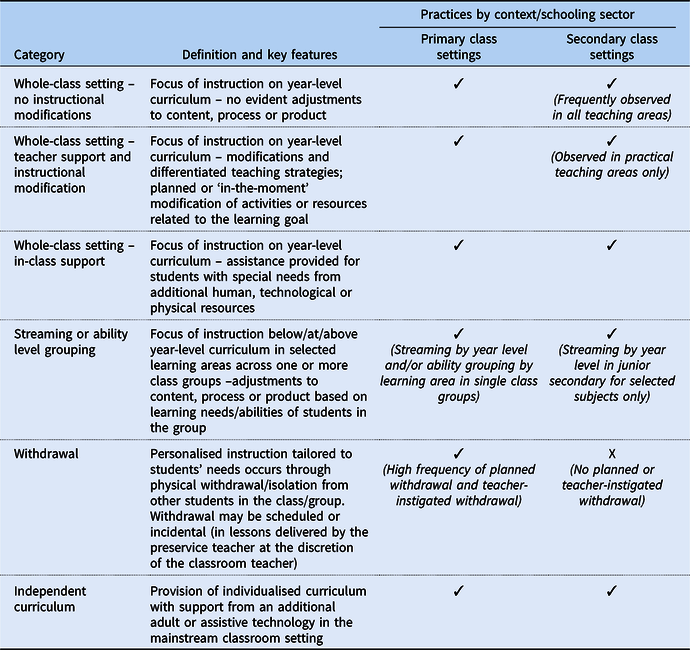
All participants described placements where their allocated classes included students with special needs, and their accounts of the practices observed in these contexts were grouped into six categories. These categories are displayed in Table 1 along with the detailed definitions that were used to code and organise the data and the occurrence of these practices in primary and secondary schooling contexts.
Modelled and Enacted Practices for Students With Special Needs in Mainstream Schools

The six categories can be separated broadly into two groups distinguished primarily by the curriculum or learning focus provided for students with special needs. Practices included in the three whole-class categories share the common characteristic of year-level curriculum delivery where students with special needs participated in content, instruction, and learning activities alongside their age-related peers. By contrast, practices grouped in the three remaining categories (streaming, withdrawal, and independent curriculum) were defined by approaches to catering for these students’ needs through the delivery of personalised curriculum that was not directly related to whole-class lesson objectives.
Interviewees described a range of teaching practices that distinguished the three different ‘whole-class’ categories. This range included practices that illustrated (a) little to no evidence of instructional modification, (b) differentiated instructional support provided by the class teacher, and (c) high levels of support provided by assistive technology or personnel other than the class teacher. One noted variation in the experiences described by preservice teachers in the secondary program was the general absence of whole-class practices where the class teacher took responsibility for planning and delivering modified instruction for students with special needs. The only exception to these observations occurred in the delivery of practical lessons in physical education, manual arts and home economics.
In the three categories that described personalised curriculum delivery, streaming or ability grouping was a practice observed in both primary and secondary school settings. These practices were experienced by preservice teachers in the secondary program (n = 7) exclusively to junior classes (Years 7–9), and only in core, rather than elective, subjects (e.g., English, mathematics, science, and humanities). Primary preservice teachers also described some instances of streaming or ability grouping at the year level in schools with multiple drafts of each class. These school-wide practices effectively created consistent groups of students of similar ability for instruction in all curriculum learning areas that defined the teaching and planning responsibilities of individual teachers. In addition to these practices, preservice teachers in primary settings described forms of streaming or ability grouping that occurred within single classes. These practices generally occurred in mathematics or literacy activities where the ‘low group’ comprised students with special needs or learning difficulties.
The scheduled withdrawal of students with special needs for learning outside the classroom setting was a practice frequently observed by preservice teachers in primary schools, though lacking in any description of practices experienced by preservice teachers in secondary settings. According to participants, withdrawal practices occurred as timetabled, planned support sessions conducted for students with special needs by specialist teachers or teacher aides. Apart from these instances, all participants described the regular occurrence of other practices that were classified in the withdrawal category. These practices separated students with special needs from the class group while preservice teachers were implementing instruction and were instigated by the classroom teachers who supervised participants’ placements.
The last category comprised independent curriculum practices, observed by preservice teachers in both primary and secondary school contexts. Participants described the organisation of zones (Chelsea) in the classroom where these practices were carried out and that effectively created a physical separation between the students and their peers and the classroom teacher. Practices in this category included the use of assistive technologies or the regular presence of another adult in the zone to support students with special needs that prohibited preservice teachers’ contact with them during their placements.
The Formation of Preservice Teachers’ Perspectives of Inclusive Education
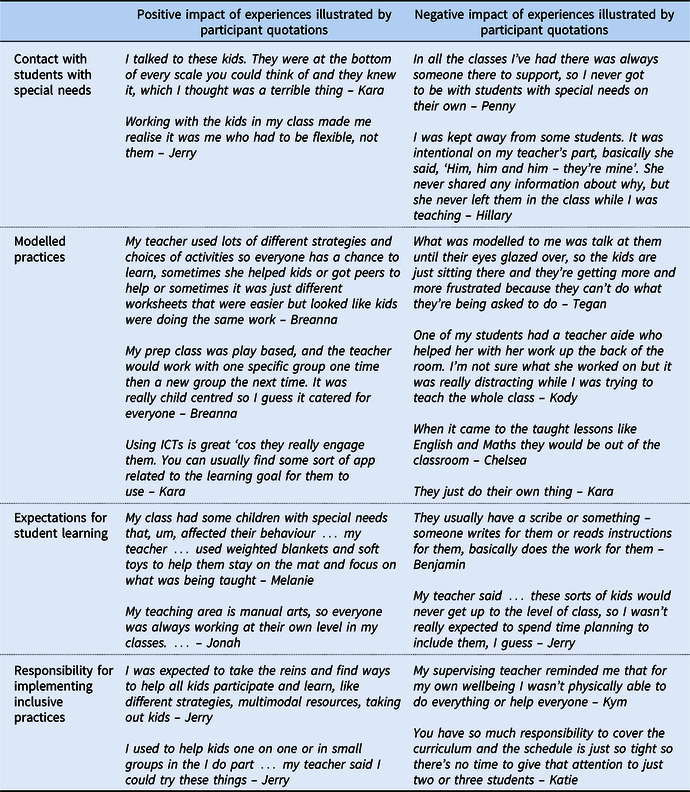
The second aim of this study was to understand the ways in which placement experiences shaped preservice teachers’ perspectives on the inclusion of students with special needs in mainstream classes. The four themes found in the data shed light on the potential positive and negative impacts of preservice teachers’ placement experiences and are illustrated with participant quotations in Table 2. The themes of contact and responsibility for implementing inclusive practices are closely related to the opportunities for skill acquisition afforded to preservice teachers during placements. Similarly, the themes of modelled practices and expectations for student learning are related to the impact of role models on preservice teachers’ attitude formation. The findings of the second stage of the analysis are presented according to these formative influences on the preparation of preservice teachers.
Effects of Placement Experiences on Perspectives Towards Inclusion

Opportunities for Skill Acquisition
Opportunities for preservice teachers to learn about inclusion and practise the skills for its successful implementation were affected by two main organisational features of their placements: the extent of meaningful contact with students with special needs and their allocated responsibilities for implementing inclusive practices with diverse learner groups. The presence or absence of these characteristics affected participants’ interpretation of their legislative responsibilities and their attitudes towards students with special needs.
Preservice teachers who assumed responsibility for meaningful instructional interactions with students with special needs expressed awareness of their responsibility for including these students in classroom activities and supporting their learning. For example, Jerry reflected on the need to adjust his practices to ensure his students with special needs were learning: ‘Working with these kids in my class made me realise it was me who had to be flexible, not them’. These interactions promoted recognition of students with special needs as ‘members of the class with a right to be there’ (Billy) and fostered preservice teachers’ genuine efforts to cater for their learning:
My approach was, let’s get them to do things they can do and then use that as a basis for building their learning because I want them to learn. (Gema)
Contact with students also influenced the expression of more holistic perspectives on the principles of inclusive education that accounted for students’ social and emotional needs, wellbeing and self-esteem. Kara suggested that bonding with students was an important starting point for her teaching, and Gema described the positive effects of her contact with students that changed the way she thought about them and their needs:
We’re giving them a number … reducing them back to where they are in terms of achievement, but that’s not who they are as people.
On the other hand, participants who completed placements that consistently separated them from students with special needs tended to normalise these approaches, suggesting that catering for the learning and social needs of included students was the responsibility of others rather than themselves. Chelsea’s comments exemplified this perspective when she described withdrawal practices in this way:
They’re just the school’s strategy for working with special needs kids. They’re included in the class for just like general activities during the day rather than the actual learning.
This attitude towards their responsibility for the instruction of all students was reinforced by the fact that preservice teachers often had little awareness of what students with special needs were actually doing when withdrawn from whole-class lessons; for example, ‘They’re working on their own little booklets’ (Melanie); ‘doing things with the teacher aide’ (Benjamin); or ‘they just have a game’ (Kara).
Participants explained that their contact with students with special needs was also constrained when removal of these students from their usual participation in whole-class lessons was instigated by supervising teachers. In these instances, preservice teachers expressed a range of perspectives that showed varied understandings of their responsibilities and preparedness for implementing inclusive education. Kara was disgruntled when she stated, ‘I would have appreciated my teacher leaving the class as it is’. She interpreted the removal of ‘challenging’ students from her lessons as judgements made by her supervising teacher about her teaching skills and management abilities. On the other hand, Hillary described the practice as one that negatively affected her ability to learn and prepare for her future teaching career:
I don’t know how I’m supposed to cope when I start teaching. I have no idea how the needs of these kids affect their learning and I’m never going to learn it either if teachers keep them away from me in every single lesson.
Hillary’s viewpoint was challenged by some participants who expressed varying degrees of relief at the removal of students with special needs from their lessons. Vivienne explained her feelings in this way:
Really, I was grateful. It helped my confidence because I always knew I had my supervising teacher there to intervene and assist.
Similarly, Chelsea’s expressed passive acceptance and even mild appreciation for her supervising teacher’s intervention when she justified the rationale for this type of withdrawal as one that supported a ‘focus on my pedagogy’. For her, the withdrawal of students with special needs from her lessons seemed to send a message that their presence was a distraction and their learning was unimportant.
Overall, despite some evidence of positive experiences and a commitment to learning more about inclusive practices on the part of some participants in this study, limited contact or responsibility for students with special needs appeared to have a detrimental effect on the understandings of inclusive education that these preservice teachers took away from their school placements. These effects were captured by Eva when she described the practices she came to rely on during her placement:
We studied all the stuff on diversity but on my placement. It’s awful but I sometimes forgot about them … I’d see them there and think — Oh, I had to do something. Thank goodness for the teacher aide who seemed to know what to go on with …
The Impact of Role Models on Preservice Teachers’ Perspectives
The practices modelled by experienced teachers had a powerful impact on these participants’ professional learning during their placements. Great variability was identified in the types of practices witnessed by these preservice teachers (see Table 2). Their descriptions ranged from detailed accounts of strategies that they recognised as successful for achieving inclusion through to the types of practices that they deemed as inappropriate, or simply models of real practice that were necessary for a teacher’s survival and wellbeing.
Modelled practices and attitudes towards students with special needs influenced the way in which preservice teachers talked about the difficulty of managing inclusive classrooms. Breanna described practices used by her supervising teachers that she believed were highly effective in supporting the needs of all students, but she also recognised the challenges associated with learning these practices herself:
It’s a very daunting idea for when you are on your own. I’d really like to team teach with someone like that for the first year to get a better understanding.
While Melanie also observed practices that were responsive to students with special needs, she emphasised the need for pedagogical support from her supervising teacher to be able to make sense of these strategies and apply them in her own lessons:
She’s a fantastic operator and I have faith that I can be like that one day … if I just had more understanding about what she was doing and why, that would help
Other participants described practices and interactions with their supervising teachers that communicated low expectations for the learning of students with special needs. These practices abrogated teachers (and the preservice teachers who observed them) from any responsibility for producing learning outcomes for these students; for example, ‘some kids can just sit there’ (Gina); ‘these kids … wouldn’t be able to do the work anyway’ (Kara). The primary message reported by preservice teachers who experienced these sorts of classroom environments focused on acquiring and demonstrating strategies for managing the behaviours of students with special needs that distracted the learning of other students. Gema’s remarks clearly illustrate the power of these comments for influencing preservice teachers’ attitudes towards inclusive education:
I was told if they are behaving in class, keep them in, if they’re not, kick ‘em out … get rid of them because they’re disrupting the learning of everyone else.
Discussion
The experiences reported by participants in this study confirm predictions that practical placements are contexts where preservice teachers will be exposed to student diversity (Hamman et al., Reference Hamman, Lechtenberger, Griffin-Shirley and Zhou2013). Despite this predictability, the findings show that placement settings do not consistently represent contexts where aspiring teachers are exposed to the types of meaningful contact or successful experiences claimed to be fundamental preparation for inclusive practice (Gigante & Gilmore, Reference Gigante and Gilmore2018).
First, participants’ accounts suggest that preservice teachers develop limited practical understanding of effective strategies for inclusion during placements when they are separated from students with special needs or receive minimal encouragement or support for trialling inclusive practices from their supervising teachers. The pedagogical support of experienced teachers is recognised as an important feature of professional learning that helps preservice teachers understand students’ diverse needs (Hamman et al., Reference Hamman, Lechtenberger, Griffin-Shirley and Zhou2013) and the decision-making that underpins inclusive teaching practices (Arthur-Kelly et al., Reference Arthur-Kelly, Sutherland, Lyons, Macfarlane and Foreman2013). Although some participants described positive experiences where their mentors actively promoted their professional understanding and skill development, other preservice teachers appeared oblivious to learners’ specific needs or the personalised curriculum that students with exceptional needs experienced, especially when withdrawal practices or support from another adult were characteristics of their placement classrooms.
This absence of pedagogical support, along with a reported lack of meaningful instructional contact with students with exceptional needs, influenced the tendency for preservice teachers in this study to express understandings of their current and future teaching practice that were inconsistent with legislation and inclusion principles. Some participants implied that the learning of students with exceptional needs was the responsibility of others as a result of the teaching practices modelled to them. Mergler and colleagues (Reference Mergler, Carrington, Kimber and Bland2016) emphasised the potential impact of modelled practices on the formation of preservice teachers’ attitudes towards students with special needs. Consequently, the practices that normalised the separation of these preservice teachers from students with special needs fuelled the development of attitudes that failed to valorise the contributions of students with special needs in the classroom (Wolfensberger, Reference Wolfensberger1995). Similarly, the practices that preservice teachers were encouraged to emulate in their planning and teaching showed little real commitment to the equity goals expressed in Australia’s guiding national policy for education, the Melbourne Declaration. The more common perception voiced by preservice teachers in both primary and secondary ITE programs revealed a tendency to equate inclusive practice with various forms of classroom management, or disruption prevention, rather than responsive teaching. A clear example of this perception and the way this attitude was cultivated during some preservice teachers’ professional experience placements is evident in Gema’s explanation of the advice given to her by her supervising teacher:
If they’re willing to sit there and not bother the class and not bother you, they can stay there.
Second, this study identifies the prevalence of ‘anti-inclusion messages’ (Beacham & Rouse, Reference Beacham and Rouse2012, p. 8) heard and seen by preservice teachers while learning to teach in their placement classrooms. Studies into teachers’ attitudes towards inclusion suggest that beliefs about students and the success of inclusive practices are formed during the period of teacher preparation (Sharma, Forlin, & Loreman, Reference Sharma, Forlin and Loreman2008). These assertions emphasise the significance of these findings.
Participants’ responses to the core interview questions provided multiple examples of the effect of these sorts of messages on their developing attitudes towards inclusion. Statements such as ‘there’s no time to give that attention’ (Katie) and ‘these kids … wouldn’t be able to do the work anyway’ (Kara) suggest that preservice teachers encounter negative dispositions and deficit attitudes towards students with exceptional needs during their placements in schools. These perceptions tended to align with modelled practices that favoured teacher-directed models of instruction and emphasised getting through the content rather than trying to ‘do everything or help everyone’ (Kym). The frequency of ‘anti-inclusion’ messages reported by preservice teachers in this study suggest that movement away from a deficit view of students with special needs towards the celebratory view of difference expressed in contemporary Australian educational policy (Hardy & Woodcock, Reference Hardy and Woodcock2015) has been slow for practising teachers. These perspectives inevitably influence the attitudes that preservice teachers adopt in relation to their teaching responsibilities (Arthur-Kelly et al., Reference Arthur-Kelly, Sutherland, Lyons, Macfarlane and Foreman2013). In addition, the power of these messages potentially renders the effects of university coursework that strives to cultivate positive attitudes towards inclusion (Mergler et al., Reference Mergler, Carrington, Kimber and Bland2016) to little more than theoretical aspirations rather than the reality of teaching practice.
Although this study draws attention to the quality and adequacy of preservice teachers’ experiences during placements, there are important limitations that must be acknowledged. First, the data comprise the placement experiences of a small group of preservice teachers from one university in a regional area of Australia. While the majority of participants recounted practices observed or implemented in more than one class setting and more than one school, their accounts may not be representative of the experience of all preservice teachers. The study did not investigate interactions or experiences between participants and individuals with exceptional needs that occurred outside of placement settings, which may influence preservice teachers’ dispositions towards implementing successful inclusion. In addition, the impact of different experiences or the cumulative effect of multiple placements on preservice teachers’ accounts of inclusive practice were beyond the scope of this study.
In addition, it must be acknowledged that these data represent preservice teachers’ interpretations of their experiences, rather than observed practices. Subsequently, these data may be influenced by the limitations of preservice teachers’ pedagogical knowledge or the level of reflective understanding they bring to bear on their observations and teaching practices. It is also possible that preservice teachers experienced difficulties in their interpersonal relationships with supervising teachers that tainted their perceptions of the quality of teaching practice they observed and its impact on the participation, learning, and engagement of students with exceptional needs. Despite these limitations, the sample included participants from both primary and secondary ITE programs, all of whom were encouraged to describe their experiences of multiple and diverse placements. Future research would benefit from triangulation of these self-reported data with observations of preservice teachers’ actual teaching practice in authentic settings where class composition included students with exceptional needs.
Conclusion
While this research suggests that placement experiences are not consistently supportive of the goals of inclusive education, it acknowledges authentic classroom environments as important and essential places for learning the complex process of teaching (Burn et al., Reference Burn, Mutton, Hagger, Peters, Cowie and Menter2017). However, given the evidence of a lack of pedagogical support for preservice teachers’ professional learning in some placement settings reported in this study, ITE providers have an important role to play in addressing this limitation in the design of a high-quality teacher education curriculum.
Loreman (Reference Loreman and Forlin2010) notes that preservice teacher placements should occur in ‘positive inclusive environments’ (p. 63) to avoid sending mixed messages to aspiring teachers about their future roles. Although this suggestion is undoubtedly worthy, it is also difficult to guarantee for all preservice teachers. ITE providers can improve the outcomes of preservice teacher placements by nurturing partnerships with schools to embrace inclusion and support the mentoring skills of supervising teachers. In addition, creating regular opportunities for preservice teachers to discuss, deconstruct, and reflect on their attitudes and experiences of included students and inclusive instructional practices following their professional experience placements is one proactive and essential approach to producing graduate teachers who are willing and armed with practical strategies for implementing successful inclusion.