INTRODUCTION
Researchers have long observed that children's use of grammatical morphemes is highly variable during early stages of acquisition (Brown, Reference Brown1973). This variability depends not only on the nature of the target morpheme, but also on the phonological environment in which the morpheme appears (Song, Sundara & Demuth, Reference Song, Sundara and Demuth2009). In English, there are three grammatical morphemes that all have the same formal representation of -s. The first -s morpheme acquired is the plural (e.g., cats), the second acquired is the possessive (e.g., Sue's), and the third acquired is the third person singular (e.g., sits) (Brown, Reference Brown1973). Previous studies have looked at possible phonological context effects on both the acquisition of the plural and third person singular in two-year-olds' early speech. While these morphemes differ from the possessive morpheme syntactically and semantically (e.g., the third person singular marks tense and agreement), they are phonologically the same. However, no studies to date have explored the possibility that the variable production of the possessive morpheme may also be influenced by interactions with the phonological environment. Hence, our study aims to fill this gap in the literature.
Fricatives such as /s/ are often difficult for children to produce as they require complex tongue and airflow control (Koenig, Lucero & Perlman, Reference Koenig, Lucero and Perlman2008). They are therefore later acquired compared to speech sounds such as stops (McLeod, Reference McLeod and McLeod2007). Smit (Reference Smit1993) reports that between the ages of two and three, only 60% of word-final /s/ phonemes are correctly produced. However, children's production of word-final /s/ and /z/ morphemes are also influenced by the phonological contexts in which they appear. For example, Song et al. (Reference Song, Sundara and Demuth2009) found that two-year-olds' production of third person singular -s was better for verbs with simple codas (e.g., sees) compared to coda clusters (e.g., needs). When the inflection resulted in a coda cluster, the children often simplified it to a singleton by simply omitting the -s morpheme (e.g., need). Theodore, Demuth, and Shattuck-Hufnagel (Reference Theodore, Demuth and Shattuck-Hufnagel2011) explored this effect further in a similar study designed to investigate children's early use of the plural morpheme. Interestingly, their results did not reveal an effect of coda complexity; plural -s was produced equally well in both simple codas and complex coda clusters (e.g., bees vs. dogs). This difference in the production of the plural compared to the third person singular morpheme may be due to the fact that the plural is acquired earlier. If so, perhaps children's lexical and morphological representations of the plural are more intact than for the later acquired third person singular morpheme. Brown (Reference Brown1973) reports that the possessive is typically acquired later than the plural, but earlier than the third person singular morpheme. It is therefore not clear if its variable realization will pattern more like that of the plural -s or the third person singular -s.
Coda complexity is not the only factor affecting morpheme production. Variability in coda morpheme production has also been attributed to the position the word appears in an utterance (Song et al., Reference Song, Sundara and Demuth2009), with utterance-final morphemes typically produced more accurately than utterance-medial morphemes (e.g., Now he runs vs. He runs now). This is attributed to the effects of phrase-final lengthening which provide the child with extra time to fully produce all the segments in the final syllable (Hsieh, Leonard & Swanson, Reference Hsieh, Leonard and Swanson1999). That is, utterance-final morphemes are easier to produce because the final syllable is longer than others in the utterance, providing the child with more time to approximate the intended articulatory target. In contrast, when the morpheme is utterance-medial, the syllable is shorter, and the child still has to plan and articulate the following words (Theodore et al., Reference Theodore, Demuth and Shattuck-Hufnagel2011). Both Song et al.'s (Reference Song, Sundara and Demuth2009) third person singular study and Theodore et al.'s (Reference Theodore, Demuth and Shattuck-Hufnagel2011) plural study found this utterance position effect, with production significantly worse when the target word and morpheme occurred utterance-medially compared to utterance-finally. We would therefore predict that children's early use of the possessive morpheme would also be influenced by utterance position.
The aim of the current study was therefore to acoustically investigate two-year-olds' productions of the possessive -s morpheme as both a simple coda and a coda cluster in utterance-medial and utterance-final position. In light of the previous findings, it was hypothesized that children would be worse at producing the possessive morpheme when it occurred in a consonant coda cluster compared to a simple coda. It was also hypothesized that children would be worse at producing the possessive morpheme in utterance-medial position compared to utterance-final position. Finally, we wanted to know if, even where the morpheme was produced, there would be any evidence of cluster simplification. If so, we expected this would occur at higher rates in the more challenging utterance-medial context. Acoustic analysis was used to assess cluster reduction, providing a more objective measure of when this occurred (see Theodore, Demuth & Shattuck-Hufnagel, Reference Theodore, Demuth and Shattuck-Hufnagel2012).
METHOD
Participants
The participants were twelve typically developing children (4 male, 8 female) from monolingual Australian-English-speaking homes in the Sydney region. The age range was 1;11–2;6, with a mean age of 2;3 years. All children were healthy on the day of testing and were reported by their parents to be typically developing in their speech and language skills. The children were screened using a tympanometer to ensure no middle ear blockage on the day of testing. The children's parents were asked to fill out a brief demographic survey and the MacArthur Communicative Development Inventories (CDI) 100-word checklist in order to estimate the child's vocabulary size (Fenson, Pethick, Renda, Cox, Dale & Reznick, Reference Fenson, Pethick, Renda, Cox, Dale and Reznick2000). The CDI percentile scores ranged from 15–99 with a mean of 69 (SD = 24). A regression analysis revealed no significant effects of age, gender, or CDI score on the morpheme production results. An additional sixteen children participated in the experiment but were not included in the analysis due to (i) a lack of speaking during the task (n = 9), (ii) incomprehensible speech (n = 1), or (iii) ceiling performance (i.e., no variability) on both morpheme and cluster production (n = 6). This attrition rate is similar to that found in studies involving similar tasks with children of a similar age group (Song et al., Reference Song, Sundara and Demuth2009; Theodore et al., Reference Theodore, Demuth and Shattuck-Hufnagel2011) with the exception of the ceiling performance. The overall CDI scores in our study were slightly higher than those reported in these other studies. Song et al. reported a mean CDI raw score of 74·8 compared to our 86·1, and Theodore et al. reported a mean CDI percentile score of 47·5 compared to our 68·9. This, plus the number of participants excluded due to ceiling performance suggests that the participants in our study may have been slightly more advanced than their American peers of the same age.
Stimuli
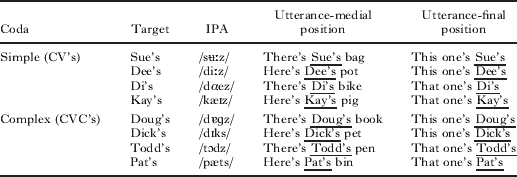
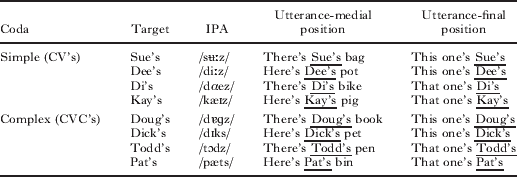
Eight target proper names were selected for the experiment, carefully controlling for syllable structure and segmental factors to facilitate subsequent acoustic analysis. Four had CV syllable structure, so with the possessive they had a CV's simple coda (e.g., Sue's /sʉːz/Footnote 1), and four had CVC syllable structure, so with the possessive they had a CVC's complex coda cluster (e.g., Doug's /dɐɡz/). For the simple codas, two of the names ended in a long vowel and two ended in a diphthong. For the possessive names resulting in complex codas, all had a short vowel, with two of the names ending in a velar consonant and two in an alveolar consonant, one voiced and one voiceless in each case. Each target name appeared in two sentence conditions, one utterance-medially and the other utterance-finally. Each sentence occurred in the present tense and consisted of three monosyllabic words with similar sentence structures. When in utterance-medial position, the possessives were followed by a noun that began with either a voiced or voiceless bilabial stop, so it was at a different place of articulation to the alveolar possessive morpheme -s. This makes the context more articulatorily challenging and reduces the possibility of resyllabification of the possessive morpheme with the following word (Theodore et al., Reference Theodore, Demuth and Shattuck-Hufnagel2011). The stimulus words and sentences are shown in Table 1.
Target names and their corresponding stimulus sentences
The target words were high-frequency names with similar summed lexical frequencies across the two conditions to avoid a confounding frequency effect. These were extracted via ChildFreq from the CHILDES database, which calculates the child's frequency of saying the target word per one million words between 2;0–3;0 (Bååth, Reference Bååth2010), and assessed for Australian appropriateness. The sum of the frequencies for the CV's simple coda words was 178 (range = 9–118), and the sum of the frequencies for the CVC's complex coda words was 164 (range = 4–128). An adult female native speaker of Australian English was recorded producing the sixteen sentences using child-directed speech. The recording took place in a sound-attenuated room using a Behringer C-2 microphone and Pro Tools LE software at a sampling rate of 44·1 K, and segmented using Praat software (Boersma & Weenink, Reference Boersma and Weenink2011).
Procedure
The child and parent were invited into a sound-attenuated test room to play a language game. The room was equipped with two computers (one used for the stimulus display and the other for recording), Sony SRS-55 speakers, and a Behringer C-2 microphone. The microphone was placed on a table near the child in order to best capture his or her speech. The child was invited to look at the pictures on the computer monitor and repeat what they heard. The presentation began with the auditory prompt ‘Say what I say!’ After a brief warm-up to familiarize the child with the task and to check the sound levels, the test items began. For each item, a picture of a child representing the corresponding name appeared on the monitor along with the auditory prompt. If needed, three attempts were allowed for each utterance in order to obtain an acoustically acceptable recording to be analyzed. The child was encouraged with praise and stickers for each trial. The entire procedure took approximately 30 minutes. The child was given a T-shirt and/or stickers and the parents received a gift card for their time.
Acoustic analysis and coding
The children's utterances were recorded using Pro Tools LE at a sampling rate of 44·1 K, then excised and coded by a trained coder using Praat. Of the 192 tokens, 19 were excluded as the child did not produce the target word or it was inaudible (n = 10), or the acoustic quality was poor due to noise interference (n = 9). The remaining 173 tokens were acoustically coded for morpheme and coda cluster realizations. The acoustic measurements used were based on Stevens' (2002) feature-cue-based model in which distinctive feature bundles representing speech segments are derived from the acoustic cues of the vocal tract configuration. Each acoustic cue was identified by visual inspection of the waveform and spectrogram and by listening to the utterance. We were interested in two aspects of the children's productions; first the production of the possessive -s morpheme, and second the production of the stop coda of the name (e.g., the /ɡ/ in Doug's).
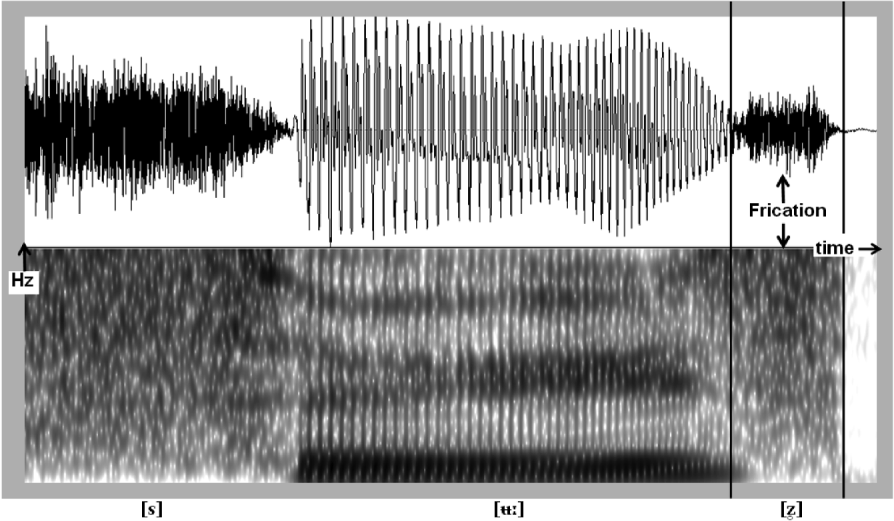
For CV names with a simple -s coda, there needed to be high-frequency, aperiodic word-final frication noise representing the vocal tract constriction for the phoneme /z/ for the morpheme to be considered produced (see Figure 1).
Waveform and spectrogram of acoustic cues from adult speaker for utterance-medial target word Sue's.

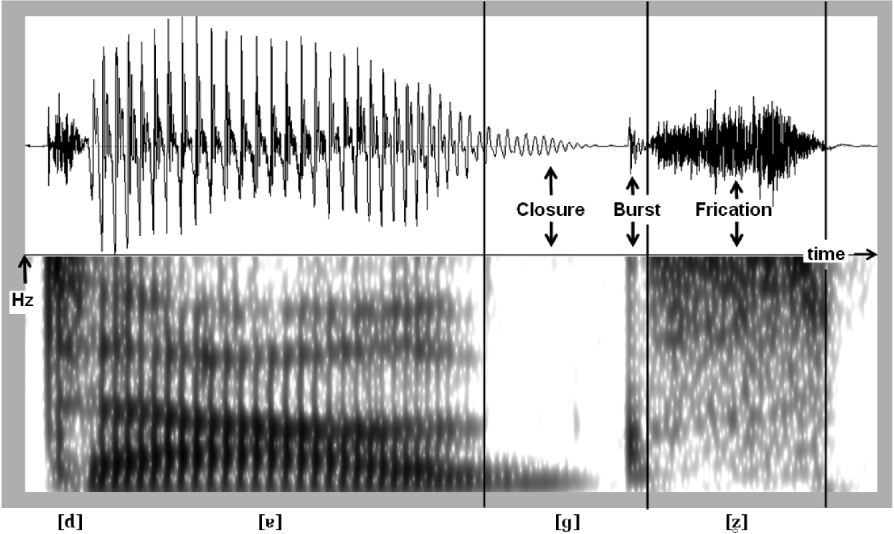
For names with final clusters, we looked for evidence of both closure (usually followed by a burst release) for the word-final stop, as well as high-frequency, aperiodic frication noise representing the possessive -s morpheme (see Figure 2). Therefore, for the target word Doug's, we coded both [dɐɡz] and [dɐz] as the possessive morpheme produced, but only [dɐɡz] as a full coda cluster production. All of the tokens were initially coded by one trained coder, then 15% were coded by a second trained coder. Reliability between the two coders for marking the presence or absence of acoustic cues to a stop coda and fricative morpheme coda was 99%.
Waveform and spectrogram of acoustic cues from adult speaker for utterance-medial target word Doug's.
RESULTS
Possessive morpheme productions
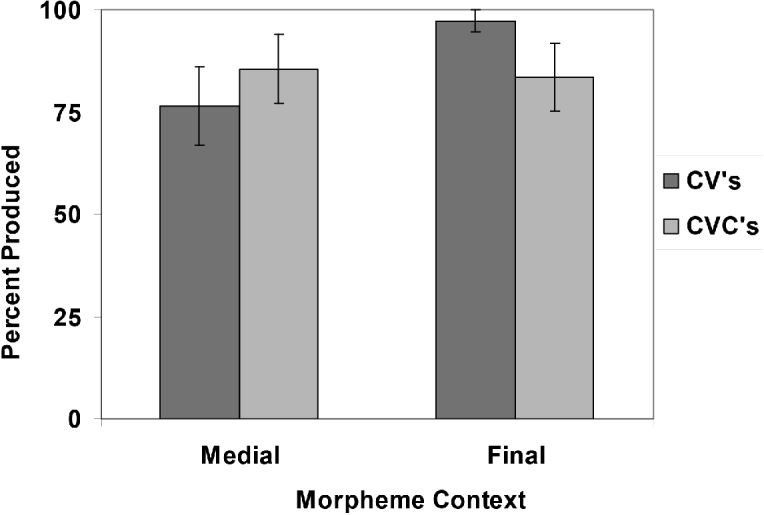
Recall that possessive -s production was hypothesized to be more poorly produced in complex compared to simple codas, and utterance-medially compared to utterance-finally. To examine this, the mean numbers of possessive -s realizations across children were submitted to a repeated-measures ANOVA. The factors of coda type (simple vs. complex) and utterance position (medial vs. final) were used. The ANOVA results, however, revealed no significant differences for coda type (F(1, 44) = 0·099, p = ·754, ηp2 = ·002), or utterance position (F(1, 44) = 0·105, p = ·231, ηp2 = ·032), and there was no interaction between factors (F(1, 44) = 2·205, p = ·145, ηp2 = ·048). This shows that possessive -s morpheme production for these children is highly robust, as shown by the near ceiling performances in each condition (see Figure 3).
Mean percent of possessive -s morphemes realized for medial and final utterance positions. Error bars indicate standard error of the mean.
Thus, Australian-speaking children aged 2;3 have little difficulty using the possessive morpheme in this task, even with names embedded utterance-medially or as part of a coda cluster. This may be due to their high mean score on the CDI, indicating good vocabulary size for their age. Or, it may mean they are focusing on the morpheme at the cost of producing the entire coda cluster.
Coda cluster realizations
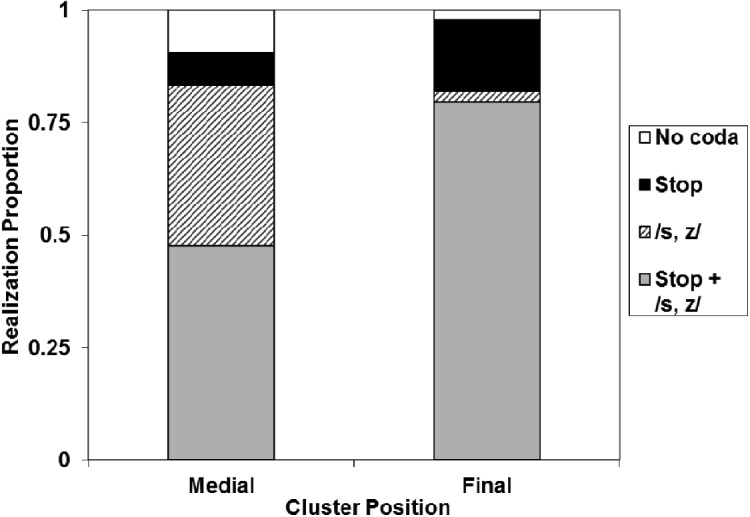
We then conducted a second analysis to examine more closely the acoustic realization of the coda cluster. Even though there were no significant differences across contexts, this did not necessarily mean target-like production of the full cluster for the complex coda words. For example, the stop–fricative coda cluster may have been simplified to just the fricative (e.g., Doug's becoming [dɐz]), hence the morpheme was produced, but not the entire coda cluster. That is, perhaps children keep the morpheme but omit the end of the lexical item itself, thereby producing a simple (morphemic) coda consonant. Recall that for the complex coda to be realized, both the final stop consonant of the name (represented by closure on the spectrogram) and the word-final frication for the possessive -s needed to be evident (Figure 2). Therefore, there were four possible types of coda cluster realization, illustrated here using the target name Doug's: (i) no coda ([dɐ]), (ii) stop coda only ([dɐɡ]), (iii) fricative coda only ([dɐz]), and (iv) target-like stop+fricative coda ([dɐɡz]). Again, we expected that more target-like productions would occur utterance-finally compared to utterance-medially, and this was the case. Figure 4 provides a breakdown of how the children produced coda clusters in utterance-medial compared to utterance-final position. The bottom two bars combined represent possessive -s morpheme production, but notice that in utterance-medial position, 41% of these morpheme productions involved cluster simplification, with the stop omitted. It is therefore of interest that, in most of the coda cluster simplifications, the possessive -s morpheme was retained rather than the stop that was part of the lexical item/name.
Realization of coda clusters for target CVC's possessive words.
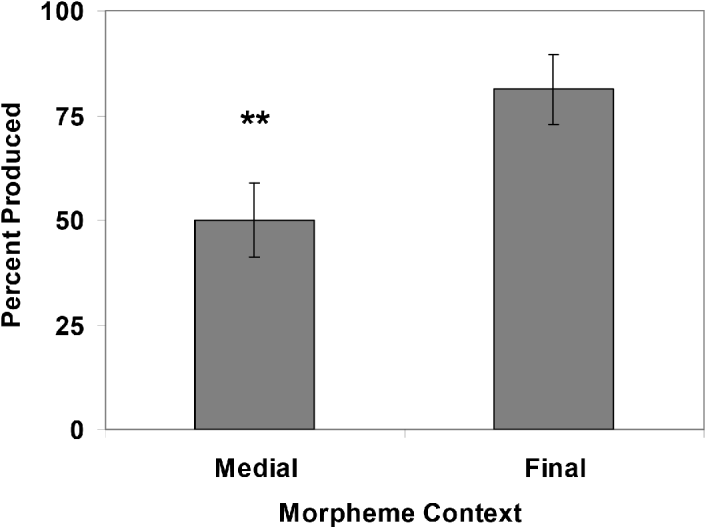
A paired t-test was conducted to compare coda cluster production in this position compared to utterance-final position. As anticipated, the results revealed that complex coda production was significantly lower utterance-medially compared to utterance-finally (t(11) = −3·341, p = ·003, d = 1·097) (see Figure 5).
Mean percent of coda clusters realized for medial and final utterance positions. Error bars indicate standard error of the mean: ** p<·01.
It may be thought that cluster simplification is due to children's lack of ability to produce certain syllable structures. These results, however, clearly show that this is not the case; the children were much better at producing the entire cluster in utterance-final compared to utterance-medial position. This is probably due to the increased duration of phrase-final syllables in English and therefore their increased perceptual salience (Hsieh et al., Reference Hsieh, Leonard and Swanson1999; Oller, Reference Oller1973; Slobin, Reference Slobin and Slobin1985; Snow, Reference Snow1994). Thus, it appears that the processing and planning factors needed to execute the same morphological cluster are mediated by phonological context. But it is not clear if children simply omit the stop coda in these cases of cluster reduction, or also lengthen the word to compensate for the missing stop (cf. Song & Demuth, Reference Song and Demuth2008). We therefore conducted a follow-up analysis to investigate this issue.
Compensatory lengthening effects
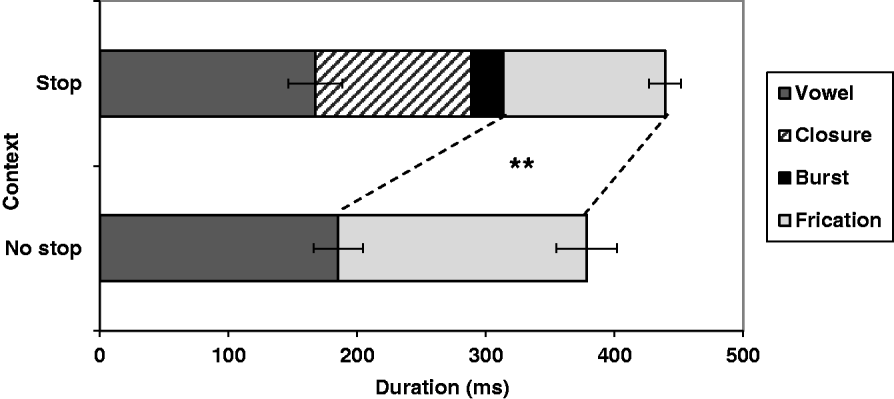
In this analysis we explored the possibility that children would leave a (covert) acoustic trace showing that they ‘know’ that a segment was missing from their production, even if we could not hear it (e.g., Scobbie, Reference Scobbie, Gruber, Higgins, Olson and Wysocki1998; Song & Demuth, Reference Song and Demuth2008). We therefore examined the possibility of compensatory vowel or fricative lengthening when the coda cluster was reduced to an -s singleton in utterance-medial position (as this is where it most often occurred). Since all four target word names with a complex coda target contained a short vowel (/ɐ, ɪ, ɔ, æ/), we collapsed across items for the vowel duration analysis. As half the target stops/fricatives were voiced and half voiceless, with no effect of target /s, z/ fricative voicing on morpheme production, and no fricative durational differences, these were also collapsed. The vowel durations and frication durations when the stop was produced (e.g., Doug's [dɐgz]) were then compared to when the stop was omitted (e.g., Dou's [dɐz]). The differences between the vowel durations with and without the stop being produced were not significant (t(29) = −0·600, p = ·277, d = 0·224, M[stop omitted] = 185 ms, M[stop produced] = 168 ms). However, the second independent samples t-test revealed overall fricative lengthening when the stop was omitted compared to when it was produced (t(29) = −2·741, p = ·005, d = 1·023, M[stop omitted] = 193 ms, compared to M[stop produced] = 125 ms). These results are shown in Figure 6.
Segmental durations for target words in utterance-medial position when coda cluster was produced compared to when the cluster was simplified to /s, z/: ** p < ·01.
These results suggest that children may have some awareness that they are omitting the stop of the consonant cluster. As Song and Demuth (Reference Song and Demuth2008) suggest, this compensatory lengthening shows that children's phonological representation may be more adult-like than often thought, despite imperfections in executing the intended target.
DISCUSSION
Previous studies have found that children's production of the third person singular -s morpheme was not as good when it was part of a coda cluster compared to when it was a simple coda (Song et al., Reference Song, Sundara and Demuth2009). Interestingly, no coda complexity effect was found for the earlier acquired plural -s using a similar aged population and methods (Theodore et al., Reference Theodore, Demuth and Shattuck-Hufnagel2011). However, both morphemes were omitted more often in utterance-medial compared to utterance-final position. In the current study, we explored the acquisition of the possessive -s morpheme, which is typically acquired later than the plural but before the third person singular. Surprisingly, the results showed high morpheme production in all contexts, with no effects for either coda complexity or utterance position.
A second analysis, however, revealed that, in utterance-medial position, these children were simplifying the coda clusters. Although the possessive -s morpheme was produced at a high rate (85%) utterance-medially, 41% of these involved cluster simplification (e.g., [dɐz] for Doug's). This finding differs from both the plural (Theodore et al., Reference Theodore, Demuth and Shattuck-Hufnagel2011) and third person singular findings (Song et al., Reference Song, Sundara and Demuth2009), where cluster simplification mostly resulted in morpheme rather than stop omission (e.g., dog for dogs; need for needs). A follow-up analysis of the utterance-medial productions, however, suggested that children are compensating for the stop coda they omit by lengthening the fricative morpheme.
These findings are interesting for several reasons. First, the plural morpheme is typically thought to be acquired earlier than the possessive (Brown, Reference Brown1973), yet the possessive morpheme in the current study was produced at a much higher overall rate than that reported for previous studies of the plural using almost identical methods (Theodore et al., Reference Theodore, Demuth and Shattuck-Hufnagel2011). The American children in Theodore et al.'s plural study, however, had a low MacArthur CDI mean percentile score (M = 47·5), whereas the Australian children had a mean percentile score of 69% in the current study. Given these high CDI scores and near ceiling performance found for some of the children in our study, it is possible that our participants had above average vocabulary even though the mean age was the same. This may have resulted in better overall morpheme production.
Second, although cluster simplification was also found in utterance-medial position in Theodore et al.'s (Reference Theodore, Demuth and Shattuck-Hufnagel2011) plural study, the type of cluster simplification differed from that found in our study. For the plurals, the stop coda tended to be preserved, whereas for the possessives, the stop coda tended to be omitted and the morpheme preserved. This is very interesting, first because it was the lexical item that was reduced, and second because stop codas are typically acquired earlier and produced more accurately in English than fricative codas (Koenig et al., Reference Koenig, Lucero and Perlman2008), so we would have expected the reverse.
These results raise many questions about children's lexical and morphological representations, and how these are stored, retrieved, and produced. Interestingly, a recent study using ultrasound imaging methods to examine the articulatory gestures used to produce morphemic and non-morphemic coda clusters shows early sensitivity to morphological structure (Song, Demuth, Shattuck-Hufnagel & Ménard, unpublished observations). Focusing again on children aged 2;3, that study examined the production of /ks/ clusters in the morphologically simple word box /bɔks/ versus the morphologically complex word rocks /ɹɔks/. For the lexical item box, the articulators appeared to target the /k/, whereas for rocks, the articulatory target was the plural /s/ for both children and adults. This suggests a difference in articulatory planning for the production of morphemic versus non-morphemic coda clusters. This may have been why, in the more challenging utterance-medial position, most of these precocious children's cluster simplifications in our study preserved the possessive -s morpheme at the expense of the lexical stop. The children then tried to compensate for this missing segment by lengthening the fricative. Thus, although being able to produce a particular consonant cluster is a prerequisite for producing the same cluster in a morphologically complex form, this is no guarantee that the form will be accurately produced in all phonological contexts.
These findings have important implications for understanding the nature of grammatical morpheme acquisition in language-delayed populations. For example, hearing-impaired children have shown marked delays for fricative acquisition compared to normal-hearing children, and this is likely to impact greatly on their language development (Stelmachowicz, Pittman, Hoover, Lewis & Moeller, Reference Stelmachowicz, Pittman, Hoover, Lewis and Moeller2004). It would therefore be interesting to acoustically investigate these children's attempts at s-cluster target words, and if there are any morphological effects. Children with a Specific Language Impairment (SLI) also have deficits in grammatical morpheme use compared to children with a similar Mean Length of Utterance (MLU) (Leonard, Eyer, Bedore & Grela, Reference Leonard, Eyer, Bedore and Grela1997). It would therefore be of interest to further examine possessive and other morpheme productions in these children, where preliminary findings suggest a marked delay in the use of syllabic -es morphemes (e.g., Trish's /tɹɪʃəz/) (Tomas, Demuth & Smith-Lock, Reference Tomas, Demuth, Smith-Lock, Cox, Demuth, Lin, Miles, Palethorpe, Shaw and Yuen2012), perhaps due to the challenges of producing a sequence of fricatives (Mealings, Cox & Demuth, in press).
CONCLUSIONS
This study has shown that English-speaking children as young as 2;3 are very good at producing the possessive morpheme regardless of coda cluster complexity and the prosodic context/utterance position in which the morpheme appears. Nonetheless, in utterance-medial position, these children often reduced final consonant clusters to just the morpheme -s (e.g., (e.g., [dɐz] for Doug's), indicating that producing the possessive in this utterance-medial context comes at a cost. Interestingly, however, children also compensated for this missing segment by lengthening the fricative morpheme, suggesting that they have some phonological representation for the stop consonant they ‘omit’. These results raise many questions about the nature of -s morpheme acquisition in children with language delay, such as those with hearing loss or SLI, where acoustic analysis is only beginning to explore possible covert contrasts in such children's speech. The findings here therefore complement a growing body of evidence showing that the segmental realization of children's early word productions is highly influenced by the phonological contexts in which these words appear. It also points to the importance of acoustic analysis as a tool for helping reveal what children's early phonological and morphological representations may be.