International collaboration on health technology assessment (HTA) projects, by sharing the experience, skills, tools and methodology, is an efficient way to reduce redundancy and avoid duplication of HTA products, to increase capacity to produce comprehensive common core, high-quality HTA information and to increase the number of timely national HTA reports, while respecting the independence of national decision making (Reference Mäkelä, Rosén, Jamtvedt, Kristensen and Mørland1–Reference Drummond, Schwartz and Jonsson5).
Since the beginning, the HTA community in and outside of Europe has facilitated joint assessment, but not too many joint assessments have come about, and even fewer have reported experiences, challenges, and barriers (Reference Sampietro-Colom, Semberg and Dolors Estrada2;Reference Hailey, Marshall and Sampietro-Colom4).
The Nordic countries Denmark, Finland, Norway, and Sweden already started active collaboration in HTA in the 1980s and 1990s by establishing the collaborative body Nordic Evaluation of Medical Technology (NEMT) (Reference Mäkelä, Rosén, Jamtvedt, Kristensen and Mørland1). Sweden was also active in the establishment of the International Network of Agencies for Health Technology Assessment (INAHTA) in 1993 (Reference Mäkelä, Rosén, Jamtvedt, Kristensen and Mørland1). Collaborative HTA projects on technologies used for the management of osteoporosis, prostate cancer screening, positron emission tomography, telemedicine, hearing impairment among adults, undertaken by members of the INAHTA, demonstrated the feasibility of international collaborative health technology assessment (Reference Sampietro-Colom, Semberg and Dolors Estrada2;Reference Hailey, Marshall and Sampietro-Colom4). Some barriers to successful international collaboration are already recognized, such as local language as working language, organizational differences, different time frames, difficulties in project management, and insufficient financial support (Reference Sampietro-Colom, Semberg and Dolors Estrada2;Reference Rottingen, Gerhardus, Garrido, Garrido, Kristensen, Nielsen and Busse6). The main recognized benefits were the increased knowledge and experience of participants and the increased quality and numbers of HTA reports (Reference Mäkelä, Rosén, Jamtvedt, Kristensen and Mørland1;Reference Sampietro-Colom, Semberg and Dolors Estrada2). Main characteristics of ideal international joint projects, such as good scientific quality, appropriate, competent and qualified partners, and wide, balanced country participation, are recognized as well (Reference Sampietro-Colom, Semberg and Dolors Estrada2).
Evidence of topic duplication clearly indicates the inefficient usage of resources available within the HTA community and highlights the need for increased collaborations among HTA institutions (Reference Rottingen, Gerhardus, Garrido, Garrido, Kristensen, Nielsen and Busse6–Reference Kristensen and Gerhardus8). The needs, challenges, and opportunities for improved interaction between regulatory, HTA and coverage processes are recognized, too (Reference Kristensen, Nielsen, Chase, Lampe, Lee-Robin, Mäkelä, Velasco-Garrido, Kristensen, Palmhøj Nielsen and Busse9;Reference Henshall, Mardhani-Bayne, Fronsdal and Klemp10).
In Europe, different projects have been supported and funded to promote the collaboration of Member States on HTA: three projects from 1993 to 2002; EUnetHTA Project 2006–08; and two EUnetHTA Joint Actions (2010–12 and 2012–15) (Reference Kristensen3). To facilitate collaboration, EUnetHTA has developed common tools and methodology guidelines, such as the HTA Core Model or the Planned and Ongoing Projects (POP) database (Reference Kristensen3;Reference Kristensen, Lampe and Chase11;Reference Lampe, Mäkelä and Garrido12). The HTA Core Model presents a framework to guide the content and preparation of collaborative HTAs. It contains more than one hundred generic questions concerning nine domains that those carrying out the HTA should consider in their assessment (Reference Lampe, Mäkelä and Garrido12). The POP database was set up with the aim to support collaboration on new technologies and to contribute to the reduction of work duplication on the premarket/prereimbursement assessment of new health technologies. The database currently contains information on 1,100 planned and ongoing projects, enables searches by topic or agency, and suggests possible overlaps with the projects of one's own agency (Reference Wild, Hinterreiter, Warmuth and Erdös13).
Finally, in March 2011 the Directive 2011/24/EU of the European Parliament and of the Council on the application of patients’ rights in cross-border healthcare was set up in the European regulation. According to Article 15 on cooperation in HTA, the Union shall support and facilitate cooperation and the exchange of scientific information among Member States within a voluntary network connecting national authorities or bodies responsible for HTA designated by the Member States (14).
The aim of this article is to present first collaboration experiences of agencies participating in the EUnetHTA Joint Action project (2010–12), comprising different technologies, for a different target audience, different life cycles and different types of collaboration through four case studies.
METHODS
Design and Period
A retrospective analysis of first collaboration experiences of agencies participating in the EUnetHTA Joint Action project (2010–12), comprising different technologies, for a different target audience, different life cycles, and different types of collaboration, was performed through four case studies. The first three studies (out of four), started in December 2010, were based on active brokering, and the fourth study, which had begun in December 2011, was based on individual contact between agencies after the identification of a common topic in the POP database.
These four studies represent collaborations done out of the official EUnetHTA project collaboration frame on two full Core HTAs and one Core HTA on the rapid relative effectiveness assessment (REA) of pharmaceuticals.
Analytical Categories for Analyzing the Case Studies
Different processes of collaboration are presented by describing the methods used to initiate collaboration, the contribution of partners, the methodology of assessment, the structure of reports and the time frame of the collaborative assessments. Factors acting as possible barriers or facilitators for collaboration are identified as well.
Methods Used to Initiate Collaboration
The first three case studies (out of four conducted) were initiated by the active brokering of information, named “call for collaboration,” by the Ludwig Boltzmann Institute for Health Technology Assessment (LBI-HTA). To identify partners interested in collaborating within the LBI-HTA's Early Awareness and Alert System for “Oncologic Drugs” a first call was issued in December 2010. Furthermore, the LBI-HTA inquired whether other European agencies wanted to participate in a program line for “New High-Technology Interventions in Hospitals” in January 2011. The LBI-HTA served as the initiator, coordinator, project manager, and first author in the projects. Agencies interested in collaborating were asked to reply within 1 week to express their willingness. If more than one agency expressed their interest, the second collaborating partner contributed as a reviewing author not actively involved in literature selection and data extraction.
The assessment of the different health technologies was performed through a systematic review of clinical efficacy/effectiveness and safety according to standard evidence-based medicine methodology: a systematic literature search was carried out on standard medical and HTA databases, complemented by a hand search. Study selection was performed by two researchers independently and the data extraction was also checked by the second authors. Different extraction results were discussed to achieve consensus; a third person was involved in case of uncertainty. In two collaborative projects the quality of the body of evidence was synthesized according to the Grading of Recommendations Assessment, Development, and Evaluation Group (GRADE) methodology (Reference Higgins and Green15–Reference Guyatt, Oxman and Akl18). Due to the different scopes of the two program lines, no strict deadline applied to the collaboration on oncologic drugs, but to reports on high technologies in hospitals.
Started in December 2011, the fourth project was the only one identified through the POP database. In this case, the Finnish Office for Health Technology Assessment (FINOHTA) took the initiative to contact the French National Authority of Health (HAS) after the identification of a common topic (carpal tunnel syndrome) in the POP database. This collaboration represents another form of cooperation: both agencies produce their own HTA, with different objectives and scopes, but share the work in some respects. The common elements were identified from the list of research questions created by using the EUnetHTA Core Model.
RESULTS
1 Case Study on Oncologic Drugs
Collaborating Partners and Their Contribution, Methodology of Assessment, and Structure of the Report
Collaboration between the LBI-HTA and the HTA Centre Bremen was established for an assessment on cabazitaxel as second-line chemotherapy for the treatment of castration-resistant metastatic prostate cancer after a first call for collaboration had been sent out by the LBI-HTA in mid-December 2010. The LBI was seeking (a) partner(s) interested in jointly conducting a report within “Horizon Scanning in Oncology” (HSO) (19), a permanent work program of the LBI whose aim is to inform decision makers about new anticancer drugs. The call was addressed to those agencies which had attended a workshop on oncologic drugs hosted by the LBI-HTA. This workshop, an offspring of the EUnetHTA program, took place in October 2010, and twelve agencies from nine European countries participated.
The reports of the HSO program follow a given structure comprised of chapters on drug description, indication, current regulatory status, burden of disease, current treatment, evidence, estimated costs, ongoing research, and a commentary. Systematic review methodology was used for these assessments (Reference Higgins and Green15;Reference Higgins, Altman and Gotzsche16). The collaborating partners were asked to participate in the study selection, as well as the data extraction, and to contribute to the critical appraisal/commentary section. Besides the literature search, study selection and data extraction, the lead agency, the LBI-HTA, was responsible for the composition of a first draft. Even though the tasks had been clearly set out for the collaborating agency, a precise definition of its role (i.e., internal reviewer or second author) had not been assigned in the call. However, both agencies agreed that the researchers from HTA Centre Bremen would act as “internal reviewers”.
Time Frame of the Collaborative Assessment and Factors Acting as Possible Barriers to Collaboration
The initially proposed time frame for the report was from mid-December 2010 until the end of February 2011, but the report went online at the beginning of April 2011. In addition to the fact that the time frame might have been rather tight from the very beginning, this rather minor delay was caused by external circumstances and thus not those related to the collaboration (e.g., recruitment of an external reviewer).
In addition, the two agencies had to clarify several issues concerning the methods used. There were some discussions about criteria for study selection, data extraction and presentation, as well as about formulating an overall conclusion about the drug's safety and efficacy. Also, minor technical problems had to be solved before the HTA Centre Bremen could start working: for example, appropriate software allowing data conversion from different reference managing systems had to be found. After these minor hindrances were resolved, the final report went online on the LBI's Web site on the 12th of April 2012 (Reference Nachtnebel20).
Factors Facilitating Collaboration
Overall, the collaboration worked very well and e-mail correspondence, only occasionally supplemented by telephone calls, proved to be a viable means to reconcile differences. Factors facilitating collaboration might have been the lack of strict deadlines, and thus the time to reach a consensus on several methodological differences. Moreover, because the HSO reports deal with oncology drugs early in their life cycle, around market licensing by the European Medicines Agency, the evidence base is still limited at that time, resulting in a manageable workload.
Because both agencies were located in German-speaking countries, language barriers would not have been an issue, but this fact was not relevant because the HSO reports are written in English anyway. Nevertheless, the advantages of sharing the same language were obvious, as e-mail communication and discussions on methodological differences in one's mother tongue are generally easier and more straightforward than when using another language.
2 Case Study on High Technology in Hospitals
Collaborating Partners and Their Contribution, Methodology of Assessment and Structure of the Report
For the topic “Selective Internal Radiotherapy/SIRT Using Yttrium-90 Microspheres for Primary and Secondary Liver Malignancies,” three institutes even replied to the LBI's call and thus contributed to the report. These agencies were: the Istituto Oncologico Veneto, the Hepatobiliary and Liver Transplantation Unit of the University of Padova, and the Agenzia nazionale per i servizi sanitari regionali (AGENAS), all from Italy. It was agreed that the first two agencies act as second authors, whereas AGENAS would serve as the third author.
These decision-support documents assess single hospital medical services for which reimbursement is sought through the Austrian hospital benefit catalogue. They adhere to a stringent methodology: the formulation of a PICO question is followed by a systematic literature search, complemented by a hand search. To derive transparent recommendations, the Grading of Recommendations Assessment, Development, and Evaluation Group (GRADE) approach was applied (Reference Guyatt, Oxman and Akl18).
Time Frame of the Collaborative Assessment and Factors Acting as Possible Barriers to Collaboration
Despite that the call had been sent in December, the precise research question was not submitted from the Austrian Ministry of Health to the LBI-HTA before mid-January. Because all decision-support documents were subject to a strict deadline (31st of March), only 2.5 months, therefore, remained for finishing the report, including external review and formatting.
Due to these time constraints, the lead agency started with the systematic literature search according to the predefined “Population-Intervention-Control intervention-Outcome” (PICO) question. The responsibilities and tasks for the collaborating agencies were explained in more depth by e-mail only. Because all institutes involved were nonnative English speakers, some misunderstandings occurred, necessitating the clarifications of tasks and methods used. Moreover, more than 900 hits were identified by the systematic literature search, making it difficult for the co-partners to comply with internal deadlines set for finishing the literature selection to start with, and consequently for data extraction as well. This delay culminated in the fact that no time was left for the collaborating partners to discuss the GRADE methodology which ultimately enables deriving recommendations for or against reimbursement of the technology assessed.
In addition, due to the deadline and the very strict methodology, there was hardly any time to discuss and potentially amend the PICO question and therefore the criteria for study inclusion and exclusion. Even though reasonable proposals were made by the partners, for example, the inclusion of only those studies whose level of evidence according to the Centre for Evidence Based Medicine is not lower than 3 (17), they could not be taken into account, because the lead agency had already progressed with the study selection and data extraction, as well as with writing the report. Modifying the PICO question as outlined by the partners would have suggested a great deal of changes and thus a loss of time. Even though it was theoretically possible, complying with the set deadline even without major amendments was challenging, because the report had to be written twice due to the collaboration, once in German for the Ministry of Health, and a second version in English for the collaborating partners, a fact which imposed a high workload on the lead agency from the very beginning. However, the English and the German reports were finished on time and, after a period of confidentiality, were allowed to go online in July 2011 (Reference Nachtnebel, Sotti, Vitale and Perrini21).
Factors Facilitating Collaboration
Due to the fact that some of the collaborating partners were medical experts in the investigated topic, important contributions on clinical aspects of the technology were made.
Furthermore, participation of more than one agency led to comments and/or corrections on various issues. Besides content improvements, suggestions, for example, on structure and enhanced ways of presenting the findings were received.
3 Case study on Bevacizumab (Avastin®) and Ranibizumab (Lucentis®) for Diabetic Macular Edema
Collaborating Partners and Their Contribution, the Methodology of Assessment and Structure of the Report
One of the topics to be addressed in the LBI-HTA's “High Technology Interventions in Hospitals” program was “Avastin® and Lucentis® in the Management of Diabetic Macular Oedema.” The call on this subject was answered by two agencies (University Hospital A. Gemelli, Italy, and the Agency for Quality Accreditation in Health Care, Department for Development, Research and HTA [AAZ]), Croatia. It was agreed that the LBI-HTA would be the coordinator and project manager (first author) and the AAZ in Croatia would participate as second author. The Italian group would have an advisory role during the process (e.g., commenting on the PICO question and report drafts as an internal reviewer).
The research process followed a stringent protocol with clear definitions of the authors’ roles and a strict deadline (see Case Study 2).
Time Frame of the Collaborative Assessment and Factors Acting as Possible Barriers to Collaboration
The project had to be carried out within 2.5 months between mid-January and March 31st. The working language was English, but because the Austrian Ministry of Health insists on German-written documents, reports needed to be produced in two languages. In contrast, according the Croatian HTA Guideline (22), full HTA reports in English, with a Croatian summary, are allowed in Croatia.
The cornerstones of the process were translated into English and communicated by means of e-mail to make the co-author acquainted with the project structure. The first challenge occurred when it became clear that the participating institutions did not use the same literature management programs. As a solution, the second author installed a trial version of the program used by the LBI-HTA (EndNote). As a precautionary measure, the search results were transferred into a simple Word document, which was then sent to the second author/AAZ. Due to technical problems with the literature administration program, references that were to be selected on the basis of abstracts were marked in color by the second author in the Word document. Selected full texts were all obtained by the coordinating institute/LBI-HTA and were then sent again by e-mail to the co-authoring institute. For documenting reasons, the results of the literature selection process were transferred back into the electronic database manually by the first author. Discussions on whether to include or exclude studies were held by means of e-mail only and required a very quick “send-and-reply” process.
Both authors critically appraised the selected full texts independently from one another. However, some misunderstandings occurred concerning the checklist to be used, which resulted in using two slightly different versions. However, only minor problems occurred during the data extraction process, which was led by the project coordinator. The data extraction and summarizing process using the GRADE methodology was accompanied by an e-mail discussion on how to present the data appropriately. The final reports to be used by the decision makers in both countries were identical, except for minor differences concerning the epidemiological data and the cost data presented (Reference Zechmeister-Koss and Huić23;Reference Zechmeister-Koss and Huić24).
Immediately after the reports were finished, the results were transferred into a scientific paper. The paper was finally accepted for publication in BMJ Ophthalmology in October 2011 (Reference Zechmeister-Koss and Huić25).
Factors Facilitating Collaboration
The success factors for this project were a predefined project management, a strong commitment of the partner institutes to the project and an awareness of the tight timelines. At the start of this call for collaboration, the AAZ had only one permanent expert, who had not yet requested any HTA report at national or hospital level. Responding to the call for collaboration was an opportunity for the rather novel Croatian HTA Department to show the importance of successful international collaboration and the efficient and timely production of HTA reports at European and national levels. Moreover, recognition of the HTA process and reports at national level and their relevance for Croatian decision makers could be demonstrated.
Furthermore, the technology analyzed was of high relevance to the participating partners. However, due to the severe time constraints, participating partners needed to have a common understanding of the methods applied and advanced experience in HTA. Because there was no time for a debate on principles, the co-authors needed to fully agree upon the process and standards applied.
4 Case Study on Carpal Tunnel Syndrome
Collaborating Partners and Their Contribution, Methodology of Assessment, and Structure of the Report
The fourth project was started through the identification of a common topic (carpal tunnel syndrome) in the POP database. After some e-mail exchange between the FINOHTA and the HAS, the researchers noticed that they had two completely different scopes in their assessments: The Finnish agency was looking at the efficacy of a new point-of-care neurography (ENG) device in the diagnosis and management of carpal tunnel syndrome (CTS), whereas the French agency wanted to define appropriateness criteria for decision making about CTS surgery in their country.
Regardless of the completely different scopes, objectives and working methods, it was evident to both agencies that some questions were of shared interest for both assessments. To identify the areas of common interest HAS screened the list of the 96 Core Model research questions of FINOHTA with the aid of their expert team. Out of these, seven research questions were identified to be in the scope of HAS's assessment as well. There were questions about the incidence and prevalence of CTS, and about the value of ENG or electroneuro(myo)graphy (ENMG) in predicting the outcome of surgery or conservative treatment, or in determining prognosis.
At the point of contact, both agencies had already scoped their HTAs, performed literature searches, and identified possibly relevant studies for their own assessments. The same pivotal systematic reviews and HTAs had been identified by both agencies and the first thing to share was the effort of double-checking the quality of these documents. An Excel sheet was designed, on which both evaluators marked their ratings for all the items of the two quality appraisal tools used. One researcher from each agency completed the quality appraisal of three systematic reviews, including one HTA report, and two guidelines using a measurement tool for the assessment of multiple systematic reviews, (AMSTAR), and Appraisal of Guidelines for Research & Evaluation (AGREE) Instrument (Reference Shea, Grimshaw and Wells26;27). Disagreements in rating were marked in the table and discussed in two telephone meetings where the disagreements were either solved and a final score agreed, or they were retained and explained in a comment field.
Answers to the shared research questions were provided in English and entered in the Core Model online. Both organizations used this information in their national reports written in their national languages.
Time Frame of the Collaborative Assessment and Factors Acting as Possible Barriers to Collaboration
This collaboration on the shared research questions started in December 2011.
As this has been an ad hoc collaboration of two individual assessment projects, the timing was an obvious challenge. The collaborating partners did not have the opportunity to plan the collaboration and schedule the tasks; instead FINOHTA went on collaborating whenever it was feasible from the perspective of their own timelines. Collaboration required extra telephone conferences and e-mail exchange, and several documents needed to be amended with English-language explanations or partial translations.
Factors Facilitating Collaboration
Several factors have been recognized. The quality check of a set of the included studies was properly performed by two independent evaluators, and the methodological discussions will likely increase the methodological validity of the work of both.
It was clearly evident that the electronic searches were neither sensitive nor specific in this topic, and there was a substantial amount of relevant studies which would have been missed in the search of one agency. Additionally, merging the methodological expertise of both agencies was a definite benefit, especially in the complex area of prognostic HTA questions.
5 Factors Facilitating Collaboration in All Four Cases
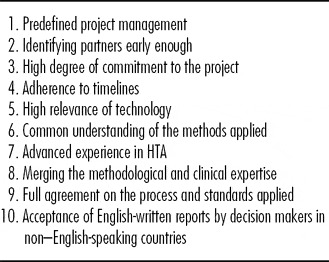
Several factors facilitating collaboration were recognized in all four cases (Table 1).
Factors Facilitating Collaboration in All Four Cases

DISCUSSION
Literature data confirm the inefficient usage of resources available within the HTA community due to the small number of joint international HTA projects (Reference Rottingen, Gerhardus, Garrido, Garrido, Kristensen, Nielsen and Busse6), as well as the rather high redundancy and duplication of efforts in the POP database: approximately 12 to 15 percent of European HTA products assess identical technologies, mostly pharmaceutical or other single technologies (such as surgical or diagnostic interventions). From a broader perspective on bundles of interventions for specific indications, there is an overlap of around 30 percent (internal communications, EUnetHTA JA, WP7, Strand B).
This article presents first collaboration experiences on different processes comprising different technologies, for a different target audience, different life cycles, and different types of collaboration, as well as facilitators of and barriers to collaborative HTA projects involving HTA institutions participating in the EUnetHTA Joint Action project (2010–12) through four case studies. Our findings confirm that timely and efficient collaborative HTA processes and final reports on relative efficacy/effectiveness and safety in Europe are possible. Several success factors are recognized: the high degree of commitment to the project; the adherence to timelines; the high relevance of technology; a common understanding of the methods applied and advanced experience in HTA, already recognized as one main characteristic of ideal international joint projects (Reference Sampietro-Colom, Semberg and Dolors Estrada2); and finally, acceptance of English-written reports by decision makers in non–English-speaking countries. Nevertheless, there are still barriers to overcome.
Finding partners fast and in good time is crucial. The POP database, together with active brokering activities within HTA agencies sharing similar work program profiles such as prereimbursement decision support, are essential facilitators. Maintaining them, however, requires commitment and resources. Identifying partners early enough would allow joint project planning in terms of sharing work and expertise in common timelines. If the partners are found later on during the assessment, or if the objectives and preferred methods are diverse, there will be no collaborative project. But, as was shown in the fourth case study of this article, despite different scopes of assessment, examining the potential commonalities may be useful in these kinds of projects.
Acceptance of English as a working language can be a matter of concern in some countries. The report of Case Study 1 is published in English only. Case Studies 2 and 3 produced bilingual reports to fulfill the language requirements of the public authority recipients. In Case Study 4, agencies produced two reports in their respective national language and only published the shared assessment elements in English in the Core-HTA online service of EUnetHTA. Providing translations is a considerable additional workload. The “reward” must, therefore, be found elsewhere, in joint peer-reviewed publication (Case Study 3), or in sharing the workload by dividing the chapters or gaining additional aspects (Case Study 4) or solely in “showing off” as early innovators of a joint EU project.
Barriers such as the use of different (or no) reference management programs, different grading of levels of evidence tools or different workflows are easy to overcome once collaboration has begun. The process may be facilitated by a process manual written in English and by using “modern” communication tools such as Skype conferences or e-meetings more often. One could also consider more advanced technologies for information transfer and Internet-based file sharing to avoid e-mailing large data files. Strong commitment and a predefined project management, already recognized as factors to successful international collaboration (Reference Sampietro-Colom, Semberg and Dolors Estrada2), facilitate the process.
An invisible barrier not easily overcome is that small countries (Austria, Finland, The Netherlands), countries with a shorter history in HTA (Croatia, Poland) and countries with less formalized production procedures (Italy) are more inclined to both initiate and respond to collaborations than big countries that have implemented highly formalized and predefined procedures (Germany, Great Britain). Less-developed HTA institutions, such as those in early phase of their establishment, or in Central-East European countries, would clearly recognize the benefit of their increased capacity through international collaboration (Reference Kristensen and Gerhardus8;Reference Sorenson28).
Our results are in concordance with other literature reports on this issue. Mäkelä et al. found that since the Nordic HTA collaboration started, each country had many positive experiences, and some projects have been more successful than others. The number and the quality of HTA reports have risen, but collaboration takes time with limited resources and funding (Reference Mäkelä, Rosén, Jamtvedt, Kristensen and Mørland1). Sampietro-Colom et al. presented several strengths, weaknesses, opportunities and threats that characterize international joint HTAs: The two most important strengths were the enthusiasm to cooperate and the availability of a wide range of expertise among HTA doers. Difficult management, insufficient funding, unsuccessful coordination and language difficulties were reported as major weaknesses of international collaboration (Reference Sampietro-Colom, Semberg and Dolors Estrada2). Kristensen and Gerhardus presented lessons from the collaboration on HPV vaccines; variations between HTA doers regarding the reliance on specific data sources, approaches to interpreting surrogate end points and the attitude toward weighing benefits and risks become more apparent when there is uncertainty about the effectiveness of technology (Reference Kristensen and Gerhardus8). Kleijnen et al. found that some important methodological aspects for the relative effectiveness assessment (REA) of pharmaceuticals are approached in a similar way in many jurisdictions, so collaboration on assessment may be feasible (Reference Kleijnen, George and Goulden29), which could facilitate further timely production of national HTA reports for the reimbursement process. Of course, the reimbursement decision-making process stays in a national/regional responsibility.
International joint assessments are only the tip of the iceberg. Other forms of collaboration are conceivable and possible: the exchange of literature search protocols, PICO questions with predefined inclusion and exclusion criteria, literature findings, even retrieved publications, extraction tables and other “bits and pieces” (core elements) of systematic reviews and HTAs. Even contacting partner agencies to ask for planned publication dates instead of starting one's own project is a form of collaboration, as it is a means to reduce redundancy. Resources are made available for further new HTA reports. The establishment of the POP database as one output of EUnetHTA JA has laid the groundwork for possible international collaborations; collaboration partners can either be sought by means of calls for collaborations or by early identification of an agency with identical topics; commitment of HTA recipients (decision makers) to accept HTA reports written in English would further enhance international collaboration to avoid duplication and reduce redundancy.
CONCLUSION
Timely and efficient, different collaborative HTA processes and final reports on relative efficacy/effectiveness and safety on different health technologies, different time cycles such as in horizon scanning or for the reimbursement process and for different HTA users in Europe are all possible. Barriers that should be overcome include the late identification of collaborative partners, the nonacceptance of the English language and of the different methodology of assessment, such as the use and acceptance of different outcomes, the level of acceptance of different types of comparison and the study type. Further experiences will be gathered within Work Packages 4 and 5 of EUnetHTA JA 2 through the collaborative production of full Core HTA and Core HTA on the rapid REA of drugs, medical devices and other health technologies which will put an effective and sustainable collaboration in Europe into practice, bringing added value at the European, national and regional levels. Several benefits are expected from European collaboration: significantly less time will be required for the production of national HTA reports, which will increase the number and quality of reports, facilitate greater transparency and quality of decision-making process, quicken patient access to effective health technologies, as well as boost the quality of health care.
CONTACT INFORMATION
Dr. med Mirjana Huic, MSc (mirjana.huic@aaz.hr), Agency for Quality and Accreditation in Health Care and Social Welfare, Department for Development, Research and Health Technology Assessment, Zagreb, Croatia
Dr. med Anna Nachtnebel, MSc, Dr. rer. soc. oec. Ingrid Zechmeister, MA, Ludwig Boltzmann Institute for Health Technology Assessment, Vienna, Austria
Dr. med Iris Pasternak, Finnish Office for Health Technology Assessment at THL, Helsinki, Finland
Priv.Doz.Dr.phil. Claudia Wild, Director, Ludwig Boltzmann Institute for Health Technology Assessment, Vienna, Austria
CONFLICTS OF INTEREST
All authors report they have no potential conflicts of interest.