

Voters in democratic regimes take stock of their own and their country’s economic well-being and decide whether incumbents are responsible for such outcomes. In principle, voters give incumbents credit for superior economic outcomes and re-elect them, or assign them blame for inferior economic outcomes and vote the rascals out. Two different strands of literature suggest, however, that voters appraise incumbents asymmetrically. The first strand suggests that globalization can induce asymmetrical effects on responsibility attribution by obfuscating the links between policy and outcomes. Such “clarity of responsibility” arguments suggest that voters in countries open to “global market forces” find it difficult to award credit (assign blame) to politicians during periods of economic expansion (recession). The second strand of research points to asymmetries in responsibility attribution for economic performance built around a psychological “negativity bias.” So-called “grievance asymmetry” arguments suggest that voters are psychologically primed not only to blame governments for bad economic outcomes but also to withhold credit for good economic performance.
We assess these theoretical accounts and notice that, if both asymmetries do exist, we should see interactive effects on responsibility attribution flowing from the combination of globalization and economic performance. In particular, the grievance asymmetry should be much less pronounced among individuals who perceive their country’s economic fortunes to be tied to global market forces. We provide the first pre-registered experiment exploring interactive effects of clarity of responsibility and grievance asymmetries. We assign participants randomly to four different treatments that combine frames for “fast” and “slow” economic growth, and for “openness” and “closure” to global market forces, which is an intervention meant to alter perceptions of globalization. A second contribution of our paper is that we seek to understand who benefits when voters engage in asymmetrical attribution of responsibility to incumbent politicians. We do so by providing participants a chance to credit “global market forces” or “business people,” as opposed to “politicians,” for positive economic outcomes.
Our evidence comes from three pre-registered survey experiments in the USA in April 2014 and April 2015 and in Canada in October 2015. We confirm (i) that voters are much more likely to blame politicians for poor growth but hardly ever give them credit for positive economic performance, instead crediting businesses and entrepreneurs for high economic growth, and (ii) that there is mixed support for the notion that these responses are affected by alternative globalization frames, with some evidence that globalization blurs responsibility attribution in the USA, but no evidence of this impact in Canada. We speculate about the source of these differences in the conclusion.
GLOBALIZATION, ECONOMIC PERFORMANCE, AND RESPONSIBILITY ATTRIBUTION
Previous research has documented that economic performance shapes government approval and voting, either through sociotropic considerations about national economic growth or through pocketbook assessments of individual or household economic standing (Lewis-Beck and Stegmaier Reference Lewis-Beck and Stegmaier2000). More recent work on political behavior has increased knowledge about how the economy shapes government approval by describing “asymmetries” in voters’ reactions to economic outcomes.
A first theory suggests that asymmetric responses to economic outcomes may follow from the conditions under which individuals attribute responsibility. Building on Powell and Whitten (Reference Powell and Whitten1993), Hellwig (Reference Hellwig2001) argues that globalization can limit “clarity of responsibility,” diminishing the ability of voters to hold politicians responsible for economic outcomes. In this view, economic openness limits both the ability of individuals to credit politicians for economic growth and to blame them for recessions, suggesting a clarity of responsibility asymmetry: The ability of voters to credit (blame) politicians for good (bad) economic performance should be lower in countries open to the global economy (globalization asymmetry hypothesis).
Observational studies furnish mixed evidence for this hypothesis. Hellwig (Reference Hellwig2001) shows that greater exposure to trade reduces the role of economic factors in shaping an individual’s vote intention (see also Alcañiz and Hellwig Reference Alcañiz and Hellwig2011; Hellwig and Samuels Reference Hellwig and Samuels2007), although Fernández-Albertos Reference Fernández-Albertos(2006) finds no such relationship. In other work, Hellwig, Ringsmuth, and Freeman (Reference Hellwig, Ringsmuth and Freeman2008) argue that economic openness increases the weight that voters place on non-economic factors when deciding their vote. Kayser (Reference Kayser2009) further documents how globalization, by promoting the correlation of domestic business cycles, has led to co-variation in voting intentions across countries, and Duch and Stevenson (Reference Duch and Stevenson2010) show that economic voting is reduced in trade-dependent economies. Campello and Zucco (Reference Campello and Zucco2016) find that presidents are rewarded and punished for economic factors, even if these economic conditions are beyond the control of politicians.
Experimental evidence consistent with the globalization asymmetry hypothesis is scant. In an original survey experiment in the USA, Hellwig, Ringsmuth, and Freeman (Reference Hellwig, Ringsmuth and Freeman2008) find that most Americans believe that government can affect economic outcomes, although attributions of responsibility for economic performance to politicians vary by partisanship and levels of knowledge. In a survey of Greece, Kosmidis (Reference Kosmidis2018) finds that economic performance has a major impact on voting, but there is no evidence that different “room to maneuver” treatments impact this relationship.
A second theory, the “grievance asymmetry theory,” suggests that individuals display “negativity bias” in their attributions of responsibility, blaming incumbent politicians for negative economic performance but not crediting them for good economic outcomes. Thus, for example, an economic recession would lead voters to express dissatisfaction with the incumbent government, while fast economic growth would at best produce mild praise for the incumbent (grievance asymmetry hypothesis). In the extreme, incumbent politicians face only a downside in economic performance. These reactions are consistent with the main tenets of prospect theory, especially with the idea that individuals experience “loss aversion” and react more sharply to economic deterioration than to improvements in economic performance (Kahneman and Tversky Reference Kahneman and Tversky1979). Other works, such as Soroka (Reference Soroka2006) and Singer (Reference Singer2011), argue that this asymmetry can be driven by the greater media coverage of negative events.Footnote 1
Evidence of grievance asymmetries comes mostly from analysis of vote-popularity functions based on observational cross-sectional data (e.g., Bloom and Douglas Price Reference Bloom and Douglas Price1975; Nannestad and Paldam 1994; Reference Nannestad and Paldam1997; Soroka, Stecula, and Wlezien Reference Soroka, Stecula and Wlezien2014; Stanig Reference Stanig2013). Experimental data in support of the grievance asymmetry hypothesis have recently started to accumulate. Olsen (Reference Olsen2015) reports on a number of experiments in which Danish citizens react to prompts about outcomes produced by a school and a hospital. When the prompt emphasizes failure, for example, 15% of students failed their exams, respondents are much more likely to respond negatively and to seek blame attribution than when the prompt emphasizes success, for example, 85% of students passed their exams.
We claim that these asymmetrical effects could combine to generate situations in which voters systematically show lower disapproval for incumbent governments. If both asymmetries were present, respondents’ ability to see incumbent politicians as responsible for bad economic performance would be reduced in open economies, as per the globalization asymmetry hypothesis, without really improving the chances that politicians would be credited for good economic performance, as per the grievance asymmetry hypothesis. We call this double asymmetry the blame mitigation hypothesis. Though no previous study considers the possibility of an interaction, our experiments are close to those reported in Hansen, Olsen, and Bech (Reference Hansen, Olsen and Bech2014), who consider the possibility of negative bias alongside an explicit international comparison. The choice experiment they report is performed on a nationally representative sample of Danish citizens who appear to feel aggrieved when prospective economic outcomes are framed as worse than Sweden’s, but are not symmetrically elated by the prospect of outcomes superior to those in Sweden.
EVIDENCE FROM SURVEY EXPERIMENTS
We pre-registered designs and analysis plans at Evidence in Governance and Politics for three survey experiments fielded in the USA and Canada immediately prior to fielding each of the surveys (http://egap.org/registration/665). In our first survey, we expressed interest in the globalization asymmetry and blame mitigation hypotheses. After fielding our first survey, we received substantive and methodological suggestions on further testing these hypotheses, and thus we pre-registered a follow-up survey, this time explicitly registering the grievance asymmetry hypothesis as well. Our first two survey experiments were fielded online in the USA in the April 2014 and April 2015 modules of The American Panel Survey at Washington University in St. Louis, a five-year nationally representative panel of 2,000 respondents administered by Knowledge Networks. We fielded a third survey experiment among 2,185 respondents in Ontario and Quebec, in Canada in October 2015, in which we asked questions identical to those fielded in our second (2015) survey experiment in the USA, simply substituting “Canada” for “USA” (these panels are representative at the provincial level). Experiments on two countries lessen concerns about the external validity of our findings. Though both countries are economically open, there is important variation in degree, as Canada is much more open to trade and capital flows than the USA.Footnote 2 The exact wording of all questions appears in our registration document; Appendix A provides the wording used in the first experiment, but the wording in the second experiment is basically identical. Appendix B shows balance of individual-level characteristics across treatment arms as evidence of appropriate randomization.
In our experiments, respondents receive one of the four possible treatments, where each treatment combines a frame that manipulates participants’ perceptions of past economic growth and a frame that evokes global market forces as a reminder about the reality of economic openness in the USA and Canada. Specifically, we varied (i) whether recent economic growth was portrayed as relatively fast or slow compared to the historical average and (ii) whether or not we highlighted only domestic factors or global market factors as influences on economic growth.
Though these frames purport to prime participants to think about good/bad economic outcomes in contexts of openness/closure to globalization, we acknowledge potential threats to their validity. We fielded the survey in a context in which per capita GDP growth in Canada and the USA had averaged about 1.25 and 1.48, respectively, from 2010 to 2015; these rates are below post-1970s average growth (1.67 and 1.87) and reflect the relatively tepid economic recovery that followed the recession of 2008–2009 (Arel-Bundock Reference Arel-Bundock2013). Against this background, we nudged participants into thinking about economic growth as fast by mentioning that “some experts” saw past economic growth as relatively fast compared with historical economic growth averages.Footnote 3 Specifically, our frame for “fast growth/no globalization” reads as follows:
Economic growth can be affected by government policy and the decisions of companies. Some experts have noted that over the past decades US economic growth has been relatively fast [italics not in survey] compared to the US historical average.
The frame for “slow growth” simply substituted “slow” for “fast” in the previous statement. In bringing attention to growth “over the past decades,” we sought to assuage the concern that participants could hardly be nudged into thinking of recent economic growth as “fast,” given that the timing of the survey coincided with an era of tepid recovery after the global recession of 2007–2008. That is, we wanted to avoid an overblown treatment. It is possible that respondents discount positive appraisals of economic growth; fortunately, the possibility that participants discount the claim that economic growth has been fast means that our estimate of the responsibility attribution effect could be biased downward. As we explain below, we still observe sizable differences in attribution of responsibility under alternative fast and slow economic growth frames even under this subtle prompt.Footnote 4
In our design, the frame for globalization is an equally subtle mention of global market forces, similar to a treatment used by Hellwig, Ringsmuth, and Freeman (Reference Hellwig, Ringsmuth and Freeman2008). The “fast growth/globalization” frame thus reads as follows:
Economic growth can be affected by government policy, the decisions of companies, and global market forces [italics not in survey]. Some experts have noted that over the past decades US economic growth has been relatively fast [italics not in survey] compared to the US historical average.
One potential concern is that this treatment may not even be perceived by respondents. If the treatments are subtle, we argue, any estimate of a responsibility attribution effect under a weak treatment can best be seen as a lower bound. We note that both our economic growth prime and globalization prime are similarly subtle. As we show in our analysis, this subtle growth prime has substantive effects on responsibility attribution, while our globalization treatment has little impact on attribution. We believe that these differences in attribution across two similar treatments provide us with credible evidence on the role of growth as well as globalization on responsibility attribution.
Experiment #1: USA April 2014
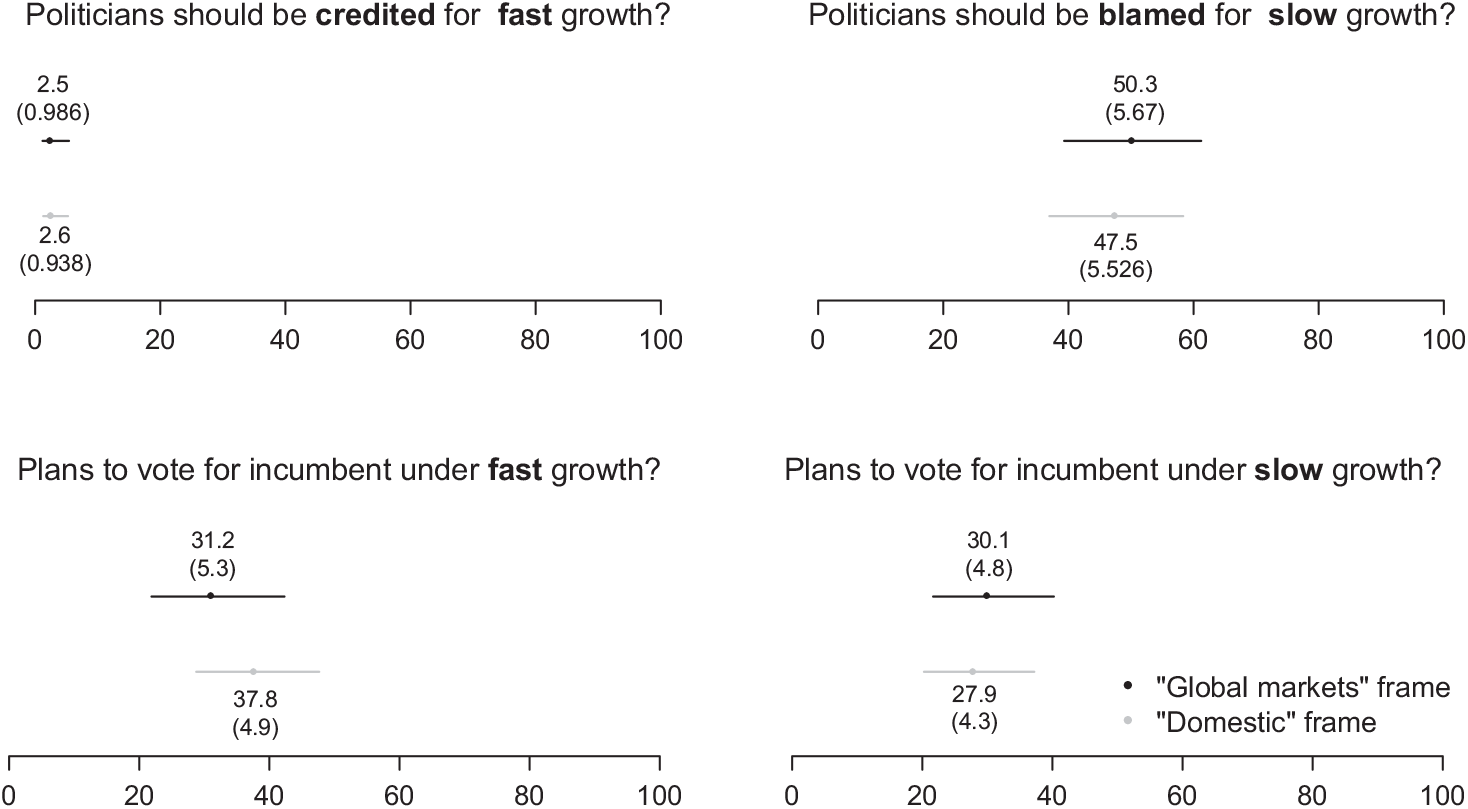
Our first experiment collected participants’ attributions of responsibility for past and future growth, along with participants’ intention to vote for the incumbent Democratic Party in the 2016 elections.Footnote 5 These questions appeared after receiving one of the four different treatments, each of which combined an economic growth frame with a globalization frame. Summary results for Experiment #1 appear in Figure 1; here, we comment briefly on the main findings. Consider the top panel first, where we summarize inferences about how the US population attributes responsibility for economic growth to politicians.Footnote 6 When we inspect attribution of responsibility for past economic outcomes in the top row, we find a large disparity in that respondents primed to believe that past growth was relatively slow (top right) are quick to blame politicians (the point estimates 47.5% and 50.3% are not statistically distinguishable from each other). In contrast, respondents primed to believe that past growth was relatively fast (top left) notoriously refuse to give credit to politicians; we estimate that only about 2.5% are willing to attribute fast growth to politicians. Contrary to our globalization asymmetry hypothesis, we do not find in this experiment a gap in responsibility attribution across globalization and domestic frames.Footnote 7
Inferences about attributions of credit/blame for fast/slow growth when varying globalization frames in the US population, 2014. Quantities are survey-weighted mean and 95% confidence interval (sample-weighted standard errors in parenthesis).

We consider respondents’ intention to vote for the incumbent Democratic Party government in the bottom row of Figure 1. This is of course a different outcome than government approval, but we certainly expect that attributions of responsibility would inform vote choice and thus anticipate that our hypotheses would also hold. However, we find that the fast/slow growth asymmetry disappears under the globalization frame (the share of voters planning to support the incumbent is 31.2% and 30.1% under fast and slow growth, respectively, which are not statistically different), but continues to be marked in the domestic treatments (the two-tailed p-value for the difference between 37.8% and 27.9% is 0.06). Even though attributions of responsibility for economic growth appear unchanged across globalization and domestic treatments in the top panel, we find that vote intentions are consistent in the bottom panel with the globalization asymmetry hypothesis. In other words, voters that are reminded of globalization support the incumbent governments at similar rates regardless of whether they are primed to think of economic growth as fast or slow. However, if voters are not reminded about the globalized character of the modern-day economy, they tend to decrease their support for the incumbent party under conditions of slow economic growth while increasing their support for the incumbent party under conditions of fast economic growth. Reminders about globalization obfuscate the difference between fast and slow economic growth, at least when it comes to vote intentions.Footnote 8
Experiments #2 and #3: USA April 2015, Canada October 2015
The main difference between Experiment #1 and Experiments #2 and #3 is that in the latter two we prompted participants to identify which actors — politicians, entrepreneurs, or global market forces — they hold responsible for economic growth. In Experiments #2 and #3, the design is a 2 × 2 treatment with frames for fast/slow growth and either a mention of global market forces or not. The responsibility attribution question then is: “Who is most responsible for the (strong/weak) economic performance of the USA [Canada] over the past few decades?” Participants could choose from among four answers: business people, US [Canadian] politicians, global market forces, and others (with an opportunity to provide an unscripted answer). Participants could also leave the question unanswered or reply “don’t know.” We focus on this retrospective question, but we notice that results are very similar when examining an alternative prospective question that we included in Experiment #2 (Experiment #3 did not incorporate a prospective question).
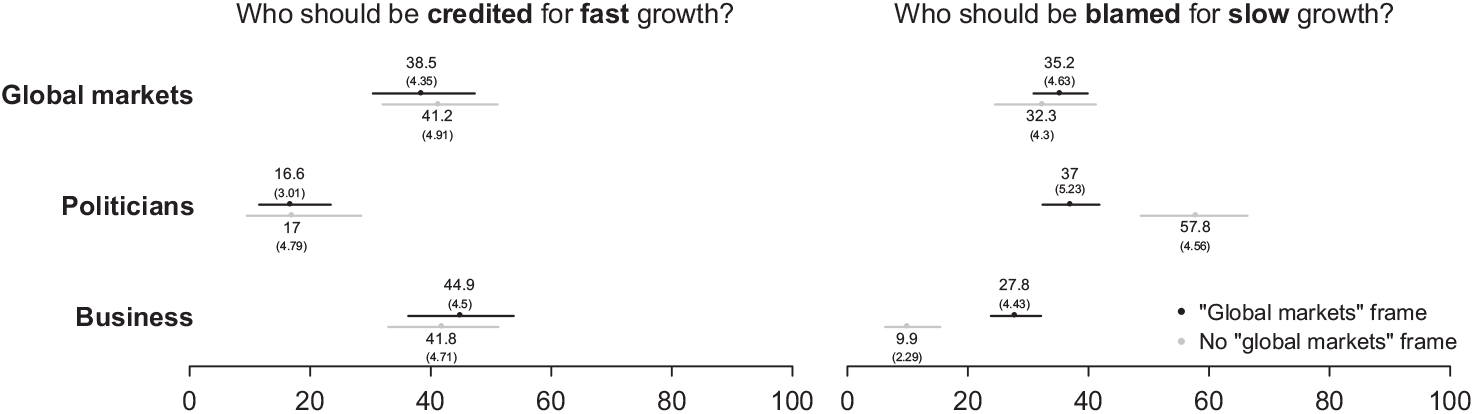
A comparison of population inferences across treatments based on the US survey appears in Figure 2. As in Experiment #1, we find that respondents are much more likely to blame politicians for bad economic performance. Under the “global markets frame”, roughly 37% of respondents indicated politicians were primarily responsible for low growth, while only 16.6% gave politicians credit for high growth, an asymmetric attribution of scant credit for fast growth and large blame for slow growth that is consistent with our previous experiment.
Inferences about attributions of responsibility for economic growth in the USA, 2015. Quantities are sample-weighted percentages of respondents that credit/blame each actor and 95% confidence intervals (sample-weighted standard errors in parenthesis).

We see this asymmetry as well under the “domestic frame” (i.e., the gray “no global markets” points and lines), except that, in this case, the grievance asymmetry is much more pronounced: 57.8% blame politicians for slow economic growth, while 17% credit them with fast economic growth. We see then that voters seldom credit politicians for fast growth regardless of whether they receive a globalization treatment or not (the difference between 16.6% and 17% is not statistically significant); when they receive a globalization treatment, voters are still likely to blame politicians for slow growth but to a much lower degree than when they fail to receive the globalization treatment (37% as opposed to 57.8%; the two-tailed p-value for this difference is smaller than 0.01). This result is consistent with the blame mitigation hypothesis: slow growth hurts US politicians, but much less so when voters are reminded of the important role that global markets play in the operation of a modern-day economy. We are careful to avoid over-reaching in our interpretation given that the blame mitigation hypothesis is corroborated only in this single test.
Who benefits from the misfortune of politicians? Figure 2 also includes estimates of the percentage of the US voting population that attributes responsibility for growth to impersonal global forces or to businesspeople. We find ample stability in attribution of outcomes to global market forces across economic growth and globalization frames. Our estimates about the percentage of the US voting population that attributes responsibility to global market forces fluctuate from 32.3 to 41.2, a difference for which we calculate a two-tailed p-value of 0.08. In contrast, businesspeople are seldom held as scapegoats for slow economic growth. Though we see statistically similar levels of credit to businesspeople for fast economic growth (41.8% and 44.9% across “domestic” and “global markets” frames), under the slow growth treatment, voters are more likely to blame businesspeople under the global frame (27.8%) than under the domestic frame (9.9%) (the two-tailed p-value for this difference is smaller than 0.01). This finding supports the notion that globalization helps politicians, but we note that this particular outcome variable is close to compositional: a respondent that fails to blame a politician is per force blaming either businesspeople or global market forces. In consequence, we do not interpret this result as an additional, independent piece of evidence.
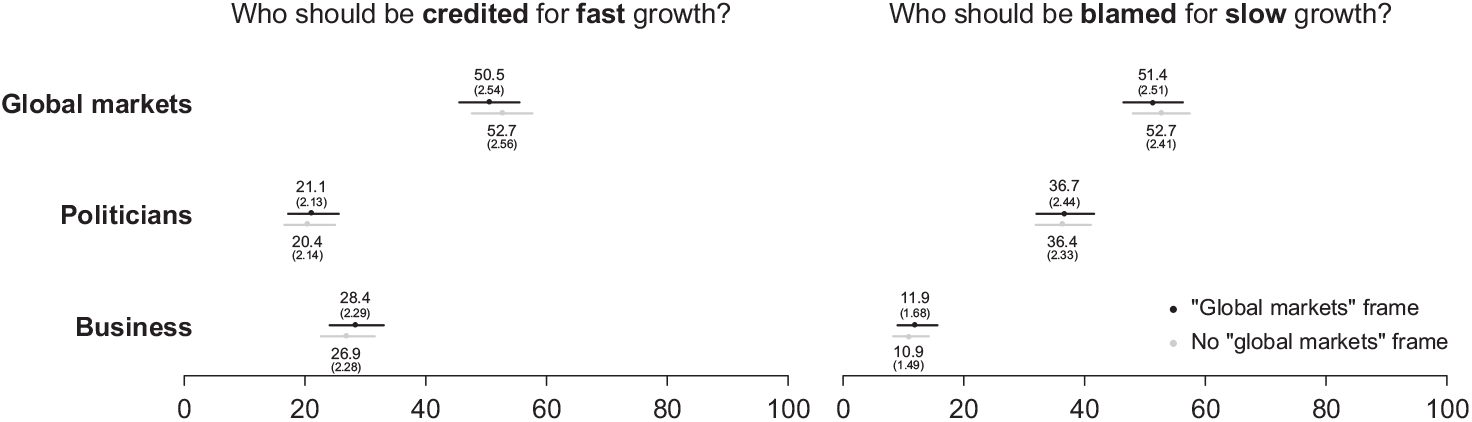
Figure 3 presents evidence on how Canadian respondents allocate credit among politicians, businesspeople, and global markets. Our inferences are easy to communicate, as we find no substantive differences between the globalization treatments and the domestic treatments; highlighting global market forces in the introduction to the survey basically has no impact on credit or blame. In other words, we see no support in this experiment for the globalization hypothesis. In contrast, we again find support for the grievance asymmetry hypothesis that suggests that politicians receive more blame for slow growth than credit for fast growth. We estimate that around 36.4%/36.7% of Canadian voters blame politicians for poor economic performance when primed with a low growth frame. In contrast, only about 20.4%/21.1% of respondents primed with a high growth frame see politicians as primarily responsible for superior economic performance. The results are exactly opposite for businesspeople: Only about 10.9%/11.9% of Canadian voters blame them for poor economic growth in the slow growth frame, but close to 26.9%/28.4% credit them for their contributions in the fast growth frame. Finally, like US respondents, Canadian participants are remarkably consistent across all treatments in their allocation of credit or blame to global markets. The only major difference is the higher percentage of Canadian voters that allocate credit or blame to globalization across treatments (about 52.7%/51.4%) relative to US voters (about 32.3%/35.2%).Footnote 9
Inferences about attributions of responsibility for economic growth in Canada, 2015. Quantities are sample-weighted percentages of respondents that credit/blame each actor and 95% confidence intervals (sample-weighted standard errors in parenthesis).

CONCLUSION
Our pre-registered research finds little evidence that globalization affects responsibility attributions, which is inconsistent with both the globalization asymmetry and blame mitigation hypotheses. Only in one test (Experiment 2) do we find support for the blame mitigation hypothesis that suggests that globalization reduces blame for poor economic performance. The experimental evidence we collect across three different studies in Canada and the USA consistently fails to find statistically significant attenuations of responsibility attribution when respondents are assigned to a globalization frame. Only in one test do we find evidence consistent with the globalization asymmetry hypothesis, and that is when we consider vote intentions: US voters are more likely to report support for the incumbent government under fast growth than under slow growth but only under the domestic treatment; under the globalization treatment, this differential support evaporates completely. Thus, economic openness appears to have an effect on vote intention that operates independently of responsibility attributions.
Setting aside those null findings, our results are fairly consistent with the grievance asymmetry hypothesis, where politicians in the USA and Canada are punished for low economic growth, yet receive very little credit for fast economic growth. Our pre-registered experimental design in two countries additionally provides evidence on the reason why policy-makers fail to get credit for good economic outcomes. We find that respondents in the slow growth arm of our experiments overwhelmingly blamed policy-makers for bad economic outcomes; almost symmetrically, respondents in the fast growth frames overwhelmingly praised business people for good outcomes. Furthermore, the willingness to blame policy-makers but to credit business people is constant across alternative globalization frames and across countries.
Our analysis is based on two countries with different levels of international economic exposure. Hellwig (Reference Hellwig2015) does find that objective levels of openness affect responsibility attribution, which stands in stark contrast to our result. Arguably, our approach is limited by the fact that Americans and Canadians may already be predisposed to think about their economies as open or closed, a disposition that our subtle prime cannot change. Yet, to our surprise, an equally subtle prime on economic growth, which should presumably also fail to change prior perceptions, actually effects major changes in responsibility attribution. We only find limited support for the idea that globalization impacts the logic of responsibility attribution among Americans. With only two countries in our analysis, we can say that differences across the USA and Canada are consistent with differences in objective exposure to global market forces, but that further study in other national settings is warranted.
Our experiments vary in whether they directly ask about responsibility attribution (Experiment 1) or directly allocate responsibility to an actor (Experiments 2 and 3), and this discrepancy may drive some differential results across experiments. Note, however, that only in Experiment 2 do we find any evidence of globalization affecting responsibility attribution, and question wording in that experiment is identical to that of Experiment 3. With the benefit of hindsight, we should have aligned more closely the questions asked in Experiment 1 with those asked in Experiments 2 and 3, but we are inclined to believe that this difference in question wording is not driving the mixed results that we observed.
Why are our respondents quick to assign blame to politicians for poor economic results but stingy in giving them credit for good outcomes? Is this simply an artifact of the current anti-establishment animus that seems to have gripped electorates around the world or is it an example of a “loss aversion” instinct at play? Are voters truly making radically different inferences about the managerial competence of incumbents depending on economic performance? Is this because they understand the economic stewardship role of politicians as basically a responsibility “not to mess things up”? We expect future research to corroborate whether the dispositions known to give rise to grievance asymmetries are equally strong regardless of the degree of economic openness of a country.
Supplementary Material
To view supplementary material for this article, please visit https://doi.org/10.1017/XPS.2019.24