INTRODUCTION
The smooth puffer Lagocephalus laevigatus (Linnaeus, 1766) is distributed in the tropical eastern Atlantic Ocean from the Strait of Gibraltar to Angola, and as far north as Portugal; and in the western Atlantic from the northern United States to Argentina (Shipp, Reference Shipp1974, Reference Shipp, Fischer, Bianchi and Scott1981; Menezes et al., Reference Menezes, Buckup, Figueiredo and de Moura2003). This species generally lives in shallow waters to depths of 180 m, on mud or silt bottoms, where it is found alone or in small independent groups (Shipp, Reference Shipp, Fischer, Bianchi and Scott1981). Adults are pelagic, but live close to the continental margins, while young individuals are found on coastal banks (Robins & Ray, Reference Robins and Ray1986). They feed on fish and shrimp (Diouf, Reference Diouf1996), and, according to Silva (Reference Silva2007), belong to the functional pelagic guild, have omnivorous habits, occur in the marine–estuarine environment, and have low economic importance. The smooth puffer, which may reach 1 m in total length (Shipp, Reference Shipp, Fischer, Bianchi and Scott1981), has very tasty meat, although because it possesses deadly toxins in its skin and viscera, its consumption is contra-indicated for humans (Maigret & Ly, Reference Maigret and Ly1986; Bianchi et al., Reference Bianchi, Carpenter, Roux, Molloy, Boyer and Boyer1999; Oliveira et al., Reference Oliveira, Pires, Morales, Bloch, Schwartz and Freitas2003). Despite this, there are records of its consumption by traditional communities in south-eastern Brazil (Hanazaki & Begossi, Reference Hanazaki and Begossi2000). The economic importance of this species derives from being a food resource for the common dolphinfish Coryphaena hippurus and the wahoo Acanthocybium solandri (Pimenta et al., Reference Pimenta, Lima, Cordeiro, Tardelli and Fernandes2003).
Tetrodotoxin, with a bacterial origin (Yasumoto et al., Reference Yasumoto, Yotsu, Endo, Murata and Naoki1989), and saxitoxin, produced by the dinoflagellate Gonyaulax spp. (Hashimoto, Reference Hashimoto1979), are found in L. laevigatus and may be acquired through the food chain or by symbiotic bacteria found on the skin and digestive tract of these fish (Oliveira et al., Reference Oliveira, Pires, Morales, Bloch, Schwartz and Freitas2003). Although the toxin is produced by symbiotic bacteria, the mechanisms of its incorporation, transport and accumulation remain unknown (Oliveira et al., Reference Oliveira, Pires, Morales, Bloch, Schwartz and Freitas2003). Information on its population biology and diet may be important to elucidate the mechanism of toxin accumulation by the smooth puffer, even more because the fragmentary information on this species' biology includes only studies of its tooth constitution (Andreucci & Britski, Reference Andreucci and Britski1969), occurrence (Sampaio et al., Reference Sampaio, Lopes and Olavo2001), toxicity (Oliveira et al., Reference Oliveira, Pires, Morales, Bloch, Schwartz and Freitas2003) and diet (Chalom et al., Reference Chalom, Muto and Soares2008).
From 2003 to 2004, a study on the by-catch fauna of the Atlantic seabob shrimp, Xiphopenaeus kroyeri, was carried out in Caraguatatuba Bay, a sheltered area influenced by a small estuary on São Paulo's northern coast. This was the first study on the fish of this bay. Therefore, this study on the population biology of the puffer L. laevigatus also contributes to the local knowledge of this area, which is undergoing substantial anthropic changes, including the installation of gas pipelines, the implementation of a gas treatment facility, and the expansion of São Sebastião Port. Also, State Decree No. 49.215, of 7 December 2004, which treats the Ecological Economic Zone (Zona Econômica Ecológica, ZEE) of São Paulo's northern coast, forbids trawling in bay areas. All these interventions have a great potential to alter the structure of benthic and pelagic communities in this area, and the data presented here may help in the understanding of these eventual changes. Finally, the present study presents new information on this puffer fish's diet. The consumption of large quantities of the sea whip Leptogorgia setacea suggests that the fish may acquire toxins from their diet.
MATERIALS AND METHODS
Study area
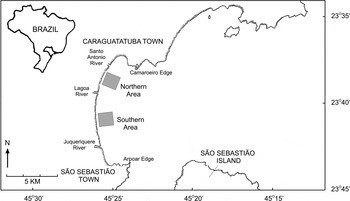
Caraguatatuba Bay (23o37′S to 23o44′S and 45o24′W to 45o26′W) is about 16 km long, and contains several sandy beaches (Enseada, Flecheiras, Porto Novo, Romance, Palmeiras, Pan-Brasil, Indaiá, Centro and Camaroeiros; Figure 1).
Caraguatatuba Bay: the grey squares indicate the study areas (north and south).

Two areas, each 2 × 2 km, homogeneous but distinct from each other, were selected for this study (Figure 1) in order to exclude the strong influence of rivers in the region (Juqueriquerê, Lagoa and Santo Antônio; Figure 1). The first or south area extends from Porto Novo to Palmeiras beaches; it has a gentler slope and is more influenced by the Juqueriquerê River, with a small estuary. The north area, located between Indaiá and Centro beaches, has a steeper slope and is influenced only by small rivers (Lagoa and Santo Antônio).
Sampling method
Monthly samples were taken from August 2003 through to October 2004. Three sampling stations were selected in each area, south and north, among 200 possibilities, i.e. the beach length of 2000 m was divided into 10-m intervals. The position of the station was stored in the GPS at MLW (mean low water), and then the distance of 800 m was located, perpendicular to the beach, using a fishing boat (class G2M, 11 m long with a 22-HP engine).
At each station, an 800-m trawl was utilized, from 800 to 1600 m from MLW. This interval is equivalent to depths from 1 to 4 m. The trawling speed was 1 knot. The trawls were made with two otter trawls with 2.0 cm mesh, mouth aperture of 1.6 m high and 6.0 m long, and bag depth of 3.5 m.
The fish were removed from the net and immediately preserved in a 10% formalin solution in order to stop the enzyme action, preserving the digestive-tract contents (Uieda & Castro, Reference Uieda, Castro, Caramaschi, Mazzoni and Peres1999). The samples were identified and stored in plastic containers. After identification of species in the laboratory, all specimens were transferred to 70% ethanol.
Population analysis and diet
All individuals of Lagocephalus laevigatus obtained in the samples were measured for total length (TL) and standard length (SL), which is the distance between the anterior head edge and the caudal fin base edge (beginning of caudal fin rays; Figueiredo & Menezes, Reference Figueiredo and Menezes1978).
A total of 160 individuals of L. laevigatus were sorted from the 199 obtained in the samples for the diet analysis, using a random digits table. An abdominal-ventro-sagittal incision was made from the anal aperture forward to the level of the pectoral-fin bases. The digestive tracts and the gonads were removed. The gonads were analysed according to Vazzoler (Reference Vazzoler1996).
The digestive tract length (distance from the beginning of the oesophagus to the end of the rectum; DTL) was measured in order to establish the DTL/SL (digestive tract length/standard length) ratio and verify a possible relationship to the diet of L. laevigatus (Knöppel, Reference Knöppel1970; Uieda, Reference Uieda1995). The digestive tracts were then preserved in 70% ethanol until the diet contents analysis.
Finally, the contents of each digestive tract were identified to the lowest possible taxonomic level and, when possible, the number of specimens was counted. The volume of each item was measured according to methodologies from Bemvenute (Reference Bemvenute1990) and Petti (Reference Petti1990).
Data analysis
The mean number of individuals of Lagocephalus laevigatus was calculated for the study months and areas (north and south). The sum of the areas was also computed. Two-way analysis of variance was performed to test the differences in the spatial (north and south areas) and temporal (months) distribution. A histogram illustrating the relative frequency distribution of the size-classes (TL) was produced for the total population.
The diet of L. laevigatus was analysed by the frequency of occurrence (F%), percentage volume (V%) and alimentary importance index (AIi), which was calculated by a modification of the method used by Kawakami & Vazzoler (Reference Kawakami and Vazzoler1980), based on the frequency of occurrence (Fi%) and on the percentage volume (Vi%) of each item.
RESULTS
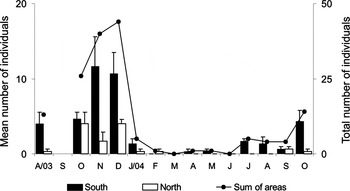
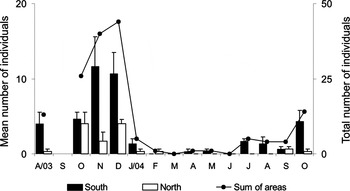
Lagocephalus laevigatus was a relatively rare species in Caraguatatuba Bay, since in the 15-month period of the study, only 199 individuals were captured. The smooth puffer occurred in higher densities (Figure 2) in the southern area of the bay (F = 9.811; gl = 13; P < 0.001). It was more abundant in the spring (F = 24.506; gl = 1; P < 0.001), from October through to December 2003, followed by August 2003 and October 2004 and then by January, July, August and September 2004. The distribution of the individuals among months depended on the collection area (north or south) (F = 3.643; gl = 13; P < 0.001), with the abundance in the north area being proportionally higher in the beginning of the study period.
Lagocephalus laevigatus: monthly mean (+ standard error) number of individuals/trawl in each of the two study areas (north and south) and monthly total number of individuals in Caraguatatuba Bay, south-eastern Brazil, from August 2003 through to October 2004.
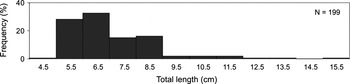
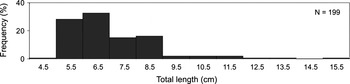
The L. laevigatus obtained in Caraguatatuba Bay had total lengths between 4.8 and 15.4 cm, with a mean length of 6.3 cm. The length–frequency distribution (Figure 3) showed a unimodal pattern (6.5 cm) skewed to the right, with a relatively low abundance of large-sized fish. Small-sized individuals (<5.0 cm) were also under-represented. All 160 individuals analysed had immature gonads.
Lagocephalus laevigatus: size (total length—cm) frequency distribution of individuals in Caraguatatuba Bay, south-eastern Brazil, from August 2003 through to October 2004.
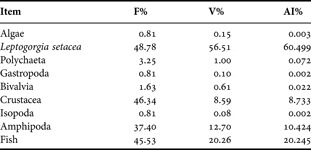
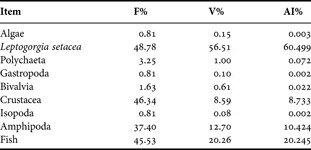
The diet of L. laevigatus in Caraguatatuba Bay consisted of nine items, including algae, invertebrates and fish (Table 1). Of the 160 individuals analysed, 37 had empty digestive tracts. The DTL/SL ratio was 0.93, suggesting a carnivorous habit according to Knöppel (Reference Knöppel1970) and Uieda (Reference Uieda1995). The main dietary items, in order of frequency of occurrence, were the sea whip Leptogorgia setacea, followed by unidentified crustaceans, fish fragments and amphipods. The remaining items (polychaetes, bivalves, algae, gastropods and isopods) were less frequent (<5% in total). Considering the volume of the items ingested by L. laevigatus, the sea whip L. setacea was most consumed, followed, with much less importance, by fish, amphipods and unidentified crustaceans. Polychaetes, bivalves, algae, gastropods and isopods comprised very small volumes in the puffer diet.
Lagocephalus laevigatus. Frequency of occurrence (F%), percentage volume (V%) and alimentary importance index (AI%) in Caraguatatuba Bay, south-eastern Brazil, from August 2003 through to October 2004. Total number of individuals, 160; individuals with empty digestive tract, 37; mean total length ± standard error, 6.93 ± 0.13 cm.
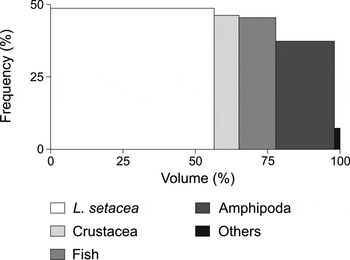
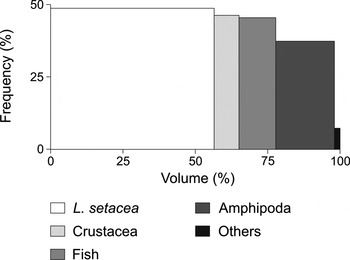
The alimentary index, which makes a combined analysis between the frequency of occurrence and the percentage volume (Figure 4), evidences the major consumption of L. setacea with high values of both tested variables. The items unidentified crustaceans and fish, despite being frequent, were not voluminous. The contrary occurred with amphipods, a voluminous item, although this was less frequent in the diet of L. laevigatus. The remaining items had very low alimentary importance values.
Lagocephalus laevigatus: relationship between the frequency of occurrence and the percentage volume of the items with highest alimentary importance indices in Caraguatatuba Bay, south-eastern Brazil, from August 2003 through to October 2004.
DISCUSSION
As related by Sampaio et al. (Reference Sampaio, Lopes and Olavo2001), the smooth puffer Lagocephalus laevigatus is a rare species in coastal areas, recorded only recently for the shores in the State of Bahia, north-eastern Brazil. In Caraguatatuba Bay this species was obtained in a relatively low quantity (199 individuals of a total of 21,882 fish sampled in trawls; M.R. Denadai, unpublished data) in the 15 months of this study, confirming it to be a less common species in that place. Despite the lack of studies on the life cycle of L. laevigatus, this species seems to use estuarine regions as nursery grounds, as is very common for fish (Boesch & Turner, Reference Boesch and Turner1984; Butler & Jernakoff, Reference Butler and Jernakoff1999; Laegdsgaard & Johnson, Reference Laegdsgaard and Johnson2001; Cabral et al., Reference Cabral, Vasconcelos, Vinagre, França, Fonseca, Maia, Reis-Santos, Lopes, Ruano, Campos, Freitas, Santos and Costa2007), as a form of refuge against predators and for achieving more available food resources (Beck et al., Reference Beck, Heck, Able, Childers, Eggleston, Gillanders, Halpern, Hays, Hoshino, Minello, Orth, Sheridan and Weinstein2001). The puffers collected from Caraguatatuba Bay were small (4.8 to 15.4 cm) in relation to the size of 60 cm, commonly recorded for the species, and to the maximum size of 1 m (Shipp, Reference Shipp, Fischer, Bianchi and Scott1981). The size–frequency distribution in the bay emphasizes the fact that very small (<5.0 cm) as well as large-sized and mature individuals did not occupy the sampled area. Smaller individuals are likely to occur in shallower areas close to sandy beaches or rocky shores. In contrast, the larger fish migrate to deeper and offshore areas (Shipp, Reference Shipp, Fischer, Bianchi and Scott1981).
The major occurrence of this fish was in the southern part of Caraguatatuba Bay, an area strongly influenced by the Juqueriquerê River, thus strengthening the argument of the use of estuarine areas by juveniles. In fact, none of the individuals of L. laevigatus showed evidence of sexual maturity, presenting gonads with filiform and translucid aspect, typical of individuals that have not reached the first sexual maturity.
The highest densities of L. laevigatus in Caraguatatuba Bay were recorded between October and December, i.e. during the spring months. Despite the lack of studies on the reproductive period of the species, the entry of new individuals into the population, and the recent recruits that use the estuary as nursery, suggest that the spawning may occur during the end of winter and the beginning of spring (August through to November). For Sphoeroides greeleyi, another puffer fish, Schultz et al. (Reference Schultz, Favaro and Spach2002) found that the reproductive period in Paraná, Brazil, started between August and January (spring–summer), with a rise in the frequency of mature and half-spawned individuals, and that spawning took place between November and December, when spawned and half-spawned individuals are most frequent. In Sphoeroides testudineus the reproductive period, with high frequencies of mature and half-spawned ovaries, also occurred in the spring–summer, between September and January in Paraná, Brazil (Rocha et al., Reference Rocha, Favaro and Spach2002).
In relation to the diet of L. laevigatus, the consumption of fish and crustaceans is known (Diouf, Reference Diouf1996), including also polychaetes and molluscs (Chalom et al., 2008). Martinelli & Cunningham (Reference Martinelli, Cunningham and Braga2008) evaluated the trophic ecology of some species, based on popular knowledge of Itanhaém fishermen (southern shore of São Paulo State), acquired when they eviscerate the fish for consumption or trade. According to these fishermen, the smooth puffer eats shrimp and many fish, which is in accordance with the literature. These studies corroborate, partially, our findings for Caraguatatuba Bay, where L. laevigatus fed frequently on fish and crustaceans, such as amphipods, the second most voluminous in the digestive tract. Nevertheless, in the few studies on members of the family Tetraodontidae, the item most consumed by L. laevigatus in Caraguatatuba Bay, the sea whip Leptogorgia setacea, was never reported. Thus, the fact that this item was found in the diet of this fish is important information for the ecology of this species, mainly because Cnidaria is a group rarely eaten, due to the presence of strong defence toxins, like the ones recorded in the Octocorallia Lophogorgia punicea (Epifanio et al., Reference Epifanio, Maia, Pinto, Hardt and Fenical1998), Phyllogorgia dilatata (Martins & Epifanio, Reference Martins and Epifanio1998; Epifanio et al., Reference Epifanio, Gama and Pereira2006), Lophogorgia violacea (Epifanio et al., Reference Epifanio, Maia and Fenical2000), Pseudopterogorgia elisabethae (Hill, Reference Hill2005) and Leptogorgia violata (Shapo et al., Reference Shapo, Moeller and Galloway2007).
In view of this new record for the diet of L. laevigatus and because this fish possesses tetrodotoxins and saxitoxin toxins in its viscera and skin (Maigret & Ly, Reference Maigret and Ly1986; Bianchi et al., Reference Bianchi, Carpenter, Roux, Molloy, Boyer and Boyer1999; Oliveira et al., Reference Oliveira, Pires, Morales, Bloch, Schwartz and Freitas2003), a possible relationship between the toxins present in the prey (L. seatacea) with that present in the predator deserves further investigation.
ACKNOWLEDGEMENTS
We are grateful for the logistical support provided by the Instituto Costa Brasilis—Desenvolvimento Sócio-Ambiental and by the Centro Universitário da Fundação de Ensino Octávio Bastos. We also thank Alessandra P. Majer, Gustavo M. Dias and Cynthia G.M. Delboni for assistance in the fieldwork. Thanks to Dr Janet W. Reid (JWR Associates) for revising the English text. Thanks also for an anonymous referee from JMBA for the valuable comments. This work was partially supported by the State of São Paulo Research Foundation (FAPESP) within the BIOTA/FAPESP—The Biodiversity Virtual Institute Program (www.biotasp.org.br). We also thank FAPESP for the ‘Programa Jovem Pesquisador em Centro Emergente’ grant offered to M.R.D. (Proc. FAPESP Nos 05/60041-6 and 06/57575-1). The Project Aware Foundation supported part of this research.