


As a globalized world begins to be challenged by climate change, isolationism, and fluctuations in the international economy, the discipline must reflect on what faculty are teaching future generations of scholars in the field of political science. More specifically, how do faculty prepare international studies (IS) majors in political science departments? What are the similarities and differences of programs that offer a globalized perspective and coursework dedicated to understanding other nations, cultures, and politics?
This research examines how political science conceptualizes programs that offer majors or tracks as well as the nature of coursework in these global-perspective programs. Analyzing the commonalities and differences across programs provides a view of what they require as foundational courses or experiences and what makes a program particularly distinct. Variety can be a marketing point to prospective students if the discipline lives up to the promise of intercultural understanding and global perspective taking (Breuning and Ishiyama Reference Breuning and Ishiyama2007).
Analyzing the commonalities and differences across programs provides a view of what they require as foundational courses or experiences and what makes a program particularly distinct.
Course requirements are the foundation of understanding for students and often the basis by which institutions and departments hire faculty members. When considering hiring decisions, teaching institutions base some decisions on which courses a new hire can offer and the emphasis or unique contributions that potential hires can make to the curriculum. The focus, then, is to provide insight into what the curriculum currently looks like across institutions. By highlighting the requirements for global studies or international studies (relations) programs, faculty are better able to make curricular decisions on necessary courses and which offerings are unique to varied programs. With diversity in curricula, do programs meet the goals with course offerings or are they missing key connections?
LITERATURE REVIEW
The foundation of IS and global studies stems from what was originally called area studies (Curran Reference Curran, Juergensmeyer, Steger, Sassen and Faessel2018, 202); however, differences between curriculum design in these majors and programs comprise a continuing debate in the field. The source of debate stems from where the program is housed and the pedagogical and empirical analyses that faculty use. Recent studies of IS and global studies programs reveal opportunities and challenges for meeting programming goals.
GOALS OF PROGRAMMING
When considering what appeals to students interested in seeking a major in IS, Breuning and Ishiyama (Reference Breuning and Ishiyama2007) suggested that there is a disconnect between the marketing of a program and the actual requirements for interdisciplinary IS majors. They found that few programs offer only a few or no required courses for all IS majors to take; the authors of this current research expected this to be different from their findings. The interdisciplinary nature of the programs in Breuning and Ishiyama’s (Reference Breuning and Ishiyama2007) study and the appeal of life skills and preparation for a career in a globalized world are frequently what programs highlight. However, 61.8% of their sample did not “provide a basic justification for the existence of the program” (Breuning and Ishiyama Reference Breuning and Ishiyama2007, 125). In addition, these interdisciplinary programs do not seem to require a foreign language beyond traditional bachelor’s degree requirements (Breuning and Ishiyama Reference Breuning and Ishiyama2007, 129). However, this article is not about interdisciplinary programs but rather political science departments that offer global studies programs. This work identifies when a program housed in political science requires interdisciplinary offerings. In this research, the authors expected to have more structure and perhaps additional foreign-language requirements or recommendations.
Examining the disciplinary offerings in political science programs, Ishiyama and Breuning (2006, 328) also found that, on average, only 14.1% of courses contained comparative or international content. Perhaps institutions lack these offerings or requirements as a result of having no faculty who teach comparative international relations or who are trained in these areas. Curriculum design for political science (at least in the Midwest) seems to lack course offerings, requirements, and faculty to teach or offer IS programs in political science.
Offering more specific goals for IS programming, Chernotsky (Reference Chernotsky2013, 18–19) suggested that departments focus on student learning outcomes to gauge success of a program. Student learning outcomes focus on what students will know, achieve, and demonstrate at the end of their college career. For Chernotsky, knowledge of the interrelations of countries; governmental systems; and social, political, and cultural structures sets up learning for other outcomes, such as regional studies and the ability to conduct and present IS research. Although they provide an IS framework, the goals of student learning outcomes are not necessarily met without a clear curriculum design and intentional connection to curricular markers.
RECENT FINDINGS
As the push to globalize curricula to produce more well-rounded college graduates began, the number of programs that offered global perspectives also increased (Qiang Reference Qiang2003). Internationalization of higher education focuses on dimensions of international and intercultural understandings. However, Brown, Pegg, and Shively (Reference Brown, Pegg and Shively2006) noted a lack of consensus in curriculum design when programs are interdisciplinary versus when they are housed in political science. Research methods is the common course of political science programming; however, beyond this finding, it does not provide specific IS information in political science departments.
IS administration also can be a challenge if there is no clear “home” for the program or major. As emphasis for “globalizing the curriculum” has spread across institutions of higher education, IS support has increased. Blanton (Reference Blanton2009) found that administration of a program is more difficult when IS is not housed in a department or an institution. Faculty collaboration across an institution can be an opportunity for interdisciplinary interaction, research, and teaching; however, if institutional support for interdisciplinary programming does not exist, then opportunities soon become challenges.
From a student’s perspective, an IS major can be a first choice, but a growing concern of students and parents is whether students can get a job after college. Due to this career-driven nature of American society, programs now discuss their outcomes in terms of careers and numbers of students in graduate programs. Zartner et al. (Reference Zartner, Carpenter, Gokcek, Melin and Shaw2018, 148) explained the necessity of IS programs to communicate knowledge and skills, which students in turn can communicate to employers.
CURRENT DEBATE: DISCIPLINARY OR INTERDISCIPLINARY?
The debate at the heart of curriculum design for IS majors is in which department the program should be housed (Bruening and Ishiyama Reference Breuning and Ishiyama2004; Hey Reference Hey2004; Ishiyama and Breuning Reference Ishiyama and Breuning2004). Based on which department owns the curriculum, different pedagogical and methodological approaches and curricular requirements develop. Differences in perspectives center on whether the program should be disciplinary (Breuning and Ishiyama Reference Breuning and Ishiyama2004) or interdisciplinary (Hey Reference Hey2004). Whereas a disciplinary focus offers a specific methodological approach, interdisciplinary programs can include a variety of social science (Curran Reference Curran, Juergensmeyer, Steger, Sassen and Faessel2018), philosophical, and critical-theory approaches. Logistically, programming decisions also can be a result of limitations in personnel, resources, and institution size.
Competition among majors also can occur if IS programs are outside of a disciplinary home. If programs are combined into a history and political science or social science department, competition may be minimal. However, across an institution that does not share resources for programming, competition for students, faculty, and resources can create contention among programs. Knotts and Schiff (Reference Knotts and Schiff2015) found a reciprocal positive relationship between political science chairs and IS programs. However, perception of political science chairs regarding IS programs is that there is less rigor in IS and, therefore, less competition for students.
Elements of the academic rigor of a program also can vary due to the nature of research. The differences between social science research and humanities research create a divide in IS similar to the discipline divide in political science with different approaches to investigating politics (Bennett Reference Bennett1991). Between small-scale descriptive studies and big-data studies, different perceptions of rigor and reasoning can impact how faculty and departments design a curriculum and teach students.
Recently, Jackson posed the question about where IS fits. Arguing whether “international studies ought to be an academic discipline in the first place,” Jackson (2018, 327–28) found that IS started with international relations as a subfield in political science. With the methodological diversity and faculty coming from numerous disciplines to study, IS has a wide variety of academics and variants (Jackson Reference Jackson, Gofas, Hamati-Ataya and Onuf2018, 330). However, Jackson concluded that IS must provide students with tools to study the practical problems facing the world today, and “our absence of disciplinarity” can be an asset to teaching and advising (Jackson Reference Jackson, Gofas, Hamati-Ataya and Onuf2018, 336, italics in original).
CRITICISMS
Undergraduate coursework in the political science discipline is varied in part as a result of the varied training of political scientists in subfields. However, there are foundations for understanding what should be in a curriculum. Bennett (1991, 202) posed the question: “Could it be that political scientists’ reluctance to say something direct about structure and coherence of our major stems from deep uncertainty about the intellectual structure and coherence of our discipline?” There is some coherence and structure within departments; the key is identifying which course offerings comprise the core common structure of majors as well as simultaneously identifying courses that produce programmatic diversity within the discipline. What professors teach the newest scholars in political science will give shape to ways in which the discipline will both change and remain the same.
The Association of American Colleges released Integrity in the College Curriculum in the hope that colleges and universities would take seriously the criticisms coming from outside of academia. The challenge that Integrity asserted was a lack of coherence in a student’s overall curriculum design. It suggested major changes in how institutions of higher education can adopt a well-rounded college core curriculum by including inquiry, literacy, understanding of numerical data, historical consciousness, science, values, art, international and multicultural experiences, and in-depth study in a discipline.
The purpose of an in-depth study of a major course of study is to examine the teaching and learning of complex structures, value of interpretation, and eventual mastery for contribution to the discipline. Introductory courses comprise the basis of knowledge that faculty expect all majors to have. If students are interested in international relations or American politics, departments have core courses that often are required. As Kaufman-Osborn (Reference Kaufman-Osborn1990) noted, departments often provide four general introductory courses: American government and politics, international relations, comparative politics, and political theory. For IS majors, common introductory courses include international relations and comparative politics. However, interdisciplinary programs housed in political science also might have an introductory global politics or global cultures course.
Whereas introductory courses are assumed to be in any department, a challenge for political science has been in how to sequence courses or whether to sequence them at all. The purpose of sequencing is to build a foundation on which new information can be amassed. Professors often expect that students “already know that” because they have taken the prerequisite introductory course. At times, sequencing can be waived, but recent research suggests that sequencing benefits students. In a comparison of political science departments, Ishiyama and Hartlaub (Reference Ishiyama and Hartlaub2003, 85) found that departments that offer more structured programs “promote the development of abstract reasoning styles more so” than flexible programs. Sequencing courses includes the requirement that introductory courses be taken before higher-level courses in the major or that methods courses be taken after introductory but before higher-division courses.
The purpose of this research is to examine how political science engages in IS curriculum design. Although there is a contribution of political science to interdisciplinary programs (Hey Reference Hey2004), the focus is on how curricula are designed by political scientists to meet the goals and requirements of majors within departments (Breuning and Ishiyama Reference Breuning and Ishiyama2004). This review is more extensive than only the Midwest (Ishiyama and Breuning Reference Ishiyama and Breuning2004) but is more specific than all IS programs (Brown, Pegg, and Shively Reference Brown, Pegg and Shively2006). Expanding and updating previous IS curricular design, this research answers questions about requirements, electives, and seminar or study-abroad experiences.
METHODS OF DATA COLLECTION
To examine the state of undergraduate curricula in IS programs housed in political science, the authors analyzed a random sample of 150 programs from the APSA Directory of Political Science Programs. This research follows similar methods used by other scholars studying core curriculum (Brown, Pegg, and Shively Reference Brown, Pegg and Shively2006; Ishiyama and Breuning Reference Ishiyama and Breuning2004, Reference Ishiyama and Breuning2006) but examines more programs (i.e., 150) than previous studies (i.e., 140 in Brown, Pegg, and Shively Reference Brown, Pegg and Shively2006). According to the 2015 list, 885 programs met this peer-group classification. To obtain a random sample, the authors used a random-number generator for 150 numbers between 1 and 885. Similar to other studies on curriculum design (Brown, Pegg, and Shively Reference Brown, Pegg and Shively2006; Ishiyama and Breuning Reference Ishiyama and Breuning2004), college and university academic catalogs were reviewed for information about requirements, recommendations, and electives. Of those institutions examined, there was an oversampling from the Northeast (30.7%, 46) with fewer institutions from the West (16%, 24), from the South (28.7%, 43), and from the Midwest (24.7%, 37). A majority of the institutions are private (68.7%, 103) and slightly less than a third are public (31.3%, 47). There were few historically black college or university (HBCU) institutions, with only eight in the sample (HBCU=5.3%; non-HBCU=94.7%, 142).
The current research design varies because of the use of a random sample of programs from the discrete APSA listing of programs rather than a general listing of colleges and universities (Brown, Pegg, and Shively Reference Brown, Pegg and Shively2006). Because of the interest in programming of IS and global studies in political science, this list is limited to programs housed in political science departments. A major limitation of this method is the use of a directory that does not include all US political science programs.
PROGRAM CHARACTERISTICS
Although there are various ways that small four-year colleges classify IS programs, four common regularities exist. First, traditional paths for global studies programs were listed as “concentration,” “focus,” or “track” in the political science department. Second, programs were listed as individual programs rather than specializations within political science degrees, with various names, such as international relations (College of St. Catherine), international studies (Rhodes College), and global studies (Gardner and Webb University)—just as Jackson (2018, 330) mentioned in the variety of programming. These programs generally were closely associated with political science departments. Third, there is variety in programs that are not assigned to a particular department but rather offer a concentration in political science or its subfields, which is largely administered and taught in these departments (Methodist University). Fourth, some colleges classified their IS programs as free-standing interdisciplinary degrees, the curricular focus of which was much less tied to political science or any other department (Denison University).Footnote 1 The first three types of programs were included in the analyses; excluded were those programs explicitly identified as interdisciplinary and administered outside of “traditional” political science departments, as well as those that offer only minor concentrations.
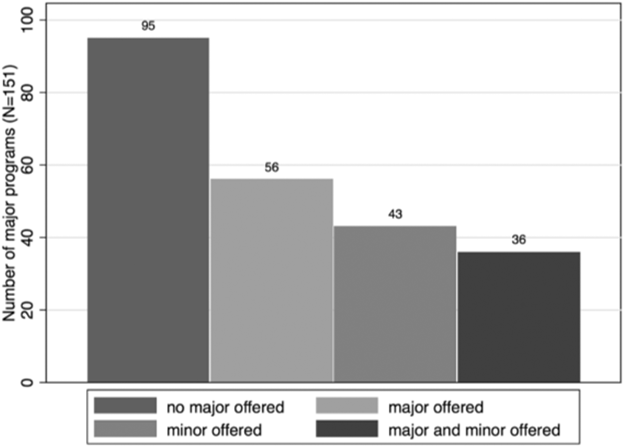
Figure 1 shows the distribution of programs that do not offer an IS concentration in the political science department (i.e., no major), as well as those that offer minor, major, or both minor and major degrees. Findings are interesting in that as many as 14 IS programs, or 35% of the eligible sample, do not offer a minor concentration but offer a major degree. This may signal an opportunity that some departments are not taking advantage of because IS minor concentrations pair well with numerous degrees in the physical and social sciences as well as the humanities.
Frequency of IS Programs Housed in Political Science Departments
In the next step of the curricular examination, this research followed the example of Brown, Pegg, and Shively’s (Reference Brown, Pegg and Shively2006) investigation of interdisciplinary IS programs and examined six basic curricular components. Because this study focuses on four-year college institutions that have a political science department, requirements are defined as (1) a course in international relations, (2) a course in comparative politics, (3) research methodology, (4) a senior capstone project, (5) a foreign language, and (6) study abroad. These curricular categories entail topical coursework, skill-focused courses, and nonpolitical-science requirements that correspond to the substance of IS degrees. In our judgment (Brown, Pegg, and Shively Reference Brown, Pegg and Shively2006; Dolan Reference Dolan2011; Ishiyama and Breuning Reference Ishiyama and Breuning2004), these six programmatic elements constitute a common core of IS programs and a good basis for assessing a common thread in IS programs in political science departments.
OPERATIONALIZING COURSE OFFERINGS
Curricular choices are defined in a way that partially maps onto Brown, Pegg, and Shively’s (Reference Brown, Pegg and Shively2006) methodology but modifies choices to suit the sample of four-year institutions and global studies degrees housed in political science departments. For each of the six programmatic categories, coding included whether the element was required for the major (1), offered as a major elective (2), or was not required and not offered as an elective for the major (0).
Introductory courses were coded following Brown, Pegg, and Shively (Reference Brown, Pegg and Shively2006). However, unlike their work, this research categorizes introduction to international relations and introduction to comparative politics separately. These courses follow traditional specialization within the field of international affairs to a study of the relations between nations and a comparative study of states. Introduction to international relations was coded as any course that qualifies as an introduction to international affairs, world politics, or international relations. The same rule applied for introductory courses to comparative politics.
The third category coded the curricular presence of empirical methods courses. This category included courses in research design and quantitative and qualitative methodology. The fourth curricular marker included senior-level capstone courses (suggested by Wahlke Reference Wahlke1991 as a senior culminating experience). Students are expected to produce a significant piece of writing (typically, a research project) that culminates their education and showcases their acquired skills: research, analytical writing, research design, and substantive knowledge of IS problems.
The final two categories coded whether the program requires a major-specific foreign language and study abroad, respectively. This research explicitly omits general education or other college-wide language requirements, coding only when a program had an explicit language requirement. Similarly, study abroad was coded as a requirement only if a department specifically expected completion of this program rather than generally encouraging students to study abroad. The opportunity to study abroad was coded as an elective if the course catalog identifies it as a course option.
RESULTS
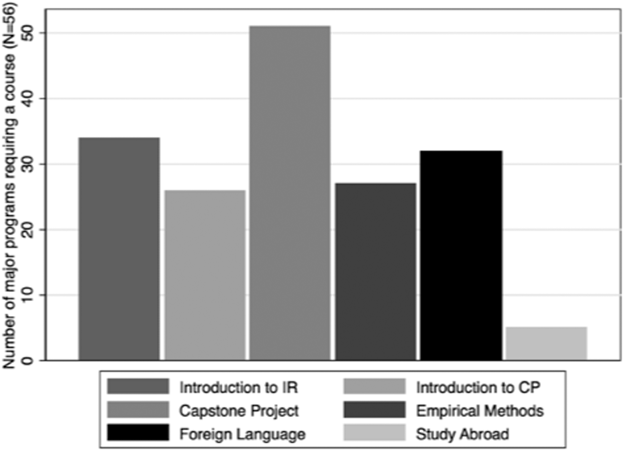
Figures 2 and 3 illustrate the number of programs that require each course. Two courses, introduction to international relations and the capstone project, are clearly the most common major courses; they are required in 58.9% and 85.7% of surveyed programs, respectively. If programs were included that do not require these courses but offer them as electives, the percentages increase to 76.8% and 89.3%, respectively.
Frequency of Specific Course Requirements in Political Science Departments with an In-House IS Major
Frequency of Specific Course Requirements Plus Electives in Political Science Departments with an In-House IS Major
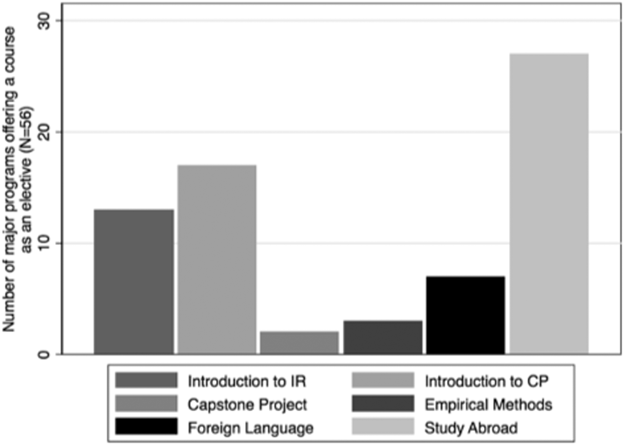
This is not a surprising result; indeed, it is an encouraging finding given that Wahlke (Reference Wahlke1991) and Ishiyama and Breuning (Reference Ishiyama and Breuning2004) suggested that effective programs need to incorporate well-structured introductory courses and culminate with a major project course. It is important that the same report noted a need to include methodological courses necessary to build toward the final applied, research-based capstone project. It is interesting that only 25 (44.6%) of all of the programs offering an IS major require a methods course (see figure 2) and three other programs list it as an elective (see figure 3).
Another insight into the curricular design reveals that an introduction to comparative politics course is required in only 24 of 56 programs with a major (42.9%) but is offered as an elective in an additional 14 (25%) programs. In other words, although an introduction to comparative politics course is available in 69.6% of all programs in the sample, less than half of the majors require it.
...although an introduction to comparative politics course is available in 69.6% of all programs in the sample, less than half of the majors require it.
Study abroad often is viewed as an essential element of a globalizing curriculum and student experience; therefore, the frequency of these program offerings within political science majors specializing in IS is being measured. Only five of 56 programs require that students participate in a study-abroad program. This is not surprising because the cost of this experience is substantial and, at minimum, could decrease access to the major for lower socioeconomic-status students and, at maximum, make this major economically untenable. Indeed, more than half (27, 48.2%) of the programs offer study-abroad courses as IS major electives, which indicates their value and popularity. In other words, a study-abroad programmatic offering is perceived as educationally valuable for IS majors in political science and also may increase the attractiveness of the major. However, the costs of these programs make requiring student participation a rare occurrence.
Finally, a major-specific foreign-language requirement is another way to increase globalization of the IS major. The programs with a foreign-language requirement in the major were included, as opposed to the foreign-language requirement imposed on all majors in a general-education curriculum. Eighteen programs (45%) had a foreign-language requirement listed in their course catalogs and another seven programs (17.5%) included foreign language as a major elective.
CONCLUSION
The state of IS curriculum is varied. This study examines the state of IS in political science departments. Updating and specifying the sample provides a detailed approach to understanding how IS programs exist in political science. Not all programs require introductory courses, but a senior capstone is most common. Whereas political science often criticizes programs housed in interdisciplinary departments as lacking rigor (Knotts and Schiff Reference Knotts and Schiff2015), departments rarely require research methods in programs. This examination suggests that faculty in these programs must agree about what should be included in the IS curriculum. Faculty have the opportunity to more closely align the curriculum to promises of intercultural understanding and global perspective taking to majors and student learning outcomes. Some of the variation in requirements is due to available resources in the number of faculty, funding, and faculty expertise. This is the beginning of a larger conversation on what is and what should be included in an IS curriculum. What do students need to be successful in graduate school and the job market after completing their education? More research on the impact of the IS curriculum on student learning outcomes and data on institutional differences that impact course requirements and offerings is essential to continue the conversation about where the field of study and the discipline are headed.
This is the beginning of a larger conversation on what is and what should be included in an IS curriculum.



