The impact of disasters on agricultural land and infrastructure in a region is considerable, rendering food stocks, storage facilities, fields, and livestock unusable. Furthermore, the aftermath of disasters can result in water and electricity shortages, road closures, and damage to food preparation equipment. This can lead to food insecurity, food shortages, and restricted access to safe and nutritious food. Consequently, disasters have a detrimental impact on the quality of nutrition and diet, thereby underscoring the importance of food relief activities in the aftermath of disasters.Reference Dembedza, Chopera and Mapara1, Reference Ainehvand, Raeissi and Ravaghi2 Food relief is defined as “the provision of foodstuffs on a national or local scale to relieve sudden food shortage and combat malnutrition in a disaster.” Reference Gunn3(p69) The objective of food aid is to ensure the availability of adequate, safe, and nutritious food in order to prevent the onset of humanitarian crises following disasters. Food aid is typically provided by national governments, international organizations, and voluntary organizations Reference Balachanthar, Zakaria and Lee4. For instance, during the Syrian civil war that commenced in 2011, the Turkish Red Crescent distributed over 870 million food supplies over a period of 11 years.Reference Anadolu5 The composition of these food supplies may vary according to the resources available. For instance, in the initial phase of food aid following the 2011 Great East Japan Earthquake, crackers, bread, canned food, and nutritional supplements were distributed. Subsequently, it was observed that food items such as oatmeal, rice, and casseroles were distributed with access to hot water. In the USA and Japan, canned foods, especially canned fish, were often used as disaster supplies.Reference Amagai, Ichimaru and Tai6 Food assistance in Asian countries was mostly similar, but consisted of rice or rice-based staple foods.Reference Balachanthar, Zakaria and Lee4
In the initial phase following a disaster, food assistance is provided based on a baseline or pre-disaster assessment of the population. In the subsequent phase, a nutritional assessment is conducted and food assistance is adapted to address the specific needs of vulnerable groups.Reference Gomez and MaSE7 For instance, in disasters, due to gender-discriminatory cultural norms and inadequate access to resources, women and children are often identified as vulnerable groups whose special nutritional requirements must be met.Reference Dembedza, Chopera and Mapara1 This is because food assistance represents an important tool in combating malnutrition among vulnerable populations.Reference Caiafa, Dewey and Michaelsen8 Furthermore, children may develop anemia as a long-term effect following disasters. Inappropriate dietary intake of those affected by the disaster may cause digestive problems.Reference Peyravi, Rahnavard and Marzaleh9 Chronic diseases such as hypertension and hyperglycemia are triggered early after a disaster, and an increase in cardiovascular diseases is observed. Poor nutrition is known to cause such health problems.Reference Tsuboyama-Kasaoka, Ueda and Ishikawa-Takata10
A number of challenges may emerge when providing nutritional assistance in the context of disasters. The quantity and quality of food may be insufficient, or the diet may be unbalanced in terms of content.Reference Tsuboyama-Kasaoka, Ueda and Ishikawa-Takata10 In order to circumvent these issues and provide optimal service, governments and organizations should align themselves with the Sphere Project’s Humanitarian Charter and Minimum Standards for Disaster Response.Reference Paulose, Cahill, Partridge, Proano and Marcozzi11 In order to enhance the effectiveness of humanitarian nutrition assistance and nutrition response, cultural values and beliefs should be respected and utilized.Reference Rahmani, Muzwagi and Pumariega12 There are numerous cultural factors that affect nutrition assistance, and it is of paramount importance for aid organizations to take these into consideration in order to ensure that the assistance reaches its destination in a correct and efficient manner. For instance, it would be erroneous to distribute wheat to individuals who typically cook with rice or to provide foods that disaster-affected individuals do not utilize or do not find appealing.Reference Twigg13 In a study examining nutrition intervention after disasters in Iran, it was stated that emergency foods should be suitable for local nutrition models, taking into account ethnic, religious, and cultural beliefs among the cultural characteristics that emergency foods should have.Reference Ainehvand, Raeissi and Ravaghi2 To the best of our knowledge, no study has been encountered in which all cultural factors affecting nutrition assistance in disasters were evaluated together. In this scoping review, the aim is to determine the cultural factors/codes that should be considered in nutrition services and food distributions after disasters.
Materials and Methods
Conceptual Framework, Protocol, and Registration
This study conducted a scoping review of articles examining the impact of cultural factors on the nutrition of people receiving nutrition services in a disaster area. This study follows the PICOS (participation, intervention, comparison, outcomes, study desings)Reference Liberati, Altman and Tetzlaff14 and Preferred Reporting Items for Systematic reviews and Meta-Analyses extension for Scoping Reviews (PRISMA-ScR).Reference Tricco, Lillie and Zarin15
Data Source and Research Strategy
The searches were conducted in databases using the following keywords: disaster and (food or nutrition) and (culture* or tradition*). The key terms were determined in consultation with experts in disaster medicine and public health researchers specializing in nutrition-related studies. The research strategy was developed in collaboration with a research team consisting of experts in disaster medicine and public health. Original articles published in Web of Science, Scopus, Pubmed, Cochrane, and ScienceDirect databases until March 30, 2023 were examined. The references about the research questions of the retrieved publications were accessed through the Google Scholar Database. No publication date restrictions were imposed.
In this study, a question was created to define the problem: What are the cultural factors/codes affecting nutrition studies in disasters? The study participants (P) were disaster- affected people who received nutrition intervention. The cultural factors (I) of the nutrition aids carried out for disaster affected people were analyzed. The type of disaster, community, and cultural characteristics that reveal these factors were compared (C). The factors obtained from the articles constitute the outcome of the research (O). In the course of this research, all studies published in the English language were subjected to analysis (S).
Inclusion Criteria
-
1. The article should consider nutrition services provided in a disaster-affected region.
-
2. At least 1 cultural characteristic influencing dietary behavior should be mentioned.
-
3. Full-text articles should be available or accessible and free of charge.
-
4. Articles with a methodology section should be included.
-
5. The study should be published in English.
Exclusion Criteria
-
1. Literature that does not meet the inclusion criteria.
-
2. Articles that do not include cultural dietary codes in disasters.
Study Selection
The titles and abstracts of the articles were independently screened and evaluated for eligibility by 2 reviewers. The full texts of the accessed articles were carefully and critically examined by the reviewers.
Data Extraction
A data extraction form was created to facilitate the collection of information from publications through content analysis. The GLIDE number16 was assigned to provide detailed information about the characteristics of the hazard in the included studies. The articles were analyzed in the context of the research question, and the data collection form was completed.
Quality Assessment and Bias Risk
To eliminate the risk of bias, the articles were reviewed using the Mixed Methods Assessment Tool (MMAT) 2018 version. The MMAT does not recommend scoring according to category criteria; instead, it offers a description of what is and is not met.Reference Hong, Pluye and Fàbregues17 Accordingly, the critical appraisal of articles according to the MMAT 2018 version ranges from 2-5 (out of 5). Two authors reviewed each article against the MMAT categories for risk of bias. In the event of any discrepancy of opinion, a third author was consulted to reach a resolution.
Data Synthesis and Analysis
Due to the heterogeneity of the findings obtained from the articles and the lack of quantitative dependent variables, it was not possible to use statistical techniques to analyze the data. Therefore, the study employed a thematic analysis framework to synthesize the findings from the included studies with a deductive approach based on Braun and Clarke’s recommendations.Reference Braun and Clarke18 Thematic analysis was conducted by 2 authors in 6 stages: (1) Identification of the data; (2) Generation of initial codes; (3) Identification of themes; (4) Review of themes; (5) Definition and naming of themes; and (6) Preparation of the report.
Results
Characteristics of the ‘Included Studies’
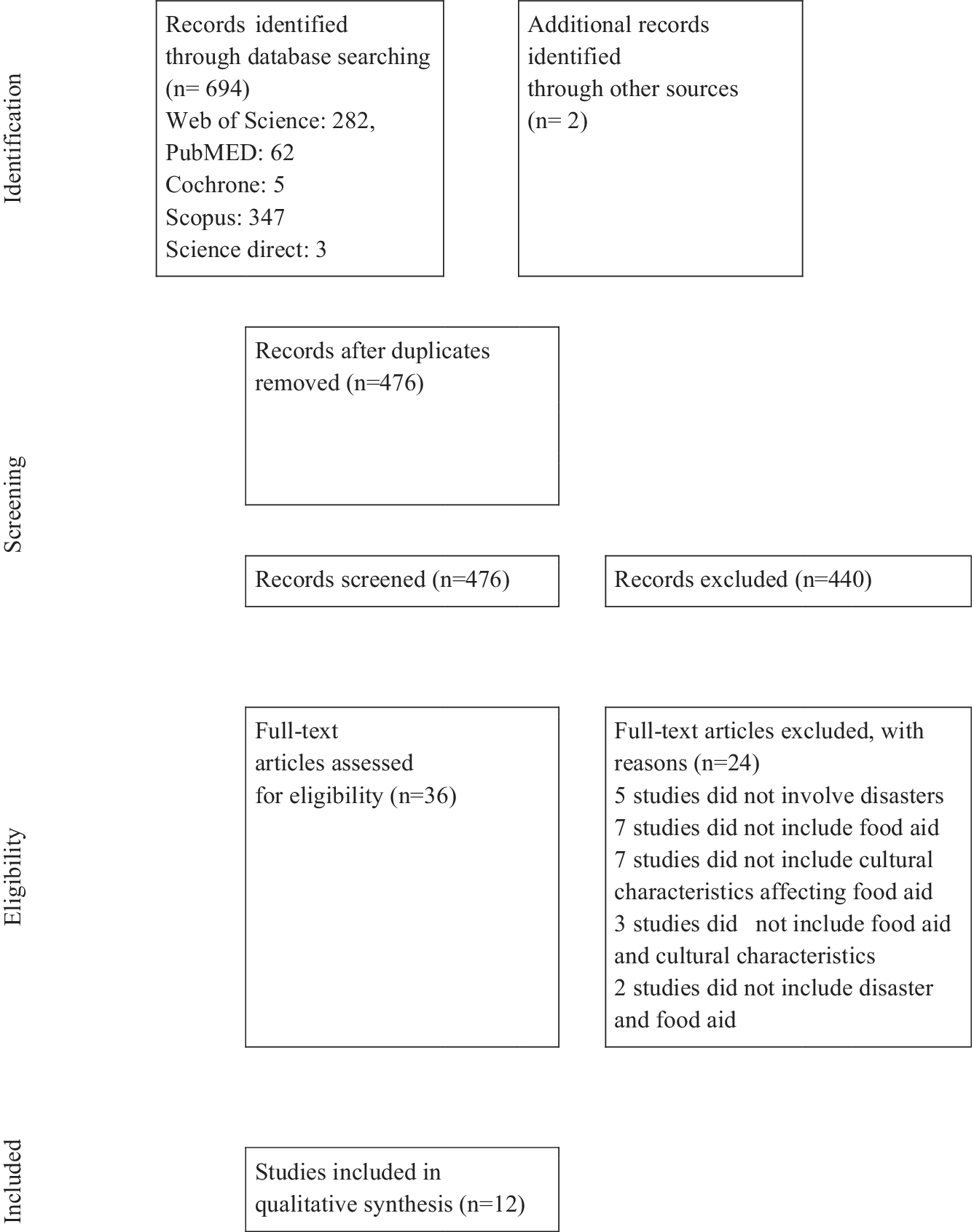
A search of the Web of Science, Scopus, Cochrane, PubMed and Science Direct databases using the keywords of the research yielded 694 studies. Of these, 220 were duplicates and 440 did not meet the inclusion criteria of the study, so their full texts were not read. Furthermore, 2 studies identified in the grey literature review were included in the findings of the study (Figure 1). The publication dates of the 12 studies included in the research findings range from 1995-March 30, 2023. Three of these studies are cross-sectional studies, 5 are qualitative research, 1 is descriptive research, and 3 are mixed methods research.
Flow of information through the different phases of a scoping review.

Characteristics of the 12 articles included

Cultural Factors/Codes Influencing Nutrition Assistance in Disasters
This study summarizes cultural factors/codes influencing nutrition activities during disasters in 7 categories: local and traditional food, socio-economic status, belief/religion, traditional practices and habits, cultural food beliefs and taboos, food sharing, and social organization.
Local and traditional food
The studies included in the research indicated that relief activities should favor regional food products. For example, in one qualitative study, it was observed that people rejected food products that did not fit their culture because they were not used to them.Reference Ainehvand, Raeissi and Ravaghi2 In another study, it was reported that refugees expressed a preference for traditional cassava flour (a gluten-free flour produced from the cassava plant) to be distributed in food aid instead of maize grain, maize flour, and lentils.Reference Pottier19 In addition, two studies demonstrated that individuals affected by disasters exhibited a preference for traditional foods in food aid and demonstrated an inability to adapt to non-traditional foods.Reference Membrebe and Briones20, Reference Asfaw, McGee and Christianson21 In a separate study, it was reported that people prefer local foods in their region because they believe that they are healthy.Reference Myeni and Wentink22 It was also understood that attention should be paid to the fact that foreign aid should encourage the use of local products of the region.Reference Le Dé, Rey and Leone23 Otherwise, it was observed that people sold some food aid products because they did not fit culturally.Reference Pottier19, Reference Bush24, Reference Kodish, Bio and Oemcke25
Socio-economic status
Socio-economic status can affect numerous aspects, including education, occupational profile, and the impact of modernization. Similarly, living in a rural or urban environment can influence these factors. Consequently, the actions of producing one’s own food in rural areas and purchasing food in urban areas are more visible. A study found that the relief food distributed in the region after the damage of agricultural crops after the cyclone was accepted at a higher rate in rural areas compared to the pre-disaster period. Additionally, dietary changes were observed to be more prevalent in rural areas.Reference Galanis, Chin-hong and Mcgarvey26 Another study indicated that rice and canned fish distributed in a region with a lower socio-economic status were perceived as a luxury by the community.Reference Le Dé, Rey and Leone23
Beliefs and religions
The study found that beliefs and religions play an important role in cultural factors affecting post-disaster food aid. In a qualitative study conducted with experts in the field of nutrition and response management in Iran, it was emphasised that religious issues affect nutrition and product labels provide information about religion. It is therefore important to carefully examine product labels in foods sent to the disaster area.Reference Ainehvand, Raeissi and Ravaghi2 In a separate study, it was observed that beef, pork, and alcoholic products were not preferred as food aid because they were incompatible with the religious beliefs of the region.Reference Balachanthar, Zakaria and Lee4
Traditional practices and habits
Traditional practices and habits are an act of nutrition acquired through teachings from the past. For instance, a study conducted in Rwanda revealed that the population was not accustomed to cooking with oil.Reference Pottier19 In a further study, it was indicated that the dietary habits of the region influenced the food aid provided. In Malaysia, it was observed that the food distributed after the floods consisted of rice and rice-based staple foods, similar to Asian countries. Reference Balachanthar, Zakaria and Lee4 In a study focusing on maternal and infant nutrition after the disaster in Nepal, it was concluded that attention should be paid to traditional nutrition practices.Reference DeYoung, Suji and Southall27 In another study, it was reported that spicy eating habits were observed and children were negatively affected by this situation.Reference Jayatissa, Bekele and Piyasena28
Cultural food beliefs and taboos
The avoidance of certain foods due to cultural or religious reasons may result in the rejection of food items that are perceived as taboo. For instance, a study conducted in Rwanda revealed that diarrhea and vomiting complaints and deaths occurred as a result of food aid. Among the disaster-affected people, the cause of deaths was attributed to the distribution of lentils.Reference Pottier19
Food sharing
In one study, individuals demonstrated behaviors such as sharing and exchanging relief goods with each other.Reference Kodish, Bio and Oemcke25 Similarly, in another study conducted in a rural area, it was observed that people shared food, which strengthened social ties.Reference Bush24
Social organization
It can be posited that women are more susceptible to and affected by disasters than men. This is evidenced by a study which found that food aid was distributed through women within the community.Reference Myeni and Wentink22
Discussion
In the aftermath of a disaster, food aid constitutes the most crucial component of humanitarian assistance. These aid measures provide immediate physical and psychological relief to disaster-affected people, while also supporting their capacity to cope with the situation. In this context, it is essential to ensure the delivery of sufficient food to survivors and to guarantee that they receive adequate nourishment. In accordance with the 2018 SPHERE standards, it is recommended that local and cultural preferences be taken into account when planning the food preferences and rations of those affected by the disaster, especially in the provision of this service.29 In addition, in order to realize these, it is important to identify various cultural factors affecting food assistance in disasters and develop actions to address them. Accordingly, in this study, cultural factors/codes affecting nutrition activities in disasters were investigated and summarized in 7 themes: local and traditional food, socio-economic status, belief/religion, traditional practices and habits, cultural food beliefs and taboos, food sharing, and social organization.
Six of the 12 included studies referenced a preference for traditional or local foods.Reference Ainehvand, Raeissi and Ravaghi2, Reference Pottier19-Reference Le Dé, Rey and Leone23 Traditional foodstuffs are defined as food products that are frequently consumed in a region, passed down from one generation to the next, and culturally valued.Reference Muhialdin, Filimonau and Qasem30 In this regard, local and regional procurement, defined as the purchase of food within the country where the food will be distributed or from a nearby country, is one of the preferred methods of food aid. It is possible that recipients may prefer local food, considering it to be more nutritious.Reference Lentz, Barrett and Gómez31 For instance, it has been observed that sweet potatoes and cassava were planted and consumed in the Philippines following the typhoon.Reference Gatto, Naziri and San Pedro32 Furthermore, the World Food Fund (WFP) also supports local purchasing while carrying out humanitarian aid activities.33 Savage’s study revealed that the absence of local food in the food packages distributed after the disaster in Vanuata was perceived negatively.Reference Savage, Bambrick and Gallegos34 In a separate study, it was reported that the noodles sent to the region as part of the disaster relief effort were a food item that the local population had not previously consumed, and that they were confused about how to cook it. Furthermore, people complained about the lack of food diversity and lack of access to fresh food.Reference Wentworth35 In light of these observations, the WFP recommended that the food distributed should be in line with local preferences.36
The findings of 4 studies included in the analysis identified traditional practices and habits related to nutrition that affect the provision of food aid in disasters.Reference Balachanthar, Zakaria and Lee4, Reference Pottier19, Reference DeYoung, Suji and Southall27, Reference Jayatissa, Bekele and Piyasena28 It is recommended that food aid in disasters be structured according to the size, values, and attitudes of the population. A wide variety of food and eating habits were found among disaster-affected people. In addition, local food production and access is reduced after disasters such as droughts, and changes in food preference may occur in the long term. In Vanuata, there has been a shift in dietary dependency from local products to imported foods, which has been influenced by changes in climatic conditions and the social structure of the region. For instance, rice distributed in aid has been integrated into the local diet in the long term.Reference Savage, Bambrick and Gallegos34 Additionally, the group to which food is distributed is also a determining feature. In the context of disasters, vulnerable groups, such as pregnant and breastfeeding women, infants, children, those with chronic diseases, and the elderly, require special nutrition assistance. Distributed food may be high in salt, which may have long-term negative effects for disaster survivors at increased risk of hypertension. People with food allergies may be unable to consume the food distributed.Reference Tsuboyama-Kasaoka, Ueda and Ishikawa-Takata10 Elderly people may have reduced food consumption due to difficulties in swallowing, difficulty in chewing, or unfamiliarity with the food.Reference Tsuboyama-Kasaoka and Purba37
One of the cultural factors affecting nutrition is socioeconomic status.Reference Le Dé, Rey and Leone23, Reference Galanis, Chin-hong and Mcgarvey26 In low- and middle-income countries, geographical location and agricultural practices affect the production and consumption of staple foods. Therefore, socioeconomic status is associated with diet quality, as foods of better quality and higher nutritional value are generally more expensive.Reference Carr and Rowe38 Nutrition is influenced by income; price; education level; and environmental, social, and economic factors.Reference Miassi, Dossa and Zannou39 As income increases, diets consisting of traditional cereal crops are replaced by more animal products, eggs and dairy products, and more processed and fast foods. A study on eating habits in Malaysia found that socioeconomic and sociocultural factors were determinants of dietary choice. In rural areas, more traditional foods were consumed.Reference Drewnowski, Mognard and Gupta40 Therefore, imported foods such as canned food distributed for aid may be seen as a luxury by the community. In urban areas, households are likely to have access to a wider variety of foods than in rural areas. However, the quality of the diet may be limited and may require different nutritional support.41 The social environment can lead to changes in lifestyle and reshape habits. Those who do not change their social environment adopt their diets better than those who do.Reference Miassi, Dossa and Zannou39 Consequently, individuals with a low socioeconomic status are at a high risk of experiencing food insecurity in the context of disasters and are more in need of food assistance programs.Reference Lewis, Colón-Ramos and Gittelsohn42
Another cultural factor that affects the provision of post-disaster food aid is religious beliefs. This study emphasises the role of religious beliefs in 2 articles.Reference Ainehvand, Raeissi and Ravaghi2, Reference Balachanthar, Zakaria and Lee4 In Asai’s study, which analyzes the reactions of Muslim and Buddhist religious communities in Japan to the Great East Japan Earthquake and the Kumamoto Earthquake, it was determined that food aid was sent with consideration of religious sensitivities.Reference Asai43 Nepal is a Hindu-Buddhist society where eating beef is taboo. Following the earthquake in Nepal, it was observed that there was food wastage as a result of beef distribution.Reference Cook, Shrestha and Htet44 In disasters, when food aid is not determined according to the nutritional beliefs of the disaster-affected people, both nutritional inadequacy and economic losses based on food wastage occur. For this reason, aid organizations aim to make food aid affordable and nutritious. However, such rations may not be local, familiar, and palatable, triggering unintended food waste.45 The Federal Emergency Management Agency recommends the distribution of vegetarian, vegan, halal, kosher, and other culturally appropriate meals during emergency support.46
Cultural beliefs and taboos surrounding food are a significant factor influencing the provision of nutrition services in the aftermath of disasters.Reference Pottier19 In most cases, culturally accepted foods are perceived as more palatable and offer a degree of psychological relief. 45 Food taboos refer to foods that are forbidden for health, cultural, or religious reasons.Reference Vasilevski and Carolan-Olah47 One study found that pregnant women believed that certain foods should be avoided during pregnancy because eating sugar cane made labor difficult and caused a large baby.Reference Tsegaye, Tamiru and Belachew48 This results in a reduction in the intake of essential nutrients, including protein and energy, which are necessary for the recovery from illness, injury, and shock. For this reason, it is important to explain the benefits of the food products that the individual needs and to highlight any potential problems that may arise in the absence of consumption.
Another cultural factor that affects the provision of nutrition services in the context of disasters is the practice of food sharing.Reference Bush24, Reference Kodish, Bio and Oemcke25 In accordance with the findings of this study, a study in which food aid was analyzed after a disaster observed that food sharing was performed within family groups and villages, a situation that was common.Reference Savage, Bambrick and Gallegos34 In the study by Goulding et al., it was observed that individuals shared food with one another following the tsunami in Japan, thereby fostering a sense of community commitment. The study also indicated that the inclination to share is typically instilled in childhood and is influenced by cultural factors.Reference Goulding, Kelemen and Kiyomiya49
It has been demonstrated that social organization is an effective means of addressing cultural factors that influence the provision of nutrition services in the context of disasters.Reference Myeni and Wentink22 It is commonly accepted that women are more vulnerable than men due to their exposure to a greater number of risks associated with social, economic, and cultural conditions during and after disasters. They are physically weaker and have lower access to education, information, and resources due to sociocultural reasons.Reference Tearne, Guragain and Ghimire50, Reference Dube and Mhembwe51 In Zimbabwe, deficiencies in the provision of resources that meet the special needs of women in the aid provided after the flood were reported. In food provision, it was recommended that appropriate food be provided to meet the special nutritional needs of pregnant women and breastfeeding mothers.Reference Dube and Mhembwe51
Limitations
It should be noted that this scoping review is not without limitations. The keywords used by the researchers, namely “disaster,” “food,” “nutrition,” “culture,” and “tradition,” may have resulted in the exclusion of relevant articles. This is particularly true for articles pertaining to disasters, as the terms “emergency” and “crises” were not included in the search. The literature search was conducted in 5 electronic databases: Web of Science, Scopus, PubMed, Cochrane, and ScienceDirect. The majority of the studies included in the findings were qualitative articles, which made it challenging to code the cultural factors affecting nutrition in disasters.
Conclusion
Seven cultural factors affecting nutrition intervention after disasters were identified. Among the articles included in the study, the 2 cultural factors affecting nutrition the most are local or traditional food preference and traditional practices and habits related to nutrition. Disaster survivors express a preference for foods grown in their own regions and to which they are accustomed in terms of taste. Otherwise, they tend not to accept these foods culturally. In order to prevent the wastage of food products distributed for aid and to ensure the efficient functioning of nutrition services in camps, it is necessary to take into consideration the cultural characteristics of the society affecting nutrition. It is therefore recommended that further studies be conducted on this issue and that studies be carried out to increase the cultural appropriateness of societies in post-disaster nutrition assistance.
Author contribution
Esma Karakuş: Conceptualization, Data curation, Formal analysis, Investigation, Methodology, Writing – original draft; Cüneyt Çalışkan: Conceptualization, Formal analysis, Investigation, Methodology, Visualization, Writing – original draft; Nihal Dağ: Investigation, Methodology, Writing – review & editing; Kerem Kınık: Supervision, Writing – review & editing; Hüseyin Koçak: Supervision, Writing – review & editing; Aysun Güzel: Supervision, Writing – review & editing.
Competing interest
The authors declare that they have no conflict of interest.