1. Introduction
1.1. Embodied cognition and abstract concepts
The proposal of embodied cognition maintains that concepts are fundamentally grounded and anchored in the simulations of actual perceptual experience (Barsalou, Reference Barsalou1999, Reference Barsalou2008; Gibbs, Reference Gibbs2005; Glenberg, Reference Glenberg1997). Previous studies have provided substantial evidence for the embodied view of language comprehension in favor of associations between the human sensorimotor system and concrete concepts, such as properties of physical objects (de Koning et al., Reference de Koning, Wassenburg, Bos and Van der Schoot2017; Zwaan & Pecher, Reference Zwaan and Pecher2012) and bodily actions (Andres, Reference Andres, Finocchiaro, Buiatti and Piazza2015; Glenberg & Kaschak, Reference Glenberg and Kaschak2002).
However, abstract concepts are more challenging to be understood from the embodied perspective (e.g., Borghi et al., Reference Borghi, Binkofski, Castelfranchi, Cimatti, Scorolli and Tummolini2017) as they cannot be perceived directly with physical senses. The conceptual metaphor theory (CMT) argues that abstract concepts can be understood through metaphorical mappings with concrete domains of daily experiences, so that they are also perceptually grounded and embodied (Gibbs, Reference Gibbs1994, Reference Gibbs2006; Jamrozik et al., Reference Jamrozik, McQuire, Cardillo and Chatterjee2016; Lakoff, Reference Lakoff and Ortony1993; Lakoff & Johnson, Reference Lakoff and Johnson1980, Reference Lakoff and Johnson1999). At the linguistic level, several previous studies have indicated solid empirical support for the embodiment of metaphorical language. They revealed the clear associations between the sensorimotor system and linguistic expressions referring to action metaphors (Desai et al., Reference Desai, Binder, Conant, Mano and Seidenberg2011), motion metaphors (Saygin et al., Reference Saygin, McCullough, Alac and Emmorey2010), texture metaphors (Lacey et al., Reference Lacey, Stilla and Sathian2012), taste metaphors (Citron & Goldberg, Reference Citron and Goldberg2014), and temporal metaphors (Lai & Desai, Reference Lai and Desai2016). The relationship between abstract concepts and embodied, concrete concepts is not just at the linguistic level but also at the conceptual level, as suggested by CMT. It was explored by many behavioral studies focusing on the congruity between embodied daily experience and abstract concepts with nonlinguistic stimuli, for example, space and valence (Schubert, Reference Schubert2005), weight and importance (Jostmann et al., Reference Jostmann, Lakens and Schubert2009), motions and time (Miles et al., Reference Miles, Nind and Macrae2010), and bodily actions and humor (Xu et al., Reference Xu, Liu and Wang2022). Besides, many neuroimaging and ERP studies also provided nonlinguistic support for the metaphorical associations between abstract concepts and the sensorimotor system by focusing on valence and spatial locations (Quadflieg et al., Reference Quadflieg, Etzel, Gazzola, Keysers, Schubert, Waiter and Macrae2011), power perception and vertical space (Zanolie et al., Reference Zanolie, van Dantzig, Boot, Wijnen, Schubert, Giessner and Pecher2012), power and affiliation with spatiotemporal information (Tavares et al., Reference Tavares, Mendelsohn, Grossman, Williams, Shapiro, Trope and Schiller2015). In sum, substantial evidence has shown that metaphors can provide reasonable explanations for how abstract concepts are grounded in the sensorimotor system regarding embodied cognition.
Nevertheless, emotional experience is discussed as an alternative type of embodied experiential base that can be directly used to understand and represent abstract concepts due to the multimodality of the human perceptual system. It is argued that embodied information consists of not only sensorimotor perceptual experience deriving from interactions with the outside world but also introspective perceptual experience of our inner states, particularly emotions (e.g., Barsalou, Reference Barsalou1999; Vigliocco et al., Reference Vigliocco, Meteyard, Andrews and Kousta2009). The two-dimensional model (Barrett & Russell, Reference Barrett and Russell1998; Russell, Reference Russell2003) indicates that emotion is best understood by a two-dimensional space spanning valence and arousal, which is a common framework in the account of emotional experience among different emotion-related theoretical models. In general, emotional valence describes the extent to which an emotion is positive or negative, whereas arousal refers to its intensity – the strength of the associated emotional state. From a grounded view of cognition, the theory of perceptual symbol system (Barsalou, Reference Barsalou1999) claims that emotion is central to the mental representation of abstract concepts. In line with this idea, Vigliocco et al. (Reference Vigliocco, Meteyard, Andrews and Kousta2009) argued that emotional information contributes more to the semantic representations of abstract words than sensorimotor information under embodied semantics. Given that language serves as a helpful interface to the investigation of the interactions between emotional information and conceptual system (Gaillard et al., Reference Gaillard, Del Cul, Naccache, Vinckier, Cohen and Dehaene2006; Kousta et al., Reference Kousta, Vinson and Vigliocco2009; Naccache et al., Reference Naccache, Adam, Baulac, Clemenceau, Cohen, Dehaene, Gaillard and Hasboun2005), strong evidence has been found supporting the association between emotional experience and the abstract concepts represented by emotionally laden linguistic expressions. For example, it was demonstrated that emotional valence plays a significant role in representing the semantics of abstract words (Kousta et al., Reference Kousta, Vigliocco, Vinson, Andrews and Campo2011; Newcombe et al., Reference Newcombe, Campbell, Siakaluk and Pexman2012), abstract words are more emotional than concrete words regarding either valence or arousal (Vigliocco et al., Reference Vigliocco, Kousta, Della Rosa, Vinson, Tettamanti, Devlin and Cappa2014), and emotional valence can support the acquisition of abstract concepts (Ponari et al., Reference Ponari, Norbury and Vigliocco2020). However, Winter (Reference Winter2023) has cautioned about the limitations to the idea that emotion is an important factor in grounding abstract concepts, given the relatively narrow range of target concepts investigated in previous studies and the cross-language differences in the way that emotionality and abstractness are related.
With the evidence from the two veins of the studies, either metaphor-based or emotion-based accounts can provide reasonable explanations for how abstract concepts are grounded in our bodily experience under the framework of embodied cognition. However, it should be noted that metaphor and emotion are not isolated from each other but closely interact when representing abstract concepts. Precisely, Citron and Goldberg (Reference Citron and Goldberg2014) found that the amygdala and the anterior portion of the hippocampus, associated with emotional memories, were more active when participants processed metaphorical expressions of taste metaphor as compared to their synonymous literal counterparts. Furthermore, Citron et al. (Reference Citron, Güsten, Michaelis and Goldberg2016) extended the stimuli from individual sentences of taste metaphor to longer passages referring to more diverse conventional metaphors in German. With the careful manipulation of a set of psycholinguistic variables, they concluded that greater emotional engagement of metaphorical language results from its higher metaphoricity with no other influencing factor (e.g., naturalness and imageability). In an empirical study on verb metaphors, Mohammad et al. (Reference Mohammad, Shutova and Turney2016) demonstrated that the metaphorical sense of a verb tends to be rated as carrying more emotionality than its literal sense. A neuroimaging study (Samur et al., Reference Samur, Lai, Hagoort and Willems2015) showed that contexts with a high emotional level can boost the sensorimotor simulation of the subsequent metaphorical expressions referring to motion.
Overall, previous studies indicated that the embodiment of abstract concepts may require an integration of both metaphor- and emotion-based accounts, which can be supplementary to each other. In other words, the abstract concepts embedded in metaphorical language with the sources grounded in the sensorimotor system (e.g., color metaphor and motion metaphor) should be simulated through not only sensorimotor perceptual experience but also emotional experience evoked by their corresponding metaphorical language. This is consistent with Vigliocco et al. (Reference Vigliocco, Meteyard, Andrews and Kousta2009) and Kousta et al. (Reference Kousta, Vigliocco, Vinson, Andrews and Campo2011), who argued that both sensorimotor and emotional information contribute to the semantic representation of abstract concepts. However, little nonlinguistic evidence has been provided to support the integrated role of conceptual metaphor and emotion in understanding abstract concepts, except for Buccino and Colagè (Reference Buccino and Colagè2022). Most previous studies were conducted based on experiments of linguistic data, for example, human ratings on literal/metaphorical utterances, and neuroimaging experiments with literal/metaphorical expressions as stimuli. The present study aims to explore this issue focusing on Chinese color metaphors with an image-based visual corpus analysis approach (Guilbeault et al., Reference Guilbeault, Nadler, Chu, Lo Sardo, Kar and Desikan2020) that allows a nonconventional way of analyzing metaphors with sensory data.
1.2. Color metaphor
Since color is perceptually grounded (Barsalou, Reference Barsalou1999; Lakoff & Johnson, Reference Lakoff and Johnson1980, Reference Lakoff and Johnson1999), color concepts provide common sources for understanding various abstract concepts in noncolor domains through conceptual metaphors. In cognitive psychology, many studies have demonstrated the congruency effect between the brightness of color and valence by measuring the judgment speed of word valence (positive vs. negative) with white or black font color (Huang et al., Reference Huang, Tseb and Xi2018; Meier et al., Reference Meier, Robinson and Clore2004; Meier et al., Reference Meier, Fetterman and Robinson2015), or the speed of color naming for words referring to morality or immorality in white or black font color (Sherman & Clore, Reference Sherman and Clore2009). Furthermore, there are studies showing multiple mapping relations between color concepts and emotions, as one color can evoke more than one emotion (Adams & Osgood, Reference Adams and Osgood1973; Davidoff, Reference Davidoff1991; Valdez & Mehrabian, Reference Valdez and Mehrabian1994). Such findings are supported by psychological experiments, for example, color-emotion matching task (Terwogt & Hoeksma, Reference Terwogt and Hoeksma1995; Zentner, Reference Zentner2001) and categorization task of emotion-related words with different colors (Winskel et al., Reference Winskel, Forrester, Hong and O’Connor2021). The multiple color-emotion mapping relations reveal the importance of color concepts in understanding abstract concepts, further supported by the metaphorical uses of color terms (CTs; Berlin & Kay, Reference Berlin and Kay1969) in the linguistic system.
CTs are widely used to describe diverse abstract concepts through metaphorical extensions in human languages, for example, white in English can refer to light/purity and cowardice/fear (Allan, Reference Allan2009), asafra ‘yellow’ in Arabic can indicate both death/illness and fearfulness (Al-Adaileh, Reference Al-Adaileh2012), vert ‘green’ in French is associated with fear or anger (Hill, Reference Hill and Wells2008), siah ‘black’ in Persian refers to evil, dirty, or hopeless (Amouzadeh et al., Reference Amouzadeh, Tavangar and Sorahi2012). In Chinese, as in other languages, the basic monolexemic CTs, including hēi 黑 ‘black’, bái 白 ‘white’, hóng 红 ‘red’, huáng 黄 ‘yellow’, and lǜ 绿 ‘green’ (Berlin & Kay, Reference Berlin and Kay1969; Wu, Reference Wu2011), are commonly found to have various metaphorical senses, some of which are Chinese-specific. For example, hóng can refer to joyous, health (Wu, Reference Wu1986) or popularity (Xie, Reference Xie2018), bái is associated with both purity and funerals (Zhang, Reference Zhang1988), huáng can describe either royal or pornographic matters (Chen & Qin, Reference Chen and Qin2003), hēi is linked to abstract meanings such as evil, bad, and illegal (Xing, Reference Xing and Xing2008), lǜ can refer to environmental, permission, or cuckold (Li, Reference Li2020).
In short, several studies focusing on metaphorical uses of CTs have shown the metaphorical associations of color concepts with various noncolor abstract concepts. Linguistically, the prevalent metaphorical uses of CTs indicate that sensorimotor information from color perception plays an essential role in anchoring the semantics of various abstract concepts, which is consistent with the theories of multimodal cognition (Barsalou, Reference Barsalou2003, Reference Barsalou2010; Gallese & Lakoff, Reference Gallese and Lakoff2005). However, there is little nonlinguistic evidence to support such metaphorical mapping relations between color concepts and varied abstract concepts. Given the strong associations between colors and emotions, little is known about the function of emotional experience in constructing color metaphors. Thus, this study attempts to investigate the color-based association of metaphor and valence to provide more fine-grained nonlinguistic evidence for the embodiment of color metaphor in the hope of shedding new light on the indivisible relation of metaphor and emotion in understanding abstract concepts.
The present study focuses on the two earliest-acquired Chinese CTs, hēi ‘black’ and bái ‘white’ (Berlin & Kay, Reference Berlin and Kay1969; Wu, Reference Wu2011), as the research targets. The reasons are twofold: first, strong linguistic evidence has shown that the color concepts of black and white in Chinese are metaphorically associated with diverse abstract concepts in different semantic domains, for example, social interaction (mǒhēi 抹黑 ‘blacken’ vs. xǐbái 洗白 ‘whitewash’), judgment on acceptability (hēi-míngdān 黑名单 ‘blacklist’ vs. bái-míngdān 白名单 ‘whitelist’), as discussed in Zhang (Reference Zhang1988), Chen and Qin (Reference Chen and Qin2003), Xing (Reference Xing and Xing2008), Li and Bai (Reference Li and Bai2013), and Lai and Chung (Reference Lai and Chung2018). Second, as contrastive extremes of colors, black and white are perceptually – both visually and emotionally – opposite to each other, which are suitable in setting the frame of reference to explore the potential perceptual congruency effect among their literal and metaphorical meanings.
The research questions proposed in the current study are: (i) whether the metaphorical meanings of hēi and bái are perceptually more similar to their corresponding literal meanings; and (ii) in what ways can emotional experience influence the perceptual (dis)similarity among the literal and metaphorical meanings. Methodologically, the research questions were investigated with a visual corpus analysis approach (Guilbeault et al., Reference Guilbeault, Nadler, Chu, Lo Sardo, Kar and Desikan2020), which allows us to represent target concepts across different semantic domains consistently based on color information extracted from online images. It should be noted that the emotional experiences evoked by hēi- and bái-related concepts were profiled regarding the valence dimension since valence is one of the most-discussed facets of emotional information pertaining to black and white. The following section reviews the application of image data on semantic representation and introduces the adopted approach.
1.3. Semantic representation with image data
As a common source of sensory information, images were widely utilized to investigate issues in cognitive science and computational linguistics. As a common presentation modality, images were used as visual stimuli in many psychological studies related to visual metaphors (e.g., Indurkhya & Ojha, Reference Indurkhya and Ojha2013; Lakens et al., Reference Lakens, Fockenberg, Lemmens, Ham and Midden2013; Liao et al., Reference Liao, Sakata and Paramei2022). Besides, the theories of multimodal distributional semantics show that incorporating sensory information extracted from images with text-based information can enrich the computational representations of word meanings (e.g., Bergsma & Goebel, Reference Bergsma and Goebel2011; Bruni et al., Reference Bruni, Tran and Baroni2014; Feng & Lapata, Reference Feng and Lapata2010; Leong & Mihalcea, Reference Leong and Mihalcea2011). It is noteworthy that image-based sensory data are also efficient in dealing with metaphor-related semantic issues. Specifically, Bruni et al. (Reference Bruni, Tran and Baroni2014) revealed that extra image-based information can help distinguish literal and nonliteral uses of CTs. Desikan et al. (Reference Desikan, Hull, Nadler, Guilbeault, Kar, Chu and Lo Sardo2020) suggested that color information can significantly enrich metaphorical word pair classification. Guilbeault et al. (Reference Guilbeault, Nadler, Chu, Lo Sardo, Kar and Desikan2020) demonstrated that the color information extracted from images is useful in dealing with embodied semantics based on experimental findings on color associations of various concepts in different semantic domains. In this study, we adopt the visual corpus analysis approach proposed by Guilbeault et al. (Reference Guilbeault, Nadler, Chu, Lo Sardo, Kar and Desikan2020), as introduced in detail below.
Technically, the visual corpus analysis approach uses the aggregate perceptually uniform color distribution to depict and quantify the target word as an eight-dimensional vector based on color information extracted from their Google Images search results. It provides a scientific way to represent and quantify both concrete and abstract concepts with sensory data in a way that is coherent with human color perception. In specific, color distribution is calculated via a state-of-the-art transformation of colorspace that can accurately capture human color perception from the RGB color information in images, namely, JzAzBz colorspace (Safdar et al., Reference Safdar, Cui, Kim and Lou2017). The JzAzBz colorspace can significantly increase the semantic coherence signal than the RGB colorspace, as discussed by Guilbeault et al. (Reference Guilbeault, Nadler, Chu, Lo Sardo, Kar and Desikan2020). This innovative image-based approach has shown high efficiency in exploring issues related to embodied semantics. Focusing on a set of concepts from the semantic domains of animals, academic disciplines, emotions, and music genres, Guilbeault et al. (Reference Guilbeault, Nadler, Chu, Lo Sardo, Kar and Desikan2020) found that color distributions of these target concepts are useful in profiling their semantic abstractness, semantic (dis)similarity, clustering membership of abstract concepts within the same domain, and metaphorical mappings between abstract concepts across different semantic domains. It is indicated that the semantically coherent efficiency of online images in representing abstract concepts is driven by not only differences in the concrete objects associated with abstract words but also designed uses of color by humans (the use of color as a stylistic or aesthetic tool) involved in the production of online images (Guilbeault et al., Reference Guilbeault, Nadler, Chu, Lo Sardo, Kar and Desikan2020).
In short, the visual corpus analysis approach provides a novel way to synthesize the metaphor- and emotion-based accounts of embodied cognition since color can encode metaphorical mappings and affective associations simultaneously between these cross-domain concepts via depicting their patterns of aesthetic coherence. It is noted that aesthetic coherence is defined by Guilbeault et al. (Reference Guilbeault, Nadler, Chu, Lo Sardo, Kar and Desikan2020, p. 2) as “the use of color to reflect both common conceptual structure and shared affective dimensions between domains.”
2. Materials and methods
Several steps are involved in adopting the visual corpus analysis approach. The first is identifying search terms that can accurately describe the target concepts. The next is collecting the top-listed images from Google Images for each identified search term, which serves as the original dataset. Color information extracted from the collected images is then utilized to represent each target concept as an eight-dimensional vector (color distribution) in the perceptually uniform colorspace. Finally, color associations between these target concepts will be empirically explored using statistical techniques based on their color distributions. The procedures of data collection, processing, and analysis procedures were conducted employing the packages comp-syn 1.0.1 (Desikan et al., Reference Desikan, Hull, Nadler, Guilbeault, Kar, Chu and Lo Sardo2020) in Python 3.9 and FactoMineR 1.34 (Lê et al., Reference Lê, Josse and Husson2008) in R 4.1.1.
2.1. Search terms construction
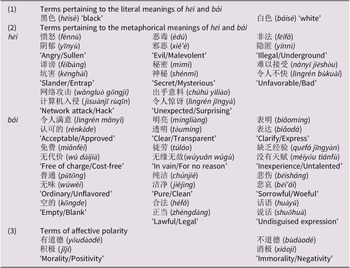
The search terms in this study fall into three categories. First, 黑色 (hēisè ‘black color’) and 白色 (báisè ‘white color’) were selected as the target terms pertaining to the literal meanings of hēi and bái, representing the concrete color concepts of black and white. Second, 20 abstract concepts based on metaphorical extensions of the two CTs – consisting of 8 metaphorical meanings of hēi and 12 metaphorical meanings of bái – were selected. These concepts and their corresponding terms were identified by reviewing the relevant previous studies (Lai & Chung, Reference Lai and Chung2018; Li & Bai, Reference Li and Bai2013; Wu, Reference Wu1986; Xing, Reference Xing and Xing2008; Zhang, Reference Zhang1988; Zhang,Reference Zhang1991) and the Contemporary Chinese Dictionary (7th ed.; Institute of Linguistics, Chinese Academy of Social Sciences, 2016). The alternative meanings were then refined depending on whether they are metaphorically derived from natural color. They were further filtered based on whether their occurrence frequency exceeds 100 in a sample dataset extracted from the two corpora – the Chinese Simplified Web 2017 Sample for web texts and the Chinese Gigaword 2 Corpus (Mainland, simplified) for newswires. These were accessed through the Sketch Engine platform (Kilgarriff et al., Reference Kilgarriff, Baisa, Bušta, Jakubíček, Kovář, Michelfeit, Rychlý and Suchomel2014). In total, there are 23,860 instances of hēi and 50,966 instances of bái. The greater number of instances of bái is due to the relatively sparser distribution of its metaphorical uses as compared to that of hēi in the corpora. Please note that most of the identified metaphorical meanings were described by two Chinese terms (or short phrases) to provide an accurate description of their corresponding abstract concepts and minimize the effect of polysemous terms during the data collection procedure. Third, a pair of terms with strong affective polarity was selected to anchor the positive and negative endpoints of the valence dimension regarding their frequent uses in previous studies when discussing the congruency effect between color brightness and valence (Huang et al., Reference Huang, Tseb and Xi2018; Meier et al., Reference Meier, Robinson and Clore2004; Meier et al., Reference Meier, Fetterman and Robinson2015; Sherman & Clore, Reference Sherman and Clore2009). Moreover, their efficiency and reliability in representing affective polarity have been further discussed in Section 4 of the Supplementary Material. They will serve as referents to measure the emotional valence of the 22 hēi- and bái-related concepts. Table 1 provides an overview of the proposed search terms, further illustrated in the Appendix.
Search terms with their English translation in three semantic domains

2.2. Data collection
Google’s Python API was used to obtain the images returned by a Google search for each term. Specifically, the first 200 images were downloaded from Google Images for concepts only described by one term. For concepts described by two terms, the first 100 images of each term were downloaded from Google Images. It is noted that the order of Google search results is shaped by the PageRank algorithm, which incorporates the population-level search activity to identify which images are most frequently interacted with by users within the geographical region associated with the IP address (Jing & Baluja, Reference Jing and Baluja2008). In this way, 24 sub-datasets containing 200 images for each concept were collected from Google Images between March 1 and 26, 2023. The datasets were then refined by excluding the repeated images, the ones that only consist of branding, and the ones that do not accurately correspond to their target meanings (e.g., the collected images of the term 空的 kōngde may refer to Sky, not related to the target sense – Empty/Blank). Besides, most of the images with texts embedded in were removed from the dataset to minimize their potential side effect of obscuring the distinguishability of different concepts in the computation of color distributions. However, images were reserved if there is only a small number of texts on them and their main content remains the designed uses of color. This is to guarantee that there are enough images to compute color distributions after refining the dataset. Finally, 100 images were randomly collected from each refined sub-dataset, obtaining a final dataset containing 24*100 images for further analysis (https://osf.io/8h3d2/?view_only=66750abca4bb48e194a476222d951078). The robustness of the dataset is evident from the consistency across varied search results. In addition to the major dataset reported in the paper, two additional datasets were collected to verify the results, one from Baidu with Chinese search terms (March 1 to 26, 2023) and the other from Google with English search terms (April 15 to 30, 2022), as detailed in Section 5 of the Supplementary Material. A comparison of the major dataset with the two additional datasets renders highly consistent findings regarding emotional valence and perceptual (dis)similarities of the literal and metaphorical meanings under study. All images were collected with an identical IP address in Hong Kong, China.
2.3. Computing color distributions
In line with Guilbeault et al. (Reference Guilbeault, Nadler, Chu, Lo Sardo, Kar and Desikan2020), a few procedures were conducted to transfer the collected images into perceptually grounded word embeddings. First, every image was compressed into an anti-aliased 300 × 300 × 3 array of sRGB values. The sRGB pixel values of each image were then transformed into their counterpart in the JzAzBz colorspace. Eight evenly segmented regions of the JzAzBz colorspace, which are equally distinguishable by the human eye (Safdar et al., Reference Safdar, Cui, Kim and Lou2017), were used to measure the density of points of each image. Lastly, an eight-dimensional vector for each target concept was obtained by averaging the JzAzBz colorspace of the 100 images in the corresponding sub-dataset, named the aggregate color distribution.
2.4. Data analysis
Based on the obtained color distributions, we investigated the emotional valence and color association strength of these 22 literal and metaphorical meanings of hēi and bái with several statistical techniques, including (i) observing their general distributional pattern with t-distributed stochastic neighbor embedding (t-SNE); (ii) examining their emotional valence with correspondence analysis (CA); and (iii) comparing their perceptual (dis)similarities employing CA and hierarchical agglomerative clustering (HAC). The results are presented in Section 3.
3. Results
3.1. General observation of the literal and metaphorical meanings of hēi and bái
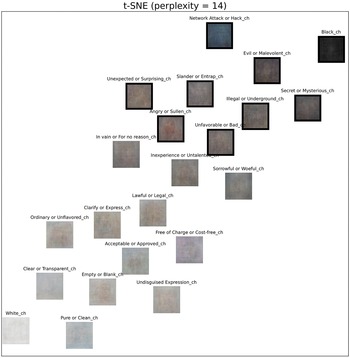
Fig. 1 provides a general observation on the distributional pattern of the literal and metaphorical meanings of hēi and bái based on their color distributions with t-SNE. It enables us to visualize their neighborhood structure through a 2-D scatterplot. In principle, meanings with similar color distributions would be neighbors with each other in Fig. 1. It is shown that the 22 concepts corresponding to either literal or metaphorical meanings of hēi and bái are evenly distributed in Fig. 1 with gradient colorgrams from black to white. Precisely, the terms ‘Black_ch’ and ‘White_ch’ lie, respectively, in the upper-right and lower-left corners, with almost the blackest and whitest colorgrams, while their metaphorical meanings are scattered in between these two terms. It is found that all the metaphorical meanings of hēi are in the vicinity of each other in the upper area of Fig. 1 with relatively blacker colorgrams, and the nonliteral meanings of bái are mainly located in the lower part with whiter colorgrams. The result indicates that both the literal and metaphorical senses of bái are visually whiter than those of hēi regarding their color distributions in the perceptually uniform colorspace, which provides preliminary evidence for the embodiment of color metaphor. However, it should be noted that the proximity between these datapoints in Fig. 1 cannot be interpreted as their relative association strength since the t-SNE only focuses on the neighborhoods but fails to preserve the whole variance of the dataset. Hence, it is hard to identify whether a given metaphorical meaning, especially for those in the middle area, has a stronger association with its corresponding literal meaning only based on their relative distance in the t-SNE plot. CA technique provides a solution for this issue as it can depict the total variance of a given dataset.
t-Distributed stochastic neighbor embedding (t-SNE) plot for color distribution data of the literal and metaphorical meanings of hēi and bái. The desired number of neighbors for each datapoint, perplexity, is set to 14 to get an ideal visualization of the t-SNE results. The datapoints were labeled with the English translations of their corresponding search terms and colorgrams, defined as “a composite image produced by averaging the color value for each pixel across all images in a search term’s image set” (Guilbeault et al., Reference Guilbeault, Nadler, Chu, Lo Sardo, Kar and Desikan2020, p. 5). The colorgrams associated with hēi were marked with a black border for easy reference.

3.2. Emotional valence of the literal and metaphorical meanings of hēi and bái
This section investigates the emotional valence of the 22 literal and metaphorical senses of hēi and bái via visualizing their relative color association strength with the referential terms of affective polarity with the CA technique, as depicted by Figs. 2 and 3. In a CA biplot, the smaller the proximity between two datapoints is, the stronger their association is. A concept is regarded to be emotionally more positive if its corresponding datapoint has closer proximity with ‘Morality/Positivity_ch’, while closer proximity with ‘Immorality/Negativity_ch’ indicates negative valence. What follows is a detailed description of the CA results.
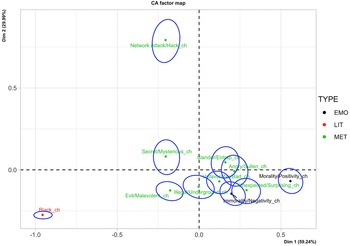
Correspondence analysis (CA) biplot for color distribution data of terms referring to the literal and metaphorical meanings of hēi, as well as the affective polarity. The datapoints were color-marked for different categories – referential terms of affective polarity in black, literal meanings in red, and metaphorical meanings in green. The positions of datapoints were predicated with 95% confidence ellipses. The variation detected by the CA technique for a dataset is depicted through several distinct dimensions, each retaining a certain proportion of the total variation. In line with the previous studies (e.g., Glynn, Reference Glynn, Evans and Pourcel2009, Reference Glynn, Schmid and Handl2010), all CA maps in this study were plotted based on the variation retained in the first two dimensions (dimensions 1 and 2).

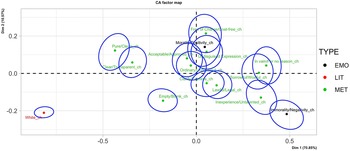
Correspondence analysis biplot for color distribution data of terms referring to the literal and metaphorical meanings of bái, as well as the affective polarity.

Fig. 2 shows the emotional valence of the literal and metaphorical meanings of hēi with significant predictive power as the cumulative variance explained by dimensions 1 and 2 exceeds 85%. Specifically, it is demonstrated that seven of the metaphorical senses are mainly distributed in the vicinity of the original point, whereas the sense ‘Network attack/Hack’ lies in the upper-left quadrant and ‘Black_ch’ in the lower-left quadrant, with relatively greater distance from the others. We found that the nine senses demonstrate closer proximities with ‘Immorality/Negativity_ch’ rather than ‘Morality/Positivity_ch’ with high statistical significance (t(8) = 9.11, p < 0.01), showing that both the literal and metaphorical meanings of hēi are more likely to evoke negative emotions. It is consistent with the emotional valence of the black color, which tends to be negatively valenced, as discussed by previous studies (e.g., Meier et al., Reference Meier, Robinson and Clore2004; Sherman & Clore, Reference Sherman and Clore2009). Besides, the term ‘Black_ch’ is significantly farther away from the two referential terms of affective polarity than others (t(7) = −8.4811, p < 0.01), indicating that the literal meaning of hēi may have weaker emotionality than its metaphorical meanings. It is noted that weak emotionality only means that the literal meaning of hēi is weaker in expressing emotions than these metaphorical senses, while its negative valence is still distinct given the proximity difference of ‘Black_ch’ with ‘Immorality/Negativity_ch’ and ‘Morality/Positivity_ch’.
In Fig. 3, the emotional valence of these bái-denoted literal and metaphorical senses was predicated on the cumulative variance (81.42%) explained by the first two dimensions. Specifically, nine of the metaphorical meanings of bái are consistent with the valence of the white color in demonstrating a positive emotional valence, including ‘Acceptable/Approved’, ‘Clarify/Express’, ‘Clear/Transparent’, ‘Free of Charge/Cost-free’, ‘Lawful/Legal’, ‘Ordinary/Unflavored’, ‘Empty/Blank’, ‘Undisguised expression’, and ‘Pure/Clean’. It is supported by their significantly closer proximity to ‘Morality/Positivity_ch’ in Fig. 3 (t(9) = −10.703, p < 0.01). Three other metaphorical senses of bái have a stronger association with negative affections as depicted by their relatively closer distance with the term ‘Immorality/Negativity_ch’ (t(2) = 1.9574, p < 0.1), which are ‘In vain/For no reason’, ‘Inexperience/Untalented’, and ‘Sorrowful/Woeful’. Besides, weaker emotionality of the literal meaning of bái is also expected since the term ‘White_ch’ lies significantly farther away from the terms of affective polarity than these metaphorical senses (one-sample Wilcoxon Rank Sum test: p < 0.01).
In short, CA results in Figs. 2 and 3 showed that both the literal and metaphorical meanings of hēi tend to be negatively valenced regarding their emotional experience, demonstrating a significant affective consistency between the source and target concepts regarding the metaphorical uses of hēi. On the other hand, although the white color is more likely to be associated with positive affections, the emotional valence of these bái-denoted metaphorical meanings can either be positive or negative. Section 1 of the Supplementary Material provides a detailed discussion on the statistical significance of the CA findings. Besides, the detected emotional valence of the literal and metaphorical senses is further confirmed by investigating their association strengths with 10 Chinese emotion words that refer to common positive and negative emotions such as 幸福 xìngfú ‘happiness’ and 恐惧 kǒngjù ‘fear’, as detailed in Section 4 of the Supplementary Material. It reveals that consistency of emotional valence does not always exist between the literal and metaphorical meanings of a CT.
3.3. Perceptual (dis)similarities among the literal and metaphorical meanings of hēi and bái
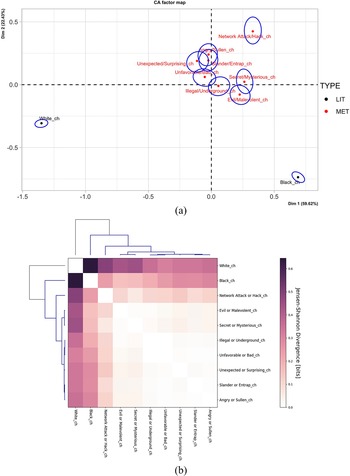
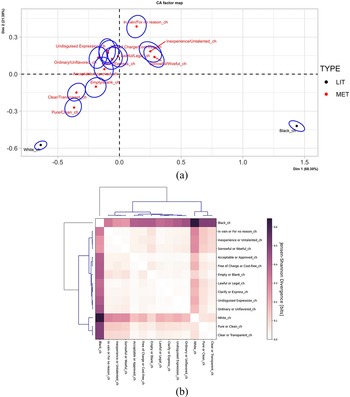
With CA and HAC techniques, this section compares perceptual (dis)similarities between the literal and metaphorical meanings of hēi and bái, respectively, in the perceptually uniform colorspace. The results are illustrated in Figs. 4 and 5.
Fig. 4 depicts the CA and HAC results on the 10 concepts pertaining to the eight metaphorical meanings of hēi and the two literal meanings of hēi and bái. In Fig. 4(a), the distributional pattern of these 10 concepts was plotted based on the cumulative variance (82.05%) of the first two dimensions. In specific, the eight metaphorical meanings of hēi mainly lie in the upper quadrants, near the original point. Their mutually overlapped confidence ellipses indicate that these eight metaphorical meanings of hēi share remarkable perceptual similarities. More importantly, it is shown that the eight metaphorical senses of hēi are more closely distributed to the term ‘Black_ch’ rather than ‘White_ch’ with statistical significance (t(7) = −4.6688, p < 0.01), which are plotted in lower-right and lower-left quadrants. Such a distributional pattern indicates that the eight abstract concepts metaphorically denoted by hēi have stronger associations with the color concept of black rather than white in the JzAzBz colorspace.
Correspondence analysis biplot (a) and clustering dendrogram (b) for the eight metaphorical meanings of hēi and the two literal meanings of hēi and bái. For (a), terms referring to literal meanings were colored in black, whereas metaphorical meanings were red. For (b), the clustering results were calculated with the ward method based on the distance matrix that consists of the Jensen–Shannon (JS; Guilbeault et al., Reference Guilbeault, Nadler, Chu, Lo Sardo, Kar and Desikan2020) divergence values between pairs of terms’ color distributions. The clustering results were visualized as a dendrogram, and JS divergence values were represented as a heatmap. Lower JS values correspond to more similar color distributions in the perceptually uniform colorspace.

The clustering results in Fig. 4(b) further support such associations among the 10 target concepts. Generally, individuals forming branches in a lower level are expected to be more similar to each other, which corresponds to smaller JS divergence values, as highlighted by the heatmap in Fig. 4(b). It is shown that the eight metaphorical meanings of hēi, as a major branch of the dendrogram in Fig. 4(b), consist of four sub-branches: (i) ‘Unexpected/Surprising_ch’, ‘Angry/Sullen_ch’, and ‘Slander/Entrap_ch’; (ii) ‘Illegal/Underground_ch’ and ‘Unfavorable/Bad_ch’; (iii) ‘Evil/Malevolent_ch’ and ‘Secret/Mysterious_ch’; and (iv) ‘Network attack/Hack_ch’. One level up, these eight senses were clustered first with the term ‘Black_ch’ rather than ‘White_ch’, indicating the higher perceptual similarity between the literal and metaphorical meanings of hēi.
Fig. 5 presents the distributional pattern of the 14 concepts pertaining to the 12 metaphorical meanings of bái and the two literal meanings of hēi and bái. Again, in Fig. 5(a), the terms ‘White_ch’ and ‘Black_ch’ are scattered in the lower-left and lower-right quadrants, respectively, with relatively far distance to the original point. It is found that the 12 metaphorical senses of bái are significantly closer to ‘White_ch’ than to ‘Black_ch’ (t(11) = 6.2367, p < 0.01). Specifically, nine of them lie in the left two quadrants, including ‘Pure/Clean_ch’, ‘Clear/Transparent_ch’, ‘Empty/Blank_ch’, ‘Ordinary/Unflavored_ch’, ‘Undisguised expression_ch’, ‘Free of charge/Cost-free_ch’ ‘Clarify/Express_ch’, ‘Acceptable/Approved_ch’, and ‘Lawful/Legal_ch’. The other three meanings of bái with negative valence – ‘Inexperience/Untalented_ch’, ‘In vain/For no reason_ch’, and ‘Sorrowful/Woeful_ch’ – were depicted in the upper-right quadrant with a relatively farther distance to ‘White_ch’ as compared to other metaphorical senses. Overall, Fig. 5(a) shows that all the 12 metaphorical meanings of bái have a closer proximity with ‘White_ch’ rather than ‘Black_ch’, indicating a stronger association between the literal and metaphorical senses of bái in the perceptually uniform colorspace. HAC analysis yields consistent results, as shown in Fig. 5(b). Two sub-branches containing 10 metaphorical meanings are observed at a relatively lower level, corresponding to the two meaning groups identified in Fig. 5(a). In the same level, ‘White_ch’ was clustered first with the two meanings, ‘Pure/Clean_ch’ and ‘Clear/Transparent_ch’, and then formed a larger branch with the other two metaphorical senses in an upper level. ‘Black_ch’ is the last member of the dendrogram. The HAC results further confirm the distinct perceptual similarity between the literal and metaphorical meanings of bái. The robustness of the HAC results is supported by comparing their cluster modularity values with a benchmark modularity distribution of random word sets, as detailed in Section 2 of the Supplementary Material.
Correspondence analysis biplot (a) and clustering dendrogram (b) for the 12 metaphorical meanings of bái and the two literal meanings of hēi and bái.

In sum, the qualitatively similar results yielded by CA and HAC demonstrated that all the metaphorical senses of hēi and bái are perceptually more similar with their corresponding literal meanings based on their color distributions with high statistical significance, even though the distinctiveness of such perceptual congruity differs from one another. It is worth mentioning that the association difference between the three negatively valenced metaphorical meanings of bái with the base terms ‘White_ch’ and ‘Black_ch’ is less distinctive than that of the other nine metaphorical meanings in terms of their relative proximity. In other words, the three negative meanings of bái share greater perceptual similarity with the literal meaning of hēi than others in the perceptually uniform colorspace (t(9.9029) = −6.6277, p < 0.01). Highly consistent results were also obtained based on the two additional datasets collected from Baidu with Chinese search terms and from Google with English search terms, as discussed in Section 5 of the Supplementary Material. A detailed discussion of the results is provided in the next section.
4. General discussion
The present study aims to figure out whether there is perceptual congruity between the literal and metaphorical meanings of hēi and bái, as well as the role of emotional valence in determining such perceptual congruity, if any, under the framework of embodied cognition. Methodologically, an image-based visual corpus analysis approach was adopted to explore the nonlinguistic dimension of their interrelations. This approach can simultaneously capture metaphorical mapping relations between different concepts and their affective associations by depicting their aesthetic coherence based on color information extracted from online images. Precisely, the emotional valence and perceptual (dis)similarities among the 22 literal and metaphorical meanings of hēi and bái, with each meaning described by one or two Chinese terms, were empirically investigated based on their eight-dimensional color distributions in the JzAzBz colorspace. Regarding the empirical results of t-SNE, CA, and HAC, three major findings were obtained: first, the metaphorical meanings of hēi and bái tend to have stronger emotionality than their literal meanings; second, valence inconsistency appears between the literal and metaphorical meanings of bái, whereas all metaphorical meanings of hēi share consistent emotional valence with the literal meaning of hēi; third, there proves to be a distinct perceptual similarity between the literal and metaphorical meanings of hēi, so is the case of bái, and the distinctiveness of such similarity can be affected by whether the pair of literal and metaphorical senses have consistent emotional valence.
4.1. The metaphorical meanings of both hēi and bái tend to carry stronger emotionality than their literal senses
This finding accords with the previous discussion on the emotionality of metaphorical language (see Section 1.1) and provides new evidence based on image-based sensory data. To explore the associations between metaphorical language and emotionality, previous studies were mainly conducted based on linguistic stimuli with participant-involved psychological experiments, for example, human rating (Mohammad et al., Reference Mohammad, Shutova and Turney2016) or neuroimaging (Citron & Goldberg, Reference Citron and Goldberg2014; Samur et al., Reference Samur, Lai, Hagoort and Willems2015). In the current study, the stronger emotionality of metaphorical language, as depicted in Figs. 2 and 3, was supported by sensory data extracted from online images with a computational method. To be specific, this study provides image-based, objective evidence to verify the stronger emotionality of metaphorical language via demonstrating the higher association strength of the metaphorical meanings of hēi and bái with the referential terms of affective polarity in the JzAzBz colorspace. The results reveal the relative weakness of the literal meanings of hēi and bái in expressing emotions compared to their metaphorical meanings. However, it is noted that the abstractness degree of these meanings may also correlate with their degrees of emotionality, according to Piccirilli and im Walde (Reference Piccirilli and im Walde2022), which was not discussed in the current study. Future inquiries are needed for further exploration.
4.2. Although most metaphorical meanings of hēi and bái tend to share consistent emotional valence with their corresponding literal senses, valence inconsistency does exist regarding pairs of literal and metaphorical meanings of bái
This finding provides a more detailed description of the emotional valence of the hēi- and bái-related concepts, which can be complementary to the findings of previous studies. Conventionally, the black color tends to be associated with negative valence, whereas the white color is more likely to be rated as positive valence, as discussed in Section 1.2. However, the current study showed that such emotional valence-color congruity regarding black and white does not always exist when their metaphorical extensions are considered. The extended meanings of the white color can be negatively valenced, at least in Chinese. In contrast to the consistently negative emotional valence of the literal and metaphorical meanings of hēi, there are three metaphorical meanings of bái (‘Inexperience/Untalented’, ‘In vain/For no reason’, and ‘Sorrowful/Woeful’) demonstrating stronger associations with negative affections. The three meanings are emotionally incongruent with the literal sense of bái in the valence dimension. In short, there can be a mismatch of emotional valence between the source and target domains of color metaphor in terms of the metaphorical uses of bái.
The present study argues that such inconsistent emotional valence between the literal and metaphorical meanings of bái can be explained based on the three-dimensional color perception theory (hue, brightness, and saturation – Fairchild, Reference Fairchild2005) and cultural connotations of black and white in the Chinese context. Specifically, previous studies mainly consider the brightness of the two colors, white as the brightest and black as the darkest, to explain their associations with positive and negative valence, summarized as a brightness-valence conceptual metaphor (e.g., Huang et al., Reference Huang, Tseb and Xi2018). This provides possible explanations for why all eight metaphorical meanings of hēi have consistent emotional valence with the black color – they are all metaphorically derived from the perceptual experience of blackness in terms of the brightness dimension. It is partly supported by the efficiency of the luminance dimension Jz in distinguishing the perceptual (dis)similarities between the metaphorical senses of hēi and the two literal senses, as detailed in Section 6 of the Supplementary Material. However, the other two dimensions of hue and saturation may also play a role. In addition to being the brightest color, white has the other two perceptual properties, zero colorfulness and absence of hue, which may serve as perceptual sources for metaphorical extensions in the abstract semantic domains. That is, these three negatively valenced metaphorical meanings of bái may be derived from its perceptual properties in hue and saturation but not the brightness dimension. Specifically, as demonstrated in Section 6 of the Supplementary Material, a t-test was performed to examine whether the three negative senses are significantly closer to either ‘Black_ch’ or ‘White_ch’ in the luminance dimension Jz. The results indicate a lack of statistical significance for both comparisons, with t-scores of 1.8455 and p-values of 0.1031 and 0.8969 for ‘Black_ch’ and ‘White_ch’, respectively. On the other hand, there is a distinct conceptual correspondence between the meaning ‘In vain/For no reason’ and the absence of hue in the white color, as the lack of intended incentives or outcomes (in vain) can be associated with the lack of hue in color perception. This issue has been discussed in a corpus-based behavioral profiles study (Dou & Liu, Reference Dou and Liu2023), focusing on the mapping relations between the three perceptual properties of white color (absence of hue, highest brightness, and zero colorfulness) and the metaphorical extensions of bái. It is suggested that the meaning ‘In vain/For no reason’ derives from the perceptual property – absence of hue, whereas the other two meanings, ‘Sorrowful/Woeful’ and ‘Inexperience/Untalented’, are associated with the property of zero colorfulness in terms of the saturation dimension. Nonetheless, the three-dimensional color perception theory cannot explain why the two meanings ‘Free of charge/Cost-free’ (lack of cost) and ‘In vain/For no reason’ (lack of outcome) have opposite emotional valence given that both senses seem to be metaphorically grounded in the same perceptual property – absence of hue; nor can it explain why the sense ‘In vain/For no reason’ is not metaphorically associated with hēi instead, since the black color also shares the perceptual property – absence of hue – and even the consistent negative valence with the meaning. We speculate that cultural connotations of white and black in the Chinese context (i.e., Zhang et al., Reference Zhang, Tao, Lai, Zhao, Lai and He2022) may provide a possible clue for these questions since conceptual metaphors can be understood as a cognitive-cultural phenomenon (Kövecses, Reference Kövecses2015). The white color is traditionally plain and sad, and thus it may denote something easy (without cost) and undesirable (without outcome).
In sum, although most of the metaphorical extensions of hēi and bái are consistently valenced with their corresponding literal senses, exceptions do exist for the metaphorical extensions of bái. It is suggested that explaining such valence (in)consistency may be accounted for by the three-dimensional color perception theory and the cultural connotations of black and white in the Chinese context. However, further research is required to pinpoint the specific cognitive interactions among the perceptual properties of the black and white colors, their metaphorical meanings, and the cultural connotations of black and white in the Chinese context.
4.3. The metaphorical meanings of hēi and bái are perceptually more similar to their corresponding literal meanings, and the distinctiveness of such perceptual similarity can be influenced by the (in)consistency of emotional valence among them
This finding provides nonlinguistic and sensory data-based evidence to support the metaphorical mapping relations indicated by the linguistic metaphors of the CTs hēi and bái. Precisely, the abstract concepts metaphorically denoted by hēi share more perceptual similarity with the black color than those of bái regarding their color distributions in the perceptually uniform colorspace. The same perceptual similarity was found between these bái-related literal and metaphorical meanings. Such congruity between pairs of concepts in the source and target domains is consistent with the theories of embodied metaphor (e.g., Gibbs, Reference Gibbs1994; Lakoff & Johnson, Reference Lakoff and Johnson1980, Reference Lakoff and Johnson1999), which claims that abstract concepts are embodied through the metaphorical mapping relations with concrete concepts that are highly grounded in sensorimotor perceptual experience.
Besides, the results also showed that emotional valence can influence the degree of perceptual distinguishability between the literal and metaphorical meanings of hēi and bái. It is mainly supported by the strong positive correlation (r = 0.912, p < 0.01) between the proximity differences of the metaphorical senses to the two referential terms of emotional valence (X) and their differences to ‘Black_ch’ and ‘White_ch’ (Y) in the CA results, as illustrated in Section 3 of the Supplementary Material. Related to that, the three negatively valenced metaphorical senses of bái (‘Inexperience/Untalented’, ‘In vain/For no reason’, and ‘Sorrowful/Woeful’) are distributed distinctively farther to ‘White_ch’ and closer to ‘Black_ch’ compared to other metaphorical senses, showing their less distinctive perceptual similarity with the literal meaning of bái. It reveals that emotional experience may play a role in constructing color metaphors as opposite emotional valences can weaken the degree of perceptual similarity between the color concept and its metaphorically related noncolor abstract concepts.
However, the influence of emotional valence is not predominant since these three negative metaphorical meanings of bái still have a stronger association with ‘White_ch’ rather than ‘Black_ch’, as discussed in Section 3.3. The limited role of emotional valence can also be concluded based on the proximity of the nine positive metaphorical meanings of bái with ‘White_ch’. That is, solely based on emotional valence, we cannot explain why ‘Empty/Blank’, ‘Clear/Transparent’, and ‘Pure/Clean_ch’ are perceptually more similar to ‘White_ch’ than the other six positive senses, which indicates the limitation of emotional valence again. We suspect that the distributional skewing can be attributed to the different degrees of abstractness of these meanings. Lower degrees of abstractness may reduce the influence of emotional valence on their perceptual similarity with ‘White_ch’ given the correlation between abstractness and emotion (Troche et al., Reference Troche, Crutch and Reilly2014, Reference Troche, Crutch and Reilly2017). Besides, varying imageability of the metaphorical senses may also contribute to the closer proximity of the three senses to the literal sense of bái, as indicated by Kastner et al. (Reference Kastner, Matsuhira, Ide and Satoh2021) and Citron et al. (Reference Citron, Güsten, Michaelis and Goldberg2016). Again, this is only a preliminary hypothesis requiring further inquiry in the future.
In sum, the statistical results not only provide nonlinguistic evidence for the conceptual mapping relations between the literal and metaphorical meanings of hēi and bái via depicting their perceptual congruity, but also reveal the important but limited influence of emotional valence on such perceptual congruity – we cannot predict the existence or distinctiveness of perceptual congruity between pairs of literal and metaphorical senses only based on whether they have consistent emotional valence. Furthermore, the current finding appears to deviate somewhat from the perspective of embodied abstract semantics (Kousta et al., Reference Kousta, Vigliocco, Vinson, Andrews and Campo2011; Vigliocco et al., Reference Vigliocco, Meteyard, Andrews and Kousta2009), which postulates that emotional experience may exert a more significant impact than sensorimotor information in the representation of abstract concepts. The present study may thus shed new light on the debatable issues regarding the role of emotional experience in representing and understanding abstract concepts.
5. Conclusion
Based on sensory data extracted from online images, the present study empirically demonstrated the distinct perceptual congruity between the literal and metaphorical senses of the two Chinese CTs, hēi ‘black’ and bái ‘white’, which provides nonlinguistic support for the metaphorical associations embedded in the linguistic metaphors of the two terms. It also discovers that emotional valence may influence such perceptual congruity to a certain extent depending on whether they share consistent emotional valence. As most metaphorical senses of hēi and bái display the same emotional valence with their corresponding literal meanings, the important role of emotional valence in perceptual (dis)similarities can be understood with the observation that opposite emotional valences between a pair of literal and metaphorical meanings may weaken the distinctiveness of their perceptual similarity. However, it should also be noted that the influence of emotional valence is not all-encompassing, nor preponderant, in determining the perceptual (dis)similarities since (i) the distinct perceptual similarity between a pair of literal and metaphorical senses cannot be dismissed by their opposite emotional valence; and (ii) the degrees of perceptual similarity may vary among different pairs of literal and metaphorical meanings that exhibit consistent emotional valence.
In conclusion, the present study not only provides new evidence for the embodiment of color metaphors in Chinese by showing the perceptual congruity between the literal and metaphorical meanings of hēi and bái, but also reveals the essential but limited role of emotional valence in influencing the perceptual congruity between the concepts in the source and target domains. Besides, this study is an initial attempt at the empirical investigation into the embodiment of color metaphors with nonlinguistic sensory data, which may contribute to the research paradigms and long-standing debate on metaphor- and emotion-related issues of embodied cognition.
Supplementary material
The supplementary material for this article can be found at https://doi.org/10.1017/langcog.2023.22.
Data availability statement
The datasets generated during the current study is available in the Open Science Framework repository at https://osf.io/8h3d2/?view_only=66750abca4bb48e194a476222d951078.
Competing interest
The authors declare none.
Appendix
A.1. Metaphorical meanings of hēi
A.1.1. Slander or entrap

A.1.2. Illegal or underground

A.1.3. Evil or malevolent

A.1.4. Unfavorable or bad

A.1.5. Angry or sullen

A.1.6. Secret or mysterious

A.1.7. Unexpected or surprising

A.1.8. Network attack or hack

A.2. Metaphorical meanings of bái
A.2.1. Clear or transparent

A.2.2. Empty or blank

A.2.3. In vain or for no reason

A.2.4. Free of charge or cost-free

A.2.5. Acceptable or approved

A.2.6. Inexperience or untalented

A.2.7. Sorrowful or woeful

A.2.8. Undisguised expression

A.2.9. Ordinary or unflavored

A.2.10. Pure or clean

A.2.11. Lawful or legal

A.2.12. Clarify or express