Introduction
As the ageing population grows in size and the number of adults who live alone at home continues to increase (Cannuscio, Block and Kawachi Reference Cannuscio, Block and Kawachi2003; Moone and Lightfoot Reference Moone and Lightfoot2009; Portacolone Reference Portacolone2011) there are likely to be significant benefits associated with increasing the proportion of older adults who are regular internet users. The internet allows us to complete tasks that would have necessitated leaving the home, such as filling out government documents, paying bills or ordering groceries to be delivered. Patients who use the internet to obtain health information report feeling more confident about their interactions with physicians and having a better understanding of how to manage their health condition(s) (Henner Reference Henner2009; Reddick Reference Reddick2006). Increasingly, devices which require an understanding of digital technology and regular internet use are being developed to monitor or improve health (Goldwater and Harris Reference Goldwater and Harris2011; Kang et al. Reference Kang, Mahoney, Hoenig, Hirth, Bonato, Hajjar and Lipsitz2010; Wild et al. Reference Wild, Boise, Lundell and Foucek2008). Furthermore, internet use has been positively related to the strength of social networks among adults over 50 years old (Hogeboom et al. Reference Hogeboom, McDermott, Perrin, Osman and Bell-Ellison2010).
Despite numerous studies delineating ways in which use of the internet can ameliorate the lives of older adults, internet use has consistently been inversely associated with age (Fox and Jones Reference Fox and Jones2009; Jansen Reference Jansen2010; Lenhart et al. Reference Lenhart, Horrigan, Raine, Allen, Boyce, Madden and O'Grady2003). Furthermore, age has been associated with greater anxiety about information technology (Czaja and Sharit Reference Czaja and Sharit1998; Czaja et al. Reference Czaja, Charness, Fisk, Hertzog, Nair, Rogers and Sharit2006; Kraus and Hoyer Reference Kraus, Hoyer, Robinson, Livingston and Birren1984; Lee, Chen and Hewitt Reference Lee, Chen and Hewitt2011; Reisenwitz et al. Reference Reisenwitz, Iyer, Kuhlmeier and Eastman2007; Ryan, Szechtman and Bodkin Reference Ryan, Szechtman and Bodkin1992). However, research seeking to understand the characteristics that distinguish older adults who are regular internet users from those who are not remains relatively confined to studies that associate computer or internet use with traits measured in older adulthood. For example, prior research on internet usage among older adults points to a strong association between having a positive perception of the usefulness, ease of use and efficacy of the internet or email, and regular internet use (Nichola, Stubbs and Woods Reference Nichola, Stubbs and Woods2005). Older adults who possess greater cognitive skills and educational attainment are much better positioned to reap the potential benefits of online tools (Freese, Rivas and Hargittai Reference Freese, Rivas and Hargittai2006). Additionally, older internet users have tended to score more favourably on measures of psychological wellbeing than non-users (Chen and Persson Reference Chen and Persson2010).
The dominant rhetoric with regard to the digital divide has focused on the split between digital technology use and non-use (Tsatsou Reference Tsatsou2011). Early research on disparities in internet use pointed to a digital divide based on socio-economic status (SES) (Lenhart et al. Reference Lenhart, Horrigan, Raine, Allen, Boyce, Madden and O'Grady2003; Wresch Reference Wresch1996) and more recent research continues to suggest that greater educational attainment and higher income are associated with an increased likelihood of internet use (Jung et al. Reference Jung, Peng, Moran, Jin, McLaughlin, Cody, Jordan, Albright and Silverstein2010). Considerable academic attention has been paid to concerns about access to technology (Horrigan and Rainie Reference Horrigan and Rainie2002; Norris Reference Norris2001; Selwyn Reference Selwyn2004) and it has been suggested that there is not a singular digital divide, but instead there are numerous digital divides which emerge from rapid technological development (Tsatsou, Pruulmann-Vengerfeldt and Murru Reference Tsatsou, Pruulmann-Vengerfeldt, Murru, Livingstone and Haddon2009). To that end, distinctions in usage rates of digital technology can be conceptualised in terms of individual differences, suggesting that it is important to uncover sources of exclusion in order to enhance usage rates (Couldry Reference Couldry2007). Social, cultural and educational parameters influence an individual's capability in using digital technologies and thus it is important to uncover nuances in the distinctions between those who make use of digital technology and those who do not (van Dijk Reference van Dijk1999, Reference van Dijk2005) in order to target efforts for building the requisite skills, knowledge and support necessary to develop digital skills.
Prior research suggests that significant gaps remain in explaining the relationship between patterns of internet use and economic as well as social capital (Lazarus and Mora Reference Lazarus and Mora2000; Norris Reference Norris2001). In particular, it has been argued that there are gaps in terms of age and SES (Wilson, Wallin and Reiser Reference Wilson, Wallin and Reiser2003). However, there is a growing body of literature focusing on the relationship between childhood SES and the internet literacy of children and young people (Cho et al. Reference Cho, de Zuniga, Rojas and Shah2003; Livingstone and Helsper Reference Livingstone and Helsper2007; van Braak and Kavadias Reference van Braak and Kavadias2005). Yet there still remains a gap in our understanding of the relationship between indicators of SES at different phases in the lifecourse and internet use in older adulthood.
Over the past decade, social gerontologists have argued that a lifecourse perspective is necessary to understand variations in the characteristics of older adults (Elder Reference Elder1992, Reference Elder1998; Elder and O'Rand Reference Elder, O'Rand, Cook, Fine and House1995). The lifecourse approach substantiates the claim that there may be a relationship between SES early in the lifecourse and outcomes that occur later in life, while pointing out that is it also possible for favourable circumstances occurring later in life to compensate for earlier disadvantages (Graham Reference Graham2002). The theory of cumulative advantage/disadvantage also suggests that over the lifecourse having favourable initial endowments such as high childhood SES can lead to large additional gains while initial disadvantage can lead to less favourable outcomes or declines (Dannefer Reference Dannefer2003).
Drawing on the lifecourse perspective, this study explored the relationship between SES at different phases in the lifecourse and internet use in older adulthood using a nationally representative sample of the United States of America's (USA) population 51 years old and over to address three questions. (1) Does higher childhood SES increase the odds of being a regular internet use in older adulthood? (2) Do SES advantages accumulate, so that higher SES throughout the lifecourse increases the odds of being an internet user in older adulthood? And because there tend to be different patterns of internet use related to age (Goldfarb and Prince Reference Goldfarb and Prince2008), as well as generational differences related to internet use (Gilleard and Higgs Reference Gilleard and Higgs2008), this study also explored (3) whether age moderated the relationship between internet use and cumulative SES.
Methods
Sample
The data were extracted from the US Health and Retirement Study (HRS), a longitudinal biannual survey of households that includes a primary respondent and his/her spouse. Initiated in 1992, the HRS is a population-based survey designed to study the health and wellbeing of community-dwelling adults in the contiguous USA who are over the age of 50. The HRS is sponsored by the National Institute of Aging and is conducted by the University of Michigan. The study is reviewed and approved by the University of Michigan's Health Sciences institutional review board. In 1992 when the HRS started, there were 7,700 households and over 12,600 individuals interviewed. In subsequent years birth cohorts were added to make the survey representative of the non-institutionalised population in the USA aged 51 and older. The sample relies primarily on HRS data from wave 10 which was collected between 2010 and 2011; however for some respondents the indicators of childhood SES were pulled in from previous waves of the HRS. The sample is limited to 11,035 respondents age 51 years old and over, for whom there was no missing data for all variables (72% of respondents).
Measure of internet use
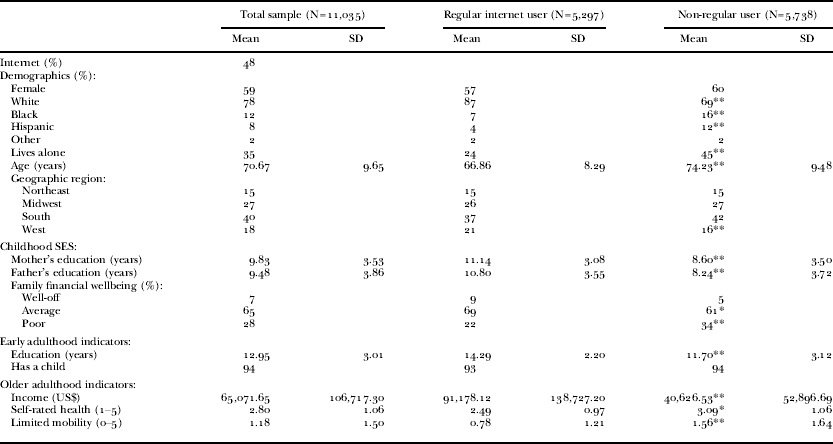
Respondents were asked whether they regularly use the World Wide Web, or the internet, for sending and receiving e-mail or for any other purpose, such as making purchases, searching for information or making travel reservations. Overall, approximately 48 per cent of respondents regularly use the internet. Table 1 presents descriptive statistics for the entire sample and by internet use status.
Descriptive statistics for the total sample and by internet use status

Notes: SD: standard deviation. SES: socio-economic status.
Significance levels: * p < 0.05, ** p < 0.01. Results from t-tests for mean differences and chi-square tests for differences in proportions between regular internet users and those who did not use the internet regularly.
Socio-economic status
Childhood SES included three items: the educational attainment of the respondent's mother and father and whether the respondent indicated that his or her family was financially pretty well-off, about average or poor. Overall, approximately half of the sample had parents who completed the ninth grade. Most of the sample (65%) rated their family's financial situation as a child as about average, only 7 per cent indicated that their family was well-off, and 28 per cent rated their family's financial situation as poor. Early adulthood SES was measured by educational attainment in years (mean = 12.95, standard deviation (SD) = 3.01). SES in older adulthood was measured by household income which was log transformed to correct for positive skewness (mean = 10.61, SD = 0.99).
Cumulative SES
A cumulative measure of SES across the lifecourse was created by summing the values of dichotomised measures of SES variables from the three measured points in the lifecourse (Carson et al. Reference Carson, Rose, Catellier, Kaufman, Wyatt, Diez-Roux and Heiss2007; Chichlowska et al. Reference Chichlowska, Rose, Diez-Roux, Golden, McNeill and Heiss2009). A dichotomous summary measure was created for childhood SES using a composite of binary measures of parental education (each cut at the mean) and family financial wellbeing (cut so that well-off was coded as 1). The childhood summary measure, early adulthood and older adulthood measures were each collapsed into two categories, low (0) and high (1), and then aggregated to create a cumulative SES score (cmlSES) which ranged from 0 (0 + 0+0) to 3 (1 + 1+1) with higher values indicating higher SES. Based on this measure of cumulative SES, a binary measure (high_cmlSES) was created to indicate that high SES was experienced during at least two points in the lifecourse. In addition, four indicators of cumulative SES trajectories were created: LLL indicated that the respondent had a consistently low SES at all three of the measured points in the lifecourse (reference group), LL indicated a low SES at any two points in the lifecourse and high SES at any one point (LLH, HLL, LHL), HH indicated having a high SES at any two points and low SES at one point (HHL, HLH, LHH), and HHH indicated having a high SES in childhood, early adulthood and older adulthood.
Other covariates
Gender, race/ethnicity, living alone, age (measured in years), geographic location of the respondent's primary residence and health status were controlled for in the multivariate analyses. More than half of the respondents were women (59%). There were four race/ethnicity categories: White (78%), Black (12%), Hispanic (8%) and other (2%). A measure of living alone (35%) was created based on the number of individuals residing in the respondent's household following prior research, indicating differences in time spent on the internet among older adults who live alone versus with others (Nie and Hillygus Reference Nie and Hillygus2002; Stepanikova, Nie and He Reference Stepanikova, Nie and He2010) and perceptions of support received from online user groups among single individuals (Sarkadi and Bremberg Reference Sarkadi and Bremberg2005). The average age of the sample was 70.67 years (SD = 10.40). The four regional categories included the following: northeast (15%), midwest (27%), south (40%) and west (18%). Because previous studies have suggested that children may be instrumental in helping older adults use the internet (Mossberger, Kaplan and Gilbert Reference Mossberger, Kaplan and Gilbert2008; Lenhart et al. Reference Lenhart, Horrigan, Raine, Allen, Boyce, Madden and O'Grady2003), a variable was created to indicate whether or not the respondent had a child (94% had at least one child).
Two measures of health in adulthood were created: self-rated health and limited physical mobility. To measure respondents' overall assessment of their own medical and functional status, an indicator of self-rated health was created based on respondents rating of their own health on a five-point scale ranging from excellent to poor (mean = 2.80, SD = 1.06). Previous research shows that self-rated health correlates well with physician-assessed health (Idler and Benyamini Reference Idler and Benyamini1997). Limited mobility was calculated by summing responses to five items assessing whether the respondent had difficulties with specific forms of ambulation such as walking a block and climbing a flight of stairs or muscle movements such as moving a large chair or picking up a coin from the table (Wallace and Herzog Reference Wallace and Herzog1995). It ranged from 0 to 5 (mean = 1.18, SD = 1.50) with alpha reliability of 0.86.
Statistical analysis
The data were analysed using Stata version 11. To address the first research question, odds ratios were estimated to examine the relationship between characteristics of respondents from different phases in their lifecourse and regular internet user status as an older adult. The first model included measures of childhood SES, the second model added in indicators from early adulthood such as own educational attainment and whether or not the individual became a parent, and the third model added in indicators from older adulthood including household income and health status. To address the second research question, the composite measures of cumulative SES were estimated using odds ratios adjusting for gender, race/ethnicity, living alone, age, geographic location, child and health status. The proportion of internet users by cumulative SES trajectory were analysed for the total sample and age sub-groups. To explore whether age moderated the relationship between internet use and cumulative SES, Wald tests and a series of regression models were run using different measures of age and cumulative SES. All regression models were estimated using robust cluster variance estimators and sample weights to compensate for the unequal probabilities of selection between the core and oversample domains. The goodness of fit for each of the regression models were assessed using McFadden's R-squared, reported as pseudo R 2.
Results
A comparison of key characteristics of respondents who regularly used the internet and non-users indicated several differences illustrated in Table 1 (t-tests confirmed the statistical significance of the differences in means and chi-square tests confirmed the statistical significance of the differences in proportions). On average, respondents who were not regular internet users were more likely to be Black or Hispanic, to live alone, to be older and to live in a region of the United States other than the west, compared to respondents who regularly used the internet. They also had mothers and fathers with lower educational attainment and were more likely to assess their childhood family financial situation as poor compared to respondents who regularly used the internet. In addition, respondents who were not regular internet users reported lower incomes and educational attainment, and were more likely to report less favourable health.
Childhood SES and internet use in older adulthood
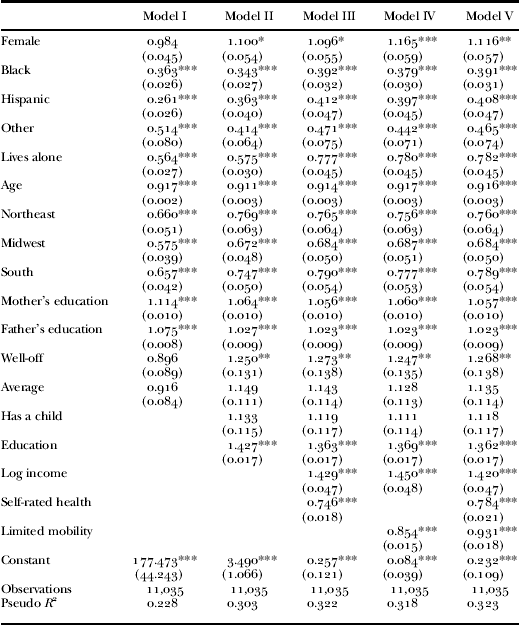
To address the first question regarding the relationship between childhood SES and the odds of being a regular internet user in older adulthood, odds ratios were estimated (Table 2). As Model I shows, the odds of regular internet use in older adulthood increased by approximately 11 per cent for each year of additional education that a respondent's mother attained and by approximately 8 per cent for each year of additional education the father attained. The potential mediating effect of adulthood SES was addressed by including measures of own educational attainment (Model II), income in older adulthood (Model III) and current health indicators (Models III, IV and V). With the inclusion of measures of early and later adulthood SES, the magnitude of the coefficients for parental educational attainment decreased, indicating that the odds of being an internet user in older adulthood increased by approximately 6 per cent with each additional year of maternal education and by approximately 2 per cent with each additional year of paternal education. The odds of regular internet use in older adulthood increased by approximately 27 per cent for individuals who grew up in families that were assessed as well-off, relative to poor. With the addition of each set of SES measures from each of the three phases in the lifecourse, the pseudo R 2 increased, indicating a better model fit.
Odds ratios of regular internet use in older adulthood
Note: Robust standard errors are given in parentheses.
Significance levels: * p < 0.1, ** p < 0.05, *** p < 0.01.
Cumulative SES and internet use in older adulthood
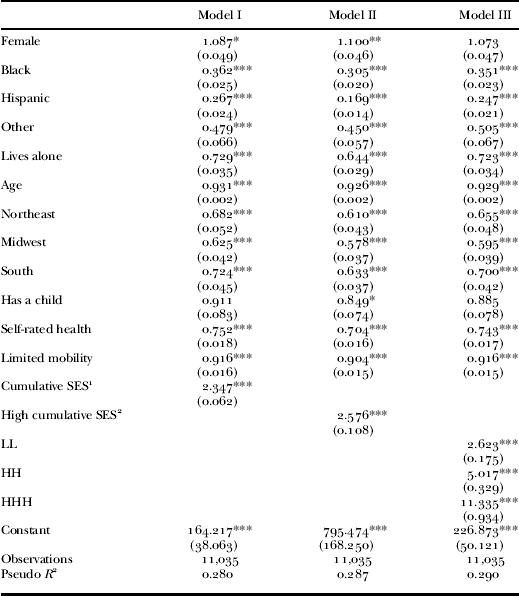
The second question explored whether SES advantages in childhood and adulthood tend to accumulate. If childhood SES, adult educational attainment and income each increase the odds of being a regular internet user in older adulthood, we should observe a cumulative effect on internet use status. Table 3 shows estimated odds ratios for internet use in older adulthood by multiple measures of cumulative SES adjusted for gender, race/ethnicity, living alone, age, geographic location, children and health status. Overall, the results indicated strong and consistent graded associations between cumulative SES and internet use in older adulthood. Estimates of cumulative SES when measured as an indicator of having a high SES during at least two points in the lifecourse (Model II), suggested that the probability of being an internet user in older adulthood was at least 70 per cent (or an odds of approximately 2.6). Model III displayed the relationship between SES trajectories, indicating the strong positive relationship between consistent high SES at all three points in the lifecourse and regular internet use in older adulthood, relative to consistently low SES.
Odds ratios of cumulative socio-economic status (SES) and regular internet use in older adulthood
Notes: Robust standard errors are given in parentheses. 1. Cumulative SES ranges from 0 to 3 (where 0 indicates low SES in childhood, early adulthood and older adulthood. 2. High cumulative SES is an indicator of having high SES during at least two of the three time periods. LL: low SES during any two of the time periods and includes LLH, LHL, HLL. HH: high SES during any two time periods and includes HHL, HLH, LHH. HHH: high SES at all three time periods (the trajectories are each in reference to LLL which indicated low at all three time periods).
Significance levels: * p < 0.1, ** p < 0.05, *** p < 0.01.
Age and cumulative SES
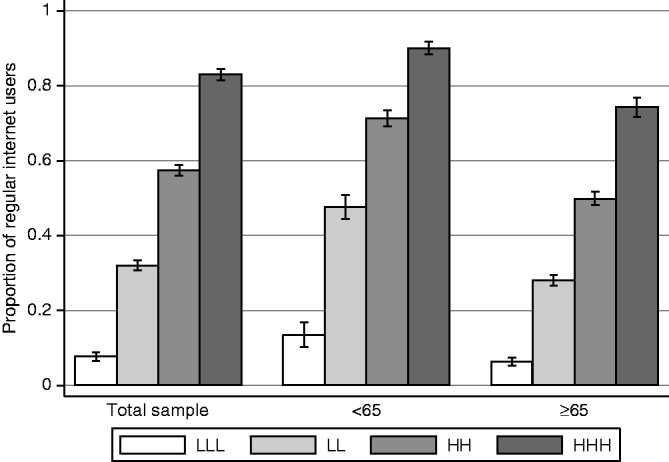
In light of prior research suggesting variation in internet usage by age, analyses were conducted to explore potential relationships between regular internet use, age and cumulative SES trajectory. Overall in the total sample, regular internet users were younger compared to non-regular internet users (Table 1) and overall the proportion of regular internet users was higher among respondents who had high SES at multiple periods in their lifecourse (see Figure 1). As Figure 1 illustrates, when the sample was divided by those who were 51–64 years old and those who were 65 and over and sorted by cumulative SES trajectory, the proportion of regular internet users was higher within each cumulative SES trajectory for respondents in the younger age group (Friedman tests confirmed statistically significant differences by age group at p < 0.001 for each of the four trajectories). However, Wald tests conducted after regression models (which adjusted for gender, race/ethnicity, living alone, geographic location, children and health status) indicated a weak relationship between age and cumulative SES (χ2 = 5.73, p < 0.0166). Furthermore, regression models which included interactions between age and cumulative SES indicated that age did moderate the internet use–cumulative SES relationship, adjusting for the other covariates (not shown).
Proportion of regular internet users in older adulthood by cumulative socio-economic status (SES) trajectory and age.
Discussion
Findings pointed to a substantive relationship between SES at different phases in the lifecourse and internet use in older adulthood. These findings provide support for the lifecourse perspective by illustrating that childhood SES (i.e. parental education and family financial wellbeing) was predictive of regular internet use in older adulthood independent of measures of SES attainment in early adulthood (i.e. educational attainment) and SES indicators in older adulthood (i.e. income). The inclusion of SES measures from each of the three phases in the lifecourse indicated a better model fit relative to models including SES measures from fewer phases also yielding support for the lifecourse approach. These findings suggest that a potential divide between older adult internet users may have developed early in their lifecourse long before the internet was developed.
The theory of cumulative advantage/disadvantage also found support in these findings. People who grew up in more advantaged families had higher odds of using the internet regularly in older adulthood relative to those who had less favourable indicators of childhood SES. Findings presented here indicating that higher income in older adulthood increased the odds of being a regular internet user were consistent with prior research concerning access and exclusion from the internet among older adults based on social stratification (Jensen et al. Reference Jensen, King, Davis and Guntzviller2010; Kontos, Bennett and Viswanath Reference Kontos, Bennett and Viswanath2007; Selwyn et al. Reference Selwyn, Gorard, Furlong and Madden2003). The results also suggest that the negative impact of low childhood SES can be ameliorated if people achieve a higher SES position in adulthood. Notably, age did not appear to moderate the relationship between cumulative SES and internet use. Overall, this may suggest that relative to earlier studies on internet use which emphasised age as a critical indicator of potential sources of exclusion, factors measured throughout the lifecourse, such as SES, may become increasingly relevant.
This study has several limitations. First, the only measure of internet use available in the HRS is relatively limited in that it is general and broad in scope, thus we do not know specific details about how often the respondent uses the internet, what types of devices he or she uses to access the internet, or the ways in which he or she uses the internet. Second, childhood SES was obtained through retrospective reports. Although some studies have shown that retrospective reports of parents' education and occupation tend to be reliable (Looker Reference Looker1989; Marmot et al. 2001; Ridolfo and Maitland Reference Ridolfo and Maitland2011), it is worth pointing out that the findings are limited due to concerns with regard to recall bias. Third, because of the limited information on childhood and the period between childhood and later adulthood, it is difficult to establish specific pathways between childhood SES and regular internet use in later life, other than adult educational attainment and household income.
Despite these limitations, this study contributes to our understanding of the relationship of SES over the lifecourse and internet use in older adulthood. This study demonstrates the importance of social mobility in one realm of technological access and provides some evidence that adulthood SES is more important for those from a disadvantaged family background than for those from more privileged families. Similar mobility patterns were found for mortality (Mare Reference Mare, Vallin, D'Souza and Palloni1990), cognitive functioning (Turrell et al. Reference Turrell, Lynch, Kaplan, Everson, Helkala and Kauhanen2002) and some health behaviours (Luo and Waite Reference Luo and Waite2005; Lynch Reference Lynch, Schneiderman, Gentry, da Silva, Speers and Tomes2000; Murray et al. Reference Murray, Mishra, Kuh, Guralnik, Black and Hardy2011). As technological advancements which aim to ameliorate the lives of older adults and individuals of all age groups continue to be made, it is increasingly important that we identify barriers to digital literacy and target interventions that enhance digital skills. This study highlights the importance of access to the internet for older adults with limited financial resources, particularly those who have had a relatively low SES throughout their lifecourse.
Acknowledgements
Material from the Health and Retirement Study (HRS) is produced and distributed by the University of Michigan with funding from the National Institute on Aging (grant number NIA U01AG009740). All responsibility for the analysis and views expressed in this study rests with the author. The author would like to thank two anonymous referees for helpful comments.