INTRODUCTION
Hoof horn growth rates have been studied in a number of ruminants (Hahn et al. Reference Hahn, McDaniel and Wilk1986; Sikarskie et al. Reference Sikarskie, Brockway, Ullrey, Schmitt, Nellist, Cooley and Ku1988; Tranter & Morris Reference Tranter and Morris1992; Smith et al. Reference Smith, Amos and Froetschel1999) and in horses (Buffa et al. Reference Buffa, Van Den Berg, Verstraete and Swart1992; Florence & McDonnell Reference Florence and McDonnell2006) and pigs (Quintanilla et al. Reference Quintanilla, Varona and Noguera2006). Hoof horn growth rate is influenced by the age (Tranter & Morris Reference Tranter and Morris1992; Dekker et al. Reference Dekker, Moonen and Pol2005) and genetics (Quintanilla et al. Reference Quintanilla, Varona and Noguera2006) of an animal together with its diet; with vitamins such as biotin (Buffa et al. Reference Buffa, Van Den Berg, Verstraete and Swart1992), minerals such as zinc (Smith et al. Reference Smith, Amos and Froetschel1999) and increased energy intake (Butler & Hintz Reference Butler and Hintz1977) enhancing the rate of growth. Environmental factors that influence the hoof growth rate include abrasiveness of the floor surface (Hahn et al. Reference Hahn, McDaniel and Wilk1986) and ambient temperature (Wheeler et al. Reference Wheeler, Bennet and Hutchinson1972).
Cattle and horses have different hoof horn growth rates between feet and between the lateral and medial aspects of the hoof. In Holstein cattle, the hoof horn growth rate is greater in the rear than in the front feet and greater in the lateral wall than in the medial wall (Hahn et al. Reference Hahn, McDaniel and Wilk1986). Vermunt & Greenough (Reference Vermunt and Greenough1995) summarized the hoof horn growth rate in cattle from nine studies. The rate ranged from 3·9 to 8·5 mm per month across all studies and horn grew faster in cattle on hard surfaces. In horses, the hoof horn growth rate is greater in the front than the rear feet (Florence & McDonnell Reference Florence and McDonnell2006).
The hoof horn growth rate in horses (Florence & McDonnell Reference Florence and McDonnell2006), deer (Miller et al. Reference Miller, Marchinton and Nettles1986) and cattle (Telezhenko et al. Reference Telezhenko, Bergsten, Magnusson and Nilsson2009) has been measured using the coronary band as the baseline and in all cases an indent (made with a drill, file and soldering iron, respectively) was made on the hoof wall and the distance between the indent and the coronary band measured to determine the growth rate. The intra-observer reliability in Florence & McDonnell (Reference Florence and McDonnell2006) was r>0·93. Buffa et al. (Reference Buffa, Van Den Berg, Verstraete and Swart1992) and Butler & Hintz (Reference Butler and Hintz1977) also used the coronary band as a marker in horses. An inverted T-shape was heat branded into the hoof from the coronary band and distal progression was measured. The use of a T-shaped marker provides more accuracy than a groove, as the meeting point of the two lines making the T allows exact pinpointing for repeat measurements. Livesey & Laven (Reference Livesey and Laven2007) used tattoo marks just proximal to the coronary band, which they considered to be more precise than the coronary band as a reference line, and burn marks (made with a soldering iron) in the hoof as points of reference in cattle. The width of the burn mark (c. 2 mm) determined the repeatability of measurements in that study.
A greater understanding of ovine (Ovis aries) hoof horn growth rate would contribute to understanding of the normal physiology of the sheep claw and the consequences of overgrowth, extreme wear or trimming hoof horn in diseased and healthy feet (Wassink et al. Reference Wassink, Grogono-Thomas, Moore and Green2003a; Kaler et al. Reference Kaler, Medley, Grogono-Thomas, Wellington, Calvo-Bado, Wassink, King, Moore, Russell and Green2010a). It would also assist in understanding the role of hoof horn in persistence and transmission of infectious foot diseases, such as foot rot (Green et al. Reference Green, Wassink, Grogono-Thomas, Moore and Medley2007; Kaler et al. Reference Kaler, Daniels, Wright and Green2010b), contagious ovine digital dermatitis (Wassink et al. Reference Wassink, Moore, Grogono-Thomas and Green2003b) and of pathogens such as foot and mouth disease virus (Dekker et al. Reference Dekker, Moonen and Pol2005).
To date there have been only two studies estimating hoof horn growth rates in sheep (Wheeler et al. Reference Wheeler, Bennet and Hutchinson1972; Dekker et al. Reference Dekker, Moonen and Pol2005). Dekker et al. (Reference Dekker, Moonen and Pol2005) measured the growth of hoof horn in five healthy newborn lambs and five healthy ewes. The horn growth was measured from the coronary band to a horizontal groove made in the right lateral claws of the front and hind feet using a hacksaw. Measurements were taken on days 3, 10, 17, 24, 31 and 59, and on each occasion the distance between the groove and the coronary band was measured using a ruler and was rounded to the nearest millimetre. However, Dekker et al. (Reference Dekker, Moonen and Pol2005) reported that using the coronary band as a baseline for measurements led to measurement error. The growth rates were 0·44 mm per day in the lambs and 0·29 mm per day in the ewes. There was no difference between the growth rate in front and hind feet. Wheeler et al. (Reference Wheeler, Bennet and Hutchinson1972) studied hoof horn growth rate under varying temperatures and day length. There was no association between day length and growth rate, but sheep kept in low ambient temperatures had a lower hoof horn growth rate. In their four experiments growth rates ranged widely from 0·024 to 0·2 mm/day. Group sizes ranged from 8 to 21 sheep per experiment and they investigated one foot in three experiments, and two feet in one experiment.
The current paper presents a novel approach for measuring hoof horn growth and estimates the precision of this technique in ovine hoof horn in non-lame sheep.
MATERIALS AND METHODS
Sheep and environment
A sample of 21 non-lame yearling mule ewes was selected from a flock of 110 yearling ewes in Gwynedd, North Wales. Sheep were on lowland pasture and were not given any food supplement. Data were collected in August and September 2009.
Measuring the hoof horn
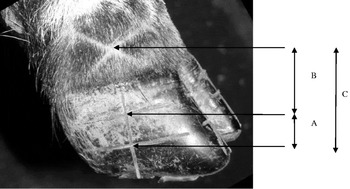
Pilot studies at the University of Warwick had investigated a variety of methods to measure hoof horn growth. From these it was concluded that the coronary band varied in width by several millimetres between weekly observations and that this was a concern, particularly in sheep with diseased feet (unpublished observation). It was also noted that variation in the angle of measurement from the coronary band to a horizontal line on the hoof horn was possible. Consequently, the final pilot approach was tested where a line in the hair above the coronary band was shaved and the horn was marked with two horizontal grooves and one vertical groove (Fig. 1). This was considered to give the most repeatable measurements.
Markings in hair and horn and distances A, B and C used to measure hoof horn growth.

In the current study, the hair above the coronary band of each digit was shaved using wireless clippers (Kim Laube, Lazor clip) and then an ‘X’ shape was shaved deep into the hair above the coronary band on each claw using a beard trimmer (BaByliss for Men Battery Beard Trimmer 7050BU). Two horizontal 0·5 mm wide grooves and one vertical groove were filed into the claw using a file (Nicholson, Three Square Smooth Cut File, 200 mm) (Fig. 1).
Measurements were made on days 0, 24, 40 and 53, using digital callipers (Linear, 49-923-150, 150 mm), in millimetres rounded to two decimal places. The distance from the centre of the shaved ‘X’ to each of the two horizontal lines at the point at which the vertical groove intercepted each horizontal line (A and C) and the distance (B) between the two horizontal lines were measured (Fig. 1).
Data analysis
Claws were excluded when less than two measurements were made, when the marks had faded from the foot between measurements, when a foot was deformed or diseased and when a ewe was lame.
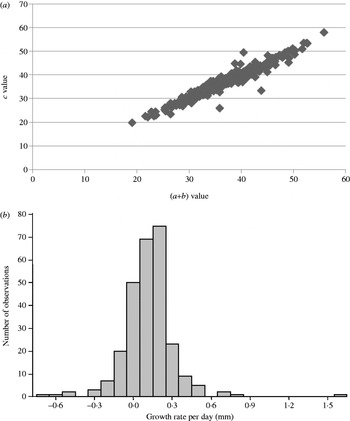
To check the accuracy of the recordings, the variation of A (Fig. 1) was assessed for repeated measurements within digit. The sum of A+B was calculated for each measurement and compared with C using a scatter graph to identify outliers and estimate correlation (Fig. 2a). Where A+B≠C the raw data were checked and amended where possible or data were excluded where an error could not be detected. The growth rate was calculated for B for each interval 0–24, 24–40 and 40–53 days. A histogram of the estimated growth rate of B was plotted (Fig. 2b) and outliers noted. The growth rate was used as the outcome variable for a three- level hierarchical model with repeated measure within foot within sheep that took the form

where Y ijk is the hoof horn growth rate per day for each digit, α is the intercept and βX is a series of vectors of fixed effects varying by measurement (ijk), digit (jk) and sheep (k) and v k is the between-sheep residual variance, u jk is the between-digit residual variance and e ijk is the between-measurement residual variance. The model fit was checked and the R 2 calculated.
(a) Scatter plot of measurements (A+B) against C in millimetres for 428 observations. (b) Histogram of hoof horn growth rate per day in 372 observations (note the four clear outliers at either end of the distribution).

RESULTS
Missing and excluded data
From a possible 672 digit observations (four occasions, eight digits per ewe) there were 372 estimates of growth rate. There were 74 digits from 20 sheep with all four measurements, giving 222 growth rates. There were 108 measurements where sheep were lame and 127 where marks on the skin faded between observations. The mean length of A+B and C were 36·6 mm (±0·28) and 36·8 mm (±0·28), respectively with a correlation of 0·97. There were four outliers at the ends of the distribution (Fig. 2b) that were excluded from further analysis.
Growth rate
The mean (s.e.m.) hoof horn growth rate based on both 372 and 222 sample estimates was 0·11 (±0·022) mm per day. This equates to 3·6 mm growth per month (30 days). There were no significant differences in the growth rates between front and rear feet (0·0±0·021 mm) or lateral and medial digits (−0·01±0·021 mm). The between-measurement residual error variance was significant at 0·024±0·0023 (giving a s.d. of 0·15) and R 2=0·245. There was no significant difference in the growth rate between sheep or digits. When the growth rates of digits with all three measurements were compared there was no difference between daily growth rates by time points in the study.
DISCUSSION
Precision and repeatability were important concerns in the current study. Overall, after excluding the four outliers, the measurement error variance was 0·024 across all 372 positive measurements. In earlier pilot studies it had been observed that the coronary band varied in depth within a digit over time (data not shown) and this, together with the fact that it is a horizontal line, made it difficult to identify a consistent point from which to measure vertically down the hoof horn. Consequently, a cross was placed in the hair above the coronary band to give a precise point to measure from. This cross faded rapidly and one error in the current study was that on 127 occasions the baseline cross had disappeared by the subsequent measurement. Ideally, a permanent mark, such as a tattoo, would have been used (Livesey & Laven Reference Livesey and Laven2007). The ethics justifying the possible pain involved in applying the tattoo are debatable but once applied a sheep could be handled less frequently, so reducing stress, because the mark above the coronary band would be permanent. It might make longer term studies such as impact of season more feasible, especially since the hoof horn growth rate did not vary significantly between sheep in the current study, suggesting that relatively few sheep would need to be studied within one age group.
Measurement errors also arose from the width of the marks on the skin and grooves in the horn (e.g., the filed grooves were c. 0·5 mm wide), which would have reduced precision in the results and also explain the apparent negative growth rates. Significant unexplained variability was only present in repeated measures within digit and was probably mostly measurement error. It was not reduced when only digits with three repeated measurements were included in the analysis, indicating that this was not an issue of insufficient sample size.
Taking measurements A, B and C and using C=A+B to check for data recording errors and plotting a histogram helped to identify large outliers in the analysis. One individual measuring the sheep throughout the study prevented between observer biases.
The current study was conducted during August and September 2009. Previous studies (Tranter & Morris Reference Tranter and Morris1992; Wheeler et al. Reference Wheeler, Bennet and Hutchinson1972) have reported that the hoof horn growth rate is less at colder temperatures; in dairy cattle in New Zealand the rates of hoof horn growth and wear were lowest in winter and greatest in summer. Wheeler et al. (Reference Wheeler, Bennet and Hutchinson1972) hypothesized that this was because there was a decreased blood supply to the distal limb. If this is also the case in sheep then the growth rate calculated in the current study is likely to be greater than growth rates during winter.
There were no significant differences in growth rates between front and rear feet in the current study. This was also reported by Dekker et al. (Reference Dekker, Moonen and Pol2005), suggesting that the fact that 60% of the weight is taken by the front feet of sheep (Kim & Breur Reference Kim and Breur2008) is not sufficient to cause greater wear of front feet that would stimulate a faster growth rate as reported in cattle (Vokey et al. Reference Vokey, Guard, Erb and Galton2001).
The growth rate of 0·11 mm per day or 3·6 mm per month in the current study was in the same range as the results from Wheeler et al. (Reference Wheeler, Bennet and Hutchinson1972) and for cattle on pasture. However, it is considerably less than the 0·29 mm per day (8·7 mm per month) calculated by Dekker et al. (Reference Dekker, Moonen and Pol2005) in five sheep. The difference between the two estimates may be due to differences in environmental factors such as ambient temperature or nutritional status, age or genetics or because the floor surface in the Dekker et al. (Reference Dekker, Moonen and Pol2005) study was hard (the sheep were housed), while the sheep in the current study were at pasture. Differences in experimental techniques may also account for some of the differences in the growth rate. In the current study, digital callipers were used to take measurements and distance was measured from a distinct point in the centre of the shaved ‘X’ to the intersections of the grooves, whereas Dekker et al. (Reference Dekker, Moonen and Pol2005) used a ruler and the distance was measured from two lines, which may have reduced the accuracy of their measurements but it is unlikely to account for all of the difference.
A traditional technique to treat foot rot in sheep has been to trim away horn to expose the lesion in the foot (Wassink et al. Reference Wassink, Grogono-Thomas, Moore and Green2003a; Kaler and Green 2009). This often requires trimming horn from the wall of the foot. Recent research has indicated that trimming hoof horn of sheep with foot rot delays healing compared with treatment with systemic antibiotics and topical spray (Kaler et al. Reference Kaler, Medley, Grogono-Thomas, Wellington, Calvo-Bado, Wassink, King, Moore, Russell and Green2010a; Wassink et al. Reference Wassink, King, Grogono-Thomas, Brown, Moore and Green2010). From the current study, it can be estimated that hoof horn trimmed by 10 mm will take c. 3 months to re-grow. If sensitive tissue is exposed during trimming (and this is the aim of therapeutic trimming) then in this 3-month period a sheep might be more likely to damage the exposed sensitive tissue and more likely to develop foot rot again (Kaler et al. (Reference Kaler, Daniels, Wright and Green2010b).
Hoof horn growth rate varies by age (Dekker et al. Reference Dekker, Moonen and Pol2005), nutritional status (Butler & Hintz Reference Butler and Hintz1977; Buffa et al. Reference Buffa, Van Den Berg, Verstraete and Swart1992; Smith et al. Reference Smith, Amos and Froetschel1999) and hardness of the walking surface (Vokey et al. Reference Vokey, Guard, Erb and Galton2001), so these were kept consistent in the current study. In addition, breed was consistent, although the mule breed is a cross of two pedigrees. Consequently, the results give an estimate of the hoof horn growth rate for one-year old, mule sheep on pasture. This could be expected to vary by age, breed and environment.
The current study has been an important step in establishing a procedure to measure the hoof horn growth rate in sheep and has highlighted improvements that can be made in future studies. Future studies can use this technique to investigate whether the rate of hoof horn growth varies by breed of sheep and hardness of walking/standing surface. Importantly how infectious foot disease (foot rot) and therapeutic and corrective foot trimming affect hoof horn growth rate would be of great interest.
We thank the farmer for access to his sheep.