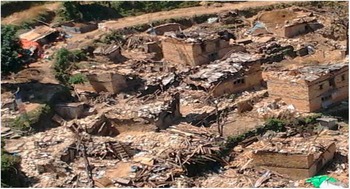
Moments after the April 25th 7.8 magnitude earthquake devastated central Nepal, the Nepalese government issued an urgent request for urban search and rescue (USAR) teams, foreign medical teams, emergency shelters, and other life-saving assistance from the global community (Figure 1). Over the next 7 days, 76 USAR teams, totaling 2242 trained personnel and 135 dogs, arrived to search for survivors under the rubble. The first teams that arrived were from countries that border Nepal: 16 Indian teams arrived on April 25, the same day as the quake, and a Chinese team arrived the following day. These teams rescued a total of 13 survivors during this time frame. Over the next 7 days, 59 additional USAR teams arrived from all over the world. They rescued 3 survivors [1].
The Aftermath of the Nepal Earthquake.

Earthquakes are a common cause of mass casualty events. Since 1990 they have claimed an average of 27,000 lives per year [Reference Guha-Sapir and Vos2]. The principal cause of death is not the earthquake itself, but building collapse. In cities with strict building codes, loss of life is minimized. But in cities with lax or nonexistent building codes, tens of thousands may die.
Time is the most important factor in saving people trapped under the rubble. USAR teams are highly skilled at finding and rescuing trapped survivors but they encounter several unavoidable logistical barriers on their way, such as the time until decision-makers decide to send them, the time until the local government requests help and approves the specific mission, transferring the equipment to the airport, mustering the teams, finding available aircraft, securing transportation from the airport to the affected area, receiving information about and making assessment of the areas with higher chances for finding survivals, and so on. These barriers often delay the arrival of USAR teams by 24 to 48 hours or more, particularly when the teams respond from thousands of miles away. Following a severe quake, the number of trained rescuers a country needs is far greater than the number of USAR teams any country can keep trained and equipped. These limitations to the efficacy of USARs are well known but rarely acknowledged.
The primary goal in a disaster is to save as many lives as possible. Today, the search and rescue component of preparedness planning for earthquakes relies heavily on USAR teams, both local and international. USAR teams are well-trained, well-equipped, and highly respected; they are, in many respects, the “special forces” of the disaster response community. Although their dedication and skill are unquestioned, their impact is often limited by geography, physics, and time. The length of time injured people can survive under rubble is limited, particularly in harsh climates. Local USAR teams, which are typically small in number, may reach the scene quickly, but international USAR teams, particularly those sent from the other side of the world, require time to mobilize, arrange logistics, identify requirements, and secure a flight. It should be taken into account that most countries do not have enough local USAR teams to deal with the multitude of buildings that may collapse in a strong earthquake, which is why international USAR teams are required. However, in nearly every case, the number of survivors rescued by USAR teams is quite small relative to the number of responders, heavy lift aircraft, supplies, and other logistics required to support these teams [Reference Peleg and Kellermann3].
The numbers tell the tale: in recent large-scale earthquakes the number of survivors rescued by USAR teams ranged from 0 in West Sumatra to 134 in Port-au-Prince in Haiti, although the latter response involved a total of 2098 rescuers and 161 dogs [Reference Peleg and Kellermann3]. However, the exploits of these teams receive heavy global press, particularly when a survivor is found alive after several days of entrapment.
What is invariably lost in the press coverage is the far larger number of victims rescued by family members, neighbors, and other local citizens [Reference Uscher-Pines, Chandra and Acosta4]. Several studies have determined that these anonymous individuals account for 50% to 95% of survivors following major earthquakes [Reference Peleg, Reuveni and Stein5].
Perhaps it is time to shift the paradigm from reliance on professional rescuers arriving from great distances to promoting “prepared communities,” particularly in disaster-prone cities. For example, the reference scenario for a major earthquake in Israel is that 20,000 homes will collapse. In addition to preparing for manmade mass casualty incidents such as terrorist bombings, the nation has trained and equipped approximately 250 search and rescue platoons, roughly one platoon for every 100 collapsed buildings. Because the notion of creating this much capacity is an unrealistic goal for most low-income countries, it may be time to consider more efficient and effective ways to optimize how communities can become more resilient. Perhaps the solution is to empower community members themselves, as they will be closest to the scene and highly motivated to respond. Recognizing that the lay population represents the most effective “unit” for light rescue (applying available assets such as carjacks and metal or wooden bars as opposed to using heavy mechanical equipment in “heavy” rescue) could ultimately save far more lives, particularly in countries such as Nepal, where many of the collapsed buildings were in remote mountain villages, inaccessible to the heavy construction equipment used by many USAR teams. In these instances, the rapid arrival and engagement of light rescue can be accomplished by laymen with basic training. The type of housing in such locations, built by hand with available materials, facilitates the application of light rescue techniques; however, the lack of training may discourage people from acting, as happened in some places in Nepal.
To create this capability, local governments, municipalities, nongovernmental organizations (NGOs), and national and regional USAR volunteers could devise and offer short training courses in the fundamentals of basic rescue techniques. The instruction would focus on how to safely remove survivors from under the rubble by using light equipment that is readily available to the community. For example, educating and training high school students in the use of car jacks and simple leverage options to create mechanical cranes will enable them to move or lift heavy objects that entrap victims. These techniques, along with teaching citizen rescuers where they have the highest chances of finding live survivors under the rubble of a collapsed structure represent just a few of the much wider range of skills mastered by a typical USAR team. But simple measures can be taught, and if applied in the first few hours after an earthquake, these measures may save far more individuals than highly sophisticated rescue techniques applied days later. This suggests that it is not only possible but likely that a light rescue system using bystanders, including neighbors, family members, and volunteers, will save more victims in the first 1 to 2 days after an earthquake, allowing later-arriving USAR teams to focus on complicated buildings that require a more strategic approach. To administer layperson training, government agencies and NGOs should enlist the help of local firefighters and other community leaders who would be chosen from among a large list of volunteers. By harnessing the spirit of community volunteers and using locally available light equipment, it should be possible to teach basic techniques in light rescue to large numbers of people at far less cost than it currently takes to create, educate, equip, maintain, transport, and supply a heavy USAR team. The light rescue skills should be taught aside the other important disaster survival skills, such as safe sheltering, water disinfection, and medical first aid, thus improving overall community preparedness. The Nepal earthquake is the latest global mass casualty incident, but there will surely be more. It is time for us to recognize that our current reliance on flying large numbers of heavy USAR teams to earthquake sites may not be the best option. This is not due to a lack of skill or motivation on the part of these rescuers; they simply arrive too late to do much good. An alternative approach may be to empower local citizens in earthquake-prone communities to master the skills they need to rescue their family members and neighbors in the event of a major earthquake. This will allow professional USAR teams to prioritize complicated rescue efforts, while substantially boosting the number of survivors rescued by laypeople. The proposed reform would therefore not negate the need for USAR teams completely but would allow balancing their scope with other assets. Arriving at the later stages of an event, USAR teams bring to the table additional important capabilities, such as improved logistics, engineering expertise, and a lot of unique knowledge, training, and equipment. Training the local population on how to provide light rescue with available tools and supplies will boost community resilience, foster social capital, and in all likelihood, increase the odds of freeing trapped survivors after an earthquake. It’s time we give it a try.
Acknowledgment
I thank Prof. Arthur Kellermann, Mrs. Nina Hakak, and Mr. Michael Rosenfeld for helping me prepare this article.
Disclaimer
My comments are my own and do not necessarily represent those of the UNDAC.