





Introduction
Overweight and obesity have become increasingly prevalent in recent decades, forming an increasing public health problem (Hecker et al., Reference Hecker, Freijer, Hiligsmann and Evers2022; RIVM, 2023a). In the Netherlands, combined lifestyle interventions (CLIs) are implemented as a possible strategy to tackle overweight and obesity. CLIs are two-year multicomponent interventions (including a treatment phase of maximally a year followed by a maintenance phase) (Oosterhoff et al., Reference Oosterhoff, De Weerdt, De Vries, Feenstra and De Wit2023a) in which participants receive guidance and advice from one or multiple specialists about healthy nutrition, physical activity, and other lifestyle factors, like sleep and stress (Van der Heiden et al., Reference Van der Heiden, Lacroix, Van Charante and Beune2022; Stiggelbout and Rosendal, Reference Stiggelbout and Rosendal2023). The aim of CLIs is to guide participants to develop and sustain an improved lifestyle, thereby improving their quality of life (Stiggelbout and Rosendal, Reference Stiggelbout and Rosendal2023; RIVM, 2023b).
Since 2019, CLIs can be reimbursed from healthcare insurance under certain conditions in the Netherlands (RIVM, 2023b). Inclusion criteria for participants are having obesity (BMI ≥ 30) or overweight (BMI ≥ 25) in combination with a risk factor and/or comorbidity of cardiovascular disease or type 2 diabetes mellitus. In addition, participants have to be sufficiently motivated to participate (RIVM, 2023b). The availability of reimbursed CLIs is becoming increasingly diverse (Oosterhoff et al., Reference Oosterhoff, De Weerdt, De Vries, Feenstra and De Wit2023a). Currently, seven different CLI programmes are reimbursed from healthcare insurance (RIVM, 2023b), although the availability of CLIs and reach of participants differs per region in the Netherlands (Oosterhoff et al., Reference Oosterhoff, De Weerdt, De Vries, Feenstra and De Wit2023a).
The Dutch National Institute for Public Health and the Environment monitors the implementation and effectiveness of reimbursed CLIs since 2019 and reports results twice a year (Oosterhoff et al., Reference Oosterhoff, De Weerdt, Klein, Feenstra and De Wit2024). The most recent results from this national monitoring, after the completion of our research, show that 84% of CLI participants reached weight loss or stabilization after maintenance phase (Oosterhoff et al., Reference Oosterhoff, De Weerdt, Klein, Feenstra and De Wit2024). Even modest weight loss or stable bodyweight improves health outcomes and has clinical significance for obesity patients, including a reduced risk of type 2 diabetes mellitus and arthritis in the knees (Hamman et al., Reference Hamman, Wing, Edelstein, Lachin, Bray, Delahanty, Hoskin, Kriska, Mayer-Davis and Pi-Sunyer2006; Saaristo et al., Reference Saaristo, Moilanen, Korpi- Hyövälti, Vanhala, Saltevo, Niskanen, Jokelainen, Peltonen, Oksa and Tuomilehto2010; Federatie Medisch Specialisten, 2023, Oosterhoff et al., Reference Oosterhoff, De Weerdt, De Vries, Feenstra and De Wit2023a). Moreover, achievement of sustainable lifestyle changes and increased quality of life are reached among CLI participants (Oosterhoff et al., Reference Oosterhoff, De Weerdt, Klein, Feenstra and De Wit2024). Quality of life of CLI participants improved by 7.8 points on a scale from 0–100 after treatment phase, which is a relatively large improvement (Oosterhoff et al., Reference Oosterhoff, De Weerdt, Klein, Feenstra and De Wit2024).
Since the reimbursement of CLIs from healthcare insurance in 2019, more than 82.000 persons have started a CLI programme (Oosterhoff et al., Reference Oosterhoff, De Weerdt, De Vries, Feenstra and De Wit2023a). There is, however, an underrepresentation of participants who are male, of younger age, and with a lower socio-economic position (Oosterhoff et al., Reference Oosterhoff, De Weerdt, Feenstra and De Wit2022; Pharos, 2022). There is an overrepresentation of participants with obesity, of which 35% has a BMI between 35 and 40 kg/m2 and 22% a BMI of at least 40 kg/m2 (Oosterhoff et al., Reference Oosterhoff, De Weerdt, Feenstra and De Wit2022). Additionally, it is a challenge to retain participants in the programme, with dropout rates of 26% during CLI’s treatment phase and 35% in the second year of treatment (Oosterhoff et al., Reference Oosterhoff, Feenstra and De Wit2023b).
General practitioners (GPs) are authorized as the primary referrer of patients to CLIs (Oosterhoff et al., Reference Oosterhoff, Feenstra and De Wit2023b), positioning them as key actors in the successful implementation (Van der Heiden et al., Reference Van der Heiden, Lacroix, Van Charante and Beune2022). In the Netherlands, GPs are seen as gatekeepers of primary healthcare (Groenewegen, Reference Groenewegen2016; Raad Volksgezondheid and Samenleving, 2023). They have a high reach and high perceived expertise (Hiddink et al., Reference Hiddink, Hautvast, Van Woerkum, Fieren and Van’t Hof1997). Prevention and lifestyle support are receiving growing attention in general practice, but the implementation of new interventions in healthcare can take years, even when evidence is present (Berwick, Reference Berwick2003; Barnett et al., Reference Barnett, Vasileiou, Djemil, Brooks and Young2011; Van der Heiden et al., Reference Van der Heiden, Lacroix, Van Charante and Beune2022). Although CLI effectiveness is known from national monitoring data (Oosterhoff et al., Reference Oosterhoff, De Weerdt, De Vries, Feenstra and De Wit2023a), GPs have different views on their involvement in prevention and referring patients to CLIs (Scheenhart et al., Reference Scheenhart, Azdahic and Metting2021). Lifestyle often remains an undiscussed topic, although there are many possibilities to discuss this with patients, preferably in an early stage of increasing overweight (Assendelft, Reference Assendelft2019). In addition, it is insufficiently clear why CLIs reach a limited part of the target group and what role general practices play in this (Scheenhart et al., Reference Scheenhart, Azdahic and Metting2021).
Previous research by Van der Heiden et al. (Reference Van der Heiden, Lacroix, Van Charante and Beune2022) investigated GPs’ perspectives regarding implementing CLIs in Dutch primary healthcare. Barriers and facilitators encountered in the early phase of implementation were identified, as the study took place relatively early after the start of the reimbursement policy in 2019. Over the past years, CLIs have been implemented more broadly in the Netherlands. As GPs’ overall perceptions of referring patients to CLIs may have changed over time, and regarding the limited referral of patients to CLIs, dropout rates, and underrepresentation of specific target groups, a new in-depth study is needed to gain insight into barriers and facilitators that GPs experience when referring patients to CLIs. This study aims to investigate the barriers and facilitators experienced by GPs as primary referrers of patients to CLIs.
Methods
Study design and setting
This qualitative study was conducted between April and December 2023 in Dutch primary healthcare. In the Netherlands, several professions work together within general practices, including GPs, practice assistants (PAs), and practice nurses (PNs). Both GPs and PNs, under responsibility of GPs, can refer patients to CLIs (Ministerie van Volksgezondheid, Welzijn en Sport, 2023). General practices can be part of healthcare centres, which are multidisciplinary primary healthcare practices (Van der Heiden et al., Reference Van der Heiden, Lacroix, Van Charante and Beune2022). General practices and healthcare centres may be part of care groups, which are regional or local GP networks that share contracts with health insurance companies on chronic care delivery (Van der Heiden et al., Reference Van der Heiden, Lacroix, Van Charante and Beune2022). Ethical approval was obtained from the WUR Research Ethics Committee (WUR-REC), and this study was conducted according to the guidelines laid down in the Declaration of Helsinki.
Theoretical framework
Relevant literature, the COM-B model of behaviour (capability, opportunity, motivation, and behaviour) (Michie et al., Reference Michie, Van Stralen and West2011), and the Theoretical Domains Framework (TDF) (Michie et al., Reference Michie, Johnston, Abraham, Lawton, Parker and Walker2005; Cane et al., Reference Cane, O’Connor and Michie2012) were integrated to form a guiding framework for the interview guide and for coding of transcripts. COM-B is an evidence-based model that can be applied at the level of healthcare professionals and has been useful in previous research about nutrition education provided by primary healthcare physicians (Crowley et al., Reference Crowley, Ball and Hiddink2020). COM-B was used as the main model to guide this research, to understand and explain referral behaviours of GPs, which is influenced by their capability, opportunity, and motivation to perform the behaviour. With this comprehensive approach to behaviour, it is recognized that behaviour is influenced by many different factors, including factors outside of the individual (Michie et al., Reference Michie, Van Stralen and West2011). Components of the COM-B model could be mapped directly onto the TDF, which further breaks down underlying individual-level barriers and facilitators to change (The Center for Implementation, 2020). Capability was explored through the TDF domains of knowledge, skills, and habits; motivation through role identify, beliefs about consequences, and beliefs about capabilities; and opportunity through environmental context and resources. The TDF provides a theoretical lens to identify determinants of behaviour and to understand the cognitive, social, affective, and environmental influences on behaviour. Thereby, it functions as a basis for behaviour change processes and intervention development to improve healthcare practice (Cane et al., Reference Cane, O’Connor and Michie2012; Francis et al., Reference Francis, O’Connor and Curran2012; Atkins et al., Reference Atkins, Francis, Islam, O’Connor, Patey, Ivers, Foy, Duncan, Coloquhoun and Grimshaw2017).
Positionality of the researchers
The research team consisted of highly educated junior and senior researchers of Dutch background. The team included a MSc student (B.v.A.), employees of the municipal health service GGD NOG (G.D., E.v.D., and A.H.N.), and an associate and emeritus professor in healthy lifestyles and nutrition communication (A.H.N, G.J.H.). Collectively, they had expertise in prevention, health promotion and communication, CLIs, and qualitative research. The team was aware that the role of GGD NOG as owner of the CLI programme SLIMMER could potentially influence data collection and interpretation. To minimize this risk, the study focused on referral to reimbursed CLIs in general rather than on a specific CLI programme. Reflexivity was promoted through regular discussions within the research team and joint coding and interpretation of part of the data.
Data collection
GPs’ barriers and facilitators of referring patients to CLIs were assessed by B.v.A. using semi-structured interviews. In total, 16 GPs were purposively recruited via professional networks of involved researchers. All GPs were invited by B.v.A. via mail and/or phone. Efforts were made to recruit an as complete and diverse group of participants as possible, with respect to the following characteristics: gender (male/female), age, geographical location of the general practice, working experience (0–10, >10 years), and type of general practice (healthcare centre: Y/N, part of care group: Y/N). Participants were only included if they had at least one year of experience with referring patients to CLIs and if no colleague from the same general practice participated in the study. A semi-structured interview guide was developed, based on the COM-B model (Michie et al., Reference Michie, Van Stralen and West2011) and TDF (Michie et al., Reference Michie, Johnston, Abraham, Lawton, Parker and Walker2005; Cane et al., Reference Cane, O’Connor and Michie2012), and all interviews were conducted by B.v.A. The interview guide was pilot-tested for length, themes, and structure by conducting a pilot interview. Based on this interview, the interview guide was slightly adapted. Data from the pilot interview were incorporated in the analyses and increased content validity. Three interviews were conducted face to face and 13 interviews were conducted online via Microsoft Teams. On average, interviews lasted about 45 minutes. Through snowballing, sufficient GPs were found. After 15 interviews, no new themes emerged, suggesting that data saturation had been reached. One additional interview was subsequently conducted to confirm saturation, and no additional information was identified. The final sample of 16 interviews included the pilot interview.
Data analysis
Qualitative reflexive thematic data analysis was performed by following the six steps as described by Braun and Clarke (Braun and Clarke, Reference Braun and Clarke2006; Braun and Clarke, Reference Braun and Clarke2019). This approach helped to identify, analyse, and report patterns within data. It allowed for a deep understanding of GPs’ experiences and views. A deductive code list was designed based on the COM-B model and TDF and additional inductive codes emerged during analysis. The codes and themes generated reflect the researchers’ interpretations. Interviews were audio recorded with GPs’ permission, transcribed verbatim, and analysed in Atlas.ti version 23. Two interviews were independently double-coded by B.v.A. and G.D. Initial coding was compared, which showed high initial agreement. Discrepancies were discussed in detail until consensus was reached on final codes. Additionally, coded transcripts were discussed by B.v.A., G.D. and G.J.H. to determine the level of data saturation across the overall theme landscape. The referral patterns were developed from qualitative data regarding CLI referral and reflect GPs’ attitudes and decision-making processes.
Results
Sample of GPs
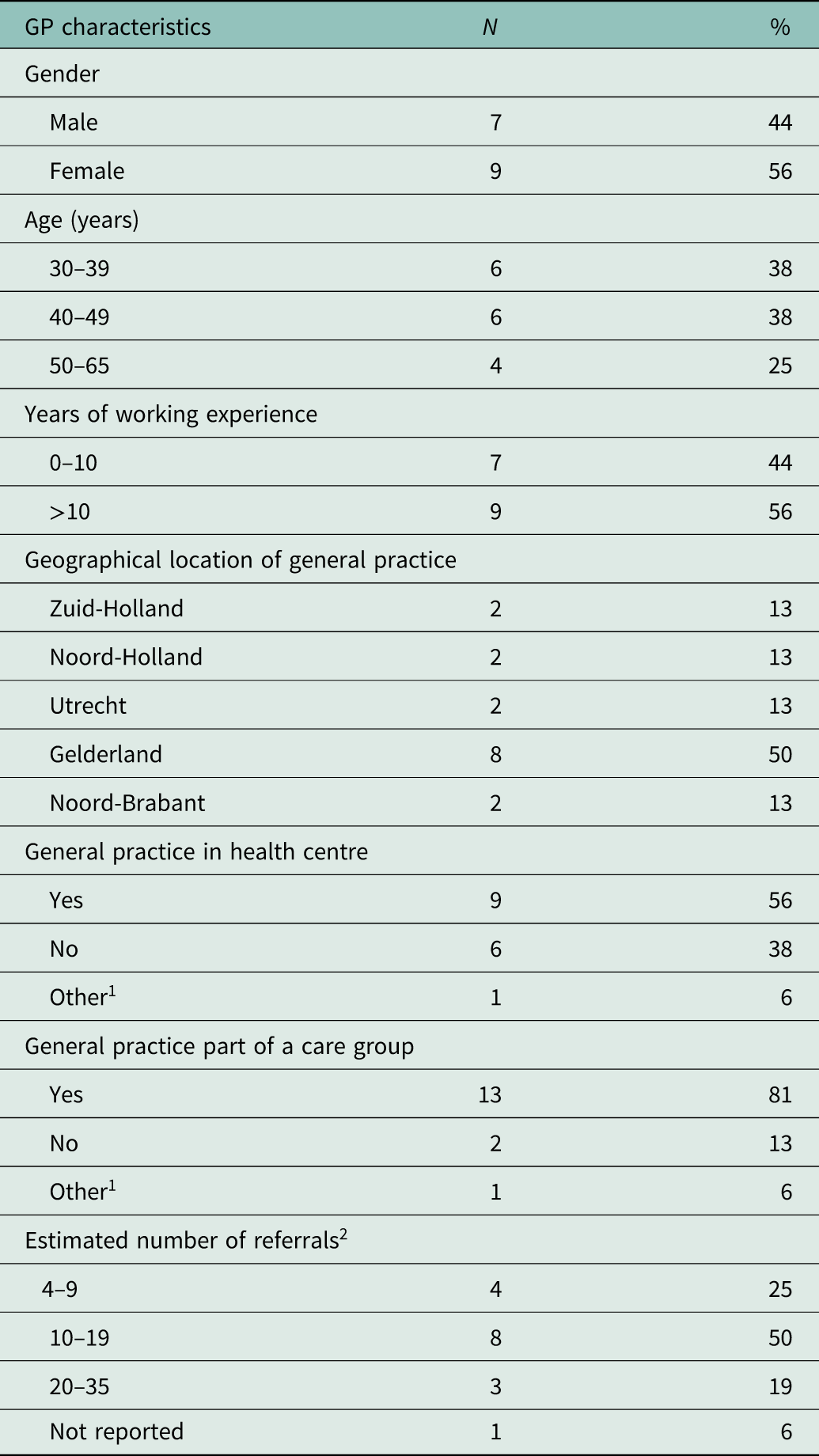
Study population characteristics are shown in Table 1. On average, GPs were 45 years old and had 11 years of working experience. Participants were located across the Netherlands in small- to big-sized cities, with most GPs working in the province of Gelderland, where also most CLI participants are located (Oosterhoff et al., Reference Oosterhoff, De Weerdt, De Vries, Feenstra and De Wit2023a). More than half of the GPs were part of a healthcare centre and most of them were part of a care group. Estimated numbers of referrals to CLIs were reported over different time periods. On average, the number of referrals varied from 1 to over 10 patients annually.
GP characteristics (n = 16)

Table 1. Long description
A table summarizing characteristics of general practitioners. The table has six rows and five columns. Column headers are GP characteristics, N, and percent. Row labels include Gender, Age (years), Years of working experience, Geographical location of general practice, General practice in health centre, General practice part of a care group, and Estimated number of referrals. Row 1: Gender, Male, 7, 44 percent. Row 2: Gender, Female, 9, 56 percent. Row 3: Age (years), 30-39, 6, 38 percent. Row 4: Age (years), 40-49, 6, 38 percent. Row 5: Age (years), 50-65, 4, 25 percent. Row 6: Years of working experience, 0-10, 7, 44 percent. Row 7: Years of working experience, greater than 10, 9, 56 percent. Row 8: Geographical location of general practice, Zuid-Holland, 2, 13 percent. Row 9: Geographical location of general practice, Noord-Holland, 2, 13 percent. Row 10: Geographical location of general practice, Utrecht, 2, 13 percent. Row 11: Geographical location of general practice, Gelderland, 8, 50 percent. Row 12: Geographical location of general practice, Noord-Brabant, 2, 13 percent. Row 13: General practice in health centre, Yes, 9, 56 percent. Row 14: General practice in health centre, No, 6, 38 percent. Row 15: General practice in health centre, Other, 1, 6 percent. Row 16: General practice part of a care group, Yes, 13, 81 percent. Row 17: General practice part of a care group, No, 2, 13 percent. Row 18: General practice part of a care group, Other, 1, 6 percent. Row 19: Estimated number of referrals, 4-9, 4, 25 percent. Row 20: Estimated number of referrals, 10-19, 8, 50 percent. Row 21: Estimated number of referrals, 20-35, 3, 19 percent. Row 22: Estimated number of referrals, Not reported, 1, 6 percent.
1 ‘Other’ concerns locum general practitioners who temporarily work in different general practices.
2 These numbers are estimated by GPs themselves and reported over different time periods.
An overview of the main emerging themes linked to GPs’ referral behaviour to CLIs is given in Figure 1. Results are placed within the theoretical framework of the COM-B model (Michie et al., Reference Michie, Van Stralen and West2011) and TDF (Michie et al., Reference Michie, Johnston, Abraham, Lawton, Parker and Walker2005; Cane et al., Reference Cane, O’Connor and Michie2012).
Themes influencing GPs’ referral behaviour to CLIs, placed within the theoretical framework.

Referral behaviours
GPs’ referral behaviour to CLIs was the result of an interplay of barriers and facilitators related to their capability, opportunity, and motivation to refer. GPs’ motivation to refer, shaped by their beliefs about consequences of CLIs, seemed to most strongly influence their referral behaviour. In general, GPs acknowledged the potential of CLIs, caused by its comprehensive lifestyle design and group-based approach.
‘I think it will make them happier in the long run. Both your physical and your mental health will get a boost when you exercise and live a healthy life.’ [P3].
‘Yes, actually it concerns predominantly those people who have been struggling with this particular problem for years and have tried everything. Therefore, you hope this combined approach will have more effect.’ [P15].
Three referral patterns to CLIs were identified along a continuum of variation in referral behaviour: 1) extensive referral, 2) critical referral, and 3) limited referral.
Extensive referral
GPs’ motivation to refer as many patients to CLIs as possible was strengthened when they viewed CLIs as interventions with added value for everyone.
‘So even though I have a patient who suffers from depression and who has a binge eating disorder, then I still think this person would benefit from improving his or her lifestyle.’ [P10].
Extensive referral behaviour seemed to be linked to the importance that GPs attached to a healthy lifestyle. Associated positive consequences of a healthy lifestyle could lead to feelings of enthusiasm, optimism, and responsibility for other people’s health, and thereby influence GPs’ role identity and referral behaviour seen through the lens of the theoretical framework. Most GPs acknowledged that even when weight loss was not achieved, an improved lifestyle contributes to participants’ physical and mental health and quality of life.
‘CLI participants also tell me they have not necessarily lost weight, but their quality of life has improved. And yes, that makes me more than happy.’ [P4].
Critical referral
More critically referring patients to CLIs entailed a targeted approach in which eligibility of patients was critically assessed and mainly determined based on patients’ motivation to participate in CLIs.
‘I am not a positivity guru. If people are not motivated, I tell them to come back when they want to work on it. And then we will arrange it [referral to a CLI]. Because it will not work if it [motivation] does not come from themselves.’ [P3].
The appropriateness of the CLI as treatment plan was also determined by patients’ capability to participate and underlying causes of overweight. Based on the judgement of GPs and the personal requests and preferences of patients, GPs decided to refer patients to a CLI, adopt an alternative treatment plan, combine a CLI and additional treatment simultaneously, or not refer patients to treatment.
‘Yes, it [referral] depends on the request for help. If patients want to visit a dietician, then I refer them to the dietician… Sometimes I refer them to the community sport coach in our neighbourhood, in case they mainly want to exercise and become fitter.’ [P14].
‘Well, usually, when other things are more important, for example debts, I first refer them to the social support team. I think that patients first should feel better about themselves before they can start working on other problems [like overweight]. Step by step.’ [P7].
Limited referral
Limited referral to CLIs was most often caused by GPs’ doubts about effectiveness of CLIs. GPs experienced unclarity and scepticism about effects of CLIs, especially when they focused on outcome measures like weight loss.
‘I think this is expensive care. And limitedly effective. So those are barriers.’ [P5].
‘What is the clinical relevance in the end?… Yes, I have some doubts about whether it [CLI] will really help that much. And if my practice nurse also doubts this and is hesitant to refer because we do not receive feedback, then our enthusiasm drops.’ [P9].
Eligibility criteria
In- and exclusion criteria of CLIs determined whether patients were eligible for referral. Digital referral systems that were used to refer patients to CLIs served as reminders for these criteria and were experienced as quick and easy to use.
‘I still have to figure out what the eligibility criteria are exactly. However, in VIP-live [digital referral system] there are a number of checkboxes to check this [eligibility criteria].’ [P13].
Some groups in a vulnerable position were not considered eligible to participate in CLIs by some CLI providers, for example people with an intellectual disability and people who are low (health) literate or who insufficiently master the Dutch language. This caused frustration among some GPs, especially since these groups would potentially greatly benefit from CLIs.
‘I think that it is a shame that a large, vulnerable part of my patient population, who would really benefit from such a combined program, is simply excluded, for all kinds of reasons.’ [P14].
Therefore, several GPs suggested a broader and more inclusive implementation of CLIs that are multicultural and overcome language or intellectual barriers.
Assessment of patients’ motivation
Most GPs considered patients’ motivation to participate in CLIs as the main inclusion criterion for referral. Motivation was subjectively assessed, facilitated by using contextual information about patients through continuity of care.
‘And the advantage is that I know my patients… some people [patients] can be approached with jokes, but with others you have to be very careful and feel whether they are open to it [conversation about lifestyle and overweight].’ [P8].
However, motivation was often not deeply investigated by GPs and could be hard to estimate.
‘But it is something subjective. And I can ask them [patients] how motivated they are on a scale from 1 to 10. But that [motivation] can be completely different one month later.’ [P1].
‘But people can seem extremely motivated and not even make an appointment. I see that often… And then later you hear they did not even show up for the referral appointment and then I think, alright, did I not understand it well or did something else happen? I do not think it is possible for a GP to estimate in advance whether someone can complete the entire program [CLI]. I may be able to estimate whether they will show up at the appointment, but I think that that is enough.’ [P10].
GPs indicated that an emerging motivation for patients to participate in CLIs was to be qualified for reimbursement of weight-reducing medication after unsuccessful CLI participation (i.e. insufficient weight loss after one year of CLI).
‘Since Saxenda [weight reducing medicine] is on the market, I have noticed that people have asked for it [CLIs] themselves.’ [P1].
According to many GPs, this development could lead to CLI participants lacking motivation to improve their lifestyle. Most interviewed GPs preferred CLIs over pharmaceutical ways to lose weight because CLIs expose patients to fewer risks and long-term effects of chronic medication use are yet unknown.
‘Some people need pills, but what you achieve by always offering prescriptions is that people become lazy and think ‘it is quite easy to take a pill’, and then they externalise the problem because the pill will solve it, so actually it is demotivating for a healthy lifestyle.’ [P4].
Habits and knowledge influencing GPs’ referral behaviour
Referral behaviours of GPs were influenced by their habits, awareness, and knowledge about CLIs. GPs’ habits impacted the decision for a treatment plan, CLI programme, or CLI provider. For example, some GPs mentioned they tend to refer patients with overweight to dieticians instead of CLIs, because they are used to it or because they perceive difficulties in determining which treatment plan fits best.
‘But it [referral to CLIs] is not always standard in your routine, because a dietician is, but a CLI coach is less.’ [P16].
GPs’ knowledge about CLIs impacted their decision for a specific CLI programme and provider, and was crucial to inform and motivate patients to participate in CLIs.
‘Sometimes I have to motivate them [patients] to do it [participate in a CLI]. Because they already have negative experiences with previous dieticians or losing weight. Dieticians have told them what they are not allowed to eat. Well, patients often have many prejudices. And I do not know whether I can take away all those prejudices, because I do not always exactly know what CLI entails.’ [P16].
GPs’ knowledge about CLIs differed, as they were informed about CLIs in different ways, for example via care groups, CLI providers, meetings with other GPs, or literature. In general, GPs were unaware of the distinction between various CLI programmes and wanted more insight in the content of CLIs, with an overview of the local CLI offering. Some interviewed GPs were not interested in the distinction between various CLI programmes.
‘I just see it [CLI] as one size fits all now… We call it all [various CLI programs] differently, which actually makes it very unclear.’ [P4].
In some cases, GPs were restricted in their ability to refer patients to a CLI because care groups pre-selected specific CLIs, or PNs decided to which CLI programme patients were referred.
Collaboration and communication with CLI providers
Referral to CLIs is influenced by collaboration and communication with CLI providers. Unclarities existed among GPs about the providers of CLIs. Therefore, GPs’ convenience, familiarity, and satisfaction with specific CLI providers impacted to which CLI patients were referred, next to patients’ preferences and geographical accessibility. GPs often did not know providers of CLIs in person, which for several GPs formed a barrier to refer patients to CLIs. According to some GPs, knowing CLI providers in person could improve GPs’ capability to determine to which CLI programme patients are referred.
‘I think it would be nice if we knew who provided the CLI during which period.’ [P5].
‘I know the physiotherapist, I know what kind of person it is, so then I can say something about it… It is nice to refer to your own network, and to have some idea about the person, and whether that would fit with the patient. And then you can also hear back from them whether a patient visited them and whether that went very well or not well at all.’ [P6].
Many GPs were unsatisfied with the lack of feedback from CLI providers. GPs would like to receive more updates on both programme level (e.g. CLI start dates) and patient level (e.g. patient outcomes). Improved collaboration and communication with CLI providers could influence the motivation and referral behaviour of GPs.
‘Currently, I am not sure whether the patients I refer to the CLI actually lose weight, but that would really help me in motivating other people, because then I could say that I have referred many people who achieved good results.’ [P12].
‘Receiving feedback on good results and people being helped well there [by CLI providers] would help me to become more motivated.’ [P16].
Role identity
GPs’ views on prevention and their role as referrer to CLIs varied. Most GPs acknowledged their role in prevention and referral to CLIs.
‘It is great if you prevent people from getting ill, so prevention is absolutely important and I do see that as my role.’ [P9].
‘A lot of things come to us [GPs], which very often includes a lifestyle problem or lifestyle component, so I think it is right that it is our responsibility.’ [P13].
Additionally, GPs generally felt comfortable and confident to address the topic of overweight due to their role as trained professionals in motivational interviewing techniques.
‘Well, and that [motivational interviewing techniques] helps me very well actually… I have learned to listen better and focus more on what is possible instead of what is impossible.’ [P15].
However, some GPs mentioned that referral to CLIs should not be limited to general practices.
‘Yes, but I do not think that it [referral to a CLI] should necessarily go through me. In my opinion, a dietician could also refer or a physiotherapist or an exercise specialist.’ [P14].
Several GPs indicated that the assessment of eligibility of patients should not be their task, but the full responsibility of CLI providers.
‘I would rather have an advisory role… Because I think that this medicalises the problem, right? Patients first have to go to the doctor to pick up a letter showing they qualify for it [CLI].’ [P6].
Discussion
Main findings
This study provided insights into factors that underly barriers and facilitators to refer patients to CLIs (see Figure 1). Three distinct yet overlapping referral patterns towards CLIs were identified along a continuum of referral behaviour, which could be 1) extensive, 2) critical, or 3) limited. Referral patterns were influenced by an interaction of GPs’ capability, opportunity, and motivation to refer.
Referral to CLIs was mainly facilitated by ease of use of digital referral systems and by GPs’ awareness and knowledge of CLIs, beliefs about effectiveness, and beliefs about capabilities. However, referral to CLIs could be hindered by limited motivation of patients to participate in CLIs and by GPs’ habits, role identity, lack of knowledge, doubts about effectiveness, and limited collaboration and communication with CLI providers.
We discovered that determinants influencing GPs’ referral behaviour might be interpreted as facilitators or as barriers, depending on the context of the GP. Thus, for some GPs a determinant might be a barrier to refer patients to CLIs, whereas for other GPs the same determinant might function as a facilitator to refer. For example, regarding professional role identity, a strong sense of prevention responsibility may facilitate referral, whereas the view of referral as the medicalization of a lifestyle issue could hinder referral. This shows the complexity and interrelations of factors that underly behaviour, which is also recognized in the COM-B model (Michie et al., Reference Michie, Van Stralen and West2011) and TDF (Michie et al., Reference Michie, Johnston, Abraham, Lawton, Parker and Walker2005; Cane et al., Reference Cane, O’Connor and Michie2012) that were used to guide this research.
Findings in perspective
Although our study was conducted at a later stage of implementation than the comparable study by Van der Heiden et al. (Reference Van der Heiden, Lacroix, Van Charante and Beune2022), barriers to referral persist among GPs. Similar to Van der Heiden et al. (Reference Van der Heiden, Lacroix, Van Charante and Beune2022), our findings underscore the importance of GPs’ beliefs regarding the effectiveness of CLIs as a factor influencing referral behaviour. In contrast, limited regional availability of CLI providers was not identified as a barrier in our study, which may reflect the broader nationwide implementation of CLIs since the earlier study was conducted. Additionally, our findings reveal new barriers to referral, including factors related to the increasing use of weight-reducing medication.
GPs’ motivation to refer patients to CLIs
GPs’ motivation to refer patients to CLIs could be automatic or reflective (Michie et al., Reference Michie, Van Stralen and West2011). Concerning reflective motivation, especially GPs’ beliefs about effectiveness of lifestyle interventions appear to be a pivotal requirement for their adoption (Geense et al., Reference Geense, Van de Glind, Visscher and Van Achterberg2013; Van der Heiden et al., Reference Van der Heiden, Lacroix, Van Charante and Beune2022). This seems to be confirmed by our study, as GPs’ beliefs about clinical significance and consequences of CLIs greatly impacted GPs’ motivation to refer patients to CLIs. A study on nutrition education provided by primary-care physicians (PCPs) across different continents found that training in personal health behaviours during undergraduate and PCP training may be key to increasing physicians’ interest and confidence to provide nutrition care (Crowley et al., Reference Crowley, Ball and Hiddink2020). The authors did not distinguish between PCPs working in different healthcare contexts. However, evidence from the UK suggests that competing demands on limited consultation time can still lead to de-prioritization of preventive care (O’Donnell and Kaner, Reference O’Donnell and Kaner2017). Our results also show GPs’ diverse views on their role identity, embracing their referral role or suggesting that referral to CLIs should not be limited to general practices. This influences GPs’ motivation to refer and actual referral behaviour.
Clinical significance of CLIs
In our study, the majority of GPs acknowledged the potential of CLIs but doubted its effectiveness, due to limited communication about results by CLI providers and scepticism about limited weight loss results. To demonstrate long-term effectiveness, GPs recommended continuous monitoring and evaluation of CLIs (Van der Heiden et al., Reference Van der Heiden, Lacroix, Van Charante and Beune2022). However, GPs did not mention the monitoring of the implementation and effectiveness of reimbursed CLIs by the Dutch National Institute for Public Health and the Environment, which has been conducted since 2019 and reported twice yearly (Oosterhoff et al., Reference Oosterhoff, De Weerdt, De Vries, Feenstra and De Wit2023a; Oosterhoff et al., Reference Oosterhoff, De Weerdt, Klein, Feenstra and De Wit2024). This may indicate limited awareness of these monitoring activities.
GPs’ capability to refer patients to CLIs
Awareness and knowledge about content and effectiveness of CLIs improved GPs’ capability to advise patients and determine to which specific CLI programme patients were referred. Previous research shows that GPs’ awareness and knowledge of CLIs are prerequisites for a positive attitude among GPs which impacts the degree of patient involvement (Elwyn et al., Reference Elwyn, Edwards, Gwyn and Grol1999; Geense et al., Reference Geense, Van de Glind, Visscher and Van Achterberg2013; Molema et al., Reference Molema, Wendel-Vos, Ter Schegget, Schuit and Van de Goor2019; Van der Heiden et al., Reference Van der Heiden, Lacroix, Van Charante and Beune2022). Research by Van der Heiden et al. (Reference Van der Heiden, Lacroix, Van Charante and Beune2022), conducted in 2019, at an early stage of implementation, showed that GPs had limited awareness and knowledge of CLIs. Despite the conduction of our study at a later stage of implementation, GPs still indicated to lack insight in the content, eligibility criteria, and availability of CLIs. This could possibly be due to the fragmented information provision about CLIs, which currently varies per region in the Netherlands, resulting in different levels of knowledge about CLIs among GPs. The national and regional persistence of knowledge gaps needs further exploration and might, for example, be caused by lacking structured GP education on CLIs or limited dissemination by care groups.
GPs’ opportunity to refer patients to CLIs
GPs’ opportunity to refer patients to CLIs was dependent on many different factors. Among others, limited collaboration and communication with CLI providers hindered referral to CLIs. GPs barely received updates on programme and patient level and desired improved information provision. Knowing CLI providers in person and being aware of their working methods facilitates referral to CLIs (Pharos, 2019).
GPs’ opportunity to refer was also determined by patients’ motivation to participate in CLIs, which the majority of GPs considered as the main inclusion criterion for referral. Literature shows that limited motivation of patients to participate in lifestyle interventions was often found as a barrier for referral (Kim et al., Reference Kim, Yeyong, Caterson and Harris2015; Bouma et al., Reference Bouma, Van Wilgen, Baarveld, Lemmink, Diercks and Dijkstra2019; Scheenhart et al., Reference Scheenhart, Azdahic and Metting2021). Strikingly, an emerging motivation of patients to participate in CLIs was to be qualified for the reimbursement of weight-reducing medication after unsuccessful CLI participation (i.e. insufficient weight loss after one year of CLI). The rapid expansion of these medications may support CLI participants in improving their health when used in addition to lifestyle changes, but current reimbursement conditions may create unintended incentives.
Seen through the lens of the COM-B model (Michie et al., Reference Michie, Van Stralen and West2011), patients’ motivation to participate in CLIs will impact their commitment and CLI programme completion, thus screening of patients’ motivation and adoption of a critical referral approach by GPs may support appropriate referral to CLIs. On the other hand, reliance on such assessments carries the risk that, for example, patients with lower health literacy, those who are less assertive during consultations, or patients from lower socio-economic backgrounds are inadvertently excluded from CLIs. This might potentially contribute to the persistent underrepresentation of these groups in CLIs. Future research could investigate this further by incorporating the perspectives of the target population. In addition, our study shows that patients’ motivation was often not deeply investigated by GPs and could be hard to estimate. As professionals trained in motivational interviewing techniques, GPs are expected to stimulate patients’ intrinsic motivation to engage in lifestyle change. GPs’ use of these techniques may be limited by external barriers, such as time constraints, patient openness, and patient readiness for change (Hiddink et al., Reference Hiddink, Hautvast, Van Woerkum, Fieren and Van’t Hof1997; Hamilton et al., Reference Hamilton, Henderson, Burton and Hagger2019; Crowley et al., Reference Crowley, Ball and Hiddink2020). To address these challenges, GPs could seek collaboration with and refer to other professionals such as lifestyle coaches, neighbourhood teams, and central care coordinators to address the underlying factors that cause and maintain overweight (Pharos, 2019; Partnerschap Overgewicht Nederland, 2023). This supports national efforts to raise awareness of collaboration between the medical and social domain (Ministerie van Volksgezondheid, Welzijn en Sport, 2025). Discussing such factors with patients might give insight into what hinders or supports the desired change and might help to estimate the best suiting steps that need to be taken to tackle the overweight.
Study strengths and limitations
A strength of this research is that it was based on a theoretical framework that provided a scientific lens to identify barriers and facilitators that hindered or enabled referral of patients to CLIs, using the COM-B model (Michie et al., Reference Michie, Van Stralen and West2011) and TDF framework (Michie et al., Reference Michie, Johnston, Abraham, Lawton, Parker and Walker2005; Cane et al., Reference Cane, O’Connor and Michie2012). Additionally, this research adds to literature on CLIs and provides new in-depth insights in GPs’ role as referrer to CLIs and the associated barriers and facilitators they experienced in referral of patients to CLIs. These insights could improve the implementation of CLIs.
The team was aware that the role of GGD NOG as owner of the CLI programme SLIMMER could potentially influence data collection and interpretation. To minimize this risk, the study focused on referral to reimbursed CLIs in general rather than on a specific CLI programme. Reflexivity was promoted through regular discussions within the research team and joint coding and interpretation of part of the data.
Participants were recruited through nationwide purposive network sampling and a regional professional meeting for GPs. Efforts were made to recruit a complete and varied group of participants across a diversity of primary healthcare practices, which can be seen as a strength. The study population was considered to be diverse, because heterogeneity and wide implementation of CLIs on both regional and national level led to diverse experiences among GPs. However, relatively many GPs from the Gelderland region participated, the region with the most CLI participants (Oosterhoff et al., Reference Oosterhoff, De Weerdt, De Vries, Feenstra and De Wit2023a). A limitation of our sampling method could be self-selection, which may have led to overrepresentation of GPs who are engaged in professional networks or open to CLI referral, yielding a more positive picture of referral practice than exists in the broader GP population. Another potential limitation of this study is that most interviews (13/16) were conducted online, which may have influenced interview depth. However, the non-sensitive nature of the topic, the increased accessibility of online interviews, and participants’ familiarity with professional communication likely mitigates this concern.
Our results represent an overview of factors influencing GPs’ referral behaviour to CLIs in the Netherlands. Reported referral numbers should be interpreted with caution, as these were self-reported and not verified, thus may be subject to recall bias. However, these data were used for descriptive purposes only and were not part of the coding process or pattern development. In addition, reported referral numbers were unevenly distributed among GPs, with some GPs sharing their experiences based on a relatively thin experiential base. The transferability of our findings to other countries depends on different organization of public health and primary healthcare systems. The findings may be more applicable to countries sharing a strong gatekeeper model, that share structural similarities with the Dutch healthcare system. Lessons learned can be applied to settings where healthcare professionals hold referral responsibilities, provided that the local healthcare context supports such roles.
Conclusion
This study shows that three interacting factors determined referral behaviour of GPs to CLIs, namely capability, opportunity, and motivation. Many influences were further identified, where interpretation of barriers and facilitators depended on the context of GPs. Study findings are relevant for optimizing the referral process to CLIs and thereby their overall implementation. Improved referral may ultimately contribute to improved intervention reach and more equitable access to CLIs. This could enable a broader group of eligible patients to benefit from participation in CLIs, with potential downstream public health benefits.
Practical implications
Based on our study findings, we have retrieved leverage points to optimize the referral process to CLIs in the Netherlands and potentially also more internationally. Our implications for the Dutch practice can be found in Supplementary material, which might, for example, be useful for Dutch policymakers, care groups, and CLI programme managers. In line with national policy developments and the shift towards systems approaches to address drivers of complex problems like overweight (Vellas et al., Reference Vellas, Collard, Verbaan, Beune and Wagemakers2021; Nobles et al., Reference Nobles, Radley, Mytton and Team2022; Partnerschap Overgewicht Nederland, 2023), referral to CLIs should be embedded in an intersectoral and integrated collaboration network (Ministerie van Volksgezondheid, Welzijn en Sport, 2025).
Although our study is based in the Dutch context, similar challenges in implementing lifestyle interventions exist internationally, indicating that our findings may be relevant beyond the Netherlands. Even though the Dutch reimbursement structure, in which CLIs are fully covered by basic health insurance and accessed via GP referral, is context-specific, the underlying determinants of referral behaviour likely reflect more general mechanisms in primary healthcare, such as role perception, habits, and patient motivation. Transferability of our results is likely greatest for countries with a strong gatekeeper model, highlighting the importance of 1) identifying the barriers and facilitators GPs face in providing lifestyle advice and 2) considering how GPs can effectively act as primary referrers to CLIs, provided such interventions are available in their context.
Supplementary material
The supplementary material for this article can be found at https://doi.org/10.1017/S146342362610156X.
Data availability statement
The datasets analysed during the current study are not publicly available due to participants’ privacy, but are available from the corresponding author on reasonable request.
Acknowledgements
The authors gratefully acknowledge all GPs who participated in this study. The authors also acknowledge Sanne Huijgen for the preparatory work for this study. A preliminary version of the findings reported in this paper was presented at the European Health Psychology Society (EHPS) Conference on 5 September 2024 and published in the Book of Abstracts (p. 431).
Author contributions
All authors contributed to the study conception and design. B.v.A. collected and processed all data, and drafted the manuscript. G.D., E.v.D., G.J.H., and A.H.N. commented on previous versions of the manuscript. All authors read, contributed to, and approved the final version of the manuscript.
Funding statement
This research received no specific grant from any funding agency, commercial or not-for-profit sectors.
Open access funding provided by Wageningen University & Research.
Competing interests
G.D., E.v.D., and A.H.N. work for the municipal health service GGD NOG, intervention owner of the CLI programme SLIMMER, which was not specifically highlighted nor promoted in this study as this research aimed to improve the referral process to reimbursed CLIs in general.
Ethical standards
This study was conducted according to the guidelines laid down in the Declaration of Helsinki, and all procedures involving research study participants were approved by the WUR Research Ethics Committee (WUR-REC). Verbal and/or written informed consent was obtained from all subjects. Verbal consent was witnessed and formally recorded.


 Open access

