Introduction
Paramphistomosis (or paramphistomiasis) is a gastrointestinal parasitic disease caused by digenean trematodes of the Paramphistomidae family. Paramphistomid flukes have a dixenous life cycle with aquatic snails as intermediate hosts, while domestic and wild ruminants serve as definitive hosts. Adult flukes parasitize the fore stomachs, causing mild disease that occasionally manifests as rumen inflammation, irregular rumination and wasting. Much more severe symptoms are caused by juvenile flukes as they migrate through the intestines and parasitize the submucosa of the duodenum, feeding on epithelial cells. This results in fetid diarrhoea, electrolyte and protein loss, generalized oedema, anorexia and, in rare cases, anaemia (Sanabria & Romero, Reference Sanabria and Romero2008). Paramphistomosis has been described in lowland and frequently flooded habitats, around lakes and marshlands (Sanabria & Romero, Reference Sanabria and Romero2008). Originally the disease was thought to be limited to the tropics and subtropics (Taylor et al., Reference Taylor, Coop and Wall2007), but recent studies have detected it in temperate regions (Nikander & Saari, Reference Nikander and Saari2007).
Many Paramphistomidae species were initially described based purely on morphology, primarily the morphology of the acetabulum, pharynx, terminal genitalium, tegumental papillae and internal organs (Eduardo, Reference Eduardo1982a). However, the facts that flukes have thick, robust bodies and that most specimens from the gastrointestinal tract are sexually immature make morphological identification less reliable. As a result, some of the previously identified species are likely to be synonymous. The taxonomy of Paramphistomidae began to undergo major revision once sequencing of the internal transcribed spacer region 2 (ITS2) of ribosomal DNA came into use for species identification (Bazsalovicsová et al., Reference Bazsalovicsová, Králová-Hromadová, Špakulová, Reblánová and Oberhauserová2010; Lotfy et al., Reference Lotfy, Brant, Ashmawy, Devkota, Mkoji and Loker2010; Sanabria et al., Reference Sanabria, Moré and Romero2011; Ma et al., Reference Ma, He, Liu, Zhou, Liu, Liu and Zhu2015). For instance, whether Paramphistomum leydeni and P. cervi were one or two species remained controversial until 2015, when analysis of mitochondrial DNA ITS regions of ribosomal DNA proved them to be distinct (Ma et al., Reference Ma, He, Liu, Zhou, Liu, Liu and Zhu2015).
The epidemiology of Paramphistomum flukes in Croatia is poorly understood, since only a few reports have been published, which have described ruminal flukes in domestic and wild ruminants. In Europe, ruminal flukes infecting red deer (Cervus elaphus) have been studied in Slovakia, Serbia and Ireland, with different species identified in each country: P. cervi in Slovakia (Bazsalovicsová et al., Reference Bazsalovicsová, Králová-Hromadová, Špakulová, Reblánová and Oberhauserová2010), P. microbothrium in Serbia (Pavlović et al., Reference Pavlović, Savić, Ivanović and Ćirović2012) and P. leydeni in Ireland (O´Toole et al., Reference O'Toole, Browne, Hogan, Bassière, DeWaal, Mulcahy and Zintl2014). O´Toole et al. (Reference O'Toole, Browne, Hogan, Bassière, DeWaal, Mulcahy and Zintl2014) also identified P. leydeni in Irish fallow deer (Dama dama). Of those previous case reports from Croatia and three other studies from European countries, only Bazsalovicsová et al. (Reference Bazsalovicsová, Králová-Hromadová, Špakulová, Reblánová and Oberhauserová2010) and O´Toole et al. (Reference O'Toole, Browne, Hogan, Bassière, DeWaal, Mulcahy and Zintl2014) used molecular methods for species identification.
In the present study we describe concurrent infection of two species of paramphistomes in the rumen of a red deer together with the occurrence of the liver fluke (Fascioloides magna). This is the first molecular identification of paramphistomid species in Croatia, and the first report of P. leydeni in the country.
Materials and methods
A red deer doe was shot during regular game management near Lipovljani, in central Croatia. As part of a wildlife health monitoring programme, the digestive system and liver were transported to the Faculty of Veterinary Medicine at the University of Zagreb for parasitological examination. The gastrointestinal tract was opened, flushed with water and investigated for endoparasites. Contents of the stomach and intestine were mixed with water, sedimented and examined under a stereomicroscope. Faeces from the rectum were analysed using flotation in saturated ZnSO4 solution (specific gravity 1.35).
Flukes found in the rumen were counted, washed with phosphate-buffered saline and stored in 96% ethanol. Species were identified using both morphological and molecular tools. Randomly chosen ruminal flukes were air-dried, examined under the stereomicroscope with incident illumination, and assigned to two groups based on the presence of tegumental papillae (Eduardo, Reference Eduardo1982a). Flukes were cut into two parts, pressed and checked for the presence of eggs under the stereomicroscope.
Then DNA was extracted using a Wizard Genomic DNA Purification Kit (Promega, Madison, Wisconsin, USA). The ITS2 sequence was amplified by polymerase chain reaction (PCR) using the primers GA1 (Anderson & Barker, Reference Anderson and Barker1998) and BD2 (Luton et al., Reference Luton, Walker and Blair1992). PCR reactions (25 μl) consisted of 5 μl of DNA, 12.5 μl of GoTaq® Hot Start Colorless Master Mix (Promega), 5.5 μl of H2O and 0.2 mm of each primer. PCR conditions were 2 min at 95°C; 35 cycles at 94°C for 30 s, 55°C for 1 min and 72°C for 30 s; and a final elongation at 72°C for 10 min. Amplicons were purified and sequenced by Macrogen Europe (Amsterdam, The Netherlands). Sequence alignment was performed using Clustal W (Thompson et al., Reference Thompson, Higgins and Gibson1994) as implemented in BioEdit software (Hall, Reference Hall1999). Alignments were checked manually and compared with sequences available in GenBank, using BLAST.
The liver was examined macroscopically from the outside and then cut into slices 2 cm thick, which were flushed with water and examined for immature and mature flukes (F. magna), cysts and migratory channels. All parasites were collected and counted.
Results and discussion
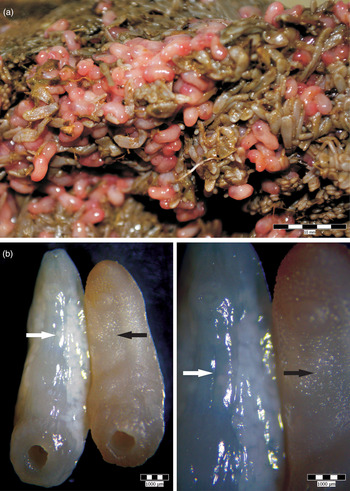
The ruminal walls of the red deer were covered with 2719 ruminal flukes. Sixty-one parasites, chosen randomly, were examined under the stereomicroscope and separated into two groups on the basis of the absence of tegumental papillae (P. cervi type, 2 of 61 flukes) or their presence (other paramphistomid types, 59 of 61 flukes) (fig. 1). Eggs were found in all flukes examined. Liver examination revealed 54 specimens of liver fluke (F. magna). Coprological examination revealed individual lungworm larvae (Protostrongylidae), strongylid and paramphistomid eggs in the faeces.
(a) Rumen of a red deer heavily infected with adult flukes of Paramphistomum leydeni and P. cervi. (b) The tegument of both species at two magnifications to show the presence of papillae (black arrows) in P. leydeni and the absence of papillae (white arrows) in P. cervi.

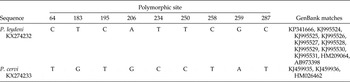
Amplification of DNA extracted from 61 ruminal flukes led to a 320-bp product. In 59 samples, the sequence was identical to a P. leydeni sequence deposited in GenBank, and the corresponding fluke was identified as paramphistomid type under the microscope (table 1). The remaining two samples were identical to P. cervi sequences deposited in GenBank and the corresponding flukes were identified as P. cervi type. The P. leydeni and P. cervi sequences differed at nine polymorphic sites and were deposited in GenBank under accession numbers KX274232 and KX274233. The P. leydeni sequences in this study matched those isolated from goats from China (Ma et al., Reference Ma, He, Liu, Zhou, Liu, Liu and Zhu2015), cattle from Uruguay (unpublished), cattle from Argentina (Sanabria et al., Reference Sanabria, Moré and Romero2011) and fallow deer from Ireland (unpublished). The P. cervi sequences in this study matched those isolated from sheep from China (Zheng et al., Reference Zheng, Chang, Zhang, Tian, Lou, Duan, Guo, Wang and Zhu2014) and red deer from Slovakia (Bazsalovicsová et al., Reference Bazsalovicsová, Králová-Hromadová, Špakulová, Reblánová and Oberhauserová2010).
Polymorphic sites identified in 320-bp sequences amplified from Paramphistomum leydeni and P. cervi DNA, and potential matches with GenBank sequences.

Here we used both morphological and molecular methods to analyse red deer ruminal flukes, revealing concurrent P. leydeni and P. cervi infection in a red deer with fascioloidosis. We also confirmed that the absence of tegumental papillae can be used to differentiate P. cervi from other paramphistomid species in Europe, using incident light stereomicroscopy of air-dried flukes. This approach may not be appropriate in other parts of the world, where the existence of other paramphistomid flukes without tegumental papillae may result in misdiagnosis. Examples of other flukes without papillae include Paramphistomum cephalophi, reported so far only in the small intestine of a black-fronted duiker (Cephalophus nigrifrons) in Africa (Eduardo, Reference Eduardo1982b), Cotylophoron macrosphinctris, reported in the rumen of African buffalo (Bubalus (Syncerus) caffer) (Eduardo, Reference Eduardo1985), Gigantocotyle gigantocotyle, reported in the stomach of common hippopotamus (Hippopotamus amphibius) and Gigantocotyle duplicitestorum, reported in the stomach and small intestine of H. amphibius in Africa (Eduardo, Reference Eduardo1984). It may also be possible to differentiate P. cervi from other ‘non-papillar’ flukes using data on the geographical distribution of flukes and hosts, as well as additional morphological features; for example, P. cephalophi has a posterior notch in the acetabular region, while Gigantocotyle spp. have an enormous acetabulum.
Morphological identification of flukes in our study depended on complete drying of the tegument, since moisture on the tegument surface can mask small tegumental papillae due to light reflection. This gives the false impression that the tegument surface is smooth and not rough, similar to other ruminal fluke species in Europe. Accurate morphological differentiation between P. cervi and P. leydeni also requires taking into account that the tegumental papillae of immature P. leydeni are visible only with the aid of scanning electron microscopy (Nikander & Saari, Reference Nikander and Saari2007). Failing to consider this possibility may lead to the false conclusion that papillae are absent and that the flukes are P. cervi. These considerations mean that previous reports of paramphistomosis should be interpreted with caution, since many authors did not report attempts to differentiate these two species. Indeed, Nikander & Saari (Reference Nikander and Saari2007) concluded that rumen flukes in reindeer (Rangifer tarandus) in Finland were P. leydeni, rather than P. cervi as usually reported. In our case, the presence of eggs in the fluke samples and faeces demonstrates fluke maturity and reduces the probability of misdiagnosing P. leydeni as P. cervi based on morphology.
Given the possibly worldwide distribution of paramphistomid flukes, it appears that paramphistomosis and its economic impact may be greater than previously thought (Lotfy et al., Reference Lotfy, Brant, Ashmawy, Devkota, Mkoji and Loker2010), especially in wildlife. While paramphistomosis is frequently studied in domestic animals, it is less studied in wild ruminants. Few details about the presence and identity of paramphistomes in cervids are known (O´Toole et al., Reference O'Toole, Browne, Hogan, Bassière, DeWaal, Mulcahy and Zintl2014), despite sweeping statements in the literature.
Financial support
Supported by a grant from the Croatian Science Foundation for the project ‘Molecular epidemiology of selected parasitic diseases of wildlife’ (no. 3421).
Conflict of interest
None.