Child abuse and neglect constitute the antithesis of the kind of sensitive and available caregiving necessary for the development of a secure attachment relationship. As such, it is not surprising that the attachments of maltreated infants consistently have been shown to be insecure (Crittenden, Reference Crittenden, Belsky and Nezworski1988; Egeland & Sroufe, Reference Egeland and Sroufe1981; Schneider-Rosen, Braunwald, Carlson, & Cicchetti, Reference Schneider-Rosen, Braunwald, Carlson and Cicchetti1985). More specifically, maltreated infants disproportionately develop disorganized–disoriented attachments with their caregivers, characterized by a breakdown of an organized emotion regulation strategy in the face of stress (Barnett, Ganiban, & Cicchetti, Reference Barnett, Ganiban and Cicchetti1999; Carlson, Cicchetti, Barnett, & Braunwald, Reference Carlson, Cicchetti, Barnett and Braunwald1989; Lyons-Ruth, Repacholi, McLeod, & Silva, Reference Lyons-Ruth, Repacholi, McLeod and Silva1991). Such associations are so well established that much recent work has now shifted to examining the efficacy of prevention programs to promote attachment security among children at risk (Bernard, Dozier, Bick, & Calson, Reference Bernard, Dozier, Bick and Carlson2012; Cicchetti, Rogosch, & Toth, Reference Cicchetti, Rogosch and Toth2006; Moss et al., Reference Moss, Dubois-Comtois, Cyr, Tarabulsy, St.-Laurent and Bernier2011).
Although there is a long history of research exploring the significance of maltreatment for the development of attachment insecurity in the early life course, the literature is notably weaker regarding the question of whether childhood maltreatment experiences have lasting implications for increased risk of insecurity into adolescence and beyond. The most widely used and well-validated assessment for studying attachment states of mind in adolescence and adulthood is the Adult Attachment Interview (AAI; Main, Goldwyn, & Hesse, Reference Main, Goldwyn and Hesse2003–2008), a semistructured protocol in which participants discuss their childhood experiences. Attachment states of mind are assessed in the AAI based on the coherence with which individuals discuss their early experiences with caregivers, with individuals producing internally inconsistent narratives or becoming emotionally overwhelmed during the AAI being classified as insecure.
The first wave of studies examining the significance of maltreatment in relation to AAI states of mind was largely focused on whether negative life experience measures that included the experience of maltreatment as an item-level indicator could account for within-person change in security from infancy (as observed, e.g., in the Strange Situation procedure) to adulthood (as assessed with the AAI; Becker-Stoll, Fremmer-Bombik, Wartner, Zimmerman, & Grossmann, Reference Becker-Stoll, Fremmer-Bombik, Wartner, Zimmermann and Grossmann2008; Hamilton, Reference Hamilton2000; Waters, Merrick, Treboux, Crowell, & Albersheim, Reference Waters, Merrick, Treboux, Crowell and Albersheim2000; Zimmermann & Grossmann, Reference Zimmermann, Grossmann, Koops, Hoeksma and van den Boom1997). In these studies, the rates of maltreatment tended to be quite low, and abuse experiences were often measured retrospectively via self-report. To our knowledge, the Minnesota Longitudinal Study of Risk and Adaptation (Sroufe, Egeland, Carlson, & Collins, Reference Sroufe, Egeland, Carlson and Collins2005) is the only investigation in which AAI data were acquired from a cohort characterized prospectively from infancy in terms of abuse experiences. Nonetheless, as with the other studies noted earlier, the Minnesota Longitudinal Study of Risk and Adaptation has only reported evidence of the role of maltreatment history in attachment-related change from infancy to adulthood (Weinfield, Whaley, & Egeland, Reference Weinfield, Whaley and Egeland2004; but see Raby, Labella, Martin, Carlson, & Roisman, Reference Raby, Labella, Martin, Carlson and Roisman2017 [this issue]). Although this research has provided insight into whether maltreatment contributes to lawful change in security, such work does not ultimately address whether maltreatment increases risk for insecurity into adolescence and beyond (but see Beckwith, Cohen, & Hamilton, Reference Beckwith, Cohen and Hamilton1999).
In the last decade, a second wave of research in this area has been undertaken to more directly explore associations between maltreatment histories and AAI states of mind (e.g., Bailey, Moran, & Pederson, Reference Bailey, Moran and Pederson2007; Hughes, Turton, McGauley, & Fonagy, Reference Hughes, Turton, Hopper, McGauley and Fonagy2004; Jacobvitz, Leon, & Hazen, Reference Jacobvitz, Leon and Hazen2006; Lyons-Ruth, Yellin, Melnick, & Atwood, Reference Lyons-Ruth, Yellin, Melnick and Atwood2003; Madigan, Vaillancourt, McKibben, & Benoit, Reference Madigan, Vaillancourt, McKibbon and Benoit2012; Riggs & Jacobvitz, Reference Riggs and Jacobvitz2002; Stovall-McClough & Cloitre, Reference Stovall-McClough and Cloitre2006; see also Bakermans-Kranenburg & van IJzendoorn, Reference Bakermans-Kranenburg and van IJzendoorn2009). Unfortunately, however, these studies have a number of significant methodological flaws that make them difficult to interpret. Perhaps most important, all have used retrospectively acquired and/or self-reported assessments of maltreatment (often drawn from the AAI itself) and tend to focus on unresolved states of mind specifically (individuals are classified as unresolved when their discourse about abuse- or loss-related experiences becomes psychologically confused).
The combination of these methodological choices makes it difficult to discern whether maltreatment increases risk for insecurity in adolescence and adulthood for two reasons. First, apart from the issue of the validity of retrospectively acquired reports of individuals who indicate a history of childhood maltreatment, self-reported assessments of maltreatment fail to identify an unknown subset of individuals who are unable or unwilling to report these experiences in later life. The misclassification of such individuals as nonmaltreated can result in an imprecise estimate of the associations of interest and also makes it impossible to study whether such individuals are at risk, as might be expected, for dismissing states of mind. Second, to be coded as unresolved, participants must self-report a “qualifying event” during the AAI (for unresolved trauma, a maltreatment experience). What this means, then, is that studies reporting correlations between retrospectively acquired, self-reported maltreatment and unresolved states of mind rely on a research design that partially confounds maltreatment status with unresolved states of mind.
Advances in our understanding of the latent structure of individual differences in adult attachment as assessed by the AAI might prove helpful in relation to the limitations of the studies just described. Specifically, although most research using the AAI still leverages mutually exclusive adult attachment categories, evidence has emerged over the last decade that the primary coding systems for the AAI (Kobak, Reference Kobak1993; Main et al., Reference Main, Goldwyn and Hesse2003–2008) capture variation in two weakly correlated state of mind dimensions (for a detailed overview, see Booth-LaForce & Roisman, Reference Booth-LaForce and Roisman2014). The first of these reflects the degree to which individuals tell internally inconsistent narratives about versus freely evaluate their attachment histories (i.e., dismissing states of mind), and the second reflects the extent to which adults become emotionally overwhelmed and psychologically confused while discussing their childhood experiences with primary caregivers (i.e., preoccupied states of mind). In addition, all four published factor analyses of the Main et al. AAI coding system have demonstrated that unresolved and preoccupied states of mind are not empirically distinct (for a review, see Haltigan, Roisman, & Haydon, Reference Haltigan, Roisman and Haydon2014; for additional discussion, see Roisman, Fraley, & Booth-LaForce, Reference Roisman, Fraley and Booth-LaForce2014). Unlike unresolved status, all participants are scored on preoccupied states of mind. Thus, studies that adopt the two-dimensional approach to assessing the AAI states of mind just described are better positioned to study whether insecure states of mind characterized by psychological confusion and attachment-related distress in particular (i.e., preoccupation) might be associated with a history of maltreatment.
In sum, no published research has examined whether maltreatment-related experiences (presence, subtype, chronicity, and identity of the perpetrator), assessed prospectively and/or independently of self-report, increase risk for dismissing and preoccupied states of mind as assessed via the AAI (but see Raby et al., Reference Raby, Labella, Martin, Carlson and Roisman2017 [this issue]). In addition, all prior studies in this area were informed by the original categorical coding system that subtly misrepresents the latent structure of the AAI in ways that have the potential to impede progress toward documenting associations between maltreatment history and AAI states of mind.
To address the limitations of prior studies in this area, in the current investigation we examined the maltreatment-related correlates of the AAI state of mind dimensions in a large sample of maltreated and nonmaltreated comparison adolescents, all of whom were drawn from low-income families. A focus on low-income families is important because child maltreatment occurs disproportionately in low socioeconomic groups (Sedlak et al., Reference Sedlak, Mettenburg, Basena, Petta, McPherson, Greene and Li2010), and thus socioeconomic status equivalence is important in order to disentangle the impact of low socioeconomic status from the impact of maltreatment on developmental adaptation. In this study we also statistically controlled for participants’ negative inferred childhood experiences with maternal and paternal caregivers as assessed during the AAI. Although there is mixed evidence as to whether such retrospective assessments provide a veridical window into direct observations of early caregiving measured prospectively (Haydon, Roisman, Owen, Booth-LaForce, & Cox, Reference Haydon, Roisman, Owen, Booth-LaForce and Cox2014; Roisman & Haydon, Reference Roisman, Haydon, Cicchetti and Roisman2011), by controlling for maternal and paternal inferred childhood experiences, we could be more confident in the current study that any maltreatment-related correlates of adolescents’ AAI states of mind were not being driven by coders scoring maltreated participants as more insecure simply because of harsh caregiving experiences explicitly reported during the AAI.
More specifically, this work was guided by the hypothesis that maltreatment-related experiences, particularly those perpetrated by primary caregivers and those with greater chronicity, are likely to increase risk for both insecure states of mind and more negative inferred childhood experiences in lasting ways. However, given the especially robust association already documented between attachment-related disorganization in infancy and the experience of maltreatment (Carlson et al., Reference Carlson, Cicchetti, Barnett and Braunwald1989; Cyr, Euser, Bakersman-Kranenburg, & van IJzendoorn, Reference Cyr, Euser, Bakermans-Kranenburg and van IJzendoorn2010), we hypothesized that insecure states of mind characterized by psychological confusion and attachment-related distress in particular (i.e., preoccupation) might be especially likely to be associated with the experience of physical and/or sexual abuse given the high likelihood of psychological trauma associated with those forms of child maltreatment.
Method
Participants
The participants included adolescents from low-income families (N = 354), assessed as part of a larger investigation of adolescent development among youth with and without histories of child maltreatment. The sample (M age = 16.7 years, SD = 1.3) involved 214 maltreated and 140 nonmaltreated adolescents and was recruited by a Department of Human Services (DHS) project liaison, who identified families with children in the targeted age range who had experienced child maltreatment as documented in DHS records. A random sample of families was approached by the DHS liaison about possible participation in the study. If interested, the parent signed a name release form in order to provide contact information to project staff. Staff subsequently met with the parent to explain the study and obtain informed consent. Comparison adolescents from nonmaltreated families were recruited from families receiving Temporary Assistance to Needy Families. The DHS liaison identified such families through DHS records and screened for the absence of maltreatment. The same procedures for maltreating families were used for recruitment of nonmaltreating families.
In addition to detailed DHS records on all maltreatment experiences obtained for independent coding, project staff also interviewed mothers regarding child maltreatment experiences (see below). Information from these interviews was incorporated into maltreatment determinations. Among nonmaltreating families, cases involving maternal report of child maltreatment experiences were excluded from further participation.
Procedures
Adolescents participated in individual research assessment sessions conducted in private interview rooms by trained staff. The AAI was completed after prior research sessions with the participant; these sessions served to establish rapport and trust in the interviewer, prior to the AAI. Interviews were audiorecorded and transcribed verbatim.
Measures
Maltreatment Classification System (MCS)
The MCS (Barnett, Manly, & Cicchetti, Reference Barnett, Manly, Cicchetti, Cicchetti and Toth1993) is a reliable and valid method for classifying maltreatment (Bolger, Patterson, & Kupersmidt, Reference Bolger, Patterson and Kupersmidt1998; English et al., Reference English, Upadhyaya, Litrownik, Marshall, Runyan, Graham and Dubowitz2005; Manly, Reference Manly2005) that uses DHS records detailing investigations and findings involving maltreatment in identified families over time. Rather than relying on official designations and case dispositions, the MCS codes all available information from DHS records, making independent determinations of maltreatment experiences. Based on operational criteria, the MCS designates all of the subtypes of maltreatment children have experienced (i.e., neglect, emotional maltreatment, physical abuse, and sexual abuse). Coding of the DHS records was conducted by trained research assistants, doctoral students, and clinical psychologists. Coders were required to meet acceptable reliability with criterion standards before coding for the study. Coders demonstrated acceptable reliability with the criterion (weighted κs with the criterion ranging from 0.86 to 0.98). The κ values for the presence versus the absence of maltreatment subtypes ranged from 0.90 to 1.00.
In terms of the subtypes of maltreatment, neglect involves failure to provide for the child's basic physical needs for adequate food, clothing, shelter, and medical treatment. In addition to inadequate attention to physical needs, forms of this subtype include lack of supervision, moral–legal neglect, and education neglect. Emotional maltreatment involves extreme thwarting of children's basic emotional needs for psychological safety and security, acceptance and self-esteem, and age-appropriate autonomy. Examples of emotional maltreatment of increasing severity include belittling and ridiculing the child, extreme negativity and hostility, exposure to severe marital violence, abandoning the child, and suicidal or homicidal threats. Physical abuse involves the nonaccidental infliction of physical injury on the child (e.g., bruises, burns, choking, and broken bones). Injuries range from minor and temporary to permanently disfiguring. Finally, sexual abuse involves attempted or actual sexual contact between the child and caregiver for purposes of the caregiver's sexual satisfaction or financial benefit. Events range from exposure to pornography or adult sexual activity, to sexual touching and fondling, to forced intercourse involving the child.
Adolescents in the maltreatment group all had documented histories of experiencing abuse and/or neglect according to DHS records. Among these adolescents, 82.7% had experienced neglect, 60.3% had experienced emotional maltreatment, 51.9% had experienced physical abuse, and 21.5% had experienced sexual abuse. As is typical in maltreated populations (Bolger et al., Reference Bolger, Patterson and Kupersmidt1998; Manly, Cicchetti, & Barnett, Reference Manly, Cicchetti and Barnett1994; Manly, Kim, Rogosch, & Cicchetti, Reference Manly, Kim, Rogosch and Cicchetti2001), the majority of adolescents had experienced multiple subtypes of maltreatment. Specifically, 61.6% of the maltreated adolescents had experienced two or more maltreatment subtypes. Given the overlap among subtypes and the relatively lower rates of physical and sexual abuse as compared to neglect and emotional maltreatment, we identified adolescents who experienced neglect and/or emotional maltreatment (63.1%) without physical or sexual abuse versus adolescents who experienced physical and/or sexual abuse (36.9%). The physical and/or sexual abuse group also may have experienced neglect or emotional maltreatment.
The MCS also determines the perpetrator(s) of maltreatment, including maternal figures, paternal figures, and others. In the current investigation, we examined the number of subtypes of maltreatment perpetrated by each maternal, paternal, and other adult figure. In addition, the developmental timing of maltreatment events is designated by the MCS. Maltreatment events are classified into six developmental periods: infancy (0–18 months), toddlerhood (19–35 months), preschool (36–59 months), early school age (5–7 years), later school age (8–12 years), and adolescence (13–18 years). As an index of maltreatment chronicity, the number of developmental periods of maltreatment was determined for each adolescent. In the current sample, 79.6% of the adolescents had experienced the onset of maltreatment prior to age 5; for most adolescents (80.1%) maltreatment occurred in more than one developmental period (M = 2.40, SD = 1.20, range = 1–6).
AAI
The AAI (George, Kaplan, & Main, Reference George, Kaplan and Main1984–1996) is a semistructured, hour-long interview in which participants are asked to describe memories related to their early childhood relationships with their primary caregivers and the effects they perceive those experiences to have had on their development. AAI coding focuses on the internal consistency of participants’ narratives as well as the extent to which participants become emotionally activated while discussing childhood memories. In the current study, we used a slight modification of the AAI (Ward & Carlson, Reference Ward and Carlson1995) involving minor word changes that simplified some language and clarified the nature of requests from interviewers for information.
The AAI Q-Sort (Kobak, Reference Kobak1993) was used to code adolescents’ AAI narratives by raters centrally trained and certified as reliable on the Main et al. (2003–2008) AAI categorical coding system. The AAI Q-Sort contains 100 cards pertaining to attachment-related states of mind and inferred parental experience as assessed by the AAI. Cards are sorted across nine piles from most to least characteristic of the participant's narrative in a forced, quasinormal distribution. The distribution of participants’ cards was then correlated with prototypic sorts based on conceptually relevant attachment dimensions. In light of large-sample exploratory and confirmatory factor analytic evidence (Haltigan et al., Reference Haltigan, Roisman and Haydon2014; Haydon, Roisman, & Burt, Reference Haydon, Roisman and Burt2012), we focused on two dimensions leveraging the dismissing prototype (e.g., “adjectives [describing early relationships with parents] supported by vague or shallow memories vs. adjectives supported by detailed episodic memories”) and preoccupied prototype (e.g., “is confused or overwhelmed with information about parents vs. information about parents is adequate and well organized”). We also created maternal and paternal inferred negative experience dimensions based on the items identified as indicators of these factors in Haltigan et al. (Reference Haltigan, Roisman and Haydon2014). To ensure reliability in the current sample, approximately 20% of the AAI transcripts cases were double sorted. Of the subset of double-coded cases, coders were reliable (≥0.6 using the Pearson–Brown prophecy formula) on 88% of cases. Where two coders were discrepant, a third coder sorted the case; the final sort was computed by averaging the two sorts (reliability ≥ 0.6) that were most highly correlated. Note that coding was completed without knowledge of maltreatment status, except as revealed within the context of the AAI itself (e.g., approximately 15% of participants reported a “qualifying” abuse and/or family trauma experience that required further probing for unresolved states of mind).
Covariates
In this low-income, range-restricted sample, nearly all families had a history of receiving public assistance, which was not correlated with the AAI dimensions. Similarly, age and race/ethnicity were not correlated with the AAI dimensions. In contrast, males in the current sample were significantly elevated on dismissing states of mind (r = .17, p < .01) and females were significantly elevated on preoccupation (r = .16, p < .01; see Haydon et al., Reference Haydon, Roisman, Owen, Booth-LaForce and Cox2014, for consistent evidence in a normative-risk sample). As such, in regression analyses that follow we control for participant sex.
Results
Analytic plan
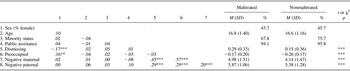
After examining the four AAI dimensions on maltreatment status using t tests, we conducted three sets of regression analyses for each AAI dimension in which parameterizations of maltreatment (i.e., subtype, perpetrator, and chronicity), along with covariates (adolescent sex and the nonfocal AAI dimensions) were entered in successive blocks. The first block examined each set of maltreatment variables. The second block added adolescent sex to examine the robustness of associations in Block 1 to the entry of this control variable into the regression equation. The third block tested whether effects were unique to the focal AAI dimension by controlling for the other three AAI dimensions. Descriptive statistics and zero-order correlations appear in Table 1.
Correlations and descriptive statistics for demographic and Adult Attachment Interview variables

**p < .01. ***p < .001.
Focal analyses
Maltreatment status
Compared to nonmaltreated adolescents, participants who had been maltreated were more dismissing (maltreated M = 0.29, SD = 0.33, nonmaltreated M = 0.15, SD = 0.36); t (352) = 3.81, p < .01; r = .20; more preoccupied (maltreated M = –0.17, SD = 0.20, nonmaltreated M = –0.26, SD = 0.17); t (352) = 4.34, p < .01; r = .23; had more negative inferred maternal experiences (maltreated M = 4.98, SD = 1.51, nonmaltreated M = 4.14, SD = 1.47); t (352) = 5.14, p < .01; r = .26; and had more negative inferred paternal experiences (maltreated M = 5.87, SD = 1.06, nonmaltreated M = 5.38, SD = 1.28); t (258) = 3.76, p < .01; r = .20. (Note that Levene's test was significant for the inferred paternal experience analysis, so the statistics reported do not assume homogeneity of variances.) According to Cohen's (Reference Cohen1992) criteria, these effects were moderate in magnitude. To provide additional context, in the normative-risk (and average income) NICHD Study of Early Child Care and Youth Development (SECCYD; Booth-LaForce & Roisman, Reference Booth-LaForce and Roisman2014) sample, the mean dismissing score was –0.02 (SD = 0.40) and the mean preoccupation score was –0.24 (SD = 0.20) on the AAI at age 18 years (N = 857). What this suggests is that, compared to the normative risk SECCYD, low-income status alone (equivalent to an r = .21, a medium difference) but especially maltreatment plus low-income status (r = .39, a large difference) increased risk of dismissing states of mind. In contrast, compared to the SECCYD, rates of preoccupation were only higher in the maltreated group of the current study (r = .16, a small difference) but not the comparison (i.e., low income only) subsample (r = –.05).
Subtype
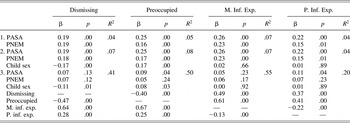
Four sets of hierarchical regressions were estimated to examine the role of maltreatment subtype using the group-based hierarchy described in the Methods section (see Table 2). More specifically, groups were dummy coded to indicate membership in the focal group (0 = nonmember, 1 = member), with “no maltreatment” as the implicit comparison group. Controlling for sex, both physical and/or sexual abuse and emotional maltreatment and/or neglect significantly increased risk for both insecure states of mind (i.e., dismissing and preoccupied) and more negative inferred caregiving experiences. After controlling for the nonfocal AAI dimensions, membership in the physical and/or sexual abuse group was only uniquely associated with preoccupied states of mind and negative inferred paternal experiences.
Hierarchical regression models predicting Adult Attachment Interview dimensions from maltreatment subtype and covariates

Note: N = 354. M., Maternal; P., paternal; Inf. Exp., inferred experience; PASA, physical and/or sexual abuse; PNEM, physical neglect and/or emotional maltreatment. For child sex, 1 = male, 2 = female. All models were significant at p < .01 at each step. The R 2 values increase significantly at p < .01 in each block except Step 2 for M inf. exp. (p = .66) and Step 2 for P inf. exp. (p = .89).
Perpetrator
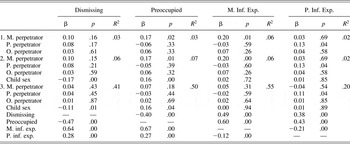
Four sets of hierarchical regressions were estimated to examine the role of maltreatment perpetrator (mother, father, and/or other). The variables used indexed the number of subtypes of maltreatment each figure was known to have perpetrated on the individual adolescent over time. As reported in Table 3, the extent of maltreatment perpetration by a maternal caregiver (but not paternal caregivers or others) significantly increased risk for preoccupied states of mind and more negative inferred maternal caregiving experiences. Maternal perpetration was not uniquely associated with any of the four AAI dimensions when controlling for the other three nonfocal AAI dimensions. The extent of paternal perpetration of maltreatment was uniquely associated with more negative inferred paternal caregiving experiences, and continued to maintain an independent association after the three nonfocal AAI dimensions were controlled.
Hierarchical regression models predicting Adult Attachment Interview dimensions from number of subtypes perpetration by different adult figures and covariates

Note: N = 354. M., Maternal perpetrator (N subtypes); P., paternal perpetrator (N subtypes); Inf. Exp., inferred experience; O., other perpetrator (N subtypes). For child sex, 1 = male, 2 = female. All models were significant at p < .01 at each step. The R 2 values increase significantly at p < .01 in each block except Step 2 for M. inf. exp. (p = .76) and Step 2 for P. inf. exp. (p = .77).
Chronicity
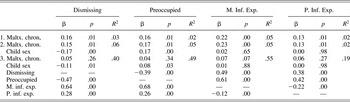
As illustrated in Table 4, more chronic maltreatment significantly increased risk for both dismissing and preoccupied states of mind and more negative inferred maternal and paternal caregiving experiences. Chronicity of maltreatment was not uniquely associated with any of the four AAI dimensions after controlling for the other three nonfocal AAI dimensions.
Hierarchical regression models predicting Adult Attachment Interview dimensions from maltreatment chronicity and covariates

Note: N = 351. M., Maternal; P., paternal; Inf. Exp., inferred experience; Maltx. chron., maltreatment chronicity. For child sex, 1 = male, 2 = female. All models were significant at p < .05 at each step. The R 2 values increase significantly at p ≤ .01 in each block except Step 2 for M. inf. exp. (p = .65) and Step 2 for P. inf. exp. (p = .98).
Discussion
This paper reports the first large sample investigation of the maltreatment-related correlates of low-income adolescents’ narratives about their childhood experiences with primary caregivers. More specifically, we demonstrated that the experience of maltreatment, particularly when chronic, is associated with increased risk for both dismissing and preoccupied states of mind and more negative inferred childhood experiences in adolescence. Although most such maltreatment-related associations were not specific to any of the four AAI dimensions, as hypothesized, the experience of physical and/or sexual abuse (but not neglect or emotional maltreatment in the absence of physical and/or sexual abuse) was uniquely associated with preoccupied states of mind even after controlling for the other AAI dimensions. We speculate that the traumatic nature of physical and sexual abuse may contribute to their independent effect on preoccupied states of mind.
It also is noteworthy that more extensive maltreatment by maternal and paternal caregivers, as determined independently from official DHS records, demonstrated specificity in relation to inferred maternal versus paternal negative experience on the AAI. That is, greater maternal perpetration of maltreatment was significantly associated with more negative maternal (but not paternal) inferred experience, whereas greater paternal (but not maternal) perpetration was significantly associated with more negative paternal inferred experience. Moreover, more extensive paternal perpetration remained a significant predictor of negative inferred paternal experience, even after other AAI dimensions were controlled (for parallel evidence of the retrodictive validity of the inferred experience scales from the AAI, see Haydon et al., Reference Haydon, Roisman, Owen, Booth-LaForce and Cox2014).
This paper extends work on the role of maltreatment in the development of attachment insecurity in a number of important ways. First, to our knowledge, no prior work has examined whether maltreatment experiences, assessed independently of self-report, increase risk for insecure states of mind as assessed by the AAI. Previous studies have largely been limited to the role of maltreatment in increasing risk for attachment insecurity generally and disorganization in particular during infancy (Carlson et al., Reference Carlson, Cicchetti, Barnett and Braunwald1989; Crittenden, Reference Crittenden, Belsky and Nezworski1988; Egeland & Sroufe, Reference Egeland and Sroufe1981; Schneider-Rosen et al., Reference Schneider-Rosen, Braunwald, Carlson and Cicchetti1985) or have operationalized abuse histories retrospectively in examining links between maltreatment and (typically) unresolved AAI states of mind (e.g., Bailey et al., Reference Bailey, Moran and Pederson2007; Madigan et al., Reference Madigan, Vaillancourt, McKibbon and Benoit2012; but see Van Hoof, Van Lang, Speekenbrink, van IJzendoorn, & Vermeiren, Reference Van Hoof, Van Lang, Speekenbrink, van IJzendoorn and Vermeiren2015). Second, the findings indicate that maltreatment in childhood continues to be reflected in insecure states of mind at least through adolescence. Third, we identified acts of abuse as having a unique role in preoccupied states of mind. In contrast, we did not find a specific role for varying maltreatment parameters in relation to dismissing states of mind, beyond the other AAI dimensions. Fourth, specificity was demonstrated in the relations of maternal versus paternal perpetration of maltreatment in associations with respective maternal versus paternal negative inferred experiences.
The current work more generally extends research examining the developmental origins of AAI states of mind (for reviews, see Grossmann, Grossmann, & Waters, Reference Grossmann, Grossmann and Waters2005; Roisman & Haydon, Reference Roisman, Haydon, Cicchetti and Roisman2011). In the largest such study to date, Haydon et al. (Reference Haydon, Roisman, Owen, Booth-LaForce and Cox2014) undertook an analysis of AAI data from the SECCYD. Despite access to a large sample and multiple assessments of caregiving experiences across childhood and adolescence, however, only between 10% and 20% of the variance could be accounted for in dismissing and preoccupied AAI states of mind. The results from the current study suggest that one way to begin to close this “explanation gap” is to measure the kinds of low base rate experiences that are the focus of this study in addition to more standard assessments of parental sensitivity and responsiveness.
The current study has a number of methodological strengths. First, the sample size was large by conventional standards. Due to the resource-intensive nature of such studies, many investigations of the correlates of AAI states of mind have used small samples and are therefore not adequately powered (for a review, see Roisman & Haydon, Reference Roisman, Haydon, Cicchetti and Roisman2011) nor provide precise estimates of the focal associations. Second, the assessment of maltreatment experiences was established independently from self-report, a method subject to recall biases and potential minimization, particularly among individuals with dismissing states of mind. Third, by leveraging the inferred experience dimensions of the AAI, it was possible to demonstrate that the experience of physical and/or sexual abuse was uniquely associated with risk for preoccupied states of mind adjusting for descriptions of adolescents’ early experiences.
There is nonetheless much work yet to be done in this area. Perhaps most notable, because participants in the current sample were relatively young (M = 16.7 years), it remains of significant interest whether the experience of abuse and neglect in childhood continues to put individuals at risk for insecure states of mind in the years of maturity (but see Raby et al., Reference Raby, Labella, Martin, Carlson and Roisman2017 [this issue]). In addition, the current study leveraged recent insights about the two most common coding systems for the AAI to explore variation in dismissing and preoccupied states of mind. It is possible that other, less commonly utilized approaches to coding the AAI, such as Crittenden and Landini's (Reference Crittenden and Landini2011) dynamic maturational model, might provide additional insights into the role of maltreatment in adults’ attachment states of mind.
All of this said, this paper provides an important point of departure for future work by offering a methodological template for such research anchored in the state-of-the-art assessment of AAI states of mind. Through investigation of a high-risk sample of maltreated and nonmaltreated adolescents, the findings of this study contribute to the larger body of knowledge regarding attachment representations obtained from more normative samples. Moreover, the findings extend research examining the influences of normative variation in parental sensitivity and availability on attachment organization by considering the adverse effects of extreme violations of adaptive parenting behavior inherent in the perpetration of abuse and neglect. Finally, the research further indicates the importance of early intervention to prevent the occurrence of child maltreatment and to promote adaptive parenting behavior and secure child attachment organization in order to avert the development of insecure states of mind and associated difficulties in interpersonal relationships and psychological functioning (Bakermans-Kranenburg & van IJzendoorn, Reference Bakermans-Kranenburg and van IJzendoorn2009; Holland & Roisman, Reference Holland and Roisman2010; van IJzendoorn, Reference van IJzendoorn1995).