

In his evocatively named “Attacks on Linking,” originally published in the International Journal of Psycho-Analysis in 1959, W. R. Bion describes patients who produce symptoms—hallucinations, stutters, sleepiness—designed, unconsciously, to destroy closeness with the analyst. In a numbered list of “clinical examples,” Bion describes incidents from his own practice: one patient sees a blue haze filling the room. Another reports two probability clouds floating in the air. A third tries to agree with what Bion has said, but stammers so markedly that he cannot get the words out. A fourth hallucinates that a piece of iron falls to the floor. The haze, the clouds, the stuttering, the “dead piece of iron,” initially inexplicable, become in Bion's hands “attacks on linking”: ways not to see, not to speak, not to connect, not to think.Footnote 1
The stammer mutilates sense by breaking words into disjointed letters and repeated sounds. The patient isn't simply stuck; the stammer, Bion writes, is an act of destruction, “designed to prevent the patient from using language as bond between him and me.”Footnote 2 Similarly, the blue haze not only blocks the patient's sight of the analyst, but by extension forestalls the possibility of the two being joined together as a couple: that is to say, as people who can communicate, who can share emotional experience, who can make meaning, and who can pass parts of themselves back and forth between them—an operation that is, for Bion, paramount not only to the analytic process, but to human relations writ large. Such acts of imaginative destruction are not only performed by psychotic patients whose symptoms make their attacks spectacular. All of us, even if less noticeably, set out at times to destroy “anything which is felt to have the function of linking one object to another.”Footnote 3 We attack the links between words, between words and the things to which they refer, between ideas, and between people. And, even more crucially, we launch attacks on our very capacity to make those links in the first place. Bion's writing, dense with reported schizophrenic thought and speech, Kleinian shorthand, and a strange paramathematical, paraphilosophical, paramystical language all his own, can be difficult to read. And yet his point is remarkably simple: we don't always let ourselves think.
Simple, yet trenchant. Bion published his most important work in the 1960s and 70s, when, building on the work of his teacher Melanie Klein, he took her ideas in a fundamentally new direction that reshaped psychoanalytic theory and practice as we know it. Despite the fifty-year lag, and the fact that his writing can be cryptic, Bion is, to my mind, the man of the hour. His notion of attacks on linking does more than simply describe a purportedly timeless truth of psychic experience: it identifies what may be the defining cognitive-affective operation of our political present. In standard psychoanalytic parlance, attacks on linking include: the infant's attack on the mother's breast, the Oedipal breaking-apart of the parental pair, the cloudy thinking that keeps the patient from processing the analyst's insight, and the envious destruction of another's ability to handle complex emotions. In the more immediate register of contemporary American sociopolitical experience, attacks on linking include: calls to “Build a Wall!” on the United States-Mexico border, climate change denial, the refusal to acknowledge the connection between mass shootings and inadequate gun control legislation, the disjuncture of America's history of race-based slavery from the present-day prison-industrial system, the daily “forgetting” of the poorly compensated third-world labor that produces so many of our goods and freedoms, and the profound disconnect endemic to the way Western powers first help to make some parts of the world unlivable and then criminalize and dehumanize migrant and refugee populations. Some links feel intolerable, and we don't always let ourselves make them.
Bion argues that attacks on linking occur “largely through varieties of stupidity.”Footnote 4 This notion accords both with George Eliot's legendary statement of sympathetic perception/self-stupefaction in Middlemarch and Bruce Robbins's creative reuse of it in his essay “The Sweatshop Sublime.”Footnote 5 There, Robbins argues that the vertiginous movements of mind that occur when a privileged Western subject takes stock of the global division of labor echoes the gestures of the Kantian sublime. First, there is a moment of “ethically inspired consumer consciousness” in which, Robbins has us suppose, “you” read the label on your t-shirt (made in Bangladesh or Mexico or the USA) and imagine the conditions of life under which it was produced: “the pitifully inadequate wages, not to speak of the locked fire exits, the arbitrary harassments and firings, the refusal of genuine union representation.” This “sudden, heady access to the global scale” in which your imagination stretches to “the outer reaches of a world economic system of notoriously inconceivable magnitude and interdependence” (or exploitation) is met by a recoil: it is too much to take in. In Immanuel Kant's description of the sublime, the imagination, having reached “its maximum,” “sinks back into itself.”Footnote 6 In Robbins's scenario, what this means is that you put on your t-shirt, stop thinking about the people who made it, and go about your day. In Bion's more idiosyncratic vocabulary, this is more active and direct than a simple powering down of the imagination. It is a “destructive and mutilating” attack on linking. It's not that we can't see or don't understand the human suffering behind what we're wearing. It's that we actively make ourselves stupid to that knowledge. If you don't want to hear the squirrel's heartbeat, just stuff your ears with wads of cotton.Footnote 7 If you don't want to hear “the cry of the children,” it doesn't take the “rushing of the iron wheels” on the factory floor, as in Elizabeth Barrett Browning's poem, to drown it out: just produce a hysterical deafness.Footnote 8 Attack not only your thoughts and sensations, but your very ability to think and to feel. Attack your own capacity to imagine the lives of others.
*
Bion (1897–1979) was born in Mathura, Uttar Predesh (then the North-Western Provinces), India, to English parents in the final years of Queen Victoria's reign. His colonial upbringing and his biographical timeline, which brought him into close contact with both world wars, make Bion both a true son of the British Empire and a living witness to its long decline. Bion was raised in India until he was eight years old, when he was sent back to England for his schooling. Fresh out of public school, and only eighteen years old, Bion enlisted in the Tank Corps in 1915. He saw heavy combat in France and became a decorated officer. Tank soldiers rarely made it out of the war alive, and Bion's experiences of bombardment and relentless artillery fire, of explosions that trapped soldiers in the heavy metal tanks, and of seeing young man after young man die under his command, forever informed both Bion's personal imaginary and his picture of the psyche.Footnote 9 Bion later wrote: “I never recovered from the survival of the Battle of Amiens.”Footnote 10 After the war, his schooling resumed, first at Oxford University, then at University College London, where he studied medicine. His work in psychology began at the Tavistock Clinic in the 1930s, where he treated Samuel Beckett for two years. In 1939, Bion joined the Royal Army Medical Corps, treating soldiers and veterans in England throughout World War II. At the Northfield Military Hospital, Bion worked with his mentor, the psychoanalyst John Rickman, to develop the leaderless group method of officer selection.Footnote 11 His experiments in group therapy at Northfield, which he describes and theorizes in the pieces eventually collected in Experiences in Groups and Other Papers (1961), were novel, radical, well received, and gave the world the first indication of Bion's truly unique analytic sensibility. Bion's founding premise is that groups are inherently psychotic in their operations: they are built around communal unconscious phantasies that are played out beyond the volition of any individual actor. “There is a matrix of thought,” Bion writes, “which lies within the confines” of the group, but “not within the confines of the individual.”Footnote 12 The fact of a larger matrix of thought and feeling means that being in a group can activate capacities that are otherwise only latent in the individual. It also means that some of the individual's thoughts and feelings can be consigned to others, so that there is a division of qualities and capacities between members of the group. Who will be assigned to carry certain perceptions and certain knowledges? Who will be assigned to feel particular aspects of the group's emotional experience for everyone else involved? Bion's refusal to directly lead his groups produces a pitch of madness in some of the participants, making his recounting of their disorientation and attempts to reorganize around it in Experiences in Groups into what I think is the best entry into Bion's work and the psychic experiences with which it is concerned. As a reader, it's impossible not to feel the buzz of confusion emanating from the work and the altered sense of reality it allows you to enter.
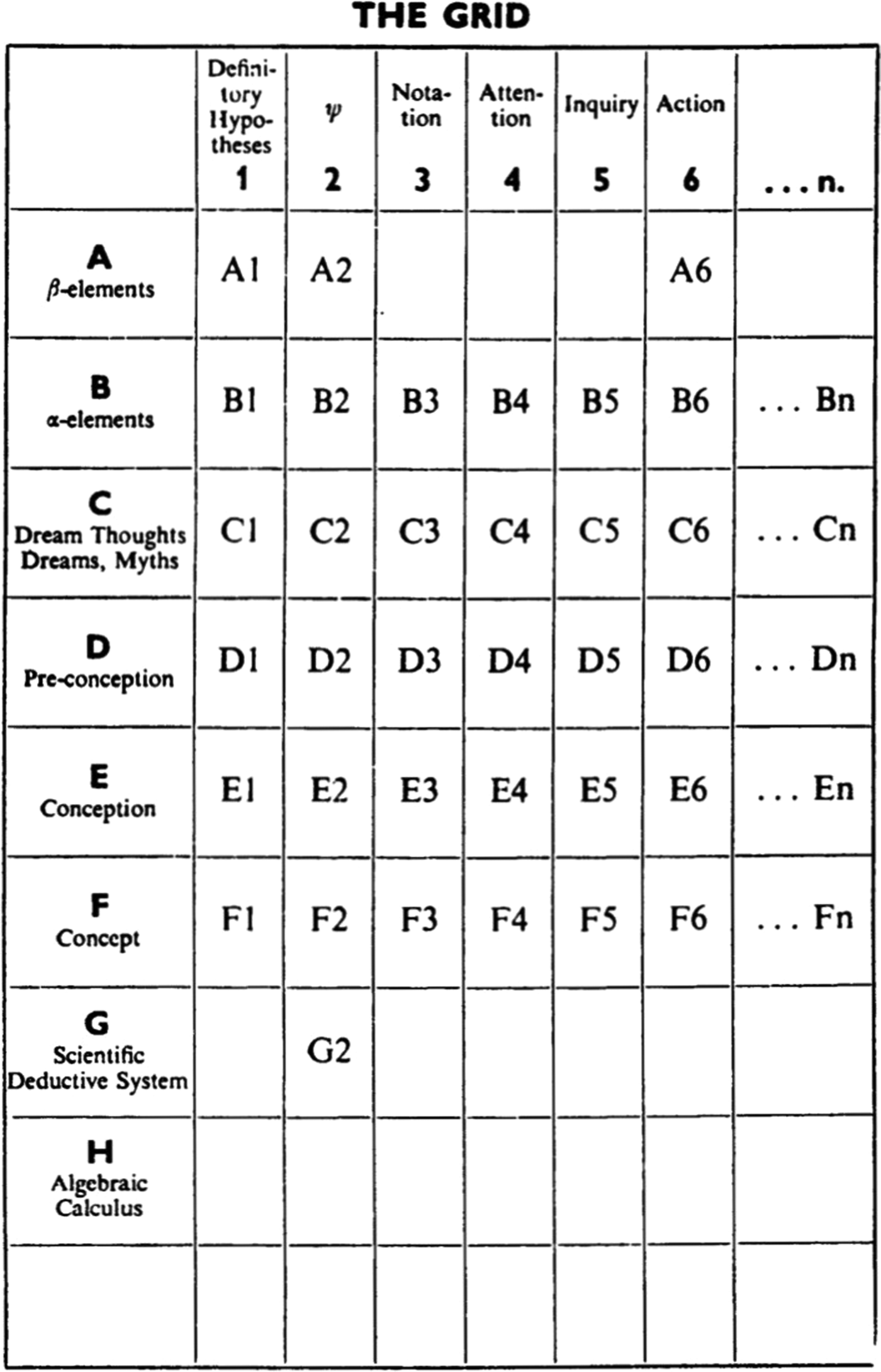
After the war, Bion turned from group work to analytic training and the psychoanalytic situation proper, with its emphasis on the one-on-one encounter. Through his initial analysis with Rickman and his later analysis with Klein, he became fully immersed in the London psychoanalytic social world. Bion was, essentially, an extremely institutionally successful iconoclast. He was clinical director of the British Psycho-Analytical Society from 1955–62, and its president, as well as chair of the Melanie Klein Trust, from 1962–65. The centerpiece of his own theory-building is the set of four books that includes Learning from Experience (1962), Elements of Psycho-Analysis (1963), Transformations (1965), and Attention and Interpretation (1970). The distinctive centerpieces of his theory include its organizing “Grid,” reprinted as the first and last pages of each of these books (fig. 1); its highly-specialized vocabulary (including mathematical signs, Greek symbols, capital letters, and ordinary language turned to special use— e.g., Transformations, Faith, “attacks on linking,” “learning from experience”); its attention to affective-cognitive functions rather than structures (α-function transforms ß-elements, the “undigested” or nondreamed “facts” of sensory life, into α-elements that can be further thought, felt, linked, dreamed, and remembered); its rewriting of the Oedipus myth; its mysticism; and its desire to evoke and describe the strange thing that happens between two people in the analytic space.Footnote 13 Although Bion's psychoanalytic career was centered in London, it also took him to Los Angeles, where he relocated in 1968 and spent the final decade of his life, and to Brazil, where his work made a strong impact and where he was invited for four long visits in the 1970s (to São Paolo and Rio de Janeiro) to offer seminars, case consultations, and supervision.Footnote 14
W. R. Bion, “The Grid.”
It boggles my mind to think about the many discordant cultural locations Bion occupied over the course of his life. To think that the boy born in India in the same year as Queen Victoria's Diamond Jubilee—that is to say, at the peak of colonial fervor and English-identity mythmaking—would end up living in 1970s Los Angeles at the height of one of its own mythmaking moments, set to the jingle-jagged, California-dreamin’ soundtrack of bands like the Mamas & the Papas and the Beach Boys, on the verge of their own dark dissolutions, surely produces its own kind of sublime effect.Footnote 15 Think about Bion as a timid eight-year-old sent away from his ayah in India to public school; think about Bion in his tank in 1918; and then think about him moving to California in 1968—the era of the Watts riots and the Fair Housing Act, the era of the Black Panthers’ electrifying “linkages between ‘First’ and ‘Third’ world” oppressions and liberation movements, the era in which the region that was economically developed by military manufacturing during World War II was now busily producing ships and aircrafts for the increasingly divisive Vietnam war effort, and where, in the decades that followed, Department of Defense–funded manufacturing would give way to the prison economy.Footnote 16 The psychoanalytic world can look small and can itself perform all kinds of critical myopias. But destupefying (and destupidifying) ourselves to the richness of these actual points of contact can reestablish crucial links and connections.
Indeed, Bion's life can be seen to inscribe many of the migrations and diasporas that have in fact shaped psychoanalytic history. Bion would have witnessed Jewish and other Eastern European refugees gathering in London during World War II, and seen others relocate to the United States and Latin America. The Brazilian psychoanalytic community that took Bion in so wholeheartedly, for instance, was formed in the 1940s by both resident psychiatrists and psychologists and by European immigrants, sent largely through arrangements made by the psychoanalyst Ernest Jones, both for their own safety and to credential groups to join the International Psychoanalytic Association.Footnote 17 This expanded biography, then, reveals some of Bion's own attacks on linking: while his life is a testament to entanglements of psychoanalysis, war, colonialism, and racism, these are issues that his theory does not directly touch.Footnote 18
For Bion, all possible links belong to one of three categories: L, H, and K, designating love, hate, and knowledge. But he also stipulates, by use of the mathematical sign used to designate negative numbers, the links −L, −H, and –K: the negation of love, hate, and knowledge. He writes, “−K represents the link constituted by NOT understanding i.e. mis-understanding. The implications of this can best be grasped by noting that −L is not the same as H, nor −H the same as L.”Footnote 19 Bion imagines all links as mathematical formulas: I can [L, H, −L, or −H] you. Likewise, a person can [K or −K] a fact or piece of information. Here is how I would phrase the mathematical formulas implicit to his work: in Bion's theory, psychoanalysis −K colonialism. Bion's theories of relationality −K race and racial difference. There is not a simple absence, but a negation, at work here: the presence of something like a blue haze, where an exploration of how sociopolitical position shapes the psyche could be. There are many such probability clouds floating around in psychoanalytic theory. But one of my arguments here is that Bion's theory also gives us ways to clear some of these clouds away.
Bion is unique among British post-Freudian psychoanalysts in his attention to the process of thinking itself—a thinking that is always inflected by emotion and by relationality. As Bion makes clear through his astounding and influential reworking of projective identification, it takes at least two people to think and to feel.Footnote 20 In Bion's theory, other people become containers for thoughts, emotions, and raw sensations that are too powerful to be contained within one's own personality proper. Others think, process, dream, digest, or feel these ß-elements for us, and return them in a more manageable form. As a process of sending and receiving, projective identification names the primitive form of communication upon which all later verbal communication depends, and the unconscious form of communication that subtends human relations throughout our lives.Footnote 21 But, like most concepts and terms in Bion's lexicon, projective identification can quickly flip over into its opposite: it can be deployed to destroy language rather than to communicate, to evacuate thoughts and feelings rather than to share them, to evade frustration rather than learn how to tolerate it.Footnote 22
Why are activities like linking, thinking, and communicating so threatening? Why do they need to be hazed over, negated, blotted out, destroyed? Among Bion's postulates is a fundamental hatred of reality—specifically, hatred of the fact that we have to learn from experience: that we have to struggle through slow development, that we have to experience difficult emotions, that we have to negotiate challenging interactions with others, that we have to tolerate our own unknowing—that we have to suffer.Footnote 23 Bion writes: “If the learner is intolerant of the essential frustration of learning he indulges phantasies of omniscience and a belief in a state where things are known.”Footnote 24 In essential ways, Bion's theory is as much about tolerance for unknowing as it is about epistemology, and as much about alternatives to thinking as it is about cognition and its negation. Because in addition to cataloguing chronic failures of understanding and of the imagination, Bion's theory pictures surprising bursts of intuition and unexpected ways of making contact with what is outside of oneself.
In his final books, Bion turns to a new symbol, O, designating “truth,” “ultimate reality,” or “the unknown and unknowable.” O marks the spot of a space apart: it is not susceptible to standard links, and, indeed, it is beyond direct sensory experience altogether. Bion writes: “It stands for the absolute truth in and of any object; it is assumed that this cannot be known by any human being; it can be known about, its presence can be recognized and felt, but it cannot be known. It is [only] possible to be at one with it.”Footnote 25 O belongs to the realm of being and becoming (Bion draws special attention to the gerund form of these verbs) rather than the realm of knowledge. Unreachable by L, H, or K, it is accessible only though faith, F: “Faith that there is an ultimate reality and truth—the unknown, unknowable, ‘formless infinite,’” Bion writes, borrowing a phrase from John Milton's Paradise Lost that he cites repeatedly in these final works.Footnote 26 If this sounds to you more like mysticism than psychoanalysis, you are not far off the mark. In his final books and lectures, Bion draws from St. John of the Cross, Meister Eckhart, Isaac Luria, and the Blessed John Ruysbroeck, and directly speculates on topics such as “The Mystic and the Group.” In his theorizations of O, Bion is indeed heading for the outer reaches of psychoanalytic theorization. And yet, for Bion, O is also distinctly internal to the psychoanalytic experience: Bion uses it in his efforts to get across the impossible-to-get-across-if-you-are-not-inside-of-it “truth” of the analytic encounter, which Bion reveals to be as nonsensible and mysterious in its workings as any union with the divine.
For Bion, what the transference/counter-transference dynamic of analysis means is that something entirely unique happens between two people: something that can never be fully conveyed after the fact, something that can never be fully known or owned by either one of its participants because its essence is to be so deeply shared and cocreated. And this sense of the O of interaction extends beyond analysis into the contact of any two people. What are the capacities of thought and feeling that come alive only in this particular intersubjective contact? What is lived between two people that will forever exceed either one of them, that cannot be adequately contained in a single subjectivity without radically reducing the experience and diminishing its dimensions? Bion writes: “The only true thought is one that has never found an individual to ‘contain’ it.”Footnote 27 O in this sense stands for creative communion, the truly vibratory space between people, whether between the analytic dyad, the romantic couple, or the many bodies in a classroom. It says that what happens when we are together, what we can be when we are together, exceeds anything either of us could think, know, experience, or feel alone. It says that your unconscious is in contact with mine, dialed in like Freud's radio receiver, in ways that shape both of us beyond our knowing.Footnote 28
If O marks the spot of interpersonal overflow, it also designates the space of literary experience, itself a kind of self-exceeding contact. In Attention and Interpretation, Bion instructs the reader of his book as follows: “The reader must disregard what I say until the O of the experience of reading has evolved to a point where the actual events of reading issue in his interpretation of the experiences. Too great a regard for what I have written obstructs the process I represent by the terms ‘he becomes the O that is common to himself and myself.’”Footnote 29 In other words, something happens between us and the literary text that will never be fully accounted for in any interpretation, essay, or critical analysis. It is experienced rather than known, something that you become while you read and that you can only approximate after. And yet, as Bion indicates, this should keep us writing rather than stop us. Just as Bion's entire later oeuvre can be understood as a systematic attempt to get across the ineffable realities of the analytic situation, literary criticism, at its best, might try to convey not just the K of having read something, but “the O of the experience of reading.”
When Maggie Tulliver sits down at the piano in The Mill on the Floss, she would just as soon produce pure sound as play a song: “The mere concord of octaves was a delight to Maggie, and she would often take up a book of Studies rather than any melody, that she might taste more keenly by abstraction the more primitive sensation of intervals.”Footnote 30 Maggie has a special relationship to music throughout the novel, and her “delight” in the “mere concord” of a low and high note played together (O is for octave) comes to stand in for the many forms of vibratory contact that animate the novel: the erotic energy that charges the air between Maggie and Stephen, the “low voice” that seems to emanate from the pages of her favorite book (an underlined copy of The Imitation of Christ by the religious mystic Thomas à Kempis, clearly treasured by another reader before her), and the O of reading that resonates between you and the novel, like a struck chord.Footnote 31 One of the many things Bion's theory offers literary studies is a critique of our supposed distance from literary objects and a way to reconceptualize the reading experience. O invites us to acknowledge how poems, novels, and essays change us for a time, allowing us to think, feel, and be certain things while we are with them that we couldn't otherwise.Footnote 32 Beyond criticism, what would literary pedagogy more attuned to O, and less bent on K, look like and accomplish? Is there a less individualistic and more relational mode of teaching, one that moves beyond the transmission of knowledge to attend more carefully to how our capacities change when we are together, in a “matrix of thought” that belongs to the group but not to any of its individual members?
I am struck too by how much Bion's blue hazes, probability clouds, and negative hallucinations have to teach us about how we read in a broader sense: effacing and mutilating links, not making them, is what shapes our academic fields of study. Attacks on linking across historical periods, geographies, and methods are what make, and make for, standard literary histories and the de facto segregations within the discipline.Footnote 33 Attacks on linking keep Victorian and postcolonial studies, ludicrously, distinct. Attacks on linking keep us from attending to what Lisa Lowe correctively describes as “the intimacies of four continents.”Footnote 34 Attacks on linking mean that we think within national boundaries and make ourselves stupid to wider networks of relations and migrations, and that we chronically fail to imagine and engage more syncretic approaches to space and time. Attacks on linking prevent us from engaging contemporary theoretical work on race and Indigeneity to help us understand nineteenth-century literature and culture and its connections with our own political moment. Attacks on linking make us plug our ears rather than letting ourselves hear what Eliot would call “the roar on the other side of silence” and what we might rename, following Jodi K. Byrd, “colonial cacophony.”Footnote 35
Much of this, in our narrow subfield of Victorian studies, is beginning to change. Daniel Hack reads nineteenth-century British and African American literature together in Reaping Something New (2016). Nathan Hensley links seemingly disparate texts and events—such as Algernon Charles Swinburne's poetry and debates around the Morant Bay Rebellion—in Forms of Empire (2016). V21 and other working groups have issued calls for “strategic presentism” in our scholarship and for more innovative pedagogy in the age of Trump.Footnote 36 And yet there's a sense here of history repeating itself: this call was made decades ago by Edward Said, by Gayatri Chakravorty Spivak, by Simon Gikandi, by Paul Gilroy, and by many others, all of whom argued that it is not possible to think Victorian England without thinking empire. This work can be done. Elaine Freedgood's The Idea in Things (2006) showed us how simply attending to the things right in front of us in Victorian novels can undo commodity fetishism and domestic-fiction-induced myopia in one fell swoop: so that, for instance, the mahogany furniture in Jane Eyre overtly links Portugal, Madeira, Jamaica, the American South, and the Victorian home by way of the sadistic transatlantic slave trade that used bodies not only for unpaid forced labor but also as so much ballast.Footnote 37 How stupid, in the truly Eliotic sense of the term, have we (and I very much count myself into this collective pronoun) had to make ourselves that we need to keep making this call for linking over and over again?
Reading Bion—that is to say, really reading him: seeing what his theory is able to think and what gets hazed out or ignored, recognizing him as a resident not just of London, but also of Mathura, of São Paolo, and of Los Angeles, placing him in the Victorian period and in the present day, as a participant in colonization and decolonization efforts alike—can help to activate our faith (F) in linking. These are not, in fact, separate worlds that we're talking about. And reading Bion can help us, too, to interrogate the psychodynamics of our stupidity. What are our symptomatic stammers, our hazes, our hysterical deafnesses, “designed” to prevent, or at least responsible for upholding? (#NAVSASoWhite.) A new deployment of Bion's work shows us that we can read with heightened attention to both literary experience and to political contexts, past, present, and future. These forms of knowledge are, in fact, compatible—joined by links that are attackable, yes, but durable too. Instead of making ourselves stupid, let's suffer pain, hear cacophony, tolerate frustration, accept unknowing (and the curiosity that Bion argues comes along with it), and learn from experience.Footnote 38



