The relationship between education and voting is one of the best-established generalizations in the electoral behavior literature (Smets and Van Ham Reference Smets and van Ham2013), also one of the most contested. The long-assumed causal connection between education and turnout has been challenged by studies claiming that education is merely proxying for pre-adult experiences rooted primarily in the family. Other studies, using equally sophisticated designs, have come to the very opposite conclusion, suggesting that there is indeed a causal relationship between education and voting. No resolution to this debate is in sight. As a recent review noted, “the literature provides a frustrating, divided picture and we are left without a clear answer as to whether education causes political participation” (Persson Reference Persson2015, 699).
A definitive test of causality is nigh impossible. However, a recent study using an innovative twin-based design has made an important advance in addressing genetic and within family sources of confounding (Dinesen et al. Reference Dinesen, Thisted, Dawes, Klemmensen, Magnusson, Sonne Nørgaard, Petersen and Oskarsson2016). Once confounding by genes and family environment is taken into account, the relationship between education and political participation disappears in Sweden and is substantially reduced in Denmark and the United States. While this design is not without its limitations, twin-based and other family-based designs clearly allow for stronger tests of causality than cross-sectional studies and enable us to get some leverage on the extent to which education may be proxying for early life influences within the family that affect both educational attainment and political participation. While any one design will necessarily have its limitations, “asking the same scientific question using different quasi-experimental approaches with different limitations … allows researchers to robustly test causal hypotheses” (D’Onofrio et al. Reference D’Onofrio, Benjamin, Turkheimer and Lichtenstein2013, S51).
To this end, we use a sibling-based design to assess how much of the association between education and voting is attributable to experiences and influences that are shared by siblings within the same family. More specifically, our data enable us to estimate the extent to which two key parental characteristics—parental education and parental turnout—account for the association between the educational attainment and turnout of their adult children. Importantly, the sibling-based design also enables us to estimate how much of that association is attributable to unobserved influences that are shared by siblings within the same family, such as shared genetic inheritance, child-rearing practices, time spent with parents, a home environment where education was valued and politics was discussed, cultural and educational activities that fostered cognitive skills, exposure to the same community norms and school experiences, and so on.
Our analyses use a unique data set that combines census data with official voting records from the 1999 Finnish parliamentary elections for adult siblings and their parents. The resulting data avoid the flawed recall and social desirability biases that make survey-based reports of turnout unreliable (Karp and Brockington Reference Karp and Brockington2005). Since neither childhood nor adult social characteristics are self-reported, they are not subject to recall bias or misreporting, either. Moreover, administrative data mitigate the problem of random measurement error that can lead sibling-based studies to underestimate the impact of education. Additionally, we have sufficient sample size to detect differential effects in a nationally representative sample.
We first review the debate about the causal status of education and the various approaches taken to estimating the impact of education on political participation, including the twin-based design. Then we explain how our sibling-based design enables us to assess the extent to which education is proxying for shared pre-adult experiences rooted within the family and we describe the data and estimation methods. After presenting the results and robustness checks, we conclude by discussing the benefits and limitations of sibling-based designs for testing causal hypotheses.
EDUCATION-AS-CAUSE VERSUS EDUCATION-AS-PROXY
There are good reasons to expect a causal connection between education and turnout (see, e.g., Wolfinger and Rosenstone 1980; Verba, Lehman Schlozman and Brady Reference Verba, Lehman Schlozman and Brady1995; Nie, Junn and Stehlik-Barry Reference Nie, Junn and Stehlik-Barry1996; Rosenstone and Hansen Reference Rosenstone and Hansen2003). Education imparts cognitive skills that enhance citizens’ information-processing abilities and reduce the costs of voting by making it easier to choose among the candidates and to navigate the process of registration and voting. Education may also foster civic-mindedness and norms of civic duty, encouraging a sense of duty to vote and increasing the expressive benefits of voting. At the same time, education may encourage psychological engagement with politics by enhancing interest in politics and a sense of personal political competence. Highly educated people also tend to have larger social networks and are thus more easily mobilized to vote by informal networks in the community and the workplace. Education may also contribute to “democratic enlightenment” (Nie, Junn and Stehlik-Barry Reference Nie, Junn and Stehlik-Barry1996). Citizens with higher levels of education are more likely to tolerate dissenting opinions, to respect the political rights of those with whom they disagree and to understand the inherent messiness of democratic politics. As a result, they may be more willing to turn out to vote.
Plausible as these arguments are, the assumption that education has a causal impact on turnout has been challenged by studies suggesting that the relationship between education and turnout is spurious. The education-as-proxy thesis argues that the relationship is attributable to pre-adult experiences and predispositions that influence both educational attainment and the propensity to participate in politics as an adult (Kam and Palmer Reference Kam and Palmer2008). Parents are seen as playing a critical role as “norm definers” who can instill an appreciation of the importance of education and a sense of civic duty. Parents can also act as role models whose behavior their children seek to emulate (Bandura Reference Bandura1977; Gidengil, Wass and Valaste Reference Gidengil, Wass and Valaste2016). If the parents are well educated, this is likely to mean both pursuing higher education and participating in politics. Kam and Palmer (Reference Kam and Palmer2008) also point to cognitive skills and personality traits, such as a sense of personal efficacy and a willingness to delay gratification, that influence both educational attainment and the propensity to participate in politics. Peer groups, experiences in school and community norms are also cited as pre-adult experiences that could influence both educational attainment and turnout, but the role of parents is central to the education-as-proxy argument.
APPROACHES TO ASSESSING THE IMPACT OF EDUCATION
Kam and Palmer (Reference Kam and Palmer2008) used propensity score matching to challenge the conventional wisdom about education-as-cause and to support their education-as-proxy argument. Matching aims to construct treatment and control groups that are identical save that members of the treatment group have achieved a higher level of education than their control group counterparts. In principle, since the groups are similar except for their educational attainment, any difference in political participation must reflect the difference in education. Kam and Palmer’s propensity scores indicate the estimated likelihood of attending college based on a variety of covariates that should theoretically predict college attendance. Individuals who attended college were matched with individuals who had similar propensity scores but ended up not going to college. Subsequent studies using a different matching algorithm have both challenged (Henderson and Chatfield Reference Henderson and Chatfield2011; Mayer Reference Mayer2011) and re-affirmed (Kam and Palmer Reference Kam and Palmer2011; Persson Reference Persson2014) their conclusion that educational attainment has no causal impact on political participation.
An important advantage of matching studies is that pre-adult experiences can be explicitly factored into the analysis. Persson (Reference Persson2014), for example, was able to match on childhood cognitive ability as well as parental education, family income and cultural experiences in childhood, using data from a British cohort study that has tracked every person born during the same week in 1970. However, matching methods have their drawbacks. It can be very difficult to achieve groups that are otherwise equivalent, leaving open the possibility of selection bias. Indeed, Henderson and Chatfield observe that, “selection may be so problematic as to make it practically impossible to recover unbiased causal estimates using even the most sophisticated matching methods as yet available” (Reference Henderson and Chatfield2011, 647). Moreover, the fact that unmatched cases have to be discarded raises concerns about the effects of sample attrition.
Other studies have taken advantage of natural experiments—involving changes in compulsory schooling or the Vietnam-era draft lottery—to capture exogenous sources of individual-level variation in educational attainment that are unrelated to voting in adulthood. On balance, these studies suggest that education does not have a causal effect on the propensity to vote (see, e.g., Milligan, Enrico Moretti and Oreopoulos Reference Milligan, Moretti and Oreopoulos2004; Siedler Reference Siedler2009; Berinsky and Lenz Reference Berinsky and Lenz2011; Pelkonen Reference Pelkonen2012, but see Dee Reference Dee2004). Tenn (Reference Tenn2007) reached a similar conclusion when comparing 18- to 24-year olds who would acquire a given level of education in the following year with young adults who were one year older and had already attained that level. The results suggest that an additional year of education has very little impact on turnout, though the effects of educational attainment may take time to manifest themselves. Similarly, Persson and Oscarssson (Reference Persson and Oscarssson2010) found that a reform in the Swedish educational system extending the length of vocational education and changing the vocational curriculum to include more social science courses did nothing to narrow the turnout gap between 19- to 29-year olds with a vocational and those with a non-vocational gymnasium education. However, based on a series of randomized field experiments originally conducted to assess the impact of various interventions on high school graduation rates, Sondheimer and Green conclude that, “educational attainment profoundly affects turnout” (Reference Sondheimer and Green2010, 185). While their study comes closest to mimicking the logic of controlled experiments, it shares the drawback of being unable to estimate the effect of other pre-adult experiences.
These studies have largely focused on confirming or debunking the conventional wisdom that education has a direct causal effect on voter turnout. Less effort has been invested in assessing the extent to which pre-adult influences help to account for the relationship between education and turnout. The Dinesen et al. (Reference Dinesen, Thisted, Dawes, Klemmensen, Magnusson, Sonne Nørgaard, Petersen and Oskarsson2016) study is an important exception. Their co-twin control design enables them to estimate how much of the relationship between education and political participation is attributable to shared genes and shared family environment. They compare the relationship within pairs of monozygotic (MZ) twins with the relationship when the twins are treated as individuals. They argue that this twin-based design makes it possible “to circumvent traditional sources of confounding of the relationship rooted in genes and early life family environment because MZ twins share both” (Dinesen et al. Reference Dinesen, Thisted, Dawes, Klemmensen, Magnusson, Sonne Nørgaard, Petersen and Oskarsson2016, 579).
However, this design may not adequately control for confounding. The fact that MZ twins are genetically identical and have been raised in the same family does not avoid the problem of unobserved confounding by factors such as upbringing, intelligence, and personality. Sharing 100 percent of their genes does not mean that MZ twins are identical.Footnote 1 If they were, the co-twin design would not be feasible because there would be no within-pair variation in educational attainment. The design requires that one twin have more education than the other. In principle, this makes it possible to compare the impact of education on the political participation of two otherwise perfectly matched individuals. However, environmental factors interact with genetic inheritance to cause genetically identical twins to differ and so twins who have different levels of educational attainment are very likely to differ in other relevant ways. For example, parents may actively strive to differentiate their twins and encourage their individuality, and so may peers and teachers. Schools will often assign twins to different classes for this very reason. Moreover, twins may be motivated to assert their individual personalities (Bound and Solon Reference Bound and Solon1999).
Dinesen et al. (Reference Dinesen, Thisted, Dawes, Klemmensen, Magnusson, Sonne Nørgaard, Petersen and Oskarsson2016) are well aware of the limitations of the co-twin design and undertake robustness checks for prenatal and postnatal factors that could plausibly influence both educational attainment and political participation and thereby bias the estimated effect of education. They rule out birth weight and birth order, both of which are correlated with cognitive abilities and some personality traits, as possible confounders. They also show that the impact of education persists when taking account of childhood experiences such as having different teachers or different friends. As they recognize, however, these robustness tests are no guarantee that the relationship between education and political participation is not confounded by unobserved differences including differential treatment by the twins’ parents.
Recognizing these problems does not mean that the co-twin and other sibling-based designs are not useful. In fact, they have a long history of application in labor economics where sorting out “how much of the empirical association between wages and schooling is due to the causal effect of schooling and how much is due to unobserved factors that influence both wages and schooling … remains one of the most challenging identification problems in applied econometrics” (Bound and Solon Reference Bound and Solon1999, 170). Critics have long recognized that “while no panacea” (Griliches Reference Griliches1979) when it comes to establishing causality, sibling data can be useful in tightening the bounds on the estimated returns to education (Bound and Solon Reference Bound and Solon1999). Sibling designs cannot definitively establish causation nor can they tell us just how much of an observed relationship is due to confounding but “crucially, when different quasi-experiments with different flaws support the same conclusion, the causal inference is strengthened considerably” (Lahey and D’Onofrio Reference Lahey and D’Onofrio2010, 319).
THE DISCORDANT SIBLING DESIGN
In this spirit, we use a sibling-based design to analyze the relationship between educational attainment and voting. Like the co-twin control design, the discordant sibling design involves comparing the estimated effect of education in a conventional cross-sectional model where the siblings are treated as individuals with a fixed effects model that accounts for all of the influences that are shared by siblings within the same family. Comparing the turnout of siblings who have different levels of education but share the same family background mimics the logic of a controlled experiment, with siblings from the same family functioning, in effect, as each other’s control group. This enables us to estimate the contribution of both observed family characteristics and unobservable characteristics that are shared by siblings within the same family. The key word here is shared. This design cannot estimate the effect of unobservable confounders that are not shared by the siblings, including the approximately 50 percent of genes that are unshared. In this respect, the design is weaker than the co-twin control design and the resulting estimates might usefully be thought of as upper bound.
The discordant sibling design nonetheless has some offsetting advantages. Like the co-twin control design, it rests on the stable unit treatment value assumption (SUTVA) (Lahey and D’Onofrio Reference Lahey and D’Onofrio2010). Satisfying this assumption requires that having more education only influences the turnout of the more educated sibling and does not have a spillover effect on the turnout of the less educated sibling(s). Violation of this assumption results in a downward bias in the estimate of the impact of education. This assumption is more plausible in the case of siblings, especially if they are a few years apart in age, than in the case of MZ twins, who are likely to be very close to one another (Dinesen et al. Reference Dinesen, Thisted, Dawes, Klemmensen, Magnusson, Sonne Nørgaard, Petersen and Oskarsson2016).
Second, where twin-based studies have to rely on survey data, we are able to use administrative data that are much less susceptible to random measurement error. Random measurement error is problematic for sibling-based designs, resulting in a weaker association even if there is no confounding (Frisell et al. Reference Frisell, Öberg, Kuja-Halkola and Sjölander2012; D’Onofrio et al. Reference D’Onofrio, Benjamin, Turkheimer and Lichtenstein2013). The problem is exacerbated in the case of twins (Griliches Reference Griliches1979; Bound and Solon Reference Bound and Solon1999). As Dinesen et al. (Reference Dinesen, Thisted, Dawes, Klemmensen, Magnusson, Sonne Nørgaard, Petersen and Oskarsson2016) note, their use of self-reported educational attainment likely results in a downward bias in their estimates of the impact of education. Accordingly, they argue that the significant positive effects observed in their American and Danish samples should be regarded as lower bound estimates. In other words, if the estimates could be corrected for measurement error, the effect of education on political participation would be stronger. We can be much more confident that our estimates of the impact of education are not significantly biased down by measurement error.
Using actual voting records also avoids the biases associated with self-reported turnout, such as misreporting due to faulty recall or over-reporting as a result of social desirability bias (Karp and Brockington Reference Karp and Brockington2005). Misreporting is a particular problem when studies have to rely on respondents’ recollections of their parents’ political activities (Brady, Schlozman and Verba Reference Brady, Schlozman and Verba2015). Using official data also minimizes the possible biases associated with self-reports of respondents’ own socioeconomic characteristics or those of their parents.
Administrative data also eliminate non-response bias. The twin-based surveys used by Dinesen et al. (Reference Dinesen, Thisted, Dawes, Klemmensen, Magnusson, Sonne Nørgaard, Petersen and Oskarsson2016) have non-response rates ranging between 33 and 53.5 percent, which necessarily raises questions about external validity. Our data allow for a very large sample size and thus greater confidence in the observed effects. We are also able to include all of the adult children within the same family, which is rarely feasible in surveys, making the data nationally representative of families with more than one adult child.
Finally, these data make it possible to link adult siblings to their parents. This enables us to estimate how much of the relationship between education and turnout is due to two key family characteristics: parental education and parental turnout. According to status transmission theory, education serves as “the engine for the transmission of political activity from generation to generation” (Verba, Lehman Schlozman and Brady Reference Verba, Lehman Schlozman and Burns2005, 98; see also Brady, Schlozman and Verba Reference Brady, Schlozman and Verba2015). Well-educated parents are more likely to provide a politically stimulating home environment and, more importantly, they are also more likely to have well-educated children. Parental voting, meanwhile, is a critical variable from the perspective of social learning theory, which highlights the role of observational learning and modeling behavior on the parental example (Bandura Reference Bandura1977; Gidengil, Wass and Valaste Reference Gidengil, Wass and Valaste2016).
DATA AND METHODS
Our study is based on a 10 percent random sample of 18- to 50-year oldsFootnote 2 with at least one sibling within the same age range living in Finland during the 1999 parliamentary elections. It takes advantage of a unique data set, constructed by Statistics Finland, combining official voting records with individual-level data for siblings and their biological parents. The socioeconomic information is compiled from various administrative sources. The voting information is collected from electoral wards and is linked by Statistics Finland to siblings and their parents using personal identification numbers. The linkage rate is more than 99.5 percent.Footnote 3 Permission to use the anonymized data for research was granted by Statistics Finland’s Ethics Committee. Total population data are not available due to data confidentiality restrictions. It would be preferable to have data on parental turnout during the siblings’ childhood but these voting records are not accessible. Given evidence that voting is a habit (e.g., Green and Shachar Reference Green and Shachar2000; Aldrich, Montgomery and Wood Reference Aldrich, Montgomery and Wood2011), it is plausible that many parents who voted in 1999 also voted in earlier elections. However, to the extent that this is not the case, we risk over-stating the impact of parental voting. Since information on parental voting is required, our sample was restricted to siblings with at least one parent alive at the time of the 1999 elections. To ensure that as many siblings as possible had completed their education, we limited the analysis to siblings aged 30–50. Including siblings whose education was incomplete would risk underestimating the impact of educational attainment (Sieben, Huinink and Graf Reference Sieben, Huinink and Graf2001). The effective sample included 78,937 individuals within 27,694 families.
Generalizability is an issue when data come from a single country. Finland is typically held up as an educational success story, but most of our sample would have been educated before the educational reforms in the 1970s began to bear fruit.Footnote 4 At 65.3 percent, turnout in the 1999 parliamentary election was similar to several other high-income post-industrial democracies (http://www.idea.int/vt/viewdata.cfm). Moreover, the relationship between education and turnout is similar to countries like the United States and Canada (Gallego Reference Gallego2015).
The key independent variables are the siblings’ education, parental education and parental voting.Footnote 5 Since the effects of education may not be linear and there is no consensus in the literature as to which level of education matters for political participation, education is represented by four dummy variables, corresponding to high school, associate degree, bachelor’s degree or equivalent and graduate degree or equivalent, with junior high school as the reference category.Footnote 6 The educational attainment of the father and the mother is categorized in the same way but with an extra category for missing information, which is mostly attributable to the parent’s death.Footnote 7 Parental voting is represented by three dummy variables corresponding to both parents voted (or only one parent was alive and voted), only the father voted and only the mother voted, with neither parent voted serving as the reference category (which includes cases in which only one parent was alive but did not vote).
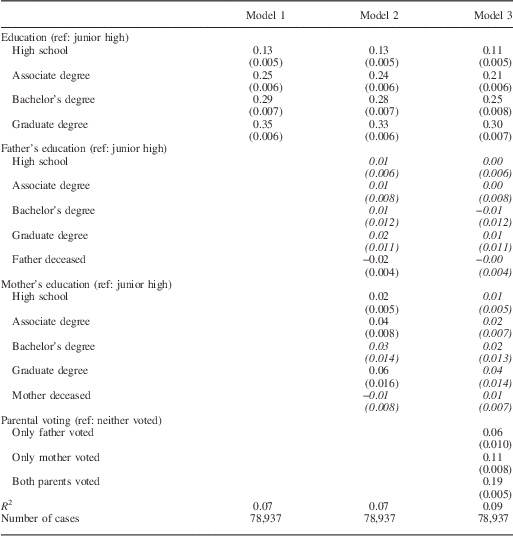
We first estimate a series of conventional linear probability regression (LPM) models using variation between individuals in estimating the coefficients. Model 1 presents the effects of the siblings’ own educational attainment, controlling only for their ascribed characteristics (sex, age and mother tongue).Footnote 8 Models 2 and 3 add parental education and then parental voting, respectively. Comparing these models with model 1 enables us to estimate the extent to which the impact of education on turnout is attenuated by controlling for these observed family characteristics. Clustering of individuals within families is accounted for by estimating robust standard errors.
The next set of analyses is based on a sibling design. Estimating fixed-effects LPM models enables us to account for all of the influences shared by siblings within the same family. In effect, we examine whether a more educated sibling has a higher propensity to vote than his or her less educated sibling(s). This involves determining whether siblings with different levels of education deviate from the family mean of voting. As only within-family variation is used in estimating the models, all of the observed and unobserved family characteristics shared by the siblings are controlled for. This corresponds to a situation where we would estimate a dummy variable for each of the 27,694 families included in the analysis (Allison Reference Allison2009). The fixed effects models take the following form:
 $$Y_{{it}} =\beta _{1} X_{{1,it}} {\plus}\,\ldots\,{\plus}\beta _{k} X_{{k,it}} {\plus}\alpha _{i} {\plus}e_{{it}} ,$$
where Y it is the dependent variable for person t in family i, X it represents one of the independent variables with the coefficient of β 1, α i the unknown intercept for each family and e it stands for the error term.
The first model only includes controls for ascribed characteristics (model 4). A comparison with model 3 from the conventional LPM regression analyses shows the extent to which the effect of education is explained by unobserved characteristics shared by siblings within the same family (net of observed family characteristics). The second model (model 5) adds controls for marital status, occupational status, employment activity and income quartile.Footnote 9 Comparing this model with model 4 makes it possible to estimate how much of the effect of education on turnout (net of shared family characteristics) is mediated by the siblings’ own social status and other adult characteristics.
For both sets of analyses, we specify linear probability models with voting as a dichotomous dependent variable. The results are presented as estimated probabilities of voting.Footnote 10 LPM was chosen instead of logistic regression because families that do not vary on the dependent variable (all siblings voted or none of them voted) would be dropped when estimating the logistic fixed effects models (Allison Reference Allison2009). LPM includes these siblings in the estimation process, which is an essential advantage of this approach. Furthermore, comparing nested LPM models to each other does not suffer from the rescaling problems associated with non-linear models (Karlson, Holm and Breen Reference Karlson, Holm and Breen2012). A final advantage is that LPM is easy to understand in the fixed effects context.
RESULTS
We begin by looking at the effect of education on the turnout of 30- to 50-year olds with at least one living sibling, controlling for sex, age and mother tongue (Table 1). These models treat the siblings as individuals. The results for model 1 follow the conventional pattern: the more education people have, the more likely they are to vote. University graduates have a 29- to 35-point higher probability of voting than people who have only completed a junior high school education.Footnote 11 While the impact of education is attenuated when parental education is added (model 2), the difference in estimated turnout between individuals with a bachelor’s or graduate degree and those with only a junior high school education drops by only 1–2 points, respectively. Adding parental voting to the model further attenuates the impact of education, with the difference in estimated turnout between those with a university degree and those with only a junior high school education dropping another 3 points.
Estimated Difference in the Probability of Voting Among 30- to 50-Year Olds With at Least One Sibling Alive (Linear Probability Models)

Note: The column entries are unstandardized coefficients with robust standard errors in parentheses. All models control for siblings’ sex, age and mother tongue.
Estimates are statistically significant at p<0.001, except for those in italics.
Comparing the effects of education in models 1 and 3, we can see that the observed family background characteristics reduce the estimated turnout gap between individuals having only a junior high school education and university graduates by 4 (bachelor’s degree) to 5 (graduate degree) percentage points.
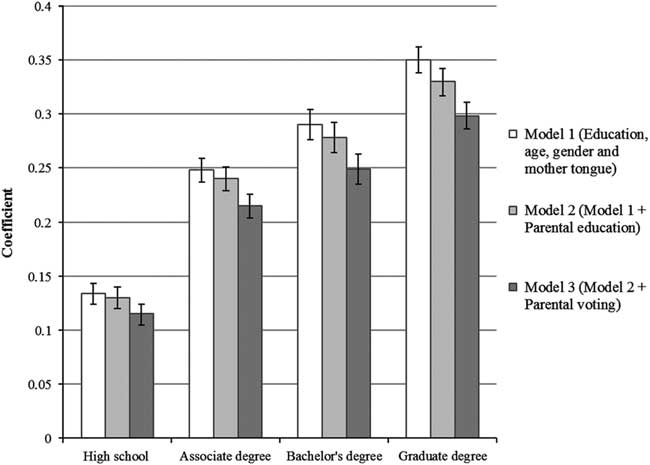
Figure 1 makes it possible to see whether the decreases in the effects of education with the addition of each set of controls are statistically significant. In the case of parental education, the drop in the predicted probability of voting is not significant in any of the educational categories. However, adding parental voting results in a significant drop in the associate and graduate degree categories. Including both observed parental characteristics leads to a significant drop compared to model 1 in every education category except for high school. However, the differences in turnout across levels of education remain significant, even controlling for parental education and parental voting.
Estimated difference in the probability of voting by education controlling for observed family characteristics among 30- to 50-year olds with at least one sibling alive (linear probability model coefficients with 95 percent confidence intervals, junior high school used as the reference category)

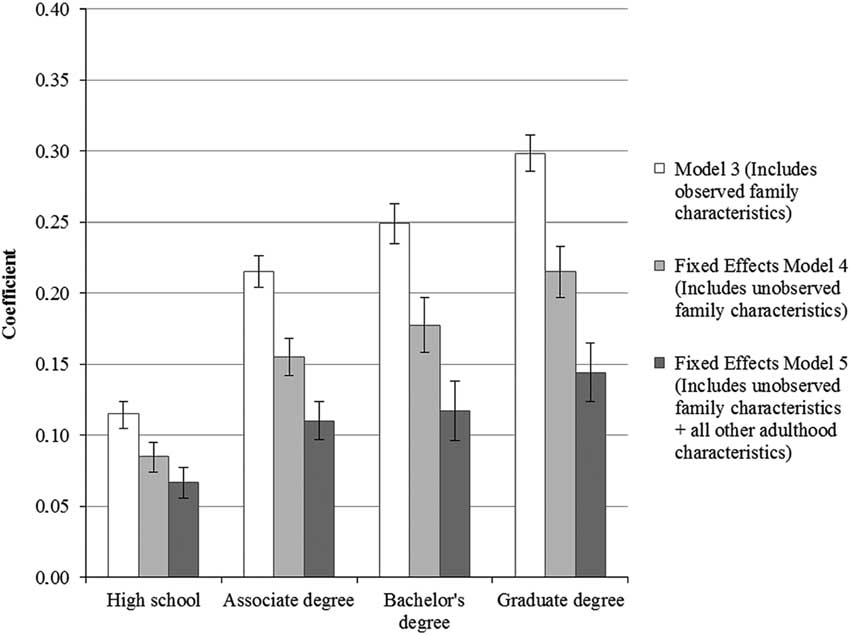
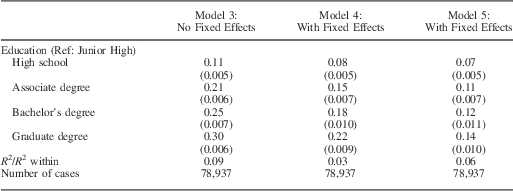
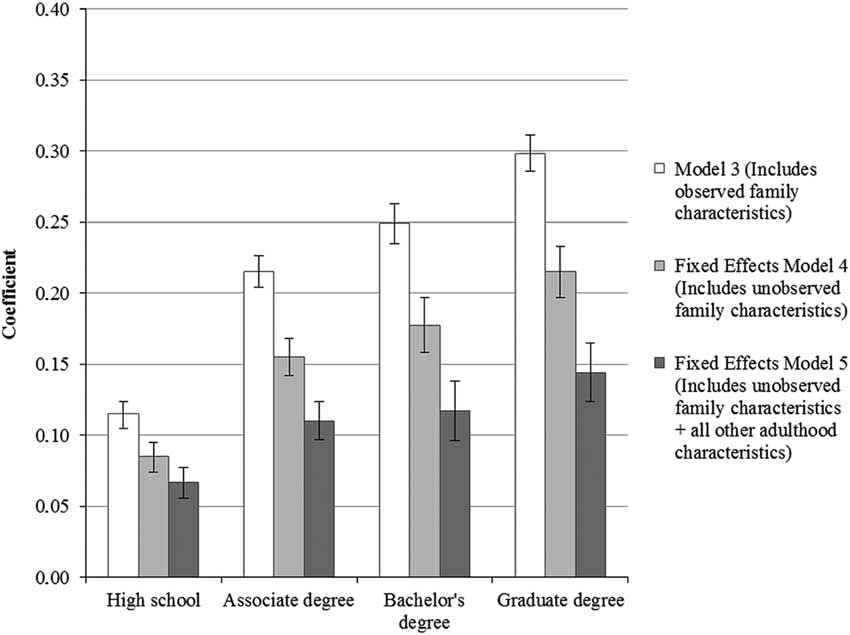
Clearly, the relationship between education and turnout does partly reflect the parents’ level of education and their turnout, as predicted by the education-as-proxy argument. What happens, when we take unobserved family characteristics and other unobserved characteristics shared by siblings into account as well? A comparison of models 3 and 4 (Table 2) shows that the estimated effect of educational attainment is reduced by a further 7–8 points, as indicated by the decrease in the estimated turnout gaps between individuals in the lowest education category and the university-educated. The decreases in the probability of voting when shared unobserved characteristics are taken into account are statistically significant in every education category (Figure 2).
Estimated difference in the probability of voting by education, controlling for observed and unobserved family characteristics, and adult characteristics among 30- to 50-year olds with at least one sibling alive (linear probability model coefficients with 95 percent confidence intervals, junior high school used as the reference category)
Estimated Difference in the Probability of Voting Among 30- to 50-Year Olds With at Least One Sibling Alive (Linear Probability Models With and Without Fixed Family Effects)

Note: The column entries are unstandardized linear probability coefficients with standard errors in parentheses. Model 3 is taken from Table 1. Models 4 and 5 control for sex, age and mother tongue. Model 5 also controls for siblings’ adult characteristics (marital status, occupational status, economic activity and income).
All the estimates are statistically significant at p<0.001.
Comparing models 1 and 4, we can see that, taken together, the observed family characteristics and the unobserved family and other shared characteristics diminish the impact of education on voting by 5 points for those with a high school education, by 10 points for those with an associate degree and by 11 points and 13 points, respectively, for those with a bachelor’s degree or graduate degree. These are substantial drops and they lend support to the education-as-proxy argument.
It is also clear from the predicted probabilities for model 4 that completing a bachelor’s degree does not significantly boost the probability of voting, compared with only completing an associate degree. As Figure 2 shows, the confidence intervals for the two levels of educational attainment overlap. This is interesting in light of disagreements in the literature over whether it is completing college (Persson Reference Persson2014) or merely attending college (Kam and Palmer Reference Kam and Palmer2008; Henderson and Chatfield Reference Henderson and Chatfield2011) that matters. Our results suggest that in Finland it is the latter.
Our final comparison enables us to see how much of the remaining effect of education is mediated through the siblings’ other adult characteristics. Comparing models 4 and 5 we can see that the estimated difference in turnout between university graduates and their siblings who only have a junior high school education has narrowed by a further 6–8 points (Table 2). Once these other adult characteristics are taken into account, the total decreases are 6 points, 14 points, 17 points and 21 points, respectively. However, even after controlling for both observed family characteristics and unobserved family and other characteristics that are shared by the siblings, as well as their other adult characteristics, substantial differences in turnout between educational categories remain.
EXTERNAL VALIDITY
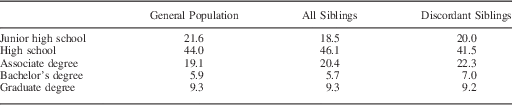
A potential drawback of sibling-based designs is that the results may not generalize to singletons or even to siblings who have similar levels of educational attainment (Lahey and D’Onofrio Reference Lahey and D’Onofrio2010; D’Onofrio et al. Reference D’Onofrio, Benjamin, Turkheimer and Lichtenstein2013). Still, sibling samples are likely to be more representative of the population than MZ twin samples. Dinesen et al. (Reference Dinesen, Thisted, Dawes, Klemmensen, Magnusson, Sonne Nørgaard, Petersen and Oskarsson2016) report that the means and standard deviations of the participation measure in their twin surveys were relatively similar to those of representative surveys in the three countries. However, the MZ twins were more educated than the general public. When we compare the discordant siblings in our sample with the general public aged 30–50, the results show that discordant siblings had only slightly higher educational levels (Table 3).
Comparison of the Educational Attainment of the Siblings and the General Population, Aged 30–50

Note: Source for general population: http://pxnet2.stat.fi/PXWeb/pxweb/en/StatFin/StatFin__kou__vkour/010_vkour_tau_101.px.
Robustness Checks
LPM can provide biased and inconsistent estimates,Footnote 12 especially when it yields a large proportion of predicted probabilities outside the unit interval of 0 and 1 (see Horrace and Oaxaca Reference Horrace and Oaxaca2006). However, robustness checks indicate that our estimates do not suffer unduly from these problems. Only 1 percent of the cases have a predicted probability over one and when we re-estimated models 1–3 using logistic regression, the predicted probabilities were nearly identical to the LPM estimates (the correlation is 0.991) and the reductions in the effects of education as controls were introduced for parental education and parental voting were virtually unchanged.
We also estimated logistic fixed effects models (a form of conditional logit) to assess whether the results differ when the problem of predicting probabilities over one is absent. When estimating logistic fixed effects models, however, all siblings with no within-family variation in voting are dropped out of the estimation (45 percent of cases). Because of this exclusion of cases for which there could be no education effect (because their values on the dependent variable are the same despite their differences in educational attainment), the logistic fixed effects models yielded larger differences in predicted probabilities of voting across educational groups. The difference in predicted probabilities between the different estimation methods indicates that the LPM fixed-effects specification is more appropriate as the logistic fixed-effects may over-estimate the difference due to exclusion of siblings with no within-family variation.Footnote 13 Because siblings with the same level of education do not contribute to the fixed effects estimates, we conducted a second robustness check using only siblings who were discordant in terms of education. Estimated effects of education were 2 percentage points lower in model 1 for graduate degrees and 1 percentage point lower for other degrees but less than 1 point lower in model 3 for all education levels. None of these changes is substantively important or has more than a slight effect on our estimates of the extent to which the association between education and turnout is attributable to parental turnout, parental education and other shared characteristics.
The implicit assumption underlying sibling-based studies is that siblings experience a similar family environment when growing up (Søndergaard et al. Reference Søndergaard, Mortensen, Nybo Andersen, Andersen, Dalton, Madsen and Osler2012). However, the extent to which this assumption is satisfied is likely to be associated with the age difference between siblings, the number of siblings and their birth order. The assumption of a stable family environment is less plausible when siblings are far apart in age. A change in the family’s financial situation or the amount of leisure time parents enjoy may affect the level of education that different siblings attain or the way that values related to voting are transmitted. Moreover, contiguity theory predicts that siblings who are close in age will tend to be more alike in terms of intelligence than siblings who are far apart (Rodgers and Rowe Reference Rodgers and Rowe1985). If there is a large age gap, there is a greater risk of differences in siblings’ cognitive abilities confounding the association between education and turnout in the fixed-effects models. Accordingly, we repeated the analyses restricting the age difference between siblings to five years. The effects of education were generally 2–3 percentage points greater in each model than in the initial analyses but the attenuation of effects is similar.
Intelligence has also been related to birth order: the higher a sibling’s biological rank within the family, the higher the intelligence score (Kristensen and Bjerkedal Reference Kristensen and Bjerkedal2007). This is attributed to differences in the way that siblings are raised rather than any prenatal or gestational factors. A similar explanation has been suggested for the association between family size and intelligence. The dilution model, for example, predicts that the number of siblings will influence the amount of time and attention and economic resources that parents devote to their children (Blake Reference Blake1981). Accordingly, we re-estimated the models restricting the number of siblings to four and including the number of siblings and birth order as covariates. The results barely changed.
Finally, we can get some analytical leverage on the issue of genetic confounding by repeating the analysis on same-sex siblings who were the same age in months. We can expect that just under a third of these twins are MZ (Cannon et al. Reference Cannon, Kaprio, Lönnqvist, Huttunen and Koskenvuo1998) and therefore this twin sample will have a higher level of genetic relatedness than the total sample.Footnote 14 A significantly weaker relationship between education and propensity to vote for the twin sample would suggest substantial confounding by genetic inheritance. However, this is not the case. While the relationship does weaken, there is no more than a 1- or 2-point difference in the predicted probabilities for models 4 and 5, compared with the results reported above.
DISCUSSION
Education has long been recognized as one of the best predictors of turnout (Smets and van Ham Reference Smets and van Ham2013). Yet, it has recently been suggested that, instead of having a causal effect, education may be proxying for pre-adult experiences that influence both educational attainment and political participation. Scholars have used a variety of sophisticated techniques to assess whether the relationship between education and turnout is causal. However, despite the emphasis that the education-as-proxy argument puts on factors rooted within the family, few studies have attempted to assess the extent to which the relationship is confounded by within-family influences. An important exception is a recent twin-based study demonstrating that when confounding by family environment and genes is taken into account, the relationship between education and political participation is substantially weakened in Denmark and the United States and disappears in Sweden (Dinesen et al. Reference Dinesen, Thisted, Dawes, Klemmensen, Magnusson, Sonne Nørgaard, Petersen and Oskarsson2016). Our discordant sibling design complements this study. We show that parental education, parental voting and other shared characteristics explain a substantial portion of the association between education and turnout in Finland. Parental education and parental turnout prove to be only part of the story; there is substantial confounding by unobservable family and other shared influences as well.
Even controlling for these influences, though, substantial differences in turnout between educational categories remain. Education is only partly proxying for pre-adult experiences within the family; parental education, parental voting and other shared characteristics within the family explain only half of the overall effect of education. Completing high school clearly matters for turnout; attending college matters even more. Interestingly, completing college does not seem to matter more than merely attending college. If our results hold more generally, they suggest future research needs to focus on what it is about these particular educational experiences that boosts turnout.
We can consider these differences in the probability of voting to be upper-bound estimates of the causal impact of different levels of education. The possibility of confounding by unobservable factors differentiating siblings within the same family remains, such as differential treatment by parents and differences in experiences at school or within peer groups. Differences in genetic inheritance could also be a source of confounding if they influence both educational attainment and propensity to vote. However, a recent analysis of genetic material from almost 300,000 people concludes that education is “a behavioural phenotype that is mostly environmentally determined” (Okbay et al. Reference Okbay2016, 539) and attempts to identify genes that might be implicated in voting have proven inconclusive (see Fowler and Dawes Reference Fowler and Dawes2008; Charney and English Reference Charney and English2013; Deppe et al. Reference Deppe, Stoltenberg, Smith and Hibbing2013; Fowler and Dawes Reference Fowler and Christopher2013). Voting, like education, is likely to be polygenic and strongly influenced by the interaction between genes and environmental factors.
Personality differences could also be a source of confounding. Differences in conscientiousness seem the most likely to confound the relationship between education and turnout. However, facets of conscientiousness, including dutifulness, achievement striving and self-discipline, explain no more than 7 percent of the variance in IQ and academic achievement (Luciano et al. Reference Luciano, Wainwright, Wright and Martin2006). And, despite the importance of a sense of duty in explaining why people vote, studies have found either no connection between conscientiousness and turnout (Mondak and Halperin Reference Mondak and Kaaren2008; Mondak et al. Reference Mondak, Matthew, Canache, Seligson and Anderson2010) or a negative relationship (Gerber et al. Reference Gerber, Gregory, Doherty, Dowling, Raso and Ha2011).
As we stated at the outset, sibling-based designs—including twin-based designs—cannot “prove” whether a relationship is causal. Indeed, a definitive test of causality is impossible in the case of the relationship between education and turnout. However, these designs can provide more rigorous tests of causality than conventional cross-sectional designs by enabling us to rule out some plausible sources of within-family confounding, including parental education, parental voting, contiguity, birth order, number of siblings and experiences shared by siblings within the same family. Unlike the co-twin design, the discordant-sibling design is unable to account for genetic confounding. However, even the co-twin control design used by Dinesen et al. (Reference Dinesen, Thisted, Dawes, Klemmensen, Magnusson, Sonne Nørgaard, Petersen and Oskarsson2016) is unable to sort out the relative contributions of genes and shared family environment to confounding.Footnote 15 On the other hand, the discordant sibling design may offer a better approximation of the SUTVA condition and when based on administrative data, is much less susceptible to any downward biasing resulting from random measurement error. Moreover, administrative data are not plagued by problems of non-response, faulty recall and social desirability bias. Importantly, in the present study, these data enabled us to link siblings with their parents. However, because co-twin control designs take genetic confounding into account, they establish tighter bounds on the estimated impact of education.
Co-twin control and other sibling-based designs cannot rule out confounding but they can “substantially reduce the number of alternative explanations for apparent causal effects” (Lahey and D’Onofrio Reference Lahey and D’Onofrio2010, 319). These alternative explanations will include confounders that are unmeasured, unobservable or even unknown (Frisell et al. Reference Frisell, Öberg, Kuja-Halkola and Sjölander2012). However, they will only bias the fixed-effects estimates if they vary among siblings and are systematically related to both education and turnout (Lahey and D’Onofrio Reference Lahey and D’Onofrio2010). These are demanding conditions and they mean that the number of potential confounders is limited. Provided we recognize their limitations, twin-based and other sibling-based designs offer political scientists an important way to get at the impact of the myriad unobservable influences that are shared by siblings within the same family and can give us important leverage on the issue of confounding.