I. INTRODUCTION
Silicon is an attractive anode material for Li-ion batteries because its theoretical charge storage capacity (3579 mAh/g as Li15Si4) is more than 10 times than that of graphite, Reference Wen and Huggins1 the current anode material in commercial cells. Despite a high theoretical charge capacity, silicon has not been successfully utilized as the anode in Li-ion batteries because the reversible reaction of lithium with silicon is accompanied by large (∼300%) changes in volume. The large increase in volume, which is isotropic in amorphous Si, can cause Si particles to displace and impinge on other parts of the anode. Reference Timmons and Dahn2 Such particle motion has been directly observed using in situ atomic force Reference Graetz, Ahn, Yazami and Fultz3 and optical microscopes. Reference Takamura, Ohara, Uehara, Suzuki and Sekine4 Theoretical studies on electrodes made of Si particles have found that in order for the particles to be adequately spaced to avoid displacement, they must occupy only 20 vol% of the electrode, whereas the remaining mass consists of the binder and conducting additives. Reference Kim, Han, Choo and Cho5 This composition leads to a serious reduction in energy density because the active Si material makes up only a small percentage of the electrode.
Furthermore, the large volume mismatch between the unlithiated and lithiated phases often results in large internal stresses Reference Green, Fielder, Scrosati, Wachtler and Moreno6 that cause the Si to delaminate from the electrode (decrepitation) or form smaller particles (pulverization) that are detached from the current collector. Mixing or ball-milling the Si with binders or other networking agents (such as carbon nanotubes Reference Chan, Peng, Liu, McIlwrath, Zhang, Huggins and Cui7–Reference Lewis, Timmons, Mar and Dahn9 ) have not completely solved these problems, as the volume changes are too large for adequate binding. Upon delithiation, Si-based electrodes will display features characterized by shrinkage due to the removal of large amounts of lithium. For instance, micropillars can shrink in size, Reference Graetz, Ahn, Yazami and Fultz3 and thin films can form cracks. Extensive shrinkage or pulverization often causes the anode to lose electronic or mechanical contact with the current collector. The consequences are loss of active material, poor discharge/charge efficiencies (coulombic efficiency), and reduced capacity over time. For example, as much as 85% capacity loss was observed after only 5 cycles in electrodes made with 10 µm Si particles. Reference Timmons and Dahn10
To solve the decrepitation problem, several electrode morphologies and architectures have been explored to relax the strain and allow the volume changes without subsequent pulverization. Reference Beattie, Larcher, Morcrette, Simon and Tarascon11 Promising results have been demonstrated by using nanostructured thin films, Reference Sethuraman, Chon, Shimshak, Srinivasan and Guduru12,Reference Eom, Park, Kwon and Rajendran13 particles, Reference Sethuraman, Chon, Shimshak, Srinivasan and Guduru12 porous structures, Reference Zhang, Zhang, Zhang, Zhao, Li, Liu and Cheng14 pillars, Reference Zhang, Zhao, Zhang, Zhang, Li, Liu and Cheng15 nanowires, Reference Ryu, Kim, Sung and Oh16,Reference Huggins and Nix17 or double-walled silicon-nanotubes. Reference Wu, Chan, Choi, Ryu, Yao, McDowell, Lee, Jackson, Yang, Hu and Cui18,Reference Wu and Cu19 All of these structures have been designed to allow room for volume expansion and relaxation of the triaxial tensile stresses. Long-term cycling (>100 cycles) at capacities close to the theoretical capacity of Si have yet to be demonstrated because the problem associated with the large volume change has not been completely resolved, although progress has been made on several fronts. Reference Wu, Chan, Choi, Ryu, Yao, McDowell, Lee, Jackson, Yang, Hu and Cui18,Reference Wu and Cu19 By constraining the outer wall and directing the volume of expansion inward, long-term cycling of double-walled silicon nanotube electrodes in the range of 600–1000 mAh/g has been demonstrated for 6000 cycles. Reference Wu, Chan, Choi, Ryu, Yao, McDowell, Lee, Jackson, Yang, Hu and Cui18,Reference Wu and Cu19
Recent studies have focused on the use of ab initio methods to evaluate the performance of electrode materials, Reference Aydinol and Ceder20 including simulating the Li insertion and de-insertion processes in crystalline Si, Reference Kubota, Escano, Nakanishi and Kasai21,Reference Chevrier, Zwanziger and Dahn22 amorphous Si, Reference Chevrier and Dahn23,Reference Chevrier and Dahn24 and Si nanowires. Reference Zhang, Zhang, Wan, Cui and Wang25 In particular, ab initio methods have been utilized to compute the energy of formation, Reference Kubota, Escano, Nakanishi and Kasai21–Reference Chevrier and Dahn24 the electronic structure, Reference Kubota, Escano, Nakanishi and Kasai21,Reference Chevrier and Dahn23,Reference Chevrier and Dahn24 the open-circuit potential, Reference Aydinol and Ceder20–Reference Chevrier and Dahn24 the volume change, Reference Chevrier, Zwanziger and Dahn22 and the diffusion path Reference Zhang, Zhang, Wan, Cui and Wang25 of the lithiated phases. Despite these efforts, the problems associated with the volume shrinkage and pulverization during delithiation have not been resolved.
Besides conventional crystalline Si (diamond cubic) and amorphous Si, other allotropes of Si such as silicon clathrates (Type I, II, or III) may also be lithiated. Silicon clathrates consist of sp
3 bonded silicon atoms arranged in one of three types (Type I, II, and III) of cage-structures.
Reference Adams, O'Keeffe, Kemkov, Sankey and Huang29,Reference San-Miguel and Toulemonde30
Type I silicon clathrate Si46, which consists of Si with a regular arrangement of 20-atom and 24-atom cages fused together through 5-atom pentagonal rings, has a simple cubic structure with a lattice parameter of 10.335 Å and 46 Si atoms per unit cell.
Reference Adams, O'Keeffe, Kemkov, Sankey and Huang29
The crystal structure (space group
 $Pm\bar 3n$
) of the Si46 clathrate is different from the common form of crystalline Si (c-Si), which is diamond cubic (space group
 $Fd\bar 3m$
) with a lattice parameter of about 5.456 Å.
Reference Mélinon, Kéghélian, Perez, Champagnon, Guyot, Saviot, Reny, Cros, Pouchard and Dianoux31
Another form of silicon clathrate (Type II) is Si34 that contains Si with a regular arrangement of 20-atom and 28-atom cages fused together through 5-atom pentagonal rings. The Si34 clathrate has a face-centered cubic (fcc) structure, with 136 Si atoms per fcc unit cell.
Reference Adams, O'Keeffe, Kemkov, Sankey and Huang29
The Si34 clathrate has a lattice parameter of 14.62 Å and belongs to the space group
 $Fd\bar 3m$
, number 227. Type III clathrates can be considered a variant of Type I clathrates with a different ratio of 20-atom and 24-atom cages.
Reference San-Miguel and Toulemonde30
Recent work by the authors identified empty Si46 and Ba-stabilized Al-substituted clathrates as potential Type I clathrate anode materials for Li-ion batteries.
Reference Chan and Miller26
Lithiation of Ba-stabilized Al-substituted clathrates has been confirmed by recent experimental and theoretical investigations.
Reference Chan and Miller26–Reference Peng, Wei, Li and Chan28
Lithiation of empty Si46, however, has not been reported because synthesis of empty Si46 is difficult. Thus, the lithiation response of empty Si46 has not been established either theoretically or experimentally.
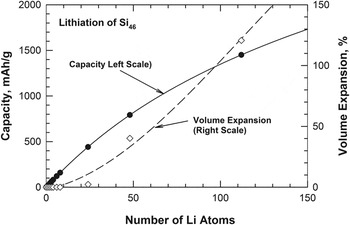
In this paper, we examine the lithiation characteristics of empty silicon clathrate (Si46) via first-principles molecular dynamics computational methods. The energy of formation and the equilibrium lattice constant of Li x Si46 are computed as a function of number of Li atoms inserted into the cage structure. The theoretical capacities and volume expansion of the unit cell associated with the lithiation were examined as a function of Li atoms ranging from 1 to 200. The theoretical results indicate that up to 23–24 Li can be inserted into empty Si46 without volume expansion (less than 2.3% volume strain). Both the capacities and calculated volume expansion increase with further lithiation, reaching a capacity of 809 and 1030 mAh/g at 48 and 66 Li atoms inserted, respectively. Motivated by the theoretical results, we have developed a solution synthesis method that successfully produced small quantities of empty Si46. Furthermore, empty Si46 electrodes were fabricated to characterize their response to lithiation. The theoretical lithiation response was compared against the experimental observations to assess the potential of empty Si46 as an anode material in Li-ion batteries.
II. METHODS
A. Computational details
First-principles methods have been utilized to model lithiation characteristics for many Li-ion battery materials. Reference Aydinol and Ceder20–Reference Zhang, Zhang, Wan, Cui and Wang25 The energy calculations were performed using an ab initio molecular dynamics code, the Car–Parrinello molecular dynamics (CPMD) code, 32 which is a plane wave implementation of density functional theory (DFT). Reference Car and Parrinello33 It uses an approximation frozen-core approach in which only the chemically active valence electrons are explicitly dealt with and the inert core electrons are considered frozen together with the nuclei as rigid non-polarizable ion cores. It is capable of both first principles wave-function optimization (static calculation) and ab initio molecular dynamics calculations. For crystalline solids, the energy and equilibrium lattice constant of a unit cell were computed by calculating the energies for unit cells with different lattice constants by performing wave-function optimization with CPMD. A 4th-order polynomial was fitted to the energy points. The equilibrium lattice constant was determined by finding the lattice constant corresponding to the minimum energy on the polynomial curve. The energy of an amorphous phase was computed by heating the corresponding crystalline phase above the melting point, followed by rapid quenching to 300 K and holding at this temperature as a function of time to allow for atom relaxation and equilibrium to occur. Using the CPMD method, 32,Reference Car and Parrinello33 first principles computations were performed to determine the energy of formation for crystalline Si (c-Si), amorphous Si (a-Si), crystalline Li15Si4 (c-Li15Si4), crystalline Si46 clathrate (c-Si46), and Type I crystalline lithium–silicon clathrates (c-Li x Si46) with x ranging from 1 to 200. For x < 8 Li atoms, the Li atoms were placed at the 8 known sites (2a and 6d) corresponding to the centers of the cavities within the cages. For lithiation in excess of 8 Li atoms, the Li atoms were placed randomly within the cage structure and the Li atoms were allowed to move to their equilibrium locations during energy optimization.
B. Experimental details
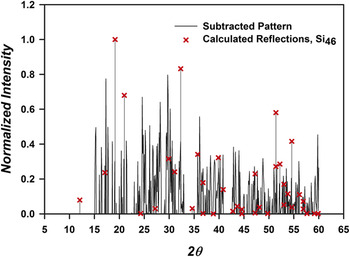
Empty Si46 was synthesized in a batch process which involved soft oxidation of Na4Si4 by a Hofmann-type elimination–oxidation reaction scheme. Reference Guloy, Ramlau, Tang, Schnelle, Baitinger and Grin34 First, a thermal processing method was devised to convert commercial fuel-grade sodium silicide (NaSi1.5) to yield the highest purity of the Zintl phase Na4Si4 possible by varying excess additions of NaH combined with the silicide. X-ray diffraction (XRD) analyses of the thermal transformation products confirmed the conversion of NaSi1.5 to the Zintl phase Na4Si4, when 10% excess NaH was combined with the silicide during thermal processing. Higher additions of NaH did not manifest the required XRD reflections for the Zintl phase. Using these processing conditions, about 10 g of Na4Si4 was synthesized for subsequent use in the batch synthesis of Si46. After successful conversion of Na4Si4, this Zintl compound was combined with an alkylammonium-AlCl3 ionic liquid to synthesize empty silicon clathrate (Si46) via Hofmann-type elimination–oxidation reaction scheme done in solution. Reference Guloy, Ramlau, Tang, Schnelle, Baitinger and Grin34,Reference Chan, Miller, Ellis-Terrell and Chan35 The XRD analysis of the reaction product indicated that the desired Type I clathrate was formed along with unreacted Zintl compound and the reaction by-products. The reaction by-products were expected to be alkene, alkylamines, and Na4Si9. Energy dispersive X-ray spectroscopy indicated that the amount of Si46 formed was about 18.1% by weight. The product (∼20 mg) was cleaned with copious amounts of acetone to remove the organic by-products (alkene and alkylamines) and any ionic liquid. The cleaning process did not completely remove all of the reaction by-products as some extra peaks still remained in the XRD pattern, as shown in Fig. 1. Attempts to further purify the products caused a loss of Si46. Thus, further purification of the Si46 products was abandoned and the Si46 products were used for half-cell testing after acetone-cleaned conditions.
Overlay of powder XRD patterns for the synthesized product and the calculated reflections of empty clathrate (Si46), after subtraction of impurity phases.

Guest-free (empty) Si46 clathrates synthesized by soft oxidation of Na4Si4 were combined with a conducting carbon black additive (25 wt% Super P) and polyvinylidene difluoride binder (20 wt%) to make a slurry. The resulting slurries were then used to cast thin-film electrodes for electrochemical half-cell evaluation. The long-term cyclic performance of guest-free Si46 was evaluated using a three-electrode split cell with a polypropylene separator film and Li metal counter and reference electrodes. The active area of the electrode was also 1.766 cm2 with a thickness of 89.2 μm. The mass of the active material was 0.3485 mg. The electrolyte was 1 M LiPF6 in ethylene carbonate (EC)/diethyl carbonate (DEC)/ fluroethylene carbonate (FEC) in 45:45:10 volume ratios. The half-cell testing was conducted according to a galvanostatic cycling protocol described as follows. The targeted voltage was cycled between 1 V and 5 mV versus Li/Li+ for cycles 1 to 3 at a C rate of C/5 for the solid electrolyte interphase (SEI) formation phase. After SEI formation, the voltage cycling range was maintained from 1 V to 5 mV versus Li/Li+ but the C rate was increased to 5.3 for the rest of the long-term cyclic tests until the tests were terminated after 1000 cycles. The C rates were computed on the basis of the mass of the active materials in the electrode.
III. RESULTS
A. Computational
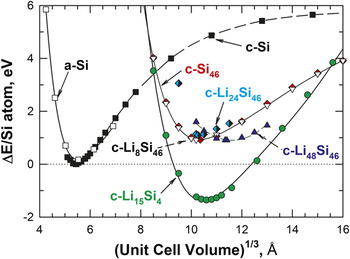
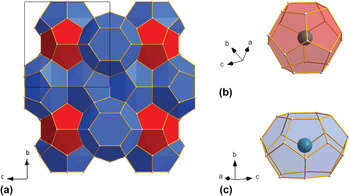
Figure 2 presents the CPMD results of the energy of formation for crystalline Si (c-Si), amorphous Si (a-Si), crystalline Li15Si4 (c-Li15Si4), crystalline Si46 clathrate (c-Si46), and three compositions of Type I crystalline lithium–silicon clathrates (c-Li8Si46, c-Li24Si46, and c-Li48Si46). The c-Li15Si4 compound has been shown to be the fully lithiated phase at room temperature for c-Si thin films. Reference Li and Dahn36 The three clathrates are examples of lithium-silicon clathrates with moderate (166 mAh/g for Li8Si46) and high charge storage capacities (499 mAh/g for c-Li24Si46 and 999 mA h/g for Li48Si46). The energy of formation of c-Si at 0 K was computed to be −107.35 eV/Si atom at the equilibrium condition. This value was taken to be the reference, and the energy of formation for a-Si, Li x Si46, and Li15Si4 was computed and presented relative to the energy of formation of c-Si. These results, presented in Fig. 2, show the energy change per Si atom as a function of the unit cell volume to the 1/3 power. The minimum in the energy curve gives the lattice parameter of the unit cell for a crystalline solid or the equivalent length scale for an amorphous solid. These results indicate that the energies of formation for a-Si and c-Si46 are comparable and both are higher than those of c-Si and c-Li15Si4, as shown in Fig. 2. The lattice parameter of c-Si (5.456 Å) is much smaller than that of c-Li15Si4 (10.642 Å). The equivalent lattice parameter of amorphous Si (a-Si), defined as a o = (unit cell volume)1/3, is about 5.533 Å and is also much smaller than that of Li15Si4 (10.642 Å). In contrast, the lattice parameter of Si46 (10.335 Å for experimental value Reference Adams, O'Keeffe, Kemkov, Sankey and Huang29 and 10.119 Å for the value computed here) matches well with that of c-Li15Si4 (10.642 Å). Calculations show that the lithiation of Si46 to form Li15Si4 would result in a volume expansion of only 9%, compared with 300% for the lithiation of crystalline Si to form Li15Si4. Reference Timmons and Dahn2 This value of volume expansion (9%) corresponds to a lithiation strain of 3%, compared to 95% for crystalline Si. The lithiation strain is computed as the change in lattice constant of the anode before and after lithiation normalized by the initial lattice constant before lithiation. Lithiation of Si46 forms c-Li8Si46 and Li48Si46, and results in lithiation strains of ≈0.77 and 10% and volume strains of ≈2.3 and 40% for Li8Si46 and Li48Si46, respectively. The Si46, Si20, and Si24 cage structures are presented in Figs. 3(a), 3(b), and 3(c), respectively.
Computed energy change per Si atom as a function of unit cell volume to the 1/3 power for c-Si, a-Si, c-Si46, c-Li15Si4, c-Li8Si46, c-Li24Si46, and c-Li48Si46.

The Si46, Si20, and Si24 cage structures for Type I silicon clathrate: (a) Si46 unit cell, (b) Si20 cage structure with a Li guest atom, and (c) Si24 cage structure with a Li guest atom.

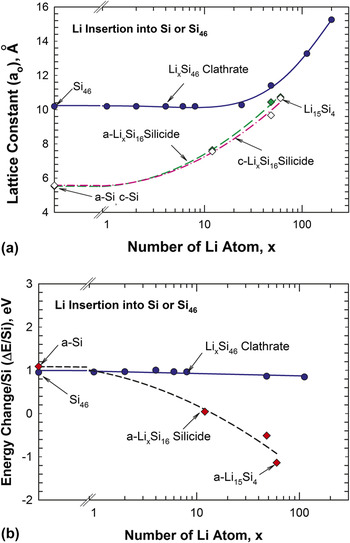
A systematic evaluation of the insertion of Li ions into a unit cell of c-Si46 indicates that the computed lattice constant, a o, of Li x Si46 clathrate remains relatively constant at 10.19 Å until the number of Li atoms inserted exceeds 24 (499 mAh/g), as shown in Fig. 4(a). The lattice constant of Li x Si46 increases from 10.19 Å to 11.41 Å when the number of Li inserted, x, increases from 24 to 48. A further increase of Li ions beyond 48 (>999 mAh/g) causes the Type I cage structure to expand to a larger lattice constant. For comparison, Fig. 4(a) also shows the increases in the lattice constant for a-Si and c-Si as a function of Li to form a unit cell of lithium silicide (Li15Si4), which contains 60 Li atoms and 16 Si atoms. The corresponding energy change/Si values associated with the insertion of Li into silicon clathrate and a-Si are compared in Fig. 4(b). The value of the energy change/Si for insertion of Li into silicon clathrate is relatively constant at about 0.85–0.95 eV for up to 112 Li atoms. The positive energy change values indicate that the Li x Si46 compounds are metastable and exhibit higher energy values than either a-Si or Li15Si4. In contrast, the energy change/Si for Li insertion into a-Si to form Li15Si4 decreases with increasing number of Li atoms and reaches −1.136 eV at 60 Li atoms. These results indicate that there is a small energy barrier for the insertion of Li into the silicon clathrate and that the Li x Si46 clathrate with x < 112 (2330 mAh/g) exhibits a higher energy than Li15Si4 silicide. Thus, there is a thermodynamic driving force for a possible phase transformation from Li x Si46 to Li15Si4. A phase transformation from Li x Si46 to Li15Si4 results in a relatively small change in the lattice constant, as shown in Fig. 4(a).
Computed lattice constants of (a) Li x Si46 clathrate and Li x Si16 silicide, and (b) computed energy change/Si as a function number of Li atoms inserted.

Figure 5 summarizes the results on the theoretical capacity of an empty Si46 as a function of Li atoms inserted into the cage structure and the corresponding volume expansion of the unit cell. Figure 5 shows that both capacity and volume expansion increases with lithiation, but at different rates. At lithiation levels of up to 24 Li atoms, the theoretical capacity increases with increasing Li atom insertion with little or no volume expansion (less than 2.3% volume strain). At 48 Li atoms, the theoretical capacity increases at a reduced rate to 791.6 mAh/g, while the volume expansion increases to 40.2% at increasing rates. At 112 Li atoms, the theoretical capacity reaches as high as 1450 mAh/g, while the volume expansion is about 120%.
Capacity and volume expansion as a function of number of Li atoms inserted into the cage structure of Si46.

B. Experimental results
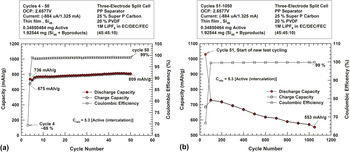
Figure 6(a) shows the capacity based on the mass of the active material (left scale) and the coulombic efficiency (right scale) as a function of cycle number of the Si46 anode from 4 to 50 cycles. The first three cycles, which were in the SEI formation phase, are not presented in this figure. During the SEI formation, the capacity was 919 mAh/g at a 21% coulombic efficiency in the first cycle at a C rate of 0.21. The capacity decreased to 890 mAh/g at a 69% coulombic efficiency in the third cycle. The C rate was increased to 5.3 after the first three cycles. As shown in Fig. 6(a), the capacity of the Si46 anode was 675 mAh/g at 4th cycle, but increased to 809 mAh/g at 50 cycles at 5.3C. The corresponding coulombic efficiency was 99%. After a temporary pause at the 50th cycle and then restarting, the capacity jumped to 1030 mAh/g at the 51st cycle as shown in Fig. 6(b). Upon further cycling, the capacity dropped from 1030 to 553 mAh/g after 1000 cycles, as shown in Fig. 6(b).
Capacity and coulombic efficiency of a Si46 electrode during cycling (a) from the 4th to the 50th cycle, and (b) from the 51st to the 1050th cycle. The C rate was based on the mass of the active material.

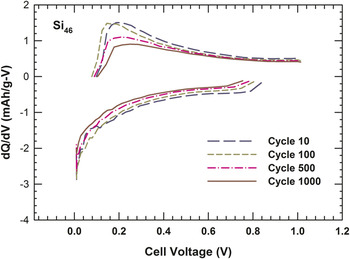
Previous work by Li et al. Reference Li, Raghavan, Wagner, Davidowski, Baggetto, Zhao, Cheng, Yarger, Veith, Ellis-Terrell, Miller, Chan and Chan27 indicated that the dQ/dV response of Ba-stabilized Al-substituted clathrates is distinctly different from that associated with lithiation of crystalline Si or amorphous Si anodes. For comparison purposes, the dQ/dV response associated with the long-term cyclic tests of empty Si46 were obtained. The results for cycles 10, 100, 500, and 1000 are compared in Fig. 7. The breaks in the dQ/dV curves shown in Fig. 7 were caused by the fact that the data of the long-term cycling tests were acquired not continuously but at specified time intervals, which led to gaps in the acquired data during the transition from lithiation and delithiation, and vice versa. The dQ/dV plots taken at various cycles are similar for empty Si46, but the peak appears to shift to lower voltages as the cycle number increases.
Plot of dQ/dV as a function of cell voltage.

IV. DISCUSSION
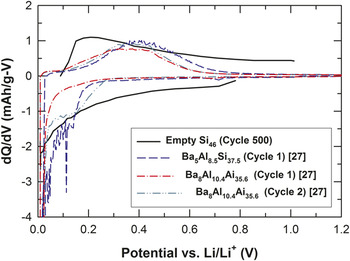
First-principles molecular dynamics computations indicate that the Li insertion process in silicon clathrate, which appears to be different from that of a-Si and c-Si, involves the storage of Li atoms in the open and accessible spaces within the cage structure of the clathrate. Recent work by Li et al. Reference Li, Raghavan, Wagner, Davidowski, Baggetto, Zhao, Cheng, Yarger, Veith, Ellis-Terrell, Miller, Chan and Chan27 showed the lithiation response of c-Si, amorphous Si, and Ba-stabilized Al-substituted silicon clathrates are indeed different with dQ/dV plots that exhibit different peaks at different voltages. Figure 8 shows a comparison of the dQ/dV plots of empty Si46 and Ba x Al y Si46−y clathrates. The comparison indicates that the dQ/dV peak for empty Si46 occurs at a lower voltage compared to those observed in Ba x Al y Si46−y , even though the shape of the dQ/dV curves are similar. The shift in the peak location may be related to the ease of inserting or extracting Li atoms from the cage structure due to the presence of Ba guest atoms in the case of Ba x Al y Si46−y and its absence in the case of empty Si46. To confirm the DFT results, we also computed the accessible volume of empty Si46 using the DMol3 package in Materials Solution (Accelrys, UK) and a Li+ probe (1.84 Å3 volume). Theoretical computation revealed an accessible volume of 42.9 Å3/unit cell for Si46. This accessible volume of silicon clathrate can accommodate 23 Li ions, indicating adequate diffusion pathways for 23 Li ions. The insertion process can proceed without an enlargement of the clathrate structure until the open structure is filled with 24 Li atoms, which is in accordance with the CPMD results shown in Fig. 4(a). Figure 4(a) also shows that the lattice constant of the clathrate structure expands by about 12% upon insertion of 48 Li atoms. At this state, the energy change for Li x Si46 is larger than those for a-Li x Si46 and a-Li15Si4. Subsequent Li insertion can proceed via two paths: (i) expanding the clathrate structure to accommodate additional Li atoms, and (ii) transforming the Li x Si46 clathrate structure to the Li x Si16 (e.g., Li15Si4) silicide structure. A transformation to lithiated a-Si has been observed during lithiation of Type II Na-filled silicon clathrate (Na x Si136). Reference Langer, Dupke, Trill, Passerini, Eckert, Pöttgen and Winter37,Reference Wagner, Raghavan, Zhao, Wei, Peng and Chan38
A comparison of dQ/dV responses of Si46 and Ba x Al y Si46−y from the literature. Reference Li, Raghavan, Wagner, Davidowski, Baggetto, Zhao, Cheng, Yarger, Veith, Ellis-Terrell, Miller, Chan and Chan27

The long-term cyclic tests suggest that Li atoms can be inserted and extracted from the cage cavities of Si46 clathrates. Previous studies Reference Chan and Miller26–Reference Peng, Wei, Li and Chan28 have also shown Li atoms can be inserted and extracted from the cage structure of Ba x Al y Si46−y clathrates. However, the insertion and removal of Li atoms from the cage cavities of empty Si46 appears to be easier and leads to improved coulombic efficiency, higher capacity, and longer life compared to Ba8Al8Si38. The observed capacities of empty Si46 were 675–809 mAh/g during stable cycling. The number of Li atoms required to achieve these observed capacities are computed to be 39 to 49, which are in agreement with theoretical predictions of a maximum of ≈48 Li based on density functional theory. At these capacity levels, Li atoms can be inserted and extracted in the presence of some volume changes (≈40% at Li = 48). A capacity increase was observed when the cell was held at open circuit between the 50th and 51st cycles during a pause. During this time, it is possible that there was an increase in the resistance of the SEI, which led to the large charge capacity of 1030 mAh/g but low coulombic efficiency of <70% observed in the 51st cycle. It is likely that the irreversible capacity was due to charge being used to re-form the SEI layer. The new SEI layer formed after the 50th cycle may have been thicker and more resistive, which may have impeded Li transport from the electrolyte to the clathrate.
After the 51st cycle, the discharge capacity started at ∼700 mAh/g, a decrease from the 809 mAh/g observed in cycle 50. At the peak capacity (1030 mAh/g), the number of Li atoms inserted was computed to be 66 at which point the lithiated Si46 cage structure began to expand substantially (>120%), Fig. 5. The lower capacities observed after the 51st cycle may originate from overlithiation, which may have caused lattice expansion and possible damage to the clathrate cage structure or amorphization, or due to formation of a thick and resistive SEI layer after the open circuit period. The decrease in capacity from 1030 mAh/g at the 51st cycle to 553 mAh/g at the 1050th cycle corresponds to a reduction of the number of Li atoms inserted from 66 to 31. The corresponding volume of expansion associated with the cage structure also decreased from 120% at the peak capacity (51st cycle) to about 10% at the 1050th cycle when the long-term cyclic test was terminated. Despite a decrease in capacity, the Si46 electrode remained functional and the number of Li atoms into the cage exceeded those required to fill the accessible volume of an unexpanded cage. This finding indicates that the dimensions of the Si46 cage may be expandable and can be cycled in an expanded state over at least 1000 cycles. The decrease in capacity, however, suggests that Li x Si46 may not be stable when x > 48 and overlithiation may lead to structural damages or amorphization of Si, depending on the lithiation path. Furthermore, the cage structure appears to be stable at low Li concentrations but may become unstable at high Li concentrations (e.g., >48 Li atoms).
In previous studies, the structural changes associated with unlithiated and lithiated Type I Ba8Al8Si38 were studied using powder x-ray and neutron diffraction, x-ray photoelectron spectroscopy (XPS), and solid state nuclear magnetic resonance (NMR). Reference Li, Raghavan, Wagner, Davidowski, Baggetto, Zhao, Cheng, Yarger, Veith, Ellis-Terrell, Miller, Chan and Chan27,Reference Chan, Miller, Ellis-Terrell and Chan35 The diffraction techniques Reference Li, Raghavan, Wagner, Davidowski, Baggetto, Zhao, Cheng, Yarger, Veith, Ellis-Terrell, Miller, Chan and Chan27,Reference Chan, Miller, Ellis-Terrell and Chan35 did not reveal discernible changes in the clathrate crystal structure after lithiation and XPS confirmed the presence of an SEI layer after cycling. Reference Li, Raghavan, Wagner, Davidowski, Baggetto, Zhao, Cheng, Yarger, Veith, Ellis-Terrell, Miller, Chan and Chan27 29Si static NMR measurements of the lithiated clathrates showed spectra very similar to unlithiated clathrates. Reference Li, Raghavan, Wagner, Davidowski, Baggetto, Zhao, Cheng, Yarger, Veith, Ellis-Terrell, Miller, Chan and Chan27 In addition, magic angle spinning solid-state 27Al NMR spectra indicated that Li insertion into the cage structure altered the relative amplitude of 27Al NMR peaks at the 16i, 6c, and 24k sites, but no significant change in chemical shift or structural order was observed. Reference Chan, Miller, Ellis-Terrell and Chan35 Similar characterization work was not performed on the unlithiated and lithiated Si46 because of limited resources. X-ray diffraction was performed on the lithiated Si46 but the results were not satisfactory due to the presence of strong Cu peaks from the collector. Attempts were also made to identify the extra peaks in the XRD pattern but without success. The extra peaks did not correspond to those of crystalline Si. Furthermore, none of the expected by-products, which included alkene, alkylamines, and Na4Si9, could be lithiated and should not have affected the lithiation response. On the other hand, some of the extra peaks could possibly be matched to the minor peaks of Type II Si34, but major peaks of Si34 were missing. It is possible that the synthesized silicon clathrate products contained a mixture of Si46 and Si34 silicon clathrates. Reference Langer, Dupke, Trill, Passerini, Eckert, Pöttgen and Winter37,Reference Wagner, Raghavan, Zhao, Wei, Peng and Chan38 Since previous studies have shown that the cycleability of Si34 is very limited Reference Langer, Dupke, Trill, Passerini, Eckert, Pöttgen and Winter37,Reference Wagner, Raghavan, Zhao, Wei, Peng and Chan38 and can result in amorphization of Si, the presence of Si34 impurities in Si46 can adversely affect the long-term cyclic performance of Si46. On this basis, the long-term cyclic performance of Si46 may be improved further by increasing the purity of the synthesized Si46 products. This could also enable the more detailed study of the structural changes after lithiation, as was previously undertaken for Type I Ba8Al8Si38.
V. CONCLUSIONS
The conclusions reached in this investigation are as follows:
-
(1) Long-term cyclic tests performed on Si46 electrodes confirmed the prediction by first-principles computations that Li atoms can be inserted and stored within the empty cavities of the cage structure of Si46.
-
(2) The theoretical studies show that Si46 structure is expandable and can accommodate Li atoms in excess of those required to completely fill the accessible volume of the empty Si46 cage.
-
(3) The empty Si46 can be cycled long-term for at least 1000 cycles in the expanded state with volume expansion ranging from 10% to 120%.
-
(4) Overlithiation of the Si46 electrodes beyond 66 Li atoms inserted per formula unit resulted in a decrease in capacities from 1030 mAh/g to 553 mAh/g.
ACKNOWLEDGMENTS
This work was supported by the Internal Research and Development Program (Project 18.R9890) of Southwest Research Institute® (SwRI®) and the Batteries for Advanced Transportation Technologies (BATT) Program at Lawrence Berkeley National Laboratory (LBNL) through Contract No. DEAC0205CH11231, with Dr. Michel Foure at LBNL as program manager. The contribution of C.K.C. was supported by the National Science Foundation through Grant No. DMR-1206795 and startup funds from the Fulton Schools of Engineering, Arizona State University (ASU). The first principles computations were performed at the Texas Advanced Computing Center of the TerraGrid network. The authors acknowledge the clerical assistance provided by Ms. Loretta Mesa, SwRI, in the preparation of the manuscript and Ms. Ran Zhao, Ph.D. student at ASU, in the preparation of Fig. 3.