A decade of research innovation is revealing the critical importance of development itself in predicting phenotypic outcomes in children and adults with different neurogenetic disorders (Karmiloff-Smith, Reference Karmiloff-Smith1998, Reference Karmiloff-Smith2007, Reference Karmiloff-Smith2009). It is no longer assumed that intellectual delay implies global impairment across multiple cognitive domains, and disorder-specific cognitive profiles are now well documented. Likewise, there is emerging agreement that “delay” involves complex, nonlinear processes and should not be viewed as a mere reduction in performance on standardized measures compared to chronological age (CA)-matched typically developing (TD) peers (e.g., Burack, in press; Burack, Evans, Klaiman, & Iarocci, Reference Burack, Evans, Klaiman and Iarocci2001; Cornish & Wilding, Reference Cornish and Wilding2010). Recently, findings from a number of developmental studies have shed further light on the dynamic role of development in shaping disorder-specific profiles from infancy through to adulthood (e.g., Cornish, Scerif, & Karmiloff-Smith, Reference Cornish, Scerif and Karmiloff-Smith2007; Hall, Burns, Lightbody, & Reiss, Reference Hall, Burns, Lightbody and Reiss2008). In this context, neurodevelopmental disorders with a clear genetic etiology and recognized phenotype can inform timely diagnoses and treatment approaches that take account of subtle but dynamic changes in performance across development. Furthermore, they may provide important clues to understanding the neurodevelopmental origins in infancy of disorders that are currently defined by their childhood phenotype (e.g., attention-deficit/hyperactivity disorder [ADHD] and autism) and therefore link otherwise heterogeneous behaviors difficult to study prospectively earlier in development (e.g., inattention and hyperactivity/impulsivity).
Fragile X syndrome (FXS) represents an important model to investigate the dynamics of trajectories of change, rather than a static view of impairment. The syndrome is a well-recognized cause of hereditary developmental delay in males, and to lesser extent females, with an estimated incidence of 1 in 2,500 worldwide (Hagerman, Reference Hagerman2008). A substantial body of cross-disciplinary research bears testament to huge advancements in our knowledge of FXS across multiple levels: at the molecular level by the discovery of the single affected X-linked gene, fragile X mental retardation 1, and its encoded protein, fragile X mental retardation protein (Garber, Visootsak, & Warren, Reference Garber, Visootsak and Warren2008); at the neural level by multiple discoveries of FMRP's role in synaptic plasticity (Willemsen, Oostra, Bassell, & Dictenberg, Reference Willemsen, Oostra, Bassell and Dictenberg2004); and at the neurocognitive level by the discovery of a FXS-specific signature of proficiencies and deficiencies that distinguish FXS from other neurodevelopmental disorders (e.g., Bertone, Hanck, Kogan, Chaudhuri, & Cornish, Reference Bertone, Hanck, Kogan, Chaudhuri and Cornish2010a, Reference Bertone, Hanck, Kogan, Chaudhuri and Cornish2010b). In particular, striking difficulties in attention, impulsivity, and working memory (WM) characterize this disorder (Cornish et al., Reference Cornish, Scerif and Karmiloff-Smith2007; Cornish & Wilding, Reference Cornish and Wilding2010; Hooper, Hatton, Barabek, Roberts, & Bailey, Reference Hooper, Hatton, Baranek, Roberts and Bailey2000; Hooper et al., Reference Hooper, Hatton, Sideris, Sullivan, Hammer and Schaaf2008; Lanfranchi, Cornoldi, Drigo, & Vianello, Reference Lanfranchi, Cornoldi, Drigo and Vianello2009; Munir, Cornish, & Wilding, Reference Munir, Comish and Wilding2000a, Reference Munir, Cornish and Wilding2000b; Scerif, Cornish, Wilding, Driver, & Karmiloff-Smith, Reference Scerif, Cornish, Wilding, Driver and Karmiloff-Smith2004, Reference Scerif, Karmiloff-Smith, Campos, Elsabbagh, Driver and Cornish2005; Scerif, Karmiloff-Smith, Campos, Elsabbagh, Driver, & Cornish, Reference Scerif, Cornish, Wilding, Driver and Karmiloff-Smith2007).
Given the relevance of these weaknesses for clinical intervention, it is crucial to explore whether end states are stable across time (suggesting that a plateau of generally poor performance is maintained across time) or whether progress occurs, either slower than or in line with mental age (MA) level. These subtle changes can only be mapped by studying change over time. In other words, does performance reflect delayed onset followed by developmental delay, but similar to typical trajectories in patterns of improvement? Conversely, performance may reach an age-specific plateau of peak development and then diverge from the normal trajectory over time. Disentangling these two alternative scenarios requires the incorporation within a single research design of cross-sectional and longitudinal assessments of children with a disorder, together with TD control groups that are matched on (a) developmental level, thereby reflecting equivalent MA levels to the atypical population, and (b) CA to account for simple maturational change and similar experiences, and to understand developmental endpoints. In the present study, we compare trajectories of performance on two experimentally driven paradigms specifically designed to tap multiple components of attention and WM in atypical and TD populations across developmental time. Together, they provide a rich source of information against which to characterize the attentional difficulties of children with FXS as either static or changing, albeit developmentally delayed.
Dynamic Relationships Across Attentional Mechanisms and WM
Although cognitive studies of FXS have assessed differing aspects of attention, recent research has tended to focus on either attentional control (e.g., Cornish et al., Reference Cornish, Scerif and Karmiloff-Smith2007) or memory (e.g., Ornstein et al., Reference Ornstein, Schaaf, Hooper, Hatton, Mirrett and Bailey2008) in isolation of one another. However, these processes are fundamentally interlinked in adults and across both typical and atypical development (Awh, Vogel, & Oh, Reference Awh, Vogel and Oh2006; Lui & Tannock, Reference Lui and Tannock2007; Olesen, Macoveanu, Tegner, & Klingberg, Reference Olesen, Macoveanu, Tegner and Klingberg2007). This dynamic interplay has not, to our knowledge, been investigated in genetic disorders of attention using experimentally driven paradigms that are designed specifically to tap atypical cognitive processing and, critically, how it unfolds over developmental time. Rather, the existing research has mainly focused on measures standardized on TD children. We use FXS as a case study of the developmental interactions of attention and WM, and study how attentional control is affected by the need to maintain information in WM.
Focusing on the endpoint of development, a substantial body of research suggests that attentional control suffers under WM requirements. If the interaction between the two operates in the same way earlier in development, younger TD children should be better able to control attention when concurrent WM is not required. However, WM and attentional control are each known to change significantly over early- to midchildhood, and therefore their interrelations need to be investigated empirically. We also predict that attentional control and WM performance in children with FXS will be overall poorer than expected given CA, but for the first time we will explore how the trajectories of interactions between attentional control and WM progress from early- to midchildhood. We hypothesize that, although delayed with respect to CA and MA level (Study 1), attentional control with and without concurrent WM demands will display dynamic, not static, developmental trajectories over a 12-month period (Study 2).
Study 1
Method
Participants
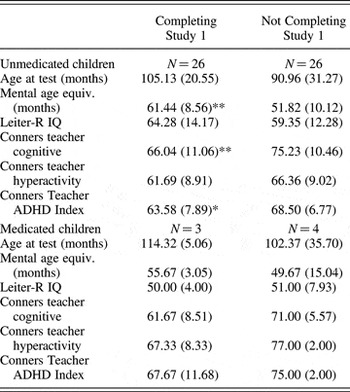
Twenty-six boys with a confirmed diagnosis of FXS (M = 8 years; 8 months, range = 4 to 10 years), were recruited through the national support group for children and families with FXS as part of a larger study of attentional difficulties in FXS (see Table 1 for characteristics of the current and of the broader study sample).
Mean (standard deviation) larger sample characteristics for the two samples of unmedicated children with fragile X syndrome who completed or did not complete Study 1

Note: Time 1 demographic characteristics, Leiter-R IQ and Conners' Teacher Rating Scale T scores for all children with fragile X syndrome who took part in our larger longitudinal study of attentional difficulties. Information for children with fragile X syndrome who were on stimulant medication is reported separately. ADHD, attention-deficit/hyperactivity disorder.
*p < .05. **p < .005. Children with fragile X syndrome (completing) > children with fragile X syndrome (not completing).
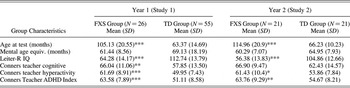
A comparison group of 55 TD boys with no reported family history of FXS (M = 5 years, 4 months; range = 4–8 years) was recruited from local nurseries and primary schools (see Table 2 for details). Signed informed consent was obtained from all participating parents following the ethical procedures approved by the appropriate local institutional review board. The final sample excluded the children in the FXS group who were taking medication for the treatment of inattention and hyperactivity symptoms (whose demographic characteristics are also reported in Table 1), because a large literature on ADHD strongly suggests that chronic stimulant medication modifies neurocognitive function and structure at multiple levels (e.g., Pliszka et al., Reference Pliszka, Liotti, Bailey, Perez, Glahn and Semrud-Clikeman2007; Semrud-Clikeman, Pliszka & Liotti, Reference Semrud-Clikeman, Pliszka and Liotti2008; Shaw et al., Reference Shaw, Eckstrand, Sharp, Blumenthal, Lerch and Greenstein2007, Reference Shaw, Sharp, Morrison, Eckstrand, Greenstein and Clasen2009). We also excluded children in the TD comparison group who scored at or above standardized clinical thresholds for ADHD symptoms, on the Conner's Teacher Rating Scale—Revised: Short Form (CTRS; Conners, 1997), and color blindness/poor visual acuity in both groups.
Mean (standard deviation) study sample

Note: Demographic characteristics, Leiter-R IQ (population mean = 100, standard deviation = 15), and Conners' Teacher Rating T Scores (population mean = 50, standard deviation = 10) for unmedicated children with fragile X syndrome (FXS) and typically developing (TD) children in Studies 1 and 2 at Time 1 and 2 (see text for further details). ADHD, attention-deficit/hyperactivity disorder.
*p < .05. **p < .005. ***p < .001. Children with FXS differ from TD children.
Of note, at Time 1 our overall study sample contained a relatively small proportion of children on stimulant medication (7 out of 59 [11.8%], of whom only 3 out of 29 [10%] completed the tasks reported in the current manuscript) compared to stimulant medication rates reported for other samples of boys with FXS (e.g., 33.4% on stimulants only or stimulants and additional medications; Sullivan et al., Reference Sullivan, Hatton, Hammer, Sideris, Hooper and Ornstein2006). A number of factors may drive this lower percentage: For example, children in the current study were younger compared to those studied in other published studies reporting on aspects of attentional control and executive functions in FXS (e.g., Hooper et al., Reference Hooper, Hatton, Sideris, Sullivan, Hammer and Schaaf2008; Sullivan et al., Reference Sullivan, Hatton, Hammer, Sideris, Hooper and Ornstein2007). Five of the 7 children on stimulant treatment in our sample were 9 years of age or older. There may also be cultural differences in stimulant treatment practices (e.g., Hsia & Maclennan, Reference Hsia and Maclennan2009). It is worth noting that, therefore, to our knowledge this is the first and largest experimental study of the interactions between attentional control and WM in medication-naive boys with FXS as young as 4–10 years of age.
Table 2 presents a summary of final group characteristics and group differences. Information on children who did not complete the current tasks and on medicated children is also reported in Table 1. As expected, given the high reported prevalence of developmental delay, hyperactivity, and inattention in individuals with FXS (Hooper et al., Reference Hooper, Hatton, Baranek, Roberts and Bailey2000; Sullivan et al., Reference Sullivan, Hatton, Hammer, Sideris, Hooper and Ornstein2006), children in our sample had significantly lower nonverbal IQ, as measured by the Leiter International Performance Scale—Revised (Leiter-R; Roid & Miller, Reference Roid and Miller1997) and higher T scores for the cognitive problems/inattention, hyperactivity, and ADHD index subscales of the CTRS than did TD children.
Measures
Measures tapping cognitive aspects of attention and WM were as follows.
Attentional control measure
This first task was an analogue to a standard continuous performance task, providing a baseline measure of attention to visual targets (high contrast Gabor patches) presented infrequently in a stream of lower contrast Gabor patches. These controlled stimuli allowed us to test that all children could discriminate targets similarly, as demonstrated by performance in a separate task in which we established similar perceptual discrimination of the test stimuli for children with FXS and controls. This is critical because the literature on both autism and FXS warns against assuming perceptual processing equivalence to TD individuals (e.g., Mottron, Burack, Stauder, & Robaey, Reference Mottron, Burack, Stauder and Robaey1999; Bertone et al., Reference Bertone, Hanck, Kogan, Chaudhuri and Cornish2010b), so that using stimuli solely designed for TD individuals in standardized assessment tools could result in differences for perceptual rather than cognitive reasons. The attentional control task was divided into three blocks, each including a total of 15 targets presented at pseudorandom intervals (providing a total of 45 targets across the three blocks).
WM measure
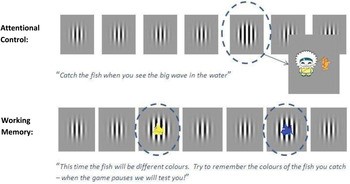
The second task adapted the attentional control task to measure WM effects on attention. To incorporate a WM component, the visual feedback fish images were randomly presented in one of four colors (blue, green, yellow, and red), and children were required to remember the color of the fish throughout the game, because whenever the task paused they would be asked to recall the color of the last fish they caught. An identical number of targets were presented as in the attentional control task. This WM component was measured three times in each block (see Figure 1).
The trial schematics of a trial description for the attentional control task and the working memory task. [A color version of this figure can be viewed online at http://journals.cambridge.org/dpp]

Both tasks were run from a Dell latitude D430 laptop and projected on to a Dell 17-in. monitor (refresh rate 75 Hz). Child responses were recorded using a Cedrus RB-530 response pad (with four-color coded response keys) and were designed and run using Eprime1.2 software.
Procedure
Children were seen at school, in a quiet space close to their classroom. The tasks were described to the children as fishing games, in which they had to watch the screen and try to catch some fish from the water whenever they saw a “big wave.”
Attentional control task
Children were asked to watch the “moving water” (low-contrast gabor patches), to look out for the “big waves” (high-contrast targets), because this meant “there was a fish swimming past to catch.” When the target wave was detected, they had to move their dominant hand from the home key to press a target key (to “catch the fish.”). If they responded correctly, a cartoon fish image was presented as positive feedback during practice, alongside auditory feedback (“yippee!”) throughout the experiment.
WM task
Children were asked to catch as many fish as possible, as in the baseline condition, and to concurrently memorize the colors of the fish, because they would be asked to report the color of the last fish that they caught at the end of the set of trials. For Block 1, children were presented with two practice sets. At the end of each practice set of trials, the children were presented with the four possible colored fish on screen and asked to report which color fish they caught last. In Blocks 2 and 3, a further set of practice trials was presented before the final test trials.
Data analysis
Dependent measures related to cognitive performance were accuracy of target detection (percentage hits) and reaction time to hits (time taken to press the target button). The independent variable for each of these analyses was group (boys with FXS and TD comparison boys) and task (attentional control task and WM task). Developmental trajectories of attentional control and WM task performance were constructed for both groups according to CA and MA level. Because these variables were continuously distributed in both the TD and the FXS samples, the effects of CA, MA, and their interactions with the categorical variables above (group and task) were analyzed using mixed-design linear regressions (following Thomas et al., Reference Thomas, Annaz, Ansari, Scerif, Jarrold and Karmiloff-Smith2009), in order to assess developmental relationships between CA, MA, attention, and WM in TD children and in children with FXS. Finally, to validate our novel experimental measures, we assessed the extent to which they correlated with general intellectual ability and independent teacher ratings of inattention and hyperactivity in the classroom for our sample of TD children. Data distributions were tested to ensure that assumptions for parametric statistical tests had been met.
Results and discussion
We assessed whether children with FXS had been able to understand and comply with the complex WM demands of the WM task by testing how well they maintained and remembered the colors of the target fish. Older children as a whole were better able to maintain information in WM (as indexed by better ability to recall target colors), F (1, 77) = 30.750, p < .001, η2 = 0.285. An interaction between group and CA, F (1, 77) = 12.664, p = .001, η2 = 0.141, suggested that children with FXS were increasingly less able to deal with this requirement than expected given their CA. However, children with FXS did not significantly differ from TD children when their MA was taken into account, as indexed by a null main effect of group with MA as a covariate, F (1, 74) = 0.597, p = .442, η2 = 0.008, and MA significantly predicted recall performance for all children, F (1, 74) = 18.831, p < .001, η2 = 0.203. This in turn suggests that the FXS group engaged with and/or were as capable to deal with the WM demands as would have been expected given their developmental delay.
Trajectories: Changes CA
Accuracy
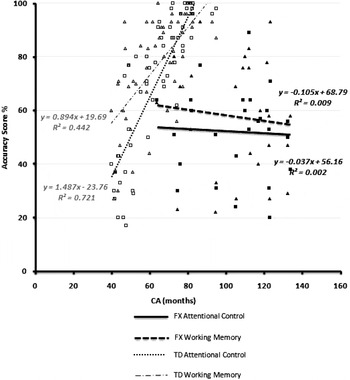
Figure 2 represents the relationship between task performance (accuracy) and CA. CA significantly predicted an increase in performance across tasks and groups, F (1, 77) = 34.591, p < .001, η2 = 0.310. Group predicted performance across all tasks in general, F (1, 77) = 14.332, p < .001, η2 = 0.157, with the TD group performing with greater accuracy than the FXS group. In addition, however, the FXS group seemed to be developing at a much slower rate across tasks than was the TD group, F (1, 77) = 43.997, p < .001, η2 = 0.364. Compared to the TD group, the FXS trajectories for both conditions were flat across the CA span. Critically, a significant interaction of Task × Group × CA, F (1, 77) = 6.069, p = .016, η2 = 0.073, suggested that the two groups followed different developmental relationships between these two task conditions. The TD group showed a significant inversion of relative ability in the two conditions with CA, with the WM task becoming increasingly more difficult than the attentional control task, as indexed by a significant interaction effect of CA and task, F (1, 53) = 20.657, p = .001, η2 = 0.280, and significant improvements over CA, F (1, 53) = 106.753, p < .001, η2 = 0.668. The FXS group trajectories, however, showed no overall difference between the two tasks, F (1, 24) = 0.396, p = .535, η2 = 0.016, nor a significant interaction effect of task and CA on accuracy scores, F (1, 24) = 0.129, p = .772, η2 = 0.005, and no overall improvement over CA, F (1, 24) = 0.179, p = .676, η2 = 0.007.
Chonological age (CA)-based trajectories of the performance (percentage accuracy) across tasks plotted against CA. Squares refer to individual data points on the attentional control task and triangles to those in the working memory task. Filled markers refer to boys with fragile X (FX) syndrome and unfilled markers refer to typically developing (TD) children.

Reaction time
Reaction times are not graphically represented for brevity, but main effects and interactions mirror those obtained for accuracy scores. Group significantly predicted reaction times (RTs) overall, F (1, 77) = 6.594, p = .012, η2 = 0.079, with the FXS group showing slower RTs than the TD group overall, FXS = 1244.88 (84.881) ms, TD = 712.23 (45.96) ms. CA significantly predicted RT overall, with RTs becoming quicker with increasing CA, F (1, 77) = 25.548, p < .001, η2 = 0.295. This depended on group, as indexed by a significant interaction of group with CA, F (1, 77) = 25.548, p < .001, η2 = 0.249, suggesting that the FXS group developed at a different rate than did the TD group in terms of their RT improvement. Follow-up analyses of covariance for each group confirmed that speed increased with CA for TD children, F (1, 53) = 64.853, p < .001, η2 = 0.550, but not for children with FXS, F (1, 53) = 0.162, p = .691, η2 = 0.007. There was also a significant main effect of task, F (1, 77) = 4.668, p = .034, η2 = 0.057, driven by slower overall reaction times for the attentional control task, 1017.25 (45.18) ms, compared to the WM task, 939.86 (63.77) ms, moderated by a marginally significant interaction effect between task and CA, F (1, 77) = 3.936, p = .051, η2 = 0.049, driven by slower responses for the WM task compared to the attentional control task at the end of the CA trajectory in both groups and a reverse pattern with faster performance in the WM task for younger children.
Trajectories: Changes over MA equivalent
Accuracy
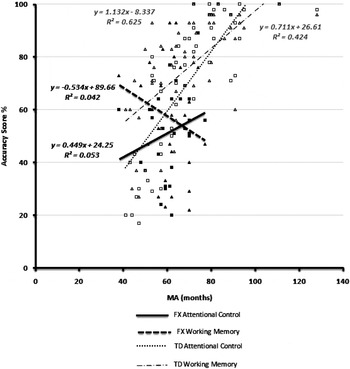
Figure 3 represents the relationship between task performance (accuracy) and MA level on the Leiter-R (indexed here by MA equivalent in months). The FXS group performed overall significantly worse than did the TD group, F (1, 74) = 4.083, p = .047, η2 = 0.052, a pattern consistent with delay. MA significantly affected performance overall, F (1, 74) = 5.474, p = .022, η2 = 0.069, and children with FXS improved with MA at a differential rate compared to TD children, as indexed by the interaction between group and MA, F (1, 74) = 6.578, p = .012, η2 = 0.082. However, both groups showed a similar trajectory in differences across task conditions, with no Task × Group interaction, F (1, 74) = 1.495, p = .225, η2 = 0.020. MA significantly moderated the difference between the two task conditions, F (1, 74) = 12.622, p = .001,η2 = 0.146, with better performance on the attentional control task compared to the WM task for older children but not for younger children, and there was now no significant Task × Group × MA interaction, F (1, 74) = 2.017, p = .160, η2 = 0.027. This suggests that, despite the overall delay and flatter overall trajectory with MA in boys with FXS, the two conditions operated similarly to controls for the FXS over the MA range assessed here, with poorer WM compared to attentional control performance for children of higher MA and the reversed pattern for children of lower MA. This interpretation was further assessed by separate analyses of variance carried out for the two groups. MA interacted with task for TD children, F (1, 51) = 13.619, p < .001, η2 = 0.211, and, albeit through a smaller effect, for children with FXS, F (1, 23) = 5.578, p = .027, η2 = 0.195. We highlight caution in interpreting these cross-sectional findings, because our scatterplots very clearly indicate a larger degree of individual differences across children with FXS than TD children.
Mental age (MA)-based trajectories. Performance across tasks plotted against MA equivalent. Squares refer to individual data points on the attentional control task and triangles to those in the WM task. Filled markers refer to boys with fragile X (FX) syndrome and unfilled markers refer to typically developing (TD) children.

Reaction time
The lack of significant main effects of group suggests that the two groups responded as quickly once differences in MA were taken into account, F (1, 74) = 0.746, p = .391, η2 = 0.010. MA level significantly predicted reaction time overall, with responses speeding with increased MA level, F (1, 74) = 7.873, p = .006, η2 = 0.196. MA and group did not interact significantly in their effects on reaction time, F (1, 74) = 1.607, p = .209, η2 = 0.021, suggesting similar trajectories across groups. None of the other interaction effects reached significance (lowest p = .135).
Validation of experimental attention and WM measures
In order to validate our novel experimental measures against intellectual ability and traditionally used measures of classroom behaviors, Pearson's correlations (or nonparametric equivalents when necessary) were carried out across our experimental measures, the Leiter-R IQ and the inattention, hyperactivity, and ADHD index age-standardized T scores from the CTRS for our TD sample. TD children who were rated as more inattentive by their teachers were significantly less accurate in detecting targets for both the attentional control task, r (55) = −.403, p = .002, and the WM task, r (55) = −.347, p = .010, and they were slower in responding to targets for both tasks, r (55) = .337, p = .012 and r (55) = .331, p = .013, respectively. TD children rated as more hyperactive by their teachers also produced significantly fewer hits in the attentional control task, r (55) = −.271, p = .045. Finally, TD children rated as higher on the ADHD index also produced fewer hits in both tasks, r (55) = −.333, p = .013 and r (55) = −.287, p = .034, respectively, and were slower in the WM task, r (55) = .273, p = .044. Accuracy of recollection on the WM task (i.e., the number of colors accurately reported by children while performing the attentionally demanding task) was related to IQ, with higher IQ associated with better report, r (55) = .316, p = .021. Relationships between measures on our experimental tasks were specific to inattentive/hyperactive behaviors, whereas a distinct index related to general intellectual functioning measured by the Leiter-R brief IQ shows a pattern that is consistent with our tasks, not simply tapping general ability, but indexing constructs relevant to attentional control.
To recapitulate, the core aim of Study 1 was to establish initial (Time 1) data on attentional and WM functioning in a large sample of young boys with FXS and compare performance to that of TD children, drawing developmental trajectories on the basis of CA and MA. We designed two novel experimental tasks to overcome the difficulties inherent in employing tasks created and standardized for TD children. As expected, our cognitive markers of attentional control and WM related to commonly used indices of behavioral inattention, hyperactivity, and general intellectual ability. As predicted, the FXS group demonstrated a significant gap in (a) their ability to withhold a response until a specific target stimuli appeared on screen, indicative of a weakness in attentional control processes, and (b) their ability to concurrently perform a WM task while completing the attentional control task, when compared to the performance of TD children. The pattern of findings is consistent with those reported in the existing literature and reflects the documented weakness in attention and WM in FXS (Cornish et al., Reference Cornish, Scerif and Karmiloff-Smith2007; Hooper, et al., Reference Hooper, Hatton, Sideris, Sullivan, Hammer and Schaaf2008; Lanfranchi, Cornoldi, Drigo, & Vianello, Reference Lanfranchi, Cornoldi, Drigo and Vianello2009; Ornstein et al., Reference Ornstein, Schaaf, Hooper, Hatton, Mirrett and Bailey2008).
At first blush, and when viewed solely from a chronological perspective, the data suggest a developmental “freeze” in performance, with both attentional control and WM plateauing, in contrast to the typical case. However, when taking into consideration MA level of boys with FXS, a different profile emerges, one that reflects overall delay but a close similarity of trajectory to the TD group. Both groups start their developmental trajectories with an advantage on the WM task, in contrast to our prediction from the adult literature of poorer performance under concurrent WM demands, and found in our older TD children. This surprising divergence from the expected adultlike end state could stem from three non-mutually exclusive developmental changes: (a) in early childhood the ability to engage in dual tasking is only just emerging, resulting paradoxically in less interference than later in development; (b) sustaining attention for briefer bursts prior to the memory recall questions is less demanding on slowly developing executive processes; and (c) maintaining information such as colors may actually engage younger children in the requirement to attend to a greater degree in the WM task than in the baseline attentional control task. With increasing developmental level, and despite the flatter trajectories in FXS, both TD and FXS children switch in the expected direction of poorer dual WM performance than attention control performance, suggesting comparable trajectories of developmental change in FXS rather than developmental freeze. These findings highlight the importance of investigating developmental trajectories, rather than merely group comparisons. However, there were substantial individual differences in performance across the sample of boys with FXS. In Study 2, we explore whether age-related changes in performance can be better captured using a longitudinal methodology.
Study 2
In Study 1 our findings indicated that trajectories based on CA suggested a performance plateau in FXS children and a growing gap between the TD profile. In contrast, trajectories based on MA pointed to delay but with a similar pattern to young TD children (with relatively poorer performance on the attentional control task than on the WM task in children of lower MA). Of note, despite this similar qualitative pattern of relationships among attentional control, WM demands, and developmental level in FXS children and TD children, overall performance improved dramatically in TD children as MA level increased, whereas the slope of overall improvement with MA in boys with FXS was much flatter: this may be either a true reflection of developmental freeze or a reflection of mapping trajectories using snapshots across different individuals from different age groups, rather than across time in the same individuals. Although cross-sectional data provide important clues to possible age-related changes, such data inherently confound age-related and individual differences, and cannot furnish information on change for individual children. Using a prospective longitudinal design, performance can be explored within a dynamic context that can address, for the first time, whether attentional control and WM in FXS change with age or whether performance reaches a plateau with no longitudinal change.
Method
Participants
All 26 boys with FXS included in Study 1 were followed up a year later (12.4 months on average), but 2 children had begun taking stimulant medication between the two time points and 3 children had moved to a more difficult version of the WM task, leaving a longitudinal sample of 21 boys for the current measures. Their performance was compared with that of 21 younger TD boys who were also followed 12 months after the initial assessment. The two groups did not differ in MA at Time 1, t (40) = −0.165, p = .870, but children with FXS tended to have reached a lower MA at Time 2, t (40) = 2.013, p = .051, as would be expected in a group with overall developmental delay. In addition, as documented at Time 1, children with FXS continued to be rated by their teachers as more hyperactive and achieving a higher ADHD index than TD boys. Furthermore, their inattention, hyperactivity, and ADHD index T scores at Time 1 did not differ significantly from those reported at Time 2 (lowest p = .624).
Apparatus and procedure
The experimental tasks and standardized measures were administered in the same way as in Study 1. As before, children with FXS engaged in the WM task requirement to the same level as that expected given their MA level, indexed by no statistically significant main effect of child type on memory for the target fish's color, F (1, 40) = 0.419, p = .522, η2 = 0.011.
Data analysis
Accuracy and reaction times (see Study 1) for the baseline attentional control task and the WM task were submitted to 2 (Group: Children with FXS or TD Children) × 2 (Time Point: Time 1 or Time 2) × 2 (Task: Attentional Control or WM). As with any longitudinal design employing identical measurements at multiple assessment points, improvements in performance could simply depend on practice effects, rather than on true developmental change. In order to address this alternative interpretation, we compared performance by these 21 TD children at Time 2 (when practice could have played a role) to performance by TD children of similar age but assessed at Time 1 (i.e., when they first encountered the test protocol). Practice effects would be indexed by better performance on the Time 2 sample compared to the Time 1 sample. In addition, the longitudinal design afforded the unique opportunity of studying whether individual differences in attentional control and WM at Time 1 predicted behavioral outcome measures such as nonverbal IQ, inattention, hyperactivity, and ADHD indices in the classroom a year later, for both TD children and boys with FXS.
Results and discussion
Longitudinal trajectories of change
Accuracy
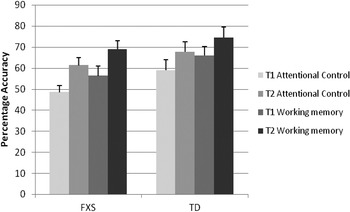
Figure 4 represents accuracy for the two groups of children and tasks, at Time 1 and Time 2. Groups did not differ significantly in their overall ability to attend to targets, F (1, 40) = 3.480, p = .069, η2 = 0.080, although the boys with FXS tended to respond less frequently (M = 58.8%, SEM = 3.5) than the TD children (M = 66.8%, SEM = 3.6). However, both groups improved in their ability to attend over time, as indexed by a statistically significant main effect of time point, F (1, 40) = 15.347, p < .001, η2 = 0.277, with accuracy improving from 57.4% (SEM = 2.8) at Time 1 to 68.2% (SEM = 2.9) at Time 2. In addition, just like for younger children at Time 1, accuracy was higher for the WM task (M = 66.5, SEM = 2.7) than for the baseline attentional control task (M = 59.1, SEM = 2.6), F (1, 40) = 13.169, p = .001, η2 = 0.248. There were no statistically significant interactions between group and any of the other factors (all Fs < 1), suggesting that, albeit delayed compared to what would be expected given their MA level, children with FXS improved as much as did young TD children and displayed similar better performance in the WM task. None of the other interaction effects reached significance (lowest p = .464).
Longitudinal trajectories of the changes in performance for the experimental tasks across Time 1 and Time 2.

Reaction time
There was a statistically significant main effect of group, F (1, 40) = 5.284, p = .027, η2 = 0.117, driven by slower responses by the boys with FXS, 1205.96 ms, than the TD boys, 1029.80 (58.18) ms. There was also a main effect of time point, F (1, 40) = 25.601, p < .001, η2 = 0.390, driven by faster responses at Time 2 compared to Time 1, but this effect was moderated by an interaction between time point and group, F (1, 40) = 4.813, p = .034, η2 = 0.107. An analysis of simple main effects revealed that the TD children were significantly faster in responding to targets at Time 2, 869.53 (58.35) ms, compared to Time 1, 1190.08 (66.48) ms, F (1,40) = 26.308, p < .001, η2 = 0.397. Children with FXS also displayed faster reaction times at Time 2, 1142.64 (58.35) ms, compared to Time 1, 1269.28 (66.48) ms, F (1, 40) = 4.107, p = .049, η2 = 0.093, but the difference was smaller than among their TD counterparts. None of the other main effects and interaction effects reached statistical significance (lowest p = .622).
Developmental change or practice effects
Performance at Time 2 by the 21 TD children who contributed to Study 2 (Time 2 sample) was compared to that a group of different 21 TD children who had performed on both the attention and the WM tasks at Time 1 (Time 1 sample). The two groups were matched in terms of CA, Time 1 sample: 69.04 (13.45) months; Time 2 sample: 66.23 (10.22) months, t (40) = 0.761, p = .451. A 2 (Task: Attentional Control or WM) × 2 (Sample: Time 1 or Time 2) mixed analysis of variance established that there was a significant main effect of task, F (1, 40) = 7.787, p = .008, η2 = 0.770, with the WM task resulting in higher accuracy (78.5%) than the attentional control task (71.9%). There was no significant effect of sample, F (1, 40) = .015, p = .190, with the Time 2 group performing (71.1%) at a similar level to, or if anything slightly less well than, the Time 1 sample (79.3%). There was no significant interaction effect of sample and task on accuracy, F (1, 40) = 1.777, p = .904. A very similar pattern was reflected in reaction time data, with neither a significant main effect of sample, F (1, 40) = 0.155, p = .696, η2 = 0.004, nor an interaction effect of sample and task on reaction time, F (1, 40) = 1.123, p = .296, η2 = 0.027. All together, these findings rule out that the improvement observed at Time 2 on our experimental measures was simply based on a practice effect.
Predicting differences in longitudinal outcome through attention and WM measures
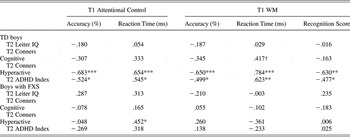
Within-group differences in attentional control predicted later longitudinal outcome: TD children who were more accurate and faster on both the attention control and the WM tasks obtained lower hyperactivity and ADHD index T scores at Time 2 than did TD children, who were less accurate and slower (all ps < .05, see Table 3). Furthermore, children with FXS who were faster on the attentional control task at Time 1 obtained lower hyperactivity T scores from their teachers at Time 2 than did children with the condition who were slower, r (21) = .452, p < .040; this also held for correlations with raw hyperactivity scores, partialing out MA to account for (CA-standardized) T scores perhaps not reflecting the behavior of boys with FXS well, r (18) = .458, p < .042. However, these prospective relationships did not hold when we used Time 1 behavioral indices as predictors of cognitive attention, WM, and IQ at Time 2 (all ps > .05).
Correlations across measures

Note: Pearson correlation coefficients between experimental attentional measures at Time 1 (T1) and outcome measures (nonverbal IQ, Leiter-R, Conners T Scores) 12 months later at Time 2 (T2) for boys with fragile X syndrome (FXS) and typically developing (TD) children. Variables met assumptions of parametric statistics. WM, working memory; ADHD, attention-deficit/hyperactivity disorder.
†p < .10. *p < .05. **p < .005. ***p < .001.
To summarize, Study 2 aimed at a prospective longitudinal design for the first time in the published work on attention and WM in young boys with FXS. Although cross-sectionally drawn developmental trajectories by boys with FXS in Study 1 shared similarities across tasks with patterns demonstrated by TD children, the trajectories of change mapped across individuals appeared much flatter. A major concern was that the high degree of individual differences might have masked true developmental changes across children in general and especially across children with a neurodevelopmental disorder with complex cascading developmental effects like FXS.
In Study 2, we found remarkable similarities in improvements across conditions in terms of accuracy for the two groups, although children with FXS did not improve as much as did TD children in overall speed of their responses. These changes contrasted with relatively unchanged behavioral indices of inattention and hyperactivity. The changes in cognitive attention and WM could not be attributed to simple practice effects, because children presented with the tasks at Time 2 performed no better than children at Time 1 who had encountered the task for the first time. For both groups, individual differences in earlier cognitive attention and WM predicted later behavioral outcomes such as teacher-rated hyperactivity and ADHD-like behaviors, whereas earlier behavioral indices were not good predictors of later cognitive measures.
General Discussion
The primary aim of the present study was to explore the developmental trajectories of the interaction of attentional control and WM in young boys with FXS and TD boys. There is now a well-documented signature of attention and memory impairments in early- and midchildhood in FXS (Cornish & Wilding, Reference Cornish and Wilding2010; Hooper et al., Reference Hooper, Hatton, Baranek, Roberts and Bailey2000; Lanfranchi et al., Reference Lanfranchi, Cornoldi, Drigo and Vianello2009; Ornstein et al., Reference Ornstein, Schaaf, Hooper, Hatton, Mirrett and Bailey2008; Scerif et al., Reference Scerif, Cornish, Wilding, Driver and Karmiloff-Smith2004, Reference Scerif, Karmiloff-Smith, Campos, Elsabbagh, Driver and Cornish2005, Reference Scerif, Cornish, Wilding, Driver and Karmiloff-Smith2007; Sullivan et al., Reference Sullivan, Hatton, Hammer, Sideris, Hooper and Ornstein2007) and a suggestion that disorder-specific mechanisms may drive age-related changes in these domains (Cornish et al., Reference Cornish, Scerif and Karmiloff-Smith2007). However, the previous findings can only provide a tantalizing glimpse of possible developmental trajectories because they are all based on cross-sectional snapshots of performance in different cohorts at different ages. In contrast, here we describe, for the first time, developmental trajectories of attention and WM that allow a more dynamic account of how these skills emerge in FXS and in TD children. The question driving this research was to the extent to which attentional difficulties in our FXS cohort do truly index “developmental arrest” or whether cognitive abilities reveal subtle yet consistent changes over time that mirror, albeit to a lesser extent, the TD profile. At Time 1, we pitted FXS boys against TD boys based on both MA and CA, which yielded two novel findings: (a) FXS performance appears static when compared to CA-matched TD children who demonstrate a linear increase in performance with increasing CA on both attentional control and WM paradigms. The ability to retain in WM simple sequences of colors appears to show an early advantage over the ability to control attention. (b) A more dynamic trajectory emerges when FXS performance is charted over MA level, and a typical trajectory in the relationships between attention control and WM performance is observed, despite overall poorer performance. In turn, this is suggestive of developmental delay rather than developmental freeze as inferred from our CA findings. Nonetheless, even when drawn against developmental level, performance in children with FXS seemed to show limited overall improvement over MA, a finding that could still be interpreted as evidence of minimal change over developmental time.
To address the question of whether performance truly remained poor over developmental time, our longitudinal data, complementing cross-sectional data (be they based on CA or MA), provide the most novel information, because they allowed us to disentangle the impact of individual differences on change over time. Our findings suggest that, across two time points, children with FXS remain overall poorer at both attentional control and WM than are TD children of equivalent MA, suggesting greater weaknesses in these cognitive abilities than expected given their MA level, group differences that mirror their higher (and seemingly unchanged) inattention, hyperactivity, and ADHD symptomatology at both time points. However, despite delay, they improved over time and exhibited better performance on the WM task compared to the attentional control task, just like the younger TD children did. Older TD children move toward an emerging advantage in performance for the attentional control task as the WM task performance becomes more effortful and attentional control competes with WM for priority of cognitive resources. By contrast, when followed longitudinally, neither the young TD group nor the FXS group (both younger than the time point at which this switch occurred in our earlier cross-sectional trajectories) showed this change in performance.
Three or more longitudinal time points would further enrich our understanding of whether the (clearly demonstrated) improvements in children with FXS eventually plateau, diverging from typical development, or whether the benefit for the attentional control condition emerges in both groups over time. We are currently addressing these questions in a further longitudinal assessment. These data build upon and extend previous findings that characterized the late childhood end state of attention and WM performance in FXS, but they go considerably further by offering a window in which to observe the developmental trajectories within these cognitive domains from both typical and atypical perspectives.
In addition, the data indicate the need for distinguishing behavioral change from cognitive change and for more precisely targeted educational and clinical interventions that prioritize early cognitive trajectories, especially those that are critical for later outcomes such as attention and WM skills. Our cognitive measures related to behavioral indices of inattention and hyperactivity at Time 1, and predicted these outcomes at Time 2, but they were much more sensitive to developmental change than those behavioral indices. Furthermore, in children with FXS the present findings highlight the necessity of looking at MA level skills and their trajectories rather than focusing exclusively on CA equivalents, which can appear to be stabilized or even in decline across the childhood years.
It is paradoxical that, given the tremendous richness of data that accrues from using longitudinal methodology, relatively few studies have chosen this pathway. From these few studies, there is already emerging evidence to indicate a dynamic cognitive profile in children with FXS for social cognition (Hernandez et al., Reference Hernandez, Feinberg, Vaurio, Passanante, Thompson and Kaufmann2009), adaptive functioning (Roberts et al., Reference Roberts, Mankowski, Sideris, Goldman, Hatton and Mirrett2009) and general intelligence (Hall et al., Reference Hall, Burns, Lightbody and Reiss2008). Our data extends this research by suggesting that in FXS attentional control and WM clearly do not index developmental freeze: if followed longitudinally, even across two time points, children with the condition show improvements in performance that were not either captured by cross-sectional comparisons or by teacher-reported behavioral scores. Furthermore, attentional control abilities predicted cognitive and classroom outcomes a year later. The latter insights could only be gleaned through an approach that involved, first, careful characterization of change using experimentally driven measures, with hypothesis-driven predictions about changes over developmental time, and, second, a longitudinal design to complement cross-sectional trajectories, stressing the importance of tracing developmental change for individual children. As a note of caution, however, it is critical to stress that the children who completed our tasks were among the developmentally more mature and least inattentive children with FXS from our larger longitudinal sample. Future studies are required to design tasks that can tap attentional control and WM as effectively in even younger children.
In conclusion, the present findings highlight three main issues. First, our results show the importance of investigating in depth the cognitive underpinnings of behavioral inattention and hyperactivity in all developmental disorders, going beyond the use of gross standardized measures that often mask subtle differences across different subdomains of attention and WM. Second, the results underscore how deceiving cross-sectional glimpses on performance can be and therefore point to how attentional difficulties in developmental disorders can only be understood by mapping task-specific change across developmental time. Third, from a clinical and educational perspective, our findings highlight the need to recognize that, although difficulties in attention and WM can be significant especially in terms of severity of behaviors in the classroom, at the cognitive level they show dynamic changes over early childhood, so strategies for intervention need to be tailored to the specific developmental time point at which each child is targeted in the clinic and the classroom, and include both behavioral and cognitive challenges.