




No CrossRef data available.
Article contents
Classifying children with heavy prenatal alcohol exposure using measures of attention
Published online by Cambridge University Press: 01 March 2004
Abstract
Deficits in attention are a hallmark of the effects of heavy prenatal alcohol exposure but although such deficits have been described in the literature, no attempt to use measures of attention to classify children with such exposure has been described. Thus, the current study attempted to classify children with heavy prenatal alcohol exposure (ALC) and non-exposed controls (CON), using four measures of attentional functioning: the Freedom from Distractibility index from the Wechsler Intelligence Scale for Children–Third Edition (WISC–III), the Attention Problems scale from the Child Behavior Checklist (CBCL), and omission and commission error scores from the Test of Variables of Attention (TOVA). Data from two groups of children were analyzed: children with heavy prenatal alcohol exposure and non-exposed controls. Children in the alcohol-exposed group included both children with or without fetal alcohol syndrome. Groups were matched on age, sex, ethnicity, and social class. Data were analyzed using backward logistic regression. The final model included the Freedom from Distractibility index from the WISC–III and the Attention Problems scale from the CBCL. The TOVA variables were not retained in the final model. Classification accuracy was 91.7% overall. Specifically, 93.3% of the alcohol-exposed children and 90% of the control children were accurately classified. These data indicate that children with heavy prenatal alcohol exposure can be distinguished from non-exposed controls with a high degree of accuracy using 2 commonly used measures of attention. (JINS, 2004, 10, 271–277.)
Information
- Type
- Research Article
- Information
- Journal of the International Neuropsychological Society , Volume 10 , Issue 2 , March 2004 , pp. 271 - 277
- Copyright
- © 2004 The International Neuropsychological Society
INTRODUCTION
Heavy prenatal alcohol exposure causes physical and neurobehavioral abnormalities. Alcohol-exposed children may exhibit a collection of symptoms known as the fetal alcohol syndrome (FAS), the cardinal features of which include pre- and/or postnatal growth deficiency, craniofacial anomalies, and central nervous system dysfunction (Jones et al., 1973; Stratton et al., 1996). Adverse neurobehavioral outcome, related to central nervous system dysfunction, can occur to varying degrees depending on a variety of factors such as dose and duration of exposure (May, 1995). Many domains of functioning are susceptible to the neurotoxicity of in utero alcohol exposure including intellect, language, learning and memory, and attention (Mattson & Riley, 1998).
The occurrence of deficits in attention in individuals with heavy prenatal alcohol exposure with or without FAS is well established. In an early study, Lemoine et al. described a group of children with prenatal alcohol exposure as agitated, irritable, and exhibiting a decreased capacity to engage in continuous activity (Lemoine et al., 1968). This association between prenatal alcohol exposure and attention problems has been repeatedly described and appears to be independent of general intelligence level (Shaywitz et al., 1980). Attention problems are also stable over time as indicated by a longitudinal prospective study that emphasized a significant relationship between prenatal alcohol exposure and disordered sustained attention at ages 4, 7, and 14 years (Streissguth et al., 1995). In addition, vigilance test scores were highly correlated with subsequent behavior ratings, suggesting that the empirical data also had ecological validity.
Caregiver and teacher ratings also support the presence of attention problems in children with prenatal alcohol exposure (Carmichael Olson et al., 1992; Mattson & Riley, 2000; Roebuck et al., 1999). Importantly, these deficits appear to exceed those expected based on IQ score and are similar in alcohol-exposed children with or without FAS. Thus, these deficits appear to be a salient marker of heavy prenatal alcohol exposure and may be more sensitive than overall intellectual deficit or facial dysmorphology (Mattson & Riley, 2000).
More recently, specific dimensions of attention have been explored in order to elucidate a possible pattern of effects. One investigation focused on auditory and visual sustained attention in adolescents prenatally exposed to alcohol, with and without dysmorphic features. The alcohol-exposed group with dysmorphic features displayed a specific deficit in the visual modality while auditory attention remained relatively spared (Coles et al., 2002). A second study (Mattson et al., 2002) also tested visual and auditory focused attention but included an attentional shift component and varied the intertarget interval for all components. As in the previous study, alcohol-exposed children exhibited a specific deficit in the visual attention domain, while auditory attention was relatively spared. Specifically, in the visual domain, alcohol-exposed children exhibited globally longer reaction times in response to target stimuli while response times in the auditory domain were only slowed when the intertarget interval was long. Prenatal alcohol consumption has also been associated with slower processing speed and longer reaction times to visual stimuli in infancy (Jacobson et al., 1993, 1994). Finally, and in contrast to the studies just described, one study has suggested that auditory attention was more impaired than visual attention in nonretarded adults with prenatal alcohol exposure (Connor et al., 1999). Deficits were apparent in visual attention, but the auditory deficits were stronger. Thus, a specific pattern of attention deficits descriptive of individuals with prenatal alcohol exposure remains unclear.
Identification of Children With Heavy Prenatal Alcohol Exposure
The physical features of FAS provide a link between prenatal alcohol exposure and subsequent behavioral or cognitive impairments. However, children with prenatal alcohol exposure who lack the distinct facial features are more difficult to identify, precisely because they lack the external stigmata of exposure (Aase et al., 1995). The lack of appropriate tools to identify these cases causes many alcohol-exposed children to go undetected or misidentified. Thus a need exists to develop or improve diagnostic tools for use with this population. Clinically, distinguishing children with heavy prenatal alcohol exposure from non-exposed children is important for early and targeted intervention. Currently, few intervention programs exist that specifically target this population. Remediation is mainly addressed with infant development programs or programs for at-risk children that are nonspecific in nature (Niccols, 1994). Eventually, more specific intervention models, guided by improvements in diagnosis, may prove to be more effective in improving outcome (Streissguth et al., 1994) and reducing the incidence of secondary disabilities (Streissguth & Kanter, 1997; Streissguth et al., 1996).
The impetus for the current study was the desire to utilize common measures of attention to define a profile of attention deficits in alcohol-exposed children and to increase detection accuracy of individuals with prenatal alcohol exposure. We attempted to classify children in this population by utilizing straightforward neuropsychological measures of cognitive ability known to be affected in individuals prenatally exposed to alcohol, with or without the facial phenotype of FAS. Additionally, by using information from multiple measures rather than any single measure, we hoped to provide a more comprehensive model for helping to detect the occurrence of prenatal alcohol exposure. Convergence of empirical data from measures of attention supports the notion that attention deficits exist within this population. However, no attempt has been made to predict the presence or absence of prenatal alcohol exposure based on these putative deficits. Therefore, the purpose of this investigation was to derive a sound statistical model capable of discriminating children with prenatal alcohol exposure from non-exposed children using common quantitative measures of attention. The statistical model described herein is intended to provide a more precise means for making this discrimination. In combination with other critical information, the model may provide important information about the etiological link between alcohol exposure and subsequent behavior problems and importantly, assist the clinician in providing the most appropriate intervention.
METHODS
Research Participants
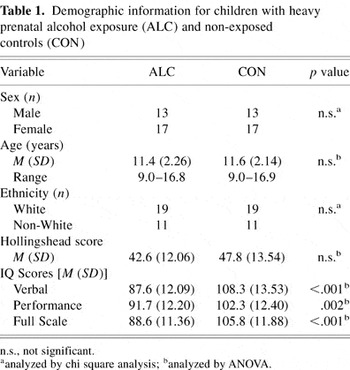
A total of 60 children participated in the study. All participants were drawn from a larger ongoing neuropsychological research project at the Center for Behavioral Teratology, San Diego State University. Two groups of children were included: children with known histories of heavy prenatal alcohol exposure (ALC, N = 30) and children without such exposure (CON, N = 30). The ALC group included alcohol-exposed children with or without a diagnosis of FAS, as determined by an examination by a dysmorphologist (K.L. Jones, M.D.). Within this group, twelve children were diagnosed with FAS. Positive diagnoses were based on the presence of growth retardation, central nervous system dysfunction, and facial dysmorphology (Jones & Smith, 1973; Jones et al., 1973; Stratton et al., 1996). Previous reports suggest similar behavioral deficits and brain anomalies in children with heavy prenatal alcohol exposure with or without FAS (Mattson & Riley, 1998, 2000; Roebuck et al., 1998) and thus, we typically combine them in one group (Mattson & Roebuck, 2002). Prenatal alcohol exposure information for all children was obtained through caregiver report, medical, or social service records. Groups were matched on age at testing (9.0–16.9 years), sex (57% female), social status, and ethnicity (63% White). The majority of the sample (71.7%) was of middle class (Hollingshead scores of 20–54). Exclusionary criteria were as follows: IQ < 70 or > 130, missing or invalid test data, teratogenic exposure other than alcohol, primary language other than English, psychiatric or neurological disorders that would interfere with test performance, uncorrected visual or hearing disorder, and diagnosis of attention deficit hyperactivity disorder (ADHD) in the CON group. Alcohol-exposed children were referred by Dr. Jones (63%), other medical or social service providers, or were self referred. Importantly, some of these children were initially referred to Dr. Jones prospectively (i.e., at or shortly after birth) or because of a history of prenatal alcohol exposure and not necessarily because of behavior concerns. Children in the control group were self-referred as a result of community outreach or advertising. Demographic information for the two groups is presented in Table 1.
Demographic information for children with heavy prenatal alcohol exposure (ALC) and non-exposed controls (CON)

Measures
Wechsler Intelligence Scale for Children–III Freedom From Distractibility Index
The Wechsler Intelligence Scale for Children–III (WISC–III; Wechsler, 1991) measures general intelligence level and is appropriate for children aged 6 through 16 years, 11 months. Performance on this test results in Verbal, Performance, and Full scale intelligence quotients (IQ) as well as four additional index scores including Freedom from Distractibility (FD). This index score comprises two subtests, Arithmetic and Digit Span, and is purported to measure the child's ability to maintain attention during testing (Sattler, 1992). It reliably distinguishes children with attention deficits from typically developing children as supported by both an exploratory factor analysis performed on the normative sample and a confirmatory factor analysis conducted on a clinical sample (Wechsler, 1991). Standard scores for the FD index score, based on the age of the child, were calculated using normative data provided by the test publisher (Wechsler, 1991).
Test of Variables of Attention
The Test of Variables of Attention (TOVA) is a computerized continuous performance test that assesses processing ability in the visual modality. The TOVA provides normative data for individuals aged 4 to 80 and is appropriate for use with normal and clinical populations (Leark et al., 1999). In this task, the participant is presented with either a target or nontarget figure at the center of the computer screen. Exposure length is 100 ms and the interstimulus interval is 2 s. The figures are composed of small black colored boxes embedded in larger colored boxes presented against a black background. The presentation of test stimuli is broken down into four quarters and stimuli are presented in random frequency per quarter. The designated target is presented in 22.5% of the trials during the first half and in 77.5% of the trials during the second half, representing stimulus-infrequent and stimulus-frequent conditions, respectively. A 2-min practice run is administered followed by the 22-min test. Two variables were examined in this study, omission errors (lack of correct response), measuring inattention, and commission errors (response to non-target), measuring impulsivity. Standard scores, based on the age and sex of the child were calculated using normative data provided by the test publisher (Leark et al., 1999).
Achenbach Child Behavior Checklist
The Child Behavior Checklist (CBCL) is a 113-item questionnaire that assesses a child's behavioral competence as rated by the parent (Achenbach, 1991). It is appropriate for children from 4 to 18 years of age and provides scores on eight problem scales. Only the Attention Problems scale was examined in this study. Items relevant to this scale include statements such as, “can't concentrate, can't pay attention for long” and “can't sit still, restless, or hyperactive.” T-scores, based on the age and sex of the child were calculated using normative data provided by the test publisher (Achenbach, 1991).
Procedure
All children were administered the WISC–III and the TOVA individually in quiet, distraction-free testing rooms at the Center for Behavioral Teratology at San Diego State University. These measures were administered on separate days within a two-week period. The TOVA was administered at the end of a 90-min testing session during which other neuropsychological tests were administered. The primary caregiver (typically the mother or foster mother) of each child was asked to complete the CBCL during the child's first test session. WISC–III FD, TOVA Omission (OM) and Commission (COM) standard scores, and CBCL Attention Problems (ATTN) T-scores were calculated and served as the independent variables in the analyses conducted in this study. Informed consent and assent were obtained prior to testing and all procedures were approved by the Institutional Review Board of San Diego State University.
RESULTS
Demographic Information
As groups were matched on age, sex, ethnicity, and social class, there were no differences between the groups on any of these variables based on chi-square analysis or analysis of variance (ANOVA) (ps > .05). However, consistent with previous reports (Mattson et al., 1997), Verbal IQ, Performance IQ, and Full Scale IQ scores were significantly different between groups based on ANOVA (ps < .01). Demographic information is presented in Table 1.
Statistical Analyses
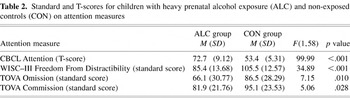
Performances on each of the four measures of attention were first tested by one-way ANOVA with group (ALC or CON) as the between-subjects variable. Group differences were found on all measures (ATTN, FD, OM, and COM; ps < .05). Descriptive data for all measures are shown in Table 2.
Standard and T-scores for children with heavy prenatal alcohol exposure (ALC) and non-exposed controls (CON) on attention measures

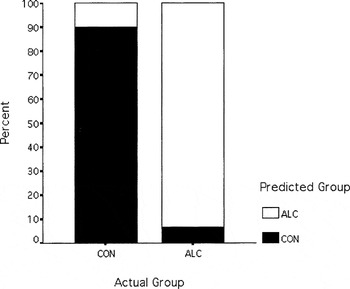
Because the main goal of this study was to determine which measures of attention best distinguish children with histories of prenatal alcohol exposure from non-exposed children, the data were analyzed using binary logistic regression. Group membership was the dependent variable (ALC or CON) and the four measures of attention (ATTN, FD, OM, COM) served as the independent variables. Prior to conducting the logistic regression, we examined the bivariate correlations for the independent variables for evidence of multicollinearity. Tabachnick and Fidell (2001) propose that variables with a bivariate correlation of greater than .70 provide redundant information to an analysis, which can cause problems of multicollinearity. Because all bivariate correlations were <.53, the initial analysis included all four attention variables. A backward stepwise procedure was utilized to determine the set of independent variables that best predicted group membership. Full models were reduced according to p values and the final model included only variables that significantly (p < .05) predicted the outcome. The final model retained two of the independent variables (ATTN and FD). This model was shown to reliably discriminate children in the ALC group from children in the CON group [χ2(2, N = 60) = 62.15, p < .001], and accounted for 86% of the variability. Using a 50% cut-off value, any case with a predicted probability of .5 or greater was classified as alcohol-exposed and any predicted probability less than .5 indicated membership in the non-exposed CON group. Group prediction was highly successful, with 93.3% of the ALC group and 90% of the CON group correctly predicted, contributing to an overall accuracy rate of 91.7% (see Figure 1).

Classification accuracy of non-exposed children (CON) and alcohol-exposed children (ALC)
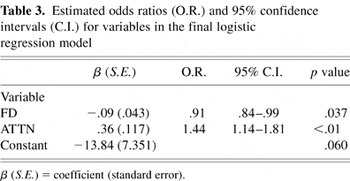
Two variables, ATTN and FD were retained in the final model and significantly predicted (p < .05) group membership. The odds ratio for ATTN was 1.44 (95% C.I. = 1.14–1.81) and the odds ratio for FD was .91 (95% C.I. = .84–.99). These results are shown in Table 3. Although statistically significant, the upper limit of the 95% confidence interval for FD was close to 1.0. However, the regression model including both FD and ATTN was significantly better than a model with ATTN only [χ2(2, N = 60) = 6.36, p = .01]. Thus, children were 1.1 times more likely to have prenatal alcohol exposure for every one unit decrease in FD score and 1.44 times more likely to have prenatal alcohol exposure for every 1 unit increase in attention score. To put this in a more clinically meaningful context, for every 15-point reduction in FD (i.e., 1 SD), children were 3.9 times more likely to have prenatal alcohol exposure. Similarly, for every 10-point increase in ATTN, children were 36.6 times more likely to have prenatal alcohol exposure. The estimated logistic regression function derived from this analysis is as follows:

, where

is the predicted probability of prenatal exposure to alcohol. The predicted probabilities are presented in Figure 2, which depicts the final model where higher ATTN scores and lower FD scores are related to membership in the ALC group.
Estimated odds ratios (O.R.) and 95% confidence intervals (C.I.) for variables in the final logistic regression model


Logistic regression curve representing predicted group membership. Probability scores at or above .5 are classified as alcohol-exposed (ALC) and those below .5 are classified as non-exposed controls (CON). Predicted probabilities are based on the logistic regression model, which includes CBCL Attention scores (ATTN) and WISC–III Freedom from Distractibility (FD) scores (see text for details). Markers denote actual group membership.
In order to examine the possibility that the observed attention deficits were not due to a general lowering of intelligence, FSIQ was analyzed with ATTN and FD in the logistic regression model. When assessing the presence of a confounding variable, the difference (if any) in the beta coefficients of the independent variables in the equation (ATTN and FD) can be examined with and without the covariate under consideration (FSIQ). The beta values for ATTN and FD were not meaningfully different after controlling for FSIQ indicating that there was no confounding effect of FSIQ. Thus, the odds ratios for both ATTN and FD remained virtually the same with and without FSIQ in the model, suggesting that the relationship between the independent and dependent variables is not affected by the presence of FSIQ. Specifically, the odds ratio for ATTN changed from 1.44 to 1.43, and the odds ratio for FD changed from .91 to .97 after controlling for FSIQ.
Lastly, to explore whether children with PEA can be accurately discriminated from control children, the final model was tested without children diagnosed with FAS. Similar effects were found, as reflected in the beta coefficients of the two variables, ATTN (−.07) and FD (.38). These results should be considered with caution because the power of the analysis is reduced with eight less subjects. However, similar to the interpretation of the inconsequential change in the model after controlling for FSIQ, the absence of change in the beta values here indicates that the relationship of ATTN and FD with prediction of group membership is similar when the model is tested without children with FAS.
DISCUSSION
This study demonstrated that the combination of parent-rated attention problems and an index measure of attention accurately discriminated children with prenatal alcohol exposure from non-exposed children, based on the logistic regression model. Specifically, ATTN scores and FD scores were the most valuable predictors of group membership. Interpretation of odds ratios suggested that the ATTN scores were more influential than FD scores, but when combined were better at predicting group membership than ATTN alone. A subsequent analysis using FSIQ as one of the independent variables supported that attention deficits were not due to lower IQ scores.
TOVA omission and commission scores were excluded from the model because these variables did not account for a significant amount of unique variance in the prediction of group membership. Hence, they did not add to the accuracy of the logistic regression model, although the groups were significantly different on these variables based on ANOVA. Previous research, including our own, has shown that alcohol-exposed children perform differently than non-exposed control children on computerized tests of attention such as the TOVA (Calarco et al., 2003; Coles et al., 2002; Mattson et al., 2002). One explanation for the exclusion of the TOVA variables from our model may be the variability within the measures, as indicated by their standard deviation values. It is possible that the length of the task (24 min) subserved the wide variation in scores such that some children exhibited low performance solely because the task was very long, regardless of exposure. It might be beneficial in the future to examine the quarters of the TOVA separately to determine whether certain children perform differentially across time. Only those variables that provided the greatest amount of unique variance in prediction of group membership were retained to produce a parsimonious model with a high rate of accuracy. Thus, the TOVA omission and commission measures did not account for anymore variance above and beyond that of ATTN and FD together. The results of this study provide a basis for understanding attention impairments in children with prenatal alcohol exposure. The combination of two commonly used, standardized measures of attention accurately predicted the presence or absence of heavy prenatal alcohol exposure. Because varied measures (i.e., parent ratings and standardized testing) of attention tapping various attention-related behaviors (encoding, inattention, and impulsivity) were explored as possible predictor variables, the sensitivity of our model to detect differences in attention was increased. Since this study was retrospective in nature, the parent-rated attention problems may be elevated due to expectations of the parents in the alcohol-exposed group. However, it is not the case that the referrals were made solely on the basis of behavior problems or specifically attention problems. Thus, our results are not likely to be negatively influenced by selection bias. The utility of our model will be enhanced by additional research testing its specificity and validity by including other clinical groups and other groups of alcohol-exposed children, respectively. We feel that our results strengthen the literature suggesting that attentional measures can be used to distinguish alcohol-exposed children from controls. However, it is still uncertain whether this pattern is unique from other attention-disordered populations, such as children with ADHD. While we were unable to incorporate children with ADHD in the current study, we suggest that the specificity of our model be tested against this additional group.
The practical utility of this model lies in its simplicity and accessibility, requiring two scores from widely used standard measures, CBCL Attention Problems and WISC–III Freedom from Distractibility. Further, when used in conjunction with other indicators of prenatal alcohol exposure, the model presented herein can improve our ability to identify children affected by prenatal alcohol exposure. Once validated, the exponential function derived from this study may enable clinicians, educators, and related professionals to accurately estimate the probability of a child having been prenatally exposed to alcohol. The cut-off value for probability of being prenatally exposed to alcohol was set at .5 for the purpose of this study and children with a probability equal to or greater than .5 were classified as alcohol-exposed. Clinically, when a child is suspected to have a history of prenatal alcohol exposure, the function may be used to determine an estimated probability of the occurrence of prenatal exposure to alcohol. In addition, to reduce the rate of false-positive classification and thus provide a more conservative estimation, a higher cut-off value could be used. Of course, a more conservative estimation will, by definition, result in more false-negative classifications (i.e., children with prenatal alcohol exposure being classified as controls). Either way, a statistical model such as this might prove beneficial in identifying children affected by prenatal alcohol exposure who do not express the facial phenotype characteristic of FAS. Although the model derived in this study is based on alcohol-exposed children with or without FAS and non-exposed control children, it also appears to be accurate in discriminating alcohol-exposed children without FAS from controls.
Despite its statistical predictive ability, the discriminative function derived in this study should only be viewed as a screening tool and not a diagnostic measure. It can be used as a preliminary indicator of prenatal alcohol exposure in conjunction with other measures. Other valuable data should be incorporated especially when the predicted probability is close to the chosen cut-off value and therefore not particularly informative. Results from this investigation point to promising paths for detection of children with prenatal alcohol exposure. The model provided herein is an initial step in this direction. Future studies need to be conducted to test the model's validity and specificity by applying it to different samples of alcohol-exposed children and other clinical samples, such as those with ADHD or low IQ scores. Such studies will enhance our accuracy in identifying children prenatally exposed to alcohol and thus improve the application of appropriate interventions and services.
ACKNOWLEDGMENTS
The authors thank the members of the Center for Behavioral Teratology, the families who graciously participate in our studies, and Leah Flury for statistical support. Research supported by NIAAA Grants AA10417, AA10820, and AA12596.
References
REFERENCES
Aase, J.M.,
Jones, K.L., &
Clarren, S.K.
(1995).
Do we need the term “FAE”?
Pediatrics,
95,
428–430.Google Scholar
Achenbach, T.M.
(1991).
Manual for the child behavior
checklist/4–18 and 1991 profile.
Burlington, VT:
University of Vermont Department of Psychiatry.
Calarco, K.E.,
Mattson, S.N.,
Robertson, B., &
Riley, E.P.
(2003).
Heavy prenatal alcohol exposure or adhd? Errors make the difference.
Journal of the International Neuropsychological Society,
9,
152.Google Scholar
Carmichael Olson, H.,
Sampson, P.D.,
Barr, H.,
Streissguth, A.P., &
Bookstein, F.L.
(1992).
Prenatal exposure to alcohol and school problems in late childhood:
A longitudinal prospective study.
Development and Psychopathology,
4,
341–359.Google Scholar
Coles, C.D.,
Platzman, K.A.,
Lynch, M.E., &
Freides, D.
(2002).
Auditory and visual sustained attention in adolescents prenatally
exposed to alcohol.
Alcoholism: Clinical and Experimental Research,
26,
263–271.Google Scholar
Connor, P.D.,
Streissguth, A.P.,
Sampson, P.D.,
Bookstein, F.L., &
Barr, H.M.
(1999).
Individual differences in auditory and visual attention among fetal
alcohol-affected adults.
Alcoholism: Clinical and Experimental Research,
23,
1395–1402.Google Scholar
Jacobson, S.W.,
Jacobson, J.L., &
Sokol, R.J.
(1994).
Effects of fetal alcohol exposure on infant reaction time.
Alcoholism: Clinical and Experimental Research,
18,
1125–1132.Google Scholar
Jacobson, S.W.,
Jacobson, J.L.,
Sokol, R.J.,
Martier, S.S., &
Ager, J.W.
(1993).
Prenatal alcohol exposure and infant information processing ability.
Child Development,
64,
1706–1721.Google Scholar
Jones, K.L. &
Smith, D.W.
(1973).
Recognition of the fetal alcohol syndrome in early infancy.
Lancet,
2,
999–1001.Google Scholar
Jones, K.L.,
Smith, D.W.,
Ulleland, C.N., &
Streissguth, A.P.
(1973).
Pattern of malformation in offspring of chronic alcoholic mothers.
Lancet,
1,
1267–1271.Google Scholar
Leark, R.A.,
Dupuy, T.R.,
Greenberg, L.M.,
Corman, C.L., &
Kindschi, C.L.
(1999).
T.O.V.A. Test of variables of attention: Professional guide.
Los Alamitos, CA:
Universal Attention Disorders, Inc.
Lemoine, P.,
Harousseau, H.,
Borteyru, J.-P., &
Menuet, J.-C.
(1968).
Les enfants de parents alcooliques: Anomalies observées.
À propos de 127 cas [Children of alcoholic parents:
Abnormalities observed in 127 cases].
Ouest Medical,
21,
476–482.Google Scholar
Mattson, S.N.,
Lang, A.R., &
Calarco, K.E.
(2002).
Attentional focus and attentional shift in children with heavy
prenatal alcohol exposure.
Journal of the International Neuropsychological Society,
8,
295.Google Scholar
Mattson, S.N. &
Riley, E.P.
(1998).
A review of the neurobehavioral deficits in children with fetal
alcohol syndrome or prenatal exposure to alcohol.
Alcoholism: Clinical and Experimental Research,
22,
279–294.Google Scholar
Mattson, S.N. &
Riley, E.P.
(2000).
Parent ratings of behavior in children with heavy prenatal alcohol
exposure and IQ-matched controls.
Alcoholism: Clinical and Experimental Research,
24,
226–231.Google Scholar
Mattson, S.N.,
Riley, E.P.,
Gramling, L.,
Delis, D.C., &
Jones, K.L.
(1997).
Heavy prenatal alcohol exposure with or without physical features
of fetal alcohol syndrome leads to IQ deficits.
Journal of Pediatrics,
131,
718–721.Google Scholar
Mattson, S.N. &
Roebuck, T.M.
(2002).
Acquisition and retention of verbal and nonverbal information in
children with heavy prenatal alcohol exposure.
Alcoholism: Clinical and Experimental Research,
26,
875–882.Google Scholar
May, P.A.
(1995).
A multiple-level, comprehensive approach to the prevention of fetal
alcohol syndrome (FAS) and other alcohol-related birth defects
(ARBD).
International Journal of the Addictions,
30,
1549–1602.Google Scholar
Niccols, G.A.
(1994).
Fetal alcohol syndrome: Implications for psychologists.
Clinical Psychology Review,
14,
91–111.Google Scholar
Roebuck, T.M.,
Mattson, S.N., &
Riley, E.P.
(1998).
A review of the neuroanatomical findings in children with fetal
alcohol syndrome or prenatal exposure to alcohol.
Alcoholism: Clinical and Experimental Research,
22,
339–344.CrossRefGoogle Scholar
Roebuck, T.M.,
Mattson, S.N., &
Riley, E.P.
(1999).
Behavioral and psychosocial profiles of alcohol-exposed children.
Alcoholism: Clinical and Experimental Research,
23,
1070–1076.Google Scholar
Sattler, J.M.
(1992).
Assessment of children.
San Diego, CA:
Jerome M. Sattler, Publisher.
Shaywitz, S.E.,
Cohen, D.J., &
Shaywitz, B.A.
(1980).
Behavior and learning difficulties in children of normal
intelligence born to alcoholic mothers.
Journal of Pediatrics,
96,
978–982.Google Scholar
Stratton, K.,
Howe, C., &
Battaglia, F.
(1996).
Fetal alcohol syndrome: Diagnosis, epidemiology, prevention, and
treatment.
Washington, DC:
National Academy Press.
Streissguth, A. &
Kanter, J. (Eds.).
(1997).
The challenge of fetal alcohol syndrome: Overcoming secondary
disabilities.
Seattle:
University of Washington Press.
Streissguth, A.P.,
Barr, H.M.,
Kogan, J., &
Bookstein, F.L.
(1996).
Final report: Understanding the occurrence of secondary
disabilities in clients with fetal alcohol syndrome (FAS) and fetal
alcohol effects (FAE).
Seattle:
University of Washington Publication Services.
Streissguth, A.P.,
Bookstein, F.L.,
Sampson, P.D., &
Barr, H.M.
(1995).
Attention: Prenatal alcohol and continuities of vigilance and
attentional problems from 4 through 14 years.
Development and Psychopathology,
7,
419–446.Google Scholar
Streissguth, A.P.,
Grant, T.,
Ernst, C.C.,
Phipps, P., &
Gendler, B.
(1994).
Reaching out to the highest risk mothers: The birth to 3 project. Technical report, No. 94–12.
Seattle:
University of Washington Press.
Tabachnick, B.G. &
Fidell, L.S.
(2001).
Using multivariate statistics
(4th ed.).
Boston:
Allyn and Bacon.
Wechsler, D.
(1991).
Manual for the Wechsler Intelligence Scale for Children–Third
Edition.
San Antonio, TX:
The Psychological Corporation.
Demographic information for children with heavy prenatal alcohol exposure (ALC) and non-exposed controls (CON)
Standard and T-scores for children with heavy prenatal alcohol exposure (ALC) and non-exposed controls (CON) on attention measures
Classification accuracy of non-exposed children (CON) and alcohol-exposed children (ALC)
Estimated odds ratios (O.R.) and 95% confidence intervals (C.I.) for variables in the final logistic regression model
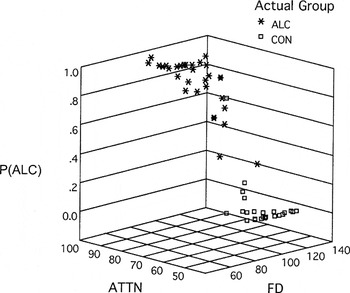
Logistic regression curve representing predicted group membership. Probability scores at or above .5 are classified as alcohol-exposed (ALC) and those below .5 are classified as non-exposed controls (CON). Predicted probabilities are based on the logistic regression model, which includes CBCL Attention scores (ATTN) and WISC–III Freedom from Distractibility (FD) scores (see text for details). Markers denote actual group membership.
 You have
Access
- 57
- Cited by