The 2008 congressional elections produced a House in which 84 members came from split-outcome districts. Forty-nine Democrats won in districts that Barack Obama lost, and 35 Republicans won in districts that Obama won. To protect their majority, the Democrats needed to retain these 49 members. Given the party's 257 seats, these split members constituted the difference between being in the majority and the minority. The 49 Democrats faced the dilemma of whether to vote with their party, given that their district voted for the presidential candidate of the other party. The focus here is on these split Democrats: their electoral situation, their votes, and their fate in 2010.
Taking their seats in 2009, these split Democrats first had to assess the general partisanship of their districts, their margins, and how much their margins diverged from the historical trends. Partisan voting has been increasing over time (Bartels Reference Bartels2000), and district-level votes for presidential and House candidates are increasingly correlated (Brewer and Stonecash Reference Brewer and Stonecash2009, 23). If partisan voting dominated in 2010 and the districts of split Democrats had a record of voting Republican, could a member in a split-outcome district vote with his or her party on controversial legislation and survive?
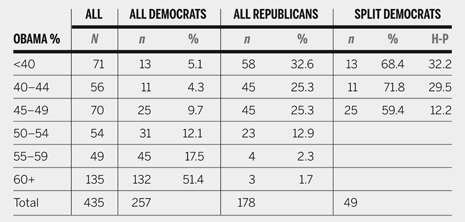
The 2008 election results indicated that the Democrats' success in winning seats was strongly associated with Obama's success in the individual members' districts (see table 1). Despite that general pattern, 13 Democrats were elected from districts where Obama received less than 40% of the vote, 11 came from districts where he received between 40% and 44% of the vote, and 25 came from districts where he received between 45% and 49% of the vote. Taken together, these 49 split Democrats constituted 19.1% of the party's members in the House. The party needed them, but these members were not from districts that were favorable to the party.
All Winners and Split Democrats in the House, 2008 Elections

Note. “H-P” is the measurement of the vote percentage received by a Democrat minus the Democratic presidential vote in the district.
These split Democrats ran well ahead of the Democratic presidential vote. Table 1 indicates how much the vote percentages of these split House Democrats exceeded the vote percentages of Obama in the district (H-P).Footnote 1 All split Democrats averaged a vote percentage that was 21.4 points above that won by Obama. The lower the vote Obama received, the greater the discrepancy. This discrepancy made these Democrats' survival in 2010 difficult.
The uncertainty that the 49 split Democrats faced was whether this difference represented a “personal vote” (Cain, Ferejohn, and Fiorina Reference Cain, Ferejohn and Fiorina1990), or whether the presidential vote reflected an underlying partisanship that might hurt them in 2010. Of this group, 37 were veteran members who were elected prior to 2008 and might have presumed that their level of support constituted a personal vote, allowing them some freedom to maneuver. These 37 members received an average of 68.1% of the vote in 2008 and ran 25.4 percentage points ahead of Obama. The 12 first-time members who were elected in 2008 were in a much more vulnerable situation, receiving an average 53.7% of the vote and running only 9.0 points ahead of Obama.
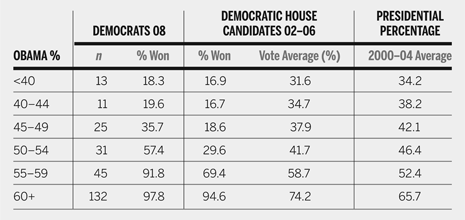
To assess their situation, the 49 split Democrats may have examined all election results from the last decade, as well as the results for their specific 49 districts. Table 2 presents information on all election results for presidentialFootnote 2 and House voting from 2000 to 2008, grouping districts by the percentage of the vote that Obama won in 2008. In general, the worse that Obama did in a district in 2008, the worse Democrats did in that district in the past. Similarly, the worse that Obama did in a district in 2008, the lower the levels of support for prior Democratic presidential candidates, the less of the average vote that Democratic House candidates received, and the lower the percentage of seats that they won. Of the districts that Obama lost in 2008, Democrats won 103 of 591 races between 2002 and 2006, or 17.4%. In 2008, they won 24.9% of the districts that Obama lost. The level of support in these districts for prior Democratic presidential candidates roughly matched the level of support that occurred in 2008. The overall historical track record could not have been comforting to the Democrats elected in these 49 split districts. For these 49 Democrats, the general pattern of past results indicated that their party's 2008 victories were atypical.
Democratic Success in 2008, Compared to 2000–06 Results

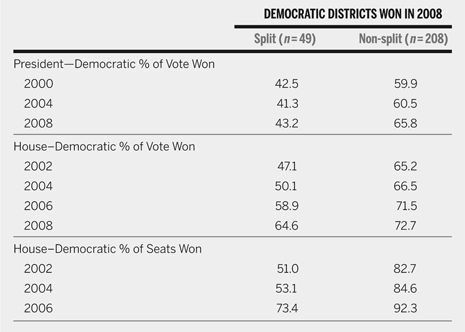
While the overall results over the prior decade might not have been comforting to split Democrats, the evidence about partisan trends in their 49 districts provided more mixed and perhaps more comforting results. As table 3 indicates, in 2000, 2004, and 2008, the percentages of the vote that Democratic presidential candidates received were consistently in the low 40s in all 49 split districts. Such low levels of support must have suggested a need for caution. On the other hand, the percentage of the vote that Democratic House candidates received in these districts steadily rose between 2002 and 2008, with Democrats winning an increasing number of the districts over time. Democrats won 59.2% of all 2002–06 contests in these 49 districts. The vote percentages for the split-district Democrats from 2002–06 ran well ahead of the Democratic presidential vote percentages in 2008 (see the “H-P” scores in table 1). As is often true for members of Congress trying to assess their situation, past results were ambiguous. It might be that these specific members could survive by selective identification with the Democratic Party, but the overall results suggested that a strong association with their party might prompt more partisan voting within their electorate and result in their defeat.
Democratic Trends by 2008 District Outcomes

Running for Reelection
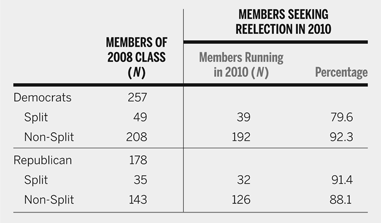
Every House member faces the decision of whether to seek reelection. Early signs indicated that 2010 would not be a good year for Democrats. President Obama's ratings were falling, and public opinion about the direction of the nation was very negative. Among the 35 Republicans representing split districts, 32 chose to run for reelection (see table 4). Among the 49 split Democrats, 39 did so. Of the 10 representatives who chose not to run again, seven had been elected before 2008 and three were first elected in 2008. Perhaps following the logic of strategic politicians monitoring the political climate (Jacobson and Kernell Reference Jacobson and Kernell1981), Democrats in split districts chose to pursue reelection at a lower rate than Democrats in non-split districts.
Running for Reelection by Whether Incumbent was in a Split District

Voting on the Stimulus Bill and Health Care Reform
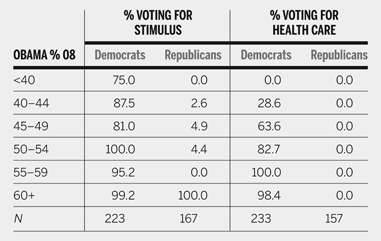
Democrats in split districts were presented with the issue of how to vote on numerous contentious issues during the 2009–10 session, but two became central as the year progressedFootnote 3: the stimulus bill and the health care reform bill. Each of these pieces of legislation became a major source of controversy and division between the parties. Table 5 indicates the breakdown of votes for each bill by party for only those members running for reelection in 2010. Results are presented by the level of support that Obama received in candidates' districts.
House Voting Percentages by Obama's 2008 Success on Stimulus and Health Reform Bills

Note. All results were taken from the New York Times website in the two to three weeks prior to the election. The Times reported who was running in each district and how those running in 2010 voted on each bill. Percentages for each vote are for those running in 2010.
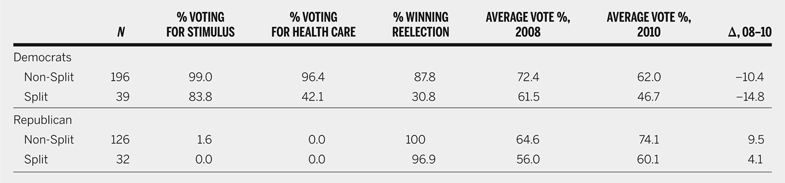
The voting records for these bills reflect the party polarization that has dominated Congress in recent years. A majority of Democrats voted for both bills, with 96% of House Democrats in non-split districts voting for both bills (see table 6). Republicans struggled in early 2009 to decide whether to work with an initially popular president or oppose him with the argument that he was dangerously expanding the size of government and intruding into the private sector too much. Ultimately, the party concluded that its poor showing during 2001–06 was attributable to the loss of its identity as fiscally conservative. During this period, the Republican Party had supported the Iraq War and its associated spending, an expensive prescription drug program, and higher deficits. The Republicans' decision in 2009 was thus to try to reestablish its image as the party of limited government and fiscal restraint (Brewer and Stonecash Reference Brewer and Stonecash2009, 184–99). To begin this process, Republicans voted almost unanimously against the stimulus bill and unanimously opposed the health care bill, which they called intrusive, too expensive, and the embodiment of socialism. The party strongly opposed the mandate that every American would be required to purchase health care.
Votes and Reelection Success, among Candidates for Reelection

The sharp divisions between the parties that were highlighted during 2009–10 set up clear contrasts for the 2010 election. Democrats hoped to present themselves as responsible, having stabilized the economy with the stimulus bill. They also hoped to get credit for addressing rising health care costs and the increasing number of people lacking health insurance. Republicans presented themselves as standing against government overspending and intrusion into private lives. The health care legislation was seen as the embodiment of such overreach, leading Republicans to vote against the bill and attack Democrats for voting for it (Sack Reference Sack2010).
Split Democrat Votes and the 2010 Election Results
In this partisan context, split Democrats had to decide how to vote for both pieces of highly contentious legislation. Among the 39 split Democrats who chose to run for reelection in 2010, 83.8% voted for the stimulus bill (see table 6). Democrats in split districts faced a more difficult choice on the health care bill. The Democratic Party needed these representatives' votes to push the legislation through the House, but the legislation had become very controversial and aroused strong public opposition.Footnote 4 Among the 39 Democrats in split districts who chose to run for reelection and voted on this legislation, only 42.1% voted for the bill.
The 2010 election produced a pronounced shift away from Democrats. The national average vote percentage for Democratic House candidates dropped from 56.2% to 46.4%. Democrats in split districts suffered significant declines, with their average voting percentage dropping from 61.5% to 46.7%. Only 30.8% won reelection. Among split-district Democrats who were first elected to Congress in 2008, a majority supported both the stimulus and the health care bill, and none won reelection in 2010.
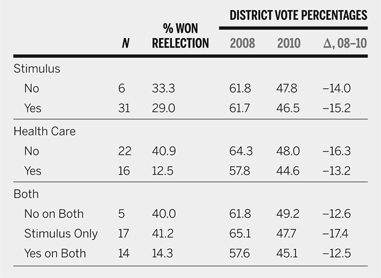
For all split-district Democrats, selective association with the party did not help much (see table 7). For the stimulus bill, split Democrats who voted for the legislation—with the party—won reelection at a slightly lower level than split Democrats who voted against the legislation. On the health care legislation, a vote for the bill cost these members dearly: only two of the 16 split Democrats who voted in favor of this measure survived the 2010 elections. Among the 14 split-district Democratic members who voted for both bills, only one won reelection. Split-district Democrats who voted solely for the stimulus bill had the highest rate of reelection, but over half still lost in 2010. The declines in vote percentages for these various groups suggest a fairly consistent decline in support for Democrats, regardless of how they voted.
Voting and Winning: Split-District Democratic Candidates in 2010

The 2008 elections produced a majority party with a substantial number of split-district members. The Democratic Party needed the votes of some of those members to pass both economic stimulus and health care reform legislation. Members from split districts who voted with the party on the health care bill suffered high rates of defeat in the subsequent 2010 elections. It is clear that drawing on the most vulnerable members of a party to support the majority can cost the party its majority. To be sure, the lack of significant improvement in the economy surely played a major role in the Democrats' defeat, but votes for the health care bill were used by Republicans against Democrats in 2010, and those votes were costly for split-district Democrats.
The Next Round of Split-Outcomes
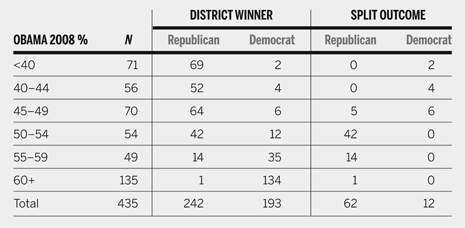
At this time, Republicans hold the majority in the House and face the same problems of relying on split-outcome members that the Democrats did in 2009–10. As table 8 indicates, 62 House Republicans represent districts that Obama won in 2008. The important matter will be how the party interprets past results. If it takes the 2008 presidential results as reflective of underlying partisanship, then getting those 62 members to go along with a largely conservative agenda will be difficult. Over the last decade, Republicans have had few members from split districts. In 2002 (using 2000 results), the party had 27. In 2004 and 2006 (using 2004), they had 16 and 8, respectively. In 2008, they had 35. Achieving unity within the party is easier when fewer members come from districts with divided results. The Republican Party now has a relatively high number of House members in such a situation.
Split Districts Following 2010

The 2012 electorate will be younger and less white, and compiling a strongly conservative record may result in split Republicans being swept out of office. If, on the other hand, the Republican leaders view their 2008 vote distribution as lower than normal because of short-term factors hurting the party, then they may pressure these 62 members to go along with the majority under the presumption that they will be able to survive the 2012 elections. Interpreting past voting patterns and interpreting future events, however, is a chancy endeavor. It will be interesting to see how Republicans seek to avoid in 2012 the same outcome that befell Democratic split-outcome members in 2010.