Implications
One of the important methods of monitoring health status is evaluation of blood. To interpret results correctly we need to consider species-specific differences, and influence of other factors: gender, age, nutrition, season and environment. South American camelids – especially alpacas – are growing in popularity all over Europe and yet there is lack of knowledge of above-mentioned factors on their blood parameters. This study evaluated influence of these factors on blood parameters of alpacas. The result should help veterinarians and alpaca breeders with correct interpretation of blood tests to diagnose clinical and subclinical metabolic health problem and possible nutritional disturbances.
Introduction
The growing number of alpacas (Vicugna pacos) all over Europe brings up the need for determination of species-specific reference intervals for biochemical parameters for the diagnosis of diseases or for preventative monitoring of herd health. There are studies on clinical chemistry of alpacas conducted in North America (Dawson et al., Reference Dawson, DeFrancisco, Mix and Stokol2011), South America (Burton et al., Reference Burton, Robinson, Roeder, Johnston, Latorre, Reyes and Schaajle2003) and Australia (Hajduk, Reference Hajduk1992), as well as in Europe (Gauly et al., Reference Gauly, Maier and Trah1998; Morgante et al., Reference Morgante, Manuali, Schiano and Ranucci2001; Foster et al., Reference Foster, Bidewell, Barnett and Sayers2009). However, most of the studies were performed on smaller number of animals or did not take into consideration the age and sex of animals, although the importance of age-adjusted reference values had been recommended for camelids, for example, by Smith et al. (Reference Smith, Van Saun, Reed, Craig and Youngberg1998) for minerals in llamas. Currently, to the author’s knowledge, the only work showing significant differences in alpaca blood parameters (in cria <6 months of age when compared with adults) was done by Hengrave Burri et al. (Reference Hengrave Burri, Tschudi, Martig, Liesegang and Meylan2005). There are other publications stating that some biochemical parameters are different in young and adult camelids (e.g. Van Saun, Reference Van Saun2008 or Fowler, Reference Fowler2010), yet again the publications are mostly relevant to llamas or camelids in general. In addition, the values described for camelids bred in North America cannot necessarily be applicable to animals bred in Europe. Therefore, in our study we considered possible effect of different conditions in Europe – such as higher amount of nutrients on blood parameters in alpacas. Furthermore, we took into consideration the seasonal effect (different feeding pattern in summer and in winter period) to examine possible influence on blood biochemical parameters (Smith and Van Saun, Reference Smith and Van Saun2001; Khan et al., Reference Khan, Hussain, Ashraf, Ashraf and McDowell2007).
We aimed this study to be useful for veterinary practitioners; therefore, we considered and statistically evaluated the influence of age, sex and season on nitrogen and lipid metabolites, enzymes, electrolytes, vitamins and minerals in blood of alpacas. The objective of the study was to establish reference interval for biochemical parameters in blood of alpacas bred in Central Europe on the basis of large population of clinically healthy animals with consideration of the above factors.
Material and methods
Animals
Blood samples were collected from 311 alpacas (61 males and 201 females >6 months of age and 49 crias ⩽6 months of age – 21 males and 28 females) during the years 2010 to 2012 as part of research work and also during preventative field work. Animals ranged from cria 2 days old up to female 17 years old. The farms were located in Central Europe (15 in Czech Republic and 2 in Germany). The owners were requested to complete the questionnaire asking about farm details (number of animals, feeding pattern in winter period/in summer period, the age, sex, medical history and origin of individual animals). All animals included in our study had either been born on farm or been in the herd for at least 3 months. All farms had similar management system, for example, animals were kept outside all the year round with free accessible shelter (wooden barn). The feeding pattern was also similar: green pasture and some hay in summer period, mainly hay and some supplements (grain, mineral and vitamin mixture) in winter period. In the study we included only clinically healthy animals (individual physical examination and basic assessment of body condition were performed on each animal before sampling) with known parasitic burden. At the time of blood collection we also took fecal samples to test them for gastrointestinal parasites. As all the farms included in our study were on regular deworming programs, the results of testing were mostly 0 to + (negligible) with only a few having ++ (moderate) parasitic burden.
Sample collection and analysis
Blood samples were collected all the year round; therefore, to determine correctly the seasonal variation we divided the samples into two groups by the feeding pattern. Group S (summer period) consists of alpacas where blood samples were collected in period 26 April to 5 October and Group W (winter period) includes animals where sampling was done from 25 October to 13 April. Blood samples were collected via jugular venipuncture using a 20 G needle into evacuated sample tubes containing no anticoagulant, under minimal restraint. Samples were allowed to clot at 20°C to 22°C (ambient air temperature) and after clotting was completed they were centrifuged at 3000×g for 10 min. The serum was separated and stored at 4oC until analyzed (48 h maximum). All laboratory analyses were performed at the Department of Laboratory Diagnostics for Large Animals (University of Veterinary and Pharmaceutical Sciences Brno).
We determined 24 biochemical parameters from blood serum.
The vitamins A and E were determined by fluorometry according to Thompson et al. (Reference Thompson, Erdody and Maxwell1973) and Bouda et al. (Reference Bouda, Jagos and Dvorak1980). Serum concentrations of sodium (Na), potassium (K), calcium (Ca) and magnesium (Mg) were determined by flame AAS method on the AAS Solaar M6 (Unicam, Witchford, Cambridgeshire, United Kingdom) device. The other parameters were determined by the automatic analyzer Liasys (AMS, Guidonia, Rome, Italy). The firms who provided the reagents for individual parameters are listed as follows: PLIVA Lachema (Brno, Czech Republic) – for urea (Urea UV KIN 4×50, Cat. No. 1307017), bilirubin (BIL 100, Cat. No. 1105309), triglycerides (TG L 4×100, Cat. No. 1312983), creatine kinase (CK NAC L 100, Cat. No. 10004494), γ-glutamyl transferase (GMT KIN 100, Cat. No. 1302082) – DIALAB (Praha, Czech Republic) – reagents for creatinine (Jaffe reaction, test Cat. No. D95595), phosphorus (Phosphomolybdat test, Cat. No. D00363), chloride (thiokyanate method, test Cat. No. D01223) – Randox Laboratories Ltd. (London, United Kingdom) – reagents for non-esterified fatty acids (NEFA, Cat. No. FA 115), β-hydroxybutyrate (BHB, RANBUT, Cat. No. RB 1007) – BioVendor (Brno, Czech Republic) – tests for cholesterol (LCholesterol, Cat. No. 10851), lactate dehydrogenase (LLDH, Cat. No. 12352), alkaline phosphatase (LALP, Cat. No. 10061), alanine aminotransferase (LALT Cat. No. 10452), aspartate aminotransferase (LAST, Cat. No. 10351), albumin (Lalbumin colorimetric, Cat. No. 10001) and total protein (LProtein total, Cat. No. 12751). The globulin value was calculated from the total protein and albumin (total protein minus albumin).
Statistical analysis
The basic statistical parameters of our set of results (means for each biochemical parameter and group of animals, pooled standard deviation) were calculated. Reference intervals were established from the lower 2.5th and upper 97.5th percentiles, after exclusions of obvious outliers detected visually or identified as values falling outside 3× the interquartile range. The data set was divided by the sex, age and feeding pattern in the groups: males and females >6 months of age in summer/winter feeding period and male and female crias ⩽6 months of age in summer.
The set of biochemical parameters was statistically tested in a factorial design within two different subsets. To find out if males >6 months of age significantly differ from females, and both sexes differ between summer and winter period, we applied the factorial ANOVA to obtain response to both factors (sex and season) and their interaction. Because no data from winter crias were available, we had to test the difference between summer data for adult and cria males and females by factorial ANOVA separately. Scripts for statistical tests were written in the R program (version 3.0.1; www.r-project.org).
Results
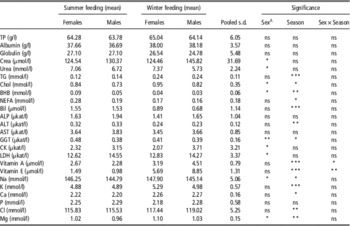
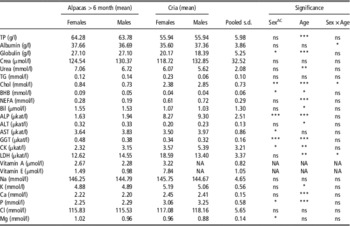
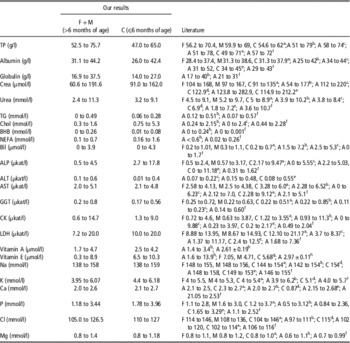
Mean, pooled standard deviation for all biochemical parameters within alpaca groups differing in sex, age and season and statistical significance of factorial ANOVA for two subsets (sex and season for older group of alpacas; sex and age in summer season for both groups) are presented in Tables 1 and 2. Number of observations per criteria and per sex/season/age are presented in Supplementary Table S1. Calculated reference ranges of serum biochemical parameters of alpacas are presented in Table 3.
Effect of sex and season on biochemical parameters in alpacas older than 6 months of age – mean, pooled s.d. and significance of two-way factorial ANOVA

TP=total protein; Crea=creatinine; TG=triglycerides; Chol=cholesterol; BHB=β-hydroxybutyrate; NEFA=non-esterified fatty acids; Bil=bilirubin; ALP=alkaline phosphatase; ALT=alanine aminotransferase; AST=aspartate aminotransferase; GGT=γ-glutamyl transferase; CK=creatine kinase; LDH=lactate dehydrogenase; ns=not significant.
‘SexA’ represents categories of males and females >6 months of age; ‘Season’ represents the year period of feeding (winter and summer feeding pattern); ‘Sex×Season’ is an interaction between ‘SexA’ and ‘Season’.
Number of observations for each parameter is presented in Supplementary Table S1.
*P<0.05, **P<0.01, ***P<0.001.
Effect of sex and age on biochemical parameters in all alpacas (younger and older than 6 months) – mean, pooled s.d. and significance of two-way factorial ANOVA within the subset of summer feeding data

NA=not available.
For abbreviations of biochemical parameters follow Table 1.
‘SexAC’ represents categories of all alpaca males and females; ‘Age’ represents alpacas (>6 months) and crias (⩽6 months); ‘Sex×Age’ is an interaction between ‘SexAC’ and ‘Age’.
Vitamins A and E were not considered in the factorial design, because they were measured only for cria females.
Number of observations for each parameter is presented in Supplementary Table S1.
*P<0.05, **P<0.01, ***P<0.001.
Calculated reference ranges of serum biochemical parameters of alpacas (our results and comparison with literature)

F=female; M=male; C=cria; A=adult alpaca.
For abbreviations of biochemical parameters follow Table 1.
aHengrave Burri et al. (Reference Hengrave Burri, Tschudi, Martig, Liesegang and Meylan2005); bFoster et al. (Reference Foster, Bidewell, Barnett and Sayers2009); cGauly et al. (Reference Gauly, Maier and Trah1998); dBurton et al. (Reference Burton, Robinson, Roeder, Johnston, Latorre, Reyes and Schaajle2003); eFowler (Reference Fowler2010); fDawson et al. (Reference Dawson, DeFrancisco, Mix and Stokol2011); gSmith et al. (Reference Smith, Van Saun, Reed, Craig and Youngberg1998); hDart et al. (Reference Dart, Kinde, Hodgson, Peauroi, Selby, Maas and Fowler1996).
The influence of sex
The differences between males and females >6 months of age were relatively weak or non-significant in most parameters (Table 1). We obtained more significant results in the second subset, where cria males and females were considered too (Table 2).
When we compare the obtained results between older males and females it shows that the only one parameter with highly significant (P<0.01) difference was GGT. The impact of sex on this parameter increases with inclusion of crias group into evaluated set of results. The same is true for ALP and cholesterol where sex-related difference increased after we included cria males and females into total set. When we calculated the range values separately for male and female group we found that for most of the parameters the values were within the ranges calculated for the whole group of older (or in the case of ALP for younger) alpacas. The only exceptions are GGT and BHB where upper range limits for males are much lower than in females (GGT 0.17 to 0.66 v. 0.20 to 0.87 μkat/l; BHB 0.02 to 0.09 v. 0.02 to 0.26 mmol/l).
The influence of age
When we compared the data of serum concentrations of individual parameters between the group of crias ⩽6 months of age and alpacas >6 months we found that from 24 parameters evaluated in our study there are 15 that significantly differ between the two groups (Table 2). The most marked differences were found in concentration of globulin but also in total protein values that are much lower in crias than in older group. We also observed lower values for urea, BHB and GGT activity in group of crias. In contrast, we observed in this group high concentration of cholesterol, NEFA, Ca, P and ALP, CK and LDH activity.
If, however, we compare the calculated ranges for observed parameters (Table 3), the range values are markedly different only for total protein, globulins, cholesterol, BHB, NEFA, P and ALP, and GGT activity.
The influence of season
Comparison of the observed parameters in alpacas >6 months of age sampled in summer feeding period (Group S) and winter feeding period (Group W) is presented in Table 1. There are many statistically significant differences between the summer and winter feeding groups (e.g. higher concentration of bilirubin, BHB, NEFA and also ALT activities in summer feeding group and higher concentrations of triglycerides, cholesterol, vitamins and some minerals in winter feeding group). In alpacas there are higher values, especially of parameters related to fat mobilization (BHB, NEFA) and liver metabolism (bilirubin, ALT, GGT) in summer period while in winter feeding period there were significantly higher values of triglycerides, cholesterol, vitamins and most minerals (Na, K, Mg, Ca and chlorides).
When we observe our calculated reference range for the most significantly different parameters (P<0.001), than there is lower range value in Group W for bilirubin and BHB (0 to 2.60 μmol/l, 0.02 to 0.06 mmol/l, respectively) when compared with Group S (0 to 4.2 μmol/l, 0.03 to 0.16 mmol/l, respectively) and lower range values for triglycerides (0 to 0.34 v. 0.06 to 0.49 mmol/l), vitamin E (0.23 to 3.88 v. 2.74 to 9.29 μmol/l) and potassium (3.93 to 6.00 v. 4.36 to 6.14 mmol/l) in Group S when compared with Group W. In addition, we found an interaction between sex and season for vitamins A and E. The levels of vitamins are generally low in summer and high in winter but while in summer there are higher concentrations in females than in males, the opposite is true for winter feeding period.
Discussion
Our study provides comprehensive reference intervals for biochemical analytes in blood serum of alpacas bred in conditions of Central Europe with consideration of age, sex and seasonal differences. The comparison of our results with other published relevant data is presented in Table 3. The data published by other authors, that we used for comparison, were specific for alpacas only with the exception of data from Dart et al. (1996) and Smith et al. (1998) who reported data of llamas and Fowler (2010) who presented data for South American camelids in general.
Our conclusion is that sex influence on most blood serum parameters is small and is in accordance with other works on alpacas or llamas. The study done on alpacas in Switzerland by Hengrave Burri et al. (Reference Hengrave Burri, Tschudi, Martig, Liesegang and Meylan2005) found no sex-affected parameter. Also, the study in the United States done by Smith et al. (Reference Smith, Van Saun, Reed, Craig and Youngberg1998) on llamas found none. Our results of significantly different cholesterol concentration and small difference in Mg concentration are in accordance with Dawson et al. (Reference Dawson, DeFrancisco, Mix and Stokol2011). For the other parameters in our study that were influenced by sex we found no similar results in the literature but we consider the level of significance low and from practical point of view not important.
Our results for protein, albumin and globulin concentrations were similar to previously reported values as well as our finding of significantly lower globulin and total protein values in crias than in older animals (Van Saun, Reference Van Saun2009; Fowler, Reference Fowler2010). Creatinine concentration is in accordance with Foster et al. (Reference Foster, Bidewell, Barnett and Sayers2009) while most authors report much higher lower limit range value. Similarly, our lower limit for urea is much lower when compared with most authors, with exception of Fowler (Reference Fowler2010). These parameters are influenced by the composition of the ration and condition of monitored animals to a great extent. However, the means for both parameters are in accordance with adult female alpacas (Burton et al., Reference Burton, Robinson, Roeder, Johnston, Latorre, Reyes and Schaajle2003) in the study done on 42 alpacas and their offsprings. The study shows large variance in urea and creatinine concentrations in blood of dams before and after delivery and similarly in blood of crias during first 35 days from birth. That may explain the differences in lower range limit for urea in crias in our study when compared with Hengrave Burri et al.’s (Reference Hengrave Burri, Tschudi, Martig, Liesegang and Meylan2005) findings (3.2 v. 5.0 mmol/l) as we sampled crias from 2 up to 180 days old. Therefore, the range interval recommended by us for this age group for urea still needs more fine tuning according to the age.
Our finding that lipid metabolites (cholesterol, BHB and NEFA) are significantly influenced by age is difficult to compare with literature as most studies presenting values for these parameters are done on adult animals or not specifying the age.
Our results that crias had significantly higher cholesterol and NEFA concentration than older group we may explain by the fact that most crias sampled had mother’s milk as main part of nutrition. Range values for bilirubin in our study are higher than the ones in Swiss study (Hengrave Burri et al., Reference Hengrave Burri, Tschudi, Martig, Liesegang and Meylan2005) and lower than values presented in studies from United Kingdom (Foster et al., Reference Foster, Bidewell, Barnett and Sayers2009) or Germany (Gauly et al., Reference Gauly, Maier and Trah1998). That could be explained by different laboratory methodology; however, the clinical importance of the finding is debatable.
Most of the enzymes monitored in our study were significantly influenced by age, with the exception of AST. The highest differences in mean and range values we found in ALP activities, which is in agreement with other European and American authors although their upper range limit is lower than ours. That again could be explained by the wide range of age of crias in our study. From our results we would indicate the need for even more time-specific reference ranges as there were much higher values of ALP activity in crias <1 month old than in crias 6 months old; however, more sampled animals would be needed to confirm this theory. Activity of GGT is in agreement with both European and American authors while CK and LDH activities differ in upper limits values (ours are higher than in most other works). We consider as interesting finding that GGT activity is lower in the group of crias than in older alpacas even when evaluating the crias <2 weeks old. Our expectation for few days old crias would be high activity of GGT due to effect of colostrum consumption similarly as in young calves (Podhorsky et al., Reference Podhorsky, Pechova, Dvorak and Pavlata2007). All crias included in our study were clinically healthy with no signs of inadequate colostrum intake; while most data published for GGT activity in few days old crias are describing animals tested and treated for failure of passive transfer of immunity. Ideally, more healthy neonatal alpacas should have been sampled to achieve more precise reference interval determination for activity of GGT.
The concentrations of Na, K and Mg evaluated in our study are in agreement with most other studies we refer to. Our results of Ca concentration are in agreement with most authors, with exception of Burton et al. (Reference Burton, Robinson, Roeder, Johnston, Latorre, Reyes and Schaajle2003), where mean values of Ca in alpacas presented are too low by our experience and would indicate possible health problem. Our finding that phosphorus concentration in alpaca crias is significantly higher than in older animals is in agreement with other publications (Smith et al., Reference Smith, Van Saun, Reed, Craig and Youngberg1998; Hengrave Burri et al., Reference Hengrave Burri, Tschudi, Martig, Liesegang and Meylan2005; Fowler, Reference Fowler2010), while our upper range values for adult alpacas are slightly higher than the other authors. These differences may have been due to preanalytical factors, such as difficult handling of some sampled animals and especially hemolysis. We excluded from our study all samples showing the hemolysis; however, there were still the outliers showing high P concentration although there was no obvious hemolysis of the serum. These outliers were consequently excluded from our set of results. When we re-checked our notes and history of these animals, most of them were individuals with higher level of stress during sample collection.
Our findings of seasonal influence on energy metabolites and liver enzymes activities (higher concentration of BHB, NEFA, ALT, GGT and bilirubin in summer period) may be explained by the fact that most of females from S Group were in last trimester of gravidity, giving birth or lactating, which affects energy metabolism as well as liver function. The late pregnancy and lactation in summer time create increased demand on metabolism of the liver due to mobilization of fat stores, resulting in an increase in circulating NEFA, BHB, and also ALT and GGT activities. When we evaluated the means for the above parameters for late pregnant/lactating females we found them significantly higher when compared with non-pregnant females. However, further study specifically aimed to monitor the above parameters in these two female groups would be needed to confirm our theory.
On the other hand, the higher values of some blood parameters in winter period (cholesterol, triglycerides, vitamins and minerals) could be explained by the increased amount of supplement that is used by most alpaca breeders in Czech Republic. This supplement is specifically made for llamas and alpacas and contains fat (2.89%), vitamins and minerals. The increase of blood cholesterol due to increased amount of fat in the ration was also described in other ruminants by Pechova et al. (Reference Pechova, Dvorak, Drastich, Lubojacka, Pavlata and Poul2006) The greater usage of mineral–vitamin supplement in winter period may also explain the higher concentration of vitamins, especially vitamin E in winter feeding period, while we expected the opposite due to green pasture in summer. Indeed, when we re-checked the feeding pattern on farms where some sampled animals were on lower limit range values of vitamin E, the farms were either not using any supplement in summer or supplementing only pregnant/lactating females. Therefore, it would appear that some animals might be vitamin E deficient in the time of green pasture, which is unexpected as green forage is very good source of vitamin E (McDowell et al., Reference McDowell, Williams, Hidiroglou, Njeru, Hill, Ochoa and Wilkinson1996). The availability of vitamin E can be adversely influenced by poor fat digestion or some other dietary or environmental factors (Herdt and Stowe, Reference Herdt and Stowe1991). Vitamin E concentrations observed in this study were similar as reported mean vitamin E concentration (2.97 μmol/l) in the study on adult llamas (Dart et al., Reference Dart, Kinde, Hodgson, Peauroi, Selby, Maas and Fowler1996) and much lower than mean vitamin E values for adult female and male llamas (7.05 and 4.71 μmol/l, respectively) reported by Smith et al. (Reference Smith, Van Saun, Reed, Craig and Youngberg1998). The latter study refers the lower limit 1.16 μmol/l that would be considered deficient in most species and explains these low levels by the diet consisting of hay exclusively. However, the alpacas in our study were on green pasture-based diet and the animals with lowest values of vitamin E were sampled in the period of May and June when green forage was plentiful. Our lowest range values are similar as the study on female llamas from different regions of United States (Herdt, Reference Herdt1995), where the mean serum vitamin E concentration differed among herds during gestation, ranging from 0.12 to 6.47 μmol/l. The amount of fat in the diet (concentrate fed in winter had higher amount of soy) is obviously increasing the fat-soluble vitamin concentration in serum of alpaca in winter period. However, to explain the fact that some animals were vitamin E deficient in the time of plentiful green forage more research is needed.
Conclusions
Our study provides reference intervals for biochemical parameters in clinically healthy young and adult alpacas in Central Europe. We found no clinically important difference between males and females (with the exception of BHB and GGT). The age factor would appear to be the most important variable evaluated as we found many significant differences between the group of crias ⩽6 months of age and the older alpacas. We suggest for most parameters to use different reference intervals (especially ALP, cholesterol, total protein, globulin, NEFA, GGT and phosphorus) for the two above-mentioned groups, while for certain parameters (ALP, GGT) even more age-specific intervals for the first few months of age would be appropriate. The interesting findings are the differences between some parameters in summer/winter feeding period. Especially females in the summer feeding period have higher values of parameters related to fat mobilization (BHB, NEFA) and liver metabolism (bilirubin, GGT, ALT). On the other hand, the winter period with increased feeding of supplements with higher amount of fat, vitamins and minerals is characteristic by increased concentration of cholesterol, vitamins A and E, and minerals (K, Na, Cl and Mg) in blood serum.
Acknowledgments
This research was made possible by research project MSM6215712403 of the Ministry of Education, Youth and Sports of the Czech Republic and by grant 43/2012/FVL of IGA of University of Veterinary and Pharmaceutical Sciences Brno.