When the notorious beast of the Gévaudan—a ferocious creature that killed scores of peasants in south-central France in the mid-1760s—was at last felled by Louis XV's gun-bearer François Antoine in September of 1765, the event inspired oddly dissonant reactions. According to the beast's own conqueror, the fierce animal whose exploits had inspired rabid theorizing since the summer of 1764 actually amounted to “nothing other than a wolf.”Footnote 1 The Gazette de France, which served as a semiofficial organ of the royal government, soon confirmed the finding. After the beast's delivery to the king's palace at Versailles, where Louis XV ceremoniously marked the end of the episode by displaying the great beast on 1 October, the French newspaper of record reported on the collective assessment of “the most experienced hunters.” The beast, they had determined, was “a true wolf that boasted nothing extraordinary, neither in its size nor in its composition.”Footnote 2
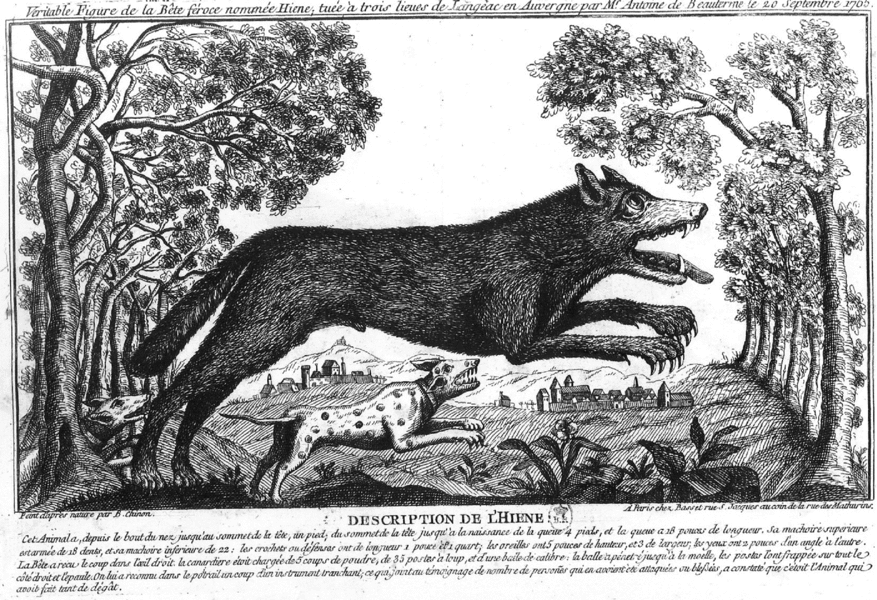
Public consensus over the beast's species was not so easily established, however. Readers across Europe had been transfixed by reports of the beast's behavior and appetites, and they had heard eyewitness accounts and secondhand reports that offered a vast range of possible identities for the creature: wolf, bear, hybrid, panther, lion, monkey, werewolf. The hyena had been a favored suspect from the beginning. For many months, anticipation of stunning news had held the attention of thousands of intrigued bystanders—including officials of state. One of these, the Auvergne intendant Simon-Charles de Ballainvilliers, followed up Antoine's triumph by writing excited letters in which he asserted that the beast killed by Antoine possessed features “proper only to a hyena.” When news of this report, written by the first royal administrator to lay eyes on the putative beast of the Gévaudan, made its way to the public in the last days of September, it acted as a spark on tinder. Spurred by Ballainvilliers's testimony, a range of journalists and artists represented the legendary beast as an exotic creature seemingly displaced from the caverns of Africa. The Mercure de France pointed to the dead animal's alleged ability to bend in half from head to tail, which, the author confidently asserted, “a wolf could not do.” In engravings peddled to the public in the autumn of 1765, artists depicted a strange creature showing little resemblance to Canis lupus lupus. One such print bore the title “True Figure of the Ferocious Beast called a Hyena, Killed Three Leagues from Langeac in Auvergne.” The artist reported the testimony of François Antoine himself in the accompanying text, but the caption nevertheless carried the prominent title: “Description of the Hyena” (see Fig. 1).
This “Description of the Hyena” was published soon after the killing at Les Chazes in September of 1765. The caption notes that “a number of persons attacked or wounded” by the beast of the Gévaudan had confirmed that Antoine's beast was the creature in question. The beast's allegedly outsize dimensions are suggested by the comparison to the hunting dog that gives chase. Bibliothèque nationale de France.

The idea of the beast-as-hyena would never be fully dispelled. The educational reformer Philipon de La Madeleine regretted in 1783 that the defeat of the Gévaudan “hyena” had become a protracted “affair of state.” (He was sure that the task could have been managed easily by properly educated peasants.) Doctor Samuel Tissot recalled in 1790 an encounter with a patient who, in the late 1760s, had been moved to epileptic spasms by the sight of an animal reminiscent of “the famous hyena of the Gévaudan.”Footnote 3 To this day, some students of the beast's story persist in claiming that the terrible killer of 1765 could be none other than a hyena.Footnote 4
In Monsters of the Gévaudan, my recent book about the long hunt for the beast, I drew attention to the many cultural forces that encouraged French men and women to imagine that the marauding animal in the Massif Central was a hideous, out-of-the-ordinary creature.Footnote 5 In the volatile political and intellectual environment of the 1760s, the allegedly “monstrous” character of the murderous and hard-to-track beast was overdetermined. In this essay I return to the frenzied theorizing that surrounded the events of 1764 and 1765 with a more specific question in mind: why were so many observers, in the 1760s and beyond, drawn to believe that the beast was a hyena? The forces that led contemporaries to eschew the most conventional explanation for the killings in the Gévaudan—wolves running amok—and to assign guilt instead to the hyena deserve closer attention. The historian of rural France Jean-Marc Moriceau has exhaustively documented the mundane reality of death-by-wolf-attack in the early modern era.Footnote 6 The rich context he has provided makes clear that the Gévaudan rampage conformed to a long-established pattern of rural mayhem inflicted by wolves. Yet many embraced an implausible hypothesis about an exotic and deadly invader wreaking havoc on French territory; they remained attached to that hypothesis even in the face of considerable contradictory evidence. Why?
In the course of the eighteenth century, learned elites came to express a growing contempt for superstitions that they increasingly associated with the vulgar and the low-born. Suspicion of “wonder,” especially fearful wonder that reflected excess religious enthusiasm or an insufficient understanding of the complexity of natural processes, became a marked characteristic of scientific practice over the course of the long eighteenth century.Footnote 7 Notwithstanding this new skepticism toward the marvelous, however, a taste for mystery survived among scientists and their readers. Specialists of the early Romantic era have even shown that a sense of excited amazement helped to fuel both the passion for scientific discovery and the poetic celebration of scientific pursuits in the late eighteenth and early nineteenth centuries. As Mary Shelley would emphatically show, science inspired its own forms of wondrous imagination.Footnote 8
The fixation on “the hyena of the Gévaudan” in the 1760s and after reveals a different dimension of the scientific thinking characteristic of the mature Enlightenment: the newly powerful attraction of the unknowable. The gradual elimination of natural mystery, and scientists’ increasing mastery over natural processes in the course of the eighteenth century, stimulated among both the learned and the semi-learned an urgent desire to keep mystery alive, to find corners of nature that resisted full illumination, to unfamiliarize the familiar. The era's restless curiosity and commitment to discovery ultimately created a powerful dialectical energy that preserved a privileged space for that which could not be known. At the intersection of expert knowledge and amateur speculation—where the Enlightenment existed as both process of empirical discovery and broadly inclusive cultural phenomenon—one finds much evidence of both rational, dispassionate analysis and a powerful will to engage impenetrable mystery.
Natural history was a preeminent site for the application of these paradoxical energies. As Bettina Dietz has noted, natural history stood out in the world of Enlightenment science as a distinctly “participatory, cooperative” and “integrative” discipline that relied on many contributors and a broad, “socially heterogeneous” network of communication.Footnote 9 The integrative and socially inclusive character of natural history opened the field to the incorporation of ideas that percolated through the realms of literature, art, philosophy, and wherever engaged and literate minds gravitated. In the second half of the eighteenth century, the emergence of the gothic literary style, the “discovery” of the ancient poems of Ossian, the staging of spectacular scientific demonstrations for popular audiences, the wide appeal of mesmerism, and the interest in exotic flora and fauna from faraway lands all reflected the allure of the unknown, and the quest for transcendent mystery, in Enlightenment culture.Footnote 10 The twin inclination to indulge curiosity about nature while also craving evidence for the limits of natural knowledge converged strikingly over the killing fields of the Gévaudan, where conventional explanations of rural predation proved less compelling than an animal that stood as an icon of mystery—the African hyena.
A desire for sublime mystery, in the face of new taxonomic certainties, led a wide range of observers of the Gévaudan phenomenon to import exotically thrilling and frightful ideas into the terrain of the ordinary. The myth of “the hyena of the Gevaudan” lived on long after 1765 not because of the suspect eyesight or careless rumor-mongering of one influential administrative official in Auvergne. The myth lived on because the exotic African quadruped addressed an intensifying need for uncertainty and pleasurable mystery in an environment suddenly awash with natural discovery. The new light cast in the age of lumières drove many imaginations toward the shadows.
* * *
The state of mind of the intendant Ballainvilliers, upon learning of the abrupt conclusion of the hunt for the beast of the Gévaudan, provides the best introduction to the symbiotic energy between certainty and mystery that characterized the entire story of the beast. As recounted in Monsters of the Gévaudan, on 22 September 1765 Ballainvilliers received word from François Antoine that the destructive beast had at last been killed on the grounds of the royal abbey of Les Chazes, just within the borders of his province of Auvergne. Multiple contemporary documents show that the beast's conqueror quickly identified his fallen enemy as a wolf. (Ballainvilliers even confirmed the arrival of “the enormous wolf you have killed” in a letter written to Antoine the day after the hunt.Footnote 11) A year's worth of wild rumor had nevertheless prepared Ballainvilliers to expect the unusual, and he immediately decided to carry out a thorough inspection of the celebrated creature that had been delivered to his door. Lacking training in natural history, the intendant gathered around him a team of respected local surgeons, led by the master surgeon Charles Jaladon; by 27 September the men in Clermont had taken the measure of Antoine's animal. Jaladon and his assistants then embalmed the animal to the best of their ability and turned it over to Antoine's son and assistant, Robert-François, who immediately set off for Versailles.
The representations of the beast produced during the frenzied six-day period between 22 and 27 September, which included an official autopsy report by Jaladon as well as detailed descriptions provided in a series of letters from Ballainvilliers to the king and his ministers at Versailles, contained generous doses of imagination and anatomical misstatement. The surgeon Jaladon had little or no experience as a huntsman, and he was ill-prepared to perform the work of a naturalist. For his part, Ballainvilliers's enthusiasm got the better of him during the denouement of a dizzyingly exciting event. Working in a relatively uncultivated province far removed from the brilliant glow of Paris and Versailles, both men may have been subject to the disorientation that sometimes accompanies a sudden brush with celebrity or the prospect of great success. But naïveté and the thrill of the moment cannot account for the specific conclusions drawn by the intendant and his helpers. More relevant to their thinking was the potent mixture of learning and fascinated theorizing that infused the literate culture of the day. Confronted with an intriguing mystery, Ballainvilliers, Jaladon, and the others had immediate recourse to both published works of natural history and a rumor-fueled mythology about hyenas, their abilities, and their character.
The team's instinctive reliance on the Histoire Naturelle of Georges-Louis Le Clerc, comte de Buffon, the most celebrated naturalist of the era, probably encouraged whatever inventive inclinations they might have brought to their work. Although Buffon and his partner Louis-Jean-Marie Daubenton had never examined a live hyena, Daubenton, a quadruped specialist, had dissected a deceased specimen. Buffon, supplying the famously evocative prose that always accompanied Daubenton's dry anatomical descriptions, knowingly exploited the allure of the exotic, which he used to draw readers into the pages of his Histoire Naturelle.Footnote 12 It is clear, in any case, that Ballainvilliers and his team read and applied Buffon's text through the grid of their own prior assumptions, which evidently included the expectation that the beast of the Gévaudan must be an exotic animal, and perhaps most likely a hyena. How else to explain the curious miscounting of the beast's teeth in the first hours after its arrival in Clermont? According to a letter composed by Ballainvilliers for the royal ministers, Jaladon's first inspection had confirmed that the beast had “thirty-four teeth . . . that is to say, eight more than a wolf.” The number thirty-four, Ballainvilliers hastened to add, was “proper only to a hyena, according to M[onsieur] Buffon.” (The intendant, who had hastily inserted faulty numbers on both sides of this dental equation, would later have to amend his letter to make clear that the beast's jaw, “examined with more attention,” actually contained forty teeth—though he offered no direct explanation for his earlier mistake or for Jaladon's evident lack of precision.)Footnote 13
Daubenton's observation, in the chapter on the hyena from Volume 9 of the Histoire Naturelle, that the disposition of the vertebrae of the hyena made them “resemble those of the leopard more than the wolf,” may have given the intendant added encouragement.Footnote 14 Ballainvilliers claimed that the beast had the “freedom to bend in half from head to tail, which a wolf could not do”—a differentiating detail that would later get picked up by the Mercure de France. (The perceived need to account for uncommon flexibility most likely reflected the intendant's familiarity with the many reports, accumulating since 1764, that the beast of the Gévaudan possessed amazing agility.Footnote 15) There were other physical features, according to Ballainvilliers's reporting, that justified placing the beast in the class of the hyena. Its eyes were “very large and sparkling” (Buffon had said of the hyena that its eyes “shine in the dark.”Footnote 16) Antoine's son had insisted that the beast emitted a foul odor at the time of its death, and “authors who have spoken about the hyena claim that the hyena possesses a similarly foul odor.” Also, the beast's tail was black and bristly, “resembling that of a hyena, as depicted in Jonston.”Footnote 17
Ballainvilliers's allusion to other “authors who have spoken” about the hyena helps to define the territory explored in this essay—the intertextual network that sustained interest in and speculation about the hyena and its place in the natural order. Pliny and Aristotle were ubiquitous guides to plant and animal life in the eighteenth century; Pliny qualified as the most-cited authority in the entire Encyclopédie.Footnote 18 Both had written intriguingly about the hyena, and their words still carried great weight. Ballainvilliers's specific mention of the hyena “as depicted in Jonston” recalled a seventeenth-century history of quadrupeds written by the Scots-Polish polymath John Johnstone, a Leiden-trained doctor who had published the first edition of his natural history in the 1650s.Footnote 19 Ballainvilliers seems unlikely to have encountered Johnstone's rendition of the hyena firsthand, however. He probably came across the image in another text that he surely would have had occasion to study closely—a Dissertation sur l’Hyène published in 1756 in Lyon.
A relatively slight text of obscure provenance, the Dissertation sur l’Hyène proved highly relevant to the search for the beast of the Gévaudan because it preserved memories of an earlier predator that offered mysteries strikingly similar to those that troubled the authorities in the Massif Central. A rash of killings had afflicted the rural Lyonnais in 1754–5, and more than a few individuals in Lyon's Academy of Sciences had speculated that the creature responsible for the rampage could be a hyena.Footnote 20 With the killer still at large in 1756, Charles-Pierre-Xavier Tolomas, the editor of the Dissertation—he claimed only to be publishing a manuscript “confided” to him by a member of the “literary society” of Lyon when he made a brief visit there in 1755—thought it useful and timely to share this “morsel of natural history” that conveyed “all that one can say about the Hyena.”Footnote 21 Tolomas assured his readers that the unidentified author of the original manuscript had combined his information in a manner “as learned as it is curious.”Footnote 22
The Dissertation presents a melange of fact and fiction ranging from the commonplace to the peculiar. The voices of the various authorities invoked as witnesses, like the voice of the “editor” Tolomas and that of the anonymous composer of the text, blend indistinguishably. The sincerity of the views expressed becomes difficult to gauge. But the multivocality of the Dissertation, and the phantasmagorical quality of the portraits it provides, are hardly incidental to its subject. The rhetorical slipperiness of the text reflected the elusive character of the animal under scrutiny. Tolomas's simultaneously “learned” and “curious” discourse expressed well the liminal function performed by the hyena in the century of the Enlightenment.
The author of the Dissertation demonstrated all the marks of learning, and all the appreciation for truth and certitude, appropriate to a naturalist. The treatise incorporated evidence from Aristotle and Pliny in their original Greek and Latin (as well as in modern translation.) The text referred to natural histories of English, Swiss, Italian, Dutch, French, and even Syrian origin, most of them written in the seventeenth and eighteenth centuries. The author of the Dissertation also showed a willingness to debunk myths. The eyes of the hyena did not actually have precious stones at their core, for example. This popular belief, the author carefully explained, probably reflected the similarities between the “brilliant variety that all naturalists attribute to the eye of the hyena” and the “diversity of colors” in the precious stone that Pliny had identified as a hyénie, which careless readers in the past had undoubtedly mistaken for the animal itself.Footnote 23 The Dissertation also followed Aristotle in rejecting the idea that hyenas were unisex creatures, and its author mocked the claim that hyenas “imitate perfectly the human voice” and had the ability to “call out the names” of prospective victims when stalking peasants in their fields.Footnote 24
Impatient skepticism is not the primary impulse driving the Dissertation, however. On the contrary, the editor Tolomas explained in his preface that publication of the text grew from the desire to confront and contemplate the unlikely and the seemingly implausible. Lyon still faced the presence of a dangerous enemy. “The beast exists. I have seen the sad effects of its fury.” Yet vexing questions about the monster's identity persisted. “Is it a Hyena? Is it a lynx or an ordinary wolf?” Mind-numbing fear and simple ignorance had so far prevented rustic eyewitnesses from making a positive identification. Until the hyena's culpability had been rendered an “absolute impossibility,” however, all interested parties should want a thorough review of the creature's habits, constitution, and abilities.Footnote 25 The need to suspend disbelief and to take inquisitive risks was only underscored by the urgency of the moment. The editor Tolomas saw signs of hope, for example, in evidence for the hyena's tameability. Music, according to the reports of many “serious authors,” had been used to lure and subdue these animals in the past. Any explanation of the “physical causes” of such a phenomenon would have to be left to “the Cartesians, the Newtonians, or, if one prefers, the Electrifiers.” Tolomas himself would rest content in having “exposed the plausible reasons for printing” a hypothesis that might eventually enable hunters to “attract, seize, and pierce with blows” the terrible scourge of the Lyonnais.Footnote 26
In the body of the text, the author of the Dissertation elaborated this call for open-minded inquisitiveness. The mere presence of a hyena in the vicinity of Lyon would count as “a most extraordinary oddity.” But those who are curious about nature must not limit their imaginations to the confines of the customary. For “if the Philosophe has any right to the title of Citizen of the universe, it is principally because there is nothing in the universe that true Philosophy does not wish to know.” Just as the geographer and mathematician Charles-Marie de La Condamine had ingeniously imagined a plausible explanation for the sudden appearance of the famed “wild girl” in the woods around Châlons—an account of the discovery and domestication of the “Eskimo” Marie-Angélique Leblanc had been published in 1755, and La Condamine was widely assumed to be the author—“the resources of the human mind” could surely conceive reasons explaining the hyena's unlikely passage into France.Footnote 27
The prospect that a voracious hyena roamed the Lyonnais thus had to be considered. “Nature has joined so many marvels in the subject I propose to treat, authors have written so varyingly about it, their stories have given birth to such a great number of questions worthy of thoughtful examination,” that the subject of the hyena “merits discussion in all respects.”Footnote 28 The lessons of prior naturalists of course provided a firm foundation for any investigation. The author of the Dissertation cited as his principal guide Buffon, who was noted for his methodical treatment of animals’ physical characteristics, histories, and relations to humankind. But genuine enlightenment also required testing the limits of knowledge and exploring the unconfirmed. This, in turn, required the courage to deviate from the most well-worn trails. “Great masters are made to clear the path to knowledge. But sometimes one must search along the byways, stopping in out of the way places, before continuing along the road opened up by these excellent guides.”Footnote 29 Both error and insights gleaned from unexpected places could help one intersect the path toward true wisdom.Footnote 30
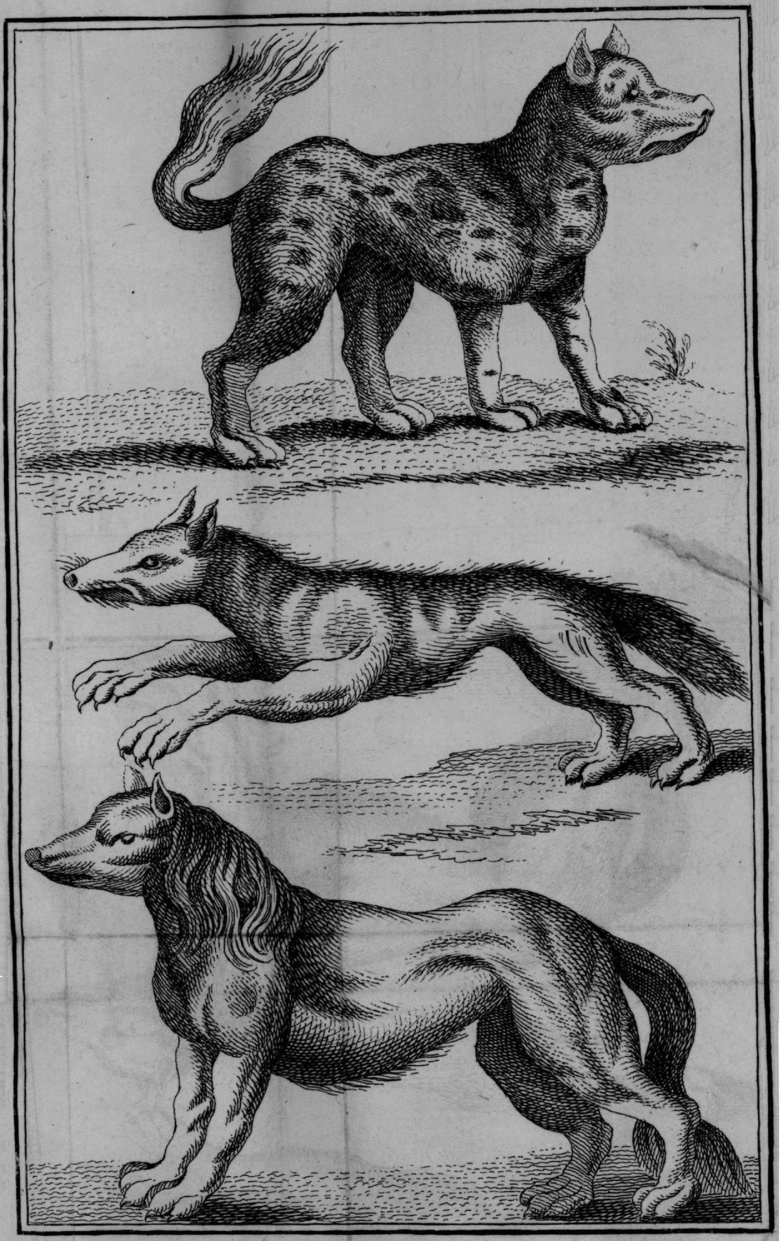
Perhaps this is why the author placed at the front of his Dissertation a set of illustrations of the hyena “as copied from Jonston” (see Fig. 2). In his seventeenth-century history of quadrupeds the “learned Englishman” Johnstone had provided not one but three images of the hyena—all of them distinctive in figure, all of them left unattributed to any specific authority. For his own discussion of the hyena's character Johnstone had simply quoted at length a text by the Roman physician and botanist Pietro Castelli, who had compared the features of the hyena to those of the civet. Because he directly inserted Castelli's prose into his own text “without approving it or contradicting it,” and because he neglected to specify the origins of the images he placed before his readers’ eyes, the solidity of Johnstone's own assessment of the hyena remained open to question. Indeed, “one might suspect the author of having traced his portraits on the basis of fantasy.” But the frontispiece “copied from Jonston,” with its variety and its imprecision, fittingly symbolized the intriguing mysteries surrounding the hyena. “In these sorts of subjects, it is useful to speak to the eyes,” the author noted, and the images from Johnstone could only excite the philosophical “wish to know.”Footnote 31
Images of the hyena, “as depicted in Jonston.” From Dissertation sur l’Hyène (Paris, 1756). University of Michigan Libraries.
There was much knowledge to absorb, at least some of it dubious. Pliny had specified that the body parts of the hyena had powerful medicinal qualities, for example. The ancient naturalist conceded that some of the recipes he shared were tainted by “superstition,” but this, the author of the Dissertation insisted, should not inspire a “general mistrust.” Untrustworthy “visionary magicians,” absurdly occupied with “impious extravagances,” had to be distinguished from “philosopher magicians” who devoted themselves to the “study and knowledge of nature.”Footnote 32 Pliny himself had seen the distinction between the two kinds of “magic,” and he signaled his suspicions of unproven ideas where appropriate; one could reasonably infer that he had “learned of the composition and efficaciousness” of all medicines and potions about which he expressed no explicit doubts. Besides, even the authors of the recent Dictionnaire de médecine continued to extend credit to those Plinian remedies that at least seemed susceptible to testing, “if one had a hyena available for the purpose.”Footnote 33 So although one might justifiably doubt whether the hyena's liver could really be used to counteract the bite of a rabid dog, the hyena's skin and bile—when mixed with other substances—apparently could produce many positive effects. Taken in the right form and measure, the substance of the hyena allegedly cured toothaches, gout, glaucoma, cataracts, colic, nervous anxiety, stomach sicknesses, apoplexy, and “nocturnal terrors.”Footnote 34 Oddly, these occult curative qualities of the hyena's dead body created an intriguing symmetry with the extraordinary, almost ghoulish, appearance of its living figure.
Many authors seemed to agree, for example, that “the hyena has no neck.” Yet those same authors, led by Aristotle, invariably attributed to the hyena a “mane that they say resembles that of a horse.” These two features hardly seemed compatible. After depriving the hyena of a neck, “where do you place a mane similar to that of a horse?” Earlier authorities had found the explanation for this curiosity in the structure of the spinal column. “Naturalists are almost all in agreement that the hyena's head is connected directly to the vertebrae, or the spine of the back, such that if it wants to look to the rear or to its sides it is forced to turn its entire body.”Footnote 35 The puzzling mane thus traversed the hyena's head and back, which formed a single unit. Another of the hyena's distinctive physical features seemed “no less remarkable: the hyena has for teeth only two continuous bones that run the length of each of the two jaws.” A precedent for this odd structural feature lived in the ocean, where, according to the English naturalist John Hill, a fish called the Monodon had only one tooth fixed to its upper jaw, running parallel to the length of the fish, “so that it has more the appearance of a horn than of a tooth.” For the author of the Dissertation, this unlikely parallel offered evidence that “nature likes to copy itself, even to the point of the bizarre.”Footnote 36
The prolific John Hill mixed anatomy, folklore, history, and ancient legends in his General Natural History (1748–52). Despite signs that his curiosity could not be fully disciplined (Horace Walpole would call him “an engrosser without merit”), Hill enjoyed sufficient standing in the 1750s to offer public criticism of London's Royal Society for the lack of scholarly rigor shown in its own experiments and publications; his caustic views even drew support from within the Royal Society itself.Footnote 37 In 1756, the considerable reputation of Hill's General Natural History led the author of the Dissertation to turn to Hill's text with “hope for something more exact and methodical than all that had been written before [on the hyena].”Footnote 38
Although the Dissertation's author was disappointed by the lack of illustrations in the General Natural History, Hill had certainly characterized the hyena in terms sure to pique a reader's curiosity. Hill's hyena, as translated in the pages of the Dissertation, resembled a dog that sported a mane. Its visage was “singular and extremely hideous.” Its “great mouth” had “good-sized teeth” (though perhaps these would have comprised the aforementioned two large masses in the upper and lower jaws). The hyena had a “flattened nose” and short, straight ears, while its eyes were “big [and] black, with a ferocious gaze.” Its tail was thick and covered with a silky, rigid fur, the mere sight of which “has something frightening about it.” The dense, rounded body was “similar to that of a pig” and its legs, though “very robust,” stood low to the ground. Found all throughout the East, hyenas were “meat-eating and ferocious”; their prey, once under paw, never escaped alive. Hill closed his physical description with a final intriguing observation. Because its cry was both “piercing and lugubrious,” some writers had classified the hyena “with the species of monkey.”Footnote 39
The author of the Dissertation admitted to having feelings of skepticism in the face of Hill's “hideous” description. He even added, immediately following his discussion of Hill, that the sixteenth-century naturalist Konrad Gesner, after contemplating all the evidence about the hyena, had reported that he could not make up his mind “whether to name [the hyena] a monster or a chimera.” But had Gesner and other doubters “seriously” proposed that the hyena “does not exist in nature”?Footnote 40 This seemed unlikely. Too many writers had spoken of the animal, and iconographical evidence from the third century indicated that hyenas had been seen in Rome. Ogier Ghiselin de Busbecq, the Flemish physician who had served as the Holy Roman emperor's envoy to Constantinople in the early sixteenth century, had reported seeing two of the animals in Turkey, though he wrote even at the time that they were “nothing less than rare” in Anatolia.Footnote 41
Hyena sightings in the vicinity of Lyon would qualify as even more rare than those in Anatolia, but the Dissertation's author still left alive the possibility of the event. Hyenas almost certainly existed, and historical evidence showed that their passage into Europe was hardly an unthinkable occurrence. A number of witnesses in the Lyonnais had described qualities suggestive of the hyena. To be sure, their testimony had to be treated with skepticism. The mention of “a few traits resembling [those of the hyena], more suspected than confirmed,” left much room for uncertainty. Everyone knew that in anxious situations “the marvelous too often gets added where there is nothing but the ordinary.”Footnote 42 Still, in light of the killer beast's elusiveness and ferocity, there was at least “reason to wonder whether an errant hyena in our provinces has perhaps coupled with a wolf, and produced from this coupling a monster.” It was widely thought that the hyena “prefers human flesh;” given the known dangers posed by wolves, a coupling of these two species would provide cause for great concern.Footnote 43 The possibility that a hyena or a wolf–hyena hybrid was responsible for the damage around Lyon led the author—as Tolomas had noted in his preface—to share ancient stories about the pacifying effects of music on the ordinarily fierce hyena. “An air, a common song, calms the ferocity of this animal,” specimens of which had even presented themselves for caressing by enemy huntsmen after being placed under the spell of musicians. Perhaps this offered hope, the author seems to have written only half in jest, that “the Orpheuses of our public squares will be skilled enough to succeed” in taming the rampaging beast of the Lyonnais.Footnote 44
* * *
When the killings in the Lyonnais came to a halt in early 1756, the Dissertation sur l’Hyène slipped quietly out of sight. The later episode in the Gévaudan nevertheless revived interest in the text, which was belatedly reviewed in July 1765 by the Journal des sciences et beaux arts (also known as the Journal de Trévoux.) The editors thought the treatise deserved to be “better known,” since it “brings together in a well-done compilation all the curious things ever written about this animal everyone is talking about today.”Footnote 45 The intendant of Auvergne probably first learned of the existence of the Dissertation sur l’Hyène in the pages of the Journal de Trévoux.
In their manuscript writings of 1765, Ballainvilliers and the surgeon Jaladon omitted any mention of music and song—the now-dead beast of the Gévaudan would have needed no such lure—but they renewed many of the themes of the Dissertation. As already noted, they had recourse to the images “depicted in Jonston” (whose name showed the same spelling used in the Dissertation). Most of the physical features on which they commented in their official reports, including the beast's eyes, tail, teeth, and back, had also inspired intriguing commentary in the text provided by Tolomas. Differences of emphasis, some of them surprising, nevertheless separate the commentary generated in the Lyonnais from those of the Gévaudan. The “ferocious” eyes of 1756 had become “sparkling” by 1765. Ballainvilliers specified that the tail of his “hyena” was black and bristly (a description that corresponded to the middle image of Johnstone's plate), thus ignoring that some authorities from the Dissertation had described the hyena as having the tail of a lion.Footnote 46 The intendant initially gave the beast thirty-four teeth, not two. Curiously, the anomalous lack of flexibility that, in the Dissertation, kept the hyena from bending to look behind had been turned into its opposite by 1765, when the Gévaudan hyena was credited with a singular ability to bend in half from head to tail. (Ballainvilliers neglected to specify the pivot point in his bending hyena, however, so perhaps the neck would not have been implicated.)
The particulars of the Dissertation are not scrupulously reproduced in the letters of Ballainvilliers, but divergences are to be expected. Ballainvilliers had an actual animal in front of him, after all, and his perception and assessment of the physical remains lying on his examination table necessarily passed through many filters: the excited and perhaps deliberately misleading testimony of Antoine's son, who had reasons to stress the extraordinary; long-accumulating hearsay about the strange characteristics of the beast of the Gévaudan; the practical knowledge of Jaladon and his team of surgeons; and the words of other noted authorities—including Buffon, whose 1761 commentary on the hyena had effectively superseded the account from 1756. What connects Ballainvilliers most strikingly to the author of the Dissertation, despite their differences in descriptive detail, is their common fixation on the hyena as a plausible perpetrator of human carnage, as well as their common search for evidence consistent with the fearsome identity that they imagined for it. The author of the Dissertation conceded that the presence of a hyena in southeastern France would constitute “a most extraordinary oddity.” Ballainvilliers knew in 1765 that François Antoine had identified his vanquished beast as a wolf. More generally, both individuals would also have been quite aware of the mundane reality of wolf attacks on human beings in the very recent French past.Footnote 47 Yet despite the low probabilities, both pursued the hyena hypothesis with dogged persistence, and both were drawn to those features of the animal widely purported to establish its exotic peculiarity: a “frightening” tail, the strange skeletal constitution, a “hideous” mouth, an arresting gaze that recalled ancient legends of the basilisk.Footnote 48
The allure of the hyena, first in 1756 and then in 1765, can be explained in part by the powerful attraction of the idea of the “monstrous” in eighteenth-century literate culture. The dissection of biological monsters had generated much activity and debate at the French Academy of Sciences, and in natural-history cabinets all across Europe, throughout the first half of the century. “The monster,” according to the 1759 edition of Richelet's Dictionnaire de la langue française, could be understood as an “animal born with parts uncalled for in nature,” a “prodigy contrary to the order of nature.”Footnote 49 Naturalists assumed that by their very “traits of difference”—their “relationship” to regularity, as Jean-Baptiste Robinet put it in 1768—monsters and freakish beings had the capacity to illuminate the mysteries of nature itself.Footnote 50 Taxonomists such as Linnaeus and Buffon gradually succeeded in incorporating monstrous anomalies into the regular order of nature, and in the last decades of the century the developing theory of epigenesis made monsters a tool for understanding embryonic development. By the first decade of the nineteenth century, when the German naturalist Johann Friedrich Meckel published his Contribution to Comparative Anatomy, the biological monster had been redefined as the product of a malformed embryo “inhibited in the first period of its development.”Footnote 51 Contemplation of the monstrous had helped to facilitate scientific mastery over natural processes.
But the “monstrous” had always encompassed more than the anomalous physical artifact seemingly resistant to natural explanation. The category of the monstrous incorporated moral, psychological, and aesthetic, as well as physical, markings. The Dictionnaire de l’Académie Française, for example, defined the monstrous as that which displayed “viciousness to excess.” The illustrative terms provided for the definition of “monster” included “horrible” and “frightening.”Footnote 52 Johann Heinrich Samuel Formey, who contributed the article “monster” to the Encyclopédie of Diderot and d’Alembert, specified that the term should be applied only to creatures that cause “astonishment” (étonnement).Footnote 53
As the natural processes behind reproduction and biological anomaly came to be better understood in the second half of the eighteenth century, and as the brute physicality of the monster presented fewer mysteries over time, the power of the moral and psychological registers of natural mystery persisted and even gained in strength.Footnote 54 Advancements in the understanding of nature added fuel to the pursuit of the enigmatic, as both learned and semi-learned students of nature sought to identify and sustain those corners of the natural world that resisted rational penetration. The progress of natural explanation enhanced, for example, the appeal of the “sublime”—an aesthetic category of experience that had gained new purchase in European culture with Nicolas Boileau's 1674 translation of Longinus’ On the Sublime. With Edmund Burke's influential exposition of the idea in his Philosophical Enquiry of 1757, the quest for the sublime became a preoccupation that both stimulated and reflected a growing interest in the shadow worlds of the Enlightenment.
As Burke understood it, “astonishment,” that essential mark of monstrosity in the rendering of Formey and the Encyclopédie, was “the effect of the sublime in the highest degree.” Confrontation with the ungraspable and the inexpressible, and encounters with images and ideas that stretched beyond the discernible limits of nature, inevitably induced feelings of the sublime, “the strongest emotion which the mind is capable of feeling.” The resultant astonishment could be understood as a “state of the soul” in which “all its motions are suspended, with some degree of horror.”Footnote 55 Burke's identification of the sublime with astonishment and the horrific underlined the centrality of fear in the generation of this distinctive passion. Danger, a sense of risk, and the dark spaces that nurtured them formed the crucible of extreme experiences. Terror, wrote Burke, could be considered “the ruling principle” of the sublime. Whatever could be construed as “in any sort terrible”—whatever excited “the ideas of pain and danger”—served as “a source of the sublime.”Footnote 56 Darkness, for example, is “terrible in its own nature” because it stimulates fearful imagination, conjures the unknown, and creates the perception of threat.Footnote 57 In Milton's gloomy description of death, “all is dark, uncertain, confused, terrible,” and, therefore, “sublime to the last degree.”Footnote 58 Similarly, whatever “is terrible with regard to sight . . . is sublime too,” whether “endowed with great dimensions or not.” “There are many animals,” for example, “who though far from being large, are yet capable of raising ideas of the sublime, because they are considered as objects of terror.”Footnote 59
Darkness, uncertainty, confused terror. Burke's conception of the sublime pointed to the liminal region between the realm of certitude and that of the endlessly opaque. “To make anything very terrible,” he continued, “obscurity seems in general to be necessary.” Clarity, by contrast, was “an enemy to all enthusiasms” and helped “but little toward affecting the passions.”Footnote 60 Denis Diderot, whose developing theory of aesthetics owed a great debt to the Anglo-Irish critic, concurred. In his Essais sur la peinture, which he began writing in 1765, he affirmed that the “accessory ideas” of “darkness and obscurity” were vital components of the sublime. The accessory ideas helped to activate the subjective experience of awe, the “agreeable sensation” that comes from the awareness of nature's infinite power and the motionless vulnerability that accompanies that awareness.Footnote 61 Burke called this form of pleasure “delight,” a kind of exhilaration that comes from the evaporation of the specter of life-threatening danger.Footnote 62 This appreciation for the exquisite pleasures created by obscurity and dark mystery—what one might call a generalized quest for the sublime—helped to drive the eighteenth century's engagement with the objects of natural history.
Strange animals that had the capacity to terrorize, like the inaccessible creatures from folk legends, popular fables, heraldic guides, and medieval bestiaries, belonged to a fabulous menagerie of the imagination.Footnote 63 They enticed precisely because they eluded the compass of mere reason; they inspired the “agreeable sensation” of awe. (The beast of the Gévaudan's “surprising agility,” reported the Année littéraire in March of 1765, had struck witnesses in the region “as being outside the rules of nature.”Footnote 64) The story of the beast of the Gévaudan, and suspicions of the hyena's culpability for the reign of terror implemented there, proved alluring to eighteenth-century readers of natural history because they offered a portal into a thrillingly unfamiliar realm. The hyena was certainly understood to be real, but its exotic and alien form remained tantalizingly obscure, an irresistible stimulant to the imagination. As a denizen of the darkness, the hyena fixed the attention of many learned and curious students of nature—even including those who were conspicuously eager to discredit extravagant falsehoods.
Consider the case of Buffon. In his 1761 essay on the hyena, Louis XV's naturalist lamented that the great Pliny “took pleasure in compiling and recounting fables.” A taste for epistemological rigor did not stop the curator of the king's natural-history collections from expressing his own lurid fascination for the hyena, however. “There are few animals about which more absurd stories have been told,” he noted. He proceeded to discount the usual rumors, including the hyena's alleged ability to imitate human voices, its annual sexual transformation from female to male, and its talent for charming rustics and rendering shepherds “lovesick.”Footnote 65
Still, Buffon deliberately placed the hyena in shadows, where it was represented as exercising frightening capacities and dark motives. Although he had never seen a living specimen, Buffon unhesitatingly gave to the animal eyes that “shine in the dark” and a cry that resembled “the sobbing of a man who struggles for air.”Footnote 66 The strangeness of these physical features was matched and even exceeded in Buffon's account by the animal's frightening disposition. The hyena was a “savage and solitary” animal that lived in caverns, crevices, and even “dens that it digs underground.” Although a relatively small animal, the hyena “cannot be tamed.” It lived on prey just like a wolf, but “it is stronger and bolder” than a wolf, and “sometimes attacks men.” At night it would “break down the doors of stables and sheep pens” and it was known to “dig up the earth with its paws and tear to shreds the cadavers of both animals and men.” The hyena had no fear of panthers, did battle with lions, and attacked leopards, “which can offer it no resistance.” Most active alone and at night, when its glowing eyes could be used to greatest advantage, and most at home underground or when shielded by rock and earth, Buffon's hyena would seem to have been crafted for a landscape of gothic horror.Footnote 67 In fact, the literary gothic genre that emerged in the 1760s grew from some of the same conditions—including a budding taste for terror—that produced Buffon's rendition of the hyena.Footnote 68
Fascination and notes of dread, mixed with skepticism over exaggerated tales, ran like a red thread through published writings about the hyena in the 1760s and 1770s, with details drawn from Buffon or Tolomas often providing the most salient highlights. Alexandre Savérien, author of the self-consciously enlightened History of the Progress of the Human Mind (1778), followed Buffon's lead in discounting the “marvelous stories” so often told about the hyena. Even so, Savérien apparently could not help but be drawn to the animal's allegedly sinister character. “Only the odor of death” brings it happiness, and “it finds pleasure only amidst tombs.” The animal's “extraordinary” character had undoubtedly served as the basis for the many wild rumors that surrounded it, and Savérien mocked all the “nonsense” that had been written. But he provided a characterization of the hyena that his readers would surely have found chilling: “A profound solitude and murder—that's what the hyena savors.”Footnote 69
Jean-Christophe Bomare's Reasoned Universal Dictionary of Natural History (1768) struck an aggressively skeptical chord in its essay on the hyena. Dismissing “absurd stories,” Bomare assured his readers that “we will present only the surest facts about this animal, in the manner of M. Buffon.” Yet Bomare also shared those “facts” produced more through Buffon's speculative imagination than through his clinical observations—the shining eyes, the strange cry, the breaking down of doors at night, the foul disposition. Bomare also cited Tolomas's Dissertation, and he notably did not rule out the possibility that a hyena had prowled the Lyonnais in 1755.Footnote 70 Antoine Duchesne, author of Manual of the Naturalist (1771), similarly announced that naturalists “favor the truth over the marvelous,” but he emphasized the hyena's “ferocious, predatory character, which can never be tamed,” and he ended his short essay on the hyena by noting its fondness for digging up cadavers.Footnote 71 Aimé-Henri Paulian, after sharing details of the hyena's alleged stealth and trickery, took a page from Tolomas's Dissertation and stressed the curative powers of the hyena's remains. “No, this is not a monster created solely to afflict us with its very real evils.” A “dreadful enemy,” the hyena could actually be turned to advantage when defeated; here Paulian repeated many of the recipes of Pliny.Footnote 72
Echoes of Tolomas also showed up in the April 1768 issue of the Gazette littéraire de l’Europe, which reported on the recent appearance of a live hyena at the famed Saint-Germain fair. The author of the piece was alert to the contemporary debates surrounding the hyena. The Gazette's readers were referred to the “very exact description of the animal [found] in the works of modern Naturalists,” including the recently published natural history of Bomare. The hyena's novel status as a recent visitor to France also received emphasis; the author observed, for example, that the animal “that recently committed so many ravages in the Gévaudan was nothing less than a hyena.”Footnote 73
Despite this awareness of the pressing zoological curiosity around the hyena, the account of the Saint-Germain display told an extraordinary tale that freely indulged popular legend. The animal's alleged owner, a captain from Malta, had reportedly encountered his hyena while walking with his men “on the banks of the Nile.” The young animal, separated from its parents, had approached the men upon hearing the sound of their voices, which, the men noticed, had had a surprisingly seductive effect on the creature. The hyena cub gave the impression of “wanting to play and be caressed,” which persuaded the men that they could easily lure the animal aboard their ship simply by continuing to talk to it. After following them on board, the hyena became familiar with the men, who quickly learned to manage it without fear. One of the animal's newly discovered characteristics hinted at the reasons for its secret attraction to talking men.
When this animal is granted a cut of meat, it lets out cries that sometimes come to resemble the sound of a human voice; this is apparently what has led some authors to say that the hyena can imitate the voice of a man so as to attract and devour shepherds.Footnote 74
The attractions of the hyena's exotic obscurity are also demonstrated in a text of 1767, a review of the French translation of Johann Gmelin's Voyage en Sibérie. A work devoted to “all the facts of natural history peculiar to this country,” Gmelin's Voyage was translated into French by the educator, army officer, and all-purpose savant Louis-Félix Keralio. It received an enthusiastic review in the pages of the Journal de Trévoux.Footnote 75 Gmelin had spent much time in the north and his four-volume work covered, among other things, Tartar religious rituals and Siberian songs. Among the few “curious particularities” that the journal's reviewer chose to highlight in the summary of the book's contents, however, was “a story that will give Naturalists cause for discussion.” Naturalists would be aroused to attention because the story involved an alleged hyena.
Near the island of Bobrovie, Gmelin's ferrymen had spotted an animal moving slowly through the woods. Some thought it a bear, but Gmelin's guide eventually identified the lethargic creature as a hyena. Using ropes and a net, the party of travelers actually managed to seize the animal, which was sick and unable to elude its pursuers. For reasons unexplained, Gmelin's account of the creature focused not on its physical characteristics or its observed behaviors but on the reputed manners and habits of the captured specimen. In search of prey, Gmelin learned, the hyena would “hide in trees between the branches,” waiting to throw itself on unsuspecting animals as they passed. But the animal had other tactics at its disposal, too. It cleverly frequented the traps of hunters, “and if it sees some animal trapped there, it takes it whole.” The sly predator seized foxes, rabbits, and birds as they slept, always circling the den or nest numerous times in preparation—so as to ensure that the selected victim would be caught unawares. Tough and resilient, the hyena ranged across every latitude from the south pole to the north pole, since “the cold fortifies its fibers” while the “warmth quickens its bodily fluids,” great quantities of which it could produce at will to ease consumption of its prey. “The northern people have named it ‘glutton,’ and with good reason, for it eats an almost incredible amount of food.” The fulsome, though slanted, review concluded with an extended footnote, covering a full page of the journal, that compared this amazing Siberian “glutton” with the enigmatic hyena of Buffon, whose Histoire Naturelle was quoted at length.Footnote 76
Buffon, far from having written the last word on the hyena in 1761, had merely provided new grounds for speculation. Gmelin and his assistants, as well as Gmelin's French readers, showed the imaginative creativity to which the image of the hyena could give rise, for they filled out the profile of their suspected hyena by subordinating firsthand knowledge to a seemingly inexhaustible stock of hearsay and lore. Here as elsewhere, the hyena's charge, like an electrical jolt, derived its force from the meeting of empirical ground with the powerful cultural current flowing from the domain of the awesome and the inexplicable. In the wake of Antoine's conquest of the monster of the Gévaudan, this same basic mixture of reported fact and imagined meaning would long continue to sustain doubts about the identity of that vanquished but perplexing beast.
* * *
Why, then, did the intendant Ballainvilliers assume, and report to others in the face of much contrary evidence, that the beast of the Gévaudan conquered in September 1765 exhibited features proper “only” to a hyena? The answer can be found in the motivations that lay behind the pursuit of natural mystery. The inscrutability of the entire phenomenon of the beast of the Gévaudan—the conflicting eyewitness testimony, the alleged physical characteristics of the culprit, the attack scenes suggesting crimes of cruelty and cunning, the frustratingly long duration of the rampage—sparked wide fascination. Like so many in this inquisitive age, including naturalists and their readers, Ballainvilliers found his gaze drawn toward the borderlands between the ordinary and the extraordinary, the known and the unexplained. On the blurry margins of natural knowledge Ballainvilliers believed that he saw a fantastically menacing hyena, an animal imagined to be so ferocious that it pursued its prey dead or alive, so sly that its abilities appeared supernatural, so strange that it verged on the chimerical. Ballainvilliers had become convinced in the course of 1765 that, in Paulian's words, only a “dreadful enemy” capable of “very real evils” could be credited with the horrors in the Gévaudan. When Antoine sent to Ballainvilliers a creature that the intendant himself acknowledged to be an “enormous wolf,” he still could not help but see the beast, as one later commentator would put it, as a “monstrous wolf known by the name of hyena.”Footnote 77
Ballainvilliers eventually overcame his fascination for the African quadruped and its bizarre qualities. When human casualties returned to the fields of the Gévaudan in December of 1765, the intendant joined the rest of the government in blaming wolves for the damage. His earlier confusion, however, did not simply reflect the gullibility of the “unenlightened.” Buffon, after all, in setting out the rationale for his decades-long project of natural investigation, had emphasized the need to banish from the imagination any thought of the “impossible.” Naturalists must “suppose that all that can be is. Ambiguous species, irregular productions, anomalous beings, will from now on cease to astonish us.”Footnote 78 Buffon undoubtedly offered this statement as a confident prediction of the steady advancement of natural knowledge, of the ultimate triumph of ordered certainty over ambiguity and irregularity. But the beckoning unknown to which he alluded nevertheless offered its own distinct attractions. The search for the limits of the possible inevitably filled minds with anticipation—a form of anticipation defined as much by a delight in the sublime as by a craving for certitude.Footnote 79
The instinct to assimilate the hyena to the shadows of the unknowable persisted well beyond 1765. For naturalists and amateurs alike, the hyena was limned with language of the extraordinary. In 1769, Jean-Baptiste Delisle de Moncel, renowned expert and practiced commentator in the art of wolf-hunting, wrote a lengthy hunting manual in which he shared a detailed history of the search for the beast of the Gévaudan.Footnote 80 He referred to the offending animal as “the hyena of the Gévaudan” (italics in the original) and he attributed to it characteristics derived from the store of the fantastic. The animal “had the ability to bend in half from head to tail,” for example. Its eyes sparkled so brightly “that it seemed impossible to withstand its gaze.” Its feet were “equipped with talons of a singular strength and configuration,” and it featured a “fat and bristly tail.” All these features, Delisle de Moncel assured his readers, “were attributed to it not by ‘the people’ but by naturalists.”Footnote 81 Given the difficulties faced by the hunter Antoine and his assistant, who had struggled mightily to subdue the beast when they finally encountered it, “one would have thought that it had the skin of a rhinoceros and the scales of a crocodile.” This hyena was truly “a monster more robust than twenty men combined.”Footnote 82
As late as 1782, in a sprawling general reference work designed as the successor to the Encyclopédie, the volume dedicated to “the natural history of animals” continued to describe the hyena in terms reminiscent of Buffon's essay from a generation earlier—“This savage, solitary, and cruel animal . . . sees better at night than in day.”Footnote 83 The Journal politique de Bruxelles, in a 1786 account of a hyena held captive on a ship of the British East Indies company, described the “hideous” creature, “the most terrible of all meat-eaters,” as having a “terrifying air,” characterized by “deformity and a cruelty beyond expression.”Footnote 84 In 1795, the preface to the volume of the Encyclopédie méthodique devoted to the art of the hunt included among the most “celebrated hunts” in human history “those carried out in France against hyenas” and other wild beasts. Its predictably detailed account of the “hyena that brought so much destruction to the Gévaudan” borrowed most of its details from Delisle de Moncel's 1769 rendition of the tale, including the “sparkling eyes,” the animal's ability to bend in half, and the need for the exertions of two men to defeat “a monster so terrible.”Footnote 85
Knowledge of the hyena grew more refined in France during the last years of the eighteenth century, as the newly founded Museum of Natural History increased its control over, and its clinical examination of, exotic animal specimens.Footnote 86 By 1805, when the museum possessed one stuffed specimen of a hyena as well as a living South African hyena (hyène du Cap) within its menagerie, Georges Cuvier had developed such expertise in the anatomy of the animal that he could distinguish its fossilized teeth and jawbones from those of the seal and the whale. On the basis of sketches sent to him by German colleagues, he was able to distinguish between several types of hyena among fossils uncovered at an archaeological dig near Stuttgart. He used bone samples housed at the Paris museum to show that a hyena whose fossilized remains had been found in the French department of the Doubs “surpassed by one-fifth [the size of] the ordinary hyena of the Near East.” Of travelers who claimed to have seen living hyenas five feet in length, Cuvier could dispassionately announce, “I suspect them of exaggeration. I have seen no hyena, living or stuffed, that exceeded three and a half feet.”Footnote 87 (Delisle de Moncel had claimed that the “hyena of the Gévaudan” reached “five feet, seven and a half inches” in length.Footnote 88)
Even as the exotic became increasingly subject to the mastery of the museum's experts, however, the legend of the hyena of the Gévaudan lived on, even within the bowels of the Museum of Natural History itself. In 1819, an anonymously authored guide for visitors to the museum's collections described the spotted hyena (hyène mouchetée) in terms reminiscent of both Buffon and the decade in which his essay on the hyena had appeared. “This ferocious and indomitable animal has been classified with the lynx,” the guidebook explained.
It lives in Egypt, it prowls around graves to uproot cadavers. In daylight, it attacks men, women, and children and devours them. It sports a mane on its back, striped like the royal tiger; [this is the same species] as that seen in the Natural History collections, which devoured a great number of persons in the Gévaudan.Footnote 89
The 1819 guidebook, with its casually erroneous assertion about the identity of the beast of the Gévaudan, may have expressed the remarkable staying power of a long-circulating rumor. But the text also captures a powerful dynamic of darkness and light. It points to the creative tension between mystery and scientific mastery in the intellectual world created by the Enlightenment. In 1802, when the directors of the museum thought to publish a catalog listing “the animals currently living” at its menagerie, their catalog had simply plagiarized Buffon's description of the dark and terrifying hyena, thereby encircling their own living specimen within a ring of fearful suspicion.Footnote 90 In the first decades of the nineteenth century, deep within the institutional setting of official scientific practice in the French capital, visitors were encouraged to seek a glimpse of sublime terror—just as readers in the Lyonnais, the Gévaudan, and Paris itself had earlier been treated to exotic hypotheses about errant hyenas instead of familiar reports about ravenous wolf populations. The museum directors’ decision, in 1819, to associate the institution's stuffed hyena with a mystifying legend from decades past suggests that the conquerors of nature harbored a residual taste—a natural craving—for the dark. Not unlike the garrulous hyena cub that traveled secretly to Paris from “the banks of the Nile” in 1768, an unspoken imperative seems to have passed into the emerging institutional apparatus of the life sciences at the end of the eighteenth century, nestled there like an undetected stowaway. Naturalists, in their exploration of the mysteries of nature, were called to remember that things frighteningly unknowable still lurked there.