Traditional models of the parent-child relationship conceptualize it as a hierarchical one in which parents are typically “in charge” and serve a key socializing influence on their children. In this context, the use of warm, supportive parenting results in a variety of positive developmental outcomes, whereas the use of harsh, aversive, or unpredictable parenting strategies leads to psychopathology and other negative developmental outcomes (Cicchetti & Lynch, Reference Cicchetti and Lynch1993; Dodge, Bates, & Pettit, Reference Dodge, Bates and Pettit1990; Gardner, Reference Gardner1989; Wilson, Rack, Shi, & Norris, Reference Wilson, Rack, Shi and Norris2008). However, contemporary models of parenting reflect that children also exert evocative effects on their caregivers in profound ways (e.g., Belsky, Reference Belsky1984; Crouter & Booth, Reference Crouter and Booth2003; Kerr & Bowen, Reference Kerr and Bowen1988; Masten & Cicchetti, Reference Masten and Cicchetti2010; Paschall & Mastergeorge, Reference Paschall and Mastergeorge2016; Patterson, Reference Patterson1982; Sameroff, Reference Sameroff1975; Serbin, Kingdon, Ruttle, & Stack, Reference Serbin, Kingdon, Ruttle and Stack2015; Shaw & Bell, Reference Shaw and Bell1993). Although many studies have examined evocative effects on parents’ behavior, few have explored children's evocative effects on maternal physiology in the context of prosocial and antisocial child behaviors. Caregivers’ poor emotion regulation and physiological reactivity have been implicated as critical risk factors underlying child maltreatment (CM; Bugental, Reference Bugental and Sameroff2009; McCanne & Hagstrom, Reference McCanne and Hagstrom1996). However, little is known about how mothers’ dynamic physiological sensitivity to their children's compliance behaviors may differ, based on maternal CM perpetration and observed parenting behavior. Thus, the goal of the current study was to examine maternal parasympathetic nervous system (PNS) responding to prosocial and aversive child compliance behaviors, in a sample of physically abusive, neglectful, emotionally maltreating, and non-maltreating mothers.
Parent-child behavioral transactions
To better understand children's evocative effects on their parents, a variety of studies has been conducted using longitudinal, experimental, and genetically informed designs (Burt, McGue, Krueger, & Iacono, Reference Burt, McGue, Krueger and Iacono2005; Gershoff, Reference Gershoff2002; Petit & Ariswalla, 2008; Serbin, Kingdon, Ruttle, & Stack, Reference Serbin, Kingdon, Ruttle and Stack2015). These studies reveal that aversive child behaviors are detrimental to parents’ perceptions of and interactions with their children (e.g., Gross, Shaw, & Moilanen, Reference Gross, Shaw and Moilanen2008; Larrson, Viding, Rijsdijk, & Plomin, Reference Larrson, Viding, Rijsdijk and Plomin2008; Pardini et al., Reference Pardini, Fite and Burke2008; Paschall & Mastergeorge, Reference Paschall and Mastergeorge2016; Stifter, Spinrad, & Braungart-Rieker, Reference Stifter, Spinrad and Braungart-Rieker1999). Disruptive child behavior draws for harsh parenting behaviors (Burke, Pardini, & Loeber, Reference Burke, Pardini and Loeber2008; Hawes, Dadds, Frost, & Hasking, Reference Hawes, Dadds, Frost and Hasking2011) and drives increases in parents’ negative attributions of their children over time (Larrson et al., Reference Larrson, Viding, Rijsdijk and Plomin2008). Longitudinal research with toddler boys, for example, has shown that children's disruptive behavior leads to declines in parental support and structuring, and increasing use of controlling parenting tactics and physical punishment across the early childhood years (Verhoeven, Junger, Van Aken, Deković, & Van Aken, Reference Verhoeven, Junger, van Aken, Deković and van Aken2010). In that study, structural equation modeling further demonstrated that, whereas boys’ aversive behavior influenced parenting behavior over time, parenting did not drive changes in child behavior (Verhoeven et al., Reference Verhoeven, Junger, van Aken, Deković and van Aken2010). However, less is known about how parents respond to specific, prosocial, and aversive child behaviors during unfolding interactions and whether these dynamics may differ across CM versus lower risk parent-child dyads.
Parent physiological sensitivity, risk, and child behavior
A growing body of literature has documented how parents’ physiological responding relates to the quality of parent-child relationships. Broadly speaking, biological reactivity to one's context is now widely implicated in processes linking experience to psychiatric disorders (e.g., Boyce & Ellis, Reference Boyce and Ellis2005; Obradovic, Bush, Stamperdahl, Adler, & Boyce, Reference Obradovic, Bush, Stamperdahl, Adler and Boyce2010). Theory and empirical evidence support the notion that CM parents may have heightened physiological sensitivity to their children. Per Bugental's (Reference Bugental and Sameroff2009) and Sameroff's (Reference Sameroff1975) biocognitive transactional models of child maltreatment, CM parents are more likely to perceive their child's behavior as threatening and, as a result, show a heightened physiological response to child-based stimuli. Review of empirical studies in this area (e.g., McCanne & Hagstrom, Reference McCanne and Hagstrom1996) provides evidence of heightened physiological sensitivity to child behavior and reduced emotion regulation capacity in parents who have abused or are at risk to abuse their children. Recent studies have further linked evidence of physiological sensitivity to child stimuli with risk for harsh, controlling parenting behavior over time (Joosen, Mesman, Bakermans-Kranenburg, & van Ijzendoorn, Reference Joosen, Mesman, Bakermans-Kranenburg and van IJzendoorn2013b).
Given its role in regulating emotion during social engagement, we focused on maternal respiratory sinus arrhythmia (RSA) as a peripheral physiological measure of measure of mothers’ emotion regulation. RSA, an index of PNS-mediated cardiac control, is used frequently to assess physiological reactivity/regulation (Beauchaine, Reference Beauchaine2001; Porges, Reference Porges2001). High resting RSA reflects greater PNS regulation of heart rate and is associated with better emotion regulation, executive function (Beauchaine & Thayer, Reference Beauchaine and Thayer2015), and adaptive social functioning (e.g., Geisler, Kubiak, Siewert, & Weber, Reference Geisler, Kubiak, Siewert and Weber2013). In the context of parenting, higher maternal resting RSA has been linked to greater sensitivity during parenting (e.g., Musser, Ablow, & Measelle, Reference Musser, Ablow and Measelle2012). CM caregivers and parents at high risk for child maltreatment show greater emotion dysregulation, indexed by lower resting levels of RSA (Creaven, Skowron, Hughes, Howard, & Loken, Reference Creaven, Skowron, Hughes, Howard and Loken2014; Crouch et al., Reference Crouch, Hiraoka, McCanne, Reo, Wagner, Krauss and Skowronski2018).
In terms of RSA responding during social interactions, mothers who engage in more warm and less harsh parenting behavior display higher average RSA scores during interactions with their children (Lorber & O'Leary, Reference Lorber and O'Leary2005; Smith, Woodhouse, Clarke, & Skowron, Reference Smith, Woodhouse, Clark and Skowron2016; Weisman, Zagoory-Sharon, & Feldman, Reference Weisman, Zagoory-Sharon and Feldman2012). Researchers are also beginning to model parent dynamic RSA responding over time in the context of parent-child interactions. For example, Hill-Soderlund and colleagues (Reference Hill-Soderlund, Mills-Koonce, Propper, Calkins, Granger, Moore and Cox2008) found that parents who displayed RSA increases from a resting baseline to the reunion phase of the Strange Situation task were more likely to have securely attached infants. Others have studied parents while they interact in stress-inducing or challenging tasks with their infant (i.e., the still-face paradigm), and have found that maternal RSA decreases are associated with more sensitive parenting behavior under these conditions (Leerkes, Su, Calkins, O'Brien, & Supple, Reference Leerkes, Su, Calkins, Supple, O'Brien and Fiese2016; Mills-Koonce et al., Reference Mills-Koonce, Propper, Gariépy, Barnett, Moore, Calkins and Cox2009; Moore et al., Reference Moore, Hill-Soderlund, Propper, Calkins, Mills-Koonce and Cox2009).
Parasympathetic responding has been shown to differ among high-risk and maltreating parents. Parents at high risk for child abuse have displayed less flexible RSA responding during an individual, cognitive challenge (Crouch et al., Reference Crouch, Hiraoka, McCanne, Reo, Wagner, Krauss and Skowronski2018) and parents with a CM history have shown lower heart rate variability while watching videos of parent-child conflicts (Disbrow, Doerr, & Caulfield, Reference Disbrow, Doerr and Caulfield1977). At least one other study reported no differences in RSA responding between CM and non-CM parents when exposed to recordings of infant cries (e.g., Reijman et al., Reference Reijman, Alink, Block, Werner, Maras, Rijnberk and Bakermans-Kranenburg2014). The authors reasoned that the lack of significant differences may have been due to their use of a high-risk, non–CM-exposed comparison group of children (i.e., all children diagnosed with a mental health disorder; Reijman et al., Reference Reijman, Alink, Block, Werner, Maras, Rijnberk and Bakermans-Kranenburg2014).
Distinct patterns of PNS responding in concordance with parenting behavior have also been observed among mothers with a history of perpetrating CM. For example, one study documented divergent patterns of RSA and behavioral responding among physically abusive, neglecting, and non-maltreating mothers while they completed a joint challenge task with their preschooler (Skowron, Cipriano-Essel, Benjamin, Pincus, & Van Ryzin, Reference Skowron, Cipriano-Essel, Benjamin, Pincus and Van Ryzin2013). In this study, physically abusive mothers showed time-ordered links between their parenting behavior and their own RSA, such that within-person increases in positive parenting were associated with concurrent declines in RSA, but led to increases in harsh controlling parenting a short time later. In contrast, for non-CM mothers, RSA decreases were followed by increases in positive parenting. For neglecting mothers, their parenting behavior seemed to drive their physiology: increases in positive parenting led to subsequent increases in RSA and decreases in harsh control led to decreasing RSA shortly thereafter. These findings may suggest that positive parenting was experienced as physically taxing for the highest risk mothers, namely those with a history of physical abuse (Skowron et al., Reference Skowron, Cipriano-Essel, Benjamin, Pincus and Van Ryzin2013). Taken together, this body of literature suggests that critical differences in CM parents’ autonomic sensitivity to child stimuli may underlie their harsh parenting behavior. More research is needed using fine-grained, behavioral observation measurement tools and time-ordered analytic techniques to disentangle how a mother's physiological sensitivity to her child may unfold in the context of specific, behavioral interchanges between mother and child.
Parental physiological sensitivity to child compliance
Whereas much research to date has focused on the evocative effects of child externalizing behavior, to our knowledge few studies have examined the effect of children's compliance behaviors on their parents. Thus, the focus of this study was to examine the evocative effects of child compliance behaviors on maternal autonomic physiology (i.e., RSA). Additionally, we were interested in determining whether contextual risk factors (i.e., CM status and observed parenting) would moderate associations between child compliance behaviors and maternal RSA. Just as defiant, noncompliant children learn functional behaviors that pay off in their environment (i.e., noncompliance leads parents to backing down or withdrawing; Kalb & Loerber, Reference Kalb and Loerber2003; Reid & Patterson, Reference Reid and Patterson1989), we wondered whether compliant children also learn to behave in ways that shape and influence their parents and the quality of their relationship outcomes.
Children's compliance with parental directives is broadly considered prosocial and desirable (Chamberlain & Patterson, Reference Chamberlain, Patterson, Bornstein and Bornstein1995; Kochanska & Aksan, Reference Kochanska and Aksan1995; Stifter et al., Reference Stifter, Spinrad and Braungart-Rieker1999). Compliance during the toddler years is viewed as an early indicator of a child's ability to internalize rules and independently self-regulate (Kochanska, Reference Kochanska1991; Kopp, Reference Kopp1982; Lytton, Reference Lytton1980) and is associated with lower rates of later externalizing behavior problems throughout childhood and adolescence (Keenan, Shaw, Delliquadri, Giovannelli, & Walsh, Reference Keenan, Shaw, Delliquadri, Giovannelli and Walsh1998; Kimonis, Frick, & McMahon, Reference Kimonis, Frick, McMahon, Mash and Barkley2014; Kochanska & Aksan, Reference Kochanska and Aksan1995). Furthermore, according to family systems theory (Bowen, Reference Bowen1978; Kerr & Bowen, Reference Kerr and Bowen1988; Skowron, Reference Skowron, Noone and Papero2015), child compliance may serve a function of calming down an anxious or aroused parent, particularly if the parent is more emotionally reactive or less differentiated.
Scant evidence exists to suggest that child compliance dynamics may differ among parent-child dyads with a history of CM, wherein caregivers may show higher emotional reactivity. For example, Crittenden and DiLalla (Reference Crittenden and DiLalla1988) videotaped interactions between maltreated children and their mothers and found that by age 1 year, toddlers exposed to physical abuse learn to inhibit behavior that upset their mothers and display higher rates of compliance with maternal demands than children who had not been maltreated or who were exposed to neglect only. Further, the quality of compliance displayed by abused children was deemed “compulsive,” characterized by affective flatness, withdrawal, and devoid of complaints or assertions of independence that would be considered developmentally typical in the early years (Crittenden & DiLalla, Reference Crittenden and DiLalla1988). The authors argued that elevated compliance may be adaptive for abused children in the short run to reduce the probability of more abuse, but may have maladaptive implications in the long term. Thus, in line with Bugental and Sameroff's biocognitive transactional models, we wondered whether CM parents, who tend to hold more ‘threat-sensitive’ attributions of their children's behavior (Bugental, Reference Bugental and Sameroff2009), would show greater physiological sensitivity to their child's compliance behaviors than non-maltreating mothers.
We also examined the moderating effect of another proximal risk factor: inconsistent parenting. CM parents not only engage in harsh, aversive control, and less support for age-appropriate child autonomy (Lyons-Ruth, Connell, Zoll, & Stahl, Reference Lyons-Ruth, Connell, Zoll and Stahl1987; Reid & Patterson, Reference Reid and Patterson1989), but also behave less predictably with their children than do non-CM parents (Skowron et al., Reference Skowron, Cipriano-Essel, Benjamin, Pincus and Van Ryzin2013; Skowron, Kozlowski, & Pincus, Reference Skowron, Kozlowski and Pincus2010; Trickett & Kuczynski, Reference Trickett and Kuczynski1986; Trickett & Susman, Reference Trickett and Susman1988). Parental inconsistency plays a critical role in maintaining coercive cycles of parent-child interaction (e.g., Wahler & Dumas, Reference Wahler and Dumas1986). Benjamin and other interpersonal researchers have investigated a powerful form of parental inconsistency originally conceptualized in early studies of schizophrenia, in which two incompatible messages about autonomy and submission are communicated in quick succession, making it difficult to respond to either message (Bateson, Jackson, Haley, & Weakland, Reference Bateson, Jackson, Haley and Weakland1963; Humphrey & Benjamin, Reference Humphrey and Benjamin1986). In the current study, we used the Structural Analysis of Social Behavior (SASB; Benjamin, Reference Benjamin1996; Benjamin & Cushing, Reference Benjamin and Cushing2000) a microsocial coding system, to observationally code a form of inconsistent parenting characterized by display of diametrically opposed behaviors of granting autonomy and then asserting control, in quick succession over the course of a parent's moment-by-moment interactions with their child. Thus, we operationalized parental inconsistency in terms of these vacillations between a mother's controlling (i.e., “Do as I say”) and autonomy-granting (“You can do it your own way”) behavior. We tested whether observations of parent inconsistency would moderate the effects of children's compliance behavior on maternal parasympathetic physiology.
The current study
Our objective was to investigate child evocative effects on caregiver parasympathetic physiology by investigating time-ordered associations between children's compliance behavior and maternal RSA. We considered two types of child compliance: warm, prosocial compliance versus aversive, hostile compliance. Prosocial child compliance was characterized by trusting and relying behaviors, whereas aversive child compliance was marked by whining, protesting, and sulking as a child submits. Research to date has not examined the differential evocative effects of prosocial versus aversive child compliance behaviors on maternal physiology, thus making this a key contribution of the current study. Next, we sought to identify risk factors that may moderate associations between child compliance and maternal RSA in an effort to better characterize mother-child dyads in which parents were more or less physiologically sensitive to their child's compliance behavior. Key moderators of theoretical interest were CM perpetration by mother (i.e., physical abuse, physical neglect, emotional abuse, or non-maltreating) as a time-invariant risk factor and maternal inconsistent parenting as a time-varying, proximal risk factor.
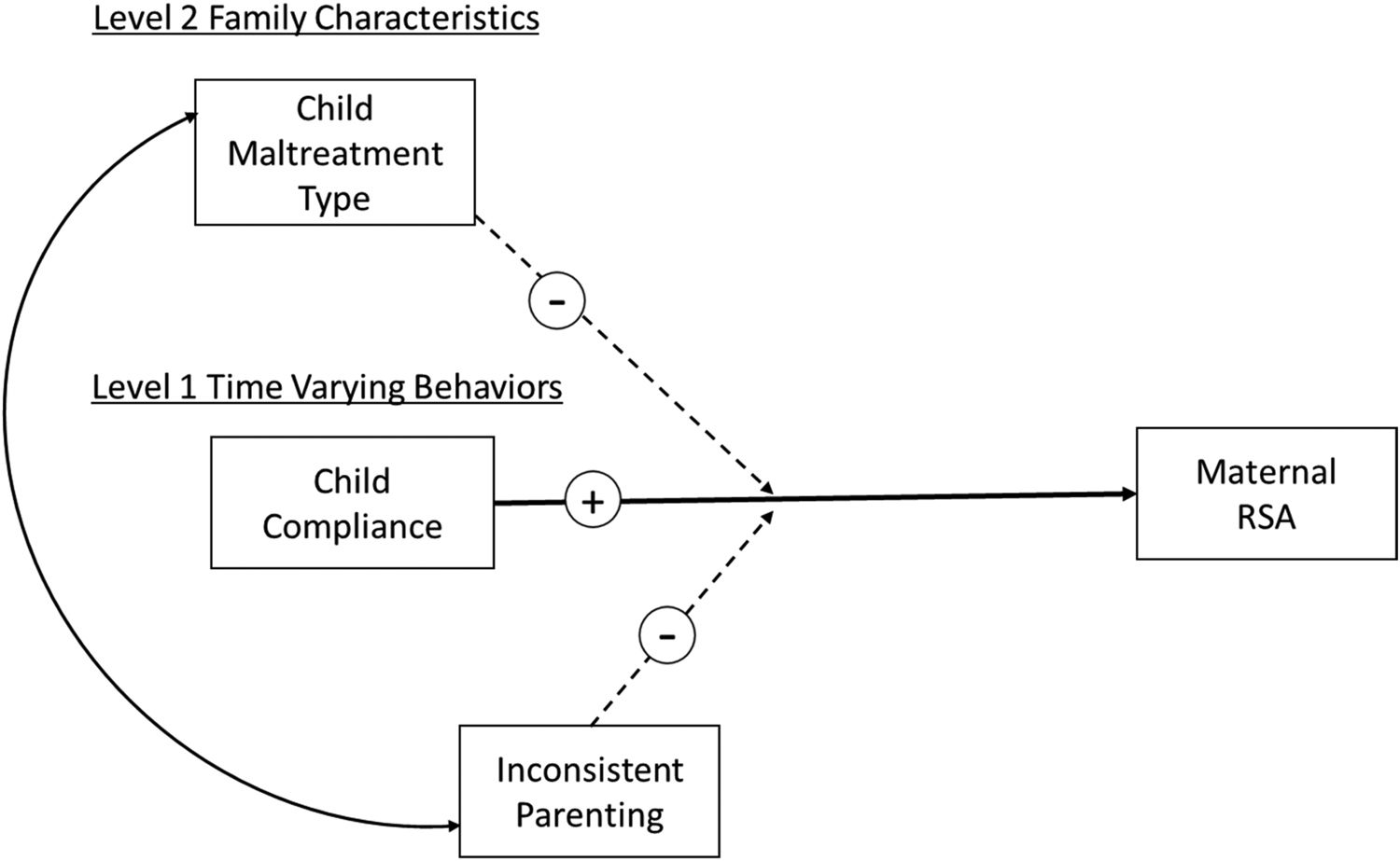
The conceptual model integrating developmental and family systems theories of dyad transactions is presented in Figure 1. The model summarizes hypothesized relationships based on the literature reviewed previously, with main effects paths shown as bold, and moderating paths shown as dashed lines. Within-dyad levels of child prosocial compliance behavior were hypothesized to “drive” increases in maternal RSA (i.e., PNS activation, greater calm), and child aversive compliance was expected to drive decreases in maternal RSA (i.e., PNS withdrawal, greater arousal). Based on theory (i.e., Bugental, Reference Bugental and Sameroff2009; Skowron, Reference Skowron, Noone and Papero2015) and previous findings that support heightened physiological arousal among maltreating and high-risk parents (e.g., McCanne & Hagstrom, Reference McCanne and Hagstrom1996), CM perpetration was hypothesized to moderate or amplify effects of child compliance behaviors in predicting maternal RSA. Specifically, we predicted that CM mothers would show greater RSA increases to child prosocial compliance and greater RSA decreases to child aversive compliance. In a similar manner, inconsistent parenting, coded using the SASB system (Benjamin & Cushing, Reference Benjamin and Cushing2000) was expected to moderate the effect of child compliance behaviors on maternal RSA. Although this aim was somewhat exploratory, we reasoned that high levels of inconsistent parenting—vacillation between maternal autonomy granting and control—may predict a mother's greater parasympathetic responding to her child's prosocial and aversive compliance behavior.
Conceptual model of hypothesized family systems relationships among family level characteristics and repeated measures mother and child behaviors predicting maternal RSA.

Method
Participants
Participants were 221 mothers and their 3- to 5-year-old children (mean [M] = 3.76, standard deviation [SD] = .74). Children were 50.7% female and white (76.9%), African-American (2.7%), Hispanic/Latino (0.5%), and multiracial (15.8%). Mothers were, on average, 30 years old (SD = 6.06) and white (88.2%), Hispanic/Latino (1.8%), multiracial (3.2%), African-American (3.6%), or Asian-American (0.5%). A majority (72.3%) of mothers reported an annual income of $30,000 or less and 74.2% had obtained a high school degree or less. Among mothers in the total sample, n = 127 mothers were classified as CM and n = 94 were classified as non-maltreating.
Procedure
Mothers and children completed three assessments over a 2- to 3-week period consisting of two home visits and a laboratory visit lasting approximately 2.5 hours. During the home visits, mothers provided demographic information and completed psychosocial assessments. Both mothers and children completed a cognitive assessment during the home visits. During the laboratory assessment, mothers and children participated in joint interaction tasks, mothers completed additional questionnaires, and children participated in a variety of individual tasks. Electrocardiograph (ECG) recordings were taken from mothers and children throughout the laboratory visit. Of particular interest to this study, mother-child dyads completed a Joint Duplo task (3–5 minutes in length), which was subjected to SASB observational coding. In the Joint Duplo task, children were given a three-dimensional model figure and instructed to construct an identical model from a set of deconstructed pieces provided. Mothers were instructed to help as they would at home without physically touching the pieces. Families received $150 for their participation in the full study, were compensated for the cost of transportation, and received snacks and small gifts for the participating child.
Measures
Maternal RSA
Disposable pregelled silver/silver chloride electrodes were applied in a modified lead II placement on the right clavicle, lower left rib cage, and lower right ribcage to monitor cardiac physiology throughout the laboratory tasks. Data were acquired via Mindware Technologies (Gahanna, OH) ambulatory ECG MW1000A, transmitted wirelessly to a computer, and monitored by a research assistant. Heart rate data were computed by passing ECG signals through an A/D converter with ECG sampled at a rate of 500 ms. Trained research assistants visually inspected ECG data offline using Mindware Technologies HRV 3.0.10 analysis program. Incorrectly identified heartbeats were deleted and missing beats were inserted as needed. The resulting interbeat interval time series was subjected to a fast-Fourier transformation, and power in the respiratory frequency band was derived from the spectral density function (e.g., Berntson et al., Reference Berntson, Thomas Bigger, Eckberg, Grossman, Kaufmann, Malik and Der Molen1997; Berntson, Cacioppo, & Quigley, Reference Berntson, Cacioppo, Quigley and Fabro1994). The RSA frequency band was set between 0.12 and 0.40, and maternal RSA was calculated in 30-second epochs across the joint Duplo problem-solving task for a total of up to 10 time-sampling epochs. The Duplo task was no longer than 5 minutes but may have been as brief as 3 minutes depending on how quickly the dyad completed the puzzle. Of the total sample, 66% had 10 epochs, 76% had at least 8 epochs, 90% had at least 6 epochs.
SASB coding
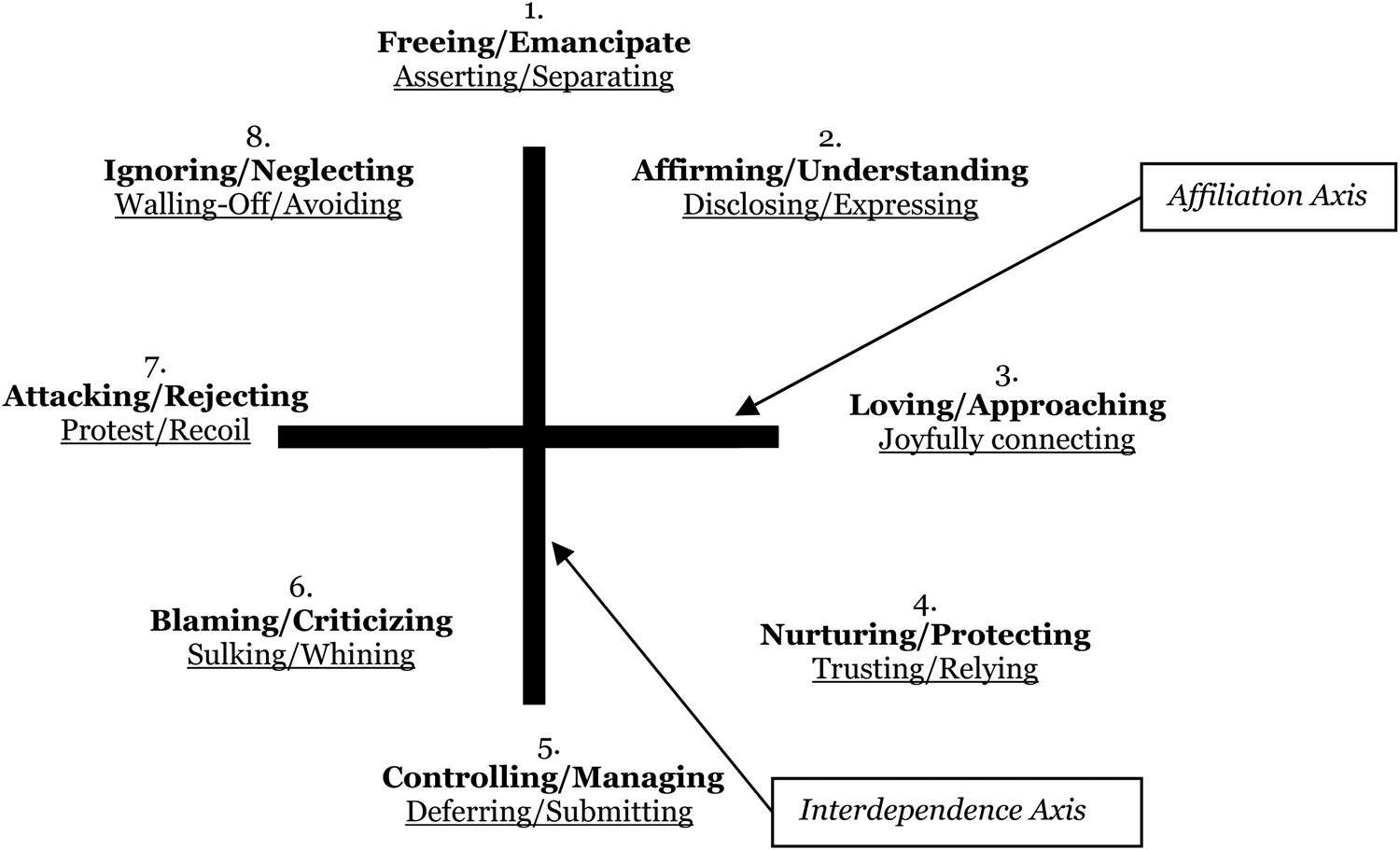
The SASB (Benjamin, Reference Benjamin1974, Reference Benjamin1996; Benjamin & Cushing, Reference Benjamin and Cushing2000), a microsocial coding system, was used to code parent and child interactions during the Joint Duplo problem-solving task. The SASB model is designed to describe behavior across three interpersonal domains: (1) focus, (2) affiliation (i.e., the degree of warmth or hostility in any interpersonal message, from attack to love), and (3) interdependence (i.e., the degree of enmeshment (control or submit) to differentiation (autonomy-giving or autonomy-taking) observed in a behavior. As shown in Figure 2, SASB behavioral codes are thus distributed across two circumplex surfaces into 16 behavioral codes reflected in 8 clusters on the circumplex. Videotaped interactions during the Duplo task were transcribed, unitized into individual speech acts, and coded by a trained team of observational coders who received over 80 hours of training. Coding began with the first speaking utterance by the mother or child and ended with the last utterance during the task. Coders used both the unitized transcripts and digital video recordings to SASB code each speech act during the mother-child interaction. Inter-rater reliability of SASB coders was based on weighted kappa coefficients, which ranged from .73 to .84. The coding teams were not informed of family's group membership or which families were examined for reliability.
SASB simplified cluster model. The affiliation axis is the x-axis and the interdependence axis is the y-axis. Labels in bold print describe proto-typical parenting behaviors directed toward another person (i.e., child) and are the focus in the present study. Labels in underline print describe proto-typically child-like actions in response to the other (intransitive).

Child prosocial compliance and aversive compliance behavior
For the current study, child prosocial compliance was operationalized as the proportion of child behaviors coded in SASB clusters 2–4 (Trust/Rely). Child aversive compliance scores were created by summing the proportion of child behaviors coded in SASB clusters 2–5 (Defer/Submit) and 2–6 (Sulk/Whine). Next, children's prosocial compliance scores and aversive compliance scores were summed separately into consecutive 30-second epochs during the Duplo task (i.e., corresponding with maternal RSA scores described previously), resulting in up to 10 time-ordered child prosocial compliance and aversive compliance scores. Task averages also were calculated for children's prosocial compliance and aversive compliance scores.
Inconsistent parenting
Mothers’ behaviors during the Joint Duplo task also were subjected to SASB coding as described previously. Maternal inconsistent parenting scores were generated using Benjamin's SASB conflict pattern coefficient, which reflects a single nonlinear polynomial curve denoting elevated behavioral cluster scores on opposing points of the horizontal axis of the interpersonal circumplex (e.g., maternal controlling vs. letting go), described as denoting an enmeshment–differentiation conflict (Benjamin & Cushing, Reference Benjamin and Cushing2000). In SASB terms, high positive conflict coefficients describe significant conflict along the vertical axis of the SASB model, namely the differentiation axis (i.e., maternal behaviors characterized by freeing/letting go on the one hand and strict control on the other). Thus, higher inconsistent parenting scores indicate greater inconsistency in mothers’ behaviors along the dimension of autonomy-granting versus control (e.g., mothers try to control their child one moment and let their child do their own thing in the next moment).
Child maltreatment
The Maltreatment Classification System (MCS; Barnett, Manly & Cicchetti, Reference Barnett, Manly, Cicchetti, Cicchetti and Toth1993) was used to code child welfare records for subtypes of child maltreatment perpetrated by mothers. The MCS differentiates CM subtypes (i.e., physical abuse, physical neglect, sexual abuse, and emotional or moral/legal maltreatment) and severity of each subtype on a 0 (none) to 5 (highest) scale (Barnett et al., Reference Barnett, Manly, Cicchetti, Cicchetti and Toth1993). Further, CM subtypes were classified hierarchically, so that mothers who had engaged in physical abuse and any other subtype of CM were categorized as physically abusive, mothers who engaged in neglect and any other subtype except physical abuse were categorized as neglecting, and mother who engaged in emotional abuse but not physical abuse or neglect were classified as emotionally maltreating (e.g., Belsky, Reference Belsky1993; Kauffman & Ziegler, Reference Kaufman, Ziegler, Cicchetti and Carlson1989; Pollak, Cicchetti, Hornung, & Reed, Reference Pollak, Cicchetti, Hornung and Reed2000). MCS coding of participating families’ child welfare records determined that, of the CM families, 17.3% of mothers had engaged in physical abuse, 48.0% engaged in physical neglect, and 8.7% had engaged in emotional maltreatment. An additional 26.0% of families were involved in child welfare services, but with no MCS codable instance of abuse or neglect recorded in their files, these families were considered in a distinct category (i.e., child welfare-involved, but no specific CM type identified). Comorbidity of CM subtypes was observed in 74% of cases, consistent with other published findings (e.g., Belsky, Reference Belsky1993; Kaufman & Ziegler, Reference Kaufman, Ziegler, Cicchetti and Carlson1989). Non-maltreating families consented to review of child welfare records to confirm there was no documented history of child maltreatment.
Analytic strategy
The time varying research questions were tested using MLM, specified as linear growth models in the HLM7 program (Raudenbush, Bryk, Cheong, Congdon, & du Toit, Reference Raudenbush, Bryk, Cheong, Congdon and du Toit2013). MLM is a regression framework also known as mixed modeling and linear mixed effects models. Analyses are multilevel because time-varying repeated measures at level 1 are nested or clustered within individuals at level 2. The repeated measure design for the present study is 10 30-second time samplings of child compliance behavior, mother physiology data, and inconsistent parenting collected during the problem-solving interaction task. The time series data were specified using methods outlined by Singer and Willett (Reference Singer and Willett2003) for entering time-ordered and time-varying covariates. That is, to better establish causal assumptions, time-varying predictors were tested concurrently over epochs and using temporally specified lagged effects and person-centered level 1 predictors (Singer & Willett, Reference Singer and Willett2003; Skowron et al., Reference Skowron, Cipriano-Essel, Benjamin, Pincus and Van Ryzin2013).
Analyses were conducted in three stages. First, we evaluated an unconditional model of a given dependent variable (e.g., RSA) to best establish the pattern of change over the 10 epochs. Next, we tested within family level 1 main effects and interactions, controlling for family level characteristics. In the final stage of analyses, we tested for level 2 moderators of level 1 effects. More specifically, in addressing the research question, testing hypothesized effects of child compliance behaviors as predictors of maternal RSA, the level 1 model was:
 $${\rm RS}{\rm A}_{ti} = \pi _{0i}\; + \pi _{1i}\lpar {{\rm Time}} \rpar + \pi _{2i}\lpar {{\rm Compliance}} \rpar + e_{ti}$$
where RSA for mother i at time t is a function of a time-varying random intercept π 0, a function of a person-centered linear growth rate π 1, and the person-centered time-varying effect of child compliance π 2, plus a residual error term e ti. As an initial step, the unconditional growth pattern of RSA is tested in a series of sequential models evaluating the fit of a random intercept model, a linear growth rate, and a quadratic or accelerated growth rate (Biesanz, Deeb-Sossa, Papadakis, Bollen, & Curran, Reference Biesanz, Deeb-Sossa, Papadakis, Bollen and Curran2004). We had no theoretical reasons for evaluating cubic and higher order polynomial time functions.
After estimation of level 1 time-varying parameters, the intercept, growth rate, and slope effect of child compliance behaviors are summarized at the family system level in the level 2 model. These coefficients represent the mean level intercept, mean growth rate, and mean compliance effect for the study sample. Child maltreatment types are time-invariant family-level characteristics entered as between family-level predictors of maternal RSA, and as moderators of RSA growth or child compliance effects. The level 2 model is specified as:
 $$\pi _{\it 0i} = \beta _{\it 00} + r_{\it 0i}$$
 $$\pi _{\it 1i} = \beta _{\it 10} + \beta _{\it 11}\lpar {{\rm Physical \; Abuse}} \rpar + \beta _{\it 12}\lpar {{\rm Neglect}} \rpar \ldots. + r_{\it 1i}$$
 $$\pi _{\it 2i} = \beta _{\it 20} + \beta _{\it 21}\lpar {{\rm Physical \; Abuse}} \rpar + \beta _{\it 22}\lpar {{\rm Neglect}} \rpar \ldots. + r_{\it 2i}$$
where β 00 is the sample average RSA across time and across mothers, β 01 is the effect of physical abuse on average RSA, and β 02 is the effect of neglect. The level 2 β 1 and β 2 effects are the respective moderators of growth in RSA and moderator of child compliance, respectively. Summarized in the full mixed model as:
 $$\eqalign{ {\rm RS}{\rm A}_{ti} = & \,\,\beta _{\it 00} + \beta _{\it 01}\lpar {{\rm Physical \; Abuse}} \rpar + \beta _{\it 02}\lpar {{\rm Neglect}} \rpar + \beta _{\it 10}\lpar {{\rm Time}} \rpar \cr & + \beta _{\it 11}\lpar {{\rm Abuse} \times {\rm Time}} \rpar + \beta _{\it 12}\lpar {{\rm Neglect} \times {\rm Time}} \rpar \cr & + \beta _{\it 20}\lpar {{\rm Compliance}} \rpar \; + \beta _{\it 21}\lpar {{\rm Abuset} \times {\rm Compliance}} \rpar \cr & + \beta _{\it 22}\lpar {{\rm Neglect} \times {\rm Compliance}} \rpar + r_{\it 0i} + r_{\it 1i}\lpar {{\rm Time}} \rpar \cr & + r_{\it 2i}\lpar {{\rm Compliance}} \rpar + e_{ti}} $$
Results
Preliminary analyses
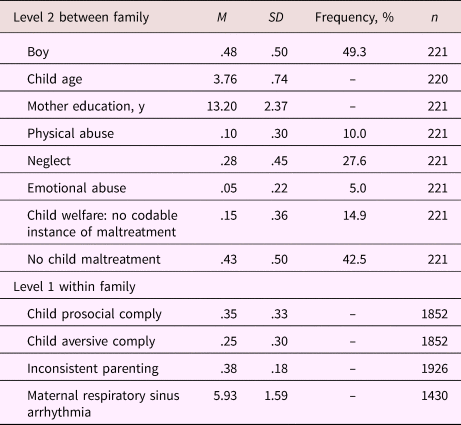
Sample M, SD, and n for the key study variables are provided in Table 1 for the key between-dyad and within-dyad variables. Frequency scores are also reported for categorical variables. Mean proportions in the level 2 characteristics represent the sample demographics described previously. The time-varying means represent the average levels of child and maternal behavior and maternal RSA. The sample was characterized by higher proportions of prosocial compliance behavior (M = .35) relative to aversive compliance (M = .25); still, one-quarter of all child behaviors were aversive. More than one-third (i.e., M = .38) of the maternal behaviors in this at-risk sample were characterized by inconsistent parenting.
M and SD of within-family level 1 repeated measure variables and between-family level 2 predictors, with frequency of categorical variables

Note: M = mean; SD = standard deviation.
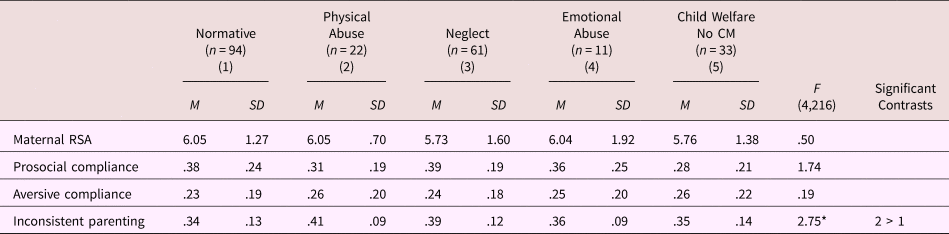
We next examined potential mean differences by family CM types using analysis of variance F tests and post hoc pairwise comparisons. M, SD, and comparisons are shown in Table 2. There were no significant differences between the family types for maternal RSA or child compliance variables. Maternal inconsistent parenting differed by family types (F (4,216) = 2.75, p < .05), with physically abusive mothers being more erratic than non-maltreating mothers.
M, SD, and mean comparisons across epochs for key study variables by maltreatment type

Note: CM = child maltreatment; M = mean; RSA = respiratory sinus arrhythmia; SD = standard deviation. *p < .05.
Predicting maternal RSA: main effects and dyad-level moderators
The first step of the maternal RSA analyses was to evaluate an unconditional growth model to best describe the patterns of maternal RSA over the 10 epochs of the joint mother-child interaction. Nested model comparisons of the χ2 deviance test showed that a random intercept model was optimal. First, in comparison of adding a growth parameter over and above a random intercept, the change in χ2 deviance significantly worsened the model for adding a linear growth rate (Δχ2 (2) = 8.32, p < .05) and a quadratic term (Δχ2 (2) = 13.62, p < .01). Second, although there was a marginal trend for a linear growth rate (β 10 = –.06, p < .10), the variance component was nonsignificant (σ2 = .18, p = .15), and only the random intercept mean and variance components were significantly different from zero (β 00 = 5.92, p < .001, and σ2 = 1.83, p < .001, respectively). Therefore, we eliminated time as a parameter in the level 1 model and proceeded with tests of dyad-level and time-varying and lagged main effects, plus the hypothesized moderators.
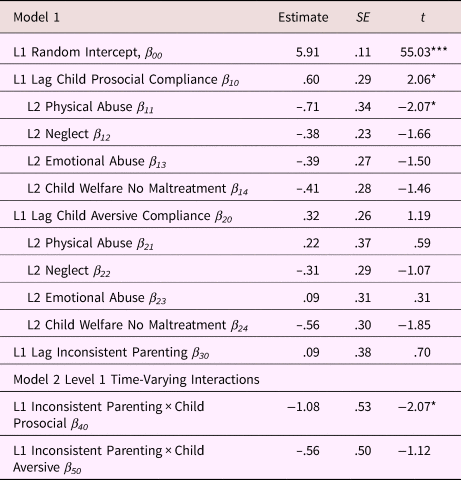
We next tested the hypothesized relationships shown in Figure 1. To specify this model, the level 1 main effects paths of child compliance were entered in the model as well as the main effect of inconsistent parenting. The paths for child maltreatment moderators of child compliance were entered as level 2 CM types predicting level 1 compliance effects, also known as cross-level interactions. Finally, the level 1 inconsistent parenting moderator was entered as a time-varying level 1 interaction term (inconsistent parenting × child compliance). Results of the MLM are presented in Table 3 in the form of unstandardized multilevel regression coefficients.
Unstandardized Estimates, SE, and t Ratio for lagged Predictors of Mother RSA

Note: L1 = level 1; L2 = level 2; L = level; RSA = respiratory sinus arrhythmia; SE = standard error. ***p < .001; **p < .01; *p < .05.
Focusing on level 1 lagged child compliance scores, main effects supported hypotheses for child prosocial compliance but were not supported for child aversive compliance. That is, controlling for CM type, greater lagged child prosocial compliance behavior was associated with higher subsequent maternal RSA (β 10 = .60, p < .05). Lagged inconsistent parenting did not obtain a significant main effect on RSA.
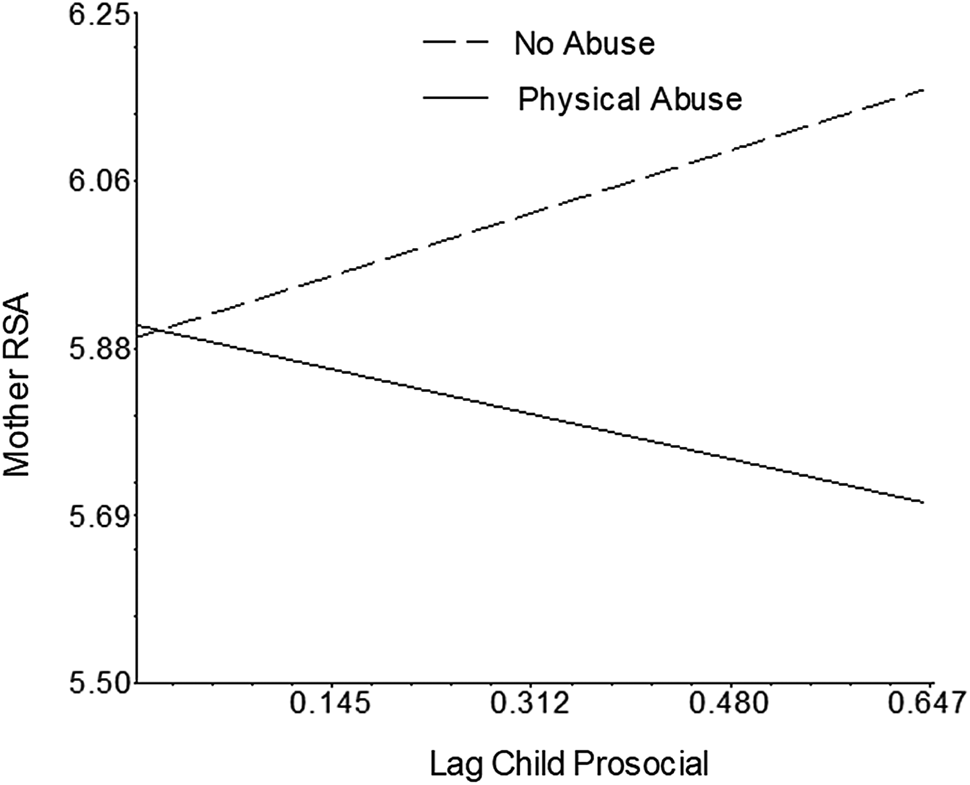
Focusing on CM types as a cross-level moderator of child compliance, the beneficial effect of children's lagged prosocial compliance on maternal RSA was moderated by the presence of physical abuse. That is, the effect of prosocial compliance was more positive in the non-maltreating families, compared to the effect of child compliance in dyads headed by physically abusive mothers (Physical Abuse × Prosocial Compliance β 13 = –.71, p < .05). No CM moderation effects were observed for aversive compliance. Physical abuse as a moderator of child prosocial compliance is plotted in Figure 3 as the model based simple slopes. Figure 3 shows the lagged effect of child prosocial compliance on maternal RSA scores was positive for non-maltreating mothers but was negative for physically abuse mothers.
Detrimental moderating effect of physical abuse on relation between child prosocial compliance and maternal RSA, a Level 2 moderator on Level 1 effect.

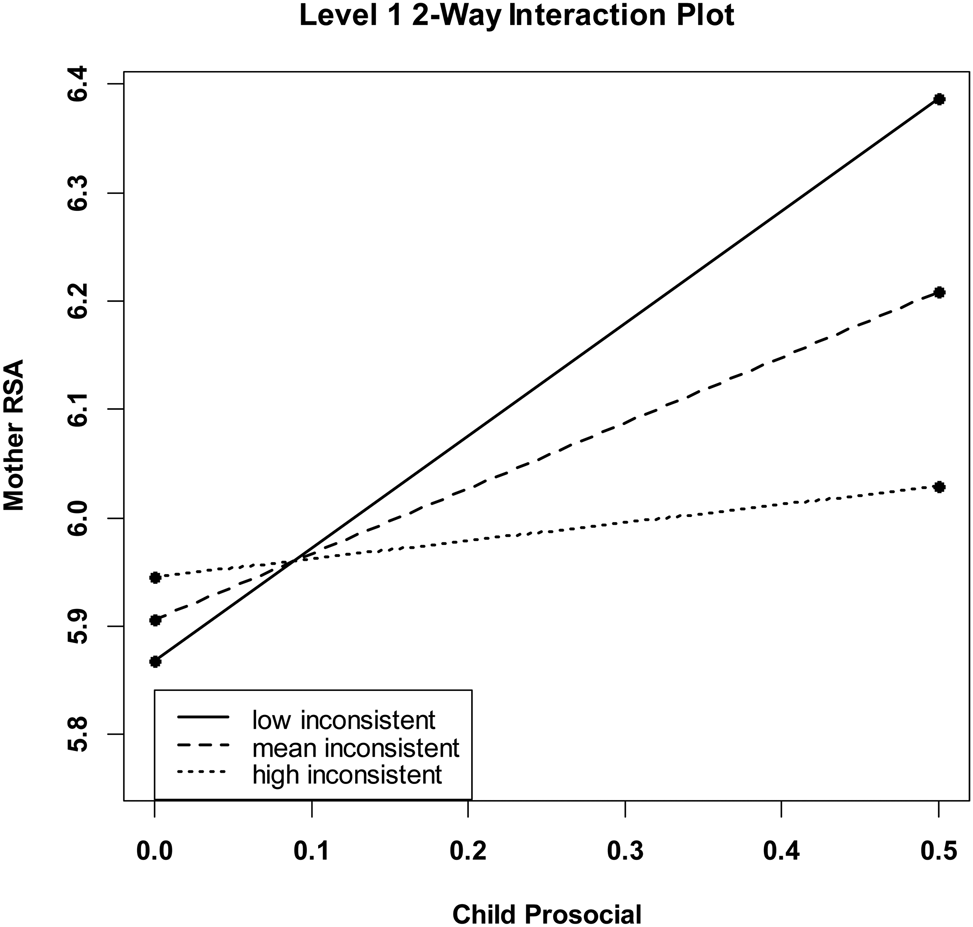
Finally, among the level 1 time-varying moderating hypotheses, inconsistent parenting moderated the effect of prosocial compliance but not aversive compliance. That is, inconsistent parenting was a further risk factor that attenuated the positive effect of child prosocial compliance on maternal RSA (Inconsistent Parenting × Child Prosocial Compliance β 40 = –1.08, p < .05). In other words, children's prosocial compliance was more influential in increasing their mother's RSA in the presence of less inconsistent parenting. This two-way level 1 interaction is plotted in Figure 4 and shows how maternal inconsistency moderated the effects of children's compliance behavior on maternal arousal. Specifically, the weakest associations between children's prosocial compliance and maternal RSA levels were observed in dyads characterized by greater inconsistent parenting (i.e., vacillating between supporting child autonomy and controlling one's child).
Two-way time-varying Level 1 interaction of inconsistent parenting with child prosocial compliance. Simple slopes estimates of child prosocial compliance were plotted at -1, 0, and 1 standard deviations of inconsistent parenting. High inconsistent parenting erodes beneficial effect of child compliance.

We also considered an alternative hypothesis that maternal physiology predicted maternal inconsistent parenting behaviors (models not shown). We specified time-ordered lag models to test whether maternal physiology predicted her parenting behaviors, controlling for evocative effects of child compliance. In these models, epoch lagged RSA was entered as a predictor of inconsistent parenting. Maternal RSA did not predict subsequent parenting behaviors. Taken together, the data support that notion that child compliance behavior and inconsistent parenting are affecting subsequent mother RSA levels, whereas maternal RSA did not predict parenting behaviors, controlling for child behaviors. The proportion of variance explained in maternal RSA was 0.25, a large effect, computed as the change in the RSA variance component between the unconditional and prediction model [(τ00 unconditional – τ00 prediction model)/τ00 unconditional].
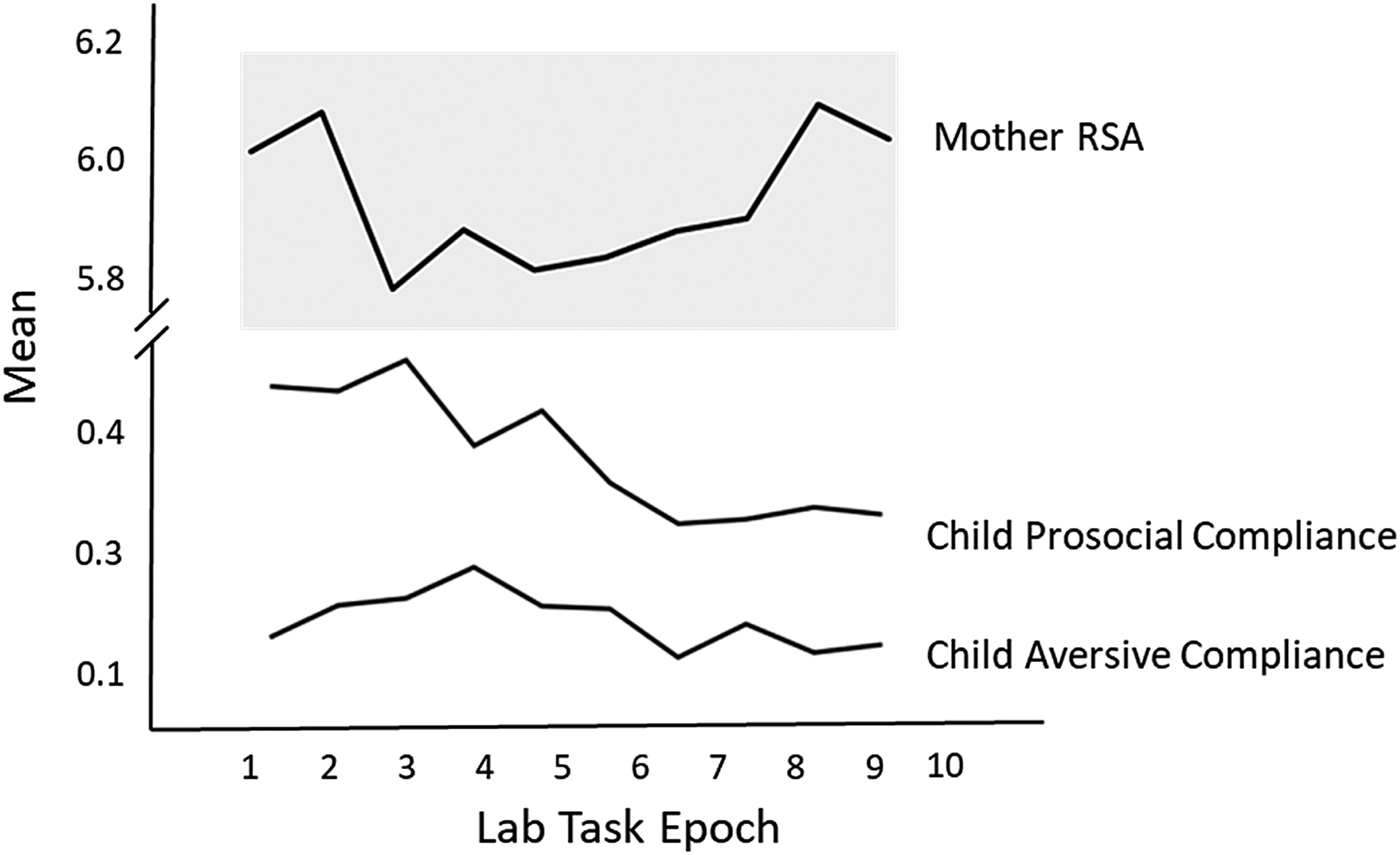
Finally, to illustrate the time-varying nature of child compliance behaviors and maternal RSA, the unconditional means for mother RSA and child behaviors were plotted across the 10 30-second epochs in Figure 5. The plotted means suggest that there was greater variation over time in the proportion of child prosocial compliance behaviors relative to aversive compliance behaviors, and early epochs support the notion that children's prosocial compliance covaried positively with maternal RSA, whereas aversive compliance was unrelated.
Plot of mother RSA, child prosocial and child aversive compliance across 10 30-second epochs.

Discussion
The current study reflects a novel effort to examine time-ordered associations in the behavioral and physiological systems of mothers and their preschool children. Using microsocial behavioral coding and dynamic measures of PNS responding, we tested the evocative effects of children's prosocial and aversive compliance behavior on maternal PNS responding (i.e., RSA). The pattern of findings observed provides new evidence of the critically different evocative effects that children's prosocial behaviors have on a caregiver physiological system implicated in bond formation and emotion regulation, based on maternal risk factors.
Child maltreatment status moderates effects of prosocial compliance
In the context of a relatively challenging laboratory task, children's prosocial behavior showed time-ordered effects on their mothers’ RSA responding during joint interactions that were moderated by CM type. Although no differences across the various CM and non-maltreating dyads were observed in levels of children's prosocial compliance behaviors, nor in mothers’ dynamic RSA responses, we found that mothers in the study were differentially physiologically responsive to their children's prosocial compliance (i.e., trusting and relying behavior) depending on whether they were physically abusive, neglecting, or non-maltreating mothers. In response to increasing prosocial compliance in their preschool-aged child, physically abusive mothers displayed patterns of RSA decreases (i.e., increasing arousal) in the next 30-second epoch, whereas non-maltreating mothers displayed patterns of RSA increases (i.e., decreasing arousal or greater calm) 30 seconds later, and neglected children's behavior showed no discernable effects on the PNS physiology of their neglectful mothers.
Thus, in non-maltreating dyads, mothers responded to their children's bids for protection and warm guidance with subsequent increasing parasympathetic influence on heart rate, promoting physiological calm that enables and supports social coordination and engagement, which may be experienced by both interactive partners as mutually reinforcing. These findings are consistent with existing literature documenting patterns of parent RSA increases during positive interactions with their preschool children. For example, previous studies show that dynamic increases in RSA (i.e., vagal activation) are generally associated with greater warmth and positive affect during parent-adolescent conversations (Connell, Dawson, Danzo, & McKillop, Reference Connell, Dawson, Danzo and McKillop2017; Cui, Morris, Harrist, Larzelere, & Criss, Reference Cui, Morris, Harrist, Larzelere and Criss2015). Other studies have found higher RSA levels linked to positive mood states (Kreibig, Reference Kreibig2010) and positive adult social interaction (Butler, Wilhelm, & Gross, Reference Butler, Wilhelm and Gross2006; Ingjaldsson, Laberg, & Thayer, Reference Ingjaldsson, Laberg and Thayer2003). These young children's prosocial compliance behaviors can be considered evolutionarily adaptive because they entail following their caregiver's lead, maintaining proximity, and seeking parent guidance. Based on our findings, these prosocial child behaviors may also serve to support caregiver homeostasis, by down-regulating and soothing mothers’ physiology in the context of connection.
In contrast, this same type of prosocial compliance behavior in children appeared to heighten arousal in their physically abusive mothers (i.e., leading to decreases in RSA in the following 30-second epoch). Thus, the highest risk mothers—those who perpetrated child physical abuse—responded to their children's prosocial bids for warm guidance with a physiological response suggestive of arousal, effortful exertion, or distress. One explanation is that abusive mothers may experience more strain in response to their children's prosocial bids for protection and guidance, relative to non-maltreating parents. Other studies have documented patterns of decreasing RSA in parents while they are interacting sensitively with their distressed infant or toddler (e.g., Leerkes et al., Reference Leerkes, Su, Calkins, Supple, O'Brien and Fiese2016; Moore et al., Reference Moore, Hill-Soderlund, Propper, Calkins, Mills-Koonce and Cox2009) or when exposed to negative child-based stimuli (e.g., Frodi & Lamb, Reference Frodi and Lamb1980; Joosen et al., Reference Joosen, Mesman, Bakermans-Kranenburg, Pieper, Zeskind and Van IJzendoorn2013a), but also in parents who engage in harsh, overreactive discipline (Lorber & O'Leary, Reference Lorber and O'Leary2005). Extending this finding to CM parents, Skowron and colleagues (Reference Skowron, Cipriano-Essel, Benjamin, Pincus and Van Ryzin2013) observed that physically abusive mothers became more physiologically aroused (i.e., declining RSA) while engaged in positive parenting, but shortly thereafter displayed increasingly harsh and controlling behavior toward their child. Taken together, the current findings indicate that physically abusive mothers may experience their children's age-appropriate, prosocial behavior as physiologically taxing. One critical next step is for researchers to determine whether these patterns of dynamic decreases in abusive mothers’ RSA scores lead to increased harsh, aversive controlling behaviors, as Skowron et al. (Reference Skowron, Cipriano-Essel, Benjamin, Pincus and Van Ryzin2013) observed, or whether these parasympathetic declines function to increase attention and engagement that might facilitate adaptive parental responding.
Although researchers have long recognized that children are active contributors to the parent-child relationship, most work to date has documented a variety of individual child factors known to heighten risk for CM (i.e., low birthweight, prematurity, temperament, developmental disabilities), by compromising the quality of children's social interactional skills (e.g., Black, Heyman, & Smith Slep, Reference Black, Heyman and Smith Slep2001; Rogosch, Cicchetti, & Aber, Reference Rogosch, Cicchetti and Aber1995). We are not aware of studies that have documented patterns of parents’ negative physiological responding to children's initiations of prosocial (i.e., socially appropriate) behavior. Of note, our findings indicate that children's developmentally appropriate, prosocial trusting and relying behavior elicits significant RSA declines 30s later in mothers who are documented perpetrators of child physical abuse. Social learning principles suggest that if children's prosocial bids are not reinforced, children are likely to use other, less positive behavioral strategies to gain parents’ attention and approval (Patterson, Reference Patterson, Reid and Dishion1992; Reid & Patterson, Reference Reid and Patterson1989; Wahler & Dumas, Reference Wahler and Dumas1986). If children of abusive mothers discern that their prosocial behavior causes arousal or distress in their parent, they may learn to adopt an alternative repertoire, potentially one that involves use of more aversive behaviors. This transaction could represent a central mechanistic process that contributes over time to elevated conduct problems in maltreated children (Kim & Cicchetti, Reference Kim and Cicchetti2010). In line with this notion, Hakman and colleagues (Reference Hakman, Chaffin, Funderburk and Silovsky2009) reported patterns of parental indiscriminate responding to children's positive and neutral behaviors, and positive parent responding to negative child behaviors in physically abusive families. Other unpublished findings from the current sample suggest that physically abused preschoolers’ aversive compliance behavior during mother-child interactions appears to drive increases in the preschooler RSA levels, indicating that physically abused children may experience their own aversive behavior in ways that are physiologically calming (Norman Wells, Degarmo, Schweer-Collins, & Skowron, in preparation).
Finally, in dyads headed by physically neglectful mothers, children's prosocial compliance behaviors were unrelated to maternal RSA, indicating that physically neglectful mothers appear unaffected physiologically by their child's positive compliance behavior. It is possible that neglecting mothers’ lack of autonomic response to their child's prosocial compliance reflects a lack of attention to and attunement with their child (e.g., Wilson et al., Reference Wilson, Rack, Shi and Norris2008), or a blunted physiological sensitivity to their child, or perhaps both. This finding may provide evidence of a biologically based vulnerability for neglectful behaviors. That is, a neglectful parents’ lack of PNS response to their child's positive bids for attention could indicate individual differences in mothers’ stress physiology that may drive the failure to engage with and provide for their child. Conversely, a lack of physiological response to child prosocial behavior may be the result of neglectful parents’ broader, effortful strategy to withdrawal or distance from their child, as has been documented in other studies (Egeland, Breitenbucher, & Rosenberg, Reference Egeland, Breitenbucher and Rosenberg1980; Kavanagh, Youngblade, Reid, & Fagot. Reference Kavanagh, Youngblade, Reid and Fagot1988).
In sum, these findings contribute to the growing evidence of children's evocative effects on parent physiology and indicate that children's prosocial behavior evokes heightened arousal in abusive mothers and a physiologically calming response in non-maltreating parents, but no discernable pattern of responding in neglectful mothers. Whereas previous research has documented heightened physiological arousal among CM parents primarily to aversive or emotionally evocative child stimuli (e.g., infant cries; McCanne & Hagstrom, Reference McCanne and Hagstrom1996), our findings indicate that physically abusive mothers also show time-ordered declines in parasympathetically mediated control of heart rate (i.e., arousal) when their children behave in positive, prosocial ways.
Inconsistent parenting moderates effects of prosocial compliance
Inconsistent parenting was also found to moderate time-ordered relations between child prosocial compliance and mother's RSA responding. In dyads headed by mothers who vacillated more often between supporting autonomy and controlling their child, variations in children's prosocial compliance behavior exerted less impact on maternal RSA levels in the subsequent epoch, regardless of CM status. Mothers who behaved more consistently, in contrast, showed a stronger PNS calming response (i.e., larger RSA increases 30s later) when their child warmly complied.
Inconsistent parenting has been linked with elevated rates of child oppositional and aggressive behavior (Chamberlain & Patterson, Reference Chamberlain, Patterson, Bornstein and Bornstein1995; Reid & Patterson, Reference Reid and Patterson1989; Wahler & Dumas, Reference Wahler and Dumas1986). Wahler and Dumas suggested that children, when faced with unpredictable and inconsistent parenting, are at greater risk for engaging in oppositional and defiant behaviors, and that they do so to elicit a more predictable, albeit aversive response from their parent. The current findings suggest that such coercive patterns may be maintained partially through the parent's physiological responsiveness to children's prosocial behaviors. Parents who engage in highly inconsistent parenting appear to be less physiologically reinforced by their children's positive behavior and may instead be responding more to their own physiological needs (e.g., Skowron et al., Reference Skowron, Cipriano-Essel, Benjamin, Pincus and Van Ryzin2013).
Aversive compliance
In contrast to effects observed for children's prosocial compliance, results indicated that during mother-child interactions, children's aversive compliance (i.e., sulking, whining, and hostile submission) did not predict their mothers’ RSA responses, in contrast to our predictions. It is well-documented that aversive child stimuli (e.g., negative affect, infant cries) tend to produce heightened physiological responding in parents (i.e., elevated heart rate, skin conductance, declines in RSA; Frodi & Lamb, Reference Frodi and Lamb1980; Joosen et al., Reference Joosen, Mesman, Bakermans-Kranenburg, Pieper, Zeskind and Van IJzendoorn2013a; Reijman et al., Reference Reijman, Alink, Block, Werner, Maras, Rijnberk and Bakermans-Kranenburg2014), particularly in caregivers who engage in harsh parenting or CM (Joosen et al., Reference Joosen, Mesman, Bakermans-Kranenburg and van IJzendoorn2013b; Lorber & O'Leary, Reference Lorber and O'Leary2005). One explanation for the current null findings may be that children's aversive compliance behavior produced a small effect on maternal RSA that was not discernable with our moderate sample size. It is likely that our study paradigm did not trigger significant levels of negative child behavior (i.e., crying and other forms of higher intensity negative affect displays) on par with other published studies. In this study, parent physiology was assessed during live interactions with their own child, whereas other published studies tend to assess parental autonomic responding in laboratory-based audio or video simulations of negative child behavior. Future research should continue to examine patterns of parents’ physiological responding to children's aversive behavior, including a wider range of child aversive behaviors, using larger sample sizes, and diverse experimental paradigms.
Limitations
It is important to note that a number of other personal and environmental risk factors, such as low socioeconomic status, large family size, unemployment, parent stress, parent depression, and parental history of CM victimization, are also associated with risk for CM perpetration (see Diaz & Peterson, Reference Diaz and Petersen2014, and Stith et al., Reference Stith, Liu, Davies, Boykin, Alder, Harris and Dees2009, for reviews). The current findings documenting the moderating effects of CM on maternal physiological response to child compliance behaviors represent only one facet of a much broader context of biopsychosocial risk linked to CM that may have contributed to the effects observed here.
We measured physiological effects of child behavior on their mothers using a single index of PNS responding: maternal RSA during a joint interaction task. Future studies will benefit from the inclusion of measures of sympathetic and neuroendocrine response systems to understand further how child compliance behavior influences parents’ physiological response systems and to better characterize variation across risk groups. To ascertain the directionality of findings observed here, there is a need go beyond use of longitudinal designs and use experimental intervention designs to enable stronger causal inference testing. Further, the current sample included mothers only, and so these findings may not generalize to fathers or other types of caregivers. Replication of these evocative child effects should be conducted in samples of at-risk father-child dyads, especially given evidence that fathers’ coercive parenting exchanges are particularly salient for child noncompliance (DeGarmo, Reference DeGarmo2010).
Finally, given the significant comorbidity in children's CM exposures and our decision to hierarchically classify physical abuse, neglect, and emotional maltreatment, conclusions regarding the effect of pure types of CM were not possible to derive (Toth, Maughan, Manly, Spagnolo & Cicchetti, Reference Toth, Maughan, Manly, Spagnola and Cicchetti2002). Additionally, some families in our sample were known to have CM backgrounds and child welfare involvement, but did not have a specific, substantiated instance of abuse in their record that could be categorized via the MCS coding system. Consistent with past studies (Belsky, Reference Belsky1993; Kaufman & Ziegler, Reference Kaufman, Ziegler, Cicchetti and Carlson1989; Pollak et al., Reference Pollak, Cicchetti, Hornung and Reed2000), we observed comorbidity across CM subtypes in 74% of sample cases. Researchers studying CM should work to use innovative methodological approaches, including open science approaches for high-powered meta-analyses, that will allow for a more nuanced examination of how maternal physiological responding to their children may vary based on the constellation of CM perpetrated by parents.
Future directions
Although findings here suggest that prosocial child behavior elicits an aversive autonomic response in physically abusive mothers, it is unknown whether and how these transactions affect children's distal behavioral and health outcomes. Future research should examine child physical health outcomes, including biomarkers of stress-related illness, to investigate whether these dyadic exchanges exact a biological cost for abused children. Further research is needed to clarify the mechanisms through which prosocial child compliance affects decreasing RSA among the physically abusive mothers, an autonomic response pattern that characterizes physiological arousal consistent with defensive responding in a social context. The increased risk for aversive parenting fueled by elevated physiological arousal has been documented elsewhere (Skowron et al., Reference Skowron, Cipriano-Essel, Benjamin, Pincus and Van Ryzin2013). Further investigations are needed to better understand how parental physiological responding may underlie and maintain commonly observed patterns of dysfunctional interactions in high-risk parent-child transactions, including inconsistent use of controlling parenting.
It seems plausible that abusive mothers’ patterns of decreasing RSA in response to their children's prosocial, age-appropriate behavior may serve to shape children's subsequent response repertoires in maladaptive ways. In the short term, this might involve children using increasingly aversive behavior to elicit a predictable response from their mother (i.e., Hakman et al., Reference Hakman, Chaffin, Funderburk and Silovsky2009); over time, children may show more significant adjustment difficulties related to these coercive transactions, such as oppositional behavior problems. In this way, abusive mothers’ physiological responding to their children's prosocial behavior may operate as a mediator of CM's negative effects on children's developmental outcomes, driving shifts toward more aversive child behavior over time.
Conclusion
The current results provide evidence that mothers’ physiological sensitivities to their child's compliance behavior critically diverges across distal (i.e., CM type) and proximal (i.e., inconsistent parenting) risk factors. Mothers’ RSA responses to children's prosocial compliance behavior appear to be positively reinforcing for non-CM mothers and aversive for physically abusive mothers, whereas child compliance does not appear to influence PNS responding in neglectful mothers. Further, regardless of CM subtype, mothers who engaged in more inconsistent parenting displayed less physiological calm in response to their children's trusting and relying behaviors. If independently replicated, these findings may provide new evidence regarding the physiological bases of maladaptive parenting and its adverse effects on children's developmental outcomes.
These patterns of physiological responding in mothers across the spectrum of risk suggest several directions for personalizing and individually tailoring parenting interventions. Among physically abusive dyads, investigation of biofeedback and mindfulness approaches to incorporate into existing evidence-based parenting interventions may yield insights into their ability to facilitate reductions in maternal arousal to children's prosocial behavior or decoupling the time-ordered associations between children's developmentally appropriate bids for parental protection and subsequent RSA withdrawal in mothers (e.g., Skowron, Reference Skowron, Noone and Papero2015). Given our findings regarding the weakened influence of child prosocial compliance on maternal RSA when mothers frequently vacillate between controlling and supporting their child's autonomy, this pattern of inconsistent parent behavior may be another important target of intervention, regardless of CM background, in order to disrupt physiologically maintained coercive cycles of parent-child interaction.
Financial support
This research was supported by the National Institute of Mental Health grants MH079328 and DA036533 to E.A.S, and in part by grant P50 DA035763 National Institute on Drug Abuse to D.S.D.