INTRODUCTION
In Thus Spoke Zarathustra, Nietzsche defines Superman as “a man who has battled modern values and overcome the flaws of humanity” (Reference Nietzsche1896, p. 2). Nietzsche refers to this higher mode of being as overman (übermensch)—someone who maximizes his or her human capabilities in a way that affects and influences the lives of others, and demonstrates the type of determination, bravery, and courage to accomplish difficult tasks in the face of extraordinary circumstances.
An example of such an individual is Harriet Tubman, a former slave and member of the Underground Railroad (UGRR), a seventeenth to nineteenth century insurgency movement created to help transport fugitive Black slaves from positions of servitude in slave-holding states to freedom in the Midwest, East Coast, and CanadaFootnote 2.
Stories about her ability to escape from bondage, and her insatiable drive to help her family and friends do the same, achieved hegemonic status in anti-slavery discussion and continue to occupy a central and romantic place in the history of this particular epoch (Bordewich Reference Bordewich2005; Bradford Reference Bradford1886; Clifford-Larson Reference Clifford-Larson2004; Conrad Reference Conrad1942; Gara Reference Gara1961; Siebert Reference Siebert1898).
However, despite the centrality of Tubman's historic accomplishments, little is known about the structural factors that allowed her to succeed with her very difficult and important task. Previous argument (Bradford Reference Bradford1886; Conrad Reference Conrad1942) about her accomplishments created an image of her as a single individual who achieved her legendary feats without the assistance of others or the benefits of a managed social structure. Apart from the fact that she rescued her friends and family as a member of a network, little is known about who was a part of this collectivity and how they worked together.
The purpose of this paper is to conduct a structural investigation into how Tubman transported more than seventy members of her enslaved family and friends to freedom by managing her social capitalFootnote 3 as a member of the New York State UGRR.
While previous studies about Tubman's exploits have sought to discuss her results, the question that motivates this paper is what structural factor or factors affected her ability to accomplish her incredible feats? What impact did she have in the network, and can this impact be interpreted quantitatively?
We attempt to answer these questions using UCINET (Borgatti et al., Reference Borgatti, Everett and Freeman2002), a program used to measure and analyze network linkages. The basis for our analysis is Padgett and Ansell's seminal study (Reference Padgett and Ansell1993) that conducted a structural analysis of existing network data of Cosimo de Medici and his family's rise to prominence in fifteenth-century Florence. The authors describe de Medici's ability to manage his network position as “robust action” (p. 1263): having his actions interpreted simultaneously and coherently from multiple perspectives and actors and translated into successful entrepreneurial social action. His actions created opportunities for de Medici to exploit his network associations to his benefit.
In a similar but different way, our analysis uses original data to present a structural image and statistical interpretation of Tubman and her network. We argue that Tubman's actions, not unlike those of Cosimo de Medici, created an opportunistic advantage for her to mobilize support for her rescue efforts across several states. We suggest that a primary factor in this mobilization was trust, which according to Simmel is best understood by a “further element of socio-psychological quasi-religious faith … [and as] another type of confidence that stands outside the categories of knowledge and ignorance” (Reference Simmel1990, p. 318). We argue that Tubman relied on these trusted relationships to facilitate the creation of a network organization that promoted a “reciprocal confidence among its members” (Simmel Reference Simmel1990, p. 319) and assisted her with her task.
Second, we show how the construction of her UGRR network in New York State was made possible by the creative actions of at least four major conductors: Stephen Myers, William Still, Frederick Douglass and Abel Brown. While other actors played critical roles in this process,Footnote 4 we suggest that the success of these conductors and their respective activities made it possible for her to proceed and succeed with her objective.
We develop our argument in the following manner. First, after a brief history and discussion of the UGRR, we discuss the methodology used to collect the study's data. Second, we use UCINET to provide sociograms—graphic representations that illuminate the structure and extent of the New York State UGRR during the period from 1830 to 1859, and of Harriet Tubman's UGRR network in New York State during the mid-to-late 1850s. Third, we discuss the role of trust, and consider why Tubman's associates transferred control of their contacts to her. Fourth, we provide data that illuminates her centrality and influence in the network, and thus allowed her to link with others with whom she was not linked (Lin et al., Reference Lin, Cook and Burt2001). We conclude our essay with a discussion of the broader implications of using historical sources to collect network data, and the role of networks in conducting historical analysis.
A BRIEF HISTORY OF THE UNDERGROUND RAILROAD (UGRR)
The UGRR was a seventeenth- to nineteenth-century insurgency movement created to help transport fugitive Black slaves from positions of servitude in slave-holding states to freedom in the Midwest, East Coast, and Canada. It was composed of an informal network of actors who shared a belief that human bondage was an immoral violation of the social contract. While there is no recorded beginning of this activity, sometime in the 1830s the name “Underground Railroad” came into being. Gara (Reference Gara1961) suggests that the original name was the “Underground Road”; with the advent of and fascination with developing rail transportation, the name transformed to the “Underground Railroad.”
Although the UGRR is often described as the routes taken by enslaved African freedom seekers, we argue that this is not the best description. We suggest that the UGRR was an antebellum movement of those seeking freedom from slavery and those who assisted them in reaching freedom. It was a movement of civil disobedience and defiance against slavery and the laws that supported it. Although most fugitive slaves who eventually ended up on the UGRR began their journey unaided by UGRR representatives (Gara Reference Gara1961; Siebert Reference Siebert1898), they usually learned about an UGRR representative or station through word of mouth.
Many people associated with the UGRR knew only their part of the operation, not the whole scheme. Hundreds of slaves obtained freedom to the North every year. Estimates of the number of “passengers” on the UGRR have ranged from 30,000 to 100,000 or more. One way to approach the issue is to review reports from the period to get an idea of what actually happened. The first annual report of the Vigilance Committee of the City of Albany reports that in 1842, some 350 persons were assisted (Brown Reference Brown1849, p. 150). A report in 1856 by the successor committee reported 256 individuals assisted in a ten-month period (Vigilance Committee Flyer, 1856). While this sort of “balance sheet” approach does not answer the question of how many individuals the UGRR assisted, it does suggest the volume of people who possibly used the UGRR along its eastern corridor.
In short, it is hard to set an ending time for the end of the UGRR. As long as slavery gripped the nation through enslavement in the South, and dependency on slavery produced products in the North, there were those who opposed it and enslaved people who escaped from it. But it seems safe to say that as the Civil War dragged on, slavery was collapsing throughout the South and increasingly the UGRR did not need to be underground to continue its work. Rather, it became known as a legitimate insurgency movement against human bondage that was composed of enslaved and free African Americans, Whites, and others sympathetic to the cause of promoting human rights, agency, and justice for all individuals.
DATA AND METHOD
We reviewed over one hundred texts that contain information about Tubman in particular, and the New York State UGRR in general. After doing so, we settled on the following seminal and primary texts: C.S. Brown, The Memoirs of Abel Brown (Reference Brown1849); W. Siebert, The Underground Railroad (Reference Siebert1898); L. Gara, The Liberty Line (Reference Gara1961); K. Clifford-Larson, Bound for the Promised Land (Reference Clifford-Larson2004); S. Bradford, Harriet Tubman: The Moses of Her People (Reference Bradford1886); S. Thomas, An Autobiography of the Life of Frederick Douglass (Reference Thomas2004); W. Still, The Underground Railroad (Reference Still1872); and F. Bordewich, Bound for Canaan (Reference Bordewich2005). Each of these books, in some measure, presents information about the major individuals who assisted Tubman in her quest to free her family and friends.
First, more than any of the other documents reviewed, the aforementioned texts contain information about the network association of the primary individuals, and of their association with Tubman in particular. In some cases, the chosen books are considered seminal or primary autobiographical texts by historians. Second, each document presents information on the associations that a conductor had with other actors in a respective segment of the UGRR. For instance, more than any text that we reviewed, Clifford-Larson (Reference Clifford-Larson2004) presents a detailed account of the actors involved in the Upstate New York UGRR, and of the extent of their connection to and involvement with Tubman. We also relied on the following archival sources as supplemental data: The Black Abolitionist Papers; The Tocsin of Liberty; The Syracuse Tribune; and the Executive Committee Report of the Eastern New York Anti-Slavery Society (1853). However, the reader should be aware that our primary motivation for choosing these texts and focusing on these specific actors rests on our reading and interpretation of sources that discuss the impact of each individual in question, and the belief in the scholarly community about the best source of information for understanding with whom these people associated. Of course, the lack of available information on other actors with whom each conductor likely associated constrains further interpretation of our analysis.
We used this information to verify the geographic locations of the primary actors and their involvement with Tubman in specific segments of the New York State UGRR. From the detailed text of these accounts, we coded a network data set, which consists of information on the conductors and their relationships with the following individuals: a) enslaved actors, b) fugitive slaves, c) plantation owners/slave masters, d) Quakers, e) members of Vigilance and Abolition societies, and f) others sympathetic to the anti-slavery movement. The network ties between each conductor and each actor were gathered to create an overall impression of the constraints on a conductor's network. As such, these data create an overall image of the type of relations each conductor used to facilitate his or her involvement with Tubman and with the New York State UGRR.
After we reached agreement on a coding strategy,Footnote 5 relations for the UGRR were coded on a scale from one to five, where one represents a weak relationship and five a strong one. Conductors were chosen because of their prominence in the literature as managers and leaders of segments of the UGRR. Thus, their centrality was determined by two primary factors: 1) the extent to which the literature suggested that each of them, and their respective activities were critical in directing others to freedom, and 2) the extent to which the literature suggested that each of them, and their respective activities, were critical in serving as the contact person in their respective areas.Footnote 6 Hence, given their centrality as managers and leaders of each respective segment of the UGRR, we assigned each conductor a weight of five; those that each person had a personal relationship with were assigned a weight between one and four. Individuals whom each conductor appeared to have known less personally, or had limited contact with were assigned weights in decreasing order (four to one), while railroad passengers were assigned a uniform weight of one. The latter was done because the narrative rarely, if ever, revealed that a freedom seeker had any contact with a conductor after their initial association.
Mapping Social Relations: Individual Sociograms
We collected data on the relations between Tubman and each respective conductor, her or his associates, and any persons with whom they had any contact for the purpose of assisting them with their objective of freeing enslaved actors. This process revealed a non-exhaustive list of relations between each conductor and her or his associates.
Conductors associated with a wide range of individuals. The spoke structure of the individual sociograms suggests a commonality in the management of UGRR relationships: direct ties to other UGRR participants. Although this type of contact may have reduced the amount of potential miscommunication that existed between the respective individuals,Footnote 7 these relations ranged from plantation owners to freedom seekers.Footnote 8 But while a conductor's association with the latter group was quite brief during the UGRR process, this brevity of contact was due to the fact that a conductor usually made contact with a freedom seeker late in the process of the fugitive's escape attempt, or when they entered a geographic area that was beyond the enforcement of the Fugitive Slave Act of 1850—a federal law that made it a crime to assist fugitive slaves (Gara Reference Gara1961).Footnote 9 The Fugitive Slave Act of 1850 was more powerful and devastating than its 1793 predecessor. The 1793 Fugitive Slave Act made it a federal crime to assist an escaping slave, called for violators to pay a $500 fine, and also made every escaped slave a fugitive-for-life, and subject to recapture at any time anyplace within the territory of the United States. Additionally, any children subsequently born to enslaved mothers were also subject to recapture. In contrast, the 1850 law sought to circumscribe the practice of aiding a fugitive slave by making such behavior a federal offense, punishable by at least six months in prison and a $1000 fine. Both laws also carried the threat of enslaving a free African-American who did not have proper documentation of her or his “free” status.
NETWORKING TO FREEDOM
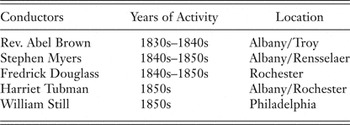
Once we mapped these relations, we asked ourselves the following questions. First, who were the conductors with whom Tubman associated, and how did these individuals assemble the necessary individuals and resources to assist her with her objective? Second, what strategies did she use to rescue her friends and family from a Maryland plantation? Answers to the first question can be found in Table 1 and Appendix A, which give a brief description of each person's life, and his or her association with the UGRR in New York State. The second question, although certainly more complicated than the first, has not adequately been answered in the literature. Instead, students of Tubman and the UGRR have focused their attention on discussing her legendary accomplishments, rather than understanding the strategies that she used to succeed with her objective.
UGRR Conductors in New York State

We argue that one of the primary reasons why Tubman and the UGRR conductors in New York State were able to transport her passengers so successfully is because of the way that she used her embedded network contacts (Granovetter Reference Granovetter1985; Uzzi Reference Uzzi1996) to manage her social capital (Bourdieu Reference Bourdieu and Richardson1986; Burt Reference Burt1992, Reference Burt1997b, Reference Burt1998; Coleman Reference Coleman1988; Lin et al., Reference Lin, Cook and Burt2001. To illustrate this, we begin by providing the following sociograms of each conductor's network. We start with Reverend Abel Brown.
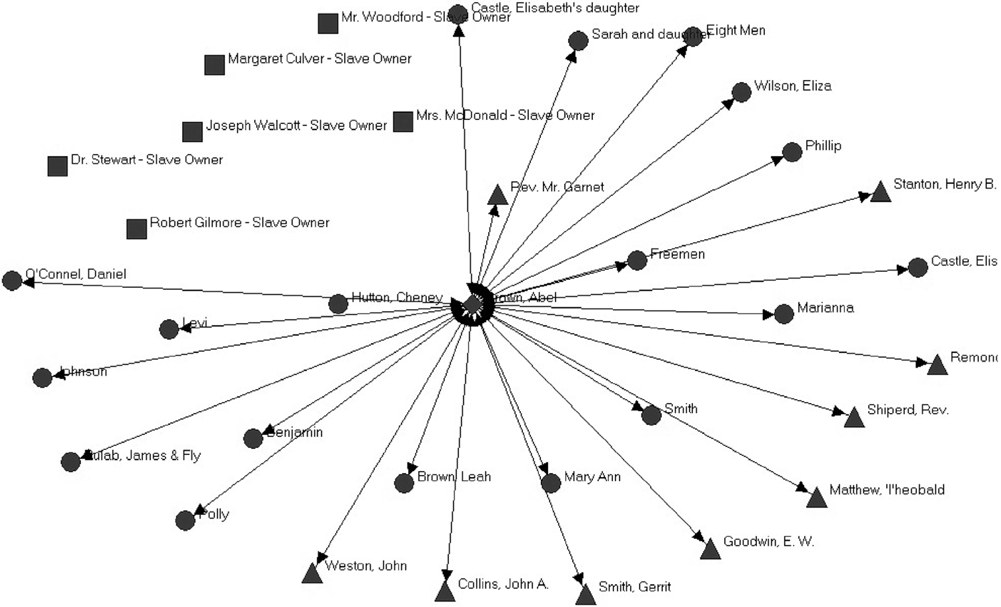
As Table 1 suggests, Brown was active in the UGRR between 1830–1844.Footnote 10Figure 1 is a sociogram of his network. He maintained contact with many people during his tenure as one of the first UGRR conductors in the upstate area. From our reading of the literature, he associated with at least 43 individuals, each of whom were, in some fashion, connected to his efforts as a UGRR conductor. His association with each of the planters notwithstanding,Footnote 11 he appeared to be associated with a wide range of individuals. Figure 1 shows Brown's connections to some of the fugitives that he helped escape, and members of the Vigilance Committee that he was the primary organizer of in 1842. His activity with this group led to him publishing a newspaper called the Tocsin of Liberty, in which he daringly not only published the first names of fugitives he helped, but also the names of the plantation owners. He was so provocative and helped so many that slave owners sent arrest warrants from distant cities seeking his capture. He was so bold that he often taunted specific planters from whom he helped enslaved fugitives escape by publicly requesting that they reimburse him for feeding and providing shelter to fugitives. It is reported that he helped more than 350 fugitives in 1842 alone (Brown Reference Brown1849).Footnote 12
Rev. Abel Brown's (center with diamond-shaped node) network with connections to the Vigilance Committee (up-triangle-shaped nodes) and some of the fugitives (circle-shaped nodes) he helped to escape (those without connections were slave owners—square nodes)

Brown's association with abolitionist Henry Stanton paved the way for his association with Stephen Myers in Albany—a Black abolitionist, member of the local Vigilance Committee, and publisher of the area's Black newspaper. Figure 2 shows Myers' network. Through his association with Stanton, Myers met prominent abolitionist Issac T. Hopper, who operated a UGRR station in New York City; James and Lucretia Mott, two of the station operators in Philadelphia; and Gerrit Smith of Peterboro, who was a major philanthropist and funder of many UGRR efforts in the state. Myers met Frederick Douglass when Myers and his expanding network helped Douglass escape in 1838 (Clifford-Larson Reference Clifford-Larson2004, p. 93). Also part of this network was William Still, the primary conductor of the Philadelphia station. William Still collected demographic information on every freedom seeker whom he helped to make her or his way to freedom.Footnote 13
Sociogram of Stephen Myers' Network

Figure 3 presents the network of Frederick Douglass. As Clifford-Larson (Reference Clifford-Larson2004, p. 93) states, Douglass, who operated a station from his location in Rochester, continued his associations with individuals who either helped him escape or whom he met during his travels as a well-sought speaker on the abolitionist speaker circuit. Some of these individuals are included in Figure 3: Harriet Beecher Stowe, author of Uncle Tom's Cabin (Bordewich Reference Bordewich2005; Gara Reference Gara1961; Clifford-Larson Reference Clifford-Larson2004); Susan B. Anthony, a pioneer of the women's movement; and John Brown, the prominent abolitionist best known for his failed take-over attempt at Harper's Ferry (Gara Reference Gara1961; Siebert Reference Siebert1898). However, it was Douglass' association with Elizabeth Cady Stanton, a co-founder of the women's rights movement, whom he later introduced to Harriet Tubman that helped transform Tubman's localized effort into a legitimate underground movement. Stanton used her contacts to help Tubman identify individuals who would help her. Together, these women helped shift the tide of the slavery institution in the state and the nation (Bordewich Reference Bordewich2005).
Sociogram of Frederick Douglass' Network

In many ways, Tubman's entry on the scene is at the end of the drama, and yet, her contribution has captured the contemporary imagination as a symbol of the period that stretched far beyond her work. For many, Tubman's life and association with the UGRR has become legendary; indeed, her “Superman” status led to her being described as the “Moses of Her People” by many of her contemporaries and others, even years after her death (Bordewich Reference Bordewich2005; Bradford Reference Bradford1886; Clifford-Larson Reference Clifford-Larson2004; Still Reference Still1872). Stories about her life and the UGRR center on her role as its most famous conductor. Indeed, her monumental efforts to bring away enslaved family and friends elevated her status to that of a heroine without equal (Clifford-Larson Reference Clifford-Larson2004). However, before now, little has been known about the networking strategies that she used to maintain a competitive advantage over the planters from whom she liberated enslaved African Americans.
Making Sense of Tubman
To gain a better understanding of Tubman and the ways in which she accomplished her legendary feats, it is important to know a little about her background before she migrated to upstate New York. Tubman, who was enslaved on the Eastern Shore of Maryland, spent much of her adult life suffering from epileptic seizures that resulted from a blow to the head by an angry overseer. She appeared to recognize at an early age that establishing the “right” relationships could serve useful to her later in life. With the assistance of an organized group of contacts she made during her childhood and early adult years, as well as the help of the North Star in the sky, she escaped from bondage when she was twenty-seven. According to Clifford-Larson, Tubman “relied upon a long-established, intricate, and secretive web of communication and support among African Americans to effect her rescues” (Reference Clifford-Larson2004, p. xvii). Over the next ten years, she developed a web of interracial associations across at least five states that would assist her in helping at least seventy or more enslaved actors find their way to freedom (Clifford-Larson Reference Clifford-Larson2004).
Tubman built her network based on two primary experiences. First, like many of her enslaved comrades, she became accustomed to being “hired out” by her owner to work at other plantations. This practice often led to many enslaved actors traveling back and forth between plantations. It was during one of these visits that she received her near fatal blow. The accident had another consequence. As Clifford-Larson states, “The head injury also coincided with an explosion of religious enthusiasm and vivid imagery” (Clifford-Larson Reference Clifford-Larson2004, p. 43) that was rooted in Methodist teachings. Tubman believed that these episodes allowed her to predict the future. This conviction persuaded some that she had spiritual powers, and often brought her closer to those whom she encountered during her “hired-out days” who shared similar religious beliefs. Eventually, she gained the trust of the plantation owner: he allowed her to hire out her skills after paying him a set wage for the year (Clifford-Larson Reference Clifford-Larson2004, p. 54). This process may have led to her discovering the importance of assembling a network to escape her situation.
The second and perhaps more significant experience that allowed her to see the value of building a network of trusted relationships came from her work on a timber gang. This experience exposed her to “the secret communication networks that were the province of black watermen and other free and enslaved blacks” (Clifford-Larson Reference Clifford-Larson2004, p. 65). While she interacted in this exclusively male world, she learned what they learned: the safe places, the travel routes, the sympathetic Whites, and the dangers that these men learned about from their travels. Taken together, these experiences helped Tubman build her network of trusted individuals and information that helped her along her path of freeing others. To better understand this, please consider the following.
TUBMAN—THROUGH TIME AND SPACE: 1851–1858
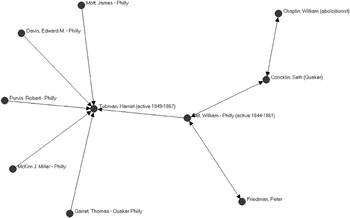
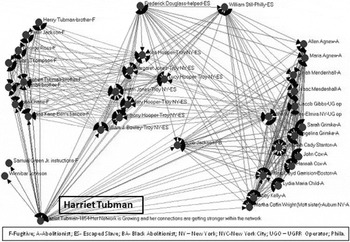
Figure 4 shows the initial set of relationships that Harriet Tubman made when she escaped to freedom from Dr. Anthony C. Thompson's Bellefield residence and made her way to Hannah Leverton's house (Clifford-Larson Reference Clifford-Larson2004). It is believed that Hannah Leverton may have had a role in Tubman's escape from the Eastern Shore and “traveling mostly at night, following the North Star and stopping at each new house she was directed to, Tubman finally crossed the border and into freedom in Pennsylvania” (Clifford-Larson Reference Clifford-Larson2004). It was in Pennsylvania that Tubman made her first contact with William Still, Conductor of the Philadelphia UGRR station. Still was informed of Tubman's arrival by Thomas Garrett of Wilmington, Delaware. Though Garrett became an admirer of Tubman in the later years, his connection to her during her escape is not clear, hence he does not appear in this sociogram. Later in her journey, she was aided by another White woman who some believe was a Quaker because “it was Quakers who gave escaping slaves the most aid” (Clifford-Larson Reference Clifford-Larson2004, p. 84). Although not every Quaker was as sympathetic to fugitives, many were critical in providing social and financial resources to those in need and in “providing a groundswell of activism to end slavery throughout the young nation, in addition to establishing a loose network of like-minded individuals who could be tapped to help freedom seekers find their way north and provide support and shelter once they arrived” (Clifford-Larson Reference Clifford-Larson2004, p. 84). Thus, Tubman became exposed to an “existing local network of abolitionists and others, including free blacks and other slaves, who were willing to help slaves make their way to freedom” (Fig. 4a) which was “functioning well on the Eastern Shore by the time Tubman took her liberty” (Clifford-Larson Reference Clifford-Larson2004, p. 84).
Tubman's Escape in 1849

Sociogram of Harriet Tubman's Network with William Still

Tubman and Still eventually traveled to Albany, New York, where they met Stephen Myers, who then directed Tubman to Frederick Douglass in Rochester. It was because of Douglass and his association with the women's rights movement that Tubman eventually met several others who served as agents and friends of the UGRR in New York City: J. Miller McKim, Robert Purvis, Edward M. Davis, Lucretia and James Mott; the Mott sisters, and Stephen Myers, John H. Hooper, and others in Albany; and Samuel J. May and J.W. Loguen of Syracuse (Clifford-Larson Reference Clifford-Larson2004, p. 94). Ultimately, the communication network that functioned between Baltimore and the Eastern Shore and between Talbot, Dorchester, and Caroline Counties, was dependent upon people whom Douglass and Tubman both knew. Through her association with Still and Lucretia Mott, a Quaker and abolitionist who often “provided for Tubman's financial and physical needs” (Clifford-Larson Reference Clifford-Larson2004, p. 94), Tubman gained access to Isaac and Dinah Mendenhall, Allen and Maria Agnew, John and Hannah Cox, Martha Coffin Wright (Lucretia's sister from Auburn, New York), and Elizabeth Cady Stanton. Taken together, these actors helped organize the first women's rights convention (Clifford-Larson Reference Clifford-Larson2004, p. 107).
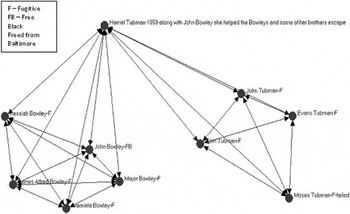
Figure 5 shows Tubman's network in 1850. In December 1850, Tubman returned to Maryland. Along with John Bowley, husband of her niece Kessiah, she devised a plan to save a member of her family from the auction block. She was aided by her brother-in-law, Tom Tubman, allowing her to rescue Kessiah and her children, James Alfred and Araminta, and to facilitate their escape to Philadelphia (Clifford-Larson Reference Clifford-Larson2004). On their way to Philadelphia, they met Major Bowley, John's brother, and recuperated with him before reaching Philadelphia (Clifford-Larson Reference Clifford-Larson2004).
Tubman along with John Bowley helping some slaves escape—1850

Figure 6 shows the contacts that Tubman used upon her return to the Eastern Shore in the fall of 1851 to help her husband escape; however, she found that he had taken another wife, a free woman named Caroline. When he refused to join Tubman to escape, she gathered a group of slaves and brought them with her to Philadelphia. Meanwhile, Congress passed the Fugitive Slave Act in September of 1850 to placate the Southerners. Philadelphia, and all other Northern cities, became unsafe for Tubman and her family and friends. Despite this threat, Tubman continued to plan the escapes of many of her still-enslaved family members. She started by taking several escaped slaves to Canada, via New York City, Albany, and Rochester, and then onwards to St. Catharines, Canada. In this attempt, she relied on the aid of Frederick Douglass (who himself had escaped in 1838) and his network of supporters: Thomas Garrett of Wilmington, Delaware; J. Miller McKim, William Still, Robert Purvis, Edward M. Davis, Lucretia & James Mott and others in Philadelphia; Oliver Johnson and Isaac T. Hopper in New York City; the Mott sisters, Stephen Myers, John H. Hooper and others in Albany; the Reverends Samuel J. May and J.W. Loguen of Syracuse; and J. P. Morris, Isaac Post and others in Rochester (Clifford-Larson Reference Clifford-Larson2004). While there is little documentation to support any previous contact between Douglass and Tubman before Tubman's own escape, they developed a deep respect and admiration for one another but never really revealed the strength of their relationship (Clifford-Larson Reference Clifford-Larson2004, p. 94). It is assumed they kept it this way to protect the identities of several vulnerable Blacks and Whites still living in Maryland. It is possible that Douglass and Tubman may have shared strong familial and community ties (Clifford-Larson Reference Clifford-Larson2004, p. 95), and it is these relationships that Tubman leveraged as she made her way to St. Catharines with eleven fugitives.
Tubman in 1851, expanding her network to include members of the movement in New York, Delaware and Philadelphia

Figure 7 shows Tubman's network in Dorchester County in 1854. Although she returned to this area in late 1852 to rescue her brothers Robert, Benjamin, and Henry, she was unsuccessful in her attempts to liberate them. While she was able to help her brother Moses escape in 1850, in both her trips between 1852 and early 1854, she failed to bring members of her family away to safety. Despite these setbacks, she continued to live and work in Philadelphia in 1853 and 1854. While there, Tubman began to associate with a small but powerful group of northern abolitionists, “who were at times overwhelmed by the force of her personality” (Clifford-Larson Reference Clifford-Larson2004, p. 107). Lucretia Coffin Mott, a Quaker living in Philadelphia, was one of the earliest to provide financial and physical support to Tubman:
“Through Mott and William Still, Tubman gained access to other prominent white and black antislavery activists and Underground Railroad operators in the greater Philadelphia community, including Isaac and Dinah Mendenhall, Allen and Maria Agnew, and John and Hannah Cox from Chester County. Lucretia, her sister Martha Coffin Wright of Auburn, New York, Elizabeth Cady Stanton (suffragist movement) and Frederick Douglass were part of a group of reformers who conducted the first women's rights convention in Seneca Falls, NY in 1848”
(Clifford-Larson Reference Clifford-Larson2004, 107).Since Mott was also a close friend of William Lloyd Garrison of Boston, Tubman's contacts now extended all the way to New England. In December 1854, Tubman, with the help of Jacob Jackson, a free Black living in Dorchester County, was able to successfully help her brothers Henry, Robert, and Benjamin; Benjamin's fiancée Jane Kane; John Chase, a slave of John Campbell Henry; Peter Jackson, a slave of George Winthrop, a Cambridge area farmer; and George Ross and William Thompson, slaves of Lewis N. Wright, another Delaware farmer (Clifford-Larson Reference Clifford-Larson2004). It is believed that Tubman's escape route took her to Wilmington, Delaware, where she stopped at Thomas Garrett's home, then on to Allen Agnew's house in Kennett, Chester County, and next to William Still in Philadelphia. The group then made their way north via New Jersey, New York City, New Bedford, Boston, and also central New York cities like Troy, Albany, Syracuse, Rochester, Buffalo, and finally the suspension bridge over Niagara Falls.
Tubman's network in 1854—There are stronger connections with active members of the Underground Railroad Movement including Abolitionists (A), Escaped Slaves (ES), Free Blacks (FB) as she helped more Fugitives (F) to escape to freedom

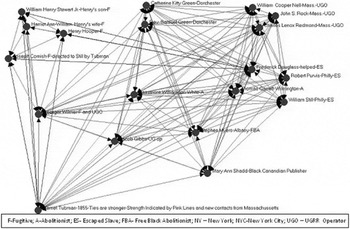
Figure 8 shows the expansion of Tubman's network to Massachusetts in 1855. During each of her forays into Dorchester County, Maryland to free her relatives and other slaves, Harriet Tubman received assistance from Jacob Gibbs in New York City and Stephen Myers in Albany. In Troy and Albany, Tubman reconnected with several family members and friends such as John and Mary Hooper, Anthony and Lucy Hooper, William and Margaret Jones, and William J. Bowley—all Maryland runaways. After ensuring that her family was safe in Canada, Tubman returned to Philadelphia to continue to work, earn more money, and continue her “personal campaign of liberation” (Clifford-Larson Reference Clifford-Larson2004, p. 122). It is believed that she attended the National Colored Convention, held in Philadelphia in October, 1855, where she likely met with Frederick Douglass, Jacob Gibbs, and Stephen Myers of New York; William Cooper Nell, Charles Lenox Remond, and John S. Rock from Massachusetts; and William Still, Robert Purvis, and others from Philadelphia. Reverend Samuel Green and his wife, Catherine “Kitty” Green, friends of Harriet Tubman, may have also been present. While men appeared to dominate the convention, Harriet Tubman and Mary Ann Shadd, publisher of the Provincial Freeman, an influential Black Canadian newspaper, were among the few women present, but were visible in their involvement. Tubman and her friend Catherine Green also took time to visit Passmore Williamson, an influential White abolitionist incarcerated in the Moyamensing Prison in Philadelphia. Williamson and others became great admirers of Tubman's tenacity and commitment to the freedom of the enslaved Black.
Harriet Tubman in 1855 Expanding Her Contacts to Massachusetts

In 1856, Thomas Garrett, who had by then become another admirer of Harriet Tubman, wrote about her to Eliza Wigham, secretary of the Ladies Emancipation Society of Edinburgh, Scotland. The sociogram in Figure 9 shows this and other relationships. Wigham and her sister, Mary Edmundson, were both staunch abolitionists and Quakers who raised funds for the anti-slavery campaigns and efforts of Garrett, Douglass, William Lloyd Garrison, and Wendell Phillips. In early December 1855, Tubman helped Henry Hooper escape, but failed to help her sister Rachel, her sister-in-law Mary Manokey, and Manokey's three children escape. In May of 1856, Garrett wrote to J. Miller McKim and William Still that he had forwarded four unidentified young men to Longwood, and that Tubman would follow the next day. Tubman arrived with the four men. Independent of this, Jesse Slacum, a freedom seeker from Dorchester County had made his way to Still's office. Tubman fell ill during the summer of 1856, but arrived in Philadelphia in September of 1856. She was able to bring Tilly (a young lover of an escaped fugitive in Canada), Francis Molock, Cyrus Mitchell, Joshua Handy, Charles Dutton, Ephraim Hudson, Josiah (Joe) Bailey, Bill Bailey, Peter Pennington, and Eliza Manokey to freedom. During their escape they sought shelter with William Brinkley, a free Black until they were able to make their way past Dover, Smyrna, and Blackbird, Delaware, at which stage other Underground Railroad operators were able to take charge of them (Clifford-Larson Reference Clifford-Larson2004).
Tubman's Network in 1856

Harriet Tubman was very active in 1857, helping her aged parents, Ben and Rit, escape to Canada, but she was unsuccessful in helping her sister Rachel and Rachel's children Ben and Angeline escape. However, she was able to help a large group of thirty-nine slaves make their own plans to escape. She also assisted the escape of a group called “The Dover Eight” (Lavinia Woolfley, James Woolfley, Thomas Elliott, Henry Predeaux, Denard Hughes, William and Emily Kiah, and an unidentified eighth man) (Figure 10). News began to circulate that Tubman's friend Reverend Samuel Green may have played a role in the escape of the Dover Eight, and he was promptly arrested. During this time, there were two occasions when large groups of slaves (twenty-eight at one time and possibly forty at another) made their own plans to escape and were quite successful. Tubman's efforts had set into motion a chain of events that led to many such incidents. Tubman's epithet, “Moses of Her People” had begun to take hold (Clifford-Larson Reference Clifford-Larson2004).
Tubman's Network in 1857

Attempts, some successful, some not, were continuously being made by enslaved Blacks to escape. Many acted alone, while others tried in groups. During this time, Tubman became more involved in relief activities in St. Catharines, where she helped newly-arriving fugitives settle into lives as free men and women. As Figure 11 shows, her network now spanned New York, Philadelphia, Boston, Wilmington, Peterboro, Syracuse, Rochester, Albany, and parts of Canada. She channeled her energies into strengthening her network of Black and White friends and supporters throughout central New York and New England, and even came into contact with John Brown, both famous and infamous for his involvement in the failed raid of the Federal Arsenal at Harper's Ferry in 1859. Although she had no involvement in the raid or the planning of it, John Brown and Harriet Tubman became friends and respected one another's efforts. Through her forays to help free enslaved Blacks (family, friends and others) who were still back in the areas from which she had originally escaped, Tubman relentlessly leveraged the embedded contacts and resources in her and others' networks to aid her in her campaign.
Tubman's Network in 1858

Overall, Tubman used these contacts, the communications network that she developed from her experience with the African-American lumbermen, and the knowledge that she received from her experience traveling through the swamps of Maryland, to make at least thirteen trips back to Maryland to free family members and friends (Bordewich Reference Bordewich2005; Clifford-Larson Reference Clifford-Larson2004).
TUBMAN RECONSIDERED: TRUST AND CONFIDENCE IN THE MAKING OF SOCIAL CAPITAL AND FREEDOM
To be sure, Tubman lived an extraordinary life. Indeed, her life was one of remarkable bravery, determination, and sacrifice, and demonstrates her tenacious will to help others gain their freedom. But, we argue that her superhero status as a liberator must not be taken out of the social context in which she was embedded; mainly, the fact that she received assistance from several actors during her personal journey to freedom and during those times in which she helped others do the same.
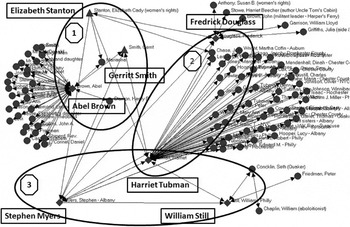
Figure 12 presents Tubman's communication network upon her arrival in New York.Footnote 14 From an interview that Siebert conducted with Tubman in Reference Siebert1898, she stated “when she left Philadelphia, she proceeded by steam railroad to New York, and from there she took the train to Albany, where Stephen Myers looked after her and her charges” (Clifford-Larson Reference Clifford-Larson2004, p. 94). According to Clifford-Larson, from there “she boarded a train bound for Rochester, where the fugitive slave, Frederick Douglass, would see that she got on the train for the Suspension Bridge and St. Catharine's in Canada” (Reference Clifford-Larson2004, p. 94). One of the individuals whom Tubman met as a result of her association with Myers and Douglass is James Mott. As the reader may recall, James and his wife Lucretia were prominent abolitionist in the Philadelphia area. While in Philadelphia, Tubman also met four other prominent abolitionists with whom she would later work very closely: Edward Davis, Robert Purvis, J. Miller McKim, and Thomas Garrett, a prominent Quaker. Taken together, these four men (Fig. 4a), along with Elizabeth Cady Stanton played an important role in Tubman's efforts, and took her communication effort to another level.
Sociogram of Whole Network of Harriet Tubman, Abel Brown, William Still, Stephen Myers and Frederick Douglass (indicated by diamonds), Gerrit Smith and Elizabeth Cady Stanton (depicted by up triangles)

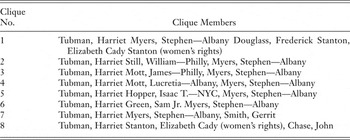
With the help of Douglass, Tubman met Stanton on the lecture circuit for women's rights. Figure 12, Oval 1 indicates the relationships among Abel Brown, Gerrit Smith, Elizabeth Cady Stanton and Henry Stanton. Oval 2 indicates the relationships among Harriet Tubman, Frederick Douglass, and John Chase, while Oval 3 indicates the relationships between Harriet Tubman, William Still and Stephen Myers. Gerrit Smith, who, as we see in Figures 13 and 14, enabled the transfer of Abel Brown's network contacts to Harriet Tubman, which she leveraged and utilized to the maximum as we see in the cliques listed in Table 4.
Sociogram of Whole Network of Harriet Tubman, Abel Brown, William Still, Stephen Myers and Frederick Douglass (indicated by diamonds), Gerrit Smith and Elizabeth Cady Stanton (depicted by up triangles)

Transfer of Complete Networks from Abel Brown via Gerrit Smith to Harriet Tubman

The members of this movement appeared to behave in ways that suggested that the operators of each segment carried out their activities without the benefit of much coordination; that is, because of the highly decentralized nature of their associations, there did not appear to exist many, if any opportunities for them to communicate their intentions before acting. Indeed, “The method of operating was not uniform but adapted to the requirements of each case … There was no regular organization, no constitution, no officers, no laws or agreement or rule except the “Golden Rule,' and every man did what seemed right in his own eyes.”Footnote 15 In fact, when “danger was immediate, and proslavery forces were strong, few who were involved in the underground knew the names of collaborators farther away than the next town or two. In ardently abolitionist areas, however, it was less a secret movement than it was a public one that kept its activities secret only from its enemies” (Bordewich Reference Bordewich2005, p. 5). Such behavior, we argue, required extreme confidence and trust—two things that, when taken together, Simmel (Reference Simmel1990, p. 317) argues are critical in determining the success of any private society.
Transferring Trust
We believe that part of Tubman's success, and the success of the other conductors and their passengers, was made possible by a well-coordinated, secret effort that involved the transfer of trust. Simmel discussed the importance of such efforts as Zweckerverband: groups in which membership is “based on some particular interest, more especially that which involves completely objective member contributions, determined by mere membership” (Reference Simmel1990, p. 317). Like monetary arrangements, such situations exist because “interaction, solidarity, and the pursuit of common purpose do not depend on everybody's psychological knowledge of everybody else” (p. 317). According to Simmel, individuals are only responsible for their particular functions, and the manner in which they achieve their success is not as relevant as their need for maintaining a “discreet sociological form par excellence” of their activities and the psychological anonymity of other members (p. 317).
According to Mollering (Reference Mollering2001, p. 404), trust is “a state of favorable expectation regarding other people's actions and intentions.” It has been viewed as the basis for individual risk-taking (Coleman Reference Coleman1988), order (Misztal Reference Misztal1996), social capital (Bourdieu Reference Bourdieu and Richardson1986; Burt Reference Burt1992; Coleman Reference Coleman1988; Cook Reference Cook2001; Lin Reference Lin2000; Putnam Reference Putnam1995), and cooperation (Gambetta Reference Gambetta1988). But, contrary to the above scholarly interpretations, Simmel's ideas of trust do not focus on trust's foundations, but rather on the “actual expectations that human beings have when they reach the state of trust” (Mollering Reference Mollering2001, p. 404). For Simmel, trust is a force in which a “further element” exists within the concept that represents an “element of socio-psychological quasi-religious faith,” which he suggests can vary in importance, is “hard to describe, and concerns a state of mind that has nothing to do with knowledge, which is both less and more than knowledge” (Reference Simmel1990, p. 179). On the other hand, confidence for Simmel is an “antecedent form of knowledge” which is “intermediate between knowledge and ignorance about a man” and which is a “logical consequence of the view that complete knowledge or ignorance would eliminate the need for, or possibility of, trust” (p. 318).
Within this context, we argue that the trust and confidence that each conductor had in each of their contacts made it easier for Tubman to gain access to these actors to help her free her family and friends. We suggest that Still's apparent endorsement of Tubman created the conditions for the New York State conductors to trust her and her ability to succeed with her crusade. Exactly why the New York State conductors chose to invest in her is unclear; however, we believe that one possibility that may explain why these actors chose to transfer control of their contacts is that these conductors reached a state of favorable expectation regarding her and her actions and intentions. Specifically, we argue that Tubman's strong belief in Christianity, combined with her tenacious will to succeed, served as the basis for the “further element” of confidence to be invested in her abilities. In essence, it appears that the conductors' decision to help Tubman may have had very little to do with her knowledge of the landscape and more to do with her determination to save her family, her belief in the power of a higher authority to guide her actions, and their recognition that she had the skill and confidence to overcome any obstacle that would prevent her from succeeding with her mission. Further, we argue that her strong belief in Christianity fit in well with the spiritualized politics of the abolitionist movement and the evangelical trend of a growing number of Americans who supported the idea that every person should be free.Footnote 16 Taken together, these factors provided the basis for transferring expectations of trust from her colleagues, who in turn, transferred their contacts to her.
NETWORK STRUCTURE: MEASURING INSURGENT ACTION IN HARRIET TUBMAN'S UGRR NETWORK
To further our understanding of how Tubman achieved her objective with the assistance of the New York State UGRR, we computed several network measures of centrality and influence (Appendix B) based on previous work by Burt (Reference Burt1982), and later extended by Brass (Reference Brass1995).
The network approach used here utilizes the theories of social capital (Lin Reference Lin2000) and structural holes (Burt Reference Burt1992). Social capital has been defined as resources embedded in a social structure that are accessed and/or mobilized in purposive actions (Bourdieu Reference Bourdieu and Richardson1986; Coleman Reference Coleman1988; Lin et al., Reference Lin, Cook and Burt2001). Structural holes are gaps in social structure between nonredundant contacts (Burt Reference Burt1992). Both ideas are measures of structural factors that facilitate or constrain an actor's ability to participate in a network. We suggest that Tubman and her fellow UGRR conductors managed their social capital relationships to identify gaps in social structure—structural holes—between nonredundant contacts, so that they might be linked to influential alters that were in a position to help them. Thus, social capital, structural holes, and other social structures provided Tubman and other UGRR conductors with opportunities to invest their human resources by linking with people who were not themselves linked (Lin et al., Reference Lin, Cook and Burt2001).
To identify this social capital and the presence of structural holes among Tubman and her fellow UGRR conductors, we used UCINET (Borgatti et al., Reference Borgatti, Everett and Freeman2002) software to display the following measures of redundancy and constraint from egocentric networks, calculated from equations described by Burt (Reference Burt1992):
Effsize: Burt's measure of the effective size of ego's network. Essentially, the number of alters (other actors in the ego's network) minus the average degree of alters within the ego (main actor) network, not counting ties to ego. Scores range from zero to one hundred.
Efficiency: The effective size divided by the number of alters in ego's network. Scores range from zero to one. A perfectly efficient network is one that has a structural hole score of one.
Constraint: Burt's constraint measure is essentially a measure of the extent to which ego is invested in people who are invested in other of ego's alters. Scores range from zero to one. Scores closer to zero are an indication of an actor having few constraints on her/his actions within a network.
Hierarchy: Burt's adjustment of constraint indicates the extent to which constraint on ego is concentrated in a single alter. Similar to the constraint measure, scores closer to zero indicate the extent to which few constraints exist on an actor's behavior; but here the measure attempts to indicate if the constraints on an actor are best explained by his or her actions.
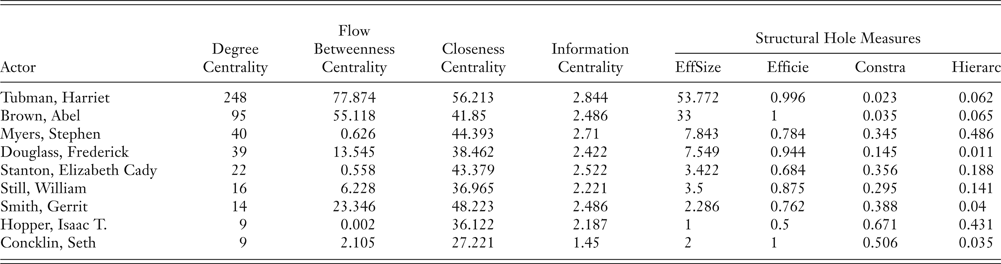
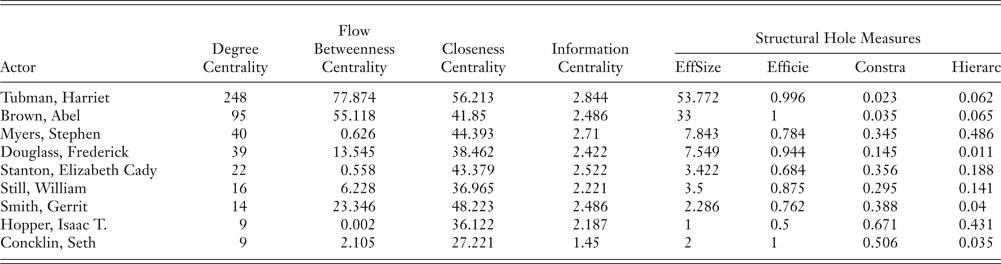
Table 2 presents centrality and structural hole measures computed of the UGRR conductors in New York State. Table 3 shows the descriptive statistics for these measures. Tubman's prominence and centrality in New York's UGRR network is indicated by her various centrality measures: degree (248), which indicates the number of direct connections and the extent of her potential influence on UGRR participants; flow betweenness (77.874), which shows that she had the strongest influence on the information that flowed in the UGRR network. Her closeness (56.213) and information (2.844) centrality scores may help explain her flow betweenness score: she was clearly in a better position than her UGRR counterparts to monitor the flow of information in the network. It appears that her network position put her in an excellent position to dictate, control, and monitor the activities and information of the actors in the UGRR network, thus reducing her “structured ignorance”Footnote 17 (Schwartz Reference Schwartz1976). The people who appear in a similar, but slightly less position than Tubman to influence the network's activities are Abel Brown's contacts. As stated earlier, Brown's work as an UGRR conductor in New York State laid the foundation for the success of future UGRR conductor efforts. Before Brown died in 1844 he successfully transferred his contacts to Myers. The degree centrality scores for the remaining UGRR conductors indicates that Myers (40), Douglass (39), and Still (16) were each directly connected to actors directly connected to Tubman's rescue effort. Of the three men, only Douglass appeared to be positioned to serve the role of broker for relationships and information (13.545), while Myers (44.393) was clearly in a slightly greater position to influence Tubman's UGRR activities than both Douglass (38.462) and Still (36.965).
Network Measures for the Main Actors in the Above Network
Descriptive Statistics

Definition of Terms/Measures
Network Centralization
Individual network centralities provide insight into the individual's location in the network. A very centralized network is dominated by one or a few very central nodes. If these nodes are removed or damaged, the network quickly fragments into unconnected sub-networks. A highly central node can become a single point of failure. Hubs are nodes with high degree and betweenness centrality. A less centralized network has no single point of failure. It is resilient in the face of many intentional attacks or random failures; that is, many nodes or links can fail while allowing the remaining nodes to still reach each other over other network paths. Networks of low centralization fail gracefully (Krebs 2008).
Degree Centrality
Social network researchers measure network activity for a node by using the concept of degrees—the number of direct connections a node has. Common wisdom in personal networks is “the more connections, the better.” This is not always the case. What really matters is where those connections lead—and how they connect the otherwise unconnected.
Betweenness Centrality
A node with high betweenness has great influence over what flows, and does not, in the network.
Closeness Centrality
The pattern of direct and indirect ties allows actors to access all the nodes in the network more quickly than anyone else. They have the shortest paths to all others—they are close to everyone else. They are in excellent positions to monitor the information flow in the network—they have the best view of what is happening in the network.
However, the work of two UGRR agents, Elizabeth Cady Stanton and Gerrit Smith, was also of critical importance in the functioning of the New York State UGRR and of Tubman's work. As indicated by their closeness centrality scores, both Cady Stanton's (43.379) and Smith's (48.223) influences are critical, as they appear to have as much, if not greater, influence on Tubman's UGRR network than some of the conductors by having short paths to others central to the UGRR effort, and in monitoring information (Cady Stanton, 2.522 and Smith, 2.486). Interestingly, Smith, working mainly as a philanthropist to the UGRR effort, appears to have the second shortest path (48.223) to others in the UGRR. Although he was restrained by his assets, which were complicated by the fact that he was very open about his work as one of the primary philanthropists of UGRR efforts,Footnote 18 Smith's influence in this realm may be best explained by his work as a broker and monitor of information: he had close ties to the political apparatus of the local area, and could alert his fellow UGRR colleagues of impending danger. Cady Stanton's connections to Douglass, Myers, and later Tubman make her a critical connection for Tubman's UGRR network. Both Cady Stanton's and Smith's roles could best be described as boundary spanners because of their connections to the primary conductors in New York State and because of their apparent centrality as brokers of information and influence in the UGRR.
Tubman's UGRR Network: The Structural Hole Effect
Tubman's role in the UGRR may best be explained by her ability to benefit from the presence of structural holes in her network. As the reader may recall, we posited earlier that she received the most benefit from her efforts because of the transfer of trust through the networks from previous UGRR conductors. This process allowed her to bridge structural holes in her network, which presented opportunities for her to invest her human resources and efforts by linking with people who were not previously linked (Lin et al., Reference Lin, Cook and Burt2001). Thus, Tubman appeared to recognize the contingent value of social capital: success in a social capital network is greatly enhanced, and is very much dependent upon the number of people doing the same work (Burt Reference Burt1997a). In Tubman's case, her ability to see the importance of transferring these networks allowed her to understand how she could innovate her skills as a conductor, and in the process, inspire fellow conductors to simulate her efforts; or put another way, her success was contingent on her ability to convince others to see the importance of being as secretive, as determined, and as committed to freeing family and friends as she was. Her efforts laid the foundation for an insurgent framework that included well-traveled, trusted maps of geographic areas, and individuals whom fugitive slaves could trust in their quest for freedom.
Tubman's structural hole story is interesting, but quite simple: she had a very effective social capital network. Because her network likely recognized the importance of its members believing in the same social capital equation (success = freedom), her effsize measure is very large (53.772). Further, for the reason just suggested, her network was very efficient (0.996), and few constraints (.023) impaired her ability to manage her efforts to free her family and friends. As her hierarchy score (0.62) indicates, she likely convinced her colleagues of the importance of working together to free their enslaved comrades. Evidence of this possibility can be seen in Figure 6, which shows Tubman's network after she received assistance from transferred networks to free her family and friends. Her structural hole scores not only reflect the fact that she was embedded in an environment rich with structural holes, but also that these disconnections may indicate that she was a loner: She was very secretive about her activities, not allowing many people to know about the strategies that she used to free enslaved actors, or the routes that she traveled to free them.
Table 4 shows the results from a clique analysis that was used to determine if there was cohesion in this network.Footnote 19 It shows Tubman's prominence in a clique or communication network. In all, eight cliques were found which appears to corroborate her centrality and structural-hole measure scores.
Clique Analysis for the Main Actors in the Above Network

We see from the eight cliques below, which have a good distribution of the main actors that information flowed well across these networks. In addition, it appears that at the command center, no member was isolated. The strong intra-responsiveness among these members was forged by a shared belief that slavery was to be opposed, that fugitives should have better lives, and to have trust in one another's ability to hold confidences. This behavior, we argue, enabled the formation of these cliques and enhanced cohesion among these individuals.
CONCLUSION
As we stated in the introduction, the Padgett and Ansell study provided the foundational basis for our analysis. Their paper is critical for making sense of how individual and collective actions can be modeled empirically. However, it is also important for another reason: Padgett and Ansell show how individuals working together can influence the political activities of states and nations. To understand state building, they assert, “one needs to penetrate beneath the veneer of formal institutions and apparently clear goals, down to the relational substratum of people's actual lives” (Reference Padgett and Ansell1993, p. 1310). Thus, they suggest that the work of building a nation is very much a network effort.
It is in this regard that we attempted to conduct our study of how Harriet Tubman managed an interracial group of like-minded individuals—Quakers, enslaved actors, free Blacks, Whites, Christians, philanthropists, and politicians—to initiate a very successful liberation movement.
Tubman's ability to rescue her family and friends led to her receiving the epithet “Superhero” by some of her associates (Bradford Reference Bradford1886; Conrad Reference Conrad1942). This label was prompted by the recognition that she had the skill and determination to overcome any obstacle that might prevent her from succeeding with her mission. But while there appears to be some truth in this statement, Tubman likely would not have achieved her success without the assistance of others, particularly their ability to help her identify and span structural holes in her environment. Operating in this way permitted the transfer of two important factors: trust and confidence. Both factors allowed Tubman's associates to succeed with their assigned objectives and allowed her to proceed with her incredible trips from Maryland to Upstate New York and Canada.
Our focus on Tubman's network and on how it allowed her to create a competitive advantage over plantation owners and others seeking to deter her from succeeding helps us to illuminate the strategies that she used to maintain this advantage. Critical attention on networks in general provides us with an advantage over traditional historical analyses and interpretations of her actions as a solo individual because such analyses are often constrained by atomistic interpretations of single persons and or single events. The network approach helps make this analysis possible by showing how relational ties act as channels for the transfer of resources and how the network's structural environment provides opportunities for and constraints on individuals and their actions (Wasserman and Faust, Reference Wasserman and Faust1994).
We believe that part of Harriet Tubman's well-documented success may be traced to what we call network transferability: the process that occurs when a trusted actor transfers his or her embedded relationships (Granovetter Reference Granovetter1985; Uzzi Reference Uzzi1996) to another trusted actor who seeks to acquire and use these relationships for the purpose of achieving a specific sort of action. This idea is similar to Burt's (Reference Burt1998) theory of how actors borrow network contacts for their purposes; however, it may be possible that Tubman's success was the result of an interracial social capital effort that involved the transfer of important contacts that assisted her with her attempt to free her family and friends from bondage on a Maryland plantation. Prominent White and Black abolitionists, free Blacks, and fugitive slaves worked together to assist Tubman by allowing her to gain access to and control over their network contacts. If this activity did occur, we argue that she received the greatest benefit from this process because she managed the newly-established relationships in a way that reduced her “structured ignorance” (Schwartz Reference Schwartz1976) and made her aware of the range of contacts that she had at her disposal. The key feature in Tubman's ability to engage in this movement was her ability to gain the trust and confidence of those from whom she sought assistance in achieving her objective, and the expectation of success that followed. We suggest that it was this expectation of success that resulted in prominent and well-connected UGRR members transferring access of their trusted contacts to her.
Essentially, having access to many networks gave her access to a broad group of actors, and created an opportunity for her to make sure that her associates agreed with her about the importance of her objective. Network transferability clarifies the process of her legendary task by illuminating how she managed her social structure of overlapping network contacts to create this possibility and thus achieve her objective. Our future work in this area will explore the extent to which other actors associated with the UGRR followed Tubman's blueprint.
In the final analysis, this article represents the first attempt to model empirically the community capacity of Harriett Tubman, a complex historical figure who has long been understood almost exclusively in folklore terms. Our use of historical sources provided us with a unique glimpse into the process that Tubman used to assemble her freedom network. However, there is a danger in collecting this type of data: it forces researchers to speculate about a person's actions and motivations on the basis of limited information. To be sure, while we are forced to speculate about the strategies that Tubman used to garner support, we believe that our interpretation provides insight into how she assembled her multi-regional, interracial network. What we gained from the process is a new way to collect and interpret network data, and a new way to measure the empirical impact of an actor in a social movement.Footnote 20 While the received academic wisdom of some (McAdam Reference McAdam1982, Reference McAdam1988, Reference McAdam and Traugott1995; McCarthy and Zald, Reference McCarthy and Zald1977; Minkoff Reference Minkoff1997; Morris Reference Morris1984; Tarrow Reference Tarrow1994; Zald Reference Zald1988) is that the civil rights movement was critical in shaping the trajectories of other movements for social change by creating opportunities for activism by other groups, such as women, progressive students, gay men and lesbians (McAdam Reference McAdam and Traugott1995), we argue that the network approach developed here has a direct bearing on the works of these authors because it helps to provide empirical meaning to the actions of movement participants and illuminates the importance of trust and confidence for the formation of a protest network. Given that organizational dynamics allow protest cycles to grow and flourish (Minkoff Reference Minkoff1997), we suggest that protest networks built because of the trust and confidence actors have in potential alters allow movement participants to see that possibilities for social action exist and can be acted on by capable individuals. Focusing on how Tubman assembled her networks allowed us to make sense of the reason(s) why they were created, and the factors that might explain why so many people in contact with her appeared never to betray her. Again, we believe that the concept of network transferability helps clarify those complicated processes. It is our hope that researchers will see the benefit of this approach for making sense of other historical events and episodes.
In short, a feat of this magnitude would have been very difficult to achieve without the leadership of an exceptional person. However, to accomplish these amazing feats, it did not take a Superman after all. It took a Superwoman with an incredible network. A Superwoman named Tubman.
APPENDIX A
Descriptions of UGRR Conductors and Agents
Rev. Abel Brown
Abel Brown was born in Springfield, Massachusetts in 1810. He began a career as a Baptist minister at age twenty-two as a temperance preacher. A radical abolitionist, he was active in Albany, Troy and Sand Lake around the late 1830s, and early 1840s. He was noted as an uncompromising and provocative individual who went to great lengths for the cause of the abolition of slavery. He was very active in assisting fugitives and not at all secretive about it.
Stephen Myers
Stephen Myers was born in 1800 in Rensselaer County as a slave. Freed at age eighteen, he became a leading spokesperson for anti-slavery activity and rights for African Americans. He and his wife Harriet published a newspaper called the Northern Star and Freedman's Advocate. He came to be the most important leader of the local UGRR movement from the 1830s through the 1850s. Without a doubt, Stephen Myers assisted thousands of individuals to move through Albany to points west, north, and east on the UGRR. At first, in the early 1840s, he used his own resources and those of the Northern Star Association, which he headed, and which published his newspaper. Later, in the 1850s, he was the principal agent of the UGRR in Albany. Under his leadership, the Albany branch of the UGRR was regarded as the most successful unit of the UGRR in New York State.
Harriet Tubman
Harriet Tubman is perhaps the best-known figure related to the UGRR. Her life and character are an outstanding example of selfless dedication to freedom and the abolition of slavery. She was born a slave in Bucktown, near Cambridge, Maryland around 1820 as Araminta Ross. She came to be known by her mother's name, Harriet, in her early life. In 1844, she married a free Black named John Tubman. She escaped from slavery in 1849 and went to Philadelphia, vowing to return for other members of her family and to help others escape. She made her first trip back to the south after the passage of the Fugitive Slave Law of 1850, and returned at least twelve times. She went on to be a scout and nurse for the Union Army in the Civil War. She was the first woman to lead a U.S. armed forces unit into battle. After the war, she settled in the Auburn area of New York State and sought to establish a home for aged former slaves.
Frederick Douglass
Frederick Douglass was one of the foremost leaders of the abolitionist movement. A brilliant orator, Douglass was asked by the American Anti-Slavery Society to engage in a tour of lectures, and so became recognized as one of America's first great Black speakers. He won world fame when his autobiography was published in 1845. Two years later, he began publishing an antislavery paper called the North Star. Douglass fought for the adoption of constitutional amendments guaranteeing voting rights and other civil liberties for Blacks. Douglass provided a powerful voice for human rights during this period of American history and is still revered today for his contributions against racial injustice.
William Still
William Still was born near Medford, in Burlington County, New Jersey. His father, Levin Steel, was a former slave who had purchased his own freedom and changed his name to Still to protect his wife Sidney, who had escaped from slavery in Maryland. He was in a unique position to provide room and board for many of the fugitives who rested in Philadelphia before resuming their journey to Canada. One of those former slaves turned out to be his own brother, Peter Still, left in bondage by his mother when she had escaped forty years earlier. William Still later reported that finding his brother led him to preserve careful records concerning former slaves, which provided valuable source material for his book, The Underground Railroad (Reference Still1872).
Elizabeth Cady Stanton
Elizabeth Cady Stanton (1815–1902) is believed to have been the driving force behind the 1848 Convention, and for the next fifty years played a leadership role in the women's rights movement. Somewhat overshadowed in popular memory by her long-time colleague Susan B. Anthony, Stanton was for many years the architect and author of the movement's most important strategies and documents. Stanton had an early introduction to the reform movements, including encounters as a young woman with fugitive slaves at the home of her cousin Gerrit Smith. It was at Smith's home that she also met her husband Henry Stanton. She played a critical role in the UGRR in New York State. Since her death in 1902, she has become regarded as one of the true major forces in the drive toward equal rights for women in the United States and throughout the world.
Gerrit Smith
Gerrit Smith was a widely-known philanthropist and social reformer who ran for President in 1848. He was born in Utica, New York in 1797 and lived in nearby Peterboro. He was Elizabeth Cady's first cousin. It was at Smith's home in Peterboro, New York that Elizabeth Cady met fellow abolitionist and future husband Henry Stanton. Elizabeth Cady Stanton met many other people at Smith's home, including his daughter, Elizabeth Smith Miller. Gerrit Smith was a financial supporter of John Brown, and was implicated in the raid on Harper's Ferry. Smith's commitment to social justice was wide-ranging. He was a major player in various anti-slavery and temperance societies. As a philanthropist he gave away forty acres of Adirondack land in Northern New York to 3000 poor (and “temperate”) African Americans, to permit them to meet the requirements for voting, and in hopes of promoting self-sufficiency. Smith was a candidate for President in 1848, 1856 and 1860. He served in the United States Congress, and was the only avowed abolitionist to do so. In all, it is estimated that Smith's philanthropy reached $8 million before he died.
APPENDIX B
Network and Centrality Measures (Brass Reference Brass1995)
Measure of Ties
Direct Links—Direct path between two actors in a network.
Indirect Links—One or more others mediate the path between two actors.
Strength—The amount of time spent, emotional intensity, intimacy, or reciprocal services between two actors. Frequency or multiplexity are both often used to measure the strength of a tie.
Direction—The extent to which the link is from one actor to another.
Symmetry (reciprocity)—The extent to which the relationship (link) is bi-directional.
Measures Assigned to Individual Actors (Brass Reference Brass1995)
Centrality—This is the extent to which an actor is central to the network. Various measures (including degree, closeness, and betweenness) have been used as indicators of centrality. Some measures of centrality weight an actor's links to others by centrality of those others.
Degree—The number of direct connections a node has. A central actor can be the one with the most direct connections in the network. This actor can be called the connector or hub. People in the immediate cluster are called the clique. In-degree is the number of directional links to the actor from other actors (in-coming links). Out-degree is the number of directional links from the actor to other actors (out-coming links).
Betweenness—While one actor may have many direct ties, another actor, though having fewer direct connections—less than the average in the network—can have a better location in the network, especially if he or she is between two important constituencies. This actor then plays a ‘broker’ role in the network, a powerful role which can also be a single point of failure to another network for which the actor is the sole outside connection. A node with high betweenness has great influence over what flows in the network.
Closeness—There could also be other actors in the network who have fewer connections than the central actor. If such actors have direct and indirect ties that allow them access to all the nodes in the network more quickly than anyone else, and they have the shortest paths to all others (i.e., they are close to everyone else), then these actors are in an excellent position to monitor the information flow in the network.
Boundary Spanners—Boundary spanners are more central than their immediate neighbors, whose connections are only local within their immediate cluster. Boundary spanners are well positioned to be innovators, since they have access to ideas and information flowing in other clusters. They are in a position to combine different ideas and knowledge into new products and services.