Colonization with multidrug-resistant organisms (MDROs) poses morbidity and mortality risks for nursing home patients. Reference Cassone and Mody1 Infection with MDROs complicates pre-existing treatment, lengthens the convalescence period, and introduces selective pressures for antibiotic resistance. Reference Montoya, Cassone and Mody2
Active surveillance for MDRO colonization permits the timely initiation of risk-management strategies, including transmission-based precautions, cohorting, and decolonization interventions. Reference Cassone and Mody1,Reference Montoya, Cassone and Mody2 Although active surveillance is a valuable tool, obtaining specimens, particularly at invasive sites such as the perineum, can be time-consuming and uncomfortable for patients, thereby potentially inducing healthy participant bias.
In this study, we conducted secondary analysis of a prospective, longitudinal cohort study (1) to evaluate whether there are differences between populations of nursing home patients with and without perianal specimens collected during eligible study visits and (2) to assess whether multianatomical, nonperianal screening and room environment surveillance could replace perianal screening.
Methods
Study design
In this study, we performed secondary analysis of data collected from a prospective, longitudinal cohort study of recently admitted patients in 6 Michigan nursing homes. Reference Mody, Foxman and Bradley3 Surveillance cultures were collected from the patient’s dominant hand, nares, groin, and perianal area and from multiple high-touch room environment surfaces on enrollment, days 14 and 30, and monthly thereafter for up to 6 months or discharge. Reference Mody, Foxman and Bradley3 Methicillin-resistant Staphylococcus aureus (MRSA), vancomycin-resistant enterococci (VRE), and resistant Gram-negative bacilli (R-GNB) were identified using microbiological methods described elsewhere. Reference Mody, Foxman and Bradley3
Patient characteristics were collected by trained research personnel at study enrollment, including demographics, Charlson Comorbidity Index (CCI) score, Reference Charlson, Szatrowski, Peterson and Gold4 Physical Self-Maintenance Scale (PSMS) score, Reference Lawton and Brody5 presence of indwelling devices (urinary catheter or feeding tube), presence of open wounds and 30-day history of antibiotic exposure. Discharge destination and duration of nursing home stay were collected using the Minimum Data Set 3.0. Reference Saliba and Buchanan6
To investigate whether perianal screening may lead to healthy participant bias, we compared the baseline characteristics, colonization status, and room environment contamination of patients for whom samples from all 4 body sites were collected during at least 1 study visit (533 patients; 1,026 complete visits) to patients for whom all of the aforementioned specimens except the perianal specimen were collected during at least 1 study visit (108 patients; 168 eligible visits). Healthy participant bias can occur when there are relevant differences in patients who participate or allow perianal screening compared with those who do not. Reference Tripepi, Jager, Dekker and Zoccali7
Next, we focused on the 1,026 study visits for which all body site specimens were collected to assess whether alternative surveillance strategies could replace perianal screening. Specifically, we evaluated the ability (eg, sensitivity and specificity) of nonperianal sites and environmental surveillance to detect MDRO-colonized patients identified when screening all body sites.
Study visits were eligible for this analysis if all body sites (hands, nares, groin, and perianal area) were collected. Visits with missing microbiological data were excluded. Nonperianal area anatomical sites were successively added to the panel to evaluate the contribution of nonperianal specimens to MDRO detection.
Next, we evaluated the contribution of room environment surveillance to MDRO detection, separately and added to the final panel of nonperianal sites. High-touch room environment specimens included in this panel: bed controls, bedside table, call button, bedside curtain, toilet seat, doorknob, TV remote, and bed rail.
Statistical analysis
To investigate differences between patients with and without perianal specimens collected during eligible study visits, we used the χ2 test and 2-sample t tests. Univariable logistic regression was used to evaluate whether baseline differences in patient colonization and room environment contamination exist between subgroups.
To assess whether alternative sites could replace perianal screening, the site of colonization was categorized into 2 groups: perianal and nonperianal. We evaluated the sensitivity and specificity of multisite surveillance using combinations of nonperianal sites and room environment surveillance. Panel sensitivity was calculated as the number of colonized visits detected by the screening panel divided by the total number of colonized visits. Colonized visits were defined as visits in which the patient was MDRO-positive at 1 or more anatomical sites. These analyses were conducted separately for each MDRO.
All analyses were conducted using SAS version 9.4 (SAS Institute, Cary, NC).
Results
Patient characteristics
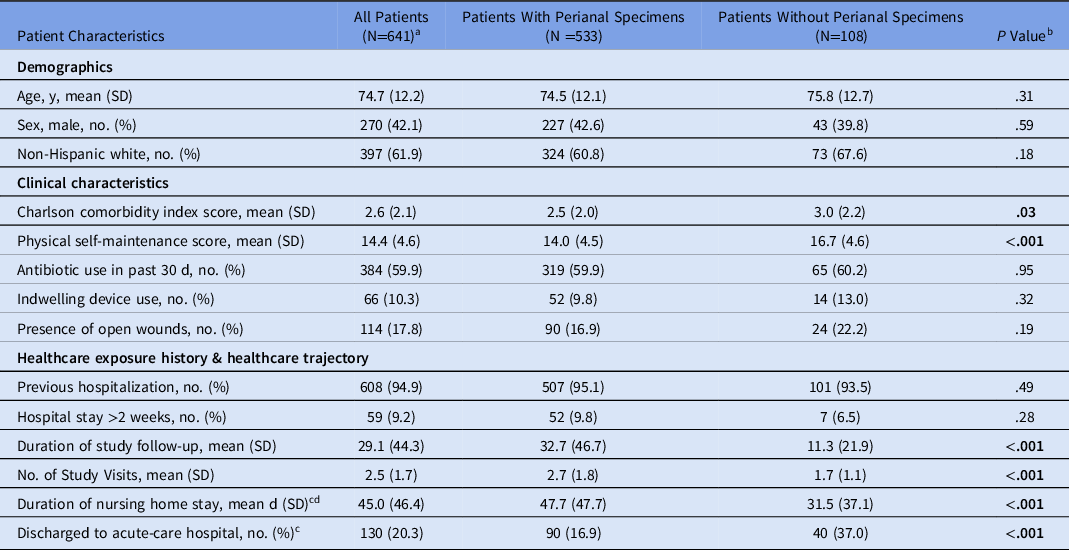
Of 651 enrolled patients, 641 had hands, nares, and groin specimens collected during at least 1 study visit and met the eligibility criteria (Supplementary Fig. 1 online). The average age was 74.7 years (SD, 12.2), 42.1% were male, 61.9% were non-Hispanic white, and 37.8% were black. On enrollment, the average CCI score was 2.6 (SD, 2.1); the average PSMS score was 14.4 (SD, 4.6); 10.3% had 1 or more indwelling devices; and 59.9% had a documented antibiotic exposure within the preceding 30 days. The average follow-up time was 29.1 days (SD, 44.3) and the average number of study visits was 2.5 (SD, 1.7).
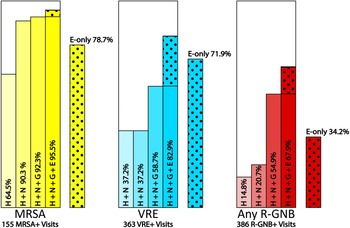
Percentage of MDRO-colonized visits detected using nonperianal area screening and room environment surveillance. Note. E, environment; G, groin; H, hands; MRSA, methicillin-resistant Staphylococcus aureus; N, nares; R-GNB, resistant Gram-negative bacilli; VRE, vancomycin-resistant enterococci.

Perianal screening may lead to healthy participant bias
Patients without perianal specimens collected during eligible study visits had significantly more comorbidities, worse functional status, shorter durations in the study, fewer follow-up visits, shorter nursing home stays, and a greater number of patients were rehospitalized than patients with perianal specimens collected during an eligible study visit (Table 1). Furthermore, patients without perianal specimens had significantly higher odds of baseline MRSA groin colonization (odds ratio [OR], 8.80; 95% confidence interval [CI], 2.46–31.54), MRSA nares colonization (OR, 2.24; 95% CI, 1.33–3.75), and MRSA hand contamination (OR, 1.74; 95% CI, 1.03–2.94). No significant differences in VRE or R-GNB were identified.
Baseline Patient Characteristics, Stratified by Perianal Screening Status During Eligible Study Visits

Note. SD, standard deviation.
a Patients were included in this secondary analysis if they had a study visit in which all of the following body site specimens were collected: hands, nares, and groin. This inclusion criterion was chosen because it serves as a proxy for patients that permitted a combination of minimally invasive specimens during participation in the parent study. Eligible patients were then stratified by whether a perianal area specimen was collected during any of their eligible study visits. To ensure consistency between study aims, 2 patients with all specimens collected during their sole study visit were excluded due to missing microbiological test data.
b The χ2 test of associated was used to test significance for categorical variables. The Student 2-sample t test and Welch’s t test were used to test significance for continuous variables.
c The duration of a patient’s nursing home stay and their discharge destinations were identified using the Minimum Data Set 3.0.Reference Saliba and Buchanan6
d To reduce skew, patients with lengths of stay >180 d were adjusted to 180.
Assessment of alternatives to perianal screening
Of 1,026 visits where all body site specimens were collected, 620 visits detected an MDRO-colonized patient: 155 MRSA (15.1%); 363 VRE (35.4%); and 386 R-GNB (37.6%) (Supplementary Fig. 2 online). If perianal specimens had not been collected, the sensitivities of multianatomical, nonperianal surveillance would have been 92.3% for MRSA, 58.7% for VRE, and 54.9% for R-GNB (Fig. 1). The addition of environmental surveillance to multi-anatomical, nonperianal screening improved sensitivities to 95.5% for MRSA, 82.9% for VRE, and 67.9% for any R-GNB. The specificities of environmental surveillance were 85.3% for MRSA, 72.7% for VRE, and 73.6% for any R-GNB.
Discussion
In this study, we conducted secondary analysis of MDRO surveillance data collected from a prospective, longitudinal study of nursing home patients to assess the relative importance of perianal screening. We found that perianal screening may lead to healthy participant bias by limiting the capacity to conduct surveillance on complex patients. Specifically, we identified that, in our population, perianal specimens were difficult to obtain from multimorbid patients and those with functional disabilities, likely due to discomfort from turning the participant. Additional barriers previously reported to reduce the nursing home patient’s capacity or desire to participate in research include cognitive function, psychological maladies, and mistrust. Reference Lam, Chow and Taylor8
To subvert this potential healthy participant bias, we evaluated whether alternative surveillance strategies could replace perianal screening. We identified that the addition of room environment surveillance to a panel of minimally invasive nonperianal sites (nares, groin, and hands) can improve the detection of VRE and R-GNB carriers. Nevertheless, it is important to acknowledge the perianal area’s strong sensitivity and specificity for VRE, R-GNB, and other fecal microorganisms, alongside its utility as an alternative to rectal surveillance. Reference Weinstein, Tallapragada, Farrel and Dembry9,Reference Lautenbach, Harris, Perencevich, Nachamkin, Tolomeo and Metlay10 Moreover, perianal-colonized nursing home patients have increased odds of MRSA transmission to healthcare worker gowns and gloves when compared to nares-colonized patients. Reference Kim, Johnson and Stucke11
This study has several limitations. First, we did not characterize the reasons for the nonattainment of perianal specimens. Anecdotally, nonattainment was due to patient refusal, unavailability of timely assistance to move the patient into the appropriate position, or care-induced time constraints. Second, molecular analyses were not conducted to validate the similarity of perianal, nonperianal, and environmental isolates. Molecular typing of select isolates from our parent study demonstrated strong clonal relationships between patient–environment pairs. Reference Cassone, Mantey and Perri12
In summary, nursing home infection preventionists and researchers must be cognizant of the tradeoffs between the improvement of MDRO detection and the potential healthy participant bias that occurs with perianal screening. Further research is needed to assess whether alternative strategies can be used to improve the utility and generalizability of MDRO surveillance and infection prevention research in nursing homes.
Acknowledgments
The authors extend their sincerest gratitude to the patients and nursing homes that participated in this study.
Financial support
This work was supported by the National Institutes of Health (grant nos. RO1 AG041780 and K24 AG050685 to L.M.); the University of Michigan Claude D. Pepper Older Americans Independence Center (REC Scholarship and pilot grant no. AG024824 to M.C.); the Michigan Institute for Clinical and Health Research (grant no. UL1TR002240 to L.M. and training grant appointment no. TL1TR002242 to K.J.G.); and the National Institute on Aging (grant no. P30 AG024824 to L.M.). L.M. is also supported by the Geriatrics Research, Education and Clinical Centers, Veterans Affairs Ann Arbor Healthcare System.
Conflicts of interest
The authors report no conflicts of interest related to this article.
Supplementary material
To view supplementary material for this article, please visit https://doi.org/10.1017/ice.2021.134