Introduction
Alzheimer's disease (AD) is characterized by progressive cognitive decline, loss of daily functions, and neuropsychiatric symptoms. There is evidence that cognitive deterioration is slower during the early phase of the disease (Morris et al., Reference Morris1993; Stern et al., Reference Stern1994; Feldman et al., Reference Feldman, Van Baelen, Kavanagh and Torfs2005) and that change can be non-linear (Morris et al., Reference Morris1993; Bozoki et al., Reference Bozoki, An, Bozoki and Little2009). Cortes et al. (Reference Cortes2005) reported significant declines in cognition, activities of daily living (ADL), and neuropsychiatric symptoms within one year in a population of AD patients (Cortes et al., Reference Cortes2005); however, one-quarter of these AD patients were stable during a two-year follow-up (Cortes et al., Reference Cortes2008).
The Consortium to Establish a Registry for Alzheimer's Disease Neuropsychological Battery (CERAD-NB) is a widely used measure of cognitive impairment in patients with AD (Morris et al., Reference Morris1989; Welsh et al., Reference Welsh1994). The CERAD neuropsychological test battery is derived from previously established cognitive tests, including MMSE (Mini-Mental State Examination; Folstein et al., Reference Folstein, Folstein and McHugh1975). The total score includes six subtests (verbal fluency, modified Boston naming test, word list memory, word list recall, word list recognition, and constructional praxis) from the original test battery (Chandler et al., Reference Chandler2005). Recent studies support the validity and usefulness of the CERAD-NB total score (Chandler et al., Reference Chandler2005) in monitoring the progression of AD-related dementia (Rossetti et al., Reference Rossetti, Munro Cullum, Hynan and Lacritz2010). A significant difference in CERAD total score has been observed across dementia stages (Seo et al., Reference Seo2010), as well as significantly greater annual changes in CERAD total score for AD patients compared to controls (Rossetti et al., Reference Rossetti, Munro Cullum, Hynan and Lacritz2010). Annual CERAD change significantly correlates with dementia severity and functional ability (Rossetti et al., Reference Rossetti, Munro Cullum, Hynan and Lacritz2010).
It has recently been suggested that measures of function, dependence on others, or global measures may be better candidates for modeling AD progression (McLaughlin et al., Reference McLaughlin2010). Neuropsychiatric symptoms increase as the disease progresses (Steinberg et al., Reference Steinberg2008). Changes in scores on cognitive and functional instruments are related to each other, while both are independent of changes in behavior (Tractenberg et al., Reference Tractenberg, Weiner, Cummings, Patterson and Thal2005). Serra et al. (Reference Serra2010) found a correlation between progression of cognitive impairment and behavioral symptoms.
The aims of the present study were to investigate the suitability of the CERAD-NB total score for monitoring cognition in the follow-up of AD, and to evaluate the progression of AD in early-diagnosed medicated patients with clinical dementia ratings (CDR) of 0.5 or 1 at baseline. We analyzed the relationships between cognition, neuropsychiatric symptoms, ADL, and disease severity during the three-year follow-up, and we simultaneously monitored the changes of all these AD-related symptoms. This three-year prospective AD study (ALSOVA) provides mean follow-up measurement results of CERAD (Morris et al., Reference Morris1989; Pulliainen et al., Reference Pulliainen, Hokkanen, Salo and Hänninen1999), MMSE (Folstein et al., Reference Folstein, Folstein and McHugh1975), ADCS-ADL (The Alzheimer's Disease Cooperative Study-Activities of Daily Living Inventory; Galasko et al., Reference Galasko1997), NPI (Neuropsychiatric Inventory; Cummings et al., Reference Cummings, Mega, Gray, Rosenberg-Thompson, Carusi and Gornbein1994), and CDR-SOB (disease severity for the clinicians; Hughes et al., Reference Hughes, Berg, Danziger, Coben and Martin1982; Morris, Reference Morris1993) in patients with very mild or mild AD at the time of the diagnosis. All the study patients were diagnosed, treated, and followed-up in their normal care system.
Methods
Participants
This study was part of the AD follow-up study ALSOVA. The voluntary participants were recruited from the memory clinics of the three central hospitals in Middle and Eastern Finland. Patients were diagnosed at these memory clinics by a geriatrician or neurologist according to the National Institute of Neurological and Communicative Disorders and Stroke and the Alzheimer's Disease and Related Disorders Association (NINCDS-ADRDA; McKhann et al., Reference McKhann, Drachman, Folstein, Katzman, Price and Stadlan1984) and Diagnostic and Statistical Manual of Mental Disorders (DSM-IV; APA, 1994) guidelines. Differential diagnostic evaluations – including neurological clinical examination, laboratory screening tests, electrocardiography, brain imaging, and neuropsychological examination – were performed for all participants. The diagnosis of AD was verified by the research doctor. There was a mean time of five months between AD diagnosis and the baseline visit. In this substudy, the inclusion criteria for patients were ≥65 years of age, with very mild or mild dementia (CDR 0.5 or 1, MMSE > 18) at baseline, and the availability of three years of follow-up and collection of caregiver interview data. The participants were Finnish-speaking, community-dwelling, and free of comorbid conditions that could have affected cognition at baseline (Välimäki et al., Reference Välimäki, Vehviläinen-Julkunen, Pietilä and Pirttilä2009; Karttunen et al., Reference Karttunen2011; Hallikainen et al., Reference Hallikainen2012). A total of 115 study patients fulfilled the inclusion criteria, and the CERAD total scores were available for 113 patients at the visit 3, because two participants declined to complete the CERAD-NB. By the end of the three-year follow-up, 61.6% of participants used cholinesterase inhibitors, 5.6% used memantine, and 25.6% used combined therapy.
Measurements
All of the 115 study patients (61 patients with very mild and 54 patients with mild AD) were followed-up for three years. The patients were evaluated and caregivers were interviewed annually at the local memory clinics. The efficacy parameters used in this study were measured by a study nurse and a psychologist. Furthermore, extensive data were collected including age, gender, education, physical health, medication, household composition, living arrangements, general well-being, caregiver burden, depression, quality of life, and society resource utilization (Välimäki et al., Reference Välimäki, Vehviläinen-Julkunen, Pietilä and Pirttilä2009; Karttunen et al., Reference Karttunen2011).
The Clinical Dementia Rating (CDR) was used to evaluate memory disorder severity. Both global CDR score and Clinical Dementia Rating Sum of Boxes (CDR-SOB) score were used (Hughes et al., Reference Hughes, Berg, Danziger, Coben and Martin1982; Morris, Reference Morris1993). The study patients were rated at baseline as either CDR 0.5 (very mild dementia) or 1 (mild dementia). The cognitive evaluation was performed with CERAD-NB and MMSE. The total CERAD-NB score was calculated for each participant using the sub-test addition method (Chandler et al., Reference Chandler2005). MMSE is a part of the original CERAD test battery but it is not used for calculating the total score. The ADCS-ADL, a set of informant-based items describing performance of ADL for patients with AD, was used to evaluate daily functioning, and the NPI was used to assess 12 behavioral disturbances occurring in dementia patients.
Ethical considerations
The Kuopio University Hospital's ethical committee reviewed the study and gave a favorable opinion (N0. 64/00). Potential participants were informed about the study orally and in writing, with emphasis on the voluntary nature of participation and the confidentiality of data collected. The informed consent form was signed by both the patient with AD and the caregiver. The caregiver also provided proxy consent on behalf of the individual with AD.
Data analysis
The data were analyzed with SPSS for Windows, version 19.0. Spearman's correlations were assessed between education, CERAD-NB total score, MMSE, ADCS-ADL, NPI, and CDR sum of boxes (SOB). For comparisons between groups – patients with very mild AD (CDR 0.5) versus mild (CDR 1) AD at baseline – the independent sample t-test and Pearson's χ2 tests were used, or the non-parametric Mann–Whitney U-test was used if any of the efficacy parameters were non-parametric. Because age, gender, and education can have an effect on CERAD-NB (Welsh et al., Reference Welsh1994; Chandler et al., Reference Chandler2005), they were chosen as covariates to the adjusted linear regression models which were created to evaluate the significance of association between total CERAD-NB and other efficacy parameters and AD severity, as well as to study the influence of education on total CERAD-NB. Furthermore, in the univariate analyses, we tested several (CDR-SOB, ADCS-ADL, NPI) covariates. For the regression models, we selected covariates with significance less than 0.2 in univariate analyses. A paired sample test was used to estimate the significance of the change in each efficacy parameter between follow-up visits. P values ≤0.05 were regarded as statistically significant.
Results
Of the 115 study patients, the mean age was 75.1 years and a minority was males (43.5%). The study groups (CDR 0.5 and CDR 1) were equal in age and gender distribution. The patients with very mild AD (CDR 0.5) at baseline had higher education levels than those with mild AD (CDR 1; 8.5 vs. 6.9 years, p = 0.012; Table 1). After three years, over half of the patients still had very mild or mild AD dementia. At the third follow-up visit, totally 5.2%, 59.1%, 32.2%, and 3.5% of all the patients (n = 115) were consequently in CDR classes 0.5, 1, 2, or 3. When dementia severity was analyzed separately in the study groups CDR-0.5 and CDR-1, 9.8%, 63.9%, 21.3%, and 4.9% of the patients with CDR 0.5 at the baseline (n = 61) and 0%, 53.75%, 44.4%, and 1.9% of the patients with CDR 1 at the baseline (n = 54) were consequently classified to the CDR classes 0.5, 1, 2, or 3.
Characteristics of the 115 study patients with very mild (CDR = 0.5) or mild (CDR = 1) Alzheimer's disease at baseline

CDR = Clinical Dementia Rating.
Independent sample t-test and Pearson's χ2 tests used in comparisons between groups.
*p < 0.05.
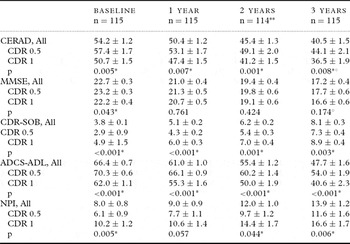
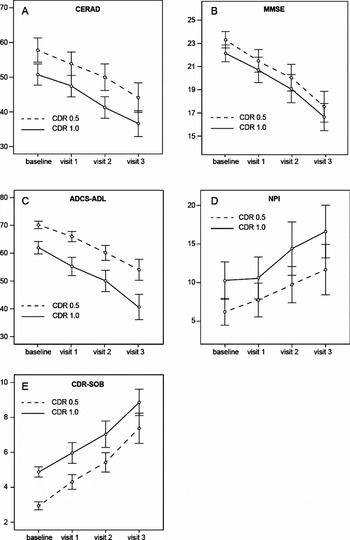
In the whole study group, cognition (change of total CERAD-NB and change of MMSE) and ADL (change of ADCS-ADL) deteriorated, and severity of dementia (change of CDR-SOB) increased significantly (p < 0.02) every year (Figure 1, Table 2). The change of NPI was significant (p < 0.02) in the whole study group between visits 1, 2, and 3, as well as in the CDR-1 group between visits 1 and 2. Interestingly, in the patients with very mild AD (CDR 0.5) at baseline, the annual change of NPI was not significant during the whole follow-up period, and in the end of the follow-up they had on average less neuropsychiatric symptoms than the CDR-1 group had at baseline even if the disease had progressed (measured by CDR-SOB) to the stage the CDR-1 group had been at the baseline (Figure 1, Table 2).
Comparison of AD progression over a three-year follow-up of medicated patients with very mild (CDR = 0.5, n = 61) or mild (CDR = 1, n = 54) AD at baseline

CDR = Clinical Dementia Rating; CERAD = The Consortium to Establish a Registry for Alzheimer's Disease Neuropsychological Battery total score, scale 0–100; MMSE = Mini-Mental State Examination, scale 0–30; CDR-SOB = Clinical Dementia Rating Sum of Boxes, scale 0–18;
ADCS-ADL = Alzheimer's Disease Cooperative Study-Activities of Daily Living Inventory, scale 0–78; NPI = Neuropsychiatric Inventory, scale 0–144.
Non-parametric Mann–Whitney U test was used in comparisons between groups. A paired sample test was used to examine the significance of the annual change of each parameter between visits.
Mean ± standard error of the mean (SEM) is shown for each efficacy parameter scores.
*p < 0.05; **Follow-up visit 2 performed for 60 patients with CDR 0.5 at baseline; °CERAD 3, n = 113. Two patients were not able to perform all parts of the CERAD test battery. All other evaluations were performed normally at the third follow-up visit.
Progression of cognition, ADL, neuropsychiatric symptoms, and dementia severity in patients with very mild (CDR 0.5) or mild (CDR 1) AD at baseline. The mean and 95% confidence interval (CI) is shown for baseline and visits 1, 2, and 3. In the entire group as well as in the CDR-0.5 and CDR-1 groups, significant changes (p < 0.02) in CERAD, MMSE, ADCS-ADL, and CDR-SOB were observed every year between visits. The change of NPI was significant (p < 0.02) in the entire group between visits 1, 2, and 3 and in the CDR-1 group between visits 1 and 2, whereas the annual change of NPI was not significant in the CDR-0.5 group. CERAD = The Consortium to Establish a Registry for Alzheimer's Disease Neuropsychological battery total score; MMSE = Mini-Mental State Examination; CDR-SOB = Clinical Dementia Rating Sum of Boxes; ADCS-ADL = Alzheimer's Disease Cooperative Study–Activities of Daily Living Inventory; NPI = Neuropsychiatric Inventory.

During the follow-up, the CERAD-NB total score revealed the difference in cognition between study groups (patients with CDR 0.5 vs. 1 at baseline; p < 0.05 at all follow-up visits), while MMSE did not (p > 0.05; Table 2). Means of each studied efficacy parameter and change of means are presented in the Table 2 and Figure 1. Since ADCS-ADL and NPI were not normally distributed, we also analyzed median values (data not shown). At baseline, the patients with CDR 0.5 had median CERAD and ADCS-ADL scores of 58 and 72, respectively, versus 51 and 63 in patients with CDR 1. In the CDR-0.5 group, the two-year median CERAD-NB score was 51 and the median ADCS-ADL score 62. Thus, in CDR-0.5 group they were after two years follow-up at the same level as in the CDR-1 group at baseline. Throughout the study, the CDR-0.5 group maintained a better ADL level than the CDR-1 group (p = 0.000; Table 2). The same was noted in analyses of neuropsychiatric symptoms, with the CDR-0.5 group showing significantly less neuropsychiatric symptoms than the CDR-1 group at baseline (p = 0.005) and at visit 3 (p = 0.006; Table 2). Median NPI scores of the CDR-0.5 and CDR-1 groups, respectively, were 4 and 9 at baseline and 6 and 13 at the three-year follow-up.
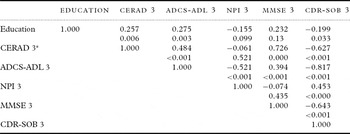
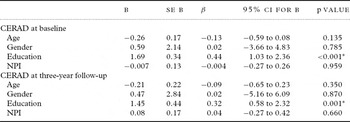
The CERAD-NB total correlated well with other cognitive or global measures, but not with NPI (Table 3). In the age- and gender-adjusted regression model, education influenced cognitive performance (CERAD-NB total score) both at baseline and at the third follow-up (p < 0.001) in the whole group (Table 4) and in patients with very mild dementia at baseline (CDR 0.5). In patients with mild dementia at baseline (CDR 1), this association was not significant (p = 0.099 at baseline and p = 0.105 at the three-year follow-up).
Spearman's correlations between education, CERAD total score, ADCS-ADL, NPI, MMSE, and CDR-SOB in study patients (n = 115) at the third follow-up visit

CERAD = The Consortium to Establish a Registry for Alzheimer's Disease Neuropsychological Battery total score; ADCS-ADL = Alzheimer's Disease Cooperative Study–Activities of Daily Living Inventory; NPI = Neuropsychiatric Inventory; MMSE = Mini-Mental State Examination; CDR-SOB = Clinical Dementia Rating Sum of Boxes.
Results given as Correlation Coefficient (upper number) and significance of correlation.
*CERAD 3, n = 113. Two patients were not able to perform parts of the CERAD test battery. All other evaluations were performed normally at follow-up visit.
Influence of age, gender, education, and neuropsychiatric symptoms on CERAD-NB total at baseline (n = 115) and at three-year follow-up visit (n = 113): linear regression model

CERAD = The Consortium to Establish a Registry for Alzheimer's Disease Neuropsychological Battery total score at baseline and at three-year follow-up, respectively; NPI = Neuropsychiatric Inventory; B = unstandardized coefficients; SE = standard error estimates; β = standardized coefficients; CI = confidence interval.
*p < 0.05.
Total CERAD-NB, MMSE, ADCS-ADL, and NPI significantly correlated (p < 0.001) with the severity of AD (CDR-SOB) in the age-, gender-, and education-adjusted regression models that were made separately for each efficacy parameter (separate models were created due to correlations between the efficacy parameters, Table 3).
Discussion
Here, we studied the suitability of the CERAD-NB total score for monitoring progression of AD-related cognitive disturbances in 115 medicated AD patients with very mild or mild disease at baseline. The patients received symptomatic AD therapy and were followed-up annually in their normal care system. This study design allowed the unique possibility for monitoring possible differences in AD progression between study groups, while simultaneously assessing MMSE, ADL, NPI, and severity of disease. All the studied efficacy parameters correlated well with the severity of AD.
In the entire study group, the average total CERAD-NB declined significantly throughout follow-up. At every follow-up visit, we observed significant differences in CERAD-NB but not in MMSE between the two study groups (very mild AD vs. mild AD at baseline). Our results are in line with those of a previous report (Chandler et al., Reference Chandler2005), and support the validity and usefulness of the CERAD-NB total score for monitoring the progression of AD dementia (Rossetti et al., Reference Rossetti, Munro Cullum, Hynan and Lacritz2010). Furthermore, our results support previous findings (Seo et al., Reference Seo2010) that there is a significant difference in CERAD total score across dementia stages. Rossetti et al. (Reference Rossetti, Munro Cullum, Hynan and Lacritz2010) found significantly greater annual changes in CERAD total score among AD patients compared to controls. In our study, the very mild AD group (CDR 0.5) had significantly better CERAD total scores than the mild AD group (CDR 1) at both baseline and the last follow-up visit; however, there was no statistically significant between-group difference in the rate of decline, perhaps due to limited study population. The rate of decline was also highly variable from person to person. However, we noticed that the CERAD-NB progression rate increased slightly after the median CDR-SOB score reached 5 points. This occurred after the first year follow-up in the CDR-1 group, and after the second year follow-up in the CDR-0.5 group. This finding is in line with the previous conclusions of other research groups that AD progresses more slowly in the early stages of the disease (Morris et al., Reference Morris1993; Stern et al., Reference Stern1994; Feldman et al., Reference Feldman, Van Baelen, Kavanagh and Torfs2005).
We found that the annual CERAD change significantly correlated with dementia severity and functional ability, as shown previously (Rossetti et al., Reference Rossetti, Munro Cullum, Hynan and Lacritz2010), but did not correlate with NPI scores. However, the changes in CERAD and NPI during the three-year follow-up were related; although cognition and neuropsychiatric symptoms are separate parts of the disease, they progressed in parallel. This was clearer in patients with mild AD at baseline; in patients with very mild AD at baseline and with very early start of AD therapy, neuropsychiatric symptoms increased only slightly, not significantly, even if cognition deteriorated. Previous studies have reported contradictory results concerning the association of cognition and neuropsychiatric symptoms during follow-up (Tractenberg et al., Reference Tractenberg, Weiner, Cummings, Patterson and Thal2005; Serra et al., Reference Serra2010). Years of formal education significantly influenced cognition, as seen previously in an aged population (Stein et al., Reference Stein2012). This influence was more evident in the CDR-0.5 group, while the effect of education was not statistically significant in the CDR-1 group. In the CDR-0.5 group, the effect of education on CERAD-NB was maintained in the progressed AD stage; thus, this statistical difference may be explained by the fact that the years of education varied more in the CDR-0.5 group than in the CDR-1 group.
Cortes et al. (Reference Cortes2008) reported that one-quarter of AD patients were stable during a two-year follow-up. In our study, after a three-year follow-up, 64% of all patients were still relatively stable according to CDR staging (still CDR 0.5 or 1). When examining the whole study population in greater detail, we noticed that cognition and ADL deteriorated and severity of dementia increased significantly every year, but neuropsychiatric symptoms did not significantly increase during the first year of follow-up in these patients. Furthermore, we analyzed median values of ADCS-ADL and NPI as they were not normally distributed, and it seemed that the CDR-0.5 group exhibited a lower incidence of neuropsychiatric symptoms than CDR-1.0 group throughout the study period. There were participants whose NPI score clearly increased. However, 75.4% of CDR-0.5 group had lower or maintained the same level of NPI than CDR-1 group had at baseline (median 9). Interestingly, for the first two years after diagnosis, the CDR-0.5 group also seemed to maintain the same ADL level than the CDR-1 group had had at baseline. Previous studies indicate that AD therapy influences ADL and behavior (Birks, Reference Birks2006; Cummings et al., Reference Cummings, Schneider, Tariot and Graham2006). Additionally, the CDR-0.5 group and their caregivers received information and support earlier than the CDR-1 group, which may have helped them to better adapt to the disease. The results of our study clearly emphasize the importance of early AD diagnosis.
The strength of the present study is that it was a non-commercial investigation with a distinct protocol for the reliable and comparatively long follow-up of AD progression. The study patients were treated with acetylcholinesterase inhibitors or memantine, and thus our study population equates to the control group of existing clinical trials, such as that reported by Salloway et al. (Reference Salloway2009). The diagnoses were made and therapy was started in earlier stages of the disease than in a previous longitudinal CERAD study (Rossetti et al., Reference Rossetti, Munro Cullum, Hynan and Lacritz2010). Furthermore, to our knowledge, this is the first longitudinal study of the suitability and sensibility of CERAD-NB total score for monitoring the differences in progression of AD in patients with very mild or mild AD at the time of diagnosis and with AD therapy. Our results are of value to clinicians as well as for clinical trials. One limitation of this study is that the study population only included patients who were able to participate in the follow-up. Two study patients declined to complete the CERAD-NB at visit 3. We considered this did not make a significant impact to the results as only two of 115 were missing.
In conclusion, the CERAD total score is a suitable and sensitive follow-up tool for measuring AD progression – not only for screening. Total CERAD was superior to MMSE for differentiating between patients with different stages of AD. This measurement correlates well with other cognitive and global measures, and lacks the ceiling and floor effects; thus, it is a promising follow-up tool for measuring global cognition in longitudinal AD trials. We observed no significant difference in progression rates of cognition between the patients with very mild or mild AD at the time of diagnosis. However, the patients with very mild AD at the time of diagnosis and early start of AD therapy seemed to exhibit milder neuropsychiatric symptoms at the end of follow-up than the patients with mild AD exhibited at baseline. Furthermore, these patients seemed to maintain their ADL functions for a longer time. In this study, we monitored participants in their normal caring system. Still, it would be valuable to evaluate the possible effect of the early therapy in more detail in different kind of study design. However, these findings emphasize the importance of early diagnosis. Furthermore, it is crucial to use a more sensitive method to measure cognition and to assess neuropsychiatric symptoms and daily functions at the diagnostic visit and during follow-up in order to be able to plan adequate individual support and therapy for each patient.
Conflict of interest
None.
Description of authors’ roles
I. Hallikainen wrote the paper, assisted in formulating the research questions, collected the data, assisted with creating databases, and assisted in data analyses. T. Hänninen designed the study, supervised the data collection, formulated the research questions, and supervised/assisted with writing the manuscript. M. Fraunberg was responsible for the statistical design of the study and performing the statistical analysis, and assisted with writing the manuscript. K. Hongisto collected the data, and assisted with creating databases and writing the manuscript. T. Välimäki collected the data, and assisted with creating the databases and writing the manuscript. A. Hiltunen and P. Karppi collected the data and gave constructive suggestions to improve the manuscript. J. Sivenius assisted in designing the study and writing the manuscript. H. Soininen designed the study, supervised the data collection, formulated the research questions, and assisted with writing the paper. A. M. Koivisto designed the study, formulated the research questions, supervised the data collection, was responsible for creating the databases, assisted in data analyses, and supervised/wrote the manuscript.
Acknowledgments
This study was supported by grants from the Yrjö-Jahnsson Foundation, Hospital Neuron, Kuopio University Hospital (EVO-grant 5220/5772728), and the Social Insurance Institute of Finland (Kela). The authors gratefully acknowledge the contribution of the late Professor Tuula Pirttilä, project director (2002–2009). The authors also thank study nurse Helena Mäkelä for her invaluable help in organizing and performing the examinations of the study participants, as well as the patients and their caregivers for their time and effort.
ALSOVA study group
Hilkka Soininen, MD, Professor, project director: Neurology of Neuro Center, Kuopio University Hospital, Institute of Clinical Medicine, Neurology, University of Eastern Finland, Kuopio Campus, Finland.
Anne M. Koivisto, PhD, MD, specialist in neurology, study coordinator and principal investigator: Neurology of Neuro Center, Kuopio University Hospital, Institute of Clinical Medicine, Neurology, University of Eastern Finland, Kuopio Campus, Finland.
Mikael von und zu Fraunberg, MD, PhD (med.), MSc. (tech.), MSc. (econ.), Statistician, Neurosurgery of Neuro Center, Kuopio University Hospital, Kuopio, Finland.
Ilona Hallikainen, MPsych, psychologist: Brain Research Unit, Clinical Research Center, University of Eastern Finland, Kuopio Campus, Finland.
Sanna-Kaisa Herukka, PhD, researcher: Neurology of Neuro Center, Kuopio University Hospital, Institute of Clinical Medicine, Neurology, University of Eastern Finland, Kuopio Campus, Finland.
Asta Hiltunen, MD, specialist in neurology: Department of Neurology, North Karelia Central Hospital, Finland.
Kristiina Hongisto, MD, geriatrician: Institute of Public Health and Clinical Nutrition, Department of Geriatrics, University of Eastern Finland, Kuopio Campus, Finland and School of Medicine, Institute of Clinical Medicine, Neurology, University of Eastern Finland, Kuopio Campus, Finland.
Tuomo Hänninen, PhD, Adjunct Professor, Neurology of Neuro Center, Kuopio University Hospital, Kuopio Finland.
Pertti Karppi, MD, geriatrician: Mikkeli Central Hospital, Finland.
Janne Martikainen, PhD, Assistant Professor, research director: School of Pharmacy, University of Eastern Finland, Kuopio Campus, Finland.
Helena Mäkelä, study nurse: Brain Research Unit, Clinical Research Center, University of Eastern Finland, Kuopio Campus, Finland.
Teemu Paajanen, MPsych, psychologist: Brain Research Unit, Clinical Research Center, University of Eastern Finland, Kuopio Campus, Finland.
Anna-Maija Pietilä, PhD, Professor: Department of Nursing Science, University of Eastern Finland, Kuopio Campus, Finland.
Juhani Sivenius, MD, Professor: Brain Research and Rehabilitation Center Neuron, Neurology of Neuro Center, Kuopio University Hospital, Institute of Clinical Medicine, Neurology, University of Eastern Finland, Kuopio Campus, Finland.
Hannu Valtonen, PhD, Professor: Department of Health and Social Management, University of Eastern Finland, Kuopio Campus, Finland.
Matti Vanhanen, PhD, neuropsychologist: Niuvanniemi Hospital, Kuopio, Finland.
Katri Vehviläinen-Julkunen, Professor: Department of Nursing Science, University of Eastern Finland, Kuopio Campus, Finland.
Tarja Välimäki, MNSc: Department of Nursing Science, University of Eastern Finland, Kuopio Campus, Finland.