Implications
Despite high-fibre content, the unique nutritional properties of chicory forage will allow high inclusion levels in cereal-based pig diets without negative effects on performance. The negative effect on feed intake limits the inclusion level of ribwort in pig diets.
Introduction
A minimum level of fibre has to be included in a pig diet to support normal physiological functions in the digestive tract (Wenk, Reference Wenk2001). However, increasing inclusion of plant fibre in the diet may impair enzymatic digestion in the upper gastrointestinal (GI) tract, while microbial digestion in the lower GI tract increases. This may negatively affect the digestibility of dietary components and impair the energy value of the diet (Noblet and Le Goff, Reference Noblet and Le Goff2001). However, increased fibre level in the diet of weaned piglets lowers the pH in the hindgut (Högberg and Lindberg, Reference Högberg and Lindberg2006) and increases the content of organic acids in the stomach and the ileum (Högberg and Lindberg, Reference Högberg and Lindberg2004, Reference Högberg and Lindberg2006). These fibre induced changes in gut environment indicates a shift in dominating bacteria and may impair the conditions for pathogen bacteria and be more beneficial for maintaining gut health (Gibson and Roberfroid, Reference Gibson and Roberfroid1995; Wenk, Reference Wenk2001). The impact of fibre level on gut environment and digestibility may differ with fibre properties (soluble v. insoluble) and with age (Högberg and Lindberg, Reference Högberg and Lindberg2006). Soluble fibre is well digested by both growing pigs and sows, whereas sows have a higher capacity to digest insoluble fibre (Jørgensen et al., Reference Jørgensen, Serena, Hedemann and Bach Knudsen2007).
Chicory (Cichorium intybus L.) and ribwort (Plantago lanceolata L.) are dicotelydenous herbs that have the potential to be complementary to more traditional forage crops, due to their favourable traits, that is, they are deep-rooted, drought resistant and have a high mineral content (Foster, Reference Foster1988). They also have a high content of uronic acid (80 to 90 g/kg dry matter (DM)) of which approximately 80% is soluble. Uronic acid in dicotelydenous plants derives from galactosyluronic acid that is the building block in pectins (Voragen et al., Reference Voragen, Beldman and Schols2001). Uronic acid has a high digestibility in other forage crops fed to growing pigs (Leming and Lindberg, Reference Leming and Lindberg2001). Moreover, pectin substances from sugar beet pulp have been shown to influence the gut microbial ecosystem, in particular by increasing the faecal Lactobacillus counts (Wang et al., Reference Wang, Zhu, Li and Jensen2004), and is therefore a very interesting fibre component in piglet nutrition.
The aim of this experiment was to evaluate the effect of inclusion of chicory and ribwort forage in a cereal-based diet on growth performance, digestibility and faecal coliform bacteria in weaned piglets.
We hypothesized that increasing dietary inclusion of chicory and ribwort forage should have a negative impact on total tract digestibility and on growth performance due to a higher dietary fibre content in the diet.
Material and methods
Animals and housing
Twenty-five 35-day-old castrated male piglets (Swedish Landrace × Yorkshire), were used in a 35-day growth experiment. The piglets originated from five different litters and had a live weight of 11.7 kg (s.d. 0.8 kg). The piglets were purchased from a herd free from diseases according to the A-list of International Office of Epizootics (OIE, 2004). The piglets were housed individually in pens equipped with a rubber mat, urine drainage and no bedding. The light regime was a 12/12 h dark/artificial light cycle, room temperature was maintained at 20°C ± 1°C and the humidity varied between 40% and 70%. In addition, each pen had a heat lamp to increase the piglet comfort during the 1st week of the experiment. Piglets had ad libitum access to feed and water throughout the experiment, except for the first days when the feed allowance was restricted. They were weighed at days 0, 7, 14, 21, 28 and 35, and the feed intake was registered weekly.
The experiment was carried out at the Swedish University of Agricultural Sciences (SLU) and was approved by the ethical committee of the Uppsala region.
Diets and experimental design
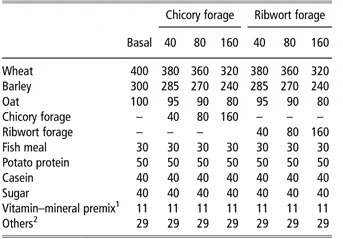
A total of seven experimental diets were formulated (Table 1). They comprised a cereal-based basal diet (B) and three diets composed to contain 40, 80 and 160 g/kg air-dry forage made from vegetative shoots of chicory (C40, C80 and C160) and leaves of ribwort (R40, R80 and R160), respectively. The basal diet was composed of ground cereals (wheat, barley and oats), milled through a 5-mm screen, supplemented with protein, amino acids, mineral and vitamins to meet the nutritional requirements of piglets (Simonsson, Reference Simonsson2006; Table 2). In diets with chicory and ribwort inclusion, the cereal mixture was substituted with the herbs on an air-dry basis. The herbs where harvested at the vegetative stage (September) with a stubble height of c. 5 cm and dried with forced air at 30°C for a week and milled through a 5-mm screen before mixing with the other feed ingredients. TiO2 was included in the diets (2.5 g/kg) as an internal digesta marker.
Ingredient composition (g/kg) of the experimental diets

1Content per kg premix: vitamins (mg): A 10 00 000 IE, D 1 00 000 IE, E 6000, K3 200, B1 200, B2 400, B6 300, B12 2, pantothenic acid 1500, niacin 2000, biotin 25. Minerals (mg): Fe 4000, Cu 1000, Mn 2000, Zn 7000, I 30, Se 35.
2Content per kg others: lysine 1.2, methionine 0.08, threonine 0.03, dibasic-calcium phosphate 20, Ca-carbonate, NaCl 2.5, FeSO4 + 4 H2O 0.24, titanium (IV) oxide 2.5.
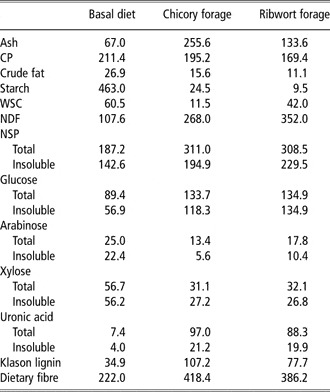
Analysed chemical composition (g/kg DM) of the basal diet, chicory forage and ribwort forage

DM = dry matter; WSC = water soluble carbohydrates (free glucose + free fructose + sucrose + fructan); NSP = non-starch polysaccharides.
The experiment was organized according to a randomized block design, with three replicates for the low- and medium-inclusion level of herbs, four replicates for the highest inclusion level of herbs and five replicates for diet B.
Sample collection and coliform counts
Faeces samples for determination of digestibility were collected once a day for five subsequent days from the carefully cleaned pen floor during the 3rd and the 5th week of the experiment, and were stored at −20°C. Feed samples were collected weekly. The feed and faeces samples were freeze-dried and milled through a 1-mm sieve before analysis. Additional faeces samples for determination of coliform bacteria numbers were collected from each piglet at days 1, 16 and 35. One gram of each faecal sample was diluted and mixed with 9 ml NaCl solution (9 g/l), then a serial dilution was made consisting of 0.5 ml of the previous dilution +4.5 ml NaCl solution. From each dilution, 100 μl was spread on blood agar plates. The plates were incubated in 37°C for 20 h before coliform counting.
Chemical analyses
Samples were analysed for DM by drying at 103°C for 16 h and for ash after ignition at 600°C for 3 h, conventional methods adopted in Sweden (Jennische and Larsson, Reference Jennische and Larsson1990). Crude protein (N × 6.25) was determined by the Kjeldahl method (Nordic Committee on Feed Analysis, 2003), using a Kjeltec Auto 1030 analyser (Tecator, Höganäs, Sweden). Crude fat was determined according to Official Journal of the European Communities (1984), using a hydrolysing unit (Soxtec System 1047 Hydrolysing Unit, Tecator AB, Höganäs, Sweden) and an extraction unit (Soxtec System HT6, Tecator AB, Höganäs, Sweden). Starch and sugars were analysed by an enzymatic method (Larsson and Bengtsson, Reference Larsson and Bengtsson1983). Neutral detergent fibre (NDF) was determined according to Weizhong and Udén (Reference Weizhong and Udén1998), with a 100% neutral detergent solution and the use of amylase and sulphite (for reduction of starch and protein). Total, soluble and insoluble non-starch polysaccharides (NSP) and their constituent sugars, Klason lignin and total dietary fibre were determined according to Bach Knudsen (Reference Bach Knudsen1997). Titanium dioxide was analysed according to Short et al. (Reference Short, Gorton, Wiseman and Boorman1996).
Calculations
Dietary fibre was calculated as total NSP+lignin.
The coefficients of total tract apparent digestibility (CTTAD) were calculated using the indicator technique (Sauer et al., Reference Sauer, Fan, Mosenthin and Drochner2000) according to the equation:

where, CTTADT is the coefficient of apparent digestibility of the nutrient in the treatment diet, TiT is the titanium dioxide concentration in the treatment diet (g/kg), NF is the nutrient concentration in faeces (g/kg), NT is the nutrient concentration in the treatment diet (g/kg) and TiF is the titanium dioxide concentration in faeces (g/kg).
The coliform counts were log10 transformed before statistical analysis.
Statistical analyses
The statistical analyses were performed with procedure Mixed in SAS (SAS Institute, Cary, NC, USA, version 9.1). The model included diet (B, C40, C80, C160, R40, R80, R160) and age (21 or 35 days) as fixed factors, and litter as random factor. For average daily weight gain (DWG), the initial weight was used as covariate in the model. Analysis was based on individual values. As faecal samples used for the digestibility and coliform counts were collected two and three times, respectively, age was analysed with repeated statement with homogeneous autoregressive of order one as covariate structure for digestibility and heterogeneous autoregressive of order one for coliform counts. Two-way interactions between treatment and age were tested, but without any significance. Degrees of freedom were estimated with the Satterthwaite method.
Results
Feed intake and growth performance
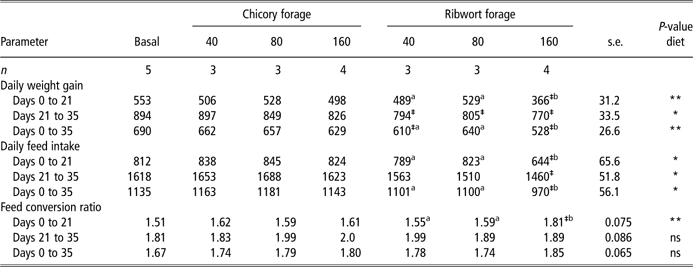
Herb inclusion affected (P < 0.05) the average daily feed intake (DFI) during days 0 to 21, 21 to 35 and during the total period (days 0 to 35; Table 3). DFI was lower for diet R160 than for diet B during these periods (P < 0.05). Within the different inclusion levels of ribwort, DFI was lower for diet R160 than for diets R40 and R80 during days 0 to 21 and during the total period (P < 0.05). Moreover, ribwort inclusion negatively affected DWG during days 0 to 21, 21 to 35 and the total period, whereas the effect on feed conversion ratio (FCR) only was observed during days 0 to 21 (Table 3). Compared to diet B, DWG was lower for diet R160 during days 0 to 21 and lower for R40, R80 and R160 during days 21 to 35 (P < 0.05). For the total period, DWG was lower for diets R40 and R160 than for diet B (P < 0.05). Within the different inclusion levels of ribwort, DWG was lower for diet R160 than for diets R40 and R80 during day 0 to 21 and the total period (P < 0.05), whereas no differences were observed during day 21 to 35 (P > 0.05). FCR was higher for diet R160 than for diets R40, R80 and diet B during day 0 to 21 (P < 0.05). However, no significant differences in DFI, DWG and FCR were observed within the chicory diets.
Effects of diet on average daily weight gain (g/day) daily feed intake (g/day) and feed conversion ratio (kg DM feed/kg weight gain) during days 0 to 21, 21 to 35 and 0 to 35. Least square means and pooled s.e.
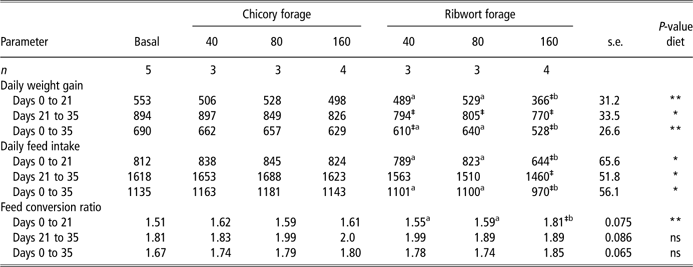
‡Symbol within a row, indicate difference (P < 0.05) compared with the basal diet.
abDifferent letters within ribwort, in a row, indicate difference (P < 0.05).
Digestibility
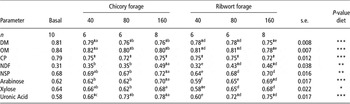
The CTTAD of DM, OM and CP were higher for diet B than for all diets with herb inclusion (P < 0.05; Table 4). Within the chicory diets, the CTTAD of DM and OM were lower for diets C80 and C160 than for diet C40 (P < 0.05). Within the ribwort diets, the CTTAD of DM and OM were lower for diet R160 than for diets R40 and R80 (P < 0.05).
Effects of diet on the CTTAD of DM, OM, CP, NDF, NSP, arabinose, xylose and uronic acid. Least square means and pooled s.e.

CTTAD = coefficient of total tract apparent digestibility; DM = dry matter; OM = organic matter; NSP = non-starch polysaccharides.
‡Symbol within a row, indicate difference (P < 0.05) compared with the basal diet.
abcDifferent letters within chicory, in a row, indicate difference (P < 0.05).
defDifferent letters within ribwort, in a row, indicate difference (P < 0.05).
In general, the fibre digestibility was higher for the herbs than for the cereals resulting in higher fibre digestibility with increasing herb inclusion (Table 4). The CTTAD of NDF was higher for diets C160, R80 and R160 than for diet B (P < 0.05). The CTTAD of NSP was higher for diet C160 and lower for diet R40 than for diet B (P < 0.05). The CTTAD of arabinose was higher for diets C160 and R160 than for the diet B (P < 0.05). The CTTAD of xylose was lower for diet R40 than diet B, and the CTTAD of uronic acid was higher for diets C40, C80, C160, R80 and R160 than for diet B (P < 0.05). Within the chicory diets, the CTTAD of fibre was higher for diet C160 than for diets C40 and C80 (P < 0.05). Between diets C40 and C80 no differences were observed except for the CTTAD of uronic acid which increased with increasing level of chicory (P < 0.05). Within the ribwort diets, the CTTAD of fibre was lower for diet R40 than for diets R80 and R160 with exception for the CTTAD of arabinose, where diets R40 and R80 were lower than diet R160 (P < 0.05).
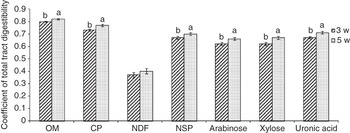
The CTTAD was higher during week 5 than during week 3 post-weaning (P < 0.05) for all parameters, except for NDF (P > 0.05; Figure 1). However, a numerical difference for the CTTAD of NDF was also observed.
Effect of age (3 and 5 weeks post-weaning) on the CTTAD of dietary components. The results are presented as least square means ± s.e. Bars with different letters differ significantly (P < 0.05). OM = organic matter; NSP = non-starch polysaccharides.

Coliform counts
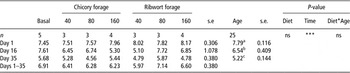
The coliform counts decreased with increasing age (P < 0.05) but was not affected by diet, there were no interaction (P > 0.05) between diet and age (Table 5).
Effects of diet, age (days 1, 16 and 36 post-weaning) and diet*age interaction on coliform counts (log10cfu−1). Least square means and pooled s.e.

abcDifferent letters in a column, indicate difference (P < 0.001).
Discussion
This is the first study on the impact on growth performance, digestibility and coliform counts of feeding chicory and ribwort forage to piglets. Chicory and ribwort forage are new as feedstuffs to piglets, but have previously been fed to deer, calves, lambs and young rabbits with good growth performance results (Fraser et al., Reference Fraser, Cosgrove, Thomas, Stevens and Hickey1988; Rumball et al., Reference Rumball, Keogh, Lane, Miller and Claydon1997; Castellini et al., Reference Castellini, Cardinali, Rebollar, Dal Bosco, Jimeno and Cossu2007).
Piglets fed chicory diets showed a high DWG, DFI and FCR at all inclusion levels and did not differ significantly from the piglets fed the control diet (diet B). However, not significant, numerical differences with lower DWG and higher FCR with increased chicory inclusion were observed in the current study. The non-significant results may be due to few animals per treatment and therefore further studies are needed to confirm the results of this study. Vestergaard et al. (Reference Vestergaard, Danielsen, Eklund Larsen and Bejerholm1996), reported decreased DFI and DWG when grass meal was included in the diet, whereas Longland et al. (Reference Longland, Carruthers and Low1994) reported maintained feed intake, body weight gain and FCR in weaning piglets fed a cereal-based diet with inclusion of fibre in the form of sugar-beet pulp. The similar response in DWG and FCR in this study and in the study by Longland et al. (Reference Longland, Carruthers and Low1994), as compared with those reported by Vestergaard et al. (Reference Vestergaard, Danielsen, Eklund Larsen and Bejerholm1996), may be explained by differences in the chemical properties between fibre sources (Bach Knudsen, Reference Bach Knudsen1997; Voragen et al., Reference Voragen, Beldman and Schols2001).
Pluske et al. (Reference Pluske, Black, Pethick, Mullan and Hampson2003) also reported maintained body weight gain when high-amylose maize starch and lupin isolate were included in rice-based diets and fed to weaning piglets. However, increased content of dietary fibre in the diet resulted in increased GI organ weight and decreased empty body weight gain. This may also have been the case in this study, although weights of GI organs were not recorded.
A decrease in DWG compared to diet B was observed for ribwort diets. This was due to a lower DFI on the ribwort diets than on the diet B and the chicory diets. There appeared to be a progressive decline in DFI with increasing ribwort inclusion. In the period 0 to 21 days, the FCR was higher for piglets fed the highest inclusion of ribwort (diet R160). This was due to feed refusal and feed spoilage on this diet, indicating that ribwort has a low palatability for piglets.
In general, the extent of digestion of OM, CP and fibre components in this study was comparable to data on barley-based diets with lucerne meal inclusion (Leming and Lindberg, Reference Leming and Lindberg2001). However, the decrease in the CTTAD of OM and CP when chicory and ribwort were included in the cereal-based basal diet was smaller than that reported with the inclusion of other fibre-rich feedstuffs (Lindberg and Andersson, Reference Lindberg and Andersson1998; Noblet and Le Goff, Reference Noblet and Le Goff2001).
In contrast to the CTTAD of OM and CP, the CTTAD of NDF and NSP were higher in the diets with high inclusion of both herbs. Inclusion of chicory or ribwort in the diet increased the uronic acid content and thereby also the soluble NSP fraction. Diet C160 contained three times more uronic acid than diet B. Interestingly, the CTTAD of uronic acid was improved with increased inclusion of chicory and ribwort, implicating a higher digestibility of uronic acid from the herbs than from the cereals. Similar results were obtained for sugar-beet pulp included in cereal-based diets fed to weaning piglets (Longland et al., Reference Longland, Carruthers and Low1994), and for lucerne leaf meal (Leming and Lindberg, Reference Leming and Lindberg2001) included in barley-based diets fed to growing pigs. Longland et al. (Reference Longland, Carruthers and Low1994) showed large difference in digestibility of different NSP monomers between sugar-beet pulp and the cereal-based diet. Arabinose and uronic acids were the monomers that differed most in digestibility between the two diets. The digestibility of arabinose was almost two times higher and uronic acid more than one third higher in sugar-beet pulp compared to the cereal-based diet. The reason for differences in digestibility of NSP monomers between fibres of different origin may be related to the differences in the fibre structure and chemistry (Andersson and Åman, Reference Andersson and Åman2001). In cereals cell walls, glucouronoarabinoxylans, a heterogenous structure that includes the monomers arabinose, xylose and uronic acid (Fardet et al., Reference Fardet, Guillon, Hoebler and Barry1997), is one of the major polysaccharides (Andersson and Åman, Reference Andersson and Åman2001). In contrast, in the cell walls of sugar beet pulp and other dicotelydenous plants pectin is a major component were arabinose and xylose can be side chains in the galactosyluronic acid chain (Voragen et al., Reference Voragen, Pilnik, Thibault, Axelos and Renard1995, Reference Voragen, Beldman and Schols2001). Fardet et al. (Reference Fardet, Guillon, Hoebler and Barry1997) showed that barley bran compared to sugar-beet pulp only was half-degraded during fermentation with human faecal bacteria and suggested that the fermentability of barley bran were limited by highly branched glucoarabinoxylans. Longland et al. (Reference Longland, Carruthers and Low1994) suggested that sugar-beet pulp either stimulated the proliferation of gut microbes or rendered the existing population more efficient when compared with cereal fibres. Leming and Lindberg (Reference Leming and Lindberg2001) showed that the hindgut digestibility of uronic acid from lucerne leaf meal was 75%. Canibe and Bach Knudsen (Reference Canibe and Bach Knudsen1997) found that more than 65% of the total tract digestibility of uronic acids in peas was digested by the hindgut microbiota. This suggests that the higher digestibility of NSP observed with inclusion of chicory and ribwort is a result of increased hindgut fermentation due to more easily degradable polysaccharides in the herbs than the cereals.
The improved digestibility of OM and fibre components, at 5 compared to 3 weeks post-weaning, indicates maturation of the hindgut and increased hindgut fermentation with increasing age. It has earlier been reported that adult sows fed fibre-rich diets have a higher digestibility of dietary components and energy than growing pigs (Noblet and Le Goff, Reference Noblet and Le Goff2001). Longland et al. (Reference Longland, Carruthers and Low1994) found an improved digestibility of NSP in 56-day-old compared to 32-day-old piglets when they were fed diets with inclusion of sugar-beet pulp, but not when they were fed cereal-based diets. The full capacity to degrade soluble NSP from sugar-beet pulp are developed within 2 weeks, whereas it may take up to 5 weeks to develop the full capacity to digest insoluble fibres (Longland et al., Reference Longland, Low, Quelch and Bray1993). This demonstrates that the origin of the fibre has a major influence on the time needed to establish effective hindgut fermentation in the pig. The increased digestibility of chicory and ribwort from 3 to 5 weeks post-weaning support our suggestion that the soluble NSP in chicory and ribwort are comparable with those found in sugar-beet pulp fibre.
The coliform numbers decreased with increased age, supporting the indication of higher hindgut fermentation, and thereby a changed gut environment. Wellock et al. (Reference Wellock, Fortomaris, Houdijk, Wiseman and Kyriazakis2008) showed decreased coliform numbers and increased lactobacillus : coliform ratio between day 6 and 14 post-weaning with addition of both soluble and insoluble NSP. Although diet did not have an effect of coliform counts in this study, the high CTTAD of fibre from the herbs indicates that the microflora can utilize fibres from herbs better than cereal fibres.
Conclusion
Chicory and ribwort forage are both promising as fibre-rich feedstuffs to weaned piglets, but the low palatability of ribwort will limit the inclusion level in the diet. Both herbs have a high-fibre digestibility and only a small negative effect on the digestibility of OM and crude protein. Thus, it should be possible to maintain a high energy and nutritive value of the diet when chicory is included as fibre source.