1. Introduction
Devonian and Carboniferous deposits in India are restricted to the extra-peninsular regions, particularly of the Kashmir and Himachal Himalayas. The Carboniferous deposits were formed on the Tethyan margin of the Gondwana palaeocontinent and include a thick succession of carbonate and siliciclastic rocks. The Fenestella Shale Formation contains a number of plant beds that yield macrofloras generally regarded as Mississippian (early Carboniferous) in age and thus representing vegetation from before the glacial interval whose onset was probably during Serpukhovian or very latest Viséan times. These floras are often mentioned in discussions of Carboniferous floristics and palaeogeography as they are geographically located between the well-documented floras of similar age in South America and Australia (Morris, Reference Morris and Campbell1975, Reference Morris, Herbert and Helby1980, Reference Morris, Wagner, Winkler Prins and Granados1985; Iannuzzi & Pfefferkorn, Reference Iannuzzi and Pfefferkorn2002).
Compared to the enormous amount of work done on the mainly Permian Gondwana plant-bearing deposits of peninsular India, however, these Himalayan Carboniferous floras remain relatively poorly understood. Plant fossils were first reported from the lower Fenestella Shale Formation by Hayden (Reference Hayden1904) from two localities in the Spiti region in Himachal Pradesh: near the villages of Po (latitude 32°03΄; longitude 78°23΄) and Thabo (latitude 32°05΄; longitude 78°27΄). The identifications given by Hayden (Reference Hayden1904) were by the French palaeobotanist R. Zeiller, and were later revised by Gothan & Sahni (Reference Gothan and Sahni1937). Høeg, Bose & Shukla (Reference Høeg, Bose and Shukla1955) described new material from Hayden's localities, as well as from a third, new locality in the same area. Other plant beds in the Lower Fenestella Shale Formation have since been found in the Pir Panjal Range and the Liddar Valley (Pal, Reference Pal1978; Pal & Chaloner, Reference Pal and Chaloner1979; Singh, Maithy & Bose, Reference Singh, Maithy and Bose1982; Tripathi & Singh, Reference Tripathi and Singh1985) and these have yielded rather better preserved macrofloras than those from Spiti. Singh, Maithy & Bose (Reference Singh, Maithy and Bose1982) also reported specimens from plant beds in the upper Fenestella Shale Formation and these were described in detail by Pant & Srivastava (Reference Pant and Srivastava1995).
The present paper will for the first time document in detail the stratigraphy and sedimentology of two of the best plant fossil localities in the Pir Panjal Range, near Gund and Arbal. The stratigraphy and tectonics of the area have been summarized by Singh (Reference Singh1999, Reference Singh2002), Bhat et al. (Reference Bhat, Singh and Pandita1997) and Singh & Bhat (Reference Singh and Bhat2002), but here we present a more detailed account of the sections, and will try to decipher the depositional environments and evolutionary history of these rocks. We also review the systematics of the fossil flora, in particular trying to determine the levels of intra-specific variation, which we believe have inflated the taxonomic lists from this flora.
2. Localities and methods
The two studied stratigraphic sections of the Fenestella shale Formation are in the Banihal Pass Section near the village of Banihal, Jammu and Kashmir State (Gund Section: latitude 33°29΄21΄΄, longitude 75°10΄39΄΄; Arbal section: latitude 33°28΄35΄΄, longitude 75°11΄43΄΄; Fig. 1). They lie on the southern slope of Pir Panjal Range, in a rugged terrain of high mountains that remains open for only seven months in a year. The Carboniferous deposits are excellently developed in this area, and are folded into anticlines and synclines, and at various places are inverted.
Geological map of the study area.

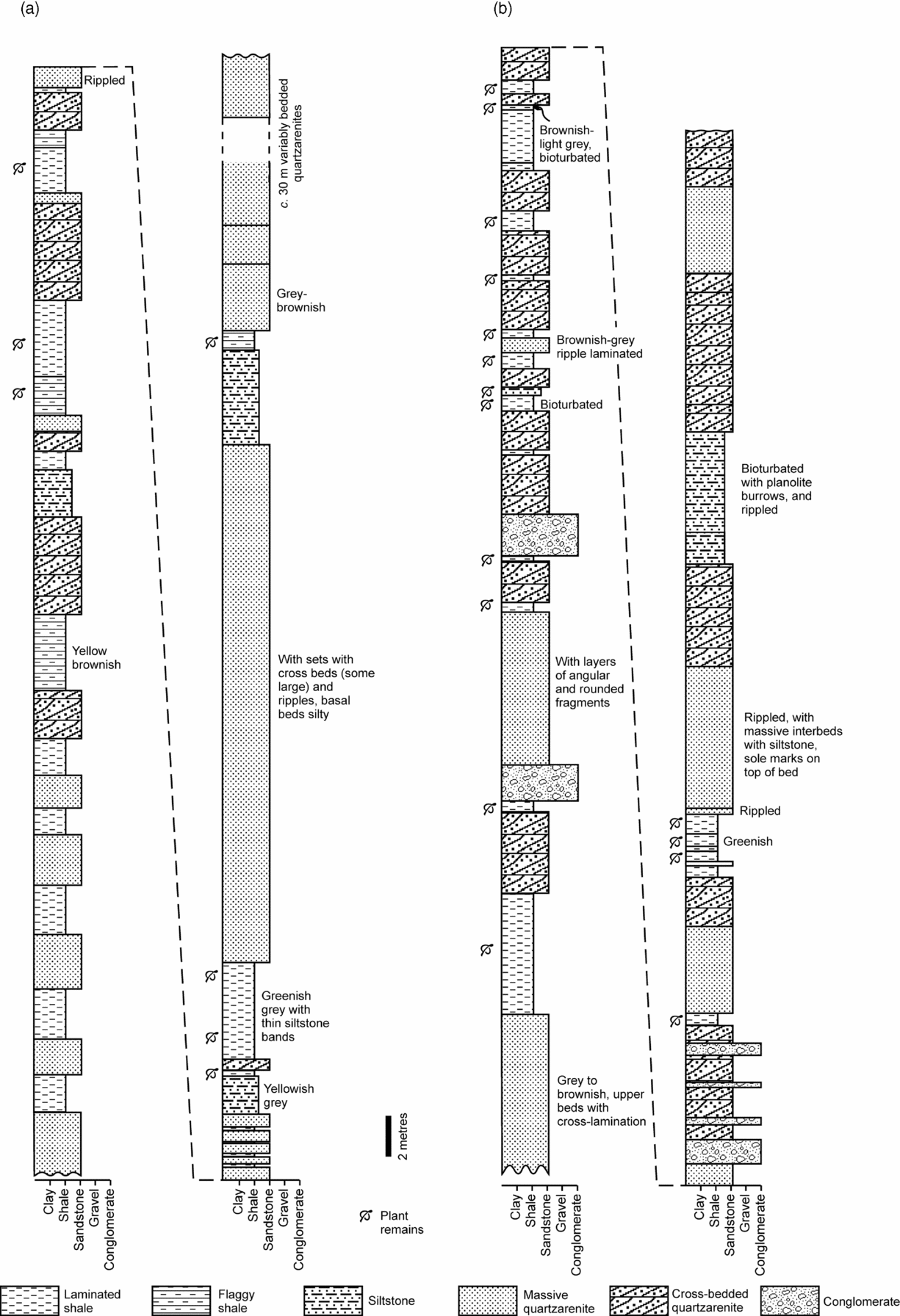
Each section was measured and sampled, bed by bed (Fig. 2). Seven distinct lithofacies were recognised and described, using a combination of lithology, texture, grain composition, sedimentary structures, plant fossils and geometry, to develop an understanding of the sedimentation and history of basin-evolution.
(a) Litholog of Fenestella Shale Formation from the Gund stratigraphic section. (b) Litholog of Fenestella Shale Formation from the Arbal stratigraphic section.

The only fossils documented in this paper are plant remains. They were collected from the grey to dark grey, thickly bedded shale and siltstone beds by one of us (RS). The fossils are impressions, casts and moulds on dark grey to black shales. The morphology of the fossils was studied under incident light and the photographs taken using a Nikon camera. The specimens have been deposited in the repository of the Birbal Sahni Institute of Palaeobotany, Lucknow, India (Statement no. 1140 and Museum specimen numbers 39177–39189, 39191–39198).
3. Stratigraphical background
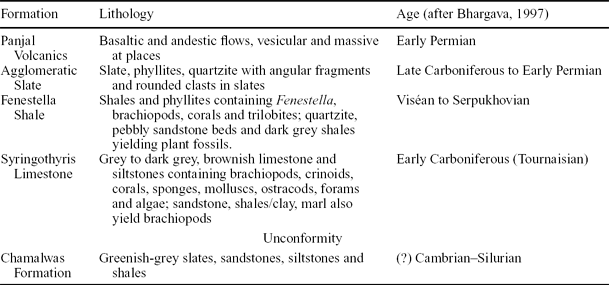
The main Palaeozoic lithostratigraphical units in the Jammu and Kashmir Basin are summarized in Table 1. The Carboniferous rocks, which lie unconformably on Lower Palaeozoic clastics, show an upwards-transition from carbonates, to siliciclastics interbedded with calcareous shale, to agglomerates (diamictite and polymictite). These are in turn overlain by the Cisuralian (early Permian) Panjal Volcanics.
Stratigraphic succession in and around Banihal town, Jammu and Kashmir Himalaya, India

The plant beds reported on in this paper are from the lower part of the Fenestella Shale Formation. This formation consists of essentially marine and essentially non-marine intervals, which Kumar, Singh & Srivastava (Reference Kumar, Singh and Srivastava1980) recognized as four members, designated in ascending stratigraphical order A to D. The Banihal plant beds are in the lowermost, mainly non-marine Member A, which Middlemiss (Reference Middlemiss1910) had referred to as the Passage Beds and Pal (Reference Pal1978) as the Gund Formation; the Wallarama Spur and Manigam Spur plant beds (Singh, Maithy & Bose, Reference Singh, Maithy and Bose1982; Pant & Srivastava, Reference Pant and Srivastava1995) are in Member C.
4. Lithofacies
Seven distinct lithofacies were identified from the Fenestella shale Formation of the Banihal area.
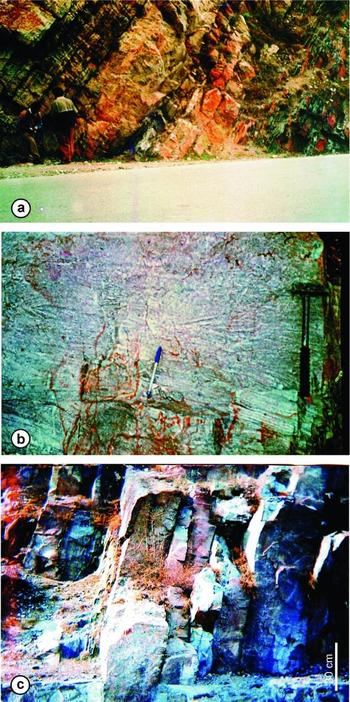
Facies I: Cross-bedded quartzarenite. This consists of mainly massive, quartzarenite beds generally 0.04 to 1 m thick, occasionally more than 1.5 m thick (Fig. 3a, b, c). The basal surface of each bed is sharp, mostly planar but at some places scoured or eroded. Some thickly-bedded quartzarenite beds contain intraclast/pebble lags at the bottom, becoming less and then more concentrated moving upward through the section. A few of these beds contain distinct laminated and mainly cross-laminated sets (Fig. 3b). At some levels, the fore-sets of these cross-laminated sets are draped by mud and siliceous silty material. The stratification in this facies is well defined, but scattered pebbles and granules in many troughs of these beds have also been observed. Some of the quartzarenite beds exhibit hummocky and swaley cross-stratification along with current-rippled lamination (Fig. 3b), which indicates strong wave-action probably under storm conditions (Harms, Southard & Walker, Reference Harms, Southard and Walker1975; Leckie & Walker, Reference Leckie and Walker1982; Singh & Bhat Reference Singh and Bhat2002). Based on modern-day nearshore bathymetry off Akita (Saito, Reference Saito1989), the depositional environments of this facies are estimated to be shelf to lower shoreface, probably at water-depths of 10 to 20 m.
Gund section. (a) Excellent exposures of cross-bedded quartzarenite facies. Man facing outcrop is 1.73 m tall. (b) Thickly bedded, grey coloured, medium grained quartzarenite beds showing hummocky cross-stratification, herringbone cross-stratification, low-angled cross-laminated and reactivation surfaces. These distinct facies have sharp end gradational contacts with each other that suggest shoreface depositional settings. Hammer is 0.3 m long. (c) Pebbly/conglomeratic beds interbedded with cross-bedded quartzarenite horizon. Scale bar is 0.3 m.

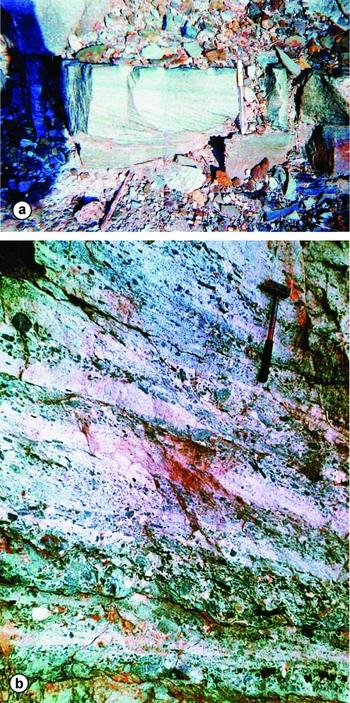
Facies II: Trough cross-bedded quartzarenite. In a few cases, units of Facies I grade upward into thickly-bedded, medium- to coarse-grained quartzarenites with large-scale trough cross-bedding (Fig. 4a). The latter units have granules and pebbles usually concentrated at the base, although layers of pebbles can also occur in the middle part of certain beds. In this facies, distinct sets of cross-beds have been observed with trough-thickness varying from 0.05 to 0.3 m. At some places, these sets are irregular in nature and their thickness varies from 0.02 to 0.15 m. This occurs in between the quartzarenite units, which are characterized by very small scale complex primary structures indicating a shore setting (Singh, Reference Singh1999, Reference Singh2002; Galloway, Reference Galloway2002; Ito, Saito & Someya, Reference Ito, Saito and Someya2002).
Gund section. (a) Thickly bedded quartzarenite bands characterized by trough cross-stratification. Pen is 140 mm long. (b) Thick bedded quartzarenites exhibiting clastic beds, at the base thick pebbly layers that are grading upward in the laminated and pebbly beds. Hammer is 0.3 m long.

This facies is interpreted as deposited in foreshore or shallow marine shelf settings, with unidirectional palaeocurrent flows (Singh, Reference Singh2002; Ito, Saito & Someya, Reference Ito, Saito and Someya2002). The adjoining quartzarenites with complex small-scale cross-bedding are interpreted as deposited in shoreface settings, particularly in mixed storm and tidal influenced conditions. Similar trough cross-bedded facies have been interpreted as having formed during a seaward progradation of the shoreline (Castle, Reference Castle2000). Some of the other sandstone horizons are also characterized by tabular and trough shaped cross-stratified bed-sets, which are internally dissected by reactivation-surfaces and show a consistent palaeoflow direction.
Facies III: Pebbly quartzarenite. Also often associated with Facies I are grey-brownish quartzarenites of varying thickness that contain 60–80% disorganized pebbles. The pebbles are generally rounded or subrounded, cemented by the siliceous cement, and are generally well-oriented and display layering (Fig. 4b). The basal surfaces of the conglomerate beds are scoured. Units of conglomerate and cross-bedded quartzarenite facies can combine to form very thick units of terrigenous rocks.
The combination of subrounded to rounded pebbles and the cross-bedding suggests deposition in a high energy environment by fast-track currents. This contrasts with the lower-energy conditions represented by the quartzarenite bands, although the intermittent pebbly layers in the latter represent low and high density current flows in the depositional system.
In some cases, the stacked storm-influenced shoals are capped by pebble-lags located at the base by coarse-grained, wave-dominated shoreface deposits that closely resembles the structures of the sharp-based shoreface deposits described in forced regressions (Plint, Reference Plint, Wilgus, Hastings, Kendall, Posamentier, Ross, C.A. and Van Wagoner1988; Posamentier, Jervey & Allen, Reference Posamentier, Jervey and Allen1990; Posamentier et al. Reference Posamentier, Allen, James and Tesson1992; Hunt & Tucker Reference Hunt and Tucker1995).
Facies IV: Silty-sandstone. This consists of pale brownish-grey, poorly sorted, massive, fine to medium grained silty-sandstones with occasional intercalations of silty beds containing granules of variable size (Fig. 5a). Some associated beds also exhibit cross-laminations. Bivalve and brachiopod fossils are scattered throughout the beds, as well as sometimes being more concentrated at distinct levels. Associated gravel beds show poor sorting, normal grading, and contain larger-sized cobbles. The brachiopods are mostly disarticulated, suggesting that they had undergone long transportation before deposition.
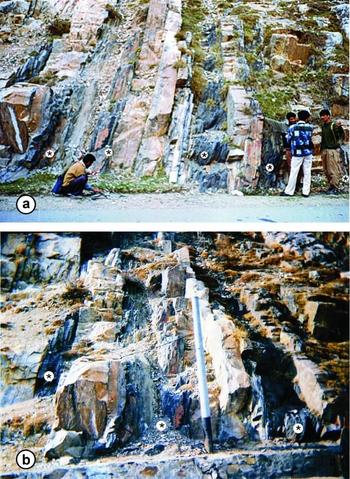
Gund section. (a) Thickly bedded grey shale and siltstone beds interbedded with quartzarenite facies. Grey shale and siltstone yield plant fossils (stars indicate the occurrence of plant fossils). Man facing outcrop is 1.73 m tall. (b) Thickly bedded shale and siltstone beds found in association with quartzarenite facies. These shale and siltstone beds contain bryozoans and plant fossils (stars indicate the occurrence of plant fossils). Pole is 0.46 m long.

The intercalation of silty beds with granule- to cobble-sized pebbles indicates a depositional system in which high energy conditions occasionally occurred. We consider that these silty-sandstones have been deposited at a depth below normal wave-action or offshore settings, but above the storm weather wave-base (Singh, Reference Singh1999). The gravel-layers represent episodic storm deposits produced by a reworking of sediments into deeper water from shallow environments, particularly above the storm wave base. This interpretation is reinforced by the presence of brachiopod shells and their fragments, which had been transported from their original shallower sandy environments.
Facies V: Carbonaceous shale and siltstone. Alternating with beds of the quartzarenite facies are thickly-bedded, fine to medium grained shales and siltstones, almost all (Fig. 5b) containing bryozoans and plant impressions. They grade upwards from fine-grained grey shale into siltstone, and further upwards into sandstone. The finer-grained intervals tend to be massive in appearance, but the overlying thickly-bedded quartzarenite beds are laminated and occasionally exhibit coloured lamination. The siltstone and shale facies vary from grey, dark-grey to black, the latter colour due to the presence of carbonaceous material. Some of the lighter grey to brownish siltstones exhibit colour-banding, and also contain lenses of ferruginous material. The distinct coloured bands are finely laminated and partly show the gradational beds. Burrows are also present which are filled with the light grey calcareous materials.
This facies formed in a shallow shelf area, in a reducing environment, probably during times of slightly elevated sea-levels. The absence of high-energy structures in the facies also suggests a prevailingly calm depositional environment (Singh, Reference Singh1999). The occurrence of plant fossils in some of the finer-grained beds suggests a shallow marine shelf environment where sedimentation was intermittent and slow. The plant remains were probably transported from marshy coastal areas.
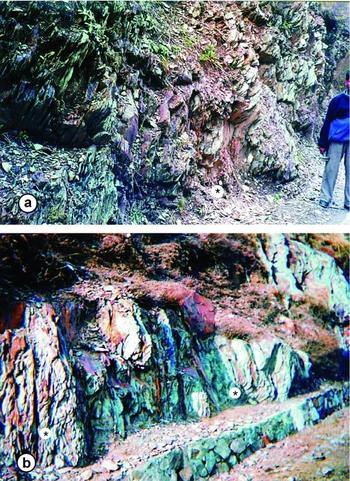
Facies VI: Dark grey shale. This consists of generally fine-grained shale beds varying from 0.03 m to 1.5 m thick (Fig. 6a). They are mostly very finely laminated, but at some levels a few beds are massive. Occasionally, there are repeating units of normal graded beds 10 to 25 mm thick. The overlying facies exhibits a coarsening upward trend, but the reverse trend in grain size is also sometimes observed. Pebbly beds are also observed in association with this shale facies. These shales also contain fragmentary plant fossils at certain levels in the lower and middle part of the formation. Some of the associated dark carbonaceous shale bands indicate intermittent influxes of carbonaceous material to the depositional site.
Gund section. (a) Exposures of thick and thinly bedded grey and black coloured carbonaceous shale facies also contain plant fossils (stars indicate the occurrence of plant fossils). Man is 1.75 m tall. (b) Grey, brownish to yellow coloured calcareous shale enriched with brachiopod fossils, containing bryozoans and plant impressions (stars indicate the occurrence of plant fossils). Check-wall beside the road is 0.9 m tall.

This laminated shale facies again does not show any high-energy primary structures except for the pebbly beds, which are found at gradational contacts with the sandstones and suggest periodic storm activity and subsequent decrease in energy conditions. The massive nature of the shale units interbedded with quartzarenites also suggests periodic high and low energy environmental conditions in the depositional system. It appears that the laminated shale facies originated in a shelf depositional setting (Castle, Reference Castle2000; Singh, Reference Singh2002).
Facies VII: Light grey-brown calcareous shale. Thickly-bedded, flaggy, brownish to yellow, fine-grained calcareous shales (Fig. 6b) are found near the Naugam area of Banihal. Large numbers of brachiopod and bivalve fossils occur in distinct hard and compact layers. These layers are adjacent to unfossiliferous or rarely fossiliferous shales, which are somewhat soft and normally fissile. Also in these brownish shales are about 50 mm thick beds of hard, grey, silty-shales. This alternation of soft and hard shale sequences is noticeable in the middle Fenestella Shale Formation. Some medium to fine grained beds of shale exhibit graded bedding at certain distinct levels. At other levels, distinct thick beds of sandy shale occur, indicating a change in the supply of material to the depositional site. This facies differs from the others in the Fenestella Shale Formation as the deposits are not exclusively terrigenous.
The fine and calcareous nature of the facies indicates a calm depositional environment, below the fair weather wave base or deeper shelf where the tides and wave processes were almost inactive. The gradual upward changes in the facies succession indicate a subsidence or deepening of the shelf, as well as intermittent transgressional phases in the depositional basin. The abundant and diverse faunas suggest an open marine environment (Proust et al. Reference Proust, Chuvashov, Vennin and Boisseau1998). The entire overlying succession, which is more than 150 m thick in the Banihal area particularly above the Gund village towards the Jawahar tunnel along the National Highway 1A, is dominated by shale interbedded with the calcareous shales. This suggests the interplay of deepening and shallowing of the depositional basin which might be due to eustatic sea level changes and basin dynamism.
5. Depositional model
The Fenestella Shale Formation represents siliciclastic deposits formed along the southern margins of the Tethyan deposition system, mostly dominated by terrestrial processes. Even during transgressions, sedimentation of terrigenous material was generally restricted to, or close to, the shoreline and in the deeper shelf, because of the increased accommodation-space on the shelf (Posamentier & Vail, Reference Posamentier, Vail, Wilgus, Hastings, Kendall, Posamentier, Ross, C. A. and Van Wagoner1988).
A series of small shallowing-upward and deepening-upward units can be recognized. Generally, shallowing upward units are composed of some combination of quartzarenite, pebbly quartzite and cross laminated quartzite, whereas deepening upward units comprise shale facies and silty shale facies with plant fossils in an ascending order. All these facies can occur in alternative settings, but the dominance of quartzarenites suggests that they were deposited during progradation in a shoreface or offshore setting influenced by wave-action during the overall regressive phase (Fig. 7). Further upward, the dominant quartzarenite facies exhibit very small-scale complex bidirectional primary sedimentary structures, forming 6 to 7 m thick units followed by units of the large scale trough and planar quartzarenite facies. The repetitive occurrence of this kind of succession suggests the presence of disconformities at distinct stratigraphical levels, such as are observed in this type of shoaling upward succession.
Schematic reconstruction of a model for a marginal basin with associated depositional environments of the Carboniferous Fenestella Shale Formation. The various processes were active during sedimentation in the basin.

The deepening upward units consist of calcareous shale facies and porous sandstone facies, containing abundant bryozoan and brachiopod fossils. In addition, pebble-lag deposits also occur, generally in the porous coarse sandstone facies. In the lower part of the formation, they are mostly made up of quartzarenite and intermittent occurrence of grey to dark grey shale facies and black shale facies suggesting deposition in a shore to shelf setting. The shale facies in the middle and upper parts of this formation, suggests the slight large scale transgression in the shelf areas. The presence of pebbles, cobbles and gravels in the porous coarse sandstone facies above the progradational quartzarenite indicates an offshore setting and also suggests an interpretation as the transitional part of transgressive phase.
Each deepening upward part of the succession is characteristically thinner than the corresponding shoaling upward interval, and indicates an asymmetric pattern of eustatic sea level changes on the Tethyan margin during late Mississippian times. The occurrence of both 1 to 2 m thick intermittent calcareous shale and dark grey shale with characteristically inner marine features like thin layers, and of brachiopods and pyrite crystals, indicates the deepening of the shelf margin. It also suggests low sediment supply into the depositional shelf during the transgression in the overall progradational phases of siliciclastic sediments in the basin. This alternation in lithofacies often occurs at intervals of more than 50 m, although at some levels at both the Gund and Arbal localities it occurs at intervals of 5–10 m thickness. A similar alternation in lithofacies in this formation has also been observed in the Naugam locality directly above the Gund area. The occurrence of 3–4 m thick silty shale, enriched with brachiopods and bioturbated structures, dark grey shale and shale facies which are characterized by brachiopods and trilobites in the middle part of the Fenestella Shale Formation, located along the NH-1A before the Naugam locality, also indicates the transgressional phase of sedimentation in the depositional basin.
Such cyclicity in sedimentation in a shoreface, offshore and deeper shelf sequence might be due to eustatic cycles, climate, tectonic activity, subsidence, variation in sediment input, or thermal activity beneath the depositional basin. Cycles, on the scale of a metre to a few metres, have developed in unique environmental settings during low amplitude, high frequency pulses of sea level change (Singh, Reference Singh2002). There were high influxes of siliciclastics into the depositional basin, but the occurrences of calcareous shale and silty shale facies at some levels also suggest intermittently rising sea levels. Overall, the alternation of fine and coarse grained intervals in this formation can be compared with the fourth-order eustatic cycles as interpreted in the Shoreman Creek Member of the terrestrial Catskill Formation (Cotter & Driese, Reference Cotter and Driese1998). The repetition of a wide range of environments, such as shoreface, offshore, innershelf and shoreface/deeper shelf margin, suggests an earlier rather passive depositional system, followed by a tectonically active depositional basin.
6. Systematic palaeobotany
The plant fossils were collected from the grey to dark grey thickly bedded shale and siltstone beds exposed near Gund and Arbal. The fossils are impressions, casts and moulds on dark grey to black shales. Morphological studies of the plant fossils were carried out under incident light and the photographs were taken using a Nikon camera. The material is identified and named using fossil taxa as defined by McNeill et al. (Reference McNeill, Barrie, Burdet, Demoulin, Hawksworth, Marhold, Nicolson, Prado, Silva, Skog, Wiersema and Turland2006), with each taxon referring to a particular plant part, life history stage and preservation state as defined in its diagnosis.
The descriptions and synonymies of the taxa are provided in the online Supplementary Material available at http://journals.cambridge.org/geo.
Sublepidodendron quadrata (Danzé-Corsin) comb.
nov.
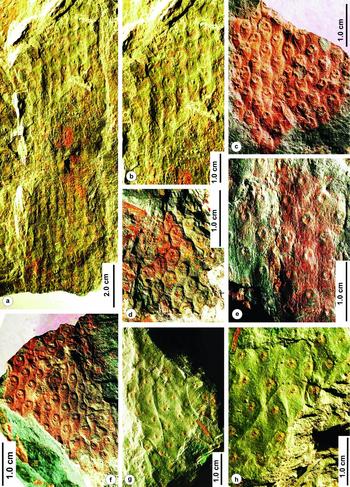
Figures 8a–h, 9a, e, h
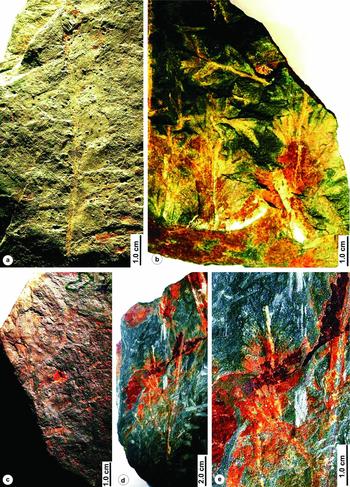
Remarks. Lycophyte stems with more or less prominent leaf cushions and true leaf scars, but lacking ligules and parichnos, are abundant in many of the Carboniferous macrofloras of India and North Africa. In many of these floras, there is an association of such stems with teardrop cushions, often referred to the fossil-genus Lepidosigillaria, and stems with subhexagonal cushions, often referred to the fossil-genus Archaeosigillaria (Danzé-Corsin, Reference Danzé-Corsin1965; Pal, Reference Pal1978; Pal & Chaloner, Reference Pal and Chaloner1979; Singh, Maithy & Bose, 1982; Pant & Srivastava, Reference Pant and Srivastava1995). This could merely represent the remains of different plants that favoured similar habitats and would thus be regularly preserved together. However, we have noted a gradation between the two types of cushion, with the smaller ones being subhexagonal, the larger ones teardrop shaped, and the intermediate ones ovoid; there are even some specimens that show the two types of cushion morphology on a single stem fragment (see Fig. 9a; also Pant & Srivastava, Reference Pant and Srivastava1995, pl. 5, fig. 5). In our view, there is little justification for separating these morphotypes taxonomically. This marked variation in cushion morphology along individual stems was noted by Pant & Srivastava (Reference Pant and Srivastava1995) and interpreted by them as due to seasonal growth.
Also associated with these stems at Gund and Wallarama Spur are the remains of stems that were referred to another genus and species by Pant & Srivastava (Reference Pant and Srivastava1995), viz. Spondylodendron wallaramensis. The principle diagnostic feature separating Spondylodendron from these other stems is that the longitudinal rows of leaf cushions become fused, a feature that they claim never occurs in what they call Lepidosigillaria. However, at least one of the specimens that they illustrate as Lepidosigillaria (Pant & Srivastava, Reference Pant and Srivastava1995, pl. 5, fig. 5) shows such fusion of the leaf cushions in the upper part of the specimen, and some specimens from Gund also show this feature (Fig. 8c; Fig. 9e). Since Spondylodendron is identical in all other features to these other stems, we see no reason for separating it taxonomically.
Sublepidodendron quadrata (Danzé-Corsin) Singh et al. comb. nov. (a–c, f–h) from the Gund section; (d–e) from the Arbal section. (a) Stem showing spirally arranged oval leaf cushions that are well preserved towards the upper part. Each cushion has a rhombic mark of a leaf scar at the apical end having a leaf trace in the centre. BSIP specimen no. 39177. Scale bar = 20 mm. (b) Upper portion of the specimen in (a), enlarged to show the details of leaf cushions, rhombic leaf scars and the leaf traces. Scale bar = 10 mm. (c) Specimen showing oval leaf cushions arranged spirally, having rhombic leaf scar marks at the apical end and leaf traces in the centre. BSIP specimen no. 39178. Scale bar = 10 mm. (d) Another specimen showing the sub-hexagonal leaf cushions. BSIP specimen no. 39181A. Scale bar = 10 mm. (e) Specimen showing elliptical leaf cushion markings arranged in steep spiral rows. Leaf scars circular and are placed at the apical end of the leaf cushions. BSIP specimen no. 39179A. Scale bar = 10 mm. (f) Another specimen of this species showing oval leaf cushions arranged vertically, rhombic leaf scar marks and centrally located leaf traces. BSIP specimen no. 39180. Scale bar = 10 mm. (g) Leaf cushions in this specimen are not so clear but the circular leaf scars are well preserved. BSIP specimen no. 39182C. Scale bar = 10 mm. (h) A portion of the specimen shown in (g) enlarged to show the details of leaf cushions and leaf scars. Scale bar = 10 mm.

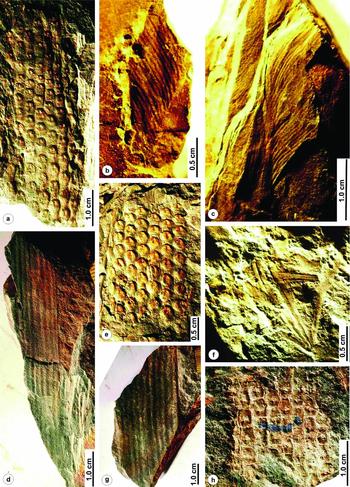
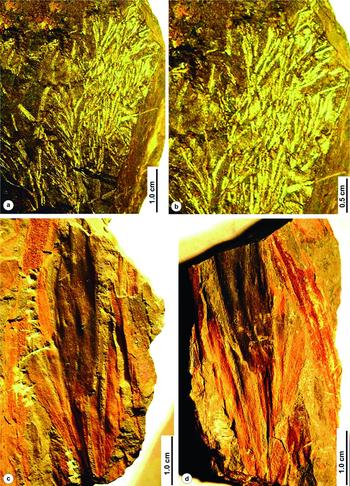
(a, e, h) Sublepidodendron quadrata (Danzé-Corsin) Singh et al. comb. nov. from the Arbal section. (a) A fragment of an axis showing hexagonal leaf cushions. Circular or oval leaf scars are placed slightly above the centre of leaf cushion with leaf traces in the centre. BSIP specimen no. 39182A. Scale bar = 10 mm. (e) Specimen showing hexagonal leaf cushions of similar length and breadth. Vascular scars are placed towards the apical side of the leaf cushions. BSIP specimen no. 39182B. Scale bar = 5 mm. (h) Fragment of an axis showing elliptical leaf cushions with their upper and lower ends constricted giving an impression of their fused form. Narrow undulating vertical grooves laterally separating the leaf cushion rows. Leaf cushion shows a rhombic leaf scar at the apical end. BSIP specimen no. 39186. Scale bar = 10 mm. (b, c) cf. Botrychiopsis plantiana (Kurtz) Archangelsky & Arrondo from the Arbal section. Specimens showing part and counter part of a broken pinnule having an elongate petiolate base and fine secondary veins. BSIP specimen no. 39183. Scale bars are (b) 5 mm and (c) 10 mm. (d, g) Archaeocalamites radiatus (Brongniart) Stur from the Gund section. Scale bars = 10 mm. (d) Incomplete specimen showing prominent ribs and grooves, but no node. BSIP specimen no. 39184. (g) Another incomplete specimen showing very prominent ribs and grooves passing straight through a faintly preserved single node. BSIP specimen no. 39185. (f) cf. Annularia sp. Sternberg. Fragment of a possible whorl of four preserved leaves from the Arbal section. BSIP specimen no. 39181B. Scale bar = 5 mm.

The degree to which the leaf cushions protrude from the stem is variable in this species, but a continuous gradation can be observed from almost smooth-surfaced stems (Fig. 8g, h) to fairly prominently protruding cushions (Fig. 8c). A Kashmiri specimen of a stem with relatively low topography was figured by Singh, Maithy & Bose (Reference Singh, Maithy and Bose1982, pl. 2, fig. 16) as Cyclostigma cf. pacifica (Steinmann) Jongmans. However, the tear-drop shaped leaf cushions of this Kashmiri specimen are clearly the same as those S. quadrata, such as those figured on our Figure 8b. Other specimens figured as Cyclostigma by Pal (Reference Pal1978, pl. 1, fig. 4; pl. 4, figs 14–15) are too unclear to verify their identity. We have seen no unequivocal evidence of Cyclostigma in the Carboniferous floras of Kashmir.
A second specimen figured by Singh, Maithy & Bose (Reference Singh, Maithy and Bose1982, pl. 3, fig. 17) as Cyclostigma is not very clearly illustrated but may belong to Lepidodendropsis liddarensis Pant & Srivastava.
The teardrop cushion morphology is that most commonly seen in these stems and so Lepidosigillaria quadrata Danzé-Corsin might be regarded as the correct name for these fossils. We agree with Pant & Srivastava (Reference Pant and Srivastava1995) that quadrata is the correct species epithet, as the Indian fossils compare well with Danzé-Corsin's (Reference Danzé-Corsin1965) North Africa types. However, there is a problem with the generic assignment of this species. Danzé-Corsin (Reference Danzé-Corsin1965) herself expressed considerable reservation about placing it in Lepidosigillaria, assigning it there only with a query. The protologue of Lepidosigillaria Kräusel & Weyland (Reference Kräusel and Weyland1949) clearly stated that the stems have leaf cushions with both a ligule and parichnos (see also Grierson & Banks, Reference Grierson and Banks1963). Since these are lacking from the quadrata species, it clearly cannot belong to that genus.
Chaloner (Reference Chaloner and Boureau1967, p. 784) and Thomas & Meyen (Reference Thomas and Meyen1984) reviewed the various available fossil-genera for lycophyte stems. The only fossil-genera that combine the features of this species are Protolepidodendropsis Gothan & Zimmermann, and Sublepidodendron (Nathorst) Hirmer (Chaloner (Reference Chaloner and Boureau1967) also suggested that Lepidodendropsis Lutz had true leaf scars, but Thomas & Meyen (Reference Thomas and Meyen1984) argued to restrict it to stems with persistent leaves). Schweitzer (Reference Schweitzer1965) revised Protolepidodendropsis and showed that the leaf cushions of the main stem have a marked depression, which he interpreted as a leaf scar, but which looks remarkably like an infrafoliar bladder (and is thus very similar to Bumbodendron Archangelsky, Azcuy & Wagner, Reference Archangelsky, Azcuy and Wagner1981). In fact, it seems that the whole of the leaf is still present in many of the figured specimens, the leaves being short and scale-like, which is very different from the Indian and North African Carboniferous stems.
Of the generic names for lycophytes stems reviewed by Chaloner (Reference Chaloner and Boureau1967) and Thomas & Meyen (Reference Thomas and Meyen1984), Sublepidodendron is thus the only one that is compatible with the features seen in the Indian and North African Carboniferous fossils (eligulate stems with clear leaf scars in the middle of a distinct leaf cushion, and no infrafoliar bladders). We therefore propose the new combination Sublepidodendron quadrata for these fossils.
Archaeocalamites radiatus (Brongniart) Stur, Reference Stur1875
Figures 9d, g, 11a, b
Material. This species is represented by six specimens, four are stem fragments and the two foliage fragments, collected from the Gund and Arbal localities respectively.
Remarks. Sphenophyte remains are scarce in the Himalayan Carboniferous floras, the only other examples having been figured by Pal (Reference Pal1978) and Pal & Chaloner (Reference Pal and Chaloner1979). These are a little narrower than the specimens documented in the present paper, but are otherwise similar in the details of the nodes and ribs.
Although not particularly well preserved, these stems are associated with foliage of a type normally associated with Archaeocalamites (e.g. Stur, Reference Stur1877, pl. 2, fig. 1) and quite different from the whorls of simple leaves found attached to the Calamites stems of the Pennsylvanian-aged palaeotropical floras of Euramerica. Also similar are leaves described by Pal (Reference Pal1978, pl. 4, fig. 16) as Rhodea tenuis from the Himalayas, which were associated with Archaeocalamites stems. Pal's specimens have slender segments as in true Rhodea, but do not show the clear pinnate arrangement that would be expected if they were fronds. Rhodea has also been reported from the Himalayas by Høeg, Bose & Shukla (Reference Høeg, Bose and Shukla1955, pl. 1, fig. 1) and Singh, Maithy & Bose (Reference Singh, Maithy and Bose1982, pl. 5, figs 26–27), but these are all very poorly preserved and were not associated with Archaeocalamites stems; hence, they have not been included in the synonymy.
cf. Annularia sp.
Figure 9f
Material. This species has a single specimen from the Arbal locality.
Remarks. Although only consisting of a part whorl, this specimen looks very similar to Annularia, such as found in the Late Carboniferous floras of Euramerica. It certainly bears little resemblance to Lobatannularia or Austrannularia as in both these species the whorl is divided into two distinct lobes and the leaves are united along half of their length. However, it is also quite different from the foliage normally associated with Archaeocalamites, which consists of irregularly-divided slender leaves that do not form regular whorls (Stur, Reference Stur1875). Either this is not the foliage borne by the stems that we (and Pal, Reference Pal1978, Pal & Chaloner, Reference Pal and Chaloner1979) have referred to as Archaeocalamites, or these stems are not true Archaeocalamites.
Nothorhacopteris kellaybelenensis Azcuy &
Suárez-Soruco, Reference Azcuy and Suárez-Soruco1993
Figures 10a, c, 12a
Material. There are two specimens of this species collected from the Gund and Arbal localities (one each).
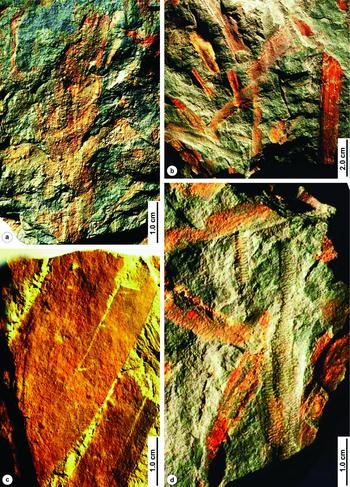
(a, c) Nothorhacopteris kellaybelenensis Azcuy & Suarez-Soruco from the Gund section. Scale bar = 10 mm. (a) Part of uni-pinnate frond having circular pinnules with broadly rounded apices and stalk like structure at the base. BSIP specimen no. 39187A. (c) Another fragment of the same species. BSIP specimen no. 39187B. (b, d, e) Triphyllopteris (?) peruviana Jongmans from the Arbal section. (b) Specimen showing haphazardly preserved pinnae. Pinnules divided into 4–5 uniform lobes, which are broadly rounded or truncated in shape. BSIP specimen no. 39188. Scale bar = 10 mm. (d) Portion of bipinnate frond with alternately attached pinnae. BSIP specimen no. 39189. Scale bar = 20 mm. (e) Portion of the pinna shown in (d), magnified to show the pinnules. Scale bar = 10 mm.

Remarks. The present specimen resembles very well the other rhacopteroid specimens figured under various names from the Himalayas by Gothan & Sahni (1937), Høeg, Bose & Shukla (Reference Høeg, Bose and Shukla1955), Pal (Reference Pal1978), Pal & Chaloner (Reference Pal and Chaloner1979) and Pant & Srivastava (Reference Pal and Chaloner1995). Pant & Srivastava (Reference Pal and Chaloner1995) assigned them to Nothorhacopteris argentinica, whose complex taxonomic history has been discussed in detail by Archangelsky (Reference Archangelsky1983). However, Iannuzzi & Pfefferkorn (Reference Iannuzzi and Rössler2002) have argued that they differ fundamentally from the type N. argentinica, as originally documented by Geinitz (Reference Geinitz1876) from a Pennsylvanian macroflora from Argentina. Instead, they placed this Himalayan material in N. kellaybelenensis Azcuy & Suárez-Soruco (Reference Azcuy and Suárez-Soruco1993) which is characterized by petiolate, wedge-shaped leaflets with a strongly crenulated distal margin.
There is some variation in leaflet morphology in this species that can cause problems when trying to identify isolated specimens. The specimens documented in the present paper have subcircular leaflets that compare with various specimens from the Himalayas that have been figured as R. circularis Walton (see synonymy list in online Supplementary Material, http://journals.cambridge.org/geo). However, in other localities in the Himalayas (e.g. Høeg, Bose & Shukla, Reference Høeg, Bose and Shukla1955), as well as in South America and Australia (as summarized by Archangelsky, Reference Archangelsky1983), specimens with such subcircular leaflets are found closely associated with others with obovate leaflets and a crenulated margin, more typical of ‘Rhacopteris ovata’ auct. non McCoy (= N. kellaybelenensis). The constancy of this association has caused most authors to accept that this represents natural morphological variation within a single biological species. The correct name for this species is N. kellaybelenensis, based on priority of the specific epithet.
The relationship between this Gondwanan material and the type Rhacopteris circularis from the Mississippian Teilia flora of Britain (Walton, Reference Walton1926) remains problematic. There are undoubted similarities in the leaflet shape, but well-preserved examples of the Gondwanan plant appear to show evidence of inter-vein fibres between the main veins, not visible in the Teilia specimens. Moreover, the Teilia specimens never show leaflets with crenulated margins as seen in the larger Gondwanan leaves. These features appear to be relatively minor and Pant (Reference Pant1996) queried whether they were sufficient to justify a generic separation. However, there appears to be a consistent geographical separation between those rhacopteroids with inter-vein fibres and crenulated margin (Gondwana) and those without fibres and with a non-crenulate margin (Euramerica) and we believe that their generic distinction is justified.
Triphyllopteris (?) peruviana Jongmans, Reference Jongmans1954
Figure 10b, d, e
Material. This species is represented by three specimens from the Arbal locality.
Remarks. The present specimens closely resemble the type of Triphyllopteris peruviana from the Lower Carboniferous of Peru. The generic position of this species is problematic. Knaus & Gillespie (Reference Knaus and Gillespie2001, p. 82) suggested that it might be an endemic Gondwanan species of Genselia, but that the frond architecture is insufficiently known to be certain. The Himalayan specimens unfortunately add nothing to this problem, and so we have tentatively retained it within Triphyllopteris.
There is also some similarity to the specimens described as Genselia lescuriana from Peru (Jongmans, Reference Jongmans1954), and the Manigam and Wallarama spurs in Jammu and Kashmir (Singh, Maithy & Bose, Reference Singh, Maithy and Bose1982; Pant & Srivastava, Reference Pant and Srivastava1995). However, the pinnules in our specimens are divided into four or five uniform segments, while the lobes in G. lescuriana are unequal in size and generally three in number.
Flabellofolium sp.
Figure 11c, d
Material. Represented by a single specimen from the Arbal locality.
(a, b) Archaeocalamites radiatus (Brongniart) Stur from the Arbal section. (a) Deeply divided foliage. BSIP specimen no. 39179B. Scale bar = 10 mm. (b) Enlargement of the upper portion of specimen shown in (a) Scale bar = 5 mm. (c, d) Flabellofolium sp. from the Arbal section. Part and counterpart showing incomplete leaf with lamina deeply incised into six cuneate segments. Incision between the segments almost extending up to the base. BSIP specimen no. 39191. Scale bars = 10 mm.

Remarks. We are using this generic name in the same sense as Retallack (Reference Retallack1980a ) for cuneate, Ginkgo-like leaves with a non-anastomosed venation and clear striae between the veins. However, the use of the name makes no implications as to the natural affinities of the leaf, which is unknown. Our specimen closely resembles the Permian leaves figured as Ginkgophyllum (Psygmophyllum) haydenni in Seward (Reference Seward1912, pl. 3, fig. 20) and Singh, Maithy & Bose (Reference Singh, Maithy and Bose1982, text-fig. 15), except that it is comparatively smaller.
cf. Botrychiopsis plantiana (Kurtz) Archangelsky &
Arrondo, Reference Archangelsky and Arrondo1971
Figure 9b, c
Material. This species is represented by a single specimen collected from the Arbal locality.
Remarks. The present specimen, although only very incomplete, compares with the specimens of Botrychiopsis plantiana described by Retallack (Reference Retallack1980b , fig. 21.3 F) from the Sydney Basin in Australia; by White (Reference White1988, p. 54) from Raymond Terrace, New South Wales, and by Guerra-Sommer & Cazzulo-Klepzig (Reference Guerra-Sommer and Cazzulo-Klepzig1993, pl. 1, fig. 5) from the Paraná Basin, Brazil in having similar kind of venation pattern and possessing petiole like base.
The identification cannot be definitely confirmed as it is such a small specimen. However, if it could be confirmed, this would be the first record of Botrychiopsis from the Carboniferous of the Himalayas. A distributional analysis of the fossil-genus by Jasper et al. (Reference Jasper, Guerra-Sommer, Cazzulo-Klepzig, Iannuzzi and Wong2007) has suggested that B. plantiana is characteristic of cooler-temperate conditions. The biostratigraphical consequences of this identification are discussed in the Section 7.
cf. Cordaites sp.
Figure 12c
Material. Represented by single specimen from Arbal locality.
(a) Nothorhacopteris kellaybelenensis Azcuy & Suarez-Soruco. Specimen showing a uni-pinnate frond having ill-preserved pinnules with obtuse apices, attached on the rachis with tapering ends. BSIP specimen no. 39195. Scale bar = 10 mm. (b) Haphazardly preserved stem fragments having irregular linear striations on their surfaces. BSIP specimen no. 39194. Scale bar = 20 mm. (c) Cordaites sp. Specimen showing a fragmentary leaf preserved without apex and base. Veins fine, nearly equidistant and parallel and do not anastomose to form any meshes. BSIP specimen no. 39192. Scale bar = 10 mm. (d) Axis with striations. Specimen showing strong transverse markings resembling certain lyginopteridalean stems and rachises such as Heterangium in which similar surface markings are the results of prominent sclerotic plates in the cortex. BSIP specimen no. 39194. Scale bar = 10 mm. All specimens from the Arbal section.

Remarks. Pant & Verma (Reference Pant and Verma1964) assigned Cordaites-like leaves from the Permian of India to Noeggerathiopsis Feistmantel because they were smaller than true Cordaites, lacked pseudo-veins and had more irregularly arranged stomata. The Himalayan fossils appear to show longitudinal structures between the veins that resemble pseudo-veins and are thus more similar to Cordaites. However, in the absence of cuticles or associated reproductive structures, and the fact that true Cordaites have never previously been found in Gondwana floras, we identify this fossil as cf. Cordaites sp.
Stems and axes
Figure 12b, d, 13a–d
Material. There are nine axes or stem fragments, all from the Arbal locality.
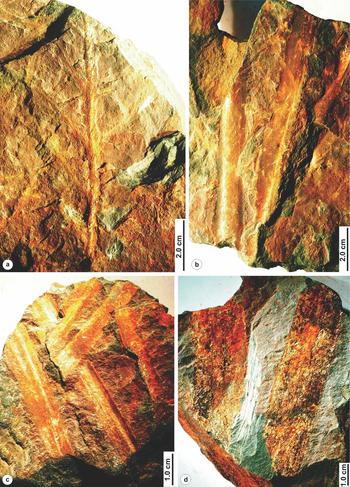
Stem fragments; siltstone from the Arbal Section. Scale bars = 20 mm (a, b), 10 mm (c, d). (a) BSIP Specimen 39193. Bipinnate axis with secondary branches attached oppositely at around 45°, but without leaves or pinnules preserved. (b) BSIP Specimen 39196. Fragments of stem. (c) BSIP Specimen 39197. Fragmentary stem axes. (d) BSIP Specimen 39198. Impressions of two axes with longitudinal furrows.

Remarks. Since none of the stem axes have attached leaves, we are not certain as to which taxa they belong to. However, the possible stem with strong transverse markings resembles certain lyginopteridalean stems and rachises such as Heterangium in which similar surface markings are the result of prominent sclerotic plates in the cortex.
7. Age of flora
The Fenestella Shale macrofloras have been traditionally interpreted as Mississippian (early Carboniferous) in age (e.g. Gothan & Sahni, Reference Gothan and Sahni1937) due to the presence of Rhacopteris, Sphenopteridium and Lepidodendropsis, which in the lower palaeolatitudes of Euramerica tend to be restricted to Mississippian floras. However, the uncritical use of these Euramerican fossil taxa for Gondwana macrofloras is highly suspect (Rigby, Reference Rigby1969) and so also must be the biostratigraphical conclusions drawn from their distribution. For instance, the Himalayan specimens originally identified as Rhacopteris are now placed in a different fossil-genus to the Euramerican species (Nothorhacopteris Archangelsky, Reference Archangelsky1983). The records of Sphenopteridium from the Himalayan floras are based exclusively on fragments of ultimate pinnae that show none of the diagnostic features of frond architecture normally used to identify that genus in Euramerican floras (as outlined by Kidston, Reference Kidston1923). Moreover, Sphenopteridium has recently been reported from a Late Pennsylvanian flora in New Mexico, USA (Mamay, Reference Mamay1992) and so its value as an index for floras of Mississippian age must be treated with some caution. Archaeocalamites is also widely regarded as an index for Mississippian-age floras, but has been reported from a Late Pennsylvanian flora in the USA (Mamay & Bateman, Reference Mamay and Bateman1991). A Mississippian age for the Fenestella Shale flora thus now depends mainly on the presence of Lepidodendropsis, but this is a fossil-genus based purely on the morphology of the bark; there is no evidence of anatomy or reproductive structures to confirm that we are dealing with remains of similar plants to those found in the Euramerican floras. Such similarities in stem morphology could merely be the result of convergence (homoplasy) in distantly related groups of plants, and so any correlations based on their relative distributions are unsafe. Meyen (Reference Meyen1977) argued that global climatic changes may result in similar physiognomic changes in plants at different latitudes and that this may allow very broad biostratigraphical correlations. This assumes, however, that distantly related plants will respond in the same way and with the same tempo to such extrinsic stress; an assumption that needs to be tested. This testing is only possible if there is independent evidence as to the relative ages of the different floras, and that it is not done on the circular basis of dating the floras on the floras themselves (as has so often been done in the past).
The presence of Nothorhacopteris kellaybelenensis in the Hiimalayan floras would seem to suggest a Mississippian age based on the range given by Iannuzzi & Pfefferkorn (Reference Iannuzzi and Pfefferkorn2002). Although not stated, this is probably based on its occurrence in the Mt Johnstone Formation in Australia, for which there is radiometric evidence for a late Viséan age (Roberts et al. Reference Roberts, Claoué-Long, Jones, Foster, Dunay and Hailwood1995). In Argentina, however, it occurs in strata dated radiometrically as Serpukhovian (Balseiro et al. Reference Balseiro, Rustán, Expeleta and Vaccari2009). If the presence of Botrychiopsis in the Himalayas could be confirmed, this would suggest a somewhat younger age, no earlier than late Bashkirian (Jasper et al. Reference Jasper, Guerra-Sommer, Cazzulo-Klepzig, Iannuzzi and Wong2007). Iannuzzi & Pfefferkorn (Reference Iannuzzi and Pfefferkorn2002, fig. 2) gave an extended range for this genus down to the latest Viséan but it is unclear on what they based this. In their appendix 2 they record Botrychiopsis from New South Wales, Australia, but this is based on Retallack (Reference Retallack, Herbert and Helby1980b ), Morris (Reference Morris, Herbert and Helby1980) and Rigby (Reference Rigby1985) who referred to fossils from the Pennsylvanian-age glacial Seaham Formation. The plant biostratigraphical evidence for the age of the Fenestella Shale macrofloras is clearly equivocal, but the balance of the argument is probably tending towards a latest Viséan or Serpukhovian age.
In the absence of reliable biostratigraphical evidence within the Fenestella Shale plant beds themselves to suggest how old they are, we must rely instead on the age-bracketing provided by the overlying and underlying beds. The underlying Syringothyris Limestone Formation is generally accepted as Tournaisian to early Viséan in age based mainly on evidence of brachiopods (Waterhouse & Gupta, Reference Waterhouse and Gupta1979; Sakagami et al. Reference Sakagami, Sciunnach and Garzanti2006). Overlying the stratigraphically lower plant bed interval of the Fenestella Shale is Member B sensu Singh, Maithy & Bose (Reference Singh, Maithy and Bose1982) which has also yielded a diverse marine fauna. This has been interpreted as Bashkirian in age (Garzanti et al. Reference Garzanti, Angiolini, Brunton, Sciunnach and Balini1998) but mainly based on correlations with the cold-water Levispustula levis Zone of Australia, rather than any independent correlation with more typical warm-water Bashkirian faunas. Assuming these cold-water faunas are associated with glacial conditions, they could be anything from late Sepukhovian to late Moscovian in age (Cleal & Thomas, Reference Cleal and Thomas2005; Fielding et al. Reference Fielding, Frank, Birgenheier, Rygel, Jones and Roberts2008). Consequently, the plant-bearing beds in the lower Fenestella Shale could be anything from early Viséan to late Moscovian in age, which is compatible with the plant biostratigraphy.
8. Comparison with other macrofloras
8.a. Other Carboniferous floras from the Himalayas
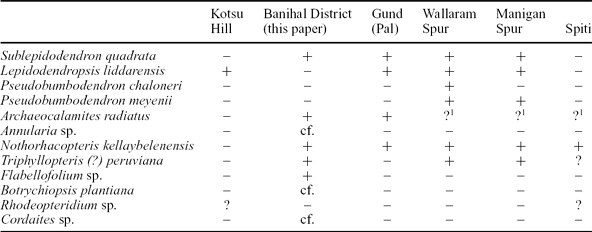
Floras comparable to that documented in this paper have been reported from several localities in this part of Kashmir (Table 2). Most originated from the Fenestella Shale Group. The only exception is the Kotsu Hill flora, which was from the upper Syringothyris Limestone, and it is notable that this is markedly less species-rich than the other assemblages. The Fenestella Shales assemblages are mostly characterized by Sublepidodendron, Lepidodendropsis, Archaeocalamites, Nothorhacopteris and Triphyllopteris. The only notable differences are among the lycophytes, which are absent from the Spiti flora, whereas the upper Fenestella Shale Formation floras (from the Wallaram and Manigan spurs) have Pseudobumbodendron which is absent from the other localities.
Comparison of Carboniferous floras of the Himalayas

1Possible foliage of Archaeocalamites
8.b. Other late Mississippian floras in Gondwana
A number of what may be superficially similar macrofloras have been described from other parts of Gondwana, and have been referred to as the northern Nothorhacopteris flora by Iannuzzi & Rössler (Reference Iannuzzi and Rössler2000) and the Paraca floral realm by Iannuzzi & Pfefferkorn (Reference Iannuzzi and Rössler2002); in this paper we use the latter term. They are dated as early Carboniferous mostly based on the similarities of the floras. There is clearly significant potential for circular argument here, especially as most of the floras tend to be poorly preserved with little or no evidence of anatomy or reproductive structures. These floras are mostly from places that were in Carboniferous times at similar latitudes. It would, therefore, be quite possible for different plant groups to evolve superficially similar foliage and/or stem morphologies in response to similar conditions.
The best documented Paraca macrofloras are from South America, such as the Ambo Formation of the Paracas Peninsula of Peru (e.g. Berry, Reference Berry1922; Gothan, Reference Gothan1928; Steinmann, Reference Steinmann1929; Read, Reference Read1938; Jongmans, Reference Jongmans1954; Doubinger & Alvarez-Ramis, Reference Doubinger and Alvarez-Ramis1980; Alleman & Pfefferkorn, Reference Alleman and Pfefferkorn1988, Reference Alleman and Pfefferkorn1997; Erwin et al. Reference Erwin, Pfefferkorn and Alleman1994). There has been no detailed monographic review of this flora since the work of Jongmans (Reference Jongmans1954) but our interpretation of the records suggests a taxonomic list for the flora as follows: ‘Cyclostigma’ pacifica (Steinmann) Jongmans (a species that lacks a ligule and parichnos, and is probably a Sublepidodendron sp.), Tomiodendron peruvianum (Gothan) Pfefferkorn & Alleman, Calamites peruvianus Gothan, Triphyllopteris (?) peruviana Jongmans, Genselia lescuriana (Meek) Knaus & Gillespie, Nothorhacopteris kellaybelenensis, Sphenopteris paracasica Gothan, Sphenopteris whitei (Berry) Jongmans, Rhodeopteridium sp., Oclloa cesariana Erwin et al. and Obandotheca laminensis Erwin et al. Reference Erwin, Pfefferkorn and Alleman1994 (the latter two taxa being pteridosperm reproductive structures). This list clearly shares many features with the Kashmir flora but is more diverse, especially in pteridophyllous species (probably pteridospermous). This greater diversity may be merely a function of the better preservation of the Paracas flora. Remains from the Kashmir flora have been recorded previously as Rhodea (= Rhodeopteridium) by Høeg, Bose & Shukla (Reference Høeg, Bose and Shukla1955), Singh, Maithy & Bose (Reference Singh, Maithy and Bose1982) and Pal (Reference Pal1978), some of which have been interpreted here as foliage of Archaeocalamites, but others may represent poorly-preserved pteridophyllous fronds with digitate ultimate segments. The age of the Paracas flora has been assumed to be Mississippian based on palynological and macrofloral biostratigraphy (e.g. Doubinger & Alvarez-Ramis, Reference Doubinger and Alvarez-Ramis1980) but there is little independent evidence to support this assertion (e.g. see comments by Archangelsky, Azcuy & Wagner, Reference Archangelsky, Azcuy and Wagner1981). All that can be definitively said is that the Ambo Formation unconformably overlies Devonian strata, and is in turn unconformably overlain by the Tarma Formation that has yielded lower to middle Pennsylvanian marine faunas (as summarized by Rocha Campos, Reference Rocha Campos, Wagner, Winkler Prins and Granados1985).
An apparently similar flora has been recorded from the Siripaca Formation of Bolivia, including Nothorhacopteris kellaybelenensis, Triphyllopteris boliviana Iannuzzi et al. and Diplothmema bodenbenderi (Kurtz) Césari (Iannuzzi et al. Reference Iannuzzi, Pfefferkorn, Díaz, Alleman and Suárez-Soruco1997, Reference Iannuzzi, Pfefferkorn, Díaz-Martínez, Alleman and Suárez-Soruco1998; Ianuzzi, Díaz-Martínez & Suárez-Soruco, Reference Iannuzzi, Díaz-Martínez and Suárez-Soruco1999). We are using the name D. bodenbenderi in the sense of Iannuzzi, Díaz-Martínez & Suárez-Soruco, (Reference Iannuzzi, Díaz-Martínez and Suárez-Soruco1999), which Iannuzzi & Pfefferkorn (Reference Iannuzzi and Pfefferkorn2002) distinguished from Diplothmema gothanica (Dolianti) Iannuzzi by the pinnules being less straight and wedge-shaped, with more divided terminal lobes, and the pinnules and rachises are attached at a more obtuse angle. However, the lectotype of D. bodenbenderi figured by Césari (Reference Césari1987, pl. 1, fig. 2) has distinctly straight and wedge-shaped pinnules very reminiscent of D. gothanica and Césari regarded them as synonyms. The specimens described by Iannuzzi, Díaz-Martínez & Suárez-Soruco (Reference Iannuzzi, Díaz-Martínez and Suárez-Soruco1999) from Siripaca Formation are clearly different from D. gothanii and may need a new name. Iannuzzi et al. (Reference Iannuzzi, Pfefferkorn, Díaz-Martínez, Alleman and Suárez-Soruco1998) also described some lycophyte and sphenophyte fragments, including reproductive structures, but these were not named or analysed in any detail. The age of this flora is again not certain; Rocha Campos (Reference Rocha Campos, Wagner, Winkler Prins and Granados1985) suggested that it may be Pennsylvanian in age, but more recently it has been regarded as Mississippian, probably late Viséan to Serpukhovian in age, based on the location of the Siripaca Formation below what is assumed to be the Mississippian–Pennsylvanian non-sequence (Grader et al. Reference Grader, Díaz-Martinez, Davydov, Montañez, Tait, Isaacson, Díaz-Martinez and Rábano2007). However, there is no corroborative faunal data from the Siripaca Formation itself (Diaz Martinez, Reference Diaz Martinez1995).
The upper Poti Formation of the Parnaíba Basin in northern Brazil has yielded a macroflora that bears some similarities to that from Kashmir. However, the only notable documentation of this flora is by Dolianiti (Reference Dolianiti1954) and, although some of the identifications have been subsequently revised (Rigby, Reference Rigby1969), full details of the taxonomic composition of the assemblage remain uncertain. Iannuzzi & Pfefferkorn (Reference Iannuzzi and Pfefferkorn2002) provided a revised species list, based at least partly on an unpublished master's thesis by the former author (University of São Paulo, 1994). Unlike the Kashmir flora it seems to be relatively poor in lycophytes both in species numbers and specimens, but with much more abundant pteridophylous foliage such as Diplothmema gothanica. The only species common to both macrofloras is Nothorhacopteris kellaybelenensis. There are also fragments of foliage that were described by Dolianiti (Reference Dolianiti1954) as Adiantites alvaroalbertoi Dolianiti, which may belong to Botrychiopsis (compare with Archangelsky & Arrondo, Reference Archangelsky and Arrondo1971). The Poti Formation is assumed to be late Viséan based on the palynology (Melo, Loboziak & Streel, Reference Melo, Loboziak and Streel1999) but this is based mainly on long-distance comparisons with palynofloras in Europe and north Africa.
Further south, a similar flora has recently been described from the Lorna de los Plojos Formation of the western Paganzo Basin, including Frenguellia exima (Frenguelli) Arrondo et al., Malanzania sp., Tomiodendron sp., Bumbodendron millanii (Arrondo & Petriella) Arrondo & Petriella, Paracalamites sp., Nothorhacopteris kellaybelenensis, Diplothmema bodenbenderi and Cardiocarpus sp. (Balseiro et al. Reference Balseiro, Rustán, Expeleta and Vaccari2009). There is no direct independent evidence for the age of the Lorna de los Plojos Formation but Césari et al. (Reference Césari, Limarino and Gulbranson2011) assigned it a Sepukhovian age based on a Baskirian (318.79 ± 0.10 Ma) age for the (unconfomably) overlying Guandacol Formation (Gulbranson et al. Reference Gulbranson, Montañez, Schmitz, Limarino, Isbell, Marenssi and Crowley2010).
Several localities in Morocco have yielded lycopsid-dominated macrofloras thought to be Viséan in age (as summarized by Danzé-Corsin, Reference Danzé-Corsin1960a and Lejal-Nicol, Reference Lejal-Nicol, Wagner, Winkler Prins and Granados1985) and which bear some similarity to the Kashmiri floras. The only photographic record of pteridophyllous foliage is by Danzé-Corsin (Reference Danzé-Corsin1960b ), and then only of small, mostly indeterminable fragments. Based on this documentation, the records of Rhacopteris, Sphenopteridium and Cardiopteridium must be dismissed as unsound. The fragments recorded as Triphyllopteris cf. collumbiana Schimper could belong to either that general group of species, or perhaps to Botrychiopsis plantiana (Carruthers) Archangelsky & Arrundo. These are associated with fragments of Archaeocalamites stems, and various eligulate lycopsids with longitudinally very elongate leaf cushions, that were variously identified as Prelepidodendron, Lepidodendropsis and Sublepidodendron. It is not totally clear from the description or figuration of these stems why they have been separated into different species, let alone genera; the evidence from the Kashmiri stems has shown that these Mississippian lycopsid stems vary considerably within individual species. At least some of the Morocco stems seem to show infrafoliar bladders (Danzé-Corsin, Reference Danzé-Corsin1960b , pl. 3, fig. 3; pl. 4, fig. 1; pl. 5, figs 1, 2) and so invite comparison with Pseudobumbodendron chaloneri Pant & Srivastava from the Kashmiri macrofloras. However, none of the specimens reported from the Morocco macrofloras resembles Sublepidodendron quadrata, which dominates the Kashmiri macrofloras.
The Tereda and Tagora formations in the Aïr Mountains of Niger, north Africa have yielded a Mississippian macroflora (probably late Tournaisian or earliest Viséan in age; Coquel et al. Reference Coquel, Lang and Yahaya1995) also dominated by lycophyte stems and some pteridophyllous foliage (de Rouvre, Reference Rouvre1984). The lycophytes, which are only known from stem impressions, include eligulate forms identified as Lepidodendropsis rhombiformis de Rouvre but they lack leaf scars and so cannot belong to this fossil-genus (Pant & Srivastava, Reference Pant and Srivastava1995). Stems with similar but smaller leaf cushions were described as Pseudolepidodendropsis nigeriensis de Rouvre and it is difficult to see why these are not just growth stages of the same species. Based on the generic scheme of Thomas & Meyen (Reference Thomas and Meyen1984), the combination of a distinct leaf scar, but lack of ligule, parichnos and infrafoliar bladders would place these stems in Sublepidodendron. However, they are totally different from the Kashmiri specimens of Sublepidodendron quadrata in the shape of the leaf cushions and the position of the scars within the cushions. De Rouvre (Reference Rouvre1984) also described various other stems that superficially resemble S. quadrata in the form of the leaf cushions and the arrangement of the scars. De Rouvre claimed that they were ligulate and so identified the stems as Ursodendron wijkianum (Heer) Radczenko and Tomiodendron varium (Radczenko) Meyen. If they are indeed ligulate, this makes them quite different from anything seen in the Kashmir floras, but it is difficult to be certain from the photographs published by de Rouvre.
De Rouvre also described a range of pteridophyllous and sphenophyte fossils in an unpublished thesis and a list of species names was given by de Rouvre (Reference Rouvre1988). We have not had the opportunity of seeing either the thesis or the collection on which it was based, but Iannuzzi & Pfefferkorn (Reference Iannuzzi and Pfefferkorn2002) did see the latter and have recorded from this flora Nothorhacopteris kellaybelenensis, Triphyllopteris sp., Paulophyton sp., Fryopsis frondosa (Göppert) Wolfe and Archaeocalamites radiata. Although this seems to be comparable with the type of assemblage found in the Himalayas, a meaningful comparison is at this stage is impossible.
Viséan macrofloras from Djarda, also in Niger, consist entirely of lycopsid stems that have been assigned to a range of fossil-taxa. Specimens have been described as Lepidosigillaria (Lejal, Reference Lejal1968) but it was noted that neither parichnos nor ligules were preserved and these are better assigned to Sublepidodendron. The range of variation in the leaf cushion shape in these Djardo Sublepidodendron stems is similar to that observed in the Banihal macrofloras and it is thus likely that they represent variation within a single species. Several stems described by Lejal (Reference Lejal1969) as Lepidodendropsis also bear some similarity with the Indian stems but, as pointed out by Pant & Srivastava (Reference Pant and Srivastava1995) they appear to differ in the details of the leaf cushions and the position of the leaf attachment.
Exclusively lycopsid macrofloras have also been described by Lejal-Nicol (Reference Lejal-Nicol1977) from Viséan strata in Libya, notably near Fezzan. As with the other north African macrofloras these lycospids are eligulate and lack leaf scars, and thus probably belong to Lepidodendropsis. A notable exception was a single stem that was interpreted as being ligulate and identified as Bothrodendron depretii Vaffier. This is not as well preserved as the specimens of this species documented by Thomas (Reference Thomas1980) but if this identification can be confirmed, it would serve to distinguish this flora from those of the Paraca floral realm, and suggest affinities with lower palaeolatitudinal vegetation of this age. There is no evidence of stems attributable to Sublepidodendron. Macrofloras from the Illizi area in Algeria also consist exclusively of lycospids, but here they are nearly all ligulate and were mostly attributed by Lejal-Nicol (Reference Lejal-Nicol1972) to Lepidodendron. This may reflect a more northern palaeogeographical situation for this area as well as the macroflora being a little younger, perhaps earliest Namurian in age.
Impoverished Viséan macrofloras preserved in sandstone were recorded by Jongmans (Reference Jongmans1940) from the Sinai in Egypt. Younger, rather better material was described by Jongmans (in Jongmans & van der Heide, Reference Jongmans and van der Heide1955) from boreholes in the area, which included mainly lycopsid stems identified as Lepidodendropsis, Sublepidodendron and Cyclostigma, together with Archaeocalamites sphenophyte stems and pinnate foliage identified as Sphenopteris whitei (Berry) Jongmans. Although based on only a limited number of specimens, these macrofloras would seem to bear a close similarity to the Paraca floras from Peru and, to an extent, the Kashmiri floras.
Iannuzzi & Pfefferkorn (Reference Iannuzzi and Pfefferkorn2002) included within the Paraca floral realm the ‘Nothorhacopteris flora’ that has been reported from various horizons in New South Wales and Queensland (Australia), including the Mt Johnstone, Italia Road, and Johnson's Creek formations. Morris (Reference Morris and Campbell1975, Reference Morris, Herbert and Helby1980, Reference Morris, Wagner, Winkler Prins and Granados1985), among others, regarded these macrofloras as Pennsylvanian in age, partly based on their greater apparent diversity compared with Mississippian macrofloras elsewhere in Gondwana. However, Retallack (Reference Retallack1980b ) argued that they were pre-glacial floras, which would indicate they are of Mississippian age. More recent radiometric work has clearly demonstrated that most if not all are Mississippian in age (Claoué-Long et al. Reference Claoué-Long, Compston, Roberts, Fanning, Berggren, Kent, Aubry and Hardenbol1995; Roberts et al. Reference Roberts, Claoué-Long, Jones, Foster, Dunay and Hailwood1995).
These Australian macrofloras are difficult to assess as there has been no comprehensive published treatment of their taxonomy or biostratigraphy. According to Morris (Reference Morris, Herbert and Helby1980, Reference Morris, Wagner, Winkler Prins and Granados1985) the stratigraphically lower of the Australian macrofloras are dominated by ‘Rhacopteris’ (presumably Nothorhacopteris). Morris (Reference Morris, Herbert and Helby1980, pl. 18.1, figs 1–5) illustrated several unlocalized specimens as Rhacopteris ovata (McCoy), some of which (her figs 1, 2, 4) resemble Nothorhacopteris kellaybelenensis similar to those found in the Himalayas, but others (her figs 3, 5) resemble Nothorhacopteris argentinica, usually associated with Pennsylvanian floras in South America. These stratigraphically older Australian floras also include sphenophyte stems similar to Archaeocalamites, lycophyte stems and rounded leaflets assigned to Fryopsis frondosa (Göppert) Wolfe. The lycophytes include specimens identified as Lepidodendropsis steinmannii Jongmans and Cyclostigmaria australis that could possibly fit into the range of variation of Lepidosigillaria, but it is impossible to be certain from the illustrations provided (Morris, Reference Morris, Herbert and Helby1980, pl. 18.1, figs10, 11). A third type of lycophyte was identified as Sigillaria (Morris, Reference Morris, Herbert and Helby1980, pl. 18.1, figs 8, 9) but as pointed out by Archangelsky, Azcuy & Wagner, Reference Archangelsky, Azcuy and Wagner1981, p. 3) this probably represents a new genus.
The stratigraphically higher Australian floras, such as from the Joe Joe Group in Queensland and the upper Mount Johnstone Formation in New South Wales, have yielded similar macrofloras but also including Botrychiopsis plantiana (Rigby, Reference Rigby1973) and various indeterminate sphenopteroid forms. This was referred to by Morris (Reference Morris, Herbert and Helby1980, Reference Morris, Wagner, Winkler Prins and Granados1985) as the Upper or ‘enriched’ Rhacopteris/Nothorhacopteris flora, although it does not differ substantially from the ‘normal’ Rhacopteris/Nothorhacopteris flora.
Stratigraphical levels below those yielding the ‘Nothorhacopteris flora’ in Australia have yielded a number of assemblages of lycophytes, referred to by Morris (Reference Morris, Herbert and Helby1980, Reference Morris, Wagner, Winkler Prins and Granados1985) as the ‘Lepidodendron Flora’. These comprise macrofloras of drifted fragments in shallow marine deposits and the specimens show none of the characteristics of true Lepidodendron. As suggested by Rigby (Reference Rigby1979, Reference Rigby1985), they are best identified as ‘lycopod stem incertae sedis’.
9. Conclusions
The Fenestella Shale Formation yields a low diversity macroflora, perhaps of latest Viséan or Serpukhovian (late Mississippian) age, which belongs to the Paraca floral realm of Iannuzzi & Pfefferkorn (Reference Iannuzzi and Pfefferkorn2002). In previous studies, the species diversity has tended to be exaggerated, mainly because of the failure to appreciate the intra-specific variation of the component taxa, especially of the lycopsid stem fossil-species. The low diversity suggests conditions were unfavourable for vegetation but this is unlikely to have been due to climate; according to Iannuzzi & Pfefferkorn (Reference Iannuzzi and Pfefferkorn2002) this was a time of warm-temperate conditions in these palaeolatitudes, prior to the onset of the Pennsylvanian–Cisuralian glacial interval. It is possible that substrate conditions were unfavourable to the development of high diversity vegetation, but as the macrofloras are consistently allochthonous it is impossible to determine what these substrate conditions were. It is also impossible to be sure how far the plant remains had drifted before being entombed in sediment and so is it feasible that taphonomic factors may at least partly explain the low species richness.
This study has nevertheless revealed a number of previously unrecognized fossil-taxa for this macroflora, notably what we have called Flabellofolium sp., Cf.Botrychiopsis plantiana and cf. Cordaites sp. These are all based on single specimens, none of which are especially well preserved, and so their identity cannot be regarded as absolutely confirmed. However, they suggest that these plant beds merit further investigation and that additional taxa may be found here.
Acknowledgments
The authors thank Dr N.C. Mehrotra, Director, Birbal Sahni Institute of Palaeobotany for giving permission to publish this research paper. RS is grateful to Prof. G.V.R. Prasad, Prof. G.M. Bhat, Head of the Department of Geology, University of Jammu, for providing facilities to carry out this research work at the initial stage, and to Profs C.S. Sudan, M.A. Malik, Y.P. Gupta and Dr B.P. Singh for the discussion related to lithofacies and depositional model in this paper. CJC thanks the Natural History Museum, London, for providing library facilities. We acknowledge Drs Yogmaya Shukla and Santosh Pandey for helping in preparation of the lithologs and plates. Thanks are also due to P.K. Bajpai, Pawan Kumar and Pradeep Mohan of BSIP for help in the preparation of the locality map and photography of the specimens. Financial help provided by the Council of Scientific and Industrial Research, New Delhi, India to RS is gratefully acknowledged. This work is partially supported by Indo-Russian Project (INT/RFBR/P-102).