The problems associated with the genesis of oil and gas remain relevant due to the high consumption of hydrocarbons by modern society. The considered mechanism makes it possible to revise the time and duration of the formation of gas–oil deposits decreasingly, as well as to explain features in the formation of various sources of hydrocarbons and observed inflow of oil into operating and exhausted wells.
The high consumption of hydrocarbons by modern society stimulates the search and exploration for new gas and oil fields, as well as the development of unconventional sources of hydrocarbons, which, until recently, were referred to as shale oil and gas. As a result, the problems associated with the genesis of oil and gas remain relevant. To date, a large number of hypotheses for the origin of oil have been expressed, but discussions on this matter have not subsided. Adherents to these or those views are usually grouped into two main groups: supporters of the organic origin of petroleum hydrocarbons and their inorganic or abiogenic synthesis. However, at present, mixed or polygenic models of oil and gas formation are being discussed more and more, especially in connection with the discovery of oil deposits at great depths, in the earth's crust basement, subduction–obduction zones, and rift zones.
The development of the theories of inorganic synthesis is facilitated by the regional confinement of oil and gas accumulations to zones of deep faults noted by specialists, as well as the presence of oil in igneous rocks and rocks of the crystalline basement, the results of hydrothermal activity of the subsoil, which indicate intensive unloading of mantle fluids and gases on the continents and in the oceans. Deep fluids, which primarily include hydrogen, methane, carbon dioxide (CO2), and water, can undoubtedly be the initial components of the synthesis of a certain amount of abiogenic hydrocarbons (Serovaiskii & Kutcherov Reference Serovaiskii and Kutcherov2020). This process is facilitated by the catalytic activity of some rocks – for example, aluminosilicates. However, we believe that an inorganic synthesis of the entire spectrum of petroleum hydrocarbons in the mantle and lower horizons of the earth's crust is unlikely because, at high temperatures, decomposition rather than synthesis of complex organic compounds predominantly occurs (Liu et al. Reference Liu, Han, Li, Huang and Jiang2014; Huang et al. Reference Huang, Liang, Zhan, Zou, Li and Peng2018).
At the same time, the presence of a close genetic relationship between oil and organic substance fossilised in sedimentary rocks and the molecular structures of living substance, as well as the optical activity of oil, indicate that the main source of petroleum hydrocarbons is still biogenic organic substance transformed in diagenesis and catagenesis (Tissot Reference Tissot1984). As a result, the sedimentary-migration theory of the origin of oil is recognised by most specialists in petroleum geology.
However, this concept is unable to explain many simple facts. For example, why in rocks of the same type of the same age, in some cases, does micro-oil migrate to the pool, while in others it does not. Consequently, from the standpoint of the sedimentary-migration theory, it is possible only to designate a geological object that is promising for oil and gas, but it is impossible to specify the location of a gas–oil reservoir. It is also difficult to answer the question of why traditional oil and shale oil deposits differ in the nature of their occurrence.
It can be assumed that the answers to these questions lie in understanding the mechanisms of hydrocarbon migration. Supporters of abiogenic oil synthesis consider the mechanism of hydrocarbon migration to be the weakest link in the sedimentary-migration theory (Timurziev Reference Timurziev2009). It is unclear how the petroleum hydrocarbons generated as a result of catagenetic transformations of dispersed organic matter (DOM) leave dense oil-source rocks. It is assumed that the generated gaseous components create increased pressure, resulting in rocks cracking (Tissot Reference Tissot1984). Hydrocarbons dissolved in the compressed gas leave the oil-source rocks. However, temperatures in the main phase of oil generation (‘oil window’) fluctuate in a rather low range of 110–45 °C. Under these conditions, chemical reactions are usually reversible. Due to this, an increase in pressure in the pores and microcracks of rocks will shift the equilibrium of the reaction towards the initial less volatile components. In sedimentary rocks, the content of DOM, as a rule, does not exceed 1–2 %. In this regard, it is difficult to assume the generation of such a large amount of gaseous components that could lead to rock cracking and ensure the primary migration of petroleum hydrocarbons. The geological literature provides descriptions of other possible mechanisms and models of hydrocarbon migration (Tissot Reference Tissot1984; Carruthers & Ringrose Reference Carruthers and Ringrose1998; Burley et al. Reference Burley, Clarke, Dodds, Frielingsdorf, Huggins, Richards, Warburton and Williams2000; Balitsky et al. Reference Balitsky, Balitskaya, Bublikova, Prokof'ev and Pentelei2007; Ivannikov Reference Ivannikov2010; Guo et al. Reference Guo, Pang, Jiang, Chen, Jiang and Dong2013).
However, even if we assume that the primary migration of hydrocarbons has been successfully carried out, the question remains, why are hydrocarbons not dispersed but concentrated in initially water-saturated reservoir rocks? After all, the concentration of hydrocarbons in the reservoir (a process that occurs with a decrease in entropy) goes against the laws of dispersion. ‘There are no phenomena and mechanisms in nature that lead to the concentration of matter from a dispersed state without the application of external forces’ (Timurziev Reference Timurziev2009). Such processes can take place only in thermodynamically open systems (Prigogine Reference Prigogine1961). Besides, filling the reservoir with micro-oil must be accompanied by the displacement of water in the pores of the rock. According to the sedimentary-migration concept, the reservoir is filled with micro-oil under the influence of gravitational and hydraulic factors. In both cases, capillary pressure will impede the floating of drops or movement in the hydrodynamic system into the oil bed roof. Its value depends on the size of pores, interpore channels, cracks, the degree of hydrophilicity of the rock, including the forces arising at the oil–water interface, etc. (Tissot Reference Tissot1984). Since the rocks are initially characterised by a hydrophilic surface, and the interpore channels are not so large, hydrophobic bubbles of oil or gas can simply block these channels, thereby preventing their further movement. As already noted, when filling a reservoir with oil or gas, the latter must displace water from the pores and channels – that is, there should be a counterflow of hydrocarbon components relative to the water. The counterflow of liquid phases, especially in narrow channels and pores, is always accompanied by resistance, to overcome which an additional source of energy is needed. It can be presupposed that the filling of reservoir rocks with oil according to these mechanisms should probably be hindered by the same factors as when pumping oil from flooded wells.
Proponents of abiogenic oil synthesis do not usually specify the mechanism of hydrocarbon migration, suggesting that deep fluid pressure is sufficient for hydrocarbons to rise and fill reservoir rocks with them. However, an experiment is described in Liu et al. (Reference Liu, Han, Li, Huang and Jiang2014), according to which, for example, ‘the oil cannot charge into the sandstone if the porosity is less than 10 % in Xifeng and Ansai areas of Yanchang Formation, Ordos Basin, even under pressurized conditions’.
The current existing hypotheses of the origin of oil also do not provide an answer to the questions of why oil deposits are mainly formed from DOM, and not concentrated. For example, oil shale is rich in organic matter, which should be enough to generate an excessive amount of volatile components required for rock cracking and the primary migration of micro-oil. However, shale oil and gas remain sealed in source or nearby rocks. For this reason, shale oil is often referred to as tight oil. The biogenic source of petroleum hydrocarbons is predominantly aquatic organic matter, both in the case of traditional deposits and shale oil (Aliyev et al. Reference Aliyev, Abbasov, Ibadzade and Mammadova2018; Wang et al. Reference Wang, Zhang, Yang, Xu, Matthew and Tang2020). The degree of maturity of organic matter in oil shale is not always inferior to DOM (Aliyev et al. Reference Aliyev, Abbasov, Ibadzade and Mammadova2018). Oil shale includes only rock in which the concentration of organic matter usually exceeds 20 %. Nevertheless, traditional oil pools in shale rock are usually rare and deplete very quickly. The following questions arise: what is preventing shale oil from migrating into the pool or, in the absence of traps, seeping to the day surface? After all, oil shale rocks are less dense than oil-source rocks with DOM. What is the reason for the different occurrence of shale oil and conventional oil fields?
Understanding the mechanism of oil and gas generation is primarily associated with understanding the mechanism of hydrocarbon migration (Ivannikov Reference Ivannikov2010; Jiao et al. Reference Jiao, Yang, Zhao, Zhang, Zhou, Zhang and Xie2010). As already noted, the concentration of hydrocarbons in the reservoir occurs in contrast to diffusion dispersion and is characterised by a decrease in entropy in the system. To carry out such processes, additional force or energy is needed, the source of which lies in the openness of the system (Prigogine Reference Prigogine1961). At the end of the 20th Century, the methods of equilibrium thermodynamics in the study of natural deep fluid systems were replaced by a more general paradigm – synergetics, i.e., thermodynamics of open, highly non-equilibrium systems (Letnikov Reference Letnikov2016). All this testifies to the fact that the process of formation of gas–oil deposits should be considered in a system that is open in the flow of energy and matter (Lifshits Reference Lifshits2009). The study of deep fluids and their interaction with lithospheric substrates should become the main direction of research in oil and gas geology of the 21st Century (Lukin & Pikovsky Reference Lukin and Pikovsky2004). At present, more and more research is being done in this direction (Lifshits & Chalaya Reference Lifshits and Chalaya2010; Khasanov et al. Reference Khasanov, Mullakaev, Galiullin and Khayrtdinova2017; Luo et al. Reference Luo, Jin, Liu and Zhang2017; Zhu et al. Reference Zhu, Liu, Jin, Meng and Wenxuan2017; Kayukova et al. Reference Kayukova, Mikhailov, Kosachev, Morozov and Vakhin2020).
Previously, we considered a model of the genesis of oil in an open system (Lifshits Reference Lifshits2009; Lifshits & Chalaya Reference Lifshits and Chalaya2010), according to which rock with DOM completely or partially penetrates deep fluid in a supercritical state. It should be noted that supercritical fluids have a very high dissolving and penetrating ability, superfluidity, and chemical activity (Makaryan et al. Reference Makaryan, Kostin and Sedov2020). The main components of deep-seated natural fluids are hydrogen, CO2, methane, and water. The conditions (temperature and pressure) for the pass to the supercritical state of CO2 (tcrit 31.0 °C and Pcrit 72.9 atm) and methane (tcrit 82.4 °C and Pcrit 46.9 atm) are achievable under the ‘oil window’ (temperature 110 ± 45 °C, depth 1.5 ÷ 3.5 km). Other components of deep fluids, water, or hydrogen can easily dissolve in a supercritical medium, thus acquiring high chemical activity (Rzoska & Rzoska Reference Rzoska, Rzoska, Rzoska, Drozd-Rzoska and Mazur2010; Makaryan et al. Reference Makaryan, Kostin and Sedov2020). Due to its high penetrating and dissolving power, as well as superfluidity, the fluid can penetrate microcracks and micropores of oil-source rock, dissolving oil hydrocarbons and transferring them into reservoir rock with the formation of gas and oil deposits. Experimentally, using the example of supercritical CO2, it was shown that such a transfer is possible and accompanied by a mild mechanochemical transformation of organic matter (Lifshits & Chalaya Reference Lifshits and Chalaya2010).
The migration of hydrocarbons in the earth's crust is closely related to the permeability of rocks. It can be assumed that the supercritical fluid is capable of transforming (partially dissolving) the mineral component of sedimentary rocks, thereby increasing their permeability, and, possibly, porosity. To test this assumption, experiments were carried out on the processing of sedimentary rocks with a supercritical fluid using the example of CO2.
1. Methods
For the experiment, samples of the following rocks were taken: No. 1 – limestone (collection of K.I. Mikulenko, Aldan anteclise, Krasny stream); No. 2 – argillite (collection of A.I. Kalinin, right bank of the Lena River, area of Tit-Ary island); No. 3 – oil shale (Kashpirskoye deposit, collection of V.A. Kashirtsev); and No. 4 – bituminous limestone (one of the wells of the Talakanskoe field, collection of V.A. Kashirtsev). Each rock was divided into two parts. One of them was crushed into powder; the second was fractionated with the release of grains of 0.2 ÷ 2 mm or 1 ÷ 2 mm.
To measure the gas permeability of rocks, the core sample was taken from the collection of K.I. Mikulenko, one of the wells of the Talakanskoe field. The first core is a carbonate rock, the second is a clay-type rock, argillite.
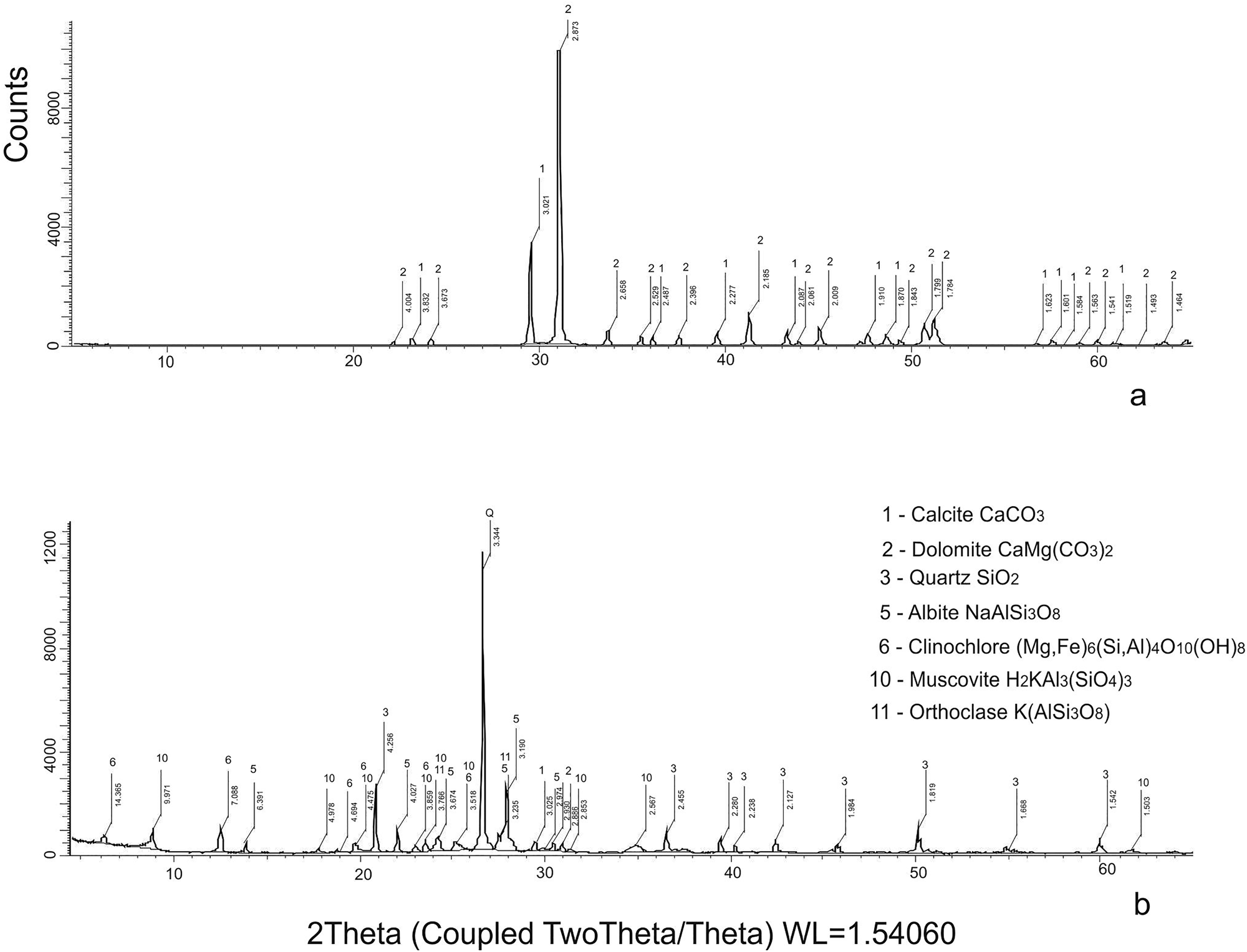
The mineralogical composition of the rocks was studied by X-ray phase analysis on a Bruker D2 PHASER diffractometer, CuKα radiation, 30 kV, 10 MA, using the PDF 2 database, a semi-quantitative analysis and identification program supplied with the device. Figure 1 shows the diffractograms of the studied rock samples. It is evident (Fig. 1a) that the main phase of the first sample (limestone) comprises calcite, dolomite, and small admixtures of quartz and anhydrite are present. The second sample (Fig. 1b) is dominated by quartz and feldspar; there are layered silicates – minerals from the chlorite and mica groups, traces of calcite with dolomite. According to the mineralogical composition, this sample can be attributed to the rock of the argillite type. The mineral part of oil shale (sample No. 3, Fig. 1c) is mainly represented by a mixture of minerals – quartz and calcite, and there is a noticeable amount of zeolite, a little mica, and pyrite. Sample No. 4 (Fig. 1d) is limestone since the main phase in its composition is calcite. Dolomite is present, and there are traces of quartz. The rocks selected for the study of gas permeability have the following mineralogical composition: core No. 1 (Fig. 2a) is a mixture of dolomite and calcite minerals. Core No. 2 (Fig. 2b) is a clay-type rock, represented by a mixture of minerals: quartz, feldspars, mica, chlorite, traces of calcite, and dolomite. It can be attributed to argillite.
Diffraction patterns of the studied rock samples: (а) limestone; (b) argillite; (c) oil shale; (d) bituminous limestone.

Diffraction patterns of rocks tested for gas permeability: (а) carbonate rock; (b) argillite.

The carbonate content of rock was determined by the change in the mass of samples ground to powder before and after their treatment with 10 % hydrochloric acid (Uspenskiy Reference Uspenskiy1975). The amount of organic carbon (Corg) in the rock was determined by burning the insoluble residue of the rock after treating it with 10 % hydrochloric acid (Uspenskiy Reference Uspenskiy1975).
The permeability of rocks was studied by the ability of an organic solvent (chloroform) to extract bituminous substances from rocks. For this, we used the hot chloroform extraction method (Uspenskiy Reference Uspenskiy1975; Measurement Technique No. 222.0119/01.00258/2014 2014). Samples of rock ground to powder and grain fractions of 0.2–2 or 1–2 mm were subjected to extraction. In geochemical studies, an exhaustive extraction is carried out from a rock ground to powder, because, in this case, there are no diffusion difficulties, as well as difficulties associated with the penetration of the solvent into the grains of the rock.
As a result, the yield of chloroform bitumoids (ChB) is maximised. During the extraction of rock grains, not all bituminous substances are available for the solvent. Thus, the assessment of the permeability of the rock can be carried out by the ability of the solvent to penetrate the pores and micropores of the rock grains with the extraction of bituminous substances from them – that is, by comparing the yields of chloroform extracts from the rock ground to powder and its grains. To determine whether the supercritical fluid interacts with the mineral component of the rocks, part of the granular fraction was treated with supercritical CO2, and then hot chloroform extraction.
The gas permeability of the rocks was determined using a UIPK-02M unit under GOST 26450.2-85. The gas permeability coefficient of the rock was calculated with the linear direction of the gas flow – technical nitrogen from the cylinders. To measure gas permeability, cylinders 5.00 ± 0.20 cm high and 3.00 ± 0.10 cm in diameter were turned from the sampled rock cores. From the first core sample, cylinders No. 1 and No. 2 (Fig. 3a), and from the second, cylinders No. 3 and No. 4 (Fig. 3b). The gas permeability of the samples was determined in five replicates. After the measurements were taken, the rock cylinders were treated with supercritical CO2, and the gas permeability of the samples was measured again.
Cylinders for measuring gas permeability: (а) carbonate rock, (b) argillite.

The treatment of rocks with supercritical CO2 was carried out on the unit shown in Figure 4. Through a high-pressure valve, the unit was connected to a cylinder with liquefied CO2, which, after filling the unit with СО2, was closed. Through metal tubes, СО2 entered a 2-l extractor, where the rock was previously loaded, and then through a system of metal pipes with valves, it proceeded into a receiver (evaporator). The receiver was warmed up with water heated in a thermostat to 80–85 °C. In this case, CO2 evaporated. The gas emerged and entered a condenser equipped with a coil through which cold tap water was passed. As a result of the cooling, gaseous СО2 passed to a supercritical state, which could be visually observed in the sight glass. Passing the sight glass, the supercritical fluid descended into the extractor, where the supercritical extraction process was carried out. Then the fluid entered the receiver, as a result of which the CO2 was heated to evaporate – that is, the fluid passed into a two-phase state with the formation of gaseous СО2 and the release of extractable in the receiver. Due to the temperature difference in the receiver and the condenser, a pressure of 85–90 atm was established in the system.
Principal schema of a supercritical extraction unit.

The temperature in the extractor was 35–38 °C. Experiments on supercritical extraction lasted 48 h – in the daytime, in flow mode, and at night, in the infusion mode. At night, the heating was turned off, the pressure gradually dropped to 55–60 atm, and, in fact, at this time the system was in a pre-critical state.
Before each experiment, a blank (without sample loading) run of CO2 was carried out to make sure that there were no extracted substances from the previous experiment in the system. This technique for conducting experiments with supercritical CO2 has been tested in previous work (Lifshits & Chalaya Reference Lifshits and Chalaya2010; Lifshits et al. Reference Lifshits, Chalaya and Zueva2012).
To study the group component composition, the isolated chloroform extracts were studied by liquid-adsorption column chromatography. The essence of the method lies in the initial precipitation of asphaltenes with petroleum ether, followed by the washing out of hydrocarbon fractions and resins with various organic solvents on a sorption column with silica gel (Uspenskiy Reference Uspenskiy1975; Measurement Technique No. 222.0119/01.00258/2014 2014).
Analytical studies were carried out in triplicate. In the tables (1, 2) the results obtained are presented as the arithmetic mean. A comparison of the mean values of the samples was performed by one-way analysis of variance. The significance of differences from control was determined using Dunnett's test for multiple comparisons at P < 0.05. The calculation was carried out using the Analyst Soft package, Stat Plus statistical analysis program, version 2007.
2. Results
The results of studies on the permeability of rocks by comparing the yield of ChB depending on the degree of grinding of these rocks are shown in Table 1. It can be seen that the yield of ChB quite strongly depends on the degree of grinding of rocks for limestone and argillite, and is practically the same in the cases of bituminous limestone and oil shale. This may indicate that limestone and argillite are poorly permeable – that is, the micropores and microcracks in these rocks appear to be too small for solvent penetration or even closed, which also suggests that bituminous limestone and oil shale, unlike limestone and argillite, are highly permeable. Of course, it should be taken into account that in the process of the oil shale crushing, a rock with a layered and brittle structure, additional cracking of the grains could occur while maintaining their integrity, which would contribute to an increase in permeability. But even this process could not so drastically affect the yield of ChB from the grains of this rock.
Results of experiments on chloroform extraction of rocks.

Let us consider how the treatment of rock grains with a supercritical fluid affects the ChB yield. As can be seen from the data given in Table 1, the treatment of grains of bituminous limestone and oil shale with supercritical СО2 led to a decrease in the yield of ChB. This is probably due to the good solubility of petroleum hydrocarbons in supercritical СО2, which could be washed out by the fluid from these rocks due to their high permeability in such a short time.
A different picture was observed for dense rocks, limestone and argillite. It can be seen (Table 1) that initially only 3 mg of bituminous substances per 100 g of rock could be extracted from the 0.2–2 mm fraction of limestone, and after supercritical treatment, 19 mg. If we take into account that the yield of bitumoid from a sample ground to powder is considered the maximum possible (21 mg/100 g of rock), then before treatment with supercritical СО2, only 14.3 % of the bituminous substances contained in the rock could be extracted from the limestone fraction with chloroform, and after processing, 90.5 %. This means that after the treatment of limestone with a supercritical fluid, the yield of ChB increased by 6.3 times. For argillite, before treatment of the fraction with supercritical СО2, 26.2 % of bituminous substances were available for dissolution in chloroform, and after treatment, 64.3 %. As a result, the yield of bitumoid after the treatment of argillite with supercritical СО2 increased by almost 2.5 times.
Studies of ChB by liquid adsorption chromatography have shown that the isolated extracts from these rocks, both before and after treatment with a supercritical fluid, contain asphalt-resinous components. In terms of absolute content, supercritical treatment increased the yield of all ChB fractions (Fig. 5), and this is despite the fact that the sizes of the molecules of asphalt-resinous components are the largest.
The yield of various ChB fractions before and after the treatment of low-permeability rocks with supercritical CO2.

Thus, the treatment of rock grains with supercritical СО2 significantly facilitated the access of the solvent to the bituminous component of the organic matter of low-permeable rocks. It can be assumed that the supercritical fluid facilitated the access of the solvent to the bituminous components by increasing the porosity of the rock due to the partial dissolution of their mineral carbonate component in the reaction (Eq. 1), since in the supercritical state it has superfluidity, increased penetrating power, and high chemical activity:
 $$CaCO_3 + CO_2 + H_2O\;\leftrightarrow Ca( HCO_3) _2$$
Also, a supercritical medium is characterised by a sharp increase in the chemical activity of water, which is necessary for the partial dissolution of carbonates and is usually present in rocks. The dissolution of carbonates to bicarbonates is referred to as karst phenomena. Karst, both surface and deep, and its reversible character are well known and described in the geological literature (Ezhov et al. Reference Ezhov, Lisenin, Andreychuk and Dublyansky1992; Grecheneva et al. Reference Grecheneva, Kuzichkin, Mikhaleva and Romanov2017).
Similarly, in geological processes, the introduction of a supercritical deep fluid containing СО2 into rocks can initiate the processes of their transformation. For limestones, this is the dissolution of carbonates to bicarbonates – that is, deep karst. In sandstones, dissolution of carbonate bridges, cementing rock grains, can occur. All this contributes to an increase in the permeability of the rock, and, possibly, their porosity. For example, in Zhu et al. (Reference Zhu, Liu, Jin, Meng and Wenxuan2017) it is indicated that ‘during the migration from deep to shallow depth, CO2 can significantly alter reservoir rocks’, creating secondary porosity. Research of the genesis of oil-associated CO2 from southern Songliao Basin in China showed that the content of CO2 in oil-associated gas is 0–99.53 %, in most cases less than 5 %. According to an isotope analysis, most of the CO2 has an inorganic mantle-magmatic origin (Qu et al. Reference Qu, Liu, Yang, Liu, Zhang and Wang2011).
Among the oil-source rocks, argillite is the most common. Therefore, in the experiment, this particular rock was taken as one of the samples. As already noted (Table 1), the treatment of argillite with supercritical СО2 also led to an increase in its permeability. This is probably because, as shown by X-ray phase analysis of the rock, as well as analysis to determine the insoluble residue of the rock, when it is treated with 10 % hydrochloric acid, the mineralogical composition of the sample contains about 11 % carbonates (Table 1). Nevertheless, the geological literature discusses the phenomenon of karst for silicate rock (Ezhov et al. Reference Ezhov, Lisenin, Andreychuk and Dublyansky1992). In contrast to carbonate karst, the rate of these processes is much lower. However, in supercritical media, the activity of water increases sharply, which can significantly accelerate the course of these processes.
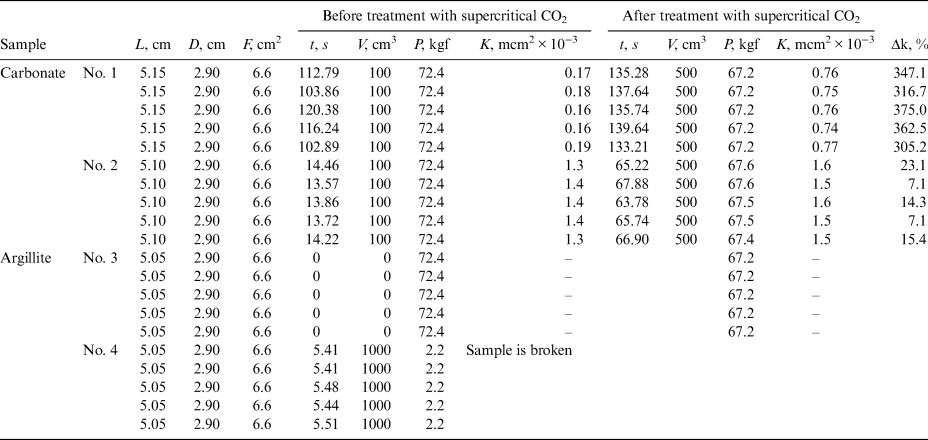
Along with assessing the permeability of rocks by the availability of an organic solvent (chloroform) to extract bituminous substances from micropores and microcracks, the gas permeability of rocks was measured in several samples before and after their treatment with supercritical СО2. The experimental results are shown in Table 2.
Results of measurements of gas permeability of rocks before and after supercritical extraction. Abbreviations: L = cylinder height; D = diameter; F = section area; t = filtration time; V = volume of gas passed through the sample; Р = pressure on the sample; K = gas permeability coefficient.

It can be seen that for the carbonate rock, the gas permeability coefficient of the first sample increased, on average, from 0.17 to 0.76 millidarcy – that is, more than 300 %. The second sample increased from 1.36 to 1.54 millidarcy – on average, by 13.4 %. The argillite (sample No. 3) proved to be impermeable both before and after treatment with supercritical СО2. Sample No. 4 broke down during testing. Thus, experimentally, it was possible to increase the gas permeability of carbonate rock by treating it with supercritical СО2. Argillite turned out to be impermeable to the entire height of the sample, but this does not exclude a partial increase in the permeability of this type of rock under similar conditions.
Thus, the results obtained in the experiment suggest that the supercritical fluid (СО2) can increase the permeability of very dense oil-source rocks, thereby facilitating the primary migration of hydrocarbons and, possibly, the porosity of the reservoir rocks.
During the experiments, the content of Corg was also determined and the bitumoid coefficient (β) was calculated, defined as the percentage of the amount of bitumoid to the total amount of Corg in the rock (see Table 1). It can be seen that the oil shale is characterised by a high Corg content of 33.66 % and a low β-value of only 0.6 %, while for bituminous limestone Corg is very small – 0.28 % – and β, on the contrary, is very high – 92.1 %. Bitumoid of oil shale can be characterised as syngenetic – that is, it is genetically related to host rock and kerogen at the site of its genesis. The Corg and β ratios for bituminous limestone may indicate the epigenetic nature of the bitumoid of this rock, as well as its migratory nature, which is typical for reservoir rock.
For argillite and limestone, β turned out to be 3.8 % and 16.2 %, respectively, which can characterise the bitumoids of these rocks as syngenetic for the first rock and parautochthonous for the second. It is believed that parautochthonous bitumoids undergo only minor movements within the source rock. These two rocks are typical representatives of sedimentary rocks with DOM, which are classified as potentially oil-source rocks. It is in rocks of this type that a bituminous component is generated in the process of evolutionary transformations of organic matter, which is the source of micro-oil. These source rocks are very dense and slightly permeable. However, due to the migration of hydrocarbons from such poorly permeable rocks, gas and oil fields are formed.
The results of the experiment showed that the oil shale is much more permeable than the potential oil-source rocks. Despite this, the migration of hydrocarbons in oil shale mainly occurs only within the mother or nearby rocks, while, from dense oil-source rocks, hydrocarbons can migrate into the pool. This apparent contradiction is associated with the fact that in terms of sedimentary migration theory, the process of accumulation of hydrocarbons in a deposit is considered in a thermodynamically closed system, in which there is no inflow of high-pressure deep fluids in a supercritical state.
3. Discussion
Earlier (Lifshits Reference Lifshits2009), we considered the case of the introduction of a flow of deep fluids in a supercritical state into a sedimentary basin with DOM. An assumption was made and shown experimentally using supercritical СО2 as an example – that the fluid is capable of extracting and transporting petroleum hydrocarbons from dense oil-source rocks, concentrating them into a pool (Lifshits & Chalaya Reference Lifshits and Chalaya2010).
Let us consider what processes could occur in the case of penetration of deep fluid into the oil shale rock. The process could develop according to two scenarios. In the case of a small thickness of oil shale layers, a powerful flow of deep fluid (the fluid does not lose its supercritical properties when penetrating the rock), and in the presence of a suitable reservoir rock, a gas–oil pool similar to the usual one can form. If the layers of oil shale are thick enough and the flow of supercritical fluid is weak, the fluid, penetrating into the layers of permeable rocks due to pressure drop, may lose its supercritical properties (high dissolving and penetrating ability). In this case, the migration of petroleum hydrocarbons is likely to be limited only to the boundaries of the layer itself or nearby rocks.
The flow of deep fluid can be formed from the oil shale itself when it is deeply immersed in the area of high pressures and temperatures due to the cracking of the organic substances under these conditions. The flow rate will depend on many factors, including the rate of dipping sedimentary rocks. Since this is most often a slow process, even if oil pools have formed, they are small and very quickly depleted. If the power of the supercritical fluid is low or there is no fluid flow at all, the bituminous substances remain in the rock that generated them. Most probably, this option is most often implemented. Likely, as a result of this, oil shale rocks are not characterised by the formation of traditional large gas–oil fields.
As shown by the results of the experiment, a supercritical fluid can increase the permeability of dense sedimentary rocks (limestone, argillite). In geological processes, this can mean the ability of deep supercritical fluid to facilitate the migration of bituminous substances and improve the reservoir properties of rocks. The ‘Chepiko's pattern’ is known, according to which differences in permeability are noted for hydrocarbon-bearing and water-saturated rocks at the same stage of compaction (Chepikov et al. Reference Chepikov, Yermolova and Orlova1959). For rocks saturated with hydrocarbons, the permeability is always higher. The considered model of filling rocks with hydrocarbons in a supercritical fluid flow capable of improving the reservoir properties of rocks makes it possible to explain this pattern. Thus, the obstacles to the accumulation of hydrocarbons in the reservoir at any stage of compaction of sedimentary rocks disappear, that is, there is not to assume that the gas–oil pool was formed before the compaction of the rocks. The reservoir properties of rocks can be revealed directly in the process of filling them with oil due to the above interaction of the supercritical fluid with the mineral component of the rocks. In other words, the supercritical fluid ‘makes its way’ and transports the hydrocarbons dissolved in it. This, in turn, allows us to revise the time and duration of the formation of gas and oil deposits in the direction of their significant reduction. The same mechanism can explain the observed flow of oil from the depths into exhausted and operating wells – for example, the Romashkinskoye field in Tatarstan (Muslimov & Plotnikova Reference Muslimov and Plotnikova2019).
The flow of deep fluid, which contains micro-oil, has the same pressure that does not allow hydrocarbons to disperse in space, but to reach the reservoir rock. Due to the high dissolving capacity of supercritical media, the introduction of deep fluid into the reservoir rock will be accompanied by the absorption or dissolution of water contained in the pores of the rock. This is because supercritical СО2 is capable of dissolving both water and hydrocarbons (Lifshits & Chalaya Reference Lifshits and Chalaya2010; Rzoska & Rzoska Reference Rzoska, Rzoska, Rzoska, Drozd-Rzoska and Mazur2010; Lifshits et al. Reference Lifshits, Chalaya and Zueva2012; Makaryan et al. Reference Makaryan, Kostin and Sedov2020). Thus, supercritical CO2 is a biphilic medium. As a result, the fluid – an interpore water system – turns into a single-phase system, which excludes the occurrence of a counterflow of two immiscible phases moving relative to each other: hydrophobic oil and, by definition, hydrophilic water.
Capillary pressure is considered to be another obstacle that inhibits the movement of micro-oil into the pool. The dissolution of pore water in a supercritical fluid promotes relative hydrophobisation of the initially hydrophilic rock walls, which will facilitate the further advancement of micro-oil into the reservoir rock. A similar principle of hydrophobisation with the participation of supercritical СО2 is used in modern technologies as applied to porous ceramic structures to increase their strength in conditions of high humidity (Bespalov et al. Reference Bespalov, Lermontov, Sipyagina, Grashchenkov and Buznik2017). The essence of the method is to apply thin uniform coatings of low molecular weight fluoroparaffins dissolved in supercritical CO2 on highly porous fibrous materials. Similarly, the introduction of a supercritical fluid with dissolved hydrocarbons into the reservoir rock leads, obviously, to hydrophobisation of the rock walls. As a result, the influence of the capillary effect on the movement of hydrocarbons into the reservoir changes dramatically: from inhibiting to accelerating.
Filling a large volume of reservoir rock with a supercritical fluid will lead to a drop in its pressure, loss of its supercritical properties, and, as a consequence, to a sharp decrease in the solubility of hydrocarbons in it and the pass of СО2 to a gaseous state – that is, the unloading of the fluid will occur, which will be accompanied by the release of three phases: gaseous, liquid hydrocarbon, and liquid water, which will be located along the height of the pool in the specified order according to their density. Most likely as a result of this, water always props up a gas–oil pool. Bicarbonates dissolved in water in the absence of a fluid flow (excess amount of СО2) due to the reversibility of the carbonate reaction (Eq. 1) will partially transform into insoluble carbonates, sealing up the pool. The processes of secondary mineralisation of rocks are widespread. So, everywhere in the earth's crust, on the continents, and the ocean floor at a certain depth, depending on the strength properties of water-saturated rocks, the cracks and pores are closed, and an almost impermeable zone is formed (Ezhov et al. Reference Ezhov, Lisenin, Andreychuk and Dublyansky1992). The insulating properties of this zone are enhanced by the deposition of secondary minerals in it.
Processes of dissolution ↔ deposition of carbonates can be repeated many times. A shift in the equilibrium of the reaction in one direction or another will depend on the presence and composition of fluids. It is known that the total mineralisation of waters decreases with depth, as they acquire a specific trace element and gas composition. Dissolved gases are often dominated by CO2 and hydrogen sulphide. The impulsive nature of deep fluid flows is noted (Ezhov et al. Reference Ezhov, Lisenin, Andreychuk and Dublyansky1992; Ivannikov Reference Ivannikov2010; Rachinsky & Kerimov Reference Rachinsky and Kerimov2015). The presence of supercritical fluid and high СО2 content will lead to the dissolution of the bridges, facilitating the movement of the fluid into the reservoir rocks. A low content (or absence) of СО2, along with its release from the supercritical state, will shift the equilibrium of the reaction towards the formation of carbonates, contributing to the isolation and safety of the pool. As long as the pressure in the oil bed is lower than the pressure in the flow of the deep fluid, the pool can be replenished with new portions of micro-oil –that is, the development of abnormally high pressures in hydrocarbon-containing reservoirs may be related to the process of filling them with oil due to the pressure of deep fluids that contain micro-oil in their composition. So, abnormally high and abnormally low reservoir pressures are explained by the pulsating nature of gas migration of hydrocarbons in reservoirs (Ivannikov Reference Ivannikov2010).
Thus, for the formation of traditional gas–oil pools, obviously, a flow of a deep fluid in a supercritical state, a sedimentary basin with DOM, and a reservoir suitable for receiving hydrocarbons are required. The presence of fluid makes it possible to explain the relationship between oil fields and deep faults in the earth's crust, along which it can penetrate into sedimentary rocks. In the sedimentary basin, biogenic organic matter is accumulated, generating petroleum hydrocarbons during catagenetic transformations – that is, the considered model of oil genesis takes into account the main arguments of the supporters of both abiogenic oil synthesis (the connection of oil fields with deep fractures of the earth's crust) and biogenic (the genetic connection of oil with fossilised organic matter in sedimentary rocks and the molecular structures of living matter) and can be attributed to mixed or polygenic models. It should be noted that polygenic models of oil genesis are now becoming more widespread (Scalera Reference Scalera2012; Teng et al. Reference Teng, Liu and Qiao2017; Skvortsov Reference Skvortsov2019). This is understandable. Within the framework of the sedimentary-migration concept, it is difficult to explain the accumulation of oil at great depths, in the rocks of the crystalline basement. As a consequence, various mechanisms of the generation and migration of hydrocarbons at great and medium depths are discussed (Guliyev et al. Reference Guliyev, Kerimov, Osipov and Mustaev2017). However, the recognition of the role of deep fluids in a supercritical state in the migration of petroleum hydrocarbons allows us to consider the process of oil genesis as proceeding according to a single mechanism at different depths. So, in the absence of traditional reservoir rock or their insufficient capacity, the unloading of deep fluid can be carried out in the cracks of the crystalline basement. Perhaps this is the mechanism of the formation of hydrocarbon deposits in fractured granitoid reservoirs of the basement of the White Tiger field in Vietnam. Geochemical studies showed that the oils in the granitoid reservoirs of the White Tiger are geochemically related to the oils of the adjacent Oligocene deposits and the organic matter dispersed in them (Vu et al. Reference Vu, Serebrennikova and Savinykh2012).
It should be noted that hydrocarbons dissolved in the flow of a deep supercritical fluid can migrate in this flow both in the lateral and vertical directions, depending on the location of the fault zones and the permeability of the rocks. This makes it possible to explain multi-blanket deposits of hydrocarbons in some sedimentary basins. In the absence of different types of reservoirs or their insufficient capacity, the unloading of deep fluid in the upper layers of the earth's crust can lead to oil seepage to the day surface. Such phenomena are well known and described in the geological literature (Lukin & Pikovsky Reference Lukin and Pikovsky2004; Zhang et al. Reference Zhang, Cao, Wang, Li, Hu, Zhou and Shi2019).
The formation of gas and oil pools in the flow of a supercritical fluid does not contradict modern concepts of the geodynamic development of sedimentary basins (Gavrilov Reference Gavrilov2010; Guliyev et al. Reference Guliyev, Kerimov, Osipov and Mustaev2017). High thermal transformation of organic matter of sedimentary rocks in the lower layers of the earth's crust during rifting processes, as well as in subduction–obduction zones, should be accompanied by the release of fluids, which will include water, СО2, and methane. As already noted, these fluids under such conditions are most likely to be in a supercritical state. The supercritical fluid can dissolve and transport in its flow the light products of cracking of organic matter of sedimentary rocks. Also, rising upward, it can penetrate the overlying layers of sedimentary rocks, dissolving the bituminous component of these rocks, and transport dissolved hydrocarbons to the pool. Thus, the considered model of oil and gas generation, without specifying the origin of the deep fluid, emphasises the fluid-dynamic nature of the formation of gas–oil deposits.
It should be noted that understanding the processes of hydrocarbon migration is not only of great scientific importance, aimed at developing modern models of oil and gas formation, but also of practical importance associated with the development of criteria for exploration and prospecting of gas and oil fields, as well as their operation. For example, special attention is paid to enhanced oil recovery technologies based on the use of supercritical CO2 (Khromykh et al. Reference Khromykh, Litvin and Nikitin2018).
4. Conclusion
The results of experimental modelling of the interaction of sedimentary rocks (carbonates, argillite, oil shale) with supercritical CO2 allowed us to draw the following conclusions:
– Supercritical CO2 can increase the permeability, and possibly the porosity, of sedimentary rocks. The increase in rock permeability is explained by the dissolution of carbonates to bicarbonates due to the high chemical activity of supercritical СО2 and water dissolved in it. Similarly, in the geological processes, the introduction of deep supercritical fluid into oil-source rocks can increase their permeability, which will facilitate the primary migration of hydrocarbons.
– Filling reservoir rocks with deep supercritical fluid can be accompanied by an improvement in their reservoir properties. The pulsating nature of deep fluid flows will lead to the fact that, in the absence of fluid, insoluble carbonates may re-form, isolating and sealing up the reservoir. Thus, the shift in the equilibrium of the carbonate reaction to one side or the other, depending on the presence or absence of a deep fluid, makes it possible to explain the alternation of the replenishment of an oil pool with self-preservation.
– The increase in rock permeability in the flow of deep supercritical fluid suggests the possibility of generating oil deposits regardless of the degree of rock compaction in the sedimentary basin. The high rate of such transformations can lead to a revision (on a geological timescale) of the duration of the formation of oil pools in the direction of its significant reduction.
– The ability of a biphilic supercritical fluid to simultaneously dissolve hydrophobic hydrocarbons and water in the pores of the rock allows us to consider the process of filling reservoir rock with micro-oil as a single-phase process. As a result, there are no counter-current phases (hydrophobic oil and hydrophilic water) moving relative to each other. Another obstacle that inhibits the movement of micro-oil into the pool, this being capillary pressure, also disappears due to the relative hydrophobisation of the initially hydrophilic rock walls. As a result, the influence of the capillary effect on the movement of hydrocarbons into the pools changes dramatically, from braking to accelerating. Filling a large volume of porous rock (reservoir) with a supercritical fluid leads to a drop in its pressure and unloading of the fluid, which is accompanied by the separation of phases: gaseous, liquid hydrocarbon, and liquid water. Most likely as a result of this, water always props up a gas–oil reservoir.
– Oil shale rocks are most often unable to form traditional large gas–oil pools, despite the high content of organic matter in them, and, apparently, rather high permeability (due to the peculiarities of their layered structure). This is precisely because high permeability does not allow the deep fluid to maintain its supercritical state due to the pressure drop during penetration into these rocks. Gaseous СО2 no longer possesses unique supercritical properties; therefore, the hydrocarbons formed as a result of catagenetic transformations of the organic matter remain dispersed in the rock that generated them, and serve as a source of so-called shale oil and gas or oil and gas from tight reservoirs.
The considered model of oil and gas formation in the flow of deep supercritical fluids is inherently fluid dynamic and polygenic since it examines the possible interaction of the upper mantle, and lower and upper layers of the earth's crust through a deep fluid in a supercritical state. Consideration of the processes of naphthydogenesis in an open and highly nonequilibrium system, as well as the special properties of supercritical fluids, make it possible to better understand and explain the mechanism of the processes of migration and accumulation of hydrocarbons into the pool, which seems to proceed with a decrease in entropy as opposed to the laws of dispersion. It is believed that the type of oil is determined by the nature of the organic matter that served as the source for its generation. Earlier (Lifshits Reference Lifshits2009), we made an assumption that the chemical composition of oil may also depend on the composition of the deep supercritical fluid. This is due to the high chemical activity of supercritical fluids. Further research in this direction will contribute to a more complete understanding of not only the mechanism of oil genesis, but also other geological processes occurring in a fluid state.
It should be noted that the existence of alternative views on the processes of oil genesis and the formation of gas–oil deposits, in addition to scientific interest, is of great practical importance, since it allows the development of new methods and criteria for the search for new oil deposits and its production, as well as seeking to find an explanation for the recently observed phenomenon of recovery of the exhausted and operating oil wells debit.
5. Acknowledgement
The author is grateful to N. V. Zayakina, O. N. Chalaya, V. M. Konovalov., and A. S. Portnyagin for their help in conducting the experiments.