The characteristics of cheese depend on many factors including the specific composition of the milk (such as protein and fat levels), animal species and on a huge number of variables applied in cheese-making. A recent challenge for scientists involved in dairy technology is the production of cheese using milk from donkeys (henceforward donkey milk). From a nutritional point of view, there is interest in producing dairy products from donkey milk due to the potential benefits for human health (Martini et al., Reference Martini, Altomonte, Tricò, Lapenta and Salari2021), such as its ability to induce the release of anti-inflammatory interleukins and upregulate the immune response in aged hosts (Amati et al., Reference Amati, Marzulli, Martulli, Tafaro, Jirillo, Pugliese, Martemucci, D'Alessandro and Jirillo2010), the prevention of atherosclerosis (Tafaro et al., Reference Tafaro, Magrone, Jirillo, Martemucci, D'Alessandro, Amati and Jirillo2007) and antiproliferative and antitumor activities (Mao et al., Reference Mao, Gu, Sun, Xu, Zhang, Yang and Ren2009). In addition, there is a great interest in using donkey milk products in the diet of children affected by cow's milk protein allergy (Iacono et al., Reference Iacono, Carroccio, Cavataio, Montalto, Soresi and Balsamo1992), due to the low allergenicity of donkey milk (Vita et al., Reference Vita, Passalacqua, Di Pasquale, Caminiti, Crisafulli, Rulli and Pajno2007). This property has been attributed to the low casein-to-whey protein ratio (Cunsolo et al., Reference Cunsolo, Saletti, Muccilli, Gallina, Di Francesco and Foti2017) and low total protein content with particular reference to κ- and α s1-casein compared to ruminant milks (Giorgis et al., Reference Giorgis, Rolla, Raie, Geuna, Boita, Lamberti, Nebbia, Giribaldi, Giuffrida, Brussino, Corradi, Bacco, Gallo Cassarino, Nicola and Cavallarin2018). In addition, α s2-casein, that is absent in human milk, is not detectable in donkey milk (Licitra et al., Reference Licitra, Chessa, Salari, Gattolin, Bulgari, Altomonte and Martini2019). However, the low total solids and casein content make donkey milk unsuitable for cheese-making because they induce poor clotting activity, with the formation of a very weak gel rather than a firm curd when renneting (Uniacke-Lowe and Fox, Reference Uniacke-Lowe, Fox, Fuquay, Fox and McSweeney2011; Marletta et al., Reference Marletta, Tidona, Bordonaro and Gigli2016). Moreover, the cheese produced from donkey milk may also be negatively affected by the low fat content (Martemucci and D'Alessandro, Reference Martemucci and D'Alessandro2012), since low fat cheeses often exhibit poor texture (Mohamed, Reference Mohamed2015).
Improvement of the properties of the coagulum and thus strengthening of the structure in dairy products is commonly achieved through manipulation of the physical properties of milk, such as via thermal treatments (Jørgensen et al., Reference Jørgensen, Abrahamsen, Rukke, Hoffmann, Johansen and Skeie2019), high pressure or membrane ultrafiltration treatments (Nelson and Barbano, Reference Nelson and Barbano2005), or by using enzymes (Mokoonlall et al., Reference Mokoonlall, Sykora, Pfannstiel, Nöbel, Weiss and Hinrichs2016). Microbial transglutaminase (MTGase; glutaminyl-peptide-amine γ-glutamyl transferase; EC 2.3.2.13) is a transferase that forms covalent crosslinks of inter- or intra-molecular ɛ-(γ-glutamyl)lysine isopeptide bonds. The enzyme acts by catalyzing an acyl transfer reaction between a γ-carboxyamide group in protein-bound glutamine residues (acyl donor) and an ɛ-amino group in a protein-bound lysine residue (acyl acceptor), leading to covalent crosslinks of inter- or intra-molecular ɛ-(γ-glutamyl)lysine isopeptide bonds (Kashiwagi et al., Reference Kashiwagi, Yokoyama, Ishikawa, Ono, Ejima, Matsui and Suzuki2002). Consequently, MTGase induces modifications in protein, determining changes in rheological and functional properties (Gharibzahedi and Chronakis, Reference Gharibzahedi and Chronakis2018). In raw milk, the protein substrates most susceptible to the cross-linking reaction of MTGase are caseins rather than whey proteins (Bönisch et al., Reference Bönisch, Tolkach and Kulozik2006) and, among caseins, the following order has been reported: k-casein > β-casein > α s-casein (Smiddy et al., Reference Smiddy, Martin, Kelly, De Kruif and Huppertz2006).
MTGase has been found to be active at a wide range of pH and temperatures. Since 1998, it has been approved as a GRAS (generally recognized as safe) substance for human intake, which does not need to be listed among the ingredients of the finished product, as its use is considered an adjunct technology, similar to that of rennet (Romeih and Walker, Reference Romeih and Walker2017; Gharibzahedi and Chronakis, Reference Gharibzahedi and Chronakis2018). A number of studies have been conducted on the incorporation of MTGase into cheese-making (Özer et al., Reference Özer, Hayaloglu, Yaman, Gürsoy and Sener2013; Aaltonen et al., Reference Aaltonen, Huumonen and Myllärinen2014; García-Gómez et al., Reference García-Gómez, Vázquez-Odériz, Muñoz-Ferreiro, Romero-Rodríguez and Vázquez2019). In a previous study, we evaluated for the first time the effects of the application of MTGase (5.0 U/g milk protein) when processing cheese from pure donkey milk (D'Alessandro et al., Reference D'Alessandro, Martemucci, Loizzo and Faccia2019). The results showed that the simultaneous addition of MTGase and rennet in donkey milk improves curd firmness. On the basis of these findings, the present study aims to evaluate the effects of different concentrations of MTGase (5.0, 8.0 and 10 U/g milk protein), added simultaneously with rennet, in the production of cheese from donkey milk under specific cheese-making conditions. The effects were investigated by assessing the physico-chemical characteristics of the cheese and the variations in the protein pattern by electrophoresis of cheese and whey. Moreover, a procedure was developed to get the first indications about the consistency of the gel obtained from donkey milk, as its specific behavior during the formation of the gel (long clotting time, very weak gel) do not allow the use of thromboelastography (Faccia et al., Reference Faccia, Gambacorta, Martemucci, Natrella and D'Alessandro2018), developed for milk from ruminant species.
Materials and methods
Materials
Donkey milk was collected during the spring season by mechanical milking (D'Alessandro and Martemucci, Reference D'Alessandro and Martemucci2012). The total protein, fat and lactose contents determined by Infrared Spectroscopy (MilkoScan™ FT1, FOSS, Hillerød, Denmark) and ash contents (incineration at 530 °C) (mean ± standard deviation) were 2.32 ± 0.09%, 0.38 ± 0.22%, 6.76 ± 0.06% and 0.39 ± 0.04%, respectively. The microbial transglutaminase (MTGase; Activa® YG) was purchased from Ajinomoto Foods Europe SAS (France Co., Inc., Hamburg, Germany). The enzyme had a declared activity of 100 U per g powder. The starter used in cheesemaking was a culture of Streptococcus thermophilus (freeze dried; Teknomilk, TKM srl, Gioia del Colle, BA, Italy). A liquid microbial rennet (Micro-Lactis 220 TL; 220 IMCU/ml, Linea Lactis s.r.l., Gioia del Colle, Bari, Italy) was used for milk coagulation.
Small-scale cheese-making process
Manufacturing of the cheeses was performed at the dairy laboratories of the Department of Agricultural and Environmental Science, University of Bari (Bari, Italy) as four independent small-scale experiments.
In each experiment, 4 litre of donkey raw milk was divided into 4 equal portions to produce cheese without the addition of MTGase as the control cheese (CC) and three experimental cheeses, with the simultaneous addition rennet and of MTGase at different concentrations: 5 U (MTG-5), 8 (MTG-8) and 10 (MTG-10) U/g milk protein.
For control cheese manufacture the milk was supplemented with calcium chloride (0.3 g/l) and heated to 40 °C before inoculation with the starter culture at a concentration of 0.01 g/l milk. The milk acidification progress was monitored. When the milk reached pH 6.30, liquid microbial rennet was added (0.1 ml/l of milk) to milk heated to 42 °C in a thermostatic water bath. The milk was allowed to coagulate at a constant temperature of 42 °C. The milk gel was then cut into 1.0 cm cubes while heating slowly to 46 °C and left to settle for 10 min. The whey was drained and the curd was placed into a cheese mold and weighed to calculate the cheese yield. The exact same procedure was used to produce the cheese in the three experimental treatments, with the experimental additions of enzyme performed simultaneously with rennet in acidified milk (pH 6.3; 42 °C; D'Alessandro et al., Reference D'Alessandro, Martemucci, Loizzo and Faccia2019) (online Supplementary Fig. S1).
Each cheese was weighed immediately after manufacturing (T0) and after 24 h of refrigeration. The yield of cheeses (cheese weight at T0/milk weight, as percentage) and their weight loss (difference between the cheese weight after 24 h in comparison with T0) were calculated.
Evaluation of gel viscosity
The gel viscosity was determined during rennet-coagulation in the milk samples. All the samples were subjected to the same temperature conditions during the cheese-making. For each sample, 40 ml acidified milk were poured into plastic containers immediately after the addition of rennet for the control (CC), and after the addition of rennet plus MTGase for the experimental treatments (MTG-5, MTG-8 and MTG-10). The samples were then incubated in a water bath at a temperature of 42 °C. Viscosity was measured at the gel formation (estimated by observation, T0) and after 15, 30, 45 and 60 min, using a Vibro Viscometer (AND, SV-10; 0.3~10 000 mPa⋅sec; A&D, Japan). Gel viscosity was determined in four replicates and expressed as mPa⋅sec.
Physico-chemical analyses of cheese
The pH was measured at room temperature immediately after cheese manufacture and after 24 h of refrigeration (2–4 °C), following an equilibration period, at 3 internal locations. After 24 h of refrigeration the CIELAB values (lightness, L*; redness, a*; and yellowness, b*) were evaluated using a HunterLab MiniScanTM XE Spectrophotometer (mod. 4500/L, 45/0 LAV, 3.20 cm diameter aperture, 10° standard observer, focusing at 25 mm, illuminant D65/10; Hunter Associated Laboratory, Inc.; Reston, Virginia, USA). Information on the chemical composition was obtained by analysis of moisture, total protein (Kjeldahl method, IDF 20B:1993; IDF, 1993) and fat (Folch et al., Reference Folch, Lees and Stanley1957).
Electrophoresis
Sodium dodecyl sulfate-polyacrylamide gel electrophoresis (SDS-PAGE) of whey, following extraction of the curd, and cheese samples was performed as described by Harper et al. (Reference Harper, Meyer, Knighton and Lelievre1989). Reagents and solvents were from Bio-Rad (Richmond, CA, USA). After electrophoresis, proteins were stained with Silver Bleu as described by Candiano et al. (Reference Candiano, Bruschi, Musante, Santucci, Ghiggeri, Carnemolla, Orecchia, Zardi and Righetti2004) and destained in water. Identification of the protein bands was performed by matching their molecular weight and using the literature data (Guo et al., Reference Guo, Pang, Zhang, Zhao, Chen, Dong and Ren2007; Chianese et al., Reference Chianese, Calabrese, Ferranti, Mauriello, Garro, De Simone, Quarto, Addeo, Cosenza and Ramunno2010). Images of the destained gels were uploaded on an image analysis system and scanned for densitometry analysis using Quantity One software (Biorad, Hercules, CA, USA). The optical densities were expressed as the ratio of the quantity to the total area of the bands. All analyses were performed in duplicate.
Statistical analysis
Statistical analysis was performed using SPSS version 21.0 (Statistical Product and Service Solutions, IBM Corporation, New York, NY, USA). All data was subjected to one-way analysis of variance (ANOVA) to determine the differences among samples. Significant differences were compared using Bonferroni test at the level of P < 0.05.
Results and discussion
Cheese-making process parameters, loss of weight and proximal composition of cheese at 24 h
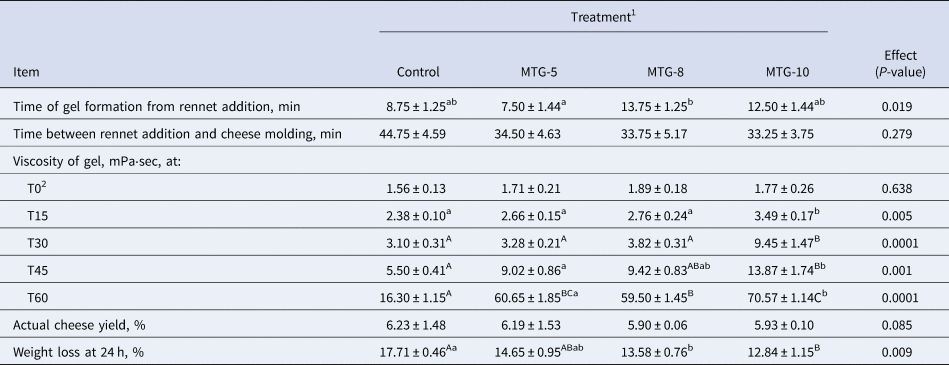
The time to gel formation from the addition of rennet was influenced by the inclusion of MTGase, resulting in the shortest time at the concentration of 5 U/g milk protein (MTG-5), with a significant difference (P < 0.05) compared to MTG-8 (Table 1). On the other hand, no differences were observed for the overall time from rennet addition to cheese molding (Table 1). This means that, despite faster gel formation for MTG-5, reaching the suitable firmness for cheese molding required the same time at all enzyme concentrations. This finding suggests that the enzyme-induced protein linking proceeded at faster rate during the syneresis phase for MTG-8 and MTG-10. However, as the same results were obtained at the end of cheesemaking, the lower MTGAse dosage should be the most suitable choice.
Effects of different microbial transglutaminase (MTGase) concentrations added simultaneously with the rennet on cheese-making process parameters, gel viscosity, cheese yield and loss of cheese weight at 24 h of storage (mean ± standard error of mean)

a,bMeans within a row with different superscripts differ (P < 0.05).
A,BMeans within a row with different superscript letters are significantly different (P < 0.01).
1 Treatments: CC = (control) no MTGase addition; MTG-5, MTG-8 and MTG-10 = addition of MTGase at the concentrations of 5 U/g milk protein, 8 U/g milk protein and 10 U/g milk protein, respectively.
2 T0: measured at the gel formation and after 15 (T15), 30 (T30), 45 (T45) and 60 (T60) min.
Variations in gel viscosity
The variations in gel viscosity among the control and MTGase-treated cheese samples were evaluated in the first 60 min from the gel formation, and the results are given in Table 1. The present study documents for the first time the effect of MTGase, added at different concentrations during cheesemaking from pure donkey milk, on viscosity during the gel formation phase. In all four cheese groups, the viscosity values increased differently throughout the coagulation process. Interestingly, the results showed that the gel obtained without the inclusion of MTGase (CC) was very weak, reaching a viscosity of 16 mPa⋅sec after 60 min. Compared to the control, the treatments MTG-5 and MTG-8 showed a remarkable (P < 0.01) effect on the viscosity at the 60th min. The use of the highest concentration of MTGase (MTG-10) also led to the formation of the strongest (P < 0.01) gel 15 min after its formation, which reached a viscosity value of 70 mPa⋅sec at the 60th min, presumably attributable to a finer and stronger gel network.
In general, it has been reported that MTGase inclusion leads to a greater viscosity in different types of cheese such as in cottage cheese (Cozzolino et al., Reference Cozzolino, Di Pierro, Mariniello, Sorrentino, Masi and Porta2003), low-fat cheese (Li-Chan, Reference Li-Chan and Yadi2004), and processed cheese (De Sá and Bordignon-Luiz, Reference De Sá and Bordignon-Luiz2010). Accordingly, we can attribute the improvement of gel strength to the cross-linking of donkey milk proteins induced by MTGase through the formation of additional covalent (ɛ-(γ-glutamyl)lysine) bonds. Considering that the cross-linking reaction of MTGase occurs preferentially in caseins rather than in whey proteins (Bönisch et al., Reference Bönisch, Tolkach and Kulozik2006), in the case of donkey milk, which has low levels of caseins (Uniacke-Lowe and Fox, Reference Uniacke-Lowe, Fox, Fuquay, Fox and McSweeney2011), a high concentration of MTGase is needed to obtain a high gel viscosity. A dose-dependent relationship was also found between the cheese hardness and MTGase concentration (Cozzolino et al., Reference Cozzolino, Di Pierro, Mariniello, Sorrentino, Masi and Porta2003).
Cheese yield
In the field of dairy product processing, the improvement of cheese yield is considered one of the main advantages of MTGase application (Romeih and Walker, Reference Romeih and Walker2017). In this study, cheese yield was not influenced by the incorporation of MTGase, even with the use of the highest enzyme concentration (MTG-10: Table 1). Simialrly, in our previous study (D'Alessandro et al., Reference D'Alessandro, Martemucci, Loizzo and Faccia2019), the addition of 5 U MTGase/g milk protein in different patterns of cheese-making treatment did not influence the cheese yield. Overall, and contrary to the results obtained in this and in the previous study (D'Alessandro et al., Reference D'Alessandro, Martemucci, Loizzo and Faccia2019), other researchers have reported that the application of transglutaminase in milk from other species does increase cheese yield (cow: Bönisch et al., Reference Bönisch, Heidebach and Kulozik2008; goats: Karzan et al., Reference Karzan, Nawal and Ashna2016). The different findings are largely attributable to the difference in the raw material used for the cheese-making process, as well as to any treatment by pre-heating, as in the study of Karzan et al. (Reference Karzan, Nawal and Ashna2016). In this case, pasteurization of the milk probably made a greater amount of whey proteins available for the action of MTGase (Zhang and Zhong, Reference Zhang and Zhong2009): it has been reported that the denaturation of whey proteins due to heat treatment induces additional sites for covalent bonds to be formed by MTGase (Bönisch et al., Reference Bönisch, Heidebach and Kulozik2008).
The inclusion of MTGase affected (P < 0.01) the rate of weight loss of the cheeses after 24 h of storage, which showed a decreasing trend at the higher MTGase concentrations (MTG8 and MTG10; Table 1). This may be due to the formation of a more stable protein network with higher molecular weight, which, during storage, reduced the separation of whey in the cheeses with higher MTGase concentration in comparison to the untreated cheese.
Physico-chemical characteristics and instrumental color analysis of cheese
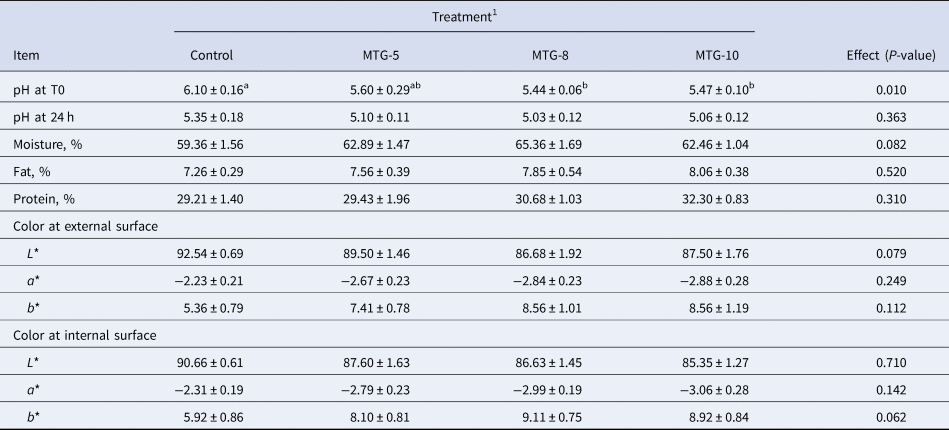
The effect of MTGase treatment on the pH of cheese, measured just after its manufacture (T0), was found to be significant (P = 0.01). Overall, lower pH values were observed in correspondence with increased MTGase concentrations, ranging from 6.10 for CC to 5.47 for MTG-10. The results are difficult to explain. However, these differences were eliminated after 24 h of storage, with a higher drop in the CC (0.75 pH points) cheese, so that the pH was similar in all the treatments (range: 5.10–5.35 for the CC) (Table 2). According to Özer et al. (Reference Özer, Kırmacı, Öztekin, Hayaloglu and Atamer2007), we can hypothesize that the crosslinking of milk proteins induced by MTGase may affect the availability of the nitrogen sources such as amino acids and low-molecular-weight peptides, and thus the activity of the starters, leading to different acidification rates in the cheese treated with different concentrations of the enzyme.
Physico-chemical characteristics and instrumental color analysis of cheese at 24 h of storage in relation to different microbial transglutaminase (MTGase) concentrations added simultaneously with the rennet (mean ± standard error of mean)

a,bMeans within a row with different superscripts differ (P < 0.05).
1 Treatments: CC = (control) no MTGase addition; MTG-5, MTG-8 and MTG-10 = addition of MTGase at the concentrations of 5 U/g milk protein, 8 U/g milk protein and 10 U/g milk protein, respectively.
The chemical characteristics of the cheeses at 24 h of storage are summarized in Table 2. The addition of MTGase at different concentrations had no significant effect on the moisture, fat, and protein contents, although a slight increasing trend was observed for protein, which increased as MTGase concentration increased. The chemical characteristics were similar to those observed in the previous study on the time of MTGase inclusion during cheesemaking (D'Alessandro et al., Reference D'Alessandro, Martemucci, Loizzo and Faccia2019). In contrast, Karzan et al. (Reference Karzan, Nawal and Ashna2016) reported a positive effect of MTGase inclusion on the total protein and total solids contents of the cheeses produced. Overall, the differences among these results could be attributable to the low availability of k-casein in donkey milk (Marletta et al., Reference Marletta, Tidona, Bordonaro and Gigli2016), which constitutes a more susceptible substrate for the cross-linking reaction of MTGase in comparison to whey proteins (Bönisch et al., Reference Bönisch, Tolkach and Kulozik2006). Moreover, it is possible that the low level of heat applied during cheese-making in this study may not have allowed for the denaturation of the whey proteins considered necessary for cross-linking by MTGase (Romeih and Walker, Reference Romeih and Walker2017).
The evaluation of the color of cheese aimed to verify if the MTGase concentration influences this sensory characteristic, which is very important for cheese acceptance by consumers. The results did not show a significant effect (Table 2). Also for goat milk whey cheeses, no differences in the color were reported by Karzan et al. (Reference Karzan, Nawal and Ashna2016) who used the microbial transglutaminase enzyme treatment at the concentration of 4 and 8 U/g whey protein.
Electrophoresis
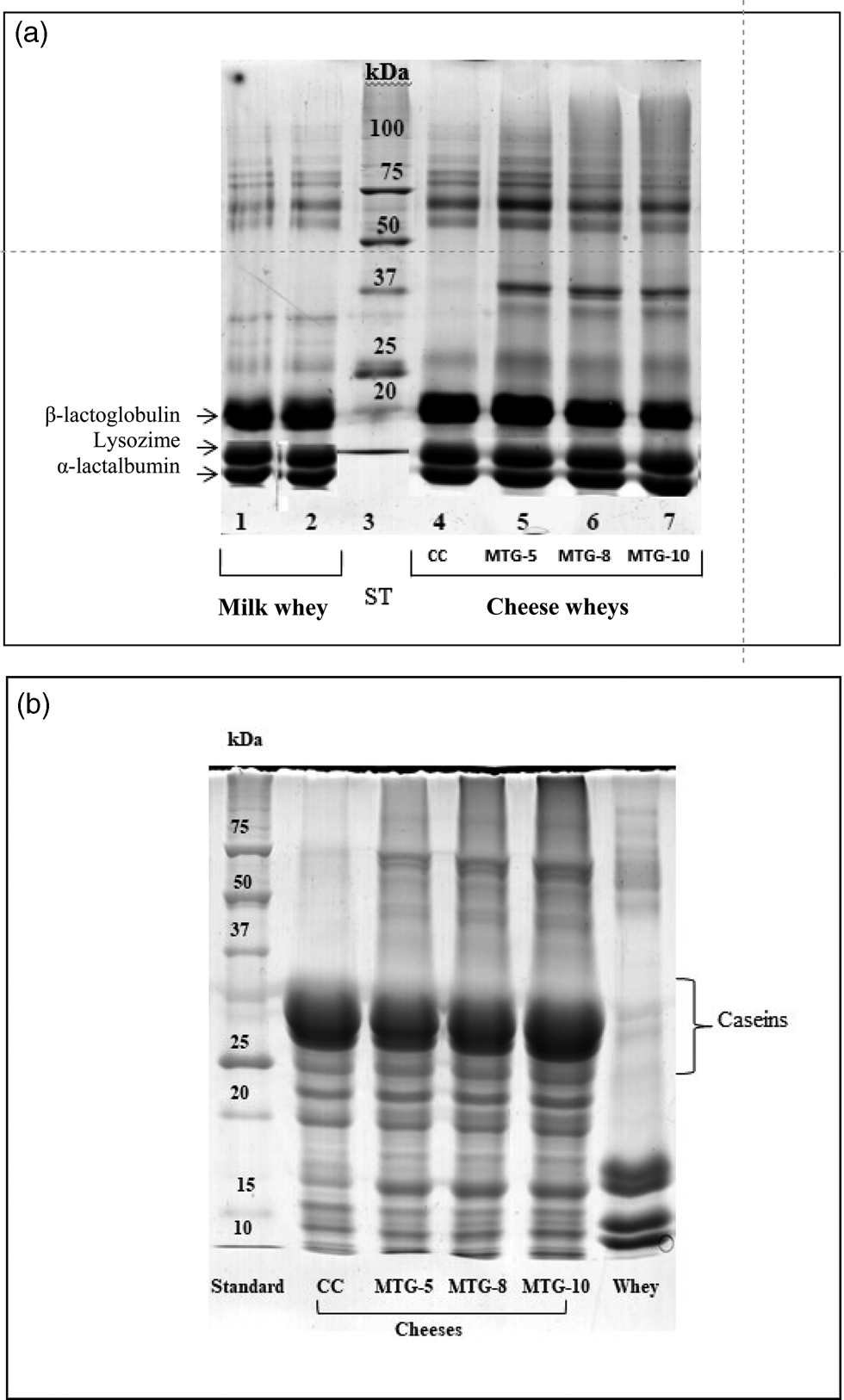
Figure 1 shows the SDS-PAGE of the whey following extraction of the curd, and of cheese samples. The electropherogram of the wheys (Fig. 1a) reveals that the addition of MTGase slightly modified the protein pattern compared to the control. The most significant differences in the experimental whey profiles are related to the presence of the 37 kDa band, which should be identified as the transglutaminase itself. The bands of β-lactoglobulin and those in the range 50–75 kDa showed a slightly decreased intensity as the MTGase concentration increased, whereas no differences were observed in the intensity of the α-lactalbumin or lysozyme bands. As expected, caseins were almost totally absent in all the whey samples. In perfect accordance with this pattern in the whey, the electropherogram of the cheeses, in which the caseins accumulated, showed an opposite trend (Fig. 1b), thus suggesting their efficient recovery during cheesemaking. In comparison with the CC, the experimental cheeses showed greater intensity of the bands in the high molecular weight zone, at the top of the gel. This was more evident with the addition of the highest enzyme concentration (MTG10). This may be attributable to the newly-formed protein aggregates of high molecular weight proteins produced by the addition of MTGase (Karzan et al., Reference Karzan, Nawal and Ashna2016) due to the formation of both inter- and intra- molecular covalent bonds (Romeih and Walker, Reference Romeih and Walker2017). In this study, a dose-related response was observed. This finding is confirmed by the higher protein content in the MTG-10 cheese (approximately 3%), which is probably connected to a slightly higher retention of whey proteins.
SDS-PAGE of (a) donkey milk whey and cheese wheys after extraction of the curd and (b) SDS-PAGE of donkey cheeses, all in relation to different concentrations of MTGase (microbial transglutaminase) addition: CC = (control) no MTGase addition; MTG-5 = 5 U/g milk protein; MTG-8 = 8 U/g milk protein; MTG-10 = 10 U/g milk protein. ST = molecular weight standard.

Overall, the results indicate that donkey milk whey proteins were only partially cross-linked by MTGase, in accordance with other studies that have found a poor susceptibility of whey proteins to cross-linking by MTGase due to their globular conformation stabilized by disulfide bonds (Bönisch et al., Reference Bönisch, Tolkach and Kulozik2006). However, in electropherograms of the whey obtained in this study (Fig. 1a), in contrast to α-lactalbumin, which did not change, the β-lactoglobulin bands showed lower intensity as the MTGase concentration increased, demonstrating a better rate of cross-linking to MTGase for β-lactoglobulin in comparison to α-lactalbumin. These results are in accordance with previous observations by Romeih and Hamad (Reference Romeih and Hamad2010), who investigated the susceptibility of whey protein fractions to MTGase cross-linking.
In conclusion, for cheese production from donkey milk, and from the range of MTGase concentrations examined, the MTGase level of 10 U/g milk protein effectively improved gel viscosity. At this inclusion level the viscosity of the gel was already highest 15 min after its formation, and continued to increase significantly up to a value of 70 mPa⋅sec after 60 min. This treatment also corresponded with the lowest loss of cheese weight after 24 h of storage. Although the cheese yield was not improved, other parameters such as the pH, chemical composition and color of the cheese at 24 h were not adversely affected. A slight increase in protein content was obtained with the addition of MTGase, probably due to a partial inclusion of β-lactoglobulin, which, in the electropherogram of the wheys, showed decreased intensity of the bands as MTGase concentration increased. Further studies are necessary to identify the protein profile of donkey milk cheese with MTGase inclusion. In addition, taking into account that a recent study (Faccia et al., Reference Faccia, Gambacorta, Martemucci, Difonzo and D'Alessandro2020) on the sensory characteristics of donkey cheese has revealed its pleasant flavor, the effects of MTGase inclusion on organoleptic as well as nutritional characteristics constitute other aspects worthy of study.
Supplementary material
The supplementary material for this article can be found at https://doi.org/10.1017/S0022029921000601
Acknowledgements
The authors declare no conflict of interest. The study was funded by University of Bari Aldo Moro.