1. Introduction
Traditional views of language have held that the relationship between the form of a word and its meaning is arbitrary (e.g., Hockett, Reference Hockett and Greenberg1963). That is, there is no special link between a word’s form (i.e., its orthography, phonology, or articulation) and its meaning. However, arbitrariness may be only one possible kind of relationship between form and meaning (see Dingemanse, Blasi, Lupyan, Christiansen, & Monaghan, Reference Dingemanse, Blasi, Lupyan, Christiansen and Monaghan2015; Perniss & Vigliocco, Reference Perniss and Vigliocco2014). Language can also be non-arbitrary via iconicity: a resemblance between form and meaning, in which aspects of a word’s form map onto aspects of its meaning (e.g., Perniss, Thompson, & Vigliocco, Reference Perniss, Thompson and Vigliocco2010). In this paper we focus on phonological iconicity, wherein a word’s phonological form maps onto meaning.
Iconicity can occur in several ways. In onomatopoeia, the phonology of a word imitates the sound to which it refers. English examples include quack, boom, and sizzle. It is also possible for a word’s form to map onto its meaning without direct imitation, but instead via association (i.e., non-onomatopoeic iconicity). This is enabled by the phenomenon of sound symbolism, in which particular language sounds evoke associations with non-auditory properties (see Lockwood & Dingemanse, Reference Lockwood and Dingemanse2015; Sidhu & Pexman, Reference Sidhu and Pexman2018). For instance, individuals associate the vowels /ɪ/ and /ɑ/ with smallness and largeness, respectively (Newman, Reference Newman1933; Sapir, Reference Sapir1929). Thus, a word like shrimp could be considered iconic because its form evokes associations (i.e., smallness) that map onto aspects of its meaning.
It has been claimed that arbitrariness and iconicity both provide benefits to language. Arbitrariness allows any form to refer to any meaning without requiring resemblance, which may not always be possible (e.g., for entirely abstract concepts; Dingemanse et al., Reference Dingemanse, Blasi, Lupyan, Christiansen and Monaghan2015). Iconicity facilitates language learning, in part by helping infants and toddlers associate speech sounds with their referents (see Imai & Kita, Reference Imai and Kita2014; Laing, Viham, & Portnoy, Reference Laing, Viham and Portnoy2017; Perniss, Lu, Morgan, & Vigliocco, Reference Perniss, Lu, Morgan and Vigliocco2018; Perry, Perlman, Winter, Massaro, & Lupyan, Reference Perry, Perlman, Winter, Massaro and Lupyan2017). In addition, it has been argued that the imitative, performative nature of iconic words makes language more direct and vivid (Dingemanse et al., Reference Dingemanse, Blasi, Lupyan, Christiansen and Monaghan2015). In the present experiments we examined another potential advantage of iconicity: that iconic links between sound and meaning make these words easier to process.
Importantly, words are not entirely arbitrary or iconic. Rather, they fall on a spectrum from extremely arbitrary to extremely iconic – containing aspects of arbitrariness and iconicity (see Dingemanse et al., Reference Dingemanse, Blasi, Lupyan, Christiansen and Monaghan2015; Perniss & Vigliocco, Reference Perniss and Vigliocco2014). For instance, while the word quack sounds like a duck quacking, there are many other ways to imitate this sound (e.g., mac in Romanian, vak in Turkish, or prääks in Estonian), and thus the choice of quack is to some extent an arbitrary one. Indeed, other sets of phonemes might better imitate the sound of a duck. Also, while /ɪ/ in the word shrimp maps onto an aspect of its meaning, its other phonemes are seemingly arbitrary.Footnote 1 A word that contained a greater proportion of small-associated phonemes might seem more iconic. Perry, Perlman, and Lupyan (2015; supplemented by Winter, Perlman, Perry, & Lupyan, Reference Winter, Perlman, Perry and Lupyan2017) quantified the subjective iconicity of a large set of English words. They had participants rate a variety of English words in terms of their iconicity on a continuous scale and discovered that words existed along the entire spectrum.
There is a great deal of work to be done to understand the effects of this variation in iconicity on language processing. Triangle models of word recognition include three components: a word’s meaning, its orthography, and its phonology. In these models, a word’s meaning is accessed via two paths: directly from a word’s orthography, and indirectly from its orthography via its phonology (Harm & Seidenberg, Reference Harm and Seidenberg2004). While other models of word recognition exist (e.g., dual route models; Coltheart, Rastle, Perry, Langdon, & Ziegler, Reference Coltheart, Rastle, Perry, Langdon and Ziegler2001), here we focus on triangle models because they specify a route by which meaning is retrieved via phonology. Note that links between each of the three components of triangle models are bi-directional. Additionally, the extent to which paths or components are emphasized varies depending on task context (Balota, Paul, & Spieler, Reference Balota, Paul, Spieler, Garrod and Pickering1999). Evidence for this is the fact that phonological variables (e.g., spelling–sound regularity; Hino & Lupker, Reference Hino and Lupker1996) play more or less of a role in word recognition when the orthographic–phonological path is prioritized to a greater or lesser extent.
Mappings between phonology and semantics are considered arbitrary in triangle models: they must be learned through experience.Footnote 2 However, iconicity presents the possibility that some connections between phonology and semantics are not solely arbitrary. Such connections may emerge or exist naturally, or be easier to learn, by virtue of the inherent resemblance between phonology and semantics. Here we evaluate the possibility that iconic words possess extra and/or more direct links between phonology and semantics which will facilitate their processing. Note that this may be a quantitative and/or a qualitative difference in the nature of links for iconic as compared to non-iconic words.
Meteyard, Stoppard, Snudden, Cappa, and Vigliocco (Reference Meteyard, Stoppard, Snudden, Cappa and Vigliocco2015) examined the possibility that special links between phonology and semantics might make iconic words more resistant to aphasia. They compared the processing of onomatopoeia and arbitrary words in aphasic patients using a variety of tasks. They found a benefit for onomatopoeia on the tasks that prioritized the mapping of phonology onto semantics. The authors also speculated that effects of iconicity may only be observable in individuals with developing or damaged language systems.
Peeters (Reference Peeters2016) conducted an EEG study on the processing of Dutch onomatopoeia using an auditory lexical decision task. He found that onomatopoeia elicited a smaller N400, interpreted as reflecting facilitated lexical access for words with iconic mappings between form and meaning. However, despite this effect, there were no behavioural differences in the processing of onomatopoeic and arbitrary words. Peeters speculated that onomatopoeia may be processed both as linguistic stimuli and as environmental sounds (e.g., boom could be interpreted both as a word and the sound to which it refers). Peeters suggested that this could interfere with lexical decision where participants must judge stimuli to be linguistic stimuli or not.
Other evidence of iconicity potentially interfering with performance on word recognition tasks comes from an analysis by Lupyan and Winter (Reference Lupyan and Winter2018). They analyzed data from a semantic decision task (abstract/concrete) collected by Pexman, Heard, Lloyd, and Yap (Reference Pexman, Heard, Lloyd and Yap2017), and found that higher iconicity actually led to lower accuracy for more abstract items. Their interpretation was that words that are more iconic activate more specific semantic representations, which nudges participants towards a ‘concrete’ (i.e., incorrect) decision.
In the present experiments we explored two questions. First, we examined whether the recognition of English iconic words is facilitated in a population of typical adults on a visual lexical decision task. Second, as a first step towards exploring the locus of such an effect, we varied the extent to which phonology was prioritized by the task.
In Experiment 1, we presented words varying in their iconicity in a visual lexical decision task (LDT: “Is this letter string a word?”). While some previous studies have used auditory lexical decision tasks (e.g., Meteyard et al. Reference Meteyard, Stoppard, Snudden, Cappa and Vigliocco2015), we elected for a visual lexical decision task because: (1) there is still evidence of phonological processing on such a task (e.g., Pexman, Lupker, & Jared, Reference Pexman, Lupker and Jared2001); and (2) using a more conservative test, and one that is more similar to everyday reading processes, allowed us to ensure that any effects would be more broadly applicable. Stimuli in the LDT were presented clearly or visually degraded. Visual degradation prevents participants from making lexical decisions solely on the basis of orthographic information, and thus tends to increase the extent to which phonological information is recruited (Hino & Lupker, Reference Hino and Lupker1996). If the nature of the links between phonology and semantics for iconic words provides a benefit to word recognition, enhancing the extent to which phonology is recruited by the task may enhance this effect. In Experiment 2, we presented the same items in a phonological lexical decision task (PLDT: “Does this letter string sound like a word?”). Phonology is explicitly emphasized in the PLDT, as participants are asked to make responses based on the phonology rather than the spelling of each item.
2. Experiment 1
2.1. methods
2.1.1. Participants
Participants were 80 undergraduate students (61 female; M age = 21.01; SD = 3.38) at the University of Calgary who participated in exchange for course credit. Participants reported English fluency and normal or corrected-to-normal vision.
2.1.2. Materials and procedure
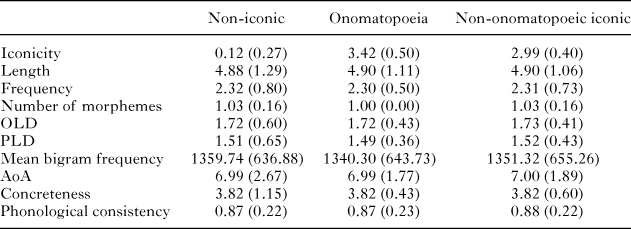
Stimuli were 120 real words and 120 nonwords. The real words were chosen from the iconicity ratings collected by Perry et al. (Reference Perry, Perlman and Lupyan2015) and Winter et al. (Reference Winter, Perlman, Perry and Lupyan2017), in which words were rated on a scale from –5 (the word sounds like the opposite of its meaning) to 5 (the word was highly iconic), with 0 indicating that the word was arbitrary. In order to sample broadly from different types of words, we selected and matched words as per a factorial design, though in the analyses we treated iconicity as a continuous variable. To that end, we selected words corresponding to three categories: non-iconic words, onomatopoeia, and non-onomatopoeic iconic words. Non-iconic words had iconicity ratings ≥ –0.50 and ≤ 0.50 (M = 0.12; Perry et al., Reference Perry, Perlman and Lupyan2015; Winter et al., Reference Winter, Perlman, Perry and Lupyan2017). Onomatopoeia had iconicity ratings ≥ 2.50 (M = 3.42) and had phonologies that imitated their meanings. Non-onomatopoeic iconic words had iconicity ratings ≥ 2.50 (M = 2.99) but had phonologies that we judged not to directly imitate their meanings (e.g., twist, fluff, slime). The three types of words were matched on length, log subtitle word frequency (Brysbaert & New, Reference Brysbaert and New2009), number of morphemes, orthographic Levenshtein distance (OLD; Yarkoni, Balota, & Yap, Reference Yarkoni, Balota and Yap2008), phonological Levenshtein distance (PLD; Yarkoni et al., Reference Yarkoni, Balota and Yap2008), mean bigram frequency, age of acquisition (Kuperman, Stadthagen-Gonzalez, & Brysbaert, Reference Kuperman, Stadthagen-Gonzalez and Brysbaert2012), concreteness (Brysbaert, Warriner, & Kuperman, Reference Brysbaert, Warriner and Kuperman2014), and initial syllable rime phonological consistency (Yap, Reference Yap2007). In addition, each type contained 26 nouns and 14 verbs. See Table 1 for properties of each type. The 120 nonwords did not contain any pseudo-homophones (i.e., nonwords that share phonology with a real word; e.g., brane) and were matched with the 120 real words on length, number of orthographic neighbours, mean bigram frequency and number of syllables (see supplementary materials, available at <http://doi.org10.1017/langcog.2019.36> for stimuli).
Mean (SD) values of lexical and semantic variables for each of the word types presented in Experiments 1 and 2

Notes. Frequency is log subtitle frequency; OLD is orthographic Levenshtein distance; PLD is phonological Levenshtein distance; AoA is average year at which word was acquired; Phonological Consistency is the first syllable rime feedforward consistency.
Participants completed an LDT in which their task was to categorize a presented letter string as a word or a nonword. Each trial began with a fixation cross for 400 msec, followed by a blank screen for 200 msec, after which the target letter string was presented. Participants categorized stimuli as nonwords or words via keyboard press. Their response triggered a 550 msec blank screen, after which the next trial began. If participants made an error, they saw the word ‘Incorrect’, and heard a brief sound, during this blank screen. Participants wore sound-attenuating headphones during the task. Stimuli were presented in a random order, in two blocks, with a break between blocks. Participants saw an equal proportion of each stimulus type in each block.
In addition, participants were randomly assigned to one of two presentation conditions: clear or degraded (40 participants in each). In the clear condition, stimuli were presented normally. In the degraded condition, we followed the approach taken by Yap, Lim, and Pexman (Reference Yap, Lim and Pexman2015) to visually degrade the letter-strings, rapidly alternating between the letter-string and a mask of random symbols of the same length. This condition was run with a refresh rate of 144 Hz.
2.2. results
2.2.1. Statistics
We used the packages ‘lme4’ [version 1.1-18-1] (Bates, Maechler, Bolker, & Walker, Reference Bates, Kliegl, Vasishth and Baayen2015), ‘afex’ [0.23-0] (Singmann, Bolker, & Westfall, Reference Singmann, Bolker and Westfall2015), and ‘RePsychLing’ [0.0.4] (Baayen, Bates, Kliegl, & Vasishth, Reference Baayen, Bates, Kliegle and Vasishth2015) to perform our statistical analysis in R [3.5.1] (R Core Team, 2018). We took a confirmatory approach and fit models including all fixed effects of interest. We developed each model’s random effects structure using the approach suggested by Bates, Kliegl, Vasishth, and Baayen (Reference Bates, Kliegl, Vasishth and Baayen2015). In brief, we began by fitting the model with all random slope terms for each fixed effect, and removed correlations among random effects if this did not converge. We then performed a principal components analysis on the random effects and simplified the structure based on the suggested number of components (Baayen et al., Reference Baayen, Bates, Kliegle and Vasishth2015). We also tested the inclusion of correlations among random effects, and the effects themselves, using likelihood ratio tests. The detailed procedure for model selection, along with the code used for the entire process, can be found online at <https://osf.io/ue7sv/>. We generated p-values using the package ‘lmerTest’ [3.0.1] (Kuznetsova, Brockhoff, & Christensen, Reference Kuznetsova, Brockhoff and Christensen2017). The ‘prediction’ package [0.3.6] was used to generate marginal predictions. Throughout all results, we only report analyses based on real-word trials.
We took the following approach to cleaning the data in these and all analyses of reaction time. First, we excluded all incorrect responses. Then trials with a reaction time less than 200 msec or greater than 3000 msec were removed. We then removed trials that were more than 2.5 standard deviations away from a participant’s mean. No more than 5.13% of trials were ever removed by this process. We took the same approach to cleaning the accuracy data except that incorrect responses were not excluded.
2.2.2. Reaction time
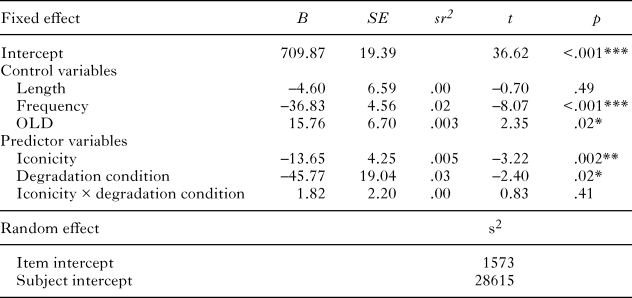
We ran a linear mixed effects modelFootnote 3 that predicted reaction time using condition (effects coded; –1 = clear presentation, +1 = degraded presentation), continuous iconicity (Perry et al., Reference Perry, Perlman and Lupyan2015; Winter et al., Reference Winter, Perlman, Perry and Lupyan2017), and their interaction. Length, frequency (log subtitle word frequency), and OLD were also included as control variables. This model revealed that there was no interaction between condition and iconicity (b = 1.82, p = .41). However, there was a main effect of iconicity such that reaction times were faster in response to words with higher iconicity (b = –13.65, p = .002). In particular, iconicity values of –1.5 and +1.5 SD resulted in predicted reaction times of 724.22 and 683.41 msecs, respectively. In addition, there was a main effect of condition, such that reaction times were faster in the clear condition (b = –45.77, p = .02). In particular, the clear and degraded conditions resulted in predicted reaction times of 659.19 and 750.72, respectively. See Table 2 for a model summary.
Linear mixed effects regression model predicting LDT reaction time in Experiment 1

Notes. * p < .05, ** p < .01, *** p < .001. Marginal R 2 = .05, computed using the Nakagawa and Schielzeth method via the ‘r2glmm’ package in R [version 0.1.2] (Jaeger, Reference Jaeger2017), as is the semi-partial R 2 for each fixed predictor.
2.2.3. Accuracy
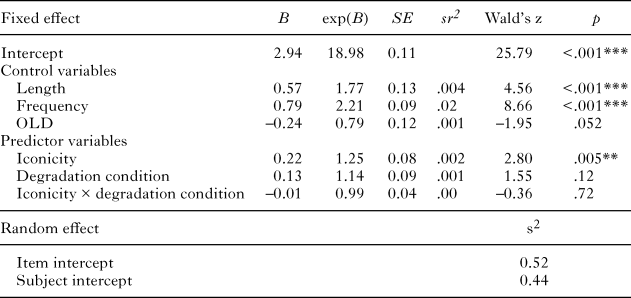
We ran a logistic mixed effects model that predicted accuracy and included the same fixed and random effects as in the main analysis of reaction time. This model revealed that there was no interaction between condition and iconicity (b = –0.01, p = .72). However, there was a main effect of iconicity such that correct responses were 1.25 times more likely for each 1 SD increase in iconicity (b = 0.22, p = .005). There was not, however, a main effect of condition (b = 0.13, p = .12). See Table 3 for a model summary.
Logistic mixed effects regression model predicting LDT accuracy in Experiment 1

Notes. * p < .05, ** p < .01, *** p < .001. Marginal R 2 = .02, computed using the Nakagawa and Schielzeth method via the ‘r2glmm’ package in R [version 0.1.2] (Jaeger, Reference Jaeger2017), as is the semi-partial R 2 for each fixed predictor.
2.3. discussion
Participants were faster and more accurate when responding to words that were higher in iconicity. This suggests that iconicity does provide a benefit to word recognition. Interestingly, the effect of iconicity did not interact with condition, suggesting that any increased use of phonology due to visual degradation did not enhance the effect of iconicity. In the next experiment, we explored the role of phonological encoding further, using a task that explicitly prioritizes phonology, by requiring participants to attend to the phonologies of each word (and not the spellings) in order to make a correct response.
3. Experiment 2
3.1. methods
3.1.1. Participants
Participants were 48 undergraduate students at the University of Calgary who participated in exchange for course credit. Participants reported English fluency and normal or corrected-to-normal vision. We tested more participants than we intended to analyze (i.e., 40), because previous work with the PLDT has found that some participants do not comply with the instructions to emphasize phonology (e.g., Pexman, Lupker, & Reggin, Reference Pexman, Lupker and Reggin2002). This non-compliance is evident in accuracy on pseudo-homophone trials. Thus, we included the 40 participants (25 female; M age = 23.15; SD = 5.41) with the highest accuracy on pseudo-homophone trials (i.e., correctly categorizing stimuli like brane as sounding like a real word; see below for details). Note that the to-be-reported significant effects remain significant when including all 48 participants.
3.1.2. Materials and procedure
In addition to the stimuli from Experiment 1, we added 60 pseudo-homophones and 60 additional nonwords. These pseudo-homophones were created by altering the spelling of an existing word (e.g., cough to koff). As in Experiment 1, we selected and matched words as per a factorial design, though we treated iconicity as a continuous variable in the analyses. To that end, pseudo-homophones were created using the phonologies of 20 non-iconic, 20 onomatopoeic, and 20 non-onomatopoeic iconic words. Stimuli requiring a ‘word’ response and stimuli requiring a ‘nonword’ response were matched on length, orthographic neighbourhood size, mean bigram frequency, and number of syllables. (See the online supplementary material for stimuli.)
Participants completed a PLDT in which their task was to categorize a letter-string as sounding like a word (i.e., having the phonology of a real word) or a nonword (i.e., not having the phonology of a real word). Except for the different decision criterion, trials were presented in the same manner as in the clear condition of Experiment 1.
3.2. results
Data were analyzed using the same approach as in Experiment 1.
3.2.1. Reaction time
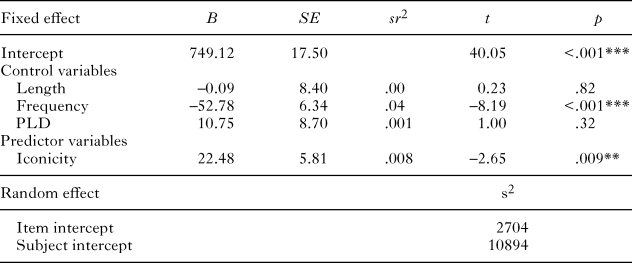
We ran a linear mixed effects model that predicted reaction time using iconicity as a predictor. The model also included length, frequency (log subtitle word frequency), and PLD (as this experiment prioritized phonology) as control variables. This model revealed an effect of iconicity such that reaction times were faster in response to words with higher iconicity (b = –22.48, p < .001). In particular, iconicity values of –1.5 and +1.5 SD resulted in predicted reaction times of 780.33 and 712.90 msecs, respectively. See Table 4 for a model summary.
Linear mixed effects regression model predicting PLDT reaction time in Experiment 2

Notes. * p < .05, ** p < .01, *** p < .001. Marginal R 2 = .06, computed using the Nakagawa and Schielzeth method via the ‘r2glmm’ package in R [version 0.1.2] (Jaeger, Reference Jaeger2017), as is the semi-partial R 2 for each fixed predictor.
We ran a supplementary analysis in which we combined the present results with those of the clear condition in Experiment 1, and tested for an interaction between task (LDT vs. PLDT) and iconicity, to examine the impact of explicitly directing participants to focus on phonology. The model also included length, frequency, and OLD as control variables; it also included a random item slope for the effect of task. The interaction between task and iconicity was non-significant (b = –5.24, p = .06).
Finally, we ran a supplementary analysis on the pseudo-homophone trials. We ran a model that predicted reaction time using the iconicity of the word on which each pseudo-homophone was based. The model also included length, orthographic neighbourhood size, and mean bigram frequency of the pseudo-homophones, and base word frequency (log subtitle frequency), as control variables. This model revealed an effect of base word iconicity, such that reaction times were faster in response to pseudo-homophones that were based on words with higher iconicity (b = –61.78, p = .04). In particular, base word iconicity values of –1.5 and +1.5 SD resulted in predicted reaction times of 1196.96 and 1011.61, respectively.
3.2.2. Accuracy
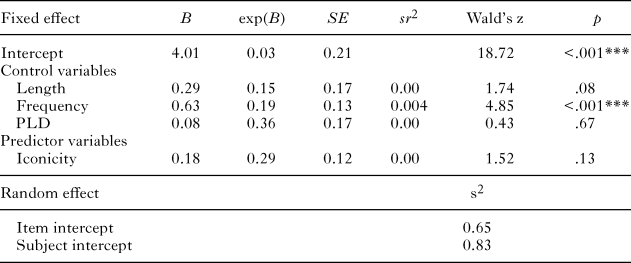
We ran a logistic mixed effects model that predicted accuracy using the same fixed and random effects as in the main analysis of reaction time. This model found no effect of iconicity on response accuracy (b = 0.18, p = .13), see Table 5.
Logistic mixed effects regression model predicting PLDT accuracy in Experiment 2

Notes. * p < .05, ** p < .01, *** p < .001. Marginal R 2 = .005, computed using the Nakagawa and Schielzeth method via the ‘r2glmm’ package in R [version 0.1.2] (Jaeger, Reference Jaeger2017), as is the semi-partial R 2 for each fixed predictor.
We ran a supplementary analysis in which we combined the present results with those of the clear condition in Experiment 1, and tested for an interaction between task and word type. The model also included length, frequency, and OLD as control variables. This model found no interaction between task and iconicity (b = 0.00, p = .97).
Finally, we again ran a supplementary analysis on the pseudo-homophone trials. We ran a model that predicted accuracy using the same fixed and random effects as in the analysis of pseudo-homophone reaction time. This model revealed an effect of base word iconicity, such that correct responses were 1.80 times more likely for each 1 SD increase in base word iconicity (b = 0.59, p = .004).
3.3. discussion
In Experiment 2, we found that participants responded faster to words with higher iconicity. They did not, however, respond more accurately. Interestingly, an iconicity benefit also emerged in the processing of pseudo-homophones. As the correct identification of these items would have relied on phonology, this speaks to the role of phonology in iconicity. We next examined responses to these words when presented in the broader context of a mega-study that included a wide variety of words.
4. English Lexicon Project analysis
We performed an analysis examining average reaction time and accuracy in the English Lexicon Project (ELP; Balota et al., Reference Balota, Yap, Hutchison, Cortese, Kessler, Loftis and Treiman2007) LDT for the 120 words used in Experiments 1 and 2.
4.1. results
We ran a linear model that predicted LDT reaction time in the ELP using iconicity as a predictor. The model also included length, frequency (log subtitle word frequency), and OLD as control variables. Note that this analysis was done at the item level, and therefore did not include random effects. This model found no effect of iconicity on reaction time (b = 11.00, p = .054). The corresponding model found no effect of iconicity on accuracy (b = 0.01, p = .46).Footnote 4
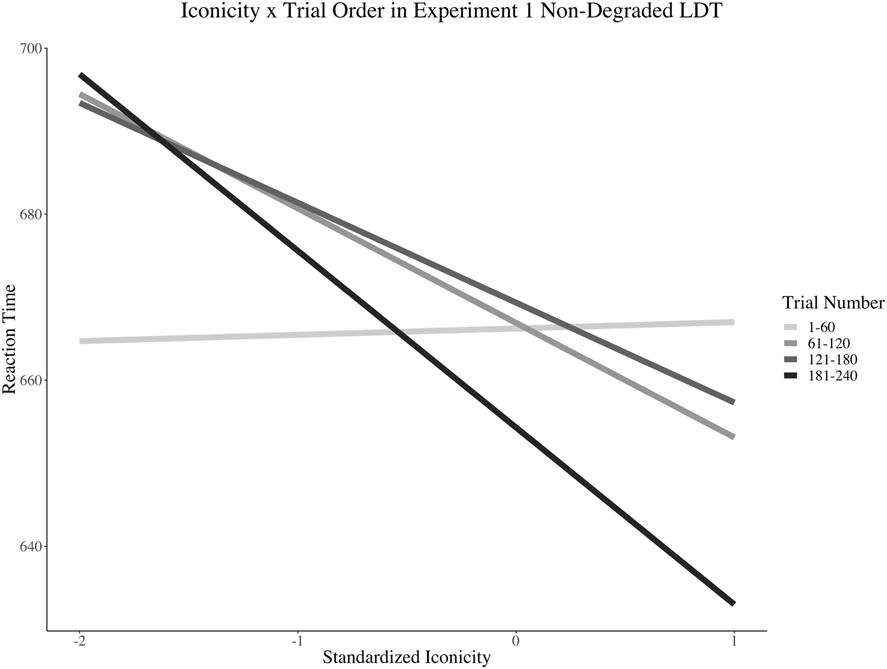
In a supplementary analysis, we explored the possibility that list context might have led to the difference in results between the ELP data and the non-degraded LDT from Experiment 1 (which both used the same task). While ELP participants were presented with a wide variety of words, two-thirds of the words in Experiment 1 were iconic. We examined whether this list context in the non-degraded LDT from Experiment 1 increased participants’ attention to iconicity through a linear mixed effects model that included trial number and its interaction with iconicity, in addition to previously used control variables. We found a significant interaction between trial number and iconicity (b = –8.82, p = .002), such that iconicity had a greater effect on later trials (see Figure 1). In particular, iconicity values of –1.5 and +1.5 SD resulted in predicted reaction times of 672.76 and 660.88 on trial 60 (of 240), and 688.20 and 629.91 on trial 180, respectively. The corresponding logistic mixed effects model found no interaction between condition and trial number (b = 0.06, p = .34).
Plot showing the relationship between iconicity and predicted reaction time in the non-degraded LDT from Experiment 1. This was calculated separately for each quarter of the experiment (e.g., the first 60 trials that a participant saw comprise the first quarter of the experiment). Each line shows the effect in a different quarter of the experiment.

4.2. discussion
We found no effect of iconicity on LDT response times in the ELP for the 120 items used in Experiments 1 and 2. This contrasts with results from the non-degraded LDT in Experiment 1. One possibility is that list context plays a role. While two-thirds of the words in Experiment 1 were iconic, this was not true in the ELP. Speaking to this is the fact that the effect of iconicity on reaction time in the non-degraded LDT from Experiment 1 emerged over time, potentially as participants shifted their attention towards iconicity as a useful cue to a ‘word’ response.
5. General discussion
It had traditionally been assumed that the relationship between a word’s form and its meaning is arbitrary (e.g., Hockett, Reference Hockett and Greenberg1963), but a more recent perspective is that this relationship contains aspects of arbitrariness and iconicity (Dingemanse et al., Reference Dingemanse, Blasi, Lupyan, Christiansen and Monaghan2015; Perniss et al., Reference Perniss, Thompson and Vigliocco2010). Here we tested the possibility that recognition might be facilitated for relatively more iconic words. Indeed, we found that more iconic words were processed faster and more accurately in a visual LDT, and faster in a phonological LDT.
These experiments suggest that iconicity can confer an advantage in processing to typical individuals, in addition to people with aphasia (Meteyard et al., Reference Meteyard, Stoppard, Snudden, Cappa and Vigliocco2015). These results stand somewhat in contrast to a study on Dutch onomatopoeic words that found no effects in reaction time (Peeters, Reference Peeters2016). Note that stimuli in the Dutch study were presented auditorily, and that this difference in modality may interact with effects of iconicity (cf. Meteyard et al., Reference Meteyard, Stoppard, Snudden, Cappa and Vigliocco2015). In fact, Peeters (Reference Peeters2016) speculated that the lack of an iconicity effect may have been due to onomatopoeia being more difficult to identify as words (as opposed to environmental sounds). Auditory presentation may have exaggerated this. It is also important to note that the study by Peeters did find a smaller N400 in response to onomatopoeic vs. non-onomatopoeic words, which was interpreted as being indicative of facilitated word retrieval, and thus consistent with the present results.
We found some evidence that list context plays a role in the effects of iconicity. Indeed, LDT reaction time and accuracy in the ELP, for the 120 items used here, were not affected by iconicity (though see footnote 4). Note that ELP participants would have received a much smaller proportion of iconic words than the participants we tested in Experiments 1 and 2. It may be that this greater proportion of iconic words served to shift participants’ attention to iconicity. Indeed, the effect of iconicity on reaction time in the non-degraded LDT from Experiment 1 emerged over the course of that experiment. Thus, it seems that participants’ use of iconicity in LDT is somewhat strategic; they can shift their response strategy to rely more heavily on iconicity when it is beneficial to do so. This is consistent with other evidence for attentional control and strategic reliance on relevant lexical and semantic variables in LDT (Balota et al., Reference Balota, Paul, Spieler, Garrod and Pickering1999; Hargreaves & Pexman, Reference Hargreaves and Pexman2012).
The results from Experiments 1 and 2 demonstrate that iconicity can confer an advantage in language processing, in addition to aiding in language learning (e.g., Imai, Kita, Nagumo, & Okada, Reference Imai, Kita, Nagumo and Okada2008) and increasing the vividness of communication (e.g., Lockwood & Tuomainen, Reference Lockwood and Tuomainen2015). Vocal iconicity has been also argued to have played a role in language evolution (Perlman, Dale, & Lupyan, Reference Perlman, Dale and Lupyan2015; Perlman & Lupyan, Reference Perlman and Lupyan2018). Various factors have been proposed to act on the relative balance of iconicity and arbitrariness in the lexicon over generations (for discussions of this topic see Perniss & Vigliocco, Reference Perniss and Vigliocco2014; Sidhu & Pexman, Reference Sidhu and Pexman2018; Winter et al., Reference Winter, Perlman, Perry and Lupyan2017). One may speculate that the facilitatory role of iconicity in processing is one such factor, and that it might increase the chances of iconic forms being maintained over time.
In addition to testing for a benefit of iconicity, we also hoped to gain insight into how such an effect would fit within existing models of word recognition. We speculated that iconicity may have an effect via links from phonology to semantics that are special in some way (see also Meteyard et al., Reference Meteyard, Stoppard, Snudden, Cappa and Vigliocco2015; Vigliocco & Kita, Reference Vigliocco and Kita2006; for evidence of phonemes activating cross modal information see Lockwood, Hagoort, & Dingemanse, Reference Lockwood, Hagoort and Dingemanse2016): iconic words could possess extra links (i.e., a quantitative difference) or links that are more direct in nature (i.e., a qualitative difference). To investigate this possibility, we examined whether increasing participants’ reliance on phonology by degrading visual stimuli (in Experiment 1) or having participants respond based on phonology (Experiment 2) increased the effects of iconicity. We found no evidence that these manipulations increased the effects of iconicity. It is worth noting, however, that while non-significant (p = .06), the numerical trend that emerged when comparing the clear condition of Experiment 1 with the phonological lexical decision task in Experiment 2, is consistent with iconicity playing a larger role in the latter.
The lack of a phonological effect speaks against the possibility that iconic words have extra links from phonology to semantics. Were this the case, increasing participants’ reliance on phonology should have allowed these extra links to facilitate processing. However, it still may be the case that iconic words have more direct links from phonology to semantics, and that these links facilitate processing regardless of the extent to which words are processed phonologically. That is, while a null result with regards to the interaction between phonology and iconicity speaks against iconic words having quantitatively different links as compared to non-iconic words, it does not necessarily rule out the possibility that iconic words have qualitatively different links. Additionally, recall that, in Experiment 2, pseudo-homophones based on words with a higher iconicity were responded to faster and more accurately. This suggests some role of phonology as correctly identifying a pseudo-homophone as sounding like a word in the PLDT largely depends on the processing of phonology, as the stimulus has no extant mapping from orthography to semantics.
Of course, it is also simply possible that the effects of iconicity do not arise from special links between phonology and semantics. If so, how else might we account for them? One possibility is that the semantic representations of iconic words are special in some way. For instance, Meteyard et al. (Reference Meteyard, Stoppard, Snudden, Cappa and Vigliocco2015) speculated that iconic words may have additional connections from semantic representations to modality-specific features. Indeed, previous work has shown relationships between iconicity and sensory experience (Sidhu & Pexman, Reference Sidhu and Pexman2018; Winter et al., Reference Winter, Perlman, Perry and Lupyan2017) and concreteness (Lupyan & Winter, Reference Lupyan and Winter2018). As iconicity ratings become available for a greater number of items, future research should explore the role of various semantic dimensions in the processing advantages of iconic words.
6. Conclusion
We found that iconicity provides a benefit to visual word recognition in typical adults. Thus, iconicity contributes to language processing and should be considered in models of word recognition. On a larger scale, these findings demonstrate another benefit of iconicity to language.
Supplementary materials
For supplementary materials for this paper, please visit <http://doi.org/10.1017/langcog.2019.36>.