There are various professional ethical codes and legal rules that regulate the professional activities of employees. Professional ethical codes are defined as the whole of the professional principles that a certain occupational group establishes and protects, which directs the members of the profession to behave in a certain way, restricts their tendencies, excludes inadequate and unprincipled members, regulates professional competition, and aims to protect service ideals (Aydın, Reference Aydın2014). While professional ethical codes are universal, legal rules may vary from society to society and from country to country depending on the culture. In the case of noncompliance with the legal rules, state sanctions are applied; but in the case of violation of professional ethical codes, internal disciplinary sanctions are applied. While legal rules meet some of the principles of professional ethics, these principles are more comprehensive than the legal rules. Additionally, professional ethical principles may sometimes serve as an auxiliary resource by facilitating the interpretation and application of legal rules; for example, if professional ethical principles are transformed into rules of procedure, they become binding rules of law (Gümüş & Eren Gümüş, Reference Gümüş and Eren Gümüş2013).
School counsellors can be undecided about which ethical principles can be applied in a situation (Cottone & Tarvydas, Reference Cottone and Tarvdays2007). When faced with such a situation, the individual may have difficulty in making decisions and end up in an ethical dilemma. An ethical dilemma is defined as a disturbing situation where a person believes they understand the logical and acceptable aspects of each of the ethical principles that they need to consider, but cannot decide which of these principles to choose (Beauchamp & Childress, Reference Beauchamp and Childress2001; Lindsay & Clarkson, Reference Lindsay and Clarkson1999).
Various professional associations have contributed to the development of guidelines for the professional ethical codes of school counselling; for example, the ACA Code of Ethics from the American Counseling Association (ACA; 2014), ASCA Ethical Standards for School Counselors from the American School Counselor Association (ASCA; 2016), Ethical Framework for the Counselling Professions from the British Association for Counselling and Psychotherapy (BACP; 2018), Code of Ethics and Practice from the Australian Counselling Association (ACA; 2019), and Code of Ethics for Psychological Counselling and Guidance from the Turkish Psychological Counselling and Guidance Association (TPCGA; 2011). In addition to these professional ethical codes, there are various legal rules, such as the laws, regulations and guidelines adopted by countries where counsellors practise their professions. Therefore, the field of activity is framed by various principles, rules and criteria set by law so that school counselling can be performed in a standard way by all. It is emphasised that it is important for counsellors to know these ethical principles and laws (Knapp & Vandecreek, Reference Knapp and Vandecreek2006). It is not always possible to meet all of these criteria in the services provided by service-oriented school counsellors due to the complex and variable structure of human nature and the fact that each person receiving assistance is unique. Moreover, it is not possible for the codes of professional ethics to be adapted to every situation that may be encountered during the counselling process (Cottone & Tarvdays, Reference Cottone and Tarvdays2007). In this context, school counsellors may experience internal conflict and ethical dilemmas as a result of conflicting or insufficient professional ethical principles and legal rules in overcoming some of the situations they face. If ethical dilemmas cannot be overcome, they may become ethical violations (Camadan, Reference Camadan and Ekiz2020). At this point, the ability to make the right decision is considered as one of the most important skills for a school counsellor to have (Erdur-Baker & Çetinkaya, Reference Erdur-Baker, Çetinkaya, Özyürek, Owen and Owen2007). Bond (Reference Bond2015) stated that overcoming ethical dilemmas and sharing with other colleagues is an important learning resource for school counsellors. In light of these explanations, it is understood that an ethical dilemma is an important issue for school counsellors.
Purpose of the Study
In the related literature, it was determined that school counsellors experience ethical dilemmas in various issues. Some of these issues that are mentioned in studies are as follows: confidentiality of student information, situations where clients self-harm or harm others; parental rights and multiple relationships with the institution (Bodenhorn, Reference Bodenhorn2006); professional responsibility, confidentiality, multiple relationships and competence (Hartley & Cartwright, Reference Hartley and Cartwright2016); confidentiality, multiple relationships, competence and value transfer (Kolay Akfert, Reference Kolay Akfert2012); confidentiality (Lazovsky, Reference Lazovsky2008; Mendes, Nascimento, Abreu-Lima, & Almeida, Reference Mendes, Nascimento, Abreu-Lima and Almeida2016); confidentiality, conflicts with school principals and multiple relationships (Siviş-Çetinkaya, Reference Siviş-Çetinkaya2014); confidentiality and professional responsibility (Tarvydas & Barros-Bailey, Reference Tarvydas and Barros-Bailey2010); multiple relationships (Nigro, Reference Nigro2004); multiculturalism (Sadeghi, Fischer, & House, Reference Sadeghi, Fischer and House2003); confidentiality, volunteering, sexuality and competence (Yam, Reference Yam2017); confidentiality and competence (İkiz, Sensoy, Balkan & Streaman, 2017a); privacy, student safety, parental rights and social media (Brown, Armstong, Bore & Simpson, Reference Brown, Armstrong, Bore and Simpson2017); and privacy, volunteering, competence, and multiple relationships (Camadan, Reference Camadan2018). These studies show that school counsellors face ethical dilemmas in many areas such as confidentiality, volunteering, abuse and competence. Therefore, it is important to address many questions, such as the kind of information school counsellors have about the ethical and legal dimensions of school counselling, the situations in which they face ethical dilemmas, how these may be overcome, and whether they receive support in these situations. As Lawrence and Kurpius (Reference Lawrence and Kurpius2000) stated, because school counsellors work directly with people, it is important and necessary to know the legal and ethical dimensions of their profession. This study aims to examine the ethical dilemmas experienced by school counsellors and to develop suggestions for solutions.
Research Question
Accordingly, this study seeks answers to the following questions:
1. What information do school counsellors have about the professional ethics and legal aspects of school counselling, and do they find themselves competent in these matters?
2. In which situations do school counsellors face ethical dilemmas, and what are their ways of overcoming them? Do school counsellors receive support in overcoming the ethical dilemmas they face, and if so, from whom and what kind of support do they prefer?
Method
Research Design
The purpose of this study, which is based on a qualitative research approach, is to identify the ethical dilemmas school counsellors face in their professional lives and determine the standpoints on recommendations for solutions to these dilemmas. The study carried out for this purpose is a descriptive one.
Participants
The study was carried out with school counsellors employed at state schools in the province of Rize in Turkey. The sample consisted of 16 school counsellors (11 female and 5 male) working at educational institutions in the academic year 2017–2018. Seven of the participants were from high schools, four from secondary schools, two from primary schools, and three from guidance research centres. In Turkey, primary schools serve students between the ages of 6–9 years, secondary schools the ages of 10–13 years, high schools the ages of 14–17 years, and guidance research centres are for students of all ages. The criterion sampling method, a purposive pampling technique, was used to determine the sample. The criterion sampling method is a method where the observation units are composed of individuals, events, objects or situations with certain qualifications when an in-depth study is intended (Büyüköztürk, Çakmak, Akgün, Karadeniz, & Demirel, Reference Büyüköztürk, Çakmak, Akgün, Karadeniz and Demirel2012). This way, the participation of people with different gender and different levels of education institutions of employment were provided to the research. In determining the number of participants, it was considered that the findings of the interviews started to repeat. It is accepted that sufficient data sources are reached when the concepts and processes that emerge are repeated (saturation point; Yıldırım & Şimşek, Reference Yıldırım and Şimşek2013). When the findings obtained in this study started to repeat, the interviews were ended.
Data Collection Instrument and Data Collection
A semistructured interview form was prepared by the researchers to collect the data. According to Robson and McCartan (Reference Robson and McCartan2016), a semistructured interview form includes a series of questions related to content. In addition to this, when such a form is used, the order of questions may vary based on the flow of the interview, and questions not included in the form may also be asked. Therefore, these forms not only allow interviews to be conducted in a systematic and consistent way, but they also provide the interviewer with freedom and flexibility for obtaining detailed information about the participant (Lune & Berg Reference Lune and Berg2016). With these aspects, it is seen as suitable to use semistructured interviews in the social sciences and educational sciences (Türnüklü, Reference Türnüklü2000). Therefore, in this study, a semistructured interview was used to obtain the views of the school counsellors in a certain systematic way and in detail.
A pilot interview was carried out due to the importance of preparing a useful interview form and for checking that the participants understood the questions (Büyüköztürk et al., Reference Büyüköztürk, Çakmak, Akgün, Karadeniz and Demirel2012). First, for the preparation of the form used in the pilot interview, a literature review was conducted. The form prepared following the review was presented to three academics, one from the field of school counselling, for approval. The form created after these stages was applied to five school counsellors and questions that were not understood sufficiently were rearranged, and new questions were added to consider the given answers. After these arrangements, approval of the academics was again sought, and the questionnaire was finalised. The questions are as follows:
1. What information do you have about the professional ethics of school counselling?
1.1. Do you find yourself adequate on this subject?
2. What information do you have about the legal aspects of school counselling?
2.1. Do you find yourself adequate on this subject?
3. In what kind of situations do you face ethical dilemmas in the profession of school counselling?
4. What are your ways of overcoming the ethical dilemmas you face?
5. Do you receive assistance in overcoming your ethical dilemmas?
5.1. If you do, from where and whom do you receive assistance?
5.2. What kind of assistance would you like to receive?
The interview form also included two questions about the gender of the participants and their levels of education. In the process of collecting the data, first the required legal permissions were received from the Directorate of National Education under which the school counsellors’ schools were operating. After receiving these permissions, the school counsellors were telephoned and appointments were made. Before the interviews, both verbal and written information were provided to the participants regarding the objective of the study, privacy concerns and that participation was on a voluntary basis. Prior to the interview, in order to maintain the objectivity of the information obtained, the participants were informed that the interviewers would ask questions and record their answers in writing. Interviews were carried out with school counsellors who agreed to participate in the study. The interviews were held at the offices of the school counsellors. Each interview took between 30 minutes and 1 hour. All interviews that were held within the scope of the study were completed in two weeks. The participants were informed that the results obtained in the study could be sent to them if they provided their email addresses.
Data Analysis
Content analysis was used to analyse the data obtained. According to Creswell and Poth (Reference Creswell and Poth2016), the steps to be followed in content analysis are as follows: (1) Transferring participants’ statements to the computer, (2) Reading and taking reminder notes, (3) Describing, classifying and interpreting data in codes and themes, (4) Interpreting the data, and (5) Presenting and visualising the data. These steps were followed in this study and the related processes presented below. Nvivo 11.0 software was used for data analysis.
Transferring participants’ statements to the computer
As a result of the interviews conducted within the scope of the research, the statements of the participants gathered in writing were transferred to computers to make the analysis easier. This way, a pool was created for the examples of the direct statements of the participants. Additionally, these data were used in the figures presented as a result of the analyses.
Reading and taking reminder notes
The statements of the participants were first read and understood as a whole. The prominent points in these statements were highlighted by markings and notes.
Describing, classifying, and interpreting data in codes and themes
At this stage, codes and themes were created from the statements of the participants.
Interpreting the data
Various inferences were made based on the codes and themes generated during the data analysis process. These classifications were aimed to be explained and interpreted this way.
Presenting and visualising the data
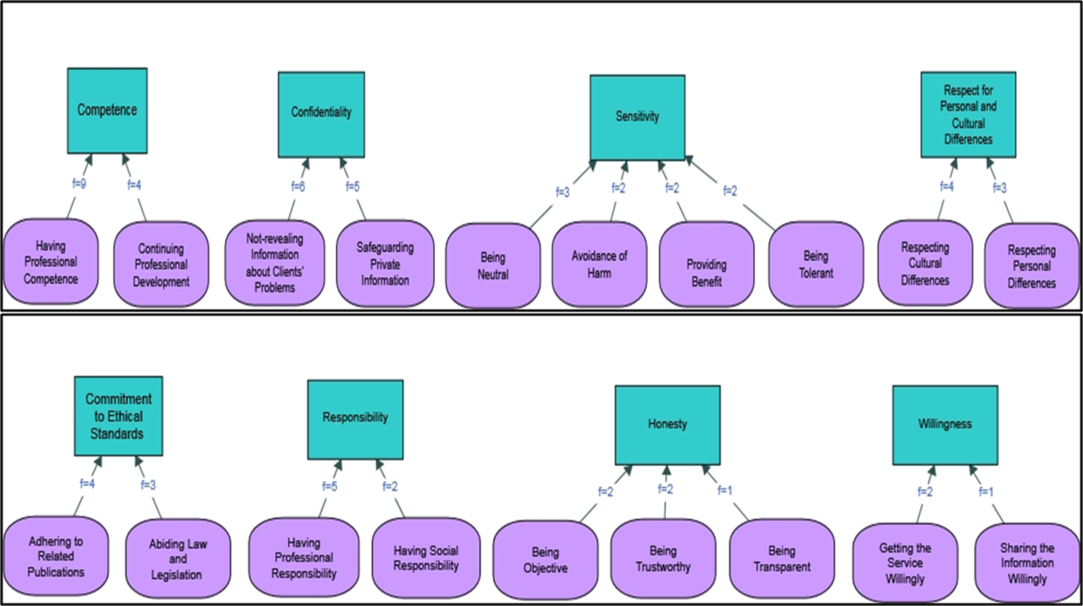
These data were presented as figures so that it could be easily understood. Along with analysing the questions asked and the answers given in this research, codes and themes accompanied by different visuals and colours are presented in Figures 1–6. In these figures, the answers that apply to each theme and which code they belong to are shown clearly. Also, these figures show the frequencies of how many participants applied to each code and theme. Additionally, participants’ statements are included in the presentation of the data. In order to clarify which statement belonged to which participant, each participant was assigned a letter (F: Female, M: Male) and a number (1, 2, 3, and so on), representing their gender and which participant they are respectively; for example, F1 is the first female participant.
Codes and themes created in accordance with the answers to the question ‘What information do you have about the professional ethics of school counselling’ (Question 1).

Validity and Reliability
For ensuring the validity of qualitative research, it is recommended to collect detailed information through face-to-face interviews, report in detail how the conclusions are reached with the analyses made on this information, and present some of the participants’ statements with direct quotations (Yıldırım & Şimşek, Reference Yıldırım and Şimşek2013). In the study, the researchers conducted individual interviews with each participant and additional questions were asked to obtain detailed viewpoints from the participants. Additionally, how the data collection instrument was prepared and the process of data collection and analysis was explained clearly and in detail. Some of the expressions used by the participants in the interviews are presented as direct quotes. The validity of the research was aimed to be ensured with the referenced studies.
To achieve reliability in qualitative studies, it is important to accurately and completely record the obtained data. In this context, showing the recorded data to the participants aimed to determine whether or not there was an error or an incomplete part (Büyüköztürk et al., Reference Büyüköztürk, Çakmak, Akgün, Karadeniz and Demirel2012). Thus, it is possible for the participants to validate their statements, and if desired, another person has the opportunity to examine the data of the study (Sönmez & Alacapınar, Reference Sönmez and Alacapınar2016). Following the interviews in this study, the forms were shown to the participants to see whether what was written in the form was inaccurate or incomplete. The statements were reorganised based on the adjustments made by the participants on their own expressions in the recorded forms. This way, it was aimed to record the obtained data accurately and completely. Furthermore, a consensus among coders was aimed to be reached to ensure reliability in this study. This was expressed as the similarity in the evaluations of multiple experts analysing the data (Creswell & Poth, Reference Creswell and Poth2016). The formula proposed by Miles and Huberman (Reference Miles and Huberman1994; reliability = agreement/[agreement + disagreement]) was used to calculate this similarity. Following the creation of the data collection instrument, the data were analysed by an academic in the field of school counselling Then, the codes and themes of the researchers and the views of this academic were compared using the above formula, and the reliability coefficient was calculated as .91 (65/[65 + 6]). The reliability of the created themes was calculated as .85 (18/[18 + 3]). Based on these results, it was calculated that a consensus among coders was reached, and the reliability of the study was achieved.
Results
What Information Do You Have about the Professional Ethics of School Counselling?
As seen in Figure 1, 19 different codes were determined based on the answers given by the participants, and these codes were classified into eight different themes. Explanations of some of these codes and themes are presented below.
Some of the responses to the question ‘What information do you have about the professional ethics of school counselling?’ (Question 1) became prominent. Some participants answered this question with the expressions of Having Professional Competence (f = 9) and Continuing Professional Development (f = 4). As the included elements covering the process of reaching the competency required for the profession, these expressions were put under the theme of Competence (f = 13). The expressions Not Revealing Information about Clients’ Problems (f = 6) and Safeguarding Private Information (f = 5) were put under the theme of Confidentiality (f = 11) as they referred to the necessity of privacy and safeguarding of information. The expressions Being Neutral (f = 3), Avoidance of Harm (f = 2), Providing Benefit (f = 2) and Being Tolerant (f = 2), because they referred to the necessity for school counsellors to be careful and sensitive towards their client, were put under the theme of Sensitivity (f = 9). In light of these results, it was understood that the school counsellors had more knowledge about the issues stated in the themes regarding school counselling. Examples of the direct statements of the participants for each of the aforementioned codes are given below:
Having professional competence: ‘Professionally conscientious individuals should be equipped with the requirements of the profession.’ (F1)
Continuing professional development: ‘Innovations in the field should be constantly monitored.’ (M4)
Not revealing information about clients’ problems: ‘Except in exceptional circumstances, client problems should not be shared.’ (F9)
Safeguarding private information: ‘Clients’ information should be kept confidential.’ (F11)
Being neutral: ‘The consultant must be neutral in the process towards the client.’ (M4)
Avoidance of harm: ‘During the consultation process, the client should not be harmed.’ (F2)
Providing benefit: ‘During the consultation process, attitudes, and behaviours that prevent the benefit of the client should be avoided.’ (F3)
Being tolerant: ‘School counselling should be in a tolerant fashion to carry out the profession with high-level competence.’ (M1)
Respecting cultural differences: ‘Values should be kept within professional principles in professional tasks.’ (M2)
Respecting personal differences: ‘It is necessary to act within the principle of unconditional acceptance.’ (F5)
Adhering to related publications: ‘It is necessary to have knowledge about the principles of the professional ethics published by TPCGA.’ (M5)
Abiding by law and legislation: ‘When choosing between privacy and law, the choice must be in favor of the law.’ (E10)
Having a professional responsibility: ‘Professional responsibilities, which are the backbone of the profession, should be possessed.’ (M3)
Having social responsibility: ‘It is necessary to be a good role model to set an example for people.’ (F3)
Being objective: ‘It’s necessary to be honest and objective in the relationship between the client and the consultant.’ (M1)
Being trustworthy: ‘A sense of trust should be established in the clients.’ (F1)
Being transparent: ‘Transparency and clarity are required by professional ethics.’ (F5)
Getting the service willingly: ‘It should be ensured that the clients are willingly getting counselling.’ (F8)
Sharing the information willingly: ‘It should be ensured that the clients are sharing their information willingly.’ (F2)
Codes and themes created in accordance with the answers to the question ‘What information do you have about the legal aspects of school counselling?’ (Question 2).

Do You Find Yourself Adequate on This Subject?
Based on the responses of the participants to the question ‘Do you find yourself adequate on this subject?’ (Question 1.1), three different codes were determined. While participants answered this question with the expression Inadequate (f = 7), which indicated that they did not find themselves adequate in terms of their knowledge of professional ethics, or the expression Adequate (f = 5), which referred to their adequacy, some others responded with the expression Partially adequate (f = 4), which indicated that they had sufficient knowledge on professional ethics, but they also had aspects that need to be improved. Therefore, it is understood that most of the school counsellors did not find themselves completely adequate in terms of the professional ethics of school counselling. Examples of the direct statements of the participants for each of the aforementioned codes are given below:
Inadequate: ‘I do not find myself adequate because there are areas where I have a dilemma or have difficulty in practising.’ (F2)
Adequate: ‘In general, I find myself sufficient for my professional experience.’ (M2)
Partially adequate: ‘I consider myself partially sufficient on this subject and think that I need to improve myself on competence and report keeping.’ (M1)
What Information Do You Have About the Legal Aspects of School Counselling?
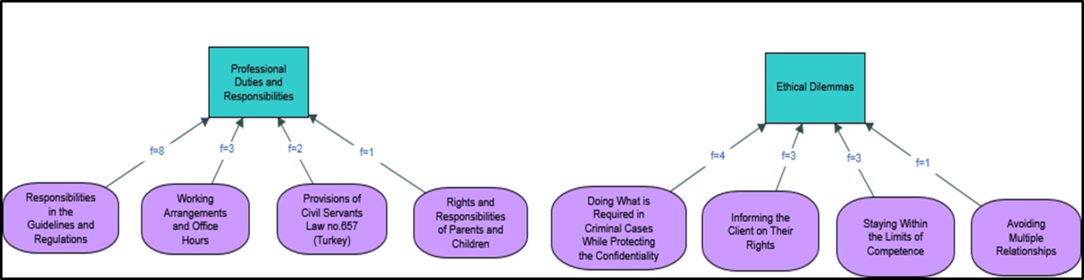
As seen in Figure 2, eight different codes were determined based on the responses of the participants. It was understood that these codes could be included under two different themes. Explanations of some of these codes and themes are presented below.
Some of the responses of the participants to the question ‘What information do you have about the legal aspects of school counselling?’ (Question 2) became prominent. Some participants answered this question with the expressions of Responsibilities in the Guidelines and Regulations (f = 8), Working arrangements and office hours (f = 3), Provisions of Civil Servants Law no. 657 (Turkey) (f = 2) and Rights and responsibilities of parents and children (f = 1). These codes were put under the theme of Professional Duties and Responsibility (f = 14) as they were related to the rules individuals need to follow in the professional process regarding the legal aspects of school counselling. Examples of the direct statements of the participants for each of these codes are given below:
Responsibilities in the Guidelines and Regulations: ‘The Guidance and Counselling Services Guide and the Ministry of National Education’s Guidance Services Regulations should be followed.’ (F 5)
Working arrangements and office hours: ‘Working arrangements should be as 30 working hours per week.’ (M 4)
Provisions of Civil Servants Law no. 657 (Turkey): ‘Must be acted within current legislation and Law no. 657.’ (M 5)
Rights and responsibilities of parents and children: ‘Must be knowledgeable about the criminal situations of the children and their parents and be conscious of the children’s rights and parents’ responsibilities.’ (M 2)
Doing what is required in criminal cases by protecting confidentiality: ‘In cases such as abuse and rape, legal obligations must be put into practice to not hide the crime.’ (F 8)
Informing the client on their rights: ‘Informing the client and raising awareness on the rights of the client should be ensured.’ (F 3)
Staying within the limits of competence: ‘In respect of our duties and responsibilities in sensitive matters, it is necessary to act in accordance with the professional boundaries and act within the framework of our duty.’ (F 2)
Avoiding multiple relationships: ‘It is necessary to be aware that the relationship established between the consultant and the consultee is equivalent to the proxy agreement.’ (M 1)
Do You Find Yourself Adequate on This Subject?
Based on the responses of the participants to the question ‘Do you find yourself adequate on this subject?’ (Question 2.1) that was asked after Question 2, three different codes were determined. While participants answered this question with the expression of Inadequate (f = 7), which indicated that they did not see themselves adequate in terms of having knowledge on the legal aspects of school counselling, or the expression of Partially adequate (f = 7), which indicated that their levels of knowledge needed to be improved, some others responded with the Adequate (f = 2), indicating that they felt sufficient regarding the issue. Therefore, it was understood that most of the school counsellors did not find themselves completely adequate regarding the legal aspects of school counselling. Examples of the direct statements of the participants for each of the aforementioned codes are given below:
Inadequate: ‘Even though we have been educated at the university about the legal dimension, I do not find myself adequate because I have problems in practice and implementation in the profession.’ (M1)
Partially adequate: ‘I cannot say that I am fully qualified as, in some cases, I have been through conflicts between the demands of the national education administration and our local supervisors, about situations determined by law and regulations.’ (M2)
Adequate: ‘Yes, I find myself adequate.’ (M5)
In What Kind of Situations Do You Face Ethical Dilemmas in the School Counselling Profession?
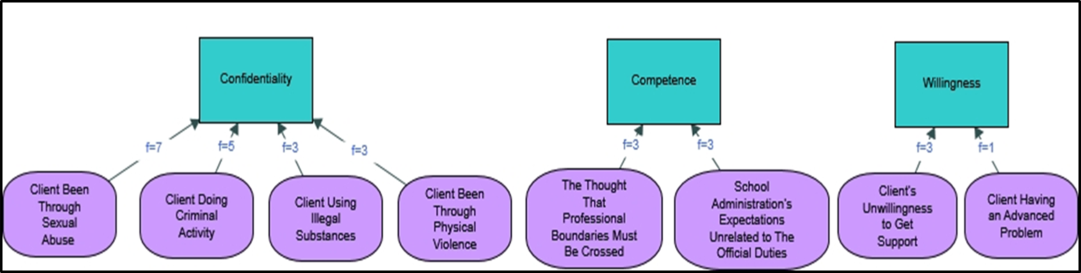
As seen in Figure 3, eight different codes were determined based on the responses of the participants, and these codes were classified into three different themes. Explanations of some of these codes and themes are presented below.
Codes and themes created in accordance with the answers to the question ‘In what kind of situations do you face ethical dilemmas in the school counselling profession?’ (Question 3).

Some of the responses of the participants to the question ‘In what kind of situations do you face ethical dilemmas in the school counselling profession?’ (Question 3) became prominent. Some participants answered this question with the expression of Client been through sexual abuse (f = 7), Client doing criminal activity (f = 5), Client using illegal substances (f = 3) and Client been through physical violence (f = 3). As these statements were considered to have been causes of dilemmas among school counsellors as they included information regarding events and phenomena that should be confidential, they were put under the theme of Confidentially (f = 18). Examples of the direct statements of the participants for each of the aforementioned themes are given below:
Client has been through sexual abuse: ‘In cases such as sexual abuse, when the counsellor does not want the family to hear the event.’ (F4)
Client doing criminal activity: ‘When there are criminal situations, where the information provided by the client is legally required.’ (M4)
Client using illegal substances: ‘If the consultant provides information about substance use during the consultation process and the necessary practices are needed.’ (M3)
Client has been through physical violence: ‘In cases where the client is subjected to violence’ (F5)
The thought that professional boundaries must be crossed: ‘In cases where I think professional boundaries should be violated.’ (F3)
School administration’s expectations unrelated to the official duties: ‘Whether or not to intervene in individuals with problematic behaviors that are not within my duty area.’ (M2)
Client’s unwillingness to get support: ‘In cases when a client, who was persuaded to get counselling by a teacher or administration decides to discontinue the counselling.’ (M5)
Client having an advanced problem: ‘Providing voluntary participation in the counselling process when working with students with advanced problems.’ (F2)
What Are Your Ways of Overcoming the Ethical Dilemmas You Face?
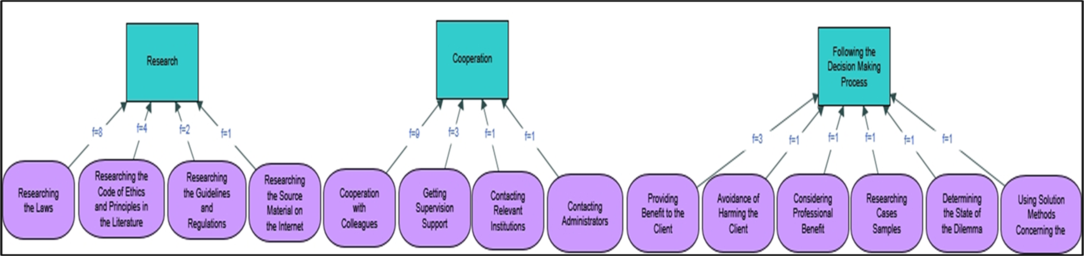
As seen in Figure 4, 14 different codes were determined based on the responses given by the participants. It was understood that these codes could be placed under three different themes. Explanations of some of these codes and themes are presented below.
Codes and themes created in accordance with the answers to the question ‘What are your ways of overcoming the ethical dilemmas you face?’ (Question 4).

Some of the responses of the participants to the question ‘What are your ways of overcoming the ethical dilemmas you face?’ (Question 4) became prominent. Some participants answered this question with the expressions of Researching the laws (f = 8), Researching the Code of Ethics and Principles in the literature (f = 4), Researching the guidelines and regulations (f = 2), and Researching the source material on the internet (f = 1). These expressions were placed under the theme of Research (f = 15) as they referred to the process of obtaining information from different sources towards solutions to the dilemma situations that are encountered. Examples of the direct statements of the participants for each of the aforementioned codes are given below:
Researching the laws: ‘If the reason for my dilemma is related to the legal framework, I examine the law that I have to abide by it.’ (M4)
Researching the Code of Ethics and Principles in the literature: ‘When I encounter a problem, I review my professional ethics and associate it with the problem.’ (F3)
Researching the Guidelines and Regulations: ‘I review the legislation on my professional boundaries and responsibilities and try to eliminate the dilemma.’ (M2)
Researching the source material on the internet: ‘I do research on the internet.’ (F2)
Cooperation with colleagues: ‘In particular, I consult my colleagues who I think are more competent than me.’ (F4)
Getting supervision support: ‘I gain experience by receiving supervision support from more competent people.’ (F7)
Contacting relevant institutions: ‘I consult the relevant institutions that I trust in their professional knowledge.’ (M1)
Contacting administrators: ‘In cases where legal responsibility is required, I try to give direction to my supervisors by giving information to them and conducting joint works with them.’ (F8)
Providing benefit to the client: ‘Considering the client’s benefit, I make a client-focused decision.’ (F1)
Avoidance of harming the client: ‘I try to find the most appropriate solution and implement practices that do not harm the client.’ (F 3)
Considering professional benefit: ‘I take steps that take priority for the benefit of my profession.’ (F 3)
Researching case samples: ‘I research examples of cases on the related subject.’ (F 5)
Determining the state of the dilemma: ‘I try to reach a conclusion by identifying the situations that cause a dilemma in detail.’ (M1)
Using solution methods concerning the dilemma: ‘I try to clarify my decision by identifying adequate and inadequate aspects of the methods used in overcoming ethical dilemmas, reviewing the current situation, and evaluating the process.’ (M5)
Do You Receive Assistance in Overcoming Your Ethical Dilemmas?
Three different codes were determined based on the responses of the participants to the question ‘Do you receive assistance in overcoming your ethical dilemmas?’ (Question 5). Participants responded to this question as Yes (f = 13), which indicated they received assistance in overcoming the ethical dilemmas they experienced, some responded as Partially (f = 2), indicating that they sometimes received assistance, and one other responded as No (f = 1), stating that they did not receive assistance. Therefore, it was understood that most of the school counsellors received assistance in overcoming the ethical dilemma situations they encountered. Below are examples of the direct statements of the participants for each of these codes:
Yes: ‘I get support because I trust my experienced colleagues’ solution recommendations and care about their ideas.’ (F6)
Partially: ‘From time to time I exchange views with experienced lecturers and colleagues.’ (M5)
No: ‘I do not receive any support regarding the ethical dilemmas I face.’ (F11)
If You Do, from Where and Whom Do You Receive Assistance?
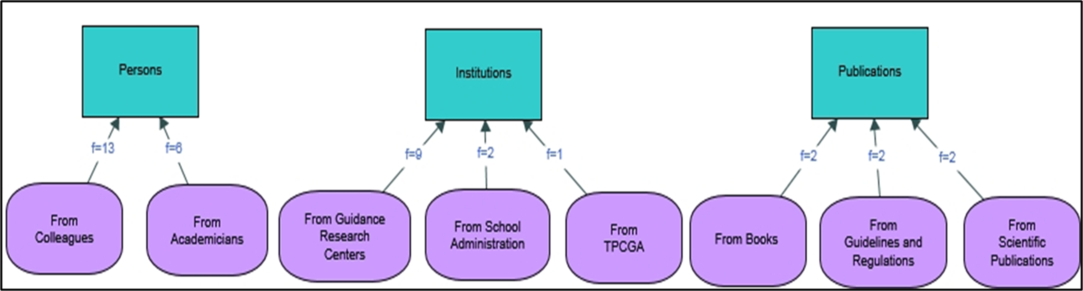
As seen in Figure 5, eight different codes were determined based on the responses of the participants. It was understood that these codes could be included under three different themes. Explanations of some of these codes and themes are presented below.
Codes and themes created in accordance with the answers to the question ‘If you do, from where and whom do you receive assistance?’ (Question 5.1).

Some of the responses of the participants to the question ‘If you do, from where and whom do you receive assistance?’ (Question 5.1) became prominent. Some participants responded to this question as From colleagues (f = 13) and From academics (f = 6). As these expressions covered individuals in the process of receiving assistance in cases of experiencing ethical dilemmas, they were put under the theme of Persons (f = 19). Examples of the direct statements from participants for each of the codes are given below:
From colleagues: ‘I get support from school counsellors at schools.’ (F6)
From academics: ‘I consult with the professors at the university.’ (M2)
From guidance research centres: ‘I get help from consultants at guidance research centres, who I think are experienced.’ (M2)
From school administration: ‘I exchange information with the school administration on relevant issues.’ (F8)
From TPCGA: ‘I apply to TPCGA.’ (F4)
From books: ‘I use professional books.’ (F1)
From guidelines and regulations: ‘I refer to the contents of the legislation.’ (M3)
From scientific publications: ‘I review research and articles on ethical dilemmas.’ (F3)
What Kind of Assistance Would You Like to Receive?
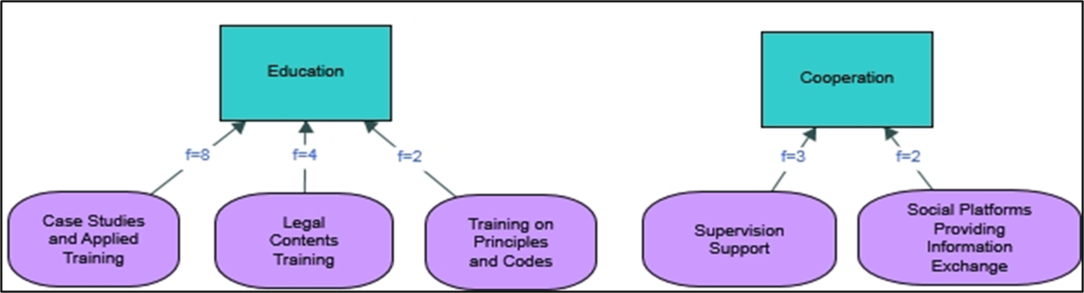
As seen in Figure 6, five different codes were determined based on the responses of the participants. It was understood that these codes could be included under two different themes. Explanations of some of these codes and themes are presented below.
Codes and themes created in accordance with the answers to the question ‘What Kind of assistance would you like to receive?’ (Question 5.2).

Some of the responses of the participants to the question ‘What kind of assistance would you like to receive?’ (Question 5.2) became prominent. Some of the participants responded to this question as: Case studies and applied training (f = 8), Legal content training (f = 4) and Training on principles and codes (f = 2). These statements were put under the theme of Education (f = 14) because they are related to the fact that the school counsellors want to receive knowledge and skill-related training to overcome their ethical dilemma situations. Below are examples of the direct statements of the participants for each of the codes:
Case studies and applied training: ‘I would like to receive practical training concerning the process and stages of decision-making about ethical dilemmas.’ (M5)
Legal content training: ‘Professionally presented support training about professional law would be very useful.’ (F10)
Training on principles and codes: ‘It would be useful to be informed by experts on topics determined by TPCGA.’ (F8)
Supervision support: ‘It is necessary to benefit from the experience of experts with the support of supervision.’ (F11)
Social platforms providing information exchange: ‘I would like to get support through the establishment of a platform on which to exchange information with experts on dilemmas by establishing a national internet network on ethical dilemmas.’ (M1)
Discussion and Conclusions
According to the results obtained from the study, the information that school counsellors have about the ethics of school counselling could be listed from the most to the least as Competence, Confidentiality, Sensitivity, Respect for Personal and Cultural Differences, Commitment to Ethical Standards, Responsibility, Honesty and Willingness. The information that school counsellors have about the legal aspects of school counselling may be listed from the most to the least as Professional Duties and Responsibilities, and Ethical Dilemmas. However, the participating school counsellors mostly perceived themselves as Inadequate about the professional ethics and legal dimension of school counselling. There are various studies in the related literature about this topic. İkiz, Sensoy, Balkan, and Akıman (Reference İkiz, Sensoy, Balkan and Akıman2017a) found that the opinions of school counsellors regarding the rules of professional ethics were related to confidentiality, sensitivity and tolerance, competence, honesty, and professional and scientific responsibility. As a result of the interviews conducted by İkiz, Sevinç, Kaval, Yeğintürk, and Kalen (2017), it was concluded that school counsellors expressed the ethical principles that should be obeyed as protecting confidentiality, accepting unconditionally, acting competently, equality, sensitivity to culture and monitoring legal processes. Lawrence and Kurpius (Reference Lawrence and Kurpius2000) determined that school counsellors faced ethical problems in terms of professional competence, confidentiality, informed consent, and child abuse. In the report prepared by Hubert and Freeman (Reference Hubert and Freeman2004), the activities of the ACA Ethics Committee between 2002 and 2003 were summarised. It was found that the complaints were in the form of relations with the client, confidentiality, professional responsibility, relations with colleagues, evaluation procedures, supervision, and research activities. In the research of Sensoy and İkiz (Reference Sensoy and İkiz2019), the authors examined the work done on this topic between 2008 and 2018 in Turkey and in other countries, and school counsellors were found to have the most ethical issues about confidentiality, professional role confusion, and school staff and parents. In a study conducted by Erdur-Baker and Çetinkaya (Reference Erdur-Baker, Çetinkaya, Özyürek, Owen and Owen2007), it was determined that school counsellors experienced ethical problems in terms of confidentiality, volunteering, and professional competence and expertise in the field. Davis and Mickelson (Reference Davis and Mickelson1994) found that consultants had more knowledge about professional ethical principles than the legal dimension of the profession. Likewise, İkiz, Sevinc et al. (2017) found that the majority of school counsellors who participated in the study were not adequately knowledgeable about legal processes related to the ethical problems they face. In interviews conducted by Dağlı (Reference Dağlı2014), school counsellors stated that they lacked information about the legal framework of their profession. Mullen, Lambie, Griffith, and Sherrell (Reference Mullen, Lambie, Griffith and Sherrell2016) and Mullen, Lambie, and Conley (Reference Mullen, Lambie and Conley2014) demonstrated that school counsellors perceived themselves as adequate in terms of professional ethics and legal issues. Therefore, the results of this study were similar to those in the literature, but there were also some differences. According to the results obtained from the study, the school counsellors’ knowledge and the issues with which they had problems overlapped. Therefore, it may be stated that school counsellors had an awareness about which issues they had problems with, and they did not find themselves sufficient about these. This result may be interpreted in the context of undergraduate education in which school counsellors are trained. Lambie, Hagedorn, and Ieva (Reference Lambie, Hagedorn and Ieva2010) found that the courses on professional ethics and legal issues contribute significantly to school counsellors’ knowledge levels. Moreover, Erdur-Baker and Çetinkaya (Reference Erdur-Baker, Çetinkaya, Özyürek, Owen and Owen2007) concluded that the knowledge and skills that school counsellors acquire as a result of their education at the university are not sufficient to solve the problems they face while practising their professions. Based on the difference between the two studies mentioned, it may be seen that school counsellors can reach a sufficient level in terms of theoretical knowledge, yet there are some deficiencies in practice. The Faculty of Education Teacher Training Undergraduate Programs were updated by the Council of Higher Education (CHE; 2018). In the Guidance and Psychological Counselling Undergraduate Program’s curriculum, which was also updated, the ‘Professional Ethics and Legal Issues’ course is theoretical and for 2 hours. The subject of the course includes ethical principles and general practice standards in the field of Psychological Counselling and Guidance, decision making in accordance with professional ethics, the rights and responsibilities of the counsellor, and legal problems. Adding practical content to the theory of this course would make it more useful. This way, school counsellors would be able to develop their skills as well as their knowledge.
In the study, it was found that the school counsellors experienced ethical dilemmas in terms of Confidentiality, Competence, and Willingness in the counselling profession. Bodenhorn’s (Reference Bodenhorn2006) study with school counsellors from 92 state schools in Virginia revealed that the most common ethical dilemmas were the confidentiality of the student’s information, the ability to harm the individual or someone else, parental rights, and multiple relationships with the institution. The research conducted by Lazovsky (Reference Lazovsky2008) with 195 school counsellors concluded that counsellors experienced various dilemmas regarding confidentiality, and these dilemmas were related to dangerous behaviours and situations, illegal behaviours, and personal and family information. As a result of the interviews carried out by Kolay Akfert (Reference Kolay Akfert2012) with 40 school counsellors, it was determined that university employees experienced dilemmas about teaching environments, school employees about volunteering, and employees in private counselling centres about wage setting. It was also determined that employees at these institutions experienced ethical dilemmas regarding confidentiality, multiple relationships, competence, and value transfer. Brown et al. (Reference Brown, Armstrong, Bore and Simpson2017) found that the most common ethical dilemmas experienced by school counsellors were confidentiality, student safety, parental rights, and social media. In other studies, the most commonly experienced dilemmas were confidentiality (Mendes et al., Reference Mendes, Nascimento, Abreu-Lima and Almeida2016; Tarvydas & Barros-Bailey, Reference Tarvydas and Barros-Bailey2010), confidentiality and competence (Hartley & Cartwright, Reference Hartley and Cartwright2016, İkiz, Sensoy et al., 2017) and confidentiality, volunteerism, and competence (Camadan, Reference Camadan2018; Yam, Reference Yam2017). Therefore, it may be stated that the results of this study overlapped with the results of other studies on the subject. Additionally, it was understood that the results of the previous research were consistent with the results of this study, which found that counsellors encountered problems related to professional ethics and legal issues in situations related to confidentiality, competence, and volunteering, and as they considered they were inadequate in overcoming these issues, it may be stated that the issues turned into dilemmas. In a study conducted by Kolay Akfert (Reference Kolay Akfert2012), it was concluded that school counsellors face an ethical dilemma when they encounter a problem related to ethics during their first term when they do not know what the legal procedures are. It would be beneficial to consider the problems that school counsellors experience and how undergraduate and in-service training programs may be enriched with courses on professional ethics and legal issues in line with the comments made in previous findings in terms of quantity and quality. This way, school counsellors will be able to choose from the alternatives that they think have ethically logical and acceptable aspects. Moreover, the fact that school counsellors had similar ethical dilemmas as the findings of previous studies may be interpreted as this being a problem that needs to be overcome and suggests that professional principles and laws should be reviewed. Indeed, as Corey (Reference Corey2005) put it, ethical principles should be open to change over time and with changing conditions; otherwise, they may not show the best path to take in new situations. In this respect, there is a need for implementation of mental health law, regulations and directives in Turkey. Furthermore, it would be useful to update the Code of Ethics for Employees in Psychological Counselling and Guidance prepared by the TPCGA (2011), to consider the current conditions and needs, universal criteria, and cultural elements. This way, the complex situations school counsellors find themselves in may be overcome without them turning into an ethical dilemma in the light of law and professional principles.
According to another finding of the study, the ways school counsellors overcame ethical dilemmas were to conduct research, to cooperate, and to follow the decision-making process. In a study by Kolay Akfert (Reference Kolay Akfert2012), interviews were conducted with school counsellors, and in response to the question about what they do when they encounter ethical dilemmas, they replied with: taking into account the ethical rules, seeking help, involving the client, making personal inquiries, trying to stay in the legal process or informing management and teachers about the ethical rules of school counselling. Erdur-Barker and Çetinkaya (Reference Erdur-Baker, Çetinkaya, Özyürek, Owen and Owen2007), as a result of their research to overcome the ethical problems experienced by school counsellors, stated that the following would be useful: providing comprehensive information and cooperation with school management and other teachers about school counselling services, training of prospective school counsellors about the problems and solutions they will encounter at school during university education, and providing both theoretical and practical training on ethical decision-making processes. Similarly, İkiz, Sevinc et al. (2017) stated that it is important that school counsellors and managers should receive training in dealing with ethical principles and ethical problems in order for school counsellors to cope effectively with ethical problems. Additionally, Bodenhorn (Reference Bodenhorn2006) emphasised the necessity and importance of cooperation among administrators, teachers and school counsellors working at universities and schools. When the results of the results obtained from this study are evaluated, it is understood that it would be appropriate to enrich school counsellors in terms of knowledge and skills, and strengthen their relations with other stakeholders and increase cooperation.
School counselling is a process that is based on theories, principles, and methods. This process is carefully structured by the school counsellor and operated over this structure. However, sometimes unplanned situations or situations require the counsellor to make a decision that contradicts ethical principles, and ethical dilemmas may arise. In this context, an ethical dilemma is an obstacle to be overcome and a problem to be solved. Failure to make accurate and effective decisions for the solution of a problem negatively affects the objectives expected from the psychological counselling process (Camadan, Reference Camadan and Ekiz2020). An ethical dilemma, which is considered to be the debatable truths of an issue and the difficulties encountered when these truths contradict each other, refers to the indecision that occurs in the solution of any situation (Kutlu, Reference Kutlu2008). Craven and Hirnle (Reference Craven, Hirnle and Henshaw1996) explained an ethical dilemma as the situation that occurs when there are two or more options and there is a difficulty in deciding which option is better. The decision-making process that could be followed in such cases of ethical dilemma is expressed as taking on the phenomenon with its different aspects against situations involving conflict, assessment of it, noticing one’s options, determination of the decision to be implemented as a result of these options, and assessment of its effects (Korkut, Reference Korkut2014).
Ethical dilemmas may be experienced in various professional activities. In addition to this, in many groups of professions, various decision-making processes and models have been developed in relation to the solution of ethical dilemmas that are experienced. For example, in the model developed by Hill, Glaser, and Harden (Reference Hill, Glaser and Harden1998) in the field of psychotherapy, it was assumed that factors such as gender, race, class and sexual preferences may affect ethical dilemmas in different ways. Swancy (Reference Swancy2019) proposed a decision-making model that could be applied by psychologists regarding ethical dilemmas encountered in therapies carried out with patients diagnosed with leukemia who want to start a pregnancy before starting cancer treatment. In studies conducted in the field of education, Cranston, Ehrich, and Kimber (Reference Cranston, Ehrich and Kimber2003) emphasised that school administrators may experience ethical dilemmas in issues such as administrative processes, competition, interests of the institution, and responsibility of accountability. They proposed an ethical decision-making model regarding the solution of these ethical dilemmas. In their study, Green and Walker (Reference Green and Walker2009) determined that educators have a model of ethical decision-making that they follow in cases of ethical dilemmas. Úriz, Idareta, Viscarret, and Ballestero (Reference Úriz, Idareta, Viscarret and Ballestero2017) presented the decision-making processes in ethical dilemmas that are encountered in the field of social work. Mallari and Tariman (Reference Mallari and Tariman2016) examined the processes that need to be followed in ethical dilemmas experienced by nurses. Gunz and Gunz (Reference Gunz and Gunz2008) examined approaches that were developed on how the ethical dilemmas experienced by employed lawyers could be overcome. Loe, Ferrell, and Mansfield (Reference Loe, Ferrell and Mansfield2000) revealed the ethical dilemmas and decision-making processes followed in business. These studies have shown that employees may experience ethical dilemmas in several fields, such as psychotherapy, education, social work, law, and business.
In overcoming situations of ethical dilemmas, it is believed to be important to follow decision-making models for school counselling as with other occupational groups. It is also important to follow decision-making processes to overcome ethical dilemmas. Brown et al. (Reference Brown, Armstrong, Bore and Simpson2017) stated that due to the difficult, complex and uncertain nature of ethical issues, school counsellors may have difficulty in coping with this problem and that it is useful to follow ethical decision-making processes. It was also stated that decision-making processes could prevent ethical dilemmas from turning into ethical violations (Korkut, Reference Korkut2014). Several models have been proposed for how school counsellors may make decisions in cases of an ethical dilemma (Bond, Reference Bond2015; Corey, Corey, & Callanan, Reference Corey, Corey and Callanan2011, Cormier & Hackney, Reference Cormier and Hackney2013; Ergene, Reference Ergene2004; Forester-Miller & Davis, Reference Forester-Miller and Davis1996; Garcia, Cartwright, Winston, & Borzuchowska, Reference Garcia, Cartwright, Winston and Borzuchowska2003; Knapp & Vandecreek, Reference Knapp and Vandecreek2006; Luke, Goodrich, & Gilbride, Reference Luke, Goodrich and Gilbride2013; Welfel, Reference Welfel2006). The steps of the ethical decision-making model, which was created by Gümüş and Eren Gümüş (Reference Gümüş and Eren Gümüş2013), are as follows: (1) identify the problem that requires ethical decision making and identify the parties involved; (2) identify the central problems of an ethical dilemma and the options that can be applied; (3) refer to professional ethical standards, principles, relevant legal regulations, peer review and literature; (4) involve the client in the decision-making process and identifying the desired outcomes; (5) develop solution options that will form the potential action and evaluate each option; (6) think carefully and decide on the direction of action; (7) plan the action, inform the appropriate people and implement the plan carefully. Following the decision-making process of this model or other models in the relevant literature will help school counsellors to overcome their ethical dilemma situation.
According to another result of the study, the school counsellors mostly received assistance for overcoming the ethical dilemmas they experienced from colleagues and academics, institutions (e.g., guidance research centres, school administrations and the TPCGA). and publications (e.g., books, manuals and regulations, scientific publications), in that order. In a study conducted by Yam (Reference Yam2017), it was concluded that school counsellors received more support from their colleagues, as well as from related publications and experts in overcoming ethical dilemmas. İkiz, Sevinc et al. (Reference İkiz, Sevinç, Kaval, Yeğintürk and Kalen2017b) concluded that school counsellors first received support from their colleagues, then regulations, school administration, the internet, and books, and some acted based on their conscience. In a study, Güngör (Reference Güngör2010) found that school counsellors received support from their colleagues and then from academics in cases of ethical dilemmas. İkiz, Sensoy et al. (2017) observed that school counsellors received support from supervision groups, colleagues, written sources, attorneys and prosecutors, institution managers, and police in cases where they experienced ethical dilemmas. In another study, McLennan, Ryan, and Randall (Reference McLennan, Ryan and Randall2018) determined that school counsellors prefer personal judgments and to discuss isses with colleagues and managers rather than consider ethical codes in overcoming ethical dilemmas. Hinkeldey and Spokane (Reference Hinkeldey and Spokane1985) found that school counsellors did not trust the legal system when deciding what to do in an ethical dilemma. The results of this study and other studies find it would be appropriate to support school counsellors systematically and professionally in overcoming the dilemmas they encounter. Within the framework of a preventive approach, it is possible for the ethical problems experienced by school counsellors to be solved without them growing, thanks to continuous and expert assistance. In this regard, Crespi and Dupe (Reference Crespi and Dube2006) emphasised that supervision-based audits at schools will contribute to the solution of problems related to professional ethics and legal issues. Similarly, Taşdan and Yalçın (Reference Taşdan and Yalçın2007) stated that although there are ethical principles established for school counselling in Turkey, there is no mechanism for controlling and supervising unethical situations, and this mechanism needs to be established to provide qualified psychological help and prevent misapplications. Therefore, it is thought that effective results may be obtained through such consultations on the psychological principles and ethical issues of school counselling. It is considered that the success of these consultations will be possible with the cooperation of the Ministry of National Education, the universities, National Education Directorates, and TPCGA. The boards and commissions established with the representatives of the mentioned institutions may provide a support mechanism for school counsellors on ethical and legal issues. This way, school counsellors would have professional support to overcome ethical dilemmas.
Limitations and Recommendations
This study has some limitations. Since this study was designed based on a qualitative research approach, the comments on the results are limited to the sample. Also, the participants did not show gender homogeneity. Therefore, it was thought that commenting on gender based on research results would not be correct. Another limitation was that the participants consisted only of school counsellors working in a community. In future research, generalisations may be obtained by collecting data from different and larger samples. The data obtained from the research was limited to a semistructured interview form created by researchers. Mixed-method studies could also be done using various scales along with interview forms in further research.
The ethical dilemmas experienced by school counsellors may also be examined in terms of different variables (e.g., professional ethical behaviours, professional self-efficacy perception, problem-solving skills and decision-making skills). In light of the results obtained in this study, it would be beneficial to conduct studies aimed at counsellors and future counsellors — those who are already in the field and those still studying at universities — as well as helping them become more knowledgeable and skilful about codes of ethics and the law. In this context, panels and workshops may be organised in which academics, school counsellors and prospective school counsellors will participate and discuss case studies and solutions to ethical dilemmas. Moreover, with a multidisciplinary understanding, various educational activities may be organised by people who are experts in the field of school counselling and law.