Introduction
Notwithstanding the fact that outdoor relief remained the modus operandi of the New Poor Law throughout its existence, the workhouse still holds a firm grip on the historiographical and public imagination. Yet our understanding of how paupers experienced, thought about, and sought to navigate the workhouse and its symbols and symbolism is drawn precariously from a very limited empirical base. One important example of this is that we know virtually nothing about the material culture of the workhouse generally, and about workhouse clothing in particular. The predominant view of workhouse dress is almost entirely negative: it is routinely described as drab, ill-fitting, deliberately coarse or ‘rough’, and sometimes of poor quality or threadbare.Footnote 1 As a result of the fact that both readymade clothing and cloth for making up was generally bought in bulk and lacked embellishment it is often characterised as a ‘uniform’. Indeed, it is often explicitly described as such and from here it is only a short step to the conclusion that such clothing was inevitably depersonalising and humiliating and was an essential part of the deterrent function of the workhouse.Footnote 2 This view is neatly summarised in Clare Rose’s study of boys’ clothing in late Victorian England:
Workhouse clothing was provided for all inmates, even those only resident for a short time, and shared many characteristics with prison clothing. It was designed to comply with the ruling of ‘less eligibility’, which ensured that workhouse accommodation would not attract the idle poor. Its uniformity and loose cut made it easier to distribute and helped to de-individualise the wearer.Footnote 3
There is nothing new in this general view of the form and function of workhouse clothing. In her seminal study of the New Poor Law workhouse written almost forty years ago Anne Crowther had little to say about workhouse dress except that, on entering the institution, a ‘pauper’s clothes were taken away to be fumigated and kept for his day of release, while he was bathed and donned the shapeless workhouse clothing’.Footnote 4 Going back even further, the testimony of those who reminisced about workhouse life from first-hand experience appears to confirm the modern view of workhouse clothing’s punitive and disciplinary functions.Footnote 5 Richmond cites a number of first-hand accounts, including that of a blind tailor who told Henry Mayhew that ‘I dread the workhouse; for the workhouse coat is a slothful, degrading badge.’Footnote 6 Even Charlie Chaplain was unequivocal about it in his moving recollection of meeting his mother for the first time after they had become inmates: ‘How well I remember the poignant sadness of that first visiting day: the shock of seeing Mother enter the visiting-room garbed in workhouse clothes. How forlorn and embarrassed she looked!’Footnote 7
Yet can we really be sure without further evidence that the reminiscences and accounts of those who looked so regretfully on the ‘degrading badge’ of workhouse dress are entirely representative, or that they tell us the whole story of workhouse clothing? For one thing, as Rose makes clear, we have very little idea of the actual nature of workhouse clothing, either from the academic literature or from first-hand accounts. ‘[I]t is hard even to know what was worn’, she writes:
workhouse clothing (unlike workhouse food) was not centrally regulated: each Union ordered sets of clothing from the contractor who submitted the cheapest bid … There is little material evidence for workhouse garments, with only one known survival from the nineteenth century.Footnote 8
Whether or not she is correct about the absolute paucity of workhouse clothing that remains or that unions always sought the cheapest contractors (and both observations are contestable), it is certainly the case that no systematic work has been done on the nature, quality and substance of workhouse dress. Toplis gives the details of a single advertised tender for workhouse clothing from Droitwich Union, and Richmond points to the particulars of exemplary suits of clothing for men and women from the 1893 Royal Commission on the Aged Poor.Footnote 9 But other than these and a few passing references in the general literature, surprisingly little work has been done to suggest precisely what paupers could expect to be given when they entered the workhouse.Footnote 10 This failure to identify, quantify and assess the actual quality of clothing provision for workhouse paupers, alongside an uncritical reliance on negative references to it from contemporary coverage, has, we would argue, created the space for academics to construct precisely the kind of limited narrative we see reflected in the accounts above, one that relies on a singular image of workhouse dress as ‘uniform, drab and ill-fitting’.Footnote 11 The fact that we currently know so little about the material culture of paupers in the workhouse further perpetuates this negative and one-dimensional view of clothing.
Other potential problems with current narratives also exist. For example, a wholly negative view of clothing takes no account of the fact that the experience of workhouse paupers generally, and certain categories of paupers in particular, changed markedly between the passing of the 1834 Act and the end of the century. Again, this is something that remains seriously understudied, but we do know that a variety of factors, such as public campaigns for workhouse reform, the impact of workhouse visiting committees, variations in legal and official guidance and, from the 1880s, the influence of female guardians had a marked impact on the workhouse experiences of the elderly, the sick and the very young.Footnote 12 The nature, comfort, respectability and cleanliness of clothing was an important part of this changed experience, with female poor law guardians, for instance, seeking to exert control over union business by making a determined stand on the need to improve clothing for women and children as they came into the workhouse and when they left.Footnote 13
Moreover, it seems likely that workhouse clothing would have conveyed very different meanings depending on the perspectives of those who encountered it, whether paupers, poor law officials or interested observers. Even these were far from homogeneous groups, so the symbolic and practical meanings of workhouse clothing would inevitably have been conditioned by a wide range of variables within these broad categories. In particular, for paupers it is axiomatic that the clothing they were allocated meant very different things depending on their background and to which ‘class’ of the poor they belonged. One of the fundamental purposes of the New Poor Law workhouse was the practical classification of paupers into different groups which would, in theory, be treated in different ways according to their ‘deservingness’.Footnote 14 It is, therefore, more than likely that the different status of workhouse paupers influenced the clothing they were given, how they viewed that clothing, and their practical approach to it. For those whose workhouse sojourn represented the lowest point and a loss of solid social status – the so-called ‘shamefaced poor’ – it is easy to think that they would construct workhouse clothing as demeaning, shameful and dreadful. Those who came to the workhouse dressed in rags – a theme to which we return below – may have attached a rather different meaning to their clothing allowance.
Of equal importance is the issue of pauper agency.Footnote 15 When we look beyond the usual tropes of workhouse life it becomes clear that paupers were never entirely without influence, even those who were supposedly least able to exercise it. This requires us to look again at how they viewed workhouse clothing symbolically, as a means by which that agency could be expressed, and practically, as a way of enhancing their workhouse experience and even mitigating their own state of poverty. This article therefore aims to test some of the underlying assumptions that have led scholars (and many contemporaries) to view workhouse dress in such a negative and restricted way. We are less interested in questions such as how the quantity and character of clothing varied over time or within and between poor law unions and areas (something that would require a major funded study in its own right, even without turning to surviving material culture) and more focused on the meaning that paupers and officials attached to clothing, and on the practical and symbolic usages to which it was put by inmates of New Poor Law workhouses in England and Wales between 1834 and 1914.Footnote 16 The article takes a wide-ranging approach, arguing that we need to disentangle those meanings and usages carefully and apply a nuanced understanding to them within the full context of relief relationships and the lives of the poor.
We turn first to the intentions behind workhouse clothing policy and its application on the part of both the central poor law authorities (the Poor Law Commissioners in London, who oversaw the formulation and application of workhouse policy) and local poor law administrators (Boards of Guardians and workhouse officials).Footnote 17 The article explores whether the imposition of a workhouse ‘uniform’ was official policy, and whether it became the intentional or de facto policy of local Boards of Guardians. It also considers what the enforcement of workhouse dress actually meant in practice. We then move on to examine the treatment of workhouse clothing in the national and local press, arguing among other things that during periods of heightened debate about the administration of indoor relief it became symbolically important for those who advocated reform. Finally, the article examines in some detail the relationship between indoor paupers themselves and the clothing they were given. We conclude that, far from simply being a symbol of subjugation and humiliation, workhouse dress could be deployed strategically by paupers as a means of placing pressure on guardians and officials for better treatment and improved conditions, and that the clothing itself could also be appropriated against the wishes of the poor law authorities for its practical and material value. In the end, we conclude, the way that workhouse dress was viewed by both officials and paupers was far more complex and nuanced than has been suggested in the literature so far, and its practical and symbolic importance was much greater than has yet been allowed. The first question to be addressed is a deceptively straightforward one: was workhouse clothing a ‘uniform’, or was it not?
‘Clothing’, ‘dress’ or a ‘workhouse uniform’?
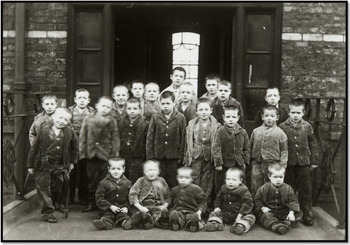
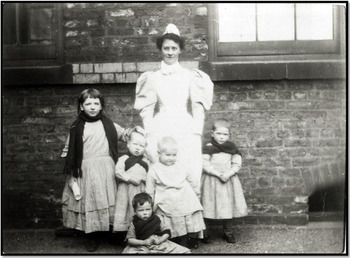
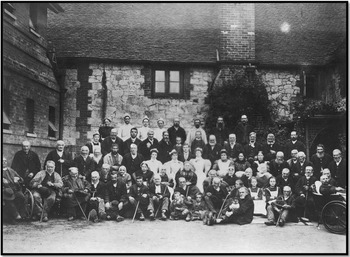
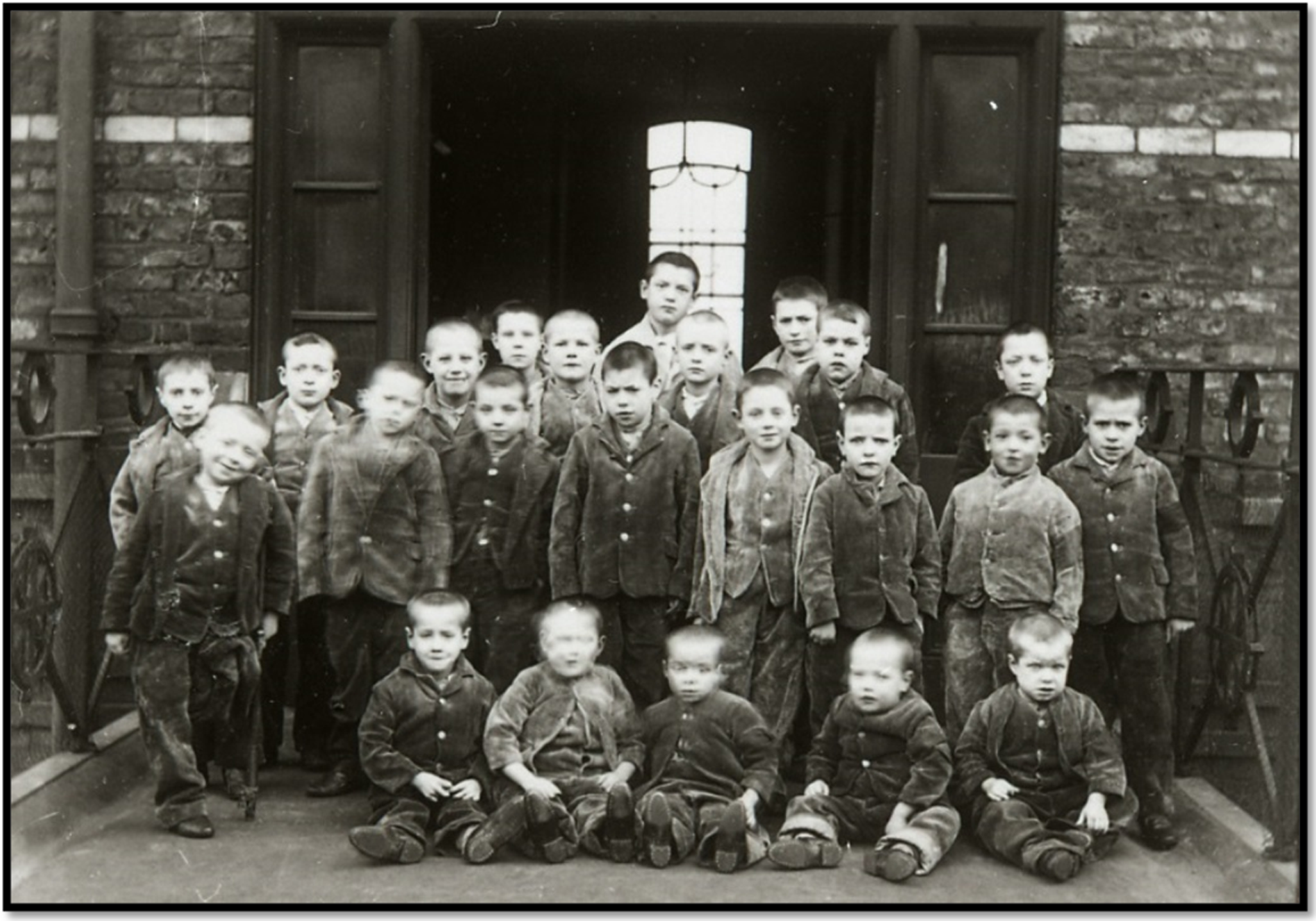
As we have seen, the idea that workhouse clothing amounted to a depersonalising and degrading uniform, either deliberately or by default, is a totemic part of the literature. Lynn Hollen Lees, in her important work on poor relief in the longue durée, notes that ‘[a]n ill-fitting, ugly uniform and a standard haircut began a process of homogenization that continued until they left the house.’ Others have used photographic evidence to emphasise a similar point. Felix Driver, for instance, describes the image that appears on the cover of his book as depicting pauper children outside Hitchen workhouse ‘wearing standard uniforms and caps, passive under the lens of the camera and the eyes of workhouse officers’.Footnote 18 The problem with photographic evidence is that, in isolation, it is open to a range of interpretations about staging and questions of representativeness. Vivienne Richmond, for example, notes of a photograph of Kent workhouse children in the 1870s that the state of their clothes is ‘shocking’, and that they were ‘badly torn, the trousers in particular, and stained’. Yet, Richmond’s comment is made in connection with the polemical observation that ‘[l]ike prisons and asylums, workhouses aimed at moral reform of the inmates’, and that, quoting a contemporary source, children were ‘roughly attired in rough clothes’.Footnote 19 However, it is undoubtedly the case that any number of other depictions of workhouse dress could be used to illustrate a very different perspective. Take, for example, the picture of boys from the Manchester Union workhouse at Crumpsall, which was taken in 1897 (Figure 1). All have similar suits of corduroy or moleskin. Some are, perhaps, a little large for the boys who wear them, and none appears to be brand new or pristine. They are, however, undoubtedly warm, made of hard-wearing stuff, and each boy has three pieces – jacket, waistcoat and long trousers – as well as strong, nailed boots. There is nothing in this photograph to suggest that their clothes were in a poor state of repair, or that they were not kept clean. Indeed, they were almost certainly of as good, if not better, quality than the clothes that would have been generally available to the children of the labouring poor of Manchester at the same time. A photograph of young girls and toddlers taken at the same time proves equally problematic (Figure 2). Again, there is something utilitarian about their outfits but, as far we can tell from the picture, the clothing was clean, hard-wearing, and in good repair. Moreover, there is sufficient subtle variation in the dress to question whether it was actually a ‘uniform’ in any functional way. This is important, because in many ways children were the most susceptible group of workhouse paupers to the imposition of uniforms.
Boys from the Crumpsall Workhouse, Manchester, 1897.
Source: GB124.DPA/2372/113, reproduced with kind permission of Greater Manchester County Record Office.
Girls from the Crumpsall Workhouse, Manchester, 1897.
Source: Manchester Libraries, Information and Archives, GB124.DPA/2372/25, reproduced with kind permission of Greater Manchester County Record Office.

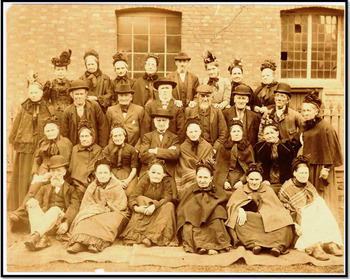
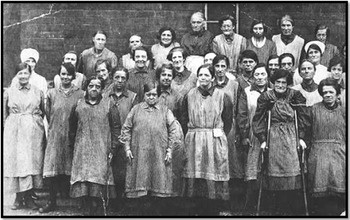
The contradictory nature of the visual evidence on workhouse dress continues throughout the pictorial record of workhouse inmates. As Figures 3–5 show, by the late nineteenth or early twentieth century it is possible to find evidence that suggests a roughly standardised uniform (such as that for women in Leeds workhouse) and equally striking pictures that convey little or no attempt by workhouse staff and guardians to impose uniforms. It seems likely, then, that there was a strong localism to the nature and character of workhouse clothing. It would be logical to conclude that such differences were related to local clothing standards for the marginal poor, but even this interpretation is complicated by evidence of radical differences in spending on clothing and its form between proximate unions, just as was the case for other aspects of relief practice.Footnote 20
Leicester Workhouse inmates, 1906.
Source: DE3736/Box 29 Swain Street, reproduced with kind permission of the Record Office for Leicestershire, Leicester and Rutland.

Leeds Workhouse residents late nineteenth or early twentieth century.
Source: The Leeds Teaching Hospitals NHS Trust, Department of Medical and Dental Illustration.

Bletchingley Workhouse, 1910.
Source: 7827/2/18/247, reproduced with kind permission of Surrey History Centre.

The difficulty with this kind of exercise is that, considered in isolation, without the sort of detailed contextualised study suggested in the introduction, such images lend themselves to virtually any interpretation that the viewer wishes to place on them – and, in particular, they can easily be used to support pre-existing narratives about the intentional imposition of a workhouse uniform (as a noun, with all its pejorative connotations) whereas, in reality, they may simply represent a degree of inevitable or de facto uniformity (adjectivally) in workhouse dress. This subjectivity of interpretation is also true of descriptions that can be found in contemporary popular culture. An anti-poor law ballad from 1837, for example, ironically observed that:
Of their uniform, too, you something shall hear,
In strong Fearnaught jackets the men do appear;
In coarse Grogram gowns the women do shine,
And a ninepenny cap – now won’t they be fine?Footnote 21
As the author no doubt appreciated, clothing like this was more than many labouring families in Lancashire at the time could aspire to. At the other end of the century, Walter Besant posed an equally ironic question to one of his characters, who was sliding dangerously close to poverty: ‘How beautiful you’ll look in the workhouse uniform, won’t you’, he wrote.Footnote 22 The consensus on the nature of the workhouse ‘uniform’ finds echoes in contemporary newspaper coverage. In an 1858 editorial on the New Poor Law workhouse, which set the tone in its opening sentence by stating that ‘In England, next to murder, the greatest of all crimes is poverty’, the London Evening Standard declared that:
A man may have paid rates for thirty or forty years to support others, and when he is no longer able to maintain himself, it is too bad that the miserable sustenance he receives should be at the expense of his personal liberty and his self-respect, which must be annihilated by his being forced to clothe himself in the hideous workhouse uniform.Footnote 23
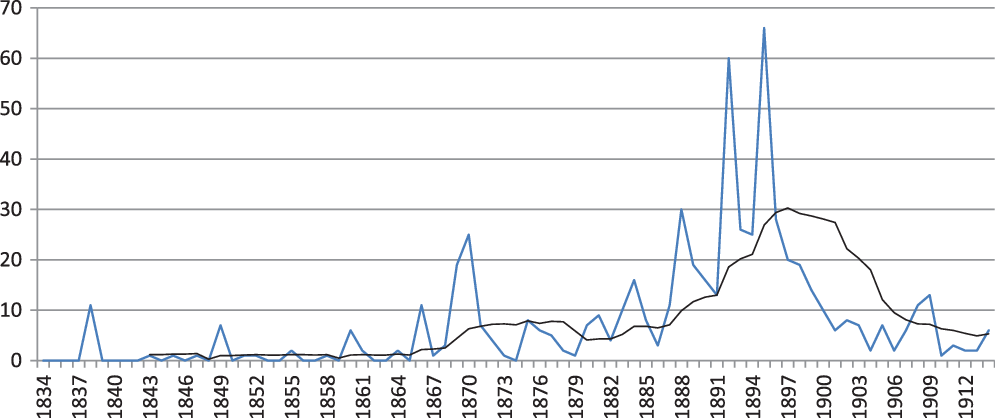
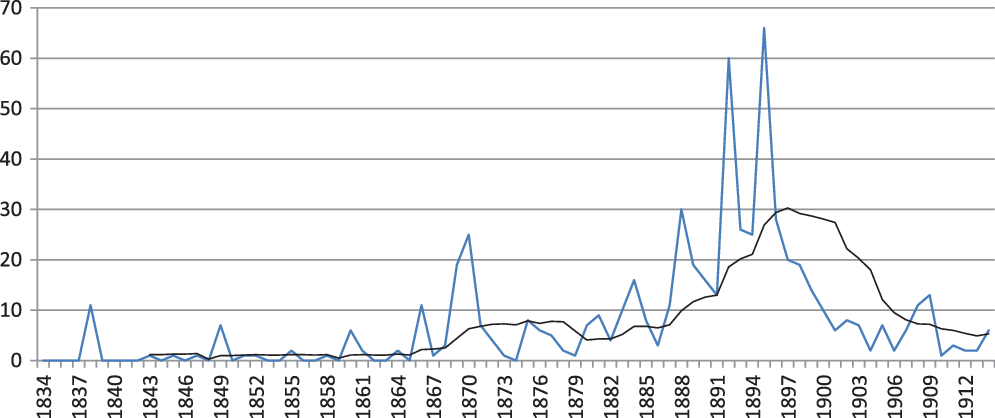
Yet, on further examination it transpires that references to an actual ‘workhouse uniform’ in the press are relatively rare. A search of the British Library’s online newspaper collection throws up 613 examples of this specific phrase in English titles between 1834 and 1914, whereas ‘workhouse dress’ occurs 940 times, and the phrases ‘workhouse clothing’ and ‘workhouse clothes’ combined appear 6,619 times (Figure 6).Footnote 24 Each of these descriptive terms could, and sometimes did, carry a note of disapprobation depending on the context within which it was used. But there appear to be subtle differences in the way that each was deployed in the press. As the examples above imply, the term ‘workhouse uniform’ tended to be reserved for the most direct and comprehensive criticisms of the clothing itself and of the workhouse system overall. It was often accompanied by other rhetorical markers such as ‘hideous’, ‘degrading’ and ‘cruel’. ‘Many of the abuses of Bumbledom have been swept away’, claimed the Bristol Mercury in 1892, ‘but the hideous and degrading uniform of the workhouse remains’.Footnote 25 The terms ‘workhouse dress’ and ‘workhouse clothing’ (or ‘clothes’), on the other hand, were more likely to be used dispassionately, or in less highly charged discussions of workhouse life. Statistically, these phrases were most likely to appear in straightforward reports of paupers who had absconded with, and sometimes sold, items of workhouse clothing, or who had been charged before magistrates with destroying their clothes within the workhouse itself (subjects to which we return in section three, below). This is borne out by a more detailed survey of nine newspapers from the British Library online collection where the phrases ‘workhouse dress’, ‘workhouse clothing’ and ‘workhouse clothes’ together occur on 506 occasions between 1834 and 1914.Footnote 26 Of these, 37 instances relate to paupers being charged with tearing or destroying their clothing, 224 occur in reports of paupers absconding with and/or selling their workhouse clothes, and a further 245 relate to other matters. Of these remaining instances, almost 70 per cent concern the appearance of prisoners brought before magistrates for matters unrelated to the stealing or destruction of their clothes and a further 16 per cent relate to tenders for workhouse provisions.
Frequency of the phrase ‘workhouse uniform’ in English and Welsh newspapers (1834–1914): yearly totals and 10 per. moving average.
Source: British Library newspapers online <https://www.britishnewspaperarchive.co.uk/> [accessed 3rd April 2020].
From this brief review it seems clear that the language used to describe the clothing allocated to workhouse paupers mattered to contemporaries – at least, to those who actively engaged with it in the public sphere – just as it does to modern commentators. Yet, it does seem to demonstrate a general lack of interest in workhouse clothing in the papers, except for those who wished to impress on the public a specific agenda. Reporters and correspondents who viewed clothing as emblematic of the punitive, degrading and dehumanising effect of workhouses were far more likely to describe it as a ‘uniform’ than those who discussed it in other contexts. It was a far from neutral subject, and the evidence from this kind of reportage, as well as from anecdotal and fictional accounts, bears out the truism that clothing was one of most obvious symbolic markers (after the imposing structure of the workhouse itself) of institutionalised welfare. It is hardly surprising, then, that those who were either against the workhouse system per se, or who were troubled by the way it was administered in specific institutions, settled upon the clothing of paupers as a way of highlighting what they viewed as its deficiencies. In particular, from the 1860s onwards the nature of workhouse dress took its place alongside other totemic issues in the drive for reform of the workhouse system overall, such as the fate of children and treatment of the sick poor.Footnote 27 Take, for example, the words of Frederick Greenwood from 1892. ‘No expedient can bring happiness into a workhouse’, he maintained:
but at very little cost, or even of none, much that painfully reminds its inmates of their fallen condition may be expelled from it. The sordid uniformity of the clothing in which these unfortunates move about, and the very meaning which seems to … mark them off from the nobler poverty that chooses to go free – no humiliation is felt more deeply than that.Footnote 28
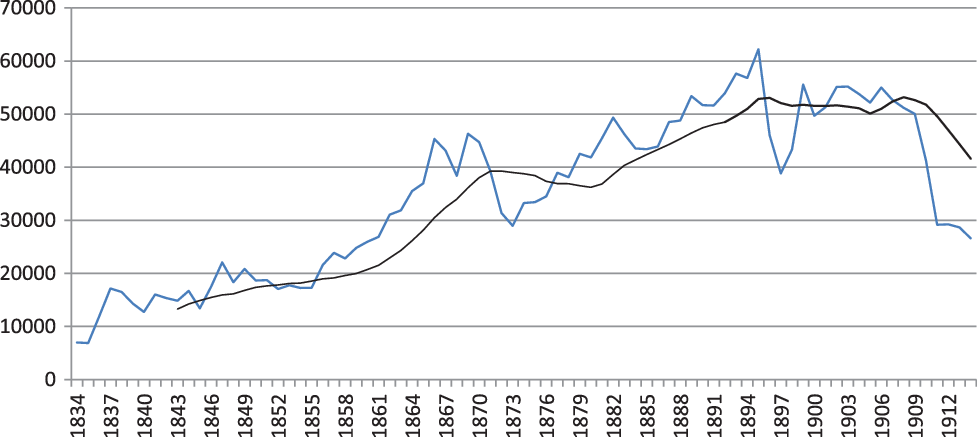
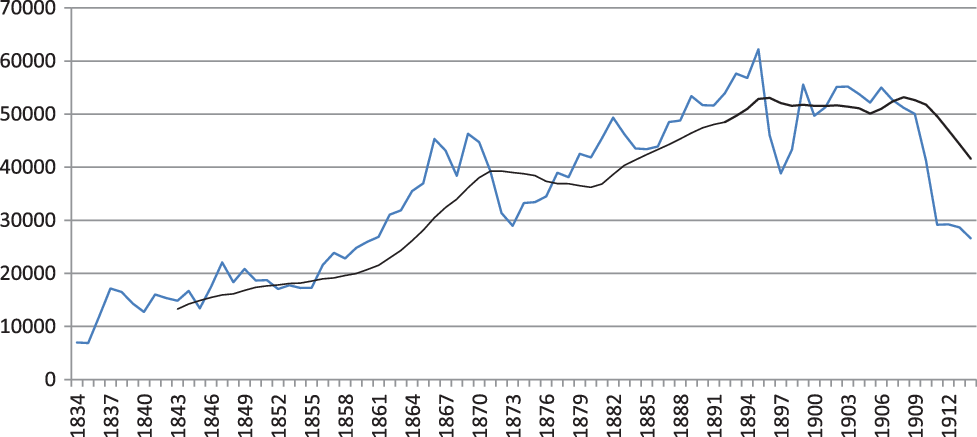
In fact, both the timing of Greenwood’s article, and the nature of its author, is highly relevant here. Greenwood was a well-known topical journalist, and he had a long and illustrious history of publishing sensational accounts of workhouse conditions. In the 1860s, he was the editor of the popular title, The Pall Mall Gazette, which, in 1865, featured a front-page editorial comparing workhouses unfavourably with gaols, almost certainly authored by Greenwood himself.Footnote 29 The following year, he commissioned his brother, James, to write one of the most famous pieces of popular journalism on the state of Victorian workhouses, a highly sensational first-person account of a night spent in the casual ward at Lambeth.Footnote 30 Frederick’s comments on the workhouse uniform, however, were written much later, in the 1890s. By this time, debates about the iniquities of a dualistic workhouse system, which was supposed both to punish the idle (through the deterrence of the workhouse test) and safeguard the interests of the ‘respectable’ poor, were reaching their climax, and one of the main battlegrounds was the meaning and uses of workhouse dress.Footnote 31 It comes as no surprise to find that the use of the far from neutral phrase, ‘workhouse uniform’, in the press appears to have increased dramatically in the last decades of the nineteenth century, that it spiked during times of particularly heated debate over the treatment of the ‘respectable poor’, and that it tailed off in the early years of the twentieth century, once many of the battles over the treatment of the ‘respectable poor’ had been won.Footnote 32 This pattern of use contrasts markedly with the more consistent increase, and less marked twentieth-century decline, in coverage of workhouse affairs more generally over the same period (Figure 7).
Frequency of the word ‘workhouse’ in English and Welsh newspaper coverage (1834–1914): yearly totals and 10 per. moving average.
Source: British Library newspapers <https://www.britishnewspaperarchive.co.uk/≥ [3rd April 2020].
With this in mind, it is important to note that the Poor Law Commissioners in London were careful never to describe workhouse clothing as a ‘uniform’, either in their annual reports or anywhere else in printed parliamentary papers. In fact, they explicitly stated early on under the New Poor Law that ‘The clothing to be worn by the paupers in the workhouse shall be made of such materials as [each] Board of Guardians may determine’, and that ‘clothing worn by the paupers need not be uniform either in colour or materials’.Footnote 33 This advice was re-emphasised in an 1869 manual of instructions to workhouse masters and matrons, and noted again by the Local Government Board in an advisory circular at the end of the century.Footnote 34 While it is true that ‘[w]orkhouse clothing might … be stamped with the name of the institution to prevent inmates from absconding or from selling their clothes’, the Commissioners also gave explicit directions that all clothing given to paupers ‘be properly numbered and marked on the inside with the name of the union’.Footnote 35 In 1869, it was further emphasised that ‘such mark or stamp shall not at any time be placed on any articles of wearing apparel so as to be publicly visible on the exterior of the same’, and that even the clothing given to vagrants (the group considered most likely to abscond with it) ‘should be marked so as to enable the … Master or Matron to identify them if necessary, but not by any word such as “vagrant”, which word being disgraceful in itself, its used would act as a punishment’.Footnote 36 It seems clear, then, that there was no intention by the central authorities that workhouse clothing should serve a deterrent or explicitly stigmatising function or that it should, in itself, play a part in the principle of less eligibility. This is important because, despite what we think we know about workhouse clothing from contemporary reportage and first-hand accounts, the evidence is that its symbolic functions cannot be said to have been significantly influenced, let alone directed, by those who were responsible for interpreting the law and overseeing its application. In fact, their advice pointed in the opposite direction, which suggests a very different approach, for example, to that of many charity schools in the eighteenth and nineteenth centuries who demanded that their students wear uniforms that were not only designed to identify the wearer as a recipient of patronage, but were often purposefully coarse and plain in order to teach the lessons of humility and gratitude.Footnote 37
The central poor law authorities had relatively little to say about the specific nature of the clothing that was to be given to the workhouse poor, leaving the final decisions about its quality, quantity and nature to local boards of guardians. But they were also surprisingly quiet on the subject of what functions it was meant to serve. In their instructions to guardians and officials, they made only brief references to the practice of clothing the indoor poor and to the responsibilities of the master and matron in this respect. The key directive on the subject stated that, on being admitted:
the pauper shall be thoroughly cleansed, and shall be clothed in a workhouse dress, and the clothes which he wore at the time of his admission shall be purified, and deposited in a place appropriated for that purpose … [and] restored to the pauper when he leaves the workhouse.Footnote 38
From this, there appears to be an implicit concern about the spreading of vermin and contagious disease; and this was confirmed when Matthew Talbot Baines, President of the Poor Law Board, responded to a question in parliament about the reasons behind the enforcement of compulsory workhouse dress. When asked ‘whether it was thought that any practical evil would arise from allowing persons entering a workhouse to wear their own dress’, Baines replied that:
from the very commencement of the amended Poor Law in 1834 it had been a rule that workhouse dress should be adopted … [and that] the rule now in force had been introduced on considerations suggested by the necessity of securing cleanliness.
He went on to emphasise that ‘by enforcing it, the cleanliness and health of the establishments had been very materially promoted’.Footnote 39 While this does not preclude other uses of enforced workhouse dress, it does accord very closely with contemporary thinking about the spread of ‘contagion’ and disease.Footnote 40 Indeed, as a way of controlling the spread of disease, it clearly transferred from the general workhouse to the specialist hospitals of the later nineteenth century. During the London smallpox epidemic of 1871, for example, the practice described above of exchanging and purifying patients’ clothing was specifically reported as one of the main precautions taken to ‘secure the immunity of the neighbourhood’.Footnote 41 Graham Mooney has demonstrated that the disinfection of domestic and institutional spaces (homes, yards, wards, etc.) was a common intervention by the time of the cholera epidemics of the 1840s and 1850s; but the possibility that clothing could also contribute to infection, as well as the spreading of ‘filth’ (vermin), seems to have been understood remarkably early on by those in control of the workhouse environment.Footnote 42
Yet, contagion control was not the only reason given for the enforcement of workhouse dress. Early in the new regime, the Poor Law Commissioners responded to a question about its value by a local guardian from Basford, in Nottinghamshire. In it, they stated that ‘[o]ne of the reasons for this practice is that on discharge from the workhouse the pauper may receive their own clothes back in the same state as when they entered’.Footnote 43 In other words, the enforcement of workhouse dress was a way of ensuring that a pauper’s clothing was preserved for future use and not degraded by the hard labour that they were required to undertake while in the workhouse. This particular function of workhouse dress was at the heart of a complaint made to the Board of Guardians at Launceston, Cornwall, in 1872. At a Board meeting in February of that year, a note was read out from two female paupers who had been left too long in the Receiving Ward and had, as a result, ‘been made to pick oakum in their own clothes’.Footnote 44 The error was found to be the Medical Officer’s, who had not notified the Master of the women’s admission, and he was reprimanded accordingly.
The fact that the Commissioners in London had essentially practical functions in mind when they advised on workhouse clothing, and that they did not envisage that it should have a symbolically punitive function, does not of course preclude the possibility that, having been given such license by the central authorities, Boards of Guardians themselves decided to impose uniforms on their indoor poor in order to create their own de facto deterrent. This is clearly a difficult proposition to test. There were, after all, around six hundred poor law unions for most of the period of the New Poor Law, and surprisingly few of these left significant traces in the archives to suggest how local workhouse policy on this matter was formulated and implemented.Footnote 45 If we turn our attention again to the press, however, there is little to suggest that guardians viewed workhouse clothing as a deterrent, either. In an editorial on the opening of a new casual ward at Ripon workhouse in 1874, the Knaresborough Post emphasised that a new pauper’s clothes ‘are removed to the disinfecting stove, which is heated to such a degree … as to destroy any vermin with which they may have become infested’, suggesting again the importance of contagion control.Footnote 46 At a meeting of the Leeds Board of Guardians in 1875, on the other hand, it was suggested that institutional clothing was necessary to prevent ‘any unkind feeling arising between the different classes in the workhouse – those who had private clothing and those who had not’.Footnote 47 Equally, there is very little evidence that it was viewed by guardians as a ‘uniform’, in the punitive sense. Of the more than six hundred tenders that have been identified in this study for the suppliers of workhouse clothing and/or the materials for making it up between 1834 and 1914, none uses the word ‘uniform’ to describe either the product itself or what it was to be used for. Instead, the standard formulation in such advertisements was for ‘suits’, ‘coats’, ‘waistcoats’, ‘trousers’, ‘gowns’, ‘dresses’, ‘stockings’ (or the materials to make them up): in short, exactly the kinds of items which were advertised by clothing stockists for the wider labouring public, and which had been given as relief in large quantities under the Old Poor Law.Footnote 48 One example from 1850 will suffice to illustrate the point, from Fordingbridge in Hampshire:
FORDINGBRIDGE UNION.
THE Board of Guardians of the above Union are desirous of receiving TENDERS for the supply by contract of the undermentioned ARTICLES, for the use of the Workhouse for the next quarter, from the 24th of Dec., 1850, to the 30th of March, 1851:
Men’s gray cloth coats, at per coat; ditto ditto waistcoats, each; ditto ditto breeches, at per pair; ditto ditto fustian and canvass trousers, at per pair; flannel, at per yard; dowlas, at per yard; strong calico, at per yard; linsey wolsey, at per yard; boy’s grey cloth jackets, each; ditto canvass trousers, at per pair; ditto fustian ditto, at per pair; men and boy’s strong hide leathern shoes, tipped and nailed, at per pair; women’s and girls’ ditto, at per pair; stout brown cotton sheets, at per pair; stout coloured cotton counterpaines, at per dozen; men’s and boys’ strong knit worsted stockings, at per pair; women’s and girls’ ditto.Footnote 49
Not only does this advert broadly mirror the example given by Toplis from Droitwich, dating from 1837, but the specific materials for which details are given (fustian, canvas, linsey-woolsey, calico, worsted) are very familiar from other sources relating to the everyday clothing that was available to, and widely used by, the labouring poor.Footnote 50
None of the above entirely confounds the view that workhouse clothing was intrinsically stigmatising or humiliating. Toplis, for example, believes that it was ‘the way they were used and depersonalized’ that made workhouse clothes contentious, especially when they ‘were used as a uniform might be’. Moreover, Richmond argues that even though ‘the regulations did not require the clothing to be a uniform … economies of scale meant that in practice it always was’.Footnote 51 In effect, then, although there is a recognition that the institutional poor were not necessarily required to wear a uniform as a mark of their degraded status or as a badge of shame, there is an historiographical assumption that this is precisely what workhouse clothing must have amounted to because Boards of Guardians and workhouse staff were not alive to the acute symbolism of clothing. Even here, there is contrary evidence. For the start of the New Poor Law period, the diary of Benjamin Woodcock (1836–8), the master of one of the Barnet union workhouses reveals much about clothing. He went to great pains to ensure that readymade clothing and cloth for making up was of good quality (not, it might be noted, value for money), sending material back to suppliers where he found it wanting. Like other workhouse masters, he removed the clothing of paupers who entered the house but where it was so ragged or infested with vermin, he had it burned, ensuring that at the termination of their residence those leaving were supplied with an outfit of clothes from workhouse stocks. This suggests that something other than a ‘uniform’ was in place. Moreover, Woodcock engaged regularly with questions of replacement clothing and thought carefully about who should get new outfits and who should be given clothes recycled within the workhouse itself. At no point did he mention a pauper uniform, and his close attention to questions of clothing suggests that he understood its symbolism very well indeed.Footnote 52 Thus, while it is inevitable that considerations of economy and practicality lent themselves to the standardisation of dress, this is a highly complex issue and we believe that such conclusions are both reductive and incomplete. As discussed earlier, they rest on long-standing assumptions about the nature of the workhouse experience that have yet to be fully tested and which tend to homogenise the experiences of what was in reality an incredibly diverse cross-section of Victorian society. They also rely on the testimony of those whose reasons for holding such views remain largely unexplored.Footnote 53 As a result, we would argue that they have resulted in interpretations of the uses and meaning of workhouse clothing for paupers that do not tell the whole story and which, on further investigation, may only tell a very small part of it. It is to these meanings and usages we turn in the next section.
The many meanings of workhouse clothing
At a conservative estimate, it is likely that anywhere between eight and fifteen million individuals were admitted as paupers to the workhouses of England and Wales between 1834 and 1900.Footnote 54 Every stage of life was abundantly represented in those admissions from cradle to grave, along with every possible reason for falling into poverty. Other work by the authors has focused on the inmate experiences of an out-of-work solicitor’s clerk, a printer and publisher of radical newspapers and pamphlets, the author of a number of popular books, a wealthy draper’s lunatic sister, a down-at-heel member of a prosperous Irish-Huguenot merchant family, and an elderly resident who had previously served as a parish officer for thirty-five years and who was, at one time, a workhouse master himself.Footnote 55 It could be argued that these individuals – those we might describe as the ‘shamefaced poor’Footnote 56 – are hardly representative of the workhouse population overall. But given how little we actually know of the make-up of workhouse populations under the New Poor Law, they might equally give us pause to consider what we mean by ‘representative’ in this context.Footnote 57 In particular, they raise significant questions about the ongoing tendency in the popular and academic literature to treat the attitudes, motivations and perspectives of that huge spectrum of humanity as homogeneous. Even though we are now beginning to disaggregate various cohorts of paupers for the purposes of academic inquiry, very little work has been done on the reasons why people ended up in the workhouse, the lives they led outside of it, or on their experiences while they were resident there, as we have already begun to observe.Footnote 58
For any, and perhaps for all, of the individuals mentioned above the notion of standardised workhouse dress may well have been abhorrent, just as it would have been for a large proportion of the so-called ‘respectable poor’ overall. But in a sense, if we accept, a priori, the assertion that very large numbers of the indoor poor did not want to be in the workhouse in the first place, it can be argued that this is both axiomatic and generally uninformative. Given the millions of life stories that lay behind the workhouse cohort in the nineteenth century it is surely far more interesting to investigate how paupers reacted – individually and collectively – to the reality of an institutional clothing spectrum. This is, essentially, a redeployment of Edward Thompson’s famous question in relation to the actions of food rioters in the eighteenth century:
being hungry, what do people do? How is their behaviour modified by custom, culture and reason? And (having granted that the primary stimulus of ‘distress’ is present) does their behaviour contribute towards any more complex, culturally-mediated function, which cannot be reduced…back to stimulus again?Footnote 59
Though not an exact fit, if we were to substitute ‘being poor’ for ‘being hungry’, and acknowledge that the great majority of inmates did not choose to be in the workhouse, then his plea to dig deeper into the meanings of things, and to pay attention to the nature of negotiation and resistance in all its forms, can lead us in some important new directions, even with regard to something as apparently straightforward as the ‘workhouse uniform’.
It is, of course, no easy task to access the thoughts and feelings of workhouse residents; but it is by no means impossible. Recent work on correspondence to and from the Poor Law Commissioners in London demonstrates that the indoor poor wrote regularly and in considerable numbers to complain about aspects of their treatment, and about the nature of workhouse regimes more generally.Footnote 60 In their list of complaints, issues surrounding clothes and clothing figure prominently, and they do so in some key and, perhaps, surprising ways. For example, in the correspondence sent by workhouse paupers to the Commissioners from twenty-four different unions between 1834 and 1871, not a single complaint can be found about having to wear workhouse dress or workhouse clothing, or about having to give up their own clothing on entering the institution.Footnote 61 On the contrary, and echoing the case of the two women detained in the Receiving Ward at Launceston, one complaint that does recur in the correspondence is that, on admission, paupers were not given workhouse clothing and were therefore forced to remain in their own clothes. For example, at Wrexham, Samuel Rowlands complained that ‘when a pauper comes in he must ware his hone shirt’ until he was given another at the caprice of the officers there, and it was also one of the complaints that led to an informal inquiry by the Chaplain at Pewsey workhouse (and subsequently to a report to The Times newspaper) in 1840. In evidence taken down from paupers, the Chaplain quite literally underlined the fact that Martha March wore ‘her own flannel petticoat and skirt for three & four months together … [and] her own stockings’ for four weeks, that Ann Andrews ‘wore her own flannel petticoat & stockings’ and that John Costar also wore ‘his own stockings [and] neither could he get a clean neck cloth’.Footnote 62 Even though the cleanliness and regularity of washing was the predominant concern, the Chaplain was keen to point out that paupers were forced to wear their own clothing in the workhouse against their wishes and against the regulations of the Commissioners.
Precisely the same complaints led thirteen able-bodied male paupers to sign a letter to the Commissioners from Basford workhouse, in 1844. A short time after this, a further letter was sent from seven of the signatories complaining that ‘out of 45 boys there is not above three that has any stockings from the house, and 2 or 3 wears their own’.Footnote 63 As with the evidence from Pewsey, however, it was the quantity of the clothing they were given, and the regularity with which it was washed, that was the main concern for these paupers. ‘Sir’, they asked, ‘how can you expect men to be clean when we have to go 11 weeks with one pair of sheets, 9 or 10 months with one pair of stockings, a fortnight or three weeks with the same shirt?’Footnote 64 Elsewhere, an anonymous correspondent from Bethnal Green claimed that ‘the old women [are] very scantily clothed’, and another lamented that the clothes given to paupers on entering ‘were very shabby, & unsuitable’, further alleging that the only way to get decent clothing was ‘to pay a premium to be decently rigged out’, suggesting that better quality clothing might be available in the grey economy of the workhouse for those who could afford it.Footnote 65 These kinds of issues, which crop up time and again in inmates’ complaints and in critical newspaper reportage of workhouse conditions, keyed into fundamental notions of ‘decency’ and the minimum standards of clothing and cleanliness that paupers expected to receive from the poor law authorities that King and Jones have suggested reached back to the Old Poor Law.Footnote 66 They were not only a practical and personal requirement for paupers; they were also an essential negotiating tool, benchmarks by which the officers and administrators of relief could be held to account. At Falmouth, for example, when the Board of Guardians was warned by a member of the Visiting Committee that some of the paupers were not getting sufficient changes of clothes, their immediate response was to replace the Matron (whose duties included overseeing the laundry and ordering new clothes) with another female officer.Footnote 67 In the case of the Basford letter writers, the investigator who was sent from London to look into their claims decided that, although the stockings were not changed as often as they should have been, the majority of the men’s complaints were spurious and concocted with the expectation that one of the guardians – ‘a Chartist Preacher’ – would be ‘a willing instrument in exciting a popular movement on their behalf’.Footnote 68 Whatever the reality of the situation, it is clear that ‘decent’, clean clothing was both a practical and a symbolic necessity for inmates, and that it was something that could be strategically deployed in discussions about their treatment by workhouse officials and guardians.
Reading letters of complaint and depositions such as these in isolation may lead to the conclusion that there were systemic deficiencies in the quality, quantity and cleanliness of clothing provision in many workhouses. But there are plenty of positive comments in Boards of Guardians’ minutes, paupers letters, inspectors’ reports for commissions of inquiry, and in the annual reports of the Poor Law Commissioners, to offset this view.Footnote 69 Much of this evidence suggests that, by-and-large, clothing provision for workhouse residents was at the very least adequate, and that it was often far better than that. At Boston, in Lincolnshire, for example, the workhouse minutes for 1837 record lists of clothing given to named paupers, including frocks, gowns, chemises, handkerchiefs and shirts, which strongly suggest that the authorities were responding to clothing need on a case-by-case basis, just as did Benjamin Woodcock in Barnet at exactly the same time.Footnote 70
At Bradford-on-Avon, also in 1837, the guardians sent the details of an informal inquiry to the Commissioners in London in which the actions and behaviour of Maria Kittlety, a pauper assistant to the Matron, were placed under scrutiny. Kittlety had a supervisory role in the workshop where much of the clothing was cut out and made up by inmates, but she was also responsible for allocating and washing pauper clothing. The depositions to this inquiry are particularly useful for the insights they give into the clothing provision. One pauper, Juliana Knott, stated that she had ‘a Garment given me a week after I came in’ along with a pair of stockings which she wore for a month, and that she had a clean shift every week and an apron which she took from the mangle room without the Master or Matron’s knowledge. Ann Little was clear that ‘I do not know of anyone in the house who has a greater number of clothes than others – 2 aprons 2 caps and 2 things of a sort except gowns’, suggesting that at least one complete change of clothes per pauper was the norm; and she also echoed Knott’s evidence, that ‘some of the women come into the mangle room and say “I haven’t got so and so, I have asked for it but I haven’t got it and will take it”’.Footnote 71 Her evidence suggests that paupers at Bradford were relatively well provisioned for clothing, both absolutely and relative to the labouring poor outside the workhouse;Footnote 72 but the fact that they were able to appropriate items informally also implies that at times they had relatively uncontrolled access to extra clothing.
Once again, however, the standard of care and general conditions in the workhouse were raised in discussions about clothing provision, albeit obliquely. Kittlety herself noted that the stockings often required mending and were not in as good condition as they should have been because ‘[t]he rats gnaw the stockings sheets &c … [they] gnaw them in the feet sometimes in the legs.’ She went on to claim that ‘I have seen 17 rats of a day in the workhouse’ and that ‘they come out of the drains … I have told Master and Misses about the rats gnawing the clothes and I have heard Mr Brooman [the Master] tell the gentlemen [of the Board of Guardians] a great many times’, but to no avail.Footnote 73 In this case, workhouse clothing – though apparently sufficient in itself – was a conduit through which other issues affecting the welfare of paupers could be raised for the attention of the guardians and the Commissioners in London. It is perhaps precisely for this reason that Benjamin Woodcock, even though he was overseeing the bringing together of all of Barnet union’s institutional provision into one single building at the time he was writing his diary, paid such close attention to the clothing needs of those who came into, resided in, and left the workhouse.
It is also clear, though, that when complaints were raised by paupers about matters of clothing and decency they were listened to and acted on by the Poor Law Commissioners if there was sufficient evidence. At Bethnal Green, for example, in response to the anonymous letter mentioned above, the Inspector noted that ‘I visited this workhouse yesterday and found that the stock of linen had been suffered to run so low that the mistress had been for some time unable to supply the requisite changes’. As a result, the guardians were immediately instructed to procure ‘500 men’s shirts, 600 womens shifts, 600 upper petticoats, 600 under petticoats, 300 Flannel jackets 150 suits of mens Clothes [and] 100 prs. of Blankets’.Footnote 74 Clearly, in the matter of clothing and personal cleanliness the Commissions in London were anxious to ensure that guardians and workhouse officials were held to account, sometimes as a result of the direct intervention of paupers themselves. At Wrexham, the complaints of paupers that they were not supplied with sufficient clothing was one of the reasons for the dismissal of the Master and Matron by the guardians in 1840, a decision later upheld by the Poor Law Commissioners.Footnote 75 There is no doubt, as King has also argued, that the vision of workhouses inmates as downtrodden, powerless and compliant requires re-examination.Footnote 76 Workhouse clothing is an excellent, if perhaps unexpected, lens through which to look again at these issues and to challenge some long-standing beliefs about the attitudes, agency and strategies of the institutional poor. From the examples given above it appears that, despite being subject to rules and regimes that were (in theory, at least) strictly enforced – and which, we may assume, the poor often submitted to only reluctantly – the nature, quality and cleanliness of workhouse clothing was one vehicle through which they could exert pressure on officials and on the Boards of Guardians who were responsible for their care.
However, there were other ways that paupers could exercise agency in the matter of workhouse clothing. In particular, they did so by destroying their clothing and by carrying it away with them unlawfully. These two infractions were a major preoccupation for Boards of Guardians and the Poor Law Commissioners alike. The marking of pauper clothing (which, as we have already noted, was directed to be done on the inside so as not to confer any stigma on the wearer) was explicitly aimed at discouraging its theft from the workhouse; but it is clear that this was only partially successful. As we saw above, between 1834 and 1914, absconding with and/or stealing or pawning clothes accounted for a little over 45 per cent of all mentions of workhouse clothing in nine local newspapers. Unsurprisingly, it also figured heavily in the minutes of Boards of Guardians’ meetings.Footnote 77 Paupers routinely took clothing, sometimes for pecuniary gain, but often because it was of considerably better quality than their own. James Porter, who complained of ill treatment at the hands of the Master of Rye workhouse in 1869, was compelled to admit that he had, in the past, absconded with workhouse clothes. When further questioned, Porter stated that he had done so only because his own clothes were not ‘fit to go out in’.Footnote 78 Henry Butts, one of the authors of the letter of complaint from Basford workhouse referred to above, was also forced to admit in his deposition that he had stolen clothes, in his case on many occasions. ‘I have been taken before the Justices ten times for running away with my clothing’, he wrote:
I have returned to the Basford Workhouse nearly naked after I have run away with the clothes. I have sold the clothes for money to buy food. It has been my practice to come into the Basford Workhouse for many years past to get clothed and then go out and come in again nearly naked.Footnote 79
For Butts, as for many destitute paupers, workhouse clothing was a valuable commodity, something which, in extremis, could even be converted into hard currency. So serious was the problem that unions expended considerable sums in tracking down and apprehending the culprits (£4 7s in the case of an absconder at Basford, and £3 1s 6d at Clutton in Somerset) and actively pursued second-hand dealers through the courts for receiving stolen clothes.Footnote 80 Even here, however, the picture of poor law attitudes towards clothing is complex. Benjamin Woodcock noted many instances of inmates walking off with workhouse clothing in the Barnet union, but there is very little evidence in his diary between 1836 and 1838 that he actively sought the apprehension or prosecution of such people. More commonly he reported or supported requests for inmates to be allowed to take union clothing out into the community when they left, or simply gave it to them having ordered the destruction of their original clothing on admission.Footnote 81
More generally, it was the actions of vagrants and ‘casuals’ in relation to their clothing that seems to have given officials – locally and nationally – the greatest headache. It was often noted in official papers, as well as being extensively reported in the press, that vagrants were wont to tear and destroy their own clothing on entering the workhouse, and this is borne out by the official figures.Footnote 82 In the Annual Judicial Statistics, collected uniformly between 1857 and 1892, only three specific offences against the poor law were recorded: Deserting or Neglecting to Support Family; Disorderly Conduct in the Workhouse; and Damaging Workhouse Clothing, Bedding &c.Footnote 83 The fact that destroying clothing was a specified offence for the purposes of central statistics demonstrates how prevalent it was, but also how seriously it was taken by the poor law authorities. As David Green has shown, the destruction of clothing was an intensely pragmatic form of refractory behaviour. As in the case of Henry Butts, above, vagrants and casual paupers understood perfectly well that the poor law authorities had an obligation to ensure that all paupers were clothed ‘decently’ both inside and when they left the workhouse.Footnote 84 This meant that if their own clothing was insufficient, or was in a very poor state, all that was required was to tear it beyond repair on entering the casual ward and the workhouse would be obliged to give them a decent suit of clothes to leave with. For vagrants and casuals, this was a particularly attractive expedient as they were only permitted to stay in each workhouse for a very short period (usually a single night), so not only could they rely on board and lodging in the short-term, but they also had a ready means of securing new clothes.Footnote 85 As Green notes, while some kept their new allocation for future use, others (like Henry Butts) undoubtedly sold it to make a little extra money.Footnote 86 Once again, we see the ways in which workhouse clothing, so often characterised as having been ‘forced’ on the workhouse pauper, could become a source of practical as well as strategic benefit. In peak years, as many as two thousand cases were tried before the magistrates, and this was almost certainly only a partial reflection of the scale of the problem. Nonetheless, by the 1890s such prosecution figures had declined to around 250 annually, a reflection of the declining scale of vagrancy on the one hand and rising background clothing standards on the other.Footnote 87
There are, of course, many potential nuances to this broad picture of clothing as a vehicle for agency and contestation. We might expect children, for instance, to be more susceptible to the forced imposition of uniforms, though even here the inability of parents to contest the treatment of their children in institutional environments has almost certainly been overplayed. Moreover, it would be surprising given wider work on the regionality of poor law practice not to see spatial differences in the potential scale of agency on the one hand and the nature and quality of clothing on the other. Yet the more general lesson of the material in the central archive – and it is important to remember that the central authorities did keep all of the correspondence they received – is that diversity, local specificity and policy malleability in terms of attitudes towards clothing were both expected and accepted.
Conclusion
On the basis of the evidence presented here, it is possible to make a number of observations about the relationship between paupers, poor law officials and workhouse clothing under the New Poor Law, observations that directly challenge the predominant (one might even say ubiquitous) view of workhouse dress as an ill-fitting uniform and a badge of shame. It seems clear that clothing was rarely, if ever, intended by those who framed and oversaw workhouse policy to humiliate the wearer, or to deter them from seeking indoor relief. Instead, it was an eminently practical solution to a number of institutional problems: a means of preventing, or at least mitigating, the risks of vermin and disease spreading from those outside the workhouse to those inside; a way of preserving the clothes of those who entered so they would be fit for purpose when they left; and, if the guardians of Leeds are to be believed (see above), perhaps even a way of forestalling jealousy and ill-feeling among a heterogeneous and economically diverse workhouse population, in much the same way that school uniforms are used today. There were, of course, many other practical advantages of workhouse dress which, for reasons of brevity, we have not addressed in this study, such as the need for durable and hard-wearing clothing appropriate for the arduous regime of labour that many inmates were required to undertake (this could, for example, easily explain the apparent uniformity of the overalls worn by the female inmates at Hinkley, see Figure 4).Footnote 88 Work was, after all, integral to the nature of the institution, so in some key ways workhouse clothing is likely to have been very similar to other types of working dress. A close comparison between workhouse clothing and that of the wider labouring population requires a large study in its own right, but it seems likely that some – perhaps many – of the contradictions in visual evidence over the nature, quality, fit and symbolism of workhouse clothing reflects the fact that the labouring poor whose dress partly informed what was acceptable in terms of clothing for paupers had a de facto dress code. In similar fashion, the use of second-hand and recycled clothing (for children and adults) was a normal part of the clothing culture of working-class communities in unions, while some element of uniformity in cloth, colouring and patterning was inevitable given the fact that those supplying clothing to such communities often purchased in considerable bulk.Footnote 89
This is not to deny that workhouse dress had a ‘flattening’ effect on the appearance of paupers, however; and neither is it to suggest that paupers were, on the whole, happy about having to wear very broadly standardised dress, whatever its quality or condition. Workhouse clothing carried a number of symbolic and practical meanings for paupers depending on their status both within the institution, and outside of it. It is highly likely that many paupers, perhaps especially the ‘respectable’ and the ‘shamefaced poor’, intensely disliked having to wear it. Nonetheless, clothing issues could still be used strategically as a way of exerting pressure on the authorities to effect change or to highlight poor treatment and conditions, as the foregoing discussion makes abundantly clear. Clothing was an aspect of the material culture of workhouse lives that inmates deployed in their efforts to exercise agency over their institutional experience precisely because it was (and had always been for the poor) so very symbolic. They used it strategically, in complaints and appeals to the central and local authorities, and they used it practically, tearing and destroying their own poor clothing in the knowledge and expectation that it would be replaced, and absconding with it for their own use or to exchange for ready cash. This latter usage of workhouse clothing points us towards one final observation that has gone largely unremarked in the literature: that, however standardised it may have been within the workhouse, it was still very often of sufficient quality, and of a kind that could easily be anonymised, that there was a ready market for it on the outside. It is for this reason that workhouse clothes were often appropriated from the institution by paupers as a replacement for their own, and sometimes they were even given away with the sanction of the authorities. At Boston, for example, the guardians (echoing Benjamin Woodcock) recommended that a number of inmates, whose own clothing was presumably of very poor quality, be ‘allowed to take out [their] union clothes’ when they were discharged.Footnote 90 While the poor survival of workhouse clothing may have been overplayed, its relative absence compared to that for other social groups is explicable in the sense that much – perhaps most – of it ended up circulating in the workhouse and in the communities outside and was quite literally worked to a thread.
What emerges from this study is the sheer complexity of the relationship between workhouse inmates and the clothing that they were allocated.Footnote 91 The view that it was simply designed to ‘de-individualize the wearer’, or that it was always experienced as a ‘hideous workhouse uniform’ is simply not tenable on this evidence. This variety matters for histories of the New Poor Law. It suggests that philosophies of deterrence and less eligibility did not gain the traction often claimed for them, either during the transitional 1830s or later as new understandings of the causes of poverty and new concepts of masculine citizenship, childhood and the maternal welfare state gained hold.Footnote 92 More than this, we can see that guardians and workhouse staff must have had a clear sense of background clothing standards in the communities with which they engaged, and must have been susceptible to pressure from those communities to ensure basic minimum standards of clothing which, we suggest, were likely to have been of greater quality and volume than for many of the still labouring poor. Finally, the paupers whose voices we have engaged with here and the many thousands more whose voices have been heard as part of our wider project, knew the value of clothing as a symbolic force and used that knowledge to engage directly with the central as well as the local authorities. They were not always successful, but in some ways this is not the point: they felt that to be decently clothed was a right and they wrote and asserted their perspectives against this backdrop. These were not, then, the powerless and cowed workhouse fare of many existing studies of the New Poor Law.
Acknowledgements
This article draws on data collected as part of the AHRC standard project grant ‘In Their Own Write’, held jointly between Nottingham Trent University and The National Archives (grant no. AH/R0002770/1). We are grateful to the AHRC for their support.