

1. Introduction
In The Big Problem of Small Change, Thomas Sargent and François Velde (2002) describe and analyse Western nations’ long struggle to create workable small-change systems − systems that would assure adequate amounts of both small- and large-denomination coins. Solving the problem, they claim, was a matter of discovering and implementing what Carlo Cipolla (Reference Cipolla1956, p. 27) first referred to as the ‘standard formula’ for supplying small-denomination coins − a formula calling for governments to issue token coins on their own account and to redeem them in standard money.
Why did it take so long for governments to solve the small-change problem? Sargent and Velde (Reference Sargent and Velde2002, p. xviii) reduce the question to a more specific one: ‘Was it poor economic theory or inadequate technology that long delayed the proper implementation of the standard formula?’ Their answer is that it was both. In attempting to solve the small-change problem, government authorities had to ‘strain against constraints’ posed, first by their failure to grasp the standard formula, and later by a lack of technical means for implementing that formula (ibid., pp. xviii, 13 and 23).
The evidence for Great Britain, however, suggests that Sargent and Velde's answer is incomplete − that is, that theoretical and technical constraints alone cannot fully account for the persistence of the small-change problem there. The present article reviews this evidence. It then goes on to explore the institutional roots of Great Britain's small-change problem. Specifically, it argues that the organization of Great Britain's official coinage system, and the monopolistic structure of that system especially, undermined incentives for implementing crucial elements of the standard formula even when technical means for doing so were at hand. Poor incentives translated into coining policies and procedures which, though perhaps optimal from authorities’ point of view, were not so from that of the general public.
2. Great Britain's big problem
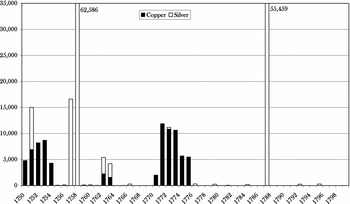
Although Great Britain suffered from small-change shortages even in the Middle Ages, its small-change problem became ‘big’ during the last decades of the eighteenth century. ‘The scarcity of Change has been severely felt by People in Trade for upwards of these Ten years past’, a 1771 pamphlet (Anonymous 1771, p. 3) declares, ‘and this Scarcity increases daily.’ Merchants had to scrounge for coins with which to make change, or forego sales altogether, while factory workers had to settle for payment in kind, or for group pay, or else see their wages go into arrears. As the century entered its last quarter the shortage became still more acute, because Great Britain's wage-labour force and retail trade were growing faster than ever, and because the Royal Mint, instead of producing more small change, produced hardly any. The bimetallic ratio was such that the Mint was ‘closed to silver as effectively as if [it] had been closed by statute’ (Carlile Reference Carlile1901, p. 14).Footnote 1 As for copper coin, which was minted on government account, the Mint filled the last order for it in 1775, and would not resume production until 1821 (see Figure 1). Although a 1785 Mint estimate put the total value of legitimate copper coins in circulation at £306,000, or 3 shillings’ worth per person, a large part of this copper had accumulated in the coffers of London brewers and merchants, who were unable to dispose of it economically (Craig Reference Craig1953, p. 252).Footnote 2
Royal Mint silver and copper coin output, pounds sterling, 1750–99

The shortage of legitimate coin encouraged counterfeiting by causing even clumsy counterfeits to be readily accepted. As Sargent and Velde (Reference Sargent and Velde2002, p. 271) observe, by 1753 close to half of the copper coin in circulation was counterfeit, while by 1787 only 8 per cent of a random sample of copper coins collected by the Mint showed ‘some tolerable resemblance to the king's coin’. But the prevalence of counterfeits was a cause as well as a consequence of the shortage of official small change, for so long as the government's own token coins could be successfully imitated it dared not offer to redeem them in legal tender. The irredeemable nature of official token coins in turn made it impossible to keep the overall supply of small change in line with the demand for it, or to routinely renew the coin stock. It also contributed to the tendency of coins to pile up, unwanted, in London. Thus complaints from the capital discouraged the government from ordering more copper coins despite severe shortages of such coins elsewhere (Mathias Reference Mathias and Mathias1979, pp. 192–5; Craig Reference Craig1953, pp. 142, 250–2).Footnote 3
3. Solutions: official and unofficial
Having faced an especially severe small-change problem, Great Britain was also the first nation to solve the problem. It first did so unofficially, using privately minted ‘tradesmen's tokens’ or ‘commercial coins’, starting with ‘Druids’ issued by the Parys [copper] Mining Company in 1787. By 1797, 20 private mints, including Matthew Boulton's Soho mint, had struck 600 tons of commercial copper coins − an amount half again as great as the Royal Mint's copper output for the previous half century. A second round of commercial coining, this time involving silver as well as copper tokens, took place between 1811 and 1817 (Mays Reference Mays1991; Withers Reference Withers and Withers1999).Footnote 4 Because tradesmen's tokens were relatively difficult to imitate, their issuers could afford to provide for their routine redemption in legal tender, thereby implementing a crucial element of the ‘standard formula’ for the very first time.
According to Sargent and Velde (Reference Sargent and Velde2002, pp. 301–4; see also Redish Reference Redish2000, ch. 5), although the official solution to Great Britain's small-change problem began with the government's decision to abandon official bimetallism and authorize an avowedly token regal silver coinage in 1816, the ‘standard formula’ was not fully implemented until 1836, when the Mint first agreed to buy the Bank of England's surplus silver coins. The unofficial solution may therefore be said to have anticipated the official one by more than four decades. Indeed, because the Royal Mint never offered to redeem unwanted copper coin, the official solution to Great Britain's small change was in one respect at least inferior to the unofficial one that preceded it.
The unofficial, private-market solution to Great Britain's small-change problem was itself far from perfect, to be sure. The overall supply of legitimate tokens fell short of what was needed to entirely eliminate shortages, leaving gaps to be filled by other sorts of private money, including anonymous and irredeemable ‘tokens for general circulation’.Footnote 5 Although several hundred distinct token ‘brands’ existed, only a few of these (mostly early tokens issued by large-scale manufacturing and mining companies) gained something approaching nationwide currency.Footnote 6 The rest enjoyed a local circulation only, and so obliged merchants to scrutinize tokens, rejecting unfamiliar varieties.Footnote 7 Still the private market did succeed, where the government had failed, in supplying the British economy with a substantial quantity of reliable small change; and, despite their shortcomings, commercial coins were greatly preferred to their official counterparts, often commanding a 100 per cent premium relative to them (Moser Reference Moser1798, p. 306).
4. Why the delay?
That a private-sector solution to the small-change problem was possible at all, and that it predated the official solution by several decades, raises a crucial question: if the problem could be unofficially (if imperfectly) solved by the early 1790s, why hadn't it been officially solved by then? Had the sole hurdles been those posed by unsound theories or inadequate equipment, private-sector coiners should not have enjoyed any special advantage in overcoming them.
Although it has been suggested (Sargent and Velde Reference Sargent and Velde2002, passim, and Redish Reference Redish2000) that a solution to the small-change problem had to await Matthew Boulton's invention of the steam-driven coinage press, Great Britain's own experience contradicts this view. Among British commercial mints, Soho alone employed steam-powered presses, which means that the technology used in manufacturing the vast majority of commercial tokens (including all save 77 tons of the eighteenth-century issues) did not differ fundamentally from that long in use at the old Tower Mint. The technical superiority of commercial coins rested, not on the motive power used in striking them, but on such old-fashioned anti-counterfeiting devices as superior die engravings, lettered or otherwise ‘milled’ edges, and (in some cases) the employment of restraining collars, which made for especially round and uniform coins (Selgin Reference Selgin2003). Dies sunk by Birmingham's outstanding engravers were beyond the capabilities of those artists’ back-alley counterparts, while ‘milled’ edges made it impossible to cast convincing imitations using sand molds taken from a genuine specimen. Striking ‘in collar’, finally, made it relatively easy to spot cut-rate fakes. The original Druid pennies, for instance, boasted all of these anti-counterfeiting devices, besides being struck to a relatively heavy standard of 16 to the pound avoirdupois of copper (as opposed to the Mint standard of 23d/lb). In short, the success of commercial coins rested mainly on technology that had been available throughout the eighteenth century, if not before.
Concerning theory, Sargent and Velde themselves note (Reference Sargent and Velde2002, p. 13) how Sir Henry Slingsby put forward a version of the ‘standard formula’ for a successful small-change system as long ago as 1661. The ability of edge markings, high-quality engravings, striking in collar, and routine renewal of the coin stock to discourage counterfeiting was, moreover, widely appreciated even in his day, that is, more than a century before the Parys Mine Company mint employed them in making its own small change. Indeed, the Royal Mint employed them on its earliest ‘milled’ coins, and occasionally thereafter, but never consistently, and seldom in the case of small-denomination coins which, owing to their fiduciary component, warranted them most. ‘It is a striking fact’, an 1849 Mint Commission reported, ‘that notwithstanding the introduction of machinery, latterly of the most ingenious kind . . . and notwithstanding the increase in Moneyers’ wages . . . scarcely an approach has been made since [the Restoration] to the excellence of the coins then executed.’ Opposition to token or fiduciary coins, and to silver token coins especially, remained a serious ‘theoretical’ impediment, to be sure. But here again the impediment did not hinder private-sector coiners, who embraced fiduciary token coinage at once, starting with copper and moving (as soon as the legal way was clear) to silver.
The cause of official delay was, I submit, institutional. So long as the production and provision of coin was the exclusive prerogative of protected monopolies, incentives were lacking for discovering and implementing a sound system of small change. The commercial coinage regime, in contrast, harbored relatively strong incentives. This fact is crucial for understanding why private mints and coin issuers rapidly embraced elements of the ‘standard formula’ that government authorities continued to resist.
5. Monopoly rights and regal coinage
As Sargent and Velde (Reference Sargent and Velde2002, p. 266) observe, the commercial coinage system that operated from 1787 to 1797 (and was briefly revived from 1811 to 1817) approximated a ‘laissez-faire’ regime. During it the government chose not to insist upon its traditional prerogative of coinage so far as copper (and later silver) coin was concerned, provided private coins were clearly distinguished from regal ones. Any private individual or firm could issue tokens legally, subject only to minor (and generally not binding) restrictions.Footnote 8
The production of commercial tokens was also unregulated. By 1797 hundreds of token issuers had taken part in the regime, using custom-designed tokens struck by a score of independent mints, almost all of which were located in Birmingham. Most of these mints were small-scale operations that subcontracted various aspects of coin making to other specialized (and competitive) firms, including rolling mills (which supplied metal sheets) and die-sinking establishments (which supplied original die matrices and working dies). Commercial coins enjoyed no legal-tender status whatsoever, so that the public was free to accept or reject them as they saw fit.
The pre-1787 official small-change regime was, in contrast, heavily monopolized. The government (traditionally the Crown; later Parliament), treated power over coinage as one of its ancient (that is, pre-Norman) prerogatives. That power included the exclusive right to issue coins, to compel their acceptance by declaring them limited or full legal tender, and to punish persons found guilty of making or ‘uttering’ coins without regal authority. Although regal coining was at first decentralized − at the time of the Conquest independent mints operated in 67 English towns − it was eventually concentrated in the Royal Mint at the Tower of London, which, except during the Civil Wars and the Great Recoinage, became exclusive supplier of coin to England, Wales and Ireland beginning in 1553, and to Scotland beginning in 1709.
Throughout most of its existence the Royal Mint operated under a system of ‘inside contracting’, described by John Buttrick (Reference Buttrick1952, pp. 205–6; compare Challis Reference Challis and Challis1992a, p. 230) as an arrangement in which the ‘capitalist’ (meaning, in this instance, the Crown)
provided floor space and machinery, supplied raw material and working capital, and arranged for the sale of the finished product. The gap between raw material and finished product, however, was filled not by paid employees . . . but by contractors, to whom the production job was delegated. They hired their own employees, supervised the work process and received a piece rate from the company for completed goods.
According to Oliver Williamson (Reference Williamson1975, p. 96), inside contracting allowed capitalists lacking technical knowledge to employ their capital productively while limiting their involvement to ‘negotiating contracts . . . inspecting and coordinating the output of the various departments, and taking responsibility for final sales’. Although in theory the Crown was to enjoy any profits derived from the coinage, in practice contractors profited also, pocketing any difference between their stipulated fees and their expenses.
The Royal Mint's inside contracting system differed in a number of respects from similar systems encountered in the private sector. For one thing, the monopoly power of the Company of Moneyers (the group of contractors responsible for the actual striking of coins) was only partly due to its knowledge of specialized production methods: the Company was the descendent and continuation of the old guild of coiners, which recruited its own members as it saw fit (mainly by restricting apprenticeships to established members’ sons), while claiming, in the words of Sir Joseph Banks, ‘the exclusive right of executing all coinages carried on at the Royal Mint’ (Great Britain 1849, p. 92).Footnote 9 Competitive bidding was therefore out of the question. Instead, a bilateral monopoly prevailed between the Crown and the Moneyers.
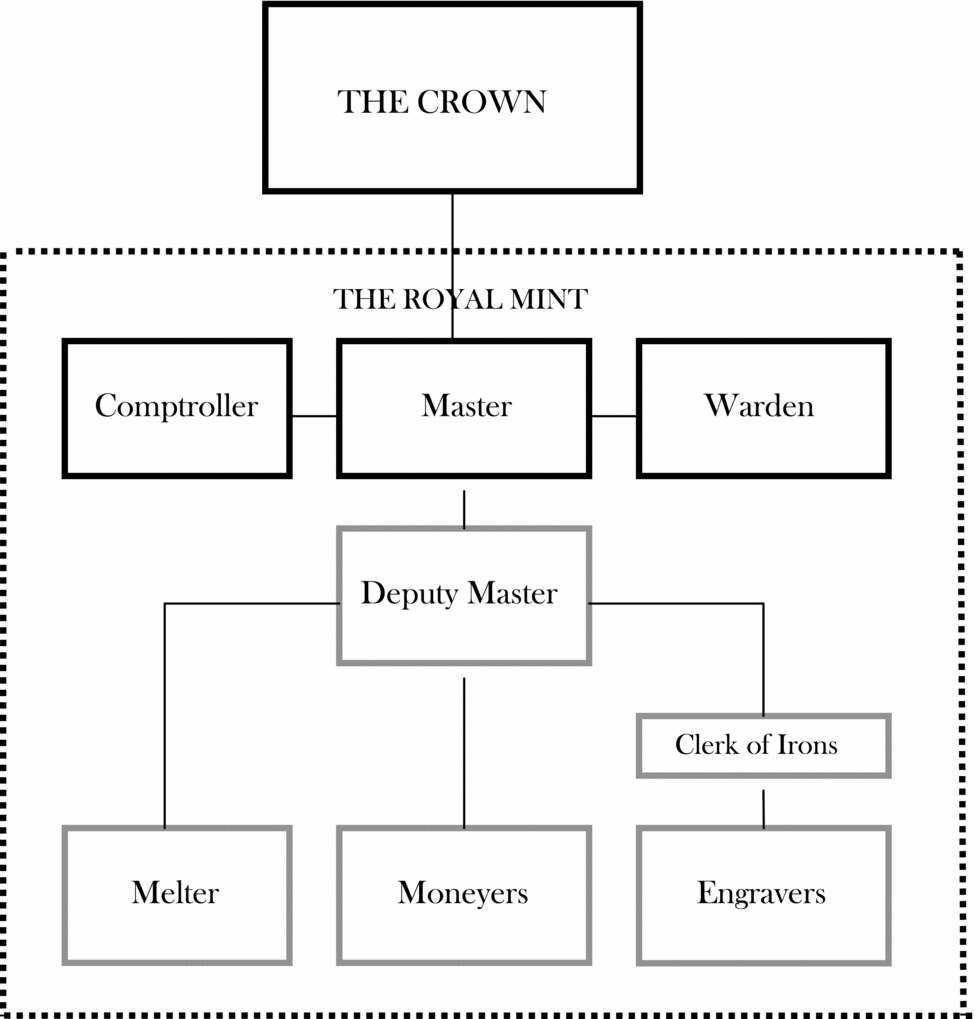
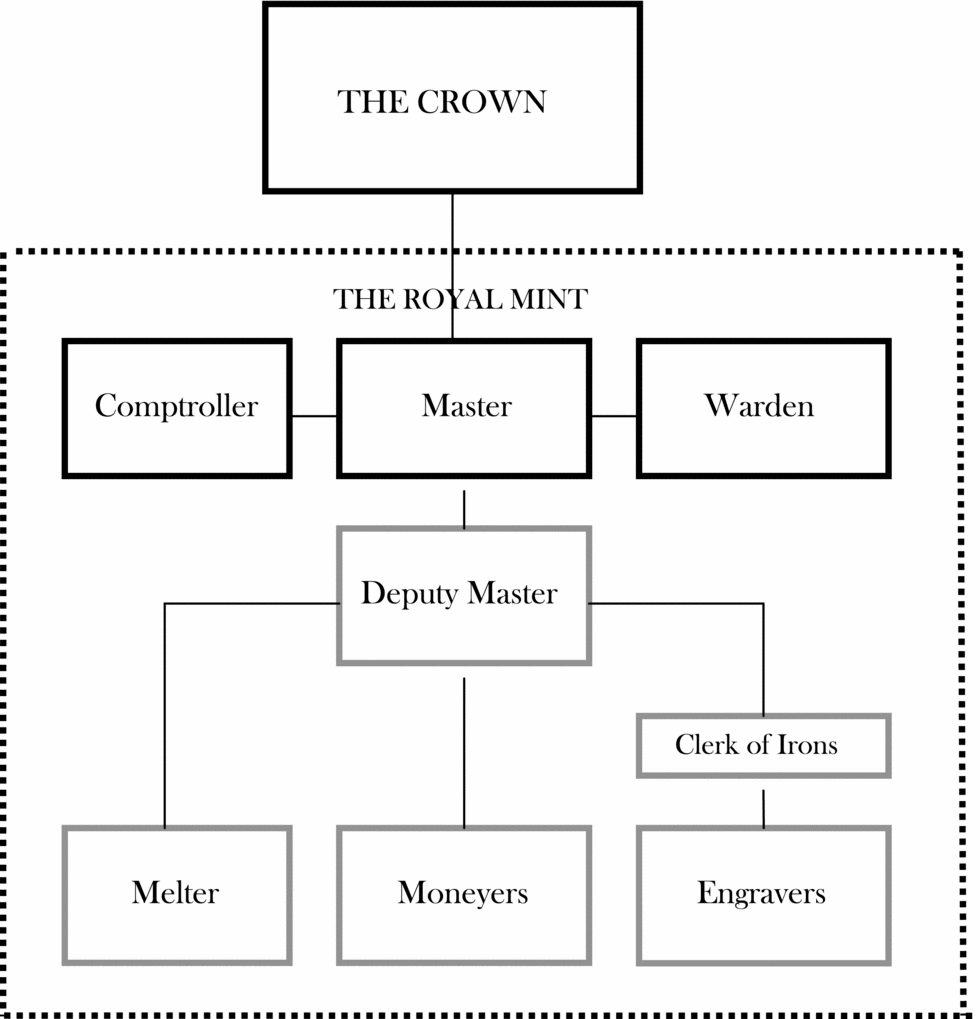
Nominally contracts were awarded to the Master of the Mint. The Master in turn subcontracted the coinage with the Moneyers, assigning them the whole of his charge save the preparation of bullion, which was the Melter's responsibility, and the preparation of dies, which was left to die-engravers acting under immediate orders of the ‘Clerk of the Irons’ (see Figure 2). Coining fees were first remitted to the Master, who was responsible for paying the Moneyers and Melter their stipulated rates. The rest was intended to cover the cost of dies and other incidental expenses, along with the Master's own stipulated fee, rewarded him in addition to his salary of £500.Footnote 10 Whatever was left also went to the Master.
Organization of British coinage, eighteenth century
Because of the great variability of coin demand and the high transactions costs involved in negotiating coining contracts, such contracts were necessarily incomplete.Footnote 11 Generally they specified the weight and standard of various coin denominations, the rates to be paid per ton of metal coined (with separate rates for coins of different sizes beginning in 1770), and (for copper and other coinages on government account) the total weight of metal to be coined. Further details were left to the Master, who in theory represented the government's interest.
In practice, though, that interest was poorly represented for several reasons. To begin with, although nominally the Mint's management was in the hands of its Master, it had long been standard practice for Mint officers, the Master among them, to deputize others to do their jobs for them, generally for a small fraction of their own rewards. The Mint's real chief executive was thus not the Master, but his deputy.Footnote 12 The Master thus took little part in the management of the coinage, becoming instead, by the eighteenth century, ‘a merely ministerial officer, having often no personal knowledge whatsoever of the practical process, and quitting office with every change of the Government, of which he came to be considered a member’ (Great Britain 1849, p. 3).
Thus ‘divested of the functions and control specifically belonging to this designation’, the Master was in no position to negotiate efficient coinage rates with the Moneyers. Deputy Masters, in contrast, were generally recruited from the Mint establishment and, once appointed, were typically confirmed by succeeding Masters until their death (Craig Reference Craig1953, p. 228). Consequently, although most Deputy Masters were familiar with the business of coining and to that extent competent to negotiate rates, their allegiance was to the Mint establishment, to which they belonged, rather than to the government.
The Master's and Moneyers’ status as residual claimants also presented them with opportunities to profit by skimping on coins’ gold content or by allowing blanks or coins to be indifferently made. Because the former abuse was relatively easy to monitor, indentures provided elaborate precautions against it. To provide against shirking on coin quality was, on the other hand, far more difficult, because a subjective element was involved in determining whether quality standards had been met, and also because the Moneyers could shift blame to the die makers for poorly struck coin. In terms of the modern theory of contracts, the government's ability to procure high-quality coins was undermined both by a ‘multi-tasking’ distortion − with contractors tending to focus their effort on measurable or ‘objective’ aspects of output at the expense of more subjective ones − and by a ‘team production’ problem − with different contractors ‘free riding’ off one another in lieu of increasing their own effort.Footnote 13 The upshot was that both the Master himself and the Moneyers were held liable only for deficiencies in coin weights or fineness, and not for any save the most flagrant deficiencies in coin design.
The government's ability to negotiate efficient coining contracts was, finally, further hampered by the Moneyers’ repeated refusal to make public their ‘cash books’ in which their profits from past coinages were recorded. The Master and his deputy were thus denied information essential to ‘equitably regulating the terms of remuneration’ (Great Britain 1849, p. x).Footnote 14 That the Moneyers earned large profits during periods of heavy coining was understood, but the full extent of these profits was never known (Dyer and Gaspar Reference Dyer, Gasper and Challis1992, p. 442).Footnote 15 That they would earn relatively little in periods of low activity was, on the other hand, clear. The practical outcome of this limited information was that coining rates tended to be determined largely if not entirely by precedent. For example, Moneyers’ rates went essentially unchanged from 1770 to 1851, save for a very modest reduction in rates in 1815 to allow for the Mint's switch to steam-powered facilities several years before. The reduction was so modest that the switch, which cost the British public upwards of £300,000, enriched the Moneyers instead of reducing the variable costs of coinage.Footnote 16 Belatedly it became evident to all that the Moneyers’ terms had allowed them to become very rich indeed. ‘[B]y the middle of the 19th century,’ T. S. Ashton (Reference Ashton1955, p. 168) observes, ‘the position of privilege enjoyed by these men had become little less than a scandal.’ But by then it was of course too late to correct the implied inefficiency of previous coinage contracts.
The general disadvantages of inside contracting, which are presumed to have been responsible for its demise in most branches of private industry, include, besides excessive contractor incomes, waste of (capitalist-provided) inputs and machinery and weak incentives for product and process innovation (Williamson Reference Williamson1975, pp. 96–8 and 1985, pp. 156–7). Because their severity tended to vary with contractors’ monopoly power, these disadvantages were especially pronounced at the Royal Mint, where they played a part in prolonging Great Britain's small-change problem long after its theoretical solution was known, and long after the technology needed to implement that solution was at hand.
6. Specific manifestations of institutional failure
6.1. Pricing
Solving the small-change problem is partly a matter of making the successful counterfeiting of legitimate small change unprofitable, if not impossible. Counterfeits will command a greater market, and the temptation to counterfeit will be correspondingly greater, the lower their selling price is, holding quality constant, relative to the price of legitimate coins. Keeping the price of counterfeits higher than or at least as high as that of legitimate coins entails raising counterfeiters’ relative costs, by means of penalties or more efficient technology or both. But the effectiveness of such methods depends crucially on how legitimate coins themselves are priced.
Because counterfeiting is itself a competitive industry, counterfeits tend to be sold for their average cost of production, inclusive of a normal return and any delivery charges. These prices will generally fall below counterfeits’ face value, and especially so when the legitimate coins being counterfeited are fiduciary or token coins. Sargent and Velde (Reference Sargent and Velde2002, p. 271) instance the case of halfpenny ‘evasives’, the legends upon which differed, often trivially, from those on the regal halfpennies they otherwise resembled, allowing their makers to avoid prosecution. Evasives were typically sold at half their face value ‘to wholesalers, who resold them at 28s. to 30s. for a gold guinea of 21s’. Outright counterfeits were similarly priced.Footnote 17
Because the minting of genuine commercial coins was also a competitive business, such coins were priced in the same manner as counterfeits. According to Thomas Sharp (Reference Sharp1834, p. ii), in 1793 William Lutwyche, one of the larger-scale commercial coiners, charged his clients £42 13s 4d, exclusive of the cost of sheet copper, to manufacture one ton (or some 100,000) of halfpenny tokens having a face value of about £208. This represented a coin blanking and striking fee of just over 4d/lb. Manufactured copper then cost about 13d/lb, making the total freight-collect cost of a pound of Lutwyche's halfpennies, nominally worth around 23d, 17d. The 24 per cent discount from face value was more than enough to cover freight charges even for the most remote places in Great Britain. It was, more importantly, comparable to the (retail) discount on counterfeit regal halfpennies, which were both substantially lighter and less current than good commercial tokens. Businessmen needing change therefore had little incentive to patronize counterfeiters instead of placing orders for legitimate commercial tokens.
Under monopoly, the selling price of coins can include a profit or seignorage component, depending on regulations. In 1666 Great Britain instituted free and gratuitous coinage of both gold and silver, so that, although the Master and Moneyers profited from the coining of those metals, the Treasury itself actually lost money, and there was no question of full-weight replicas of official silver or gold coins being made for less than the cost of their genuine counterparts.Footnote 18
Copper coins, however, were minted solely on government account and then sold to the public for their full face value in gold, silver, or bank notes. And though such coins were, according to the 1672 proclamation inaugurating them, supposed to be rated at no more than their ‘intrinsic’ (that is, metallic) value plus manufacturing costs (Challis Reference Challis and Challis1992a, p. 369), in practice they earned a profit for both Crown and Mint. In 1674, for instance, with copper blanks costing 14d/lb, the Mint's ‘operating margin’ (that is, its seignorage rate) was 41 per cent.Footnote 19 ‘In such circumstances’, Challis (Reference Challis and Challis1992a, p. 369) observes, ‘it was only to be expected that the counterfeiter would ply his trade, especially when, as it was alleged at the time, Swedish copper could actually be brought at 12d per lb and Barbary copper at half that price.’ The seignorage officially allowed on regal copper coins struck between 1718 and 1729 was 5d per lb, 2d of which went to the Moneyers. This rate translated into a net profit of £1,593 on 139 tons of halfpennies and farthings (Challis Reference Challis and Challis1992a, p. 378). Although the difference between this seignorage and the coins’ face value − a very generous 18d/lb − was officially assigned to the cost of blanks, it almost certainly included further profits to the Mint establishment. The coins were, moreover, of mediocre quality and appearance. From 1727 to 1760 the Mint's average cost for prepared copper sheets was 15d which, after adding 4d/lb. for coining, implied an average actual seignorage rate of over 14 per cent.
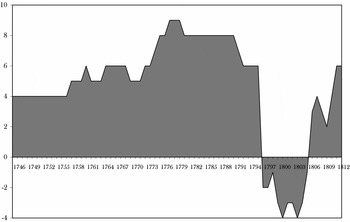
Figure 3 shows implicit copper coin seignorage rates for 1746–1812. The absolute seignorage per pound of copper coin is calculated by deducting the current cost of a pound of sheet copper, plus a fixed coinage charge of 4d/lb, from the copper coinage ‘standard’, that is, the number of pennies made from a pound of copper coin. That standard was fixed at 23d/lb until 1797, but varied afterwards. As these seignorage estimates suggest, copper coinage was a potentially profitable undertaking throughout most of the eighteenth century. But as we've seen, both aggressive counterfeiting and the tendency of copper coins to pile up uselessly in London gave rise to complaints that caused the Crown routinely to resist warranting such coinage.
Implicit seignorage rate on regal copper coin, d/lb, 1749–1816

The policy of supplying regal coins at the Tower only made counterfeits seem especially attractive to firms located in the provinces that could not afford to bear freight charges for legitimate copper. ‘[A]n insuperable [sic] Difficulty has always occurred’, a Privy Council Committee reported in 1799,
in getting them [regal copper coins] into Circulation in all parts of the Kingdom. Those who live at a Distance will not send for them and it is owing probably to this circumstance that the Counterfeits have been made use of in preference to those hitherto coined at the Tower. (Quoted in Mathias Reference Mathias and Mathias1979, p. 193)
Sargent and Velde (Reference Sargent and Velde2002, p. 348n8) understand that seignorage, whether explicit or implicit, can promote counterfeiting, citing in this connection Usher's (Reference Usher1943, p. 201) argument that ‘if seignorage exceeded the average rate of profit . . . the effective monopoly of coinage might be impaired by illegal coinage of essentially sound coins’, that is, of regal coin replicas. But instead of seeing in this circumstance an argument against monopolistic coinage arrangements, which alone are capable of supporting seignorage, they claim (2002, p. 345) that ‘a wide gap between’ the gross seignorage rate for official coins and that for counterfeits ‘was difficult to maintain unless a government's enforcement powers were strong’. The statement is misleading. The truth is rather that it is difficult to maintain a wide seignorage gap while also discouraging counterfeiting unless enforcement powers are strong. In Great Britain the seignorage gap for official copper coin was often wide, even though the state's enforcement powers were weak (Mathias Reference Mathias and Mathias1979, p. 194). Counterfeiting was therefore rampant.Footnote 20
6.2. Efficiency
Inefficient production of official coin can have consequences similar to those associated with substantial rates of seignorage, for it also makes it easier for illicit coiners to compete with official ones.
Although monopoly per se need not be inefficient, the Royal Mint's peculiar insider-contracting arrangement promoted both static and dynamic inefficiency in coining by encouraging wasteful application of available resources and technology and by discouraging the development and use of new cost-effective techniques. Besides charging inflated rates, the Company of Moneyers was notorious for its prodigious waste of master and working dies, supplied to it gratis by the Mint's engraving department, and for its rough treatment of coining machinery, the costs of which were borne by the government. The Moneyers also appeared to employ metal inefficiently, making allowances for losses much greater than the near-zero allowances characteristic of private-sector metal industries. Such allowances were, however, exaggerated to mask the Moneyers’ high profits.
The Moneyers’ refusal to disclose their actual coining profits rules out any precise assessment of the Mint's overall productive inefficiency. Available figures do nevertheless reveal a Mint establishment that was either wasteful or extremely well remunerated. Thus while the Soho mint's average rate for coining copper between 1797 and 1809 was £36 6s 8d per ton avoirdupois, exclusive of the cost of copper, the rate paid to the Royal Mint's contractors between 1821 and 1848 was just shy of £41 9s. Yet Soho had to recover its capital costs, while the capital employed by the Mint's contractors was provided free of charge by the British government (Great Britain 1849, p. 88).
Because the Royal Mint sold copper coins at face value, and because its overhead was paid out of the public purse, its operating inefficiencies had little direct bearing on the profits to be had by counterfeiting its coins. But operating inefficiency still mattered, for several reasons. First, it meant that the Royal Mint might not have deterred counterfeiters even if it had sold its coins at cost, for that cost, putting legal penalties aside, would have been higher than the competitive (illicit) market rate. Second, in raising the total public cost of any new coinage, the Mint's inefficiency reduced the frequency of new coinages. It therefore increased the likelihood that official coins would remain current despite being badly worn or minted according to an obsolete standard, that is, a standard that was either so high as to promote melting (and consequent shortages) or so low as to imply an excessive rate of seignorage, either of which encouraged counterfeiting. Finally, the Mint's inefficient organization meant that it could not be counted upon to adopt coining techniques essential for implementing the standard formula even when those techniques were both readily available and efficient.
It was, indeed, with respect to cost-cutting technical innovations that the Mint's insider-contracting arrangement took its greatest toll. When contracts are periodically renegotiated, inside contractors’ possession of superior information regarding costs and technology generally inclines them ‘to hoard information and delay process innovation’ (Williamson Reference Williamson1975, pp. 96 and 98); the inclination is all the more pronounced when desirable innovations threaten to reduce the value of contractors’ specific human capital (Buttrick Reference Buttrick1952, p. 217). In general, the more entrenched the monopoly of the contractors, the greater their ability to resist change.Footnote 21
That craft guilds were notorious sources of what Joel Mokyr (Reference Mokyr, James and Thomas1994) calls ‘technical inertia’ is well known. Instead of embracing new and superior methods, guilds ‘defended the interests of their members against outsiders [including] inventors who, with their new equipment and techniques, threatened to disturb their members’ economic status’ (Kellenbenz Reference Kellenbenz and Cipolla1974, p. 243). In an ‘aristocratic’ (guild-based) system, de Toqueville observes in Democracy in America (Reference De Toqueville, Mansfield and Winthrop2000 [1840], pp. 439–41), ‘each artisan has not only his fortune to make but his status to guard. It is not only his interest that makes the rule for him, nor even that of the buyer, but that of the corporation.’ Where, in contrast, a profession is open to all, ‘each worker . . . seeks only to gain the most money possible at the least cost’. Consequently, each ‘strives to invent processes that permit him to work not only better, but more quickly and with less cost’.
The monopoly rights enjoyed by the Royal Mint's Company of Moneyers differed from those of other English guilds in three important respects: they extended throughout Great Britain, were enforced with bloodthirsty zeal, and lasted a lot longer. These differences made it especially easy for the Mint to resist change. The tenacity with which the Mint establishment, including both the Moneyers and Mint officers, resisted technical innovations aimed at making coins more difficult to counterfeit is amply illustrated by the Mint establishment's determined and sometimes violent opposition to the screw press, which though first brought to Queen Elizabeth's attention by former Paris Mint employee Eloi Mestrell in 1561, was adopted by the Tower Mint only following a century of fierce resistance by the Mint establishment (Challis Reference Challis and Challis1992a, p. 329; see also Davis Reference Davis2001). Such resistance is hard to square with a depiction of coinage authorities struggling valiantly against external constraints in their efforts to implement a smoothly working small-change system.
That the screw press was not adopted until shortly after Sir Henry Slingsby's early statement of the ‘standard formula’ raises the possibility that Mint authorities, rather than being opposed to technical innovation per se, opposed innovation only in so far as it failed to be more efficient in making coins of proper fineness and weight only, leaving other considerations, including coins’ vulnerability to counterfeiting, aside. But the argument begs the question, for Mint authorities were just as opposed to changes in ‘the fundamental principles upon which Mint production had anciently, and rightly, rested’ (ibid.) as they were to technical innovation. To have accepted the standard formula, with its call for an avowedly token coinage, would have meant cutting the ground from beneath their favourite argument for resisting technical change and retaining their rents, to wit: that rating coins at their ‘intrinsic’ value, and coining them at their proper weight, was the best safeguard against counterfeiting, and that no machinery yet devised could outperform them when it came to getting the weights right. Monopoly rights may thus be said to have stood just as firmly in the way of sound theorizing as they stood in the way of technical innovations needed to implement sound theories.
Although the official switch from manual screw presses to steam-powered ones took less than a fifth as long as the switch from hammers to manual presses it, too, was opposed by the Moneyers, who retained the same motives as before for opposing labour-saving technology. ‘As sub-contractors for the coinage by the “hammer-and-tongs method”’, the 1849 Mint Commission reported, ‘the Moneyers were interested in opposing, and long effectively resisted’, the introduction of the screw press. ‘[N]or,’ the report continued, ‘if the representations of their descendents could have prevailed, would the Royal Mint have been provided in 1810 with steam-powered machinery’ (Great Britain 1849, p. 91). The status quo rewarded both the Mint establishment and the Moneyers handsomely, whereas labour-saving technological change threatened to injure the last group, without rewarding the first. So long as the Mint retained its monopoly status, the earnings of its officers and employees weren't adversely affected by its refusal to embrace new techniques, even (or especially) if those techniques led to substantial improvements in efficiency or coin quality.
6.3. Convertibility
A convertible token coinage helps to avert small-change shortages in several ways. It serves, most obviously, to keep the aggregate mix of outstanding coins of various types roughly if not precisely in line with the wants of the public.Footnote 22 Somewhat less obviously, it serves to maintain an efficient distribution of coins by providing for the return and re-allocation of local excesses.Footnote 23 Convertibility also allows worn and obsolete coins to be continuously withdrawn from circulation, denying counterfeiters easy targets. Finally, convertibility supplies coin issuers with a powerful motive for commissioning and issuing counterfeit-resistant coins, namely, the realization that to do otherwise is to expose oneself to ruin.
Because commercial coins enjoyed neither legal tender nor monopoly status, their issuers could only hope to give them currency by treating them as so many metallic IOUs, convertible on demand in gold coin or bank notes.Footnote 24 It was for this reason that only relatively well-known businessmen took part in supplying commercial coins. Some issuers widened the range of circulation of their tokens by arranging to redeem them in more than one town. Druids, for example, were (as their edge inscriptions indicated) redeemable ‘in London, Liverpool, or Anglesea’. The British government, in contrast, relied upon the limited legal tender status of its token coins − acceptance of regal copper coins was compulsory in transactions up to 6d − along with the suppression of private substitutes to render its tokens current despite its refusal to provide for their redemption, or even to receive them in payment of taxes and other public dues. In this respect official token coins, unlike their commercial counterparts, resembled fiat money.
6.4. Coin quality
The same market forces that compelled commercial coin issuers to convert unwanted coins on demand also compelled them to make coins that were difficult if not impossible to imitate. As Redish (Reference Redish2000, p. 110) observes, if convertible coins can be successfully imitated, any ‘authority that . . . guaranteed convertibility would soon be bankrupted’. Great Britain's commercial coin issuers generally avoided this fate, most having suffered ‘minimally from counterfeiting’ (ibid., p. 153).
Because neither the Royal Mint nor any other British government agency offered to redeem official British token coins, neither the Mint establishment nor the government bore any substantial part of the costs of counterfeiting. Counterfeiting did, of course, reduce the market for regal coin, thereby reducing potential seignorage earnings as well, both by partly addressing shortages and by aggravating surpluses. But generally speaking, neither Mint officials nor the Treasury had to contend with the risk of redeeming fake versions of official coins.Footnote 25 They therefore lacked a powerful incentive for making their coins difficult to imitate when in mint condition, and for retiring coins that had become easy to counterfeit thanks to wear and tear. Nor did the government make alternative arrangements for the continuous or otherwise routine withdrawal of worn coins. On the contrary: the Treasury tended to resist any proposal for the renewal of the coinage that would draw upon its resources until the problem of worn coin assumed the dimensions of a national scandal.
While fiscal considerations caused the government to put off renewals of the coinage, the treatment of engraving posts as sinecures meant that regal coins were often struck using mediocre dies that were relatively easy to imitate. Thus Rogers Ruding (Reference Ruding1819, pp. vii-viii), in calling attention to the ‘state of barbarism’ to which the regal coinage had, in his view, degenerated by the start of the nineteenth century, blamed it on ‘the peculiar constitution of the Mint, which entirely precludes competition, and distinguishes not in point of reward between the productions of a Masterly hand and those which betray the most consummate ignorance of the art’.
The Mint's inside-contracting system, finally, allowed the Moneyers to resist superior striking techniques and anti-counterfeiting devices not expressly called for by coin indentures or warrants even when the government was inclined to favour them: whereas workers under direct management (or what Williamson, following Herbert Simon, calls an ‘Authority Relation’) are subject to detailed capitalist supervision, and must fill any work assignment that falls within a broad contractual ‘zone of acceptance’, inside contractors enjoy considerable autonomy, being subject ‘to only very loose performance constraints (e.g., that minimal quantity standards be met . . .)’ (Williamson Reference Williamson1985, p. 219).
In the British coinage case, the ‘minimal quantity standard’ was generally satisfied by any coin of approximately correct weight and fineness. The Moneyers were therefore inclined to resist devoting any effort to improving or altering coins’ appearance (Great Britain 1849, p. 204). This outcome was an instance of the well-known problem of securing and preserving product quality using a piece-rate incentive scheme–and especially one involving cooperation among several teams (Holmstrom and Milgrom Reference Holmstrom and Milgrom1991, p. 35).Footnote 26 Occasionally a determined Master might overcome the Moneyers’ resistance, as when Wellesley Pole managed, in 1818, to overcome their opposition to striking Benedetto Pistrucci's new crowns, which had lettered edges and required three blows of the press instead of a single blow (Great Britain 1849, p. 128). Usually, however, the Moneyers had their way.
Thus when, in February 1788, Lord Hawkesbury, the president of the Board of Trade, sought the Mint establishments’ reaction to the suggestion that they make regal copper coins harder to counterfeit by resorting to better-engraved dies, fine polishing, and lettered edges, the Moneyers responded by dismissing all three ideas as ‘a departure from the simple primitive Institution of Material Money,− that of carrying full weight for value,− which is its only natural and best Security’ (British Library 1788). As far as the Moneyers were concerned, in having put legally authorized amounts of metal in the government's coins, they had amply satisfied the terms of their contract. This opinion was, bear in mind, offered less than two months after the same authorities reported that at least half of Great Britain's copper coins were fake (Great Britain, Public Record Office 1787), and precisely one year after the Parys Mine Company Mint began striking letter-edged Druids.
According to the 1849 Report of a Parliamentary Committee charged with looking into the Mint's constitution, loose contractual terms were ‘one of the most serious objections to the “Rate or Contract System”’:
beginning with legal proceedings, it provides a constant recourse to the law; nor, bound as is the Master by an agreement which specifies only a few of many circumstances affecting the business of the Mint, can he, as one of the contracting parties, issue an order involving an interpretation of its provisional terms, without subjecting himself to the imputation of desiring to become a judge in his own cause.
It might, perhaps, have been anticipated that appeals on agreements, respecting work entered into with parties who had ‘practical knowledge’, by those who had not, would usually be decided against the public, nor could other theoretical impressions have led to the assumption, that a system perpetually liable to litigation would be found compatible with subordination, or conducive to efficiency. (Great Britain 1849, p. 93)
To be sure, unsound ‘theory’ also played a part: both the Mint establishment and the government clung stubbornly to the belief that all regal coins were (and ought to be) full-bodied which, had it been valid, would have limited the need for other anti-counterfeiting measures. But doing so was in the authorities’ self-interest: once their rates had been established, the Moneyers had reason to resist by all possible means, including appeals to wrongheaded theories, any modification that would raise their coining costs and reduce their profits; and once its coins were placed in circulation, the government had every reason to resist subscribing to a theory that called upon it to take them back. Hence the persistence of an unsound theory of small change, within the coinage bureaucracy especially, was itself to some extent due to prevailing institutional arrangements.
7. Institutional reform and the official solution
If monopolistic coining arrangements were to blame for Great Britain's small-change problem, how can the problem have been officially solved without doing away with those arrangements?
The answer is threefold. First, reforms that did not directly address the problem of monopoly were nonetheless capable of improving the small-change situation, if only temporarily. Second, the monopoly rights that characterized official British coinage arrangements prior to the nineteenthth century were in fact substantially curtailed during that century. Third, the official solution to Great Britain's small-change problem has been far less satisfactory than some accounts, including Sargent and Velde's, suggest.
7.1 The nineteenth-century ‘Great Recoinage’
Although the Royal Mint's pre-1816 constitution kept it from taking steps needed to solve the small-change problem, this did not preclude direct action by the government, which found itself under increasing pressure to address the problem along with the runaway counterfeiting that went with it. Such action began, as we've seen, with the granting of a series of regal copper coinage contracts to the Soho mint − contracts that dramatically reduced the implicit seignorage rate on copper coin (Figure 2), while also providing for the first time for such coins’ national distribution. Provisions were later made for the minting of avowedly fiduciary silver Bank of England tokens, first by the Royal Mint, and then by Soho. These measures provided temporary relief in the shape of substantial quantities of fresh and relatively hard-to-fake small money, and in so doing made clear the inadequacy of traditional arrangements. The turn to an avowedly fiduciary small change also allowed the government to place more emphasis on coin quality, and less on metallic content, in evaluating suppliers’ performance.
A longer lasting but still temporary improvement came with the wholesale recoinage of silver that took place during 1817 and 1818 and with the retirement of old Tower copper around the same time. Besides adding further to the total stock of official small change these steps did away, for a while, with worn official coins, the presence of which raised counterfeiters’ potential profits while lowering their costs of production. In their immediate wake counterfeiters had no choice but to mimic official coins in something like mint condition. The government also increased penalties for making and uttering counterfeit coppers, further reducing, if only by some small degree, the gains from counterfeiting.
7.2 Reducing the role of monopoly
The Royal Mint was, in turn, gradually forced to shed its medieval constitution. For almost 30 years starting in 1787 ‘the higher administration of the Mint was virtually transferred . . . to a Committee on Coin of the Privy Council’ that was more inclined to consider radical changes than the former Mint establishment had been (Craig Reference Craig1953, p. 226). It was then that Matthew Boulton was given an opportunity to challenge the Moneyers’ monopoly. Boulton's efforts succeeded in part because he was able to convince the Coin Committee that coins produced using steam presses would be counterfeit-proof, but mainly thanks to the Soho mint's huge capacity, which allowed it to deliver coins faster than the old Tower facility could.
In order to counter Boulton's challenge the Mint establishment agreed to the construction of a new steam-powered facility at Little Tower Hill. Boulton, in agreeing to supply machines for that facility (which was completed in 1809, the year of his death), had been under the impression that the new mint would stick to coining gold and silver, leaving the copper coinage to Soho. His hopes proved mistaken, for despite Soho's greater efficiency the government instead resumed its traditional practice of contracting all its coinage with the Royal Mint staff. Indeed, it felt compelled to do so, having invested about £300,000 in their new mint.Footnote 27 Except for a small commission of halfpennies for use in St Helena, Soho never again took part in regal coinage. In 1848, following the death of Matthew Robinson Boulton, the Soho factory and mint were shut down for good, and the Royal Mint was once more without rivals.
But while they averted Boulton's immediate threat, in adopting his machines the Moneyers’ sealed their fate, for doing so rendered their specific human capital worthless, and transparently so: the new machinery could be operated by unskilled boys and girls, as it had been at Soho. The Moneyers’ status was further undermined by a Mint reform of 1815 which (among many other changes) awarded both the Master and his deputy enlarged salaries while depriving them of their traditional fees and profits, and so lowered the opportunity cost of achieving relatively hard-to-quantify improvements (Holmstrom and Milgrom Reference Holmstrom and Milgrom1991). The same reform also made the Moneyers’ rates subject to separate direct negotiation between the Master and them, with only the maximum rate fixed by indenture. This last step substantially reduced the transactions costs of altering rates to reflect process and product innovations.
Still change was slow in coming. Despite the Mint's comprehensive mechanization the Moneyers’ rates were reduced only slightly, and belatedly at that. An attempt at more fundamental reforms launched in 1837 was put off owing to the king's death and consequent disruption of the Parliament. Finally, in 1848, the former committees’ papers were dusted off and employed, in conjunction with new inquiries, in drafting a comprehensive report concerning the Mint's management and constitution. The resulting 1849 Report concluded that ‘the present Mint system is one leading to much useless expense . . . which (from its entailing either the necessity of submitting to unreasonable rates, or to postponing desirable recoinages) is irreconcilable with efficiency’ (Great Britain 1849, p. 99). The report observed, furthermore, that it was ‘evident that the parties profiting by [this system] must have an interest in resisting any economical change’ and that any lasting reform must aim at ‘keeping clear of such “rate” or contract arrangements as practically end in monopolies’ (ibid., p. 99). The report also laid the foundation for reform by finding that, despite long-standing claims to the contrary, ‘the Moneyers have no prescriptive right to exclusive employment in any department of the minting process’, their participation and remuneration being ‘absolutely at the pleasure of the Crown’ (ibid., p. 48).
Two years later, the Moneyers were, in accordance with the Report's recommendations and as part of a more sweeping reform, handed golden parachutes and forever dismissed from the Mint establishment. Although the Commissioners also recommended that contracting give way altogether to direct management (or Authority Control), the Mint's Master at the time, Richard Shiel, favoured a switch to open contracting. ‘For every description of work for which there would be sufficient competition’, he argued, ‘a contract system must be the cheapest’ (Great Britain 1852, p. 1; emphasis added). Shiel's hopes for open contracting were, however, frustrated by a lack of suitable tenders. As his successor, John Herschel, explained,
The total want of information on the part of the persons tendering as to the expense of the process, and the contingent risks to which it was exposed, made them necessarily fearful of underestimating them. The advantages of a contract of the nature intended to be formed and re-opened at limited periods, could not be derived until experience had been obtained by some of the parties likely to engage in it. (Ibid., p. 6)
Ultimately competition did play a role in promoting efficient coining, for two new private mints emerged during the decade beginning in 1850. Ralph Heaton and Sons (founded in 1850) and James Watt & Company (1860–95) played a large part in the production of official British copper and bronze coins, demand for which often outran the Royal Mint's own capacity (Sweeney Reference Sweeney1981). Their presence, plus the entry of a third private mint (King's Norton Metal Co., in 1912), checked the Royal Mint's inefficiency and monopoly power, in part by aggressively competing against it for foreign orders.Footnote 28
7.3. A smaller problem of small change
Despite the measures just reviewed, the official solution to Great Britain's ‘Big Problem’ was never a complete solution. In particular, although the Mint reluctantly agreed for a time, beginning in 1836, to receive and replace batches of unwanted silver coin from the Bank of England, and provisions were also made for the routine redemption of all badly worn or otherwise ‘physically distorted’ coins, fiduciary British coins in good condition remained generally inconvertible. This lack of convertibility, combined with the notorious instability of coin demand,Footnote 29 allowed small-change shortages and surpluses to go on burdening the British economy long after it embraced the gold standard. Thus William Stanley Jevons observed, in 1875, the tendency for unwanted bronze pence ‘to accumulate upon the hands of retail traders’, including publicans, just as unwanted copper coins had done in earlier times, and despite the lighter weight of the bronze money (and consequently lower cost of transporting it):
At one time the London brewers had such large quantities of bronze coins thrown upon their hands from the public-houses which they own, that the mint had eventually to arrange to buy it from them, instead of coining more. In large towns, arrangements have to be made for getting rid of the accumulating pence with the least trouble and loss; the coin is transferred weekly to mills and factories, where it is used in paying wages. (1875, p. 131)
Nowadays the burden of disposing of unwanted British coins is borne mainly by the (private) UK Payments Association (APACS), which though effective in handling local shortages and surpluses can do nothing about aggregate imbalances.Footnote 30
To be sure, such imbalances have become much less severe and disruptive than they once were, in part thanks to improved government forecasts but also thanks to the greatly diminished role of coin in British payments. However, the inconvertibility of unimpaired coins causes other problems apart from that of aggregate shortages and surpluses. It precludes the automatic withdrawal of coins made to defunct (and problematic) standards, and so leaves open the possibility of coins becoming undervalued, as they did in the days of bimetallism. In 2004, for example, Great Britain possessed over 10 billion 1d and 2d coins, most of which were lying idle in jam jars and drawers. Since then, however, the rising price of copper has caused those pieces minted prior to September 1992 to become worth 60 per cent more than their face value as scrap. Under a full-convertibility regime, the unwanted coins, and especially the heavy ones, might have been withdrawn from circulation some time ago, to the state's profit.
Counterfeiting also remained a serious problem long after 1816, though one that now tended to afflict silver more than copper coin, in part owing to a stiffening of previously light copper forging penalties, but also thanks to the increased fiduciary component of official silver. Although the silver recoinage of 1817–18 was followed by a lull in activity, by mid-century, according to Henry Mayhew (Reference Mayhew1967 [1851], vol. 4, p. 377), the forging of silver coins in London was ‘as prevalent as ever’. The government's continued failure to provide for the regular withdrawal of worn coins, by making fiduciary money freely convertible or by other means, was largely to blame, for almost all of the £11,120,917 in silver coin circulating at the time of Mayhew's report was coined between 1817 and 1822, and most had become badly worn since.Footnote 31 Many legitimate shillings and sixpences − the most frequently counterfeited denominations − were ‘entirely defaced’ (Great Britain 1849, p. 171), making their imitation using plaster of Paris moulds mere child's play. Even today at least 2 per cent of British one-pound coins are acknowledged to be fake. Here also a genuinely competitive coinage regime, insofar as it provided for the regular redemption of tokens, might have performed better.
8. Rethinking the ‘standard formula’
Having considered the role flawed institutions played in perpetuating Great Britain's small-change problem, we need to reconsider the merits of the ‘standard’ solution to the problem, which takes at least some of these institutions for granted, even treating them as essential.
Sargent and Velde (Reference Sargent and Velde2002, p. 303) observe, for example, that in Great Britain the ‘complete triumph’ of the standard formula was possible only when the government proceeded to ‘nationalise the business of supplying small change’ by abolishing private coinage and restoring the Royal Mint's monopoly. According to this perspective, a national coinage monopoly serves, not to encourage counterfeiting by drawing seignorage and by fostering inefficiency (as has been argued here), but to discourage counterfeting by depriving would-be counterfeiters of essential coin-making technology (ibid., p. 65). In practice, though, it is difficult if not impossible to keep efficient coin-making equipment out of private hands. Following the Royal Mint's switch to screw presses, for instance, private ownership of such presses was prohibited. But the edict proved unenforceable: eventually the Mint establishment, which was charged with the destruction of unauthorized presses, declared the assignment futile, and the law became a dead-letter.
Establishing and enforcing a government monopoly of efficient coining equipment is difficult in part because such equipment is most likely to be developed outside the official coinage establishment, where (as we've seen) it tends to be adopted only after some delay. The steam press was no exception, notwithstanding Sargent and Velde's assertion (Reference Sargent and Velde2002, pp. 65–6) that its development ‘initially gave the [Royal] mint exclusive ownership of the technology’. After developing the technology Boulton offered it to various government mints, including the Royal Mint. After Soho's closure in 1848 Ralph Heaton purchased some of its presses (by then no longer the old prototypes but improved vacuum-driven machines) for his own mint. In 1860 Heaton's became the exclusive British source of superior lever presses, which it began using in 1855, but which the Royal Mint did not get around to ordering from it until 1881.Footnote 32
To say that the British experience offers no proof that a national coinage monopoly prevents counterfeiting is not to deny some role for monopoly in a successful small-change system. But the necessary monopoly is not a monopoly of coinage as such, but one of dies used to strike authentic coins. A coinage industry characterized by monopolistic or imperfect competition, instead of outright monopoly, satisfies this requirement.
9. Conclusion
The British experience suggests that Sargent and Velde's account of the small-change problem overlooks the problem's institutional roots. In Great Britain at least those roots went deep enough to delay the problem's official solution until long after all theoretical and technical constraints had been swept aside.
The institutional perspective offered here addresses a number of otherwise puzzling historical issues. It helps to explain
1. the persistence of the small-change problem decades after both the theory and the technology required to solve it had become available;Footnote 33
2. the Mint establishments’ failure to routinely employ tried-and-true anti-counterfeiting devices, such as edge markings, together with its determined opposition to the screw press and other technical innovations aimed at making official coins harder to imitate;
3. the rapidity with which the private sector approached a solution to the small-change problem, once given an opportunity to do so;
4. the lag between the unofficial private sector solution and the official solution;
5. the incomplete and imperfect nature of the ‘official solution’ of 1816; and
6. the emphasis placed upon institutional change in post-1816 British Mint reforms.
An institutional perspective suggests, finally, that a national coinage monopoly, which is generally regarded as a desirable if not essential part of the solution to the small-change problem, was, in the British experience at least, partly to blame for the problem. The Royal Mint failed to supply adequate amounts of reliable small change not just because its staff and overseers were ignorant of steps required or because needed technology was unavailable, but because they feared that needed reforms would put their monopoly in jeopardy. Great Britain's private coiners, in contrast, could prosper only by adopting those desirable practices that official coiners spurned.
Acknowledgement
Thanks to my colleagues John Turner and Bill Lastrapes and to several anonymous readers for their comments.