Introduction
This paper examines how a large prosopographic database of tens of thousands of individuals in combination with network analysis can provide new insight into the evolution of the political elite over the course of the Tang Dynasty (618–907). In a previous work, I focused specifically on the structure of the elite in the final century of Tang rule, exploring how a group of several dozen old “aristocratic” families—whose ancestors had served in office generation after generation for hundreds of years—managed to dominate top bureaucratic offices partly by relying on the social capital embedded in a tightly knit marriage network based at the capital.Footnote 1 Here, I expand the temporal scope of my analysis to include the seventh and eighth centuries, looking not at the Tang elite at a single moment in time, but rather at how it evolved over a period of three centuries. My hope is that the methodologies I showcase here can fruitfully be used to analyze political power in other periods or places.
As is well known by historians of the Tang, there is every reason to expect that the political elite changed in fundamental ways between the Sui reunification in 589 and the collapse of the Tang following Huang Chao's sack of the capital cities in 880. To begin with, the unification process itself brought about a reorganization of the elite families that had once served the regional dynasties. Though the Sui and the Tang were both direct successors of the Western Wei and Northern Zhou based in the northwest, they made every effort to welcome into their newly centralized bureaucracies the descendants of men who had in the mid-sixth century served in the northeast (under the Eastern Wei and the Northern Qi) or the south (under the Southern Liang and the Chen). A few decades after the founding of the Tang, the rise to power of Empress Wu in the second half of the seventh century led to a new round of political reshuffling as the monarch sought to bolster her power and legitimacy by purging her opponents and recruiting new men loyal to her. Finally, the An Lushan Rebellion (755–763), which culminated in the complete autonomy of several provinces in the northeast, prompted a total reordering of the northeastern local elite and a significant restructuring of the administration elsewhere.
Aside from these political developments, there were also institutional innovations that affected the composition of the political elite. In the Sui and early Tang, the implementation of the law of avoidance (which mandated that officials not serve near their places of origin), as well as the elimination of the office of Recommending Legate 中正 (a member of the local elite who recommended local talent for government service), diminished the power of locally entrenched families. The expansion of the civil service examination under Empress Wu and the development in the mid-eighth century of provincial governments—which recruited their staffs without central government oversight—both in principle offered new routes of upward mobility into the officeholding class. Meanwhile, the deregulation of land (with the demise of the “equal-field” system) in the post-An Lushan Period and a concomitant expansion of the economy plausibly produced new landed and economic elites who could take advantage of these new opportunities to enter officialdom.Footnote 2 How did this series of political and institutional developments impact the political elite?
Needless to say, the question of what happened during the Tang to the “medieval aristocracy” has attracted considerable attention in the scholarly literature over the years.Footnote 3 Much of the most influential work broaching this topic dates to the golden age of social history, in the 1950s, 1960s, and 1970s.Footnote 4 This high-quality scholarship remains a necessary starting point for anyone wishing to examine the Tang elite. It should be noted, however, that some of this scholarship is influenced in no small part by dated meta-narratives and ways of conceptualizing history. Thus, the perspective (perhaps influenced by a Marxist conceptualization of history) that sees social change as driven by the struggle between an older social class and a newly emergent one, in combination with a faith (rooted in traditional Chinese historiography) in the power of institutional change to transform society, has led to the commonly held view that the old “aristocratic” families declined inexorably over the entire course of the Tang, as a result of the institutional changes described above, in conjunction with the inability of those families to compete with a newly risen “bureaucratic” elite. In fact, empirical evidence suggests that the old families maintained their dominance up until the very end of the dynasty without any serious competition.Footnote 5 But this does not mean that one cannot detect other sorts of fundamental changes in the structure of the political elite as a consequence of Tang political and institutional developments.
New sources of biographical data (notably the vast troves of funerary epitaphs excavated in recent decades), the digitization of this data into large datasets composed of tens of thousands of individuals, and new digital techniques together offer the possibility of reconsidering the evolution of the Tang political elite from a fresh perspective. Whereas earlier scholarship was often based on the synthesis of anecdotal evidence culled from a broad assortment of sources, or on detailed case studies of individual clans, the very large biographical datasets now available permit taking a more systematic and holistic view of the entire sociopolitical elite in its entirety. Moreover, the fact that much of the new data is based on excavated epitaphs (which dig deeper into society than dynastic history biographies and other traditional sources) means one can now take into consideration a much broader swathe of elite society.Footnote 6 Network analysis also permits a reconceptualization of social groupings. Earlier scholarship typically classified people into categories based on apparent class background, or classified families into regional blocks based on a claimed ancestral place of origin, then (whether due to source or methodological limitations or to ideological proclivity) assumed that these categories constituted cohesive social realities. By analyzing very large quantities of genealogical data in the aggregate and reconstructing networks of kin and marriage ties, one can shift one's analysis of social groupings from a theoretical to an empirical basis. One no longer needs to assume that feelings of solidarity existed between individuals sharing common characteristics; one can reconstruct categories of people based on demonstrable social connections.
Most of the data used here comes from two sources: the August 2017 release of the China Biographical Database (CBDB), and version 1 of the Prosopographic and Social Network Database of the Tang and Five Dynasties (TBDB), compiled as part of an earlier book project and largely incorporated into the recent versions of CBDB. Of particular relevance here, CBDB incorporates genealogical and marriage data taken from the several thousand Tang epitaphs included in the two-volume Tangdai muzhi huibian 唐代墓誌彙編 and its sequel volume.Footnote 7 My own TBDB focuses primarily on ninth-century epitaphs, but includes epitaphs found in a much broader assortment of publications. It also incorporates the genealogical tables of the imperial clan and families of chief ministers included in the eleventh-century New Tang History (新唐書). For the present article, I added large amounts of new data culled from recently published collections of epitaphs, with particular emphasis on three time slices (650 to 660, 720 to 730, and 800 to 810) described in more detail below, on epitaphs for members of families that produced chief ministers, and on epitaphs spanning the Sui-Tang period from provincial north China.Footnote 8 One consequence of combining datasets in this way was that it was then necessary for me to disambiguate (i.e., identify and merge) hundreds of duplicate entries. Correctly identifying duplicate entries—e.g., determining conclusively that the father-in-law mentioned in one epitaph was the same man as a member of one of the large patrilines with the same name—was particularly important in order to place individuals correctly within large family trees and identify as many marriage ties between families as possible. Finally, let me note that, for the reader's reference, version 1.5 of TBDB (available for download) includes the queries used to produce the figures and tables of the present study.Footnote 9
The Elite Marriage Network
The basic building blocks of the Tang marriage network of political elites consisted of what I have previously termed “patrilines.” A “patriline” is defined to be the largest multi-generational family tree of patrilineal kin that can be reconstructed on the basis of father–son and father–daughter relations that are attested in historical sources.Footnote 10 Unlike much past scholarship, which has often depended primarily on claims to particular great clan choronyms (i.e., the place of ancestral origin of a famous family of the same surname) as a way of identifying clan membership, the patrilines in this study have all been defined empirically on the basis of extant genealogical data. Given the fragmentary nature of much of the underlying source material, the majority of reconstructed patrilines—especially those based on epitaph data described below—contain only a handful of individuals (e.g., a great grandfather, a grandfather, a father, and two sons).Footnote 11 But other patrilines were much larger, sometimes with hundreds of known members spread across a dozen or more generations.
The major source of data for patrilineal ties remains the New Tang History genealogical tables, which identify over 17,000 father–son ties. Consequently, it is no surprise that the largest reconstructed patrilines are families represented in these tables. But genealogical data culled from excavated tomb epitaphs (which in my database consists to date of nearly 15,000 discrete father–son and father–daughter ties) will soon surpass the New Tang History tables in importance, and they have already permitted the reconstruction of a few previously unknown large patrilines. Tomb epitaphs are also much richer sources of marriage data, since dynastic histories and other traditional sources of Tang history usually identify only the marriage partners of emperors and imperial princesses. Unfortunately, epitaphs do not always provide sufficient details to confirm the identities of a woman's husband or a man's father-in-law, making disambiguation difficult. By surveying several thousand epitaphs, it has nevertheless been possible to identify hundreds of marriage connections between patrilines.
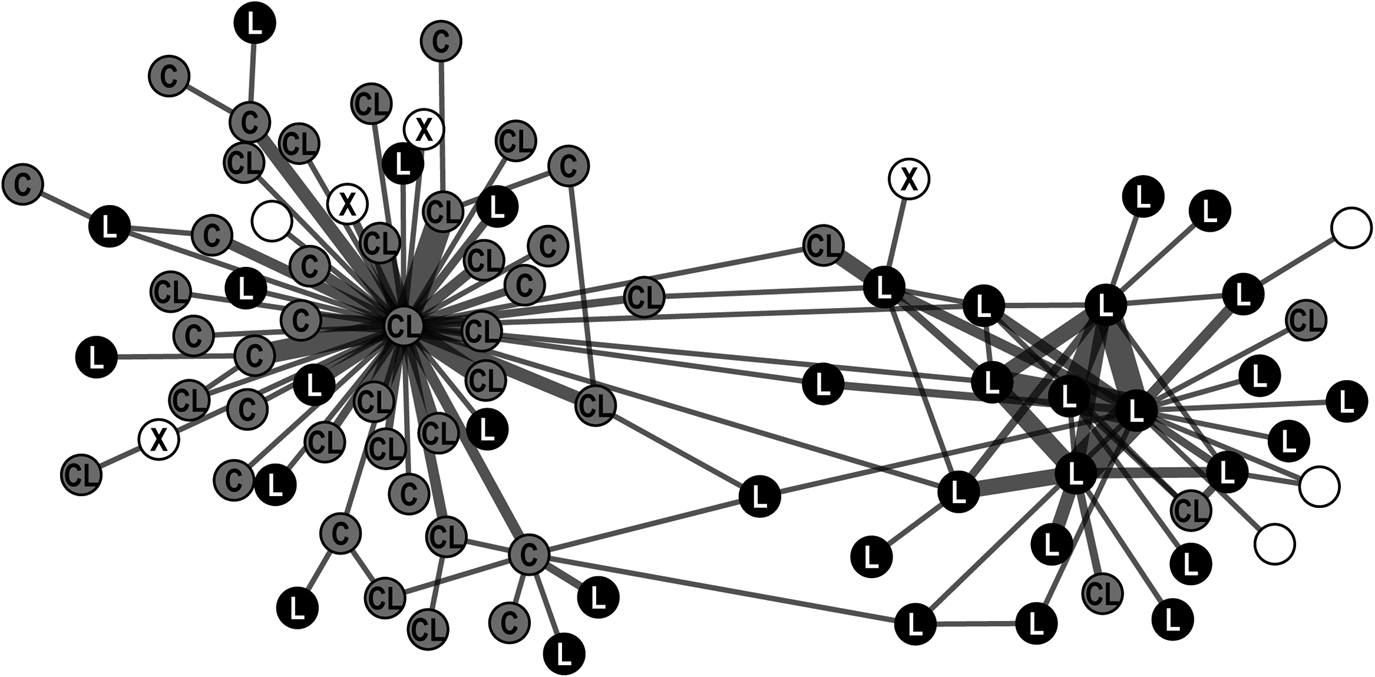
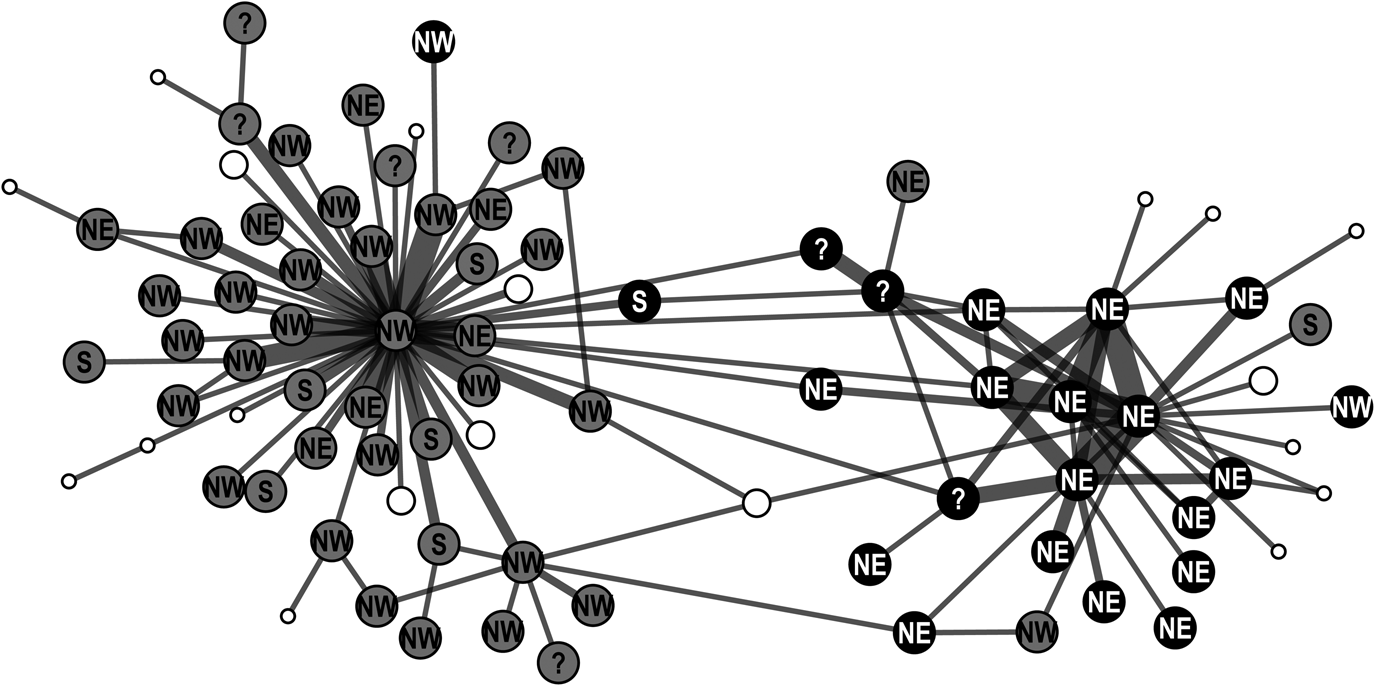
Figures 1 and 2 depict the core of a large marriage network of Tang political elites. The estimated dates of the marriages—each calculated based on the known or estimated birth dates of the groom—span the entire Sui-Tang period. The figures thus constitute a reformulation of the ninth-century marriage network in my previous study, with the addition of seventh- and eighth-century data.Footnote 12 Each node in the network represents a patriline; the thickness of lines between nodes is proportional to the number of known marriages between the two patrilines in question. Large numbers of leaves and minor branches of the network (i.e. small patrilines with few demonstrable ties to the center of the marriage network) have been eliminated to reduce clutter. In all, 87 patrilines—representing only 7 percent of the patrilines in the total network but 60 percent of known individuals—and 384 marriages are depicted in the figures.Footnote 13 As suggested in Figure 1, the network was capital-based—that is, the home base of most patrilines was either the Western Capital of Chang'an (denoted with a “C”), the Eastern Capital of Luoyang (“L”), or split between the two capitals and/or the “Capital Corridor” linking the two cities together (“CL”). In addition, by Tang times, most patrilines had served in office for many generations, going back to the pre-Sui period (gray and black nodes in Figure 2). This network embodied a capital-based bureaucratic aristocracy.
Marriage network of Tang political elites (with patriline home base if known)

Marriage network of Tang political elites (with ancestral affiliation to pre-Sui regional regimes if known)

Much like in the ninth-century case, and as analyzed in my book, one recognizes two prominent marriage cliques. The clique on the right was more diffuse, lacking any single dominant patriline. It was composed almost exclusively of Luoyang-based families (Figure 1), most of which had served northeastern regimes in pre-Sui times (Figure 2). Moreover, the families at the core of this marriage clique were all branches of the very most eminent “marriage-ban” clans (black nodes)—clans that were in early Tang times forbidden to intermarry in an ultimately unsuccessful attempt by the throne to diminish their prestige. In contrast to the marriage-ban clique, the clique on the left was organized around the imperial clan (represented by the node at the center of the clique). It was more heterogeneous, containing many families based in Chang'an, but also some families based in Luoyang or other parts of the Capital Corridor. The clique was dominated by families that had served the northwestern dynasties, but also included northeastern families. A few patrilines with southern origins also belonged to this clique, though overall the southern families occupied a relatively peripheral position in the marriage network.
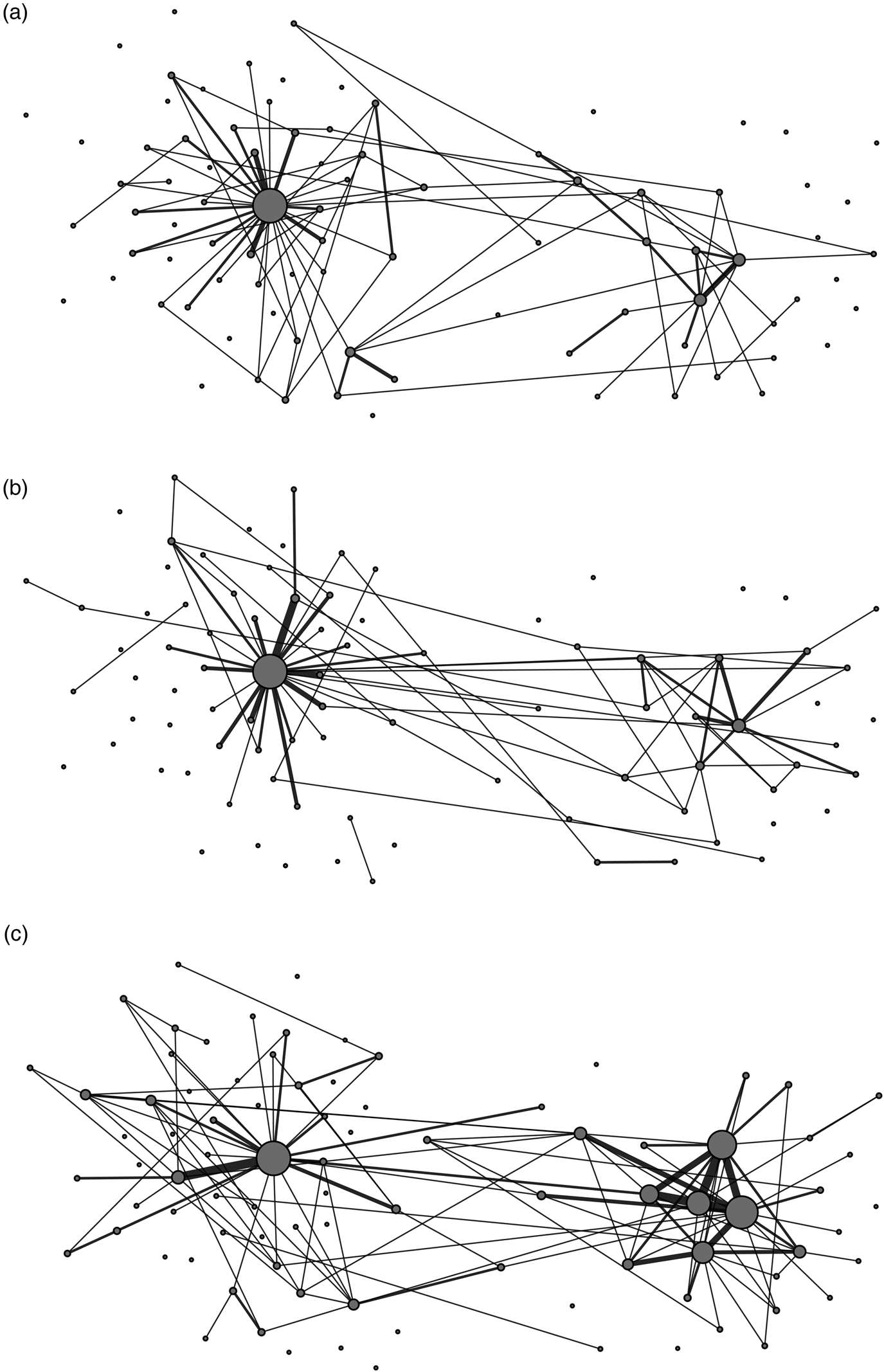
Needless to say, by aggregating three centuries of marriage data, Figures 1 and 2 tell us nothing about the evolution of the marriage network over time. To provide a sense of chronological change, Figure 3 depicts the network as it existed in three different time periods: 600–700 CE, 700–760 CE, and 780–880 CE. The two cliques are recognizable in all time periods, though there is a greater density of marriage ties within the marriage-ban clique. A possible explanation is that the marriage-ban clans preferred increasingly to intermarry with each other. Alternatively, perhaps due to a heightened sense that good marriages defined the most prestigious families, later epitaphs made more of a point to identify such good marriages explicitly.Footnote 14
Evolution of Tang elite marriage network (600-880 CE) (a) 600–700 CE (b) 700–760 CE (c) 780–880 CE

One can also assess temporal change statistically rather than graphically. Looking just at marriages involving clique members, one finds long-term continuities in the preference for intra-clique marriages. In all three periods, individuals were on the order of ten times more likely to marry within their clique than with members of the opposite clique.Footnote 15 Though the two cliques were never entirely isolated from each other, there is no evidence of a trend towards greater integration. But the two cliques did differ from each other in one measure. Two-fifths (40 percent; n = 133) of intra-clique marriages within the marriage-ban clique involved two patrilines that intermarried in all three time periods spanning the Tang, whereas such marriages were relatively less common (13 percent; n = 136) in the case of the imperial-clan clique.Footnote 16 This latter clique evidently evolved more over time, as new families—such as the descendants of Guo Ziyi, hero in the fight against the An Lushan rebels—began to intermarry with the imperial clan over the course of the Tang Dynasty.Footnote 17 By contrast, the marriage-ban clique consisted of an established marriage network with origins in the sixth-century or earlier.Footnote 18
The Chief Ministers
In addition to using network analysis to analyze a marriage network of patrilines, one can also treat individual patrilines themselves as an empirically reconstructed network—roughly speaking a family tree—of people sharing certain common characteristics. One example of a shared characteristic involves the “home base” of a patriline, which—as used in Figure 1 and Table 1—is defined as the place where the family buried its dead.Footnote 19 Given the desirability to bury kin together, one can surmise the home base of most individual members of a patriline in a particular period of time based on the discovery of only a small number of family epitaphs.Footnote 20 A second example involves marriage ties. Though one usually does not know the marriage partner of a given individual, one can—as we have seen—get a sense of a patriline's pattern of marriage alliances based on the sample of known marriages. On this basis, one can surmise with what type of family an individual kinsman is likely to have intermarried. In sum, reconstructing patrilineal kinship networks helps one to fill in inevitable gaps in the historical record.
Family background of Tang chief ministers

Note: All percentages calculated based on a count of tenures in office. Patriline home base is the place where a substantial majority (at least 78 percent) of kinsmen or unmarried kinswomen were buried according to extant epitaphs. “Capital” indicates Chang'an, Luoyang, or the Capital Corridor between the two capitals; “provinces” indicates anywhere else. “Marriage net” refers to patrilines belonging to the entire marriage network, including leaves and small branches eliminated from Figures 1–3. “Marriage-ban clique” refers to 41 patrilines at the core of the marriage-ban clique; “imperial clan clique” refers to 66 patrilines at the core of that clique.
Data source: _JCH_table1 in TBDB ver. 1.5.
Here I will apply a network-based approach to investigate the evolution in the composition of chief ministers during the Tang period. The 364 men from 246 different patrilines known to have served as chief minister at some point in the Tang constitute a useful sample of political elites. The list of chief ministers is probably comprehensive, so one need not worry excessively about biases regarding whose name survives.Footnote 21 In addition, as a result of the hard work of eleventh-century genealogists, the families of chief ministers are relatively easy to reconstruct using the tables contained in the New Tang History. Finally, it is important to bear in mind that about half of the 246 families of chief ministers supplied only a single chief minister during the entire course of the dynasty. Yet, at the same time, each of these families had an average of about forty-eight documented Tang-era officeholders (a number that will likely increase as new epitaphs are excavated), including men who served in a broad range of different offices.Footnote 22 Thus, one can think of the patrilines of chief ministers as representing a broad cross-section of the Tang political elite. Undoubtedly, there were many other very similar families that, due to the vagaries of court politics, never themselves produced a chief minister.
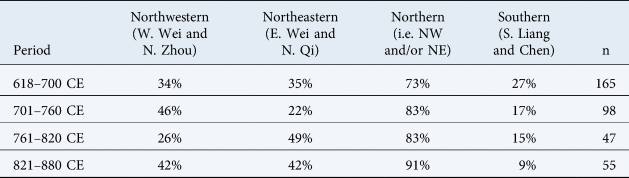
Tables 1 and 2 tabulate data concerning chief ministers divided into four sixty-year periods spanning the Tang Dynasty. The figures are in terms of percentages of tenures in office.Footnote 23 In many ways, the pool of chief ministers changed very little over the course of the dynasty, corroborating an observation made long ago by David Johnson.Footnote 24 Whereas Johnson focused specifically on the “great clan” origins of these men, the two tables presented here suggest continuities in terms of a somewhat different set of metrics. In the case of a substantial majority of chief ministers from all four periods, it is possible to trace their ancestries back to officeholders serving prior to the founding of the Tang, or even prior to the founding of the Sui. The apparent decline in percentages over time (from 87 percent to 70 percent and from 81 percent to 68 percent respectively) is probably attributable in large part to the increased difficulty of tracing genealogies over an ever greater number of generations. In addition, throughout the dynasty, a substantial majority of chief ministers came from patrilines known to have been based in the capital region, with only a tiny percentage in the earlier periods from provincially based patrilines.Footnote 25 Indeed, as we shall see below, very few provincial epitaphs have been discovered for such politically powerful families. Finally, most chief ministers in all time periods came from families with ties to the marriage network described above. It is plausible that all of these long-term continuities in the Tang political elite will become even more evident in the future as more data from excavated epitaphs becomes available, permitting more comprehensive reconstructions of kin and marriage ties.
Ancestral pre-Tang regional regime affiliations of Tang chief ministers (if known)

Note: All percentages calculated based on a count of tenures in office. Figures only include chief ministers whose ancestral pre-Tang regional regime affiliation is known. “Northern” combines “northwestern” and “northeastern” patrilines, as well as patrilines serving pre-Tang regimes in both the northwest and the northeast. Data source: _JCH_table2 in TBDB ver. 1.5.
Aside from these continuities in the characteristics of chief ministers, two long-term changes stand out in Table 1. First, the Luoyang-based marriage-ban clique provided relatively few chief ministers at the beginning of the dynasty, perhaps a consequence of the early Tang emperors’ animosity towards the marriage-ban clans. By the late eighth century, however, this clique had become as important as the clique surrounding the imperial clan. This trend corroborates an argument made previously by Maeda Aiko regarding the resurgence of the marriage-ban clans as a consequence of the rule of Empress Wu.Footnote 26 Second, patrilines whose ancestors had served the Southern Dynasties in pre-Tang times became increasingly insignificant as sources of chief ministers. The possible significance of these two developments will be examined in the Conclusion.
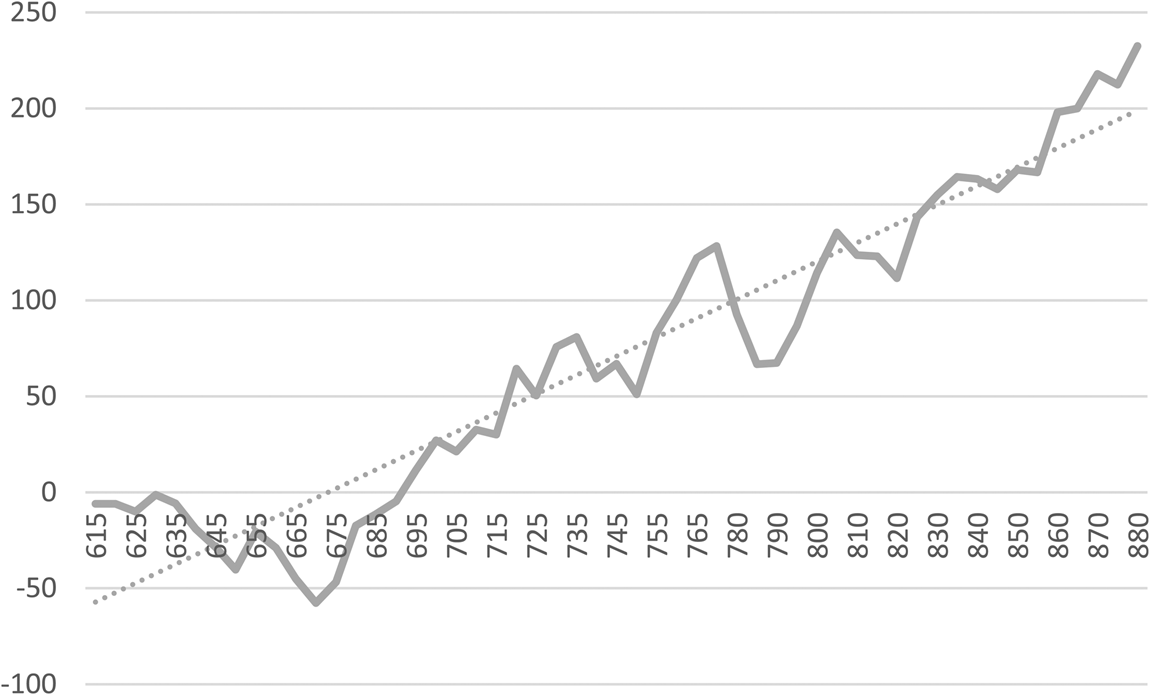
Although the data suggests that chief ministers throughout the dynasty were overwhelmingly from capital-based patrilines, the home base of a patriline was determined here based on aggregate burial data from the entire dynasty. Such a methodology does not take into consideration when a patriline first established itself in the capital. Previous scholarship has roughly dated the relocation to the capital of the most powerful families to the first half of the dynasty.Footnote 27 A more precise understanding of the timing of the relocation is important for understanding the evolution of the geography of political power during the Tang, and, more specifically, for determining to what extent the capital elite had a stranglehold on the upper echelons of the bureaucracy as early as the seventh century. Figure 4 charts the change in the difference between the start of a chief minister's tenure in office and the earliest known capital burial of a member of the chief minister's patriline. A negative number indicates that the start of the minister's tenure preceded the earliest known burial; a positive number indicates that it came after the earliest capital burial. The upward trend (from left to right) in the figure indicates that, by the eighth century, chief ministers were increasingly frequently from patrilines well established in the capital at the time of their elevation to the top office.
Difference in years between start of chief minister's tenure in office and date of first documented capital burial of a kinsman

It is tempting to conclude from the trendline, especially given its slope of roughly 1:1, that the late seventh century—that is, between where the trend line and data line cross the x-axis and roughly representing the time of Empress Wu's reign—was a key moment when many patrilines relocated from elsewhere to the capital. But we should be careful not to draw such a conclusion prematurely. A smaller number of epitaphs relatively speaking have been discovered dating to the first half of the seventh century.Footnote 28 Moreover, as noted below, epitaphs prior to the eighth century tend to identify only one or two generations of ancestors.Footnote 29 The result is that kinswomen and kinsmen of chief ministers, as well as descendants of the great families, are somewhat more difficult to identify in seventh-century epitaphs. It is perhaps telling that, as of yet, the only epitaphs that I have encountered demonstrating earlier provincial burials of members of capital-based chief minister patrilines date to the 620s or earlier.Footnote 30 It is plausible that epitaphs excavated in the future will reveal that nearly all “capital-based” patrilines in Table 1, even those of seventh-century chief ministers, were well established in the capital many years before the respective chief minister's tenure in office.
Cross-Sections of the Capital Elite
A third way to assess the evolution of the Tang elite is to take cross-sections of it during different periods of time, tabulating the composition of each cross-section based on a comprehensive survey of excavated epitaphs. Here, I focus on epitaphs from the two capital cities of Chang'an and Luoyang that date to three time periods: 650–660, 720–730, and 800–810. These particular time slices allow one to assess the social landscape at the capitals both pre- and post-Empress Wu, as well as pre- and post-An Lushan. Unlike the survey of chief ministers, this survey looks well beyond the pinnacle of the political elite. Indeed, not all epitaphs were composed for officeholders. Elsewhere, I have argued that a survey of excavated epitaphs from a single region provides a relatively representative sample of the economic elite based there.Footnote 31 At the capital, the economic elite largely overlapped with the political elite, but it did not do so entirely.
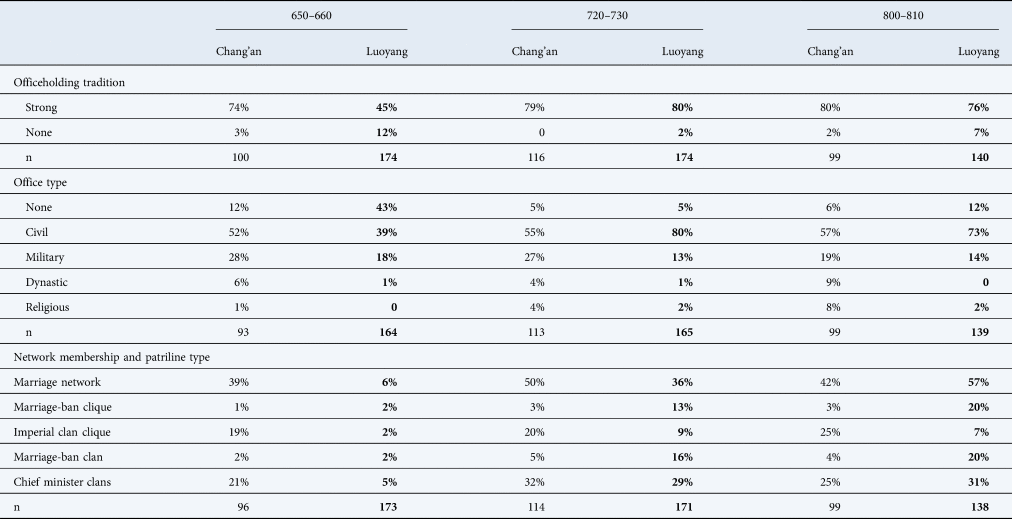
Table 3 presents data on the careers of the deceased individuals and of their immediate family members, as well as on the broader kin and marriage network to which the deceased belonged. The table begins by tabulating the “officeholding tradition,” a measure of the share of close relatives of the deceased who held office. A “strong” tradition indicates that most generations (including those of the grandfather, father, deceased or deceased's spouse, and deceased's children) held office. “None” indicates there are no known officeholders among the deceased's close relatives—that is, that the deceased in essence did not belong to the political elite no matter how it is defined. The table then identifies the “elite type” of the deceased (or that of her husband or father in the case of a woman, or that of the father in the case of a child under the age of 21). Elite types include: “no office”; “civil” for civil bureaucrats; “military” for military men; “dynastic” for imperial princes and princesses, the consorts of princes and princesses, palace women, and eunuchs; and “religious” for monks, nuns, and priests. Perhaps the most important conclusion to draw from this data is that, whereas the Chang'an elite remained relatively stable in terms of its composition throughout the dynasty, the Luoyang elite changed considerably, especially between the 650s and the 720s. In the early Tang, less than half of Luoyang epitaphs were for individuals from families with strong officeholding traditions, whereas three-quarters to four-fifths were from such families in the 720s and 800s.Footnote 32 In addition, over two-fifths (43 percent) of epitaphs from the early period were for individuals who did not themselves hold office (or whose husbands or fathers did not hold office in the case of women and children), whereas the figure drops to 5 percent in the 720s and 12 percent in the early 800s.Footnote 33 Simply put, the Luoyang elite had fewer ties to the state in the first decades of the Tang dynasty than it would in later times. Finally, one can look at the kin and marriage networks to which the individuals belonged. Here, too, one notes less change over time among the Chang'an elite. The Luoyang elite, by comparison, evolved considerably. Only a tiny percentage had demonstrable ties to the political elite marriage network in the early Tang, whereas a clear majority did so by the ninth century. In addition, the forty-one patrilines belonging to the marriage-ban clique came to occupy a disproportionate position in Luoyang society by the late Tang, whereas their presence was barely measurable in the 650s.
Cross-section of capital elite in three time periods

Note: “Elite” defined here as the class of people typically buried with an epitaph (i.e. it is a socioeconomic and not a political elite). Data based on all extant epitaphs from Chang'an and Luoyang dating to three time periods. Due to their abundance, in the case of Luoyang epitaphs from the 660s and 720s, only epitaphs dating to 650–655 and 720–725, respectively, were counted. A “strong” officeholding tradition means there were officeholders in three of four recent generations (grandfather, father, deceased's generation, children); “none” means that there is no evidence of any officeholders in four recent generations. “Office type” determined based on deceased's titles as identified in the epitaph (or based on husband or father's titles in case of women, or on father's titles in case of males under the age of 21). “None” means deceased apparently held no state or religious offices; “dynastic” refers to imperial princes, palace women, and eunuchs. On “marriage net,” “marriage-ban clique,” and “imperial clan clique,” see notes to Table 1. “Marriage-ban clan” refers to specific patrilines with demonstrable genealogical ties to one of the seven “marriage-ban” clans; these should be distinguished from the “marriage-ban clique,” which was composed primarily, but not exclusively, of some sub-branches of these clans.
Data source: _JCH_table3_pt1, _JCH_table3_pt2, and _JCH_table3_pt3 in TBDB ver. 1.5.
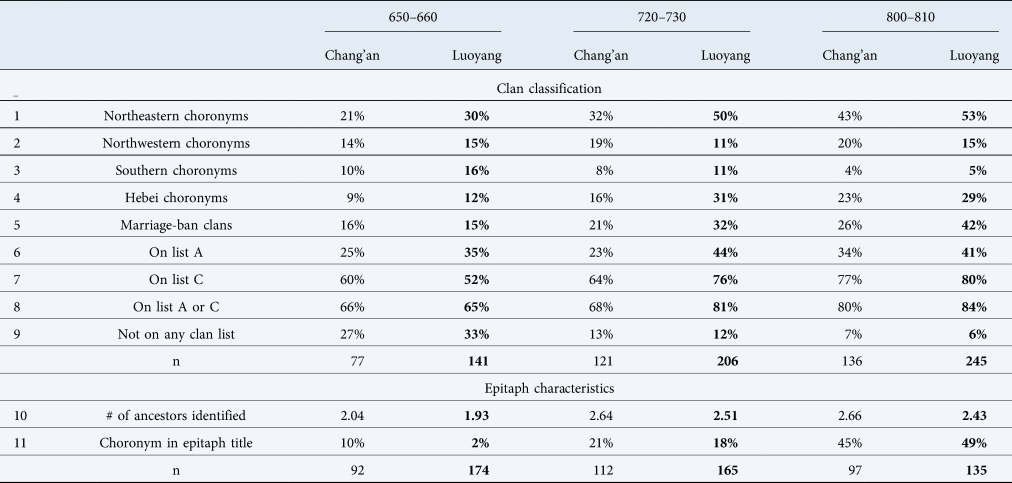
Table 4 examines a different set of data during the same slices of time. It focuses on the “choronyms” attributed in an epitaph to the deceased and to affines of the deceased (usually the spouse or sons-in-law). The “choronym” was a pre-Tang prefecture name that a great family claimed as its ancestral place of origin. By early Tang times, prefectures had all been renamed, such that choronyms became anachronistic place names usually easily distinguishable from other toponyms. Customarily, members of a great family preceded their surname with a choronym in order to establish the distinction of their ancestry. For the historian, the principle drawback of relying upon choronyms (and the reason I have preferred to focus on empirically reconstructed patrilines) is that prestigious choronyms were easily concocted (either by the deceased's family or the author of the epitaph), albeit fictive claims were probably more rampant in the provinces than at the capital. Nevertheless, a study of choronyms does offer an additional perspective on the composition of the political elite, because it involves an alternative sample of individuals—namely marriage partners and other affines mentioned in an epitaph by choronym and surname but whose patrilines cannot be conclusively identified.Footnote 34 In addition, analyzing choronym use—especially the contexts in which choronyms were invoked—sheds light on strategies used by elites to maintain their social distinction within society.
Classification of clans of deceased and deceased's affines in three time periods

Note: Data based on all extant epitaphs from Chang'an and Luoyang dating to three time periods. Due to their abundance, in the case of Luoyang epitaphs from the 660s and 720s, only epitaphs dating to 650–655 and 720–725, respectively, were counted. Rows 1–9 classify the clans of the deceased and of affines identified in epitaphs, including only clans for which both the surname and the choronym are known. “Northeastern choronyms” are choronyms referring to prefectures lying north of 33°N latitude and east of 113°E longitude; “northwestern choronyms” lie north of 33°N latitude and west of 108°E longitude; “southern choronyms” lie south of 33°N latitude. Lists “A” and “C” refer to the Dunhuang lists described in Johnson, Medieval Chinese Oligarchy, 62–70; “not on any clan list” takes into consideration all lists mentioned by Johnson, as well as an additional list of 44 clans appearing in Tackett, Destruction, 34. Because a single epitaph might identify zero or several affines and may or may not identify the choronym of the deceased, n for rows 1–9 does not equal the number of epitaphs examined. Rows 10–11, by contrast, include one data point per epitaph. “# of ancestors identified” refers to the number of immediate ancestors identified by name in the epitaph; “choronym in epitaph title” counts epitaphs in which the choronym appears in the title line of the epitaph, and excludes choronyms that appear less prominently within the epitaph, for instance as the place of ancestral origin of the deceased.
Data source: _JCH_table4_pt1 and _JCH_table4_pt2 in TBDB ver. 1.5.
The first four rows of Table 4 tabulate the frequency of claims to choronyms located in four regions: the northeast (defined as lying north of 33°N latitude and east of 113°E longitude, corresponding to Hebei and eastern Hedong and Henan); the northwest (north of 33°N latitude and west of 108°E longitude, corresponding to western Shaanxi, as well as the Gansu Corridor); the south (south of 33°N latitude, i.e. roughly speaking south of the Huai River); and Hebei (a sub-region of the northeast). It should be evident that clans claiming northeastern, northwestern, or southern choronyms were not necessarily affiliated with the pre-Sui regimes based in the northeast, northwest, and south, respectively, though many were. The data suggests that claims to northwestern choronyms (like Longxi) remained stable throughout the dynasty, whereas there was a decline in the use of southern choronyms, probably reflecting the decline in political significance of southern families, a trend alluded to above. There was also a substantial surge in the use of northeastern choronyms, largely attributable to the greater numbers of claims to Hebei ones, including notably those used by marriage-ban clans, such as Qinghe, Boling, and Zhaojun. Indeed, among claims to specific choronym-surname combinations, one sees a marked increase in references to the marriage-ban clans in particular (row 5 of Table 4).
The next three rows of the table refer to two Tang-era lists of great clans found in manuscript form among the Dunhuang documents. These lists, well known to historians, appear to identify the most famous surnames from each prefecture.Footnote 35 One sees a steady rise over the course of the dynasty in claims to choronym-surname combinations that appear on these lists. If one takes into consideration other reconstructed lists of Tang great clans that attempt to fill in the gaps in the manuscript lists (row 9 of the table), one finds a sharp decline in claims of descent from unrecognized clans. A plausible explanation is that these trends reflect a heightened awareness among epitaph authors of which choronym-surname combinations were most prestigious and most worthy of recording. The last two rows of the table are also suggestive of a greater interest over time in an individual's officeholding relatives. Whereas in the mid-seventh century, the typical Chang'an and Luoyang epitaph identified only two immediate ancestors, it was common by the 720s to identify three immediate ancestors—usually the great grandfather, grandfather, and father (see row 10). This trend coincided with a greater tendency in epitaphs to identify the deceased's officeholding maternal grandfather or father-in-law (data not shown), reflecting the importance of good marriages as well as patrilineal ancestry in defining the worth of an individual. Finally, row 11 of the table calculates the frequency with which choronyms precede the surname of the deceased in the title of the epitaph, a measure of the choronym's prominence within the text of the epitaph.Footnote 36 Taken together, I propose that the data in rows 6 to 11 point to a growing sense among scions of the most famous families that it was necessary to reassert explicitly the prestige of the family.
Provincial Elites and Imperial Power
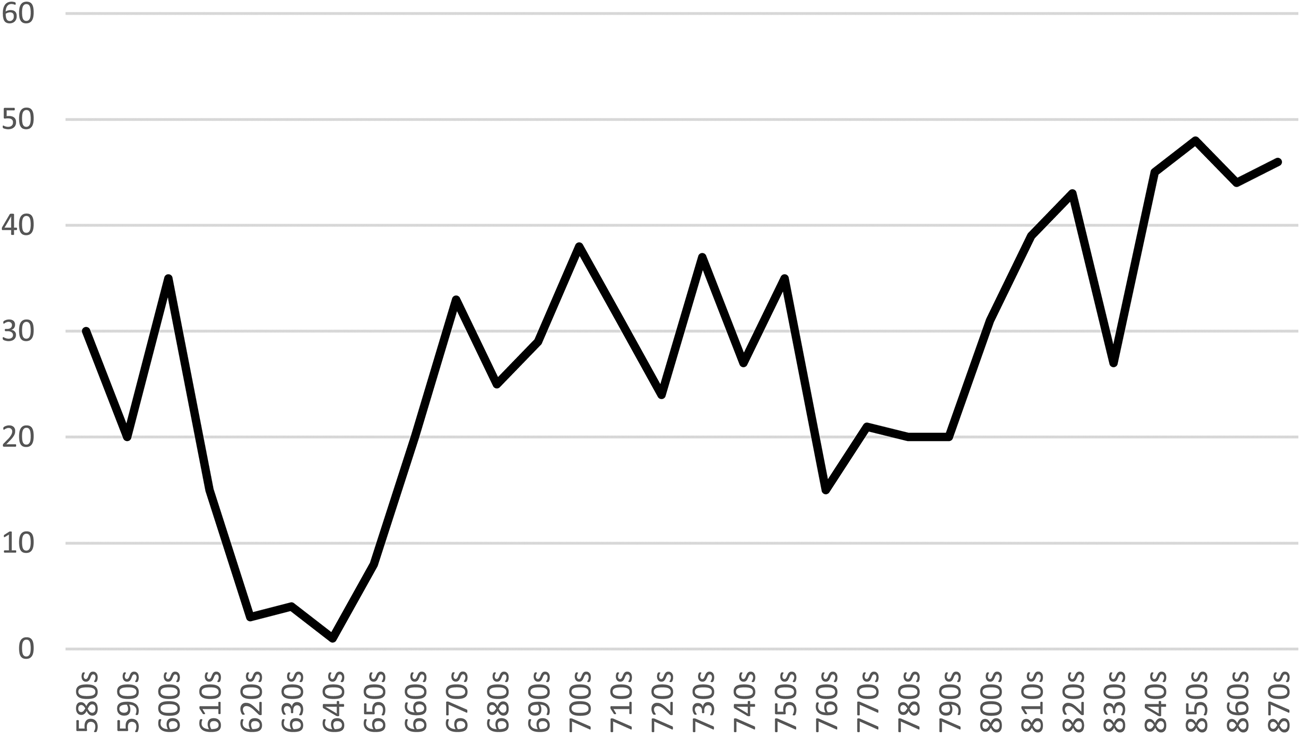
What repercussions did the aforementioned developments have on provincial elites? In this final section, I shift focus from what we can learn about the structure of the Tang elite from capital epitaphs to what we can learn from provincial ones. The sample consulted for the discussion that follows consists of most published Sui-Tang-era epitaphs from regions of north China beyond the Capital Corridor, excluding the prefecture of Luzhou.Footnote 37 It is beyond the scope of this brief survey to examine regional differences between the provinces, so I treat this sample of 800 or so inscriptions as representing a generalized cross-section of the empire's provincial elite.Footnote 38 In terms of temporal distribution, one notes an important lull in epitaph production in the 620s through 650s (Figure 5). Unfortunately, this means that, although one can discern much about the Sui Period and the period accompanying the rise of Empress Wu, one has far less data on the decades immediately following the Tang founding.
Total number of epitaphs in provincial sample (by decade)

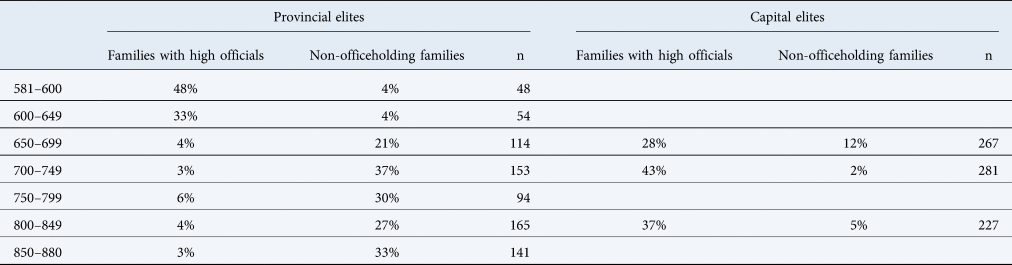
What can we learn from this sample of epitaphs? One of the most important trends transforming provincial elite society of the Sui and Tang involved declining ties between the provinces and the center of imperial power. The diminished political importance of provincials can be measured using a variety of different metrics. One can see it in the ever smaller fraction of epitaphs composed for members of the high imperial elite—that is, individuals with immediate family members serving in high-ranking positions in the civil bureaucracy—as well as the increased fraction of epitaphs composed for individuals with no officeholders in their immediate family (Table 5). The sharpest drop came sometime after the founding of the Tang. It is conceivable that there would have been a further decline in ties to officialdom in the post-An Lushan period had the provincial governments not become major employers of provincial elites (as we shall see below).Footnote 39 Of course, “non-officeholders” were not necessarily individuals with no connections to the state. Some undoubtedly served in the army—but without holding an office—or they assisted the local administration as a sort of liaison to local society.Footnote 40 Such men appear to have sometimes received honorary titles from the state in compensation for their contributions, titles that did not confer any political authority.Footnote 41 There were also individuals eligible for service, who may have sought office, but who were never assigned a substantive post.Footnote 42 And then there were those who received special titles granted to elderly members of the local elite who had reached the age of 80.Footnote 43 Such connections to the state among non-officeholders does much to suggest the hegemony of imperial power in local society. But one should not assume these non-officeholders held sway beyond their own local society; they had nowhere near the political clout of the capital-based bureaucratic elite.
Family officeholding traditions of provincial vs. capital elites (by period)

Note: Data culled from sample of provincial epitaphs depicted in Figure 5, plus cross-section of capital epitaphs defined in Table 3. Families analyzed based on officeholding of the deceased (or husband of the deceased), the deceased's brothers, the deceased's sons, and the father and grandfather of the deceased (and of the husband of the deceased). “High officials” are defined as central government bureaucrats of rank 5 or higher, the magistrates of the metropolitan counties (Wannian, Chang'an, Henan, Luoyang, Taiyuan, Jinyang, and Fengxian), as well as top prefectural officials (prefects (刺史), vice prefects (司馬), chief administrators (長史), and administrative aides (別駕)) whose place of office was not in their province of burial (i.e., prefects, etc. serving in the Hebei autonomous provinces generally did not count as “high officials”). “Non-officeholding families” were families in which no members (as defined above) held office. Non-officeholders included men whose only identified official title was a merit title (勳官) or a posthumous title (贈官), i.e. titles granted as rewards that did not confer actual political clout. Also included were office eligible individuals who did not secure an office, including exam graduates, and holders of civilian prestige titles below rank 5. By contrast, men whose only identified official title is a military prestige title, a civil prestige title of rank 5 or higher, or one of the many honorary titles prefixed with jianjiao (檢校) or shi (試) are all assumed to have concurrently held a substantive office. For more on merit/prestige titles and officeholding, see notes 41–42.
Data source: _JCH_table5_pt1 and _JCH_table5_pt2 in TBDB ver. 1.5.
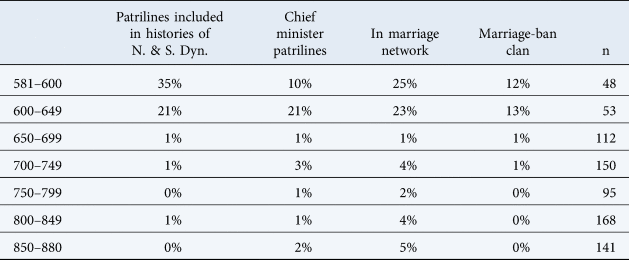
Diminishing provincial ties to the highest echelons of political power can also be measured on the basis of the fraction of epitaphs composed for scions of prominent pre-Sui families (defined here as individuals whose ancestors had biographies in the dynastic histories of the Northern and Southern Dynasties), as well as members of the clans of Tang chief ministers, of clans belonging to the capital-based marriage network described above, and of the marriage-ban clans. As shown in Table 6, one recognizes a rapid decline in the provinces of such well-connected families after the founding of the Tang, though it remains unclear if it was the fall of the Sui or the rise of Empress Wu that made the greater impact.Footnote 44
Family background of provincial elites (by period)

Note: “Patrilines included in histories of N. & S. Dyn.” refers to families with demonstrable genealogical ties to an individual with a biography in the dynastic history of one or more of the Northern and Southern Dynasties; it does not include individuals claiming a famous distant ancestor. “Chief minister patrilines” includes individuals with demonstrable genealogical ties to men included in the New Tang History tables of the families of chief ministers. On “marriage network,” see notes to Table 1. “Marriage-ban clan” refers to specific patrilines with demonstrable genealogical ties to one of the seven “marriage-ban” clans.
Data source: _JCH_table6 in TBDB ver. 1.5.
How does one account for the exceptional cases of Tables 5 and 6? Who were the provincials who apparently enjoyed ties to the heights of imperial power? Among the fifteen ninth-century epitaphs for provincials participating in the capital-based marriage network, six involved Hebei governors or their close relatives, families known to have intermarried with the imperial clan. One finds, for example, epitaphs of one of the governors of the autonomous Hebei province of Chengde and of his daughter. The governor had married the granddaughter of Emperor Xianzong—in what was essentially a dynastic marriage meant to draw the governor back into the Tang fold.Footnote 45 Of the remaining nine cases (a group that included all three ninth-century family members of chief ministers represented in Table 6), the majority were probably individuals participating in a well-documented survival strategy involving outward migration from the capital. Facing difficulty surviving in the hypercompetitive environment at the capital, some scions of prominent political families took advantage of appointments in the provinces to obtain land and reestablish themselves in the provinces. In so doing, they were in a good position to remain important in local society, even if they rapidly lost the connections necessary to secure offices at the center for themselves and their descendants.Footnote 46 Thus, for example, there is the epitaph of Wei Xiang 魏湘 (804–854), who served in office in autonomous Weibo Province, where his father had also served. Though he was a direct sixth-generation descendant of the famous early Tang chief minister Wei Zheng 魏徵 (580–643), by the time of his father's generation, his branch of the family had already committed themselves to service in Weibo.Footnote 47 Men like Wei Xiang, though they may appear to have maintained enduring ties to the high political elite, in fact represented families with rapidly dwindling connections to the capital and capital society.
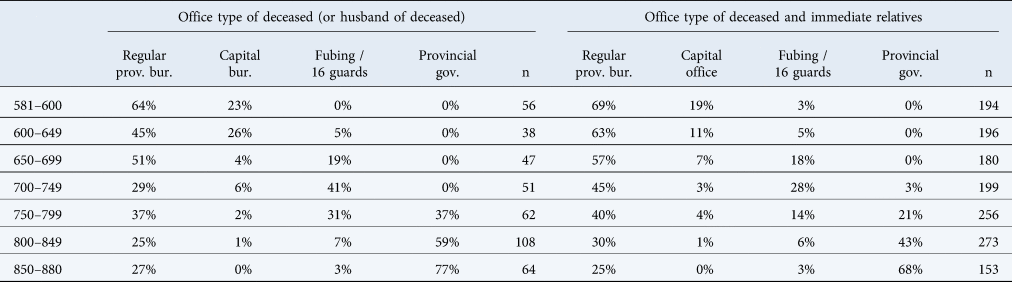
A second major trend affecting Sui-Tang provincial elite society involved the impact of a new layer of regional administration established in the post-An Lushan Period, that of provincial governments. Whereas prefectures had constituted the highest level of regional government in the early Tang, provinces were established in the post-An Lushan Period that now played an oversight role over their subordinate prefectures and also oversaw regional armed forces. This province-level of administration—headed by a governor (usually jiedushi or guanchashi)—rapidly became a major employer of provincial elites (Table 7). As is now well known, provincial governments also employed capital elites, including ambitious men early in their careers. However, unlike provincials, capital elites took positions as upper-echelon civilian bureaucrats in the provincial governments, positions that, according to court directives, provided them with fast-track promotion opportunities into the regular bureaucracy. Many of these men were initially hired by the governor at the capital (i.e., selected from among the capital-based elite) even before he left for his tenure in office. Provincial elites by contrast—with the notable exception of those inhabiting the autonomous provinces in Hebei—took either military offices or lower-echelon civilian positions, positions that precluded any hope of rising to higher office.Footnote 48
Office types of provincial officeholding elites

Note: Incorporates data from provincial epitaph sample described above; non-officeholders excluded from calculations. Office types of elites are calculated using two different methods. Left columns count only the deceased or deceased's husband; to increase the sample size, right columns include in addition the sons and brothers (of deceased), as well as the father, grandfather, and great grandfather (of deceased and husband), but excludes families with over 50 known members (so as to exclude capital-based relatives of provincial elites). “Regular provincial bureaucracy” refers to offices at the county or prefectural level; “capital bureaucracy” refers to central government administrative positions of any rank; “fubing/16 guards” refers to military and civilian officeholding positions in the fubing militias, the capital-based Sixteen Guards (十六衛府), as well as the Three Capital Guards (三衛), but excluding honorary appointments to Sixteen Guards, which became common by the second half of the eighth century; “provincial government” refers to military and civilian officeholding positions under provincial (jiedushi, guanchashi, etc.) control.
Data source: _JCH_table7_pt1 and _JCH_table7_pt2 in TBDB ver. 1.5.
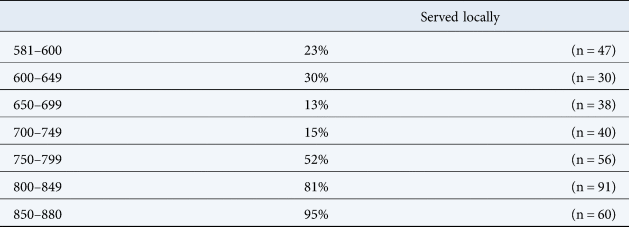
A third major trend evident from the survey of provincial epitaphs accompanied the creation of provincial governments in the immediate post-An Lushan Period. In brief, provincial officeholders increasingly came to serve in their home locales (Table 8). In earlier times, the majority of officeholders served in the regular provincial bureaucracy, or in offices in the fubing “militia” system—a system in which soldiers were rotated between the Sixteen Guards at the capital and provincial garrisons attached to one of the capital guards. These appointments seem to have adhered strictly to the law of avoidance, such that individuals traveled away from home to take up their posts. In the case of fubing appointments (particularly common among Hedong and Xiazhou elites), ordinary militia soldiers may have been locals, but epitaph data suggests that officers generally served away from home, either at an appointment at the capital or at a provincial garrison hundreds of kilometers away.Footnote 49 The establishment of provincial governments ushered in a radical departure from earlier practice. With the law of avoidance not enforced in provincial governments—which hired their staffs without direct central government involvement—new employment opportunities became available for locals to serve at home. Except in the autonomous provinces, upper-echelon civilian officials (including the governor himself) were typically outsiders, usually selected from among the capital-based elite, but the remainder of the staff consisted of men recruited locally.
Local officeholding among provincial elites

Note: Based on provincial epitaph sample described above. Includes only epitaphs for which the deceased (or husband) is an officeholder. “Served locally” means deceased (or husband) served within the prefecture of burial prior to 750 and within the province of burial post-750.
Data source: _JCH_table8 in TBDB ver. 1.5.
Conclusion
This paper has sought via four mini-studies—on the capital-based marriage network of political elites, on the backgrounds of the chief ministers, on the composition of the capital elite during three time slices, and on the makeup of the provincial elite—to offer new insight on how the political elite evolved over the course of the Tang Dynasty. One conclusion one can draw from this analysis is that the political elite was marked as much by continuities over time as by discontinuities. Throughout the dynasty, one recognizes the same marriage network of politically influential patrilines, patrilines that had served in office generation after generation since before the founding of the dynasty. These patrilines supplied most of the Tang chief ministers, and presumably the lion's share of other top officials. The network constituted a capital elite insofar as the families were almost all based in one of the two capital cities by no later than the late seventh century—even earlier than has often been assumed. Moreover, throughout the dynasty, the network was structured in a similar way, with two prominent marriage cliques at its core: one consisting primarily of the preeminent “marriage-ban” clans and one organized around the Tang imperial Li clan.
Much has been made of attempts by the Sui and early Tang to weaken the power of entrenched provincial families through institutional innovations. But one should not conclude, as many have in the past, that the medieval aristocratic families declined as a consequence. Quite to the contrary, it was precisely by diminishing their influence that institutional developments helped ensure that local elites (except those in the prefectures immediately adjacent to the capital) competed poorly for high office with their capital-based counterparts. Though they continued to serve in low-ranking offices, it was rare already by the mid-seventh century to find provincials serving in high-ranking offices at the capital. Meanwhile, scions of the old pre-Tang elite, now established in the capital cities, were able to benefit from their connections in the capital, and from what was in essence an alliance with the dynasty and the imperial clan. As it adapted to new circumstances through relocation to the capital, aristocratic families were strengthened rather than diminished by the institutional changes—and this to the very end of the dynasty.
The political divide separating the capital from the provinces was further accentuated after the An Lushan Rebellion as a consequence of the establishment of new provincial governments. In the first half of the dynasty, officeholders among local elites tended to serve away from home, in county- or prefectural-level positions all over the empire, or in an office in a fubing militia. In all appearance, official appointments adhered to the “law of avoidance,” which forbade men from serving near their home bases. The staffing of the new provincial governments fundamentally changed the situation. It did so not by opening up new avenues of upward mobility for locals, as has been previously argued, but rather by assigning them to offices near their home locales. It was as a consequence of this reorganization of the geography of political power that the provinces came to have a “colonial” relationship with the metropolitan center. By the ninth century, agents of the center were dispatched from the capital to serve in county- or prefectural-level offices, as well as in upper-echelon civilian posts in the provincial governments, where they would remain in office for a fixed term (usually no more than three years) before returning to the capital. Meanwhile, local elites served exclusively in lower-echelon posts or in the local provincial military.Footnote 50
However, though it was the same “aristocratic” families that continued to dominate power throughout the dynasty, there were discontinuities over time in the structure and makeup of the capital elite. Perhaps the most important change involved the rise to much greater political prominence of Luoyang families. Whereas Luoyang had been a secondary political center in the 650s, it grew by the 720s to be on par with Chang'an as a place where powerful patrilines concentrated. Most notable among the Luoyang-based families acquiring a new influence at court were the marriage-ban clans—that is, those patrilines at the core of one of the two marriage cliques. A more systematic analysis of Luoyang epitaphs dating to the intermediary decades between the 650s and 720s may clarify when precisely the Luoyang elites acquired their new prominence (and when and to what extent families of the marriage-ban clique relocated there from Hebei at this time). But, in all likelihood, Empress Wu's reign played a critical role. Not only did she move the imperial court to Luoyang, but she also famously sought to staff the bureaucracy with men loyal to her rather than to the Tang imperial clan. And what better group to elevate than a cluster of prestigious old families that, unlike the families of their rival marriage clique, had not intermarried extensively with the Tang imperial house?Footnote 51
The data here also sheds new light on the pre-Sui regional elites. In Chen Yinke's classic account, court politics of the seventh and eighth centuries were driven by factional struggles between three regional blocks—a northwestern, a northeastern, and a southern elite—with origins in the regional regimes of the sixth century.Footnote 52 The present study suggests that, though he had access to far less empirical data, Chen was not far off the mark. Indeed, the marriage-ban clique can be thought of as a block of families with predominantly northeastern origins. But one should not overstate the significance of regional origin as a source of political solidarity. The imperial-clan clique was less monolithic than the marriage-ban clique, and it included families from the northeast (and south) as well. Moreover, throughout the dynasty, the two cliques intermarried with each other at a low but relatively consistent rate. Finally, although Chen and others have argued that Empress Wu ushered in a class struggle between an old elite and a newly risen class of bureaucrats, it is more likely given available data that the old aristocratic families faced no significant new rivals. Right into the ninth century, the primary actors in competition with each other for political power came from a single large marriage network of patrilines, nearly all of which had officeholding traditions going back to pre-dynastic times.
If both cliques and the bulk of the broader capital-based marriage network were composed of northwestern or northeastern families, what might one surmise about the southern elite in the Tang? Historians have long ago noted the dominance of the northern elite at the early Tang court.Footnote 53 An analysis of the pre-Sui origins of elite Tang patrilines, as well as of choronym usage in capital epitaphs, suggests that southerners further declined in influence over the course of the Tang Dynasty. Their decline may reflect in part how social capital contributes to political reproduction. Southern patrilines were peripheral members of the marriage network of political elites, putting them at a disadvantage in competing with the core patrilines of the network.Footnote 54 There may have been pull factors in addition, encouraging southern families to shun office and remain in the south. As I have previously noted, in the provinces (i.e. away from the capitals and Capital Corridor), it was only in the south that one could still find as late as the ninth century scions of the old aristocratic families inhabiting their places of ancestral origin.Footnote 55 These families had no ties to officialdom, yet still managed to survive as a local elite. It is possible that, far from the political center and the much greater concentration of military power in the north, it was easier for families to persist for centuries entrenched in local society, where they perhaps took advantage of new economic opportunities.
One last point to consider in light of the data presented above is somewhat more speculative, and concerns how cultural capital was deployed as a strategy for maintaining long-term political influence. As others have noted, the Sui and early Tang courts compiled lists of eminent clans from across the realm, identifying these clans by surname and choronym. Though such lists did not guarantee a family easier access to office (as they may have had under earlier dynasties), their very compilation suggests they may have played an informal role in the selection of bureaucrats. It has been argued that the court's decision to abandon such genealogical projects by the mid-eighth century reflected the end of the aristocratic age, especially given that it coincided with a moderate expansion in the use of the civil service examination for bureaucratic recruitment. How then would certain illustrious patrilines with long histories of bureaucratic service have adapted effectively to changing circumstances, as the empirical data would suggest they did? The greater density of intermarriages between marriage-ban clans in the post-An Lushan period reflected the more extensive deployment of social capital as a resource for political reproduction.Footnote 56 This strategy was combined with concerted efforts by the old families to articulate clearly their distinction from the rest of society. Choronyms became a more explicit component of their identity, as reflected in their greater use in the title lines of epitaphs. But choronyms were insufficient in themselves to define the most powerful elites, as increasing numbers of descendants of the great families could claim such illustrious pedigrees. Thus, simultaneously, the most eminent and successful branches of the aristocracy made renewed efforts in their funerary biographies (and presumably in other public writings) to lionize the officeholders among their immediate ancestors (including three generations up the patriline) and relatives by marriage (especially maternal grandfathers and fathers-in-law).Footnote 57 Not coincidentally, it was in the ninth century (and, as far as I can tell, not earlier) that one encounters a number of epitaphs with long and elaborate celebrations of the deceased for her or his family's generations of officeholding and generations of good marriages.Footnote 58 These ways of asserting one family's eminence became part of a multi-pronged strategy for maintaining political power under changing circumstances.