Introduction
Laryngeal squamous cell carcinoma (SCC) is the most frequent malignancy occurring in the head and neck region.Reference Cann, Fried and Rothman1 It is well known that SCC is strongly related to environmental factors, and many epidemiological studies have shown that tobacco and alcohol consumption plays a major role in the development of the disease. However, only a relatively small proportion of exposed individuals develop SCC. Hence, it has been proposed that cancer associated with tobacco smoke and/or alcohol requires both exogenous exposure and genetic predisposition.Reference Muscat and Wynder2
Accumulating evidence suggests that alterations of detoxification enzymes, such as glutathione S-transferases (GSTs) and N-acetyltransferases (NATs), influence the risk of cancers associated with tobacco smoke and alcohol in exposed individuals.Reference Hein, Doll, Fretland, Leff, Webb and Xiao3, Reference Ford, Li, O'Sullivan, Demopoulos, Garte and Taioli4 Several of the GST and NAT genes are polymorphic in humans, and are currently being investigated as possible cancer risk modifiers. Two of the GST genes (GSTT1 and GSTM1) are frequently deleted in human populations. Several researchers have studied whether individuals with deletion of one or two GST genes are at increased risk of developing lung, bladder, skin or colorectal cancer; however, the present status of GSTT1 and GSTM1 deletions as cancer risk modifiers is still controversial.Reference To-Figueras, Gene, Gomez-Catalan, Galán, Fuentes and Ramón5 The GSTM3 gene is one of the mu-class GST genes (comprising types M1 to M5) and has been found to be polymorphic; a three-base deletion in intron 6 has been reported in a number of individuals.Reference Inskip, Elexperu-Camiruaga, Buxton, Dias, MacIntosh and Campbell6
The NAT2 gene is also polymorphic, and 36 alleles have so far been described (for NAT2 nomenclature, see htpp://Louisville.edu/medsschool/pharmacology/NAT.html). Sequence variations in the human NAT2 gene result in the production of NAT proteins with variable enzyme activity or stability, leading to slow or rapid acetylation. An association with either slow or rapid acetylation has been reported for different cancers.Reference Butcher, Boukouvala, Sim and Minchin7 Apart from one study, previous epidemiological studies have suggested an association between the slow acetylator phenotype and the development of head and neck SCC.Reference Henning, Cascorbi, Munchow, Jahnke and Roots8–Reference Drozdz, Gierek, Jendryczko, Pilch and Piekarska10
In the present study, we aimed to investigate whether GSTT1, GSTM1, GSTM3 and NAT2 genotype profiles were associated with the risk of laryngeal SCC in a well defined Greek cohort.
Materials and methods
Patients and controls
This hospital-based, retrospective, case–control study was conducted at the Metaxa Memorial Cancer Hospital in Piraeus, Greece, and assessed the period January 2005 to July 2007. The study group consisted of 88 Greek patients (77 men and 11 women) with a mean ± standard deviation (SD) for age of 66.5 ± 8.54 years, who were histologically diagnosed as having laryngeal SCC and who had no history of other malignancy. All patients had a mean follow up of 25.88 months and a median follow up of 20 months, regularly attended our out-patient clinic and follow up, and had complete records.
The control group included 102 healthy volunteers from the blood donor station (76 men and 26 women) with a mean ± SD for age of 62.7 ± 9.62 years, who had no history of any malignancy.
Information about tobacco and alcohol consumption was obtained. The patients and control subjects were from the same ethnic group and were genetically unrelated.
All participants gave informed consent, and the study was approved by the research and ethics committee of the hospital.
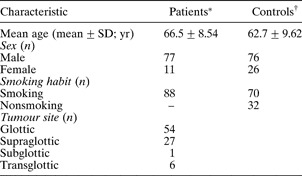
Forty-eight patients were primarily treated with surgical intervention (i.e. total or partial laryngectomy with or without neck dissection), while 40 patients were primarily treated with radiotherapy (with or without chemotherapy). Tumour localisation was supraglottic in 27 cases, glottic in 54, subglottic in one and transglottic in six. According to histopathological tumour–node–metastasis staging, 46 patients had stage I–II disease and 42 had stage III–IV disease. All the patients were heavy smokers (i.e. daily cigarette consumption of more than 20) and 50 were alcohol users. Table I summarises the patient and control group characteristics.
Demographic characteristics of patients and controls

*n = 88; †n = 102. SD = standard deviation; yr = years
Blood samples were obtained and stored at −20°C until DNA was isolated using the Nucleopsin Blood Kit (Macherey-Nagel, Dürey, Germany).
Genotyping
GSTT1 polymorphism
The polymorphic deletion of the GSTT1 gene was determined by polymerase chain reaction. The primers used to amplify the target DNA were: for GSTT-1, 5′-TTCCTTACTGGTCCTCACATCTC-3′ (where T = thymine, C = cytosine, A = adenine and G = guanine); and for GSST-2, 5′-TCACCGGATCATGGCCAGCA-3′. Forty temperature cycles were used, each cycle comprising 1 minute at 94°C, 1 minute at 62°C and 1 minute at 72°C. The first denaturation step was at 94°C for 5 minutes, and the last elongation step was extended to 5 minutes. Negative and positive control samples were included in each amplification series. The polymerase chain reaction assays were performed using the Taq polymerase of Invitrogen (Carlsbad, California, USA). The presence of at least one GSTT1 allele, identified by a 480 bp polymerase chain reaction product, or its complete deletion, were analysed by ethidium bromide 2 per cent agarose gel electrophoresis.
GSTM1 polymorphism
The polymorphic deletion of the GSTM1 gene was determined by polymerase chain reaction, as previously described.Reference To-Figueras, Gene, Gomez-Catalan, Galan, Firvida and Fuentes11 The primers used to amplify the target DNA were: for GSTM1-1, 5′-GAAGGTGGCCTCCTCCTTGG-3′; and for GSTM1-2, 5′-AATTCTGGATTGTAGCAGAT-3′. Thirty temperature cycles were used, each cycle comprising 1 minute at 94°C, 1 minute at 55°C and 1 minute at 72°C. The first denaturation step was at 94°C for 5 minutes and the last elongation step was extended to 5 minutes. Negative and positive control samples were included in each amplification series. Polymerase chain reaction assays were performed using the Taq polymerase of Invitrogen (Carlsbad, California, USA). The presence of at least one GSTM1 allele, identified by a 165 bp polymerase chain reaction product, or its complete deletion, were analysed by 2 per cent ethidium bromide agarose gel electrophoresis.
GSTM3 polymorphism
The polymorphic site of the GSTM3 locus was analysed using restriction fragment length polymorphism of polymerase chain reaction amplified fragments. Amplification of the GSTM3 locus was achieved using the primers 5′-CCTCAGTACTTGGAAGAGCT-3′ and 5′-CACATGAAAGCCTTCAGGTT-3′. After 5 minutes at 94°C, the polymerase chain reaction assay was processed through 40 temperature cycles of 50 seconds at 94°C, 40 seconds at 59°C and 50 seconds at 72°C. The last elongation step was extended to 5 minutes. Polymerase chain reaction assays were performed using the Taq polymerase of Invitrogen (Carlsbad, California, USA). A 15 µl aliquot of the polymerase chain reaction product was digested with three units of MnlI restriction enzyme (BioLabs, Ipswich, MA, USA). Detection of the different alleles was carried out by electrophoresis in 3 per cent agarose gel. The GSTM3*A/GSTM3*A homozygotes presented the expected 11, 51, 86 and 125 bp fragments. The GSTM3*A/GSTM3*B pattern demonstrated additional 134 bp fragments, and the GSTM3*B/GSTM3*B homozygotes gave the expected 11, 125 and 134 bp fragments.
NAT2 genotype
The NAT2 genotype was determined using a modification of our polymerase chain reaction restriction fragment length polymorphism assay, which was designed to avoid the pitfalls reported recently for NAT2 genotyping.Reference Doll, Fretland, Deitz and Hein12, Reference Cascorbi and Roots13 The published assay was modified to distinguish between the 26 known human NAT2 alleles.Reference Doll, Fretland, Deitz and Hein12, Reference Hein, Doll, Rustan, Gray, Feng and Ferguson14 All NAT2 genotype assignments were blind to case–control status. The NAT2 gene was amplified by polymerase chain reaction using the Taq DNA polymerase of Invitrogen (Carlsbad, California, USA) and the primers 5′-GGCTATAAGAACTCTAGGAAC-3′ and 5′-AAGGGTTTATTTGTTCCTTATTCTAAAT-3′. The mixture was subjected to a 5 minute pretreatment at 94°C, followed by 35 cycles each comprising 1 minute at 94°C, 1 minute at 55°C and 1 minute at 72°C, plus a 5 minute extension step at 72°C. The fragments G191A, A434C and C481T were detected by digesting 15 µl of the NAT2 polymerase chain reaction product with restriction enzymes MspI (10 units) and KpnI (5 units) (New England Biolabs, Beverly, Massachusetts, USA) supplemented with 100 mg/ml bovine serum albumin. The G191A fragment causes loss of an MspI site, yielding bands of 416, 384 and 66 bp, whereas the A434C fragment adds an additional MspI site, yielding bands of 416, 244, 93, 66 and 47 bp. The C481T fragment results in loss of the KpnI restriction site, yielding fragments of 707, 93 and 66 bp. When neither allele contains G191A, A434C or C481T, then 416, 291, 93 and 66 bp bands result. The fragments T111C, G590A, C759T and G857A were distinguished after digestion of the NAT2 polymerase chain reaction product with TaqI (10 units) and BamHI (10 units) (New England Biolabs) supplemented with 100 mg/ml bovine serum albumin. The T111C fragment adds a TaqI restriction site, resulting in 252, 226, 170, 98, 80 and 40 bp fragments. The G590A and C759T fragments delete TaqI restriction sites, yielding bands of 396, 332, 98 and 40 bp and of 332, 268, 226 and 40 bp, respectively. The G857A fragment causes loss of the BamHI restriction site, yielding 332, 226, 170 and 138 bp bands. When neither allele contains T111C, G590A, C759T or G857A, then 332, 226, 170, 98 and 40 bp bands result.
Statistical analysis
Allele frequency comparisons and odds ratios were obtained using Fisher's exact test and 95 confidence intervals (CI), using GraphPad version 3.00 software (GraphPad Software Inc, San Diego, California, USA). The p values were all two-sided. The level of statistical significance was set at p < 0.01. A p value of between 0.01 and 0.05 was considered a weak but still significant association meriting attention.
Results
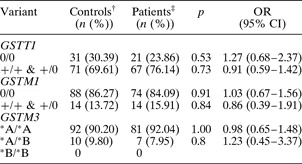
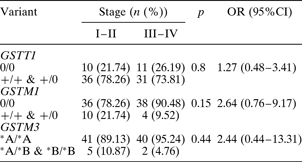
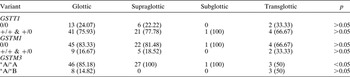
The frequency of the null genotypes at the GSTT1 and GSTM1 loci did not differ significantly, comparing the study and control groups (Table II). Furthermore, the GSTM3 genotype frequencies did not differ notably between patients and controls (Table II). The occurrence of GSTT1, GSTM1 and GSTM3 polymorphisms and their association with tumour stage and site are shown in Tables III and IV, respectively. No significant association was found between cancer stage and the GSTT1, GSTM1 and GSTM3 genotypes. Carriers of the GSTM3 genotype A*/A* were marginally more frequently represented amongst patients with supraglottic cancer (p < 0.05). With this exception, there was no correlation between cancer site and the GSTT1 and GSTM1 genotypes (Table IV). Coincident null genotypes for the GSTT1 and GSTM1 genes and the GSTM3 *A/*A genotype were found more frequently in patients than in controls (p < 0.05).
GSTT 1, GSTM1 and GSTM3 genotype variants in patients and controls

Frequencies compared using Fisher exact test. †n = 102; ‡n = 88. OR = odds ratio; CI = confidence interval
GSTT1, GSTM1 and GSTM3 genotype variants by tumour stage
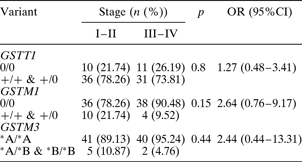
OR = odds ratio; CI = confidence interval
GSTT1, GSTM1 and GSTM3 genotype variants by tumour site

Data represent patient numbers and percentages unless otherwise specified.
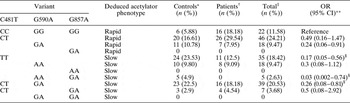
Regarding the NAT2 gene, the G191A, A434C, T111C and C759T polymorphisms were not detected in our samples. In the patient and control populations, the frequency of the C481T variant (CT and TT genotypes) was respectively 65.42 and 68.63 per cent; the frequency of the G590A variant (GA and AA genotypes) 35.23 and 48.04 per cent; and the frequency of the G857A variant (GA and AA genotypes) 4.54 and 7.84 per cent. These differences in genotype frequencies in patients and controls were not statistically significant. The reference allele NAT2*4 (C481T + G590A + G857A) was found in 18.18 and 5.88 per cent of patients and controls, respectively (Table V). We did not observe the homozygous 857AA genotype (also in laryngeal SCC group and controls), which is known to be rare among Caucasians.Reference Meyer and Zanger15
NAT2 genotype variants in patients and controls

*n = 102; †n = 88; ‡n = 190. **In calculation of odds ratios (ORs) for individual genotypes, NAT2*4/*4 (C481T + G590A + G857A) was used as reference and all corresponding ORs were determined with respect to this reference, between patients and controls. §Significant. CI = confidence interval; C = cytosine; G = guanine; T = thymine; A = adenine
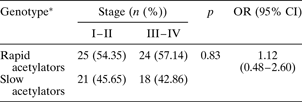
The distribution of overall genotypes was 55.68 per cent (49/88) rapid acetylator and 44.32 per cent (39/88) slow acetylator in patients, and 36.27 per cent (37/102) rapid acetylator and 63.72 per cent (65/102) slow acetylator in controls. The odds ratio for rapid acetylator status in cases versus controls was 2.207 (95 per cent CI 1.23–3.95, p = 0.0087), which was significant. The slow acetylator genotypes appeared to be protective in the population tested (Table V). No significant association was found between tumour stage and NAT2 rapid or slow acetylator genotypes (Table VI). Furthermore, there was no association between NAT2 rapid or slow acetylator genotypes and tumour site (Table VII).
NAT2 genotypes by tumour stage
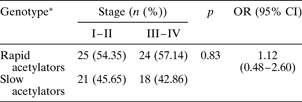
*Rapid and slow acetylator genotypes shown in Table V. OR = odds ratio; CI = confidence interval
NAT2 genotypes by tumour site

Data represent patient numbers and percentages unless otherwise specified. *Rapid and slow acetylator genotypes shown in Table V.
Discussion
In the present study, the distribution of allele and genotype frequencies in a number of genes was compared in patients with laryngeal SCC and in healthy individuals, in order to investigate a possible association between genetic polymorphisms and laryngeal SCC susceptibility. To the best of our knowledge, this is the first genotyping study of laryngeal SCC within a Greek population.
In this study, the distribution of null and present polymorphisms of the GSTT1 and GSTM1 genes was similar in patients and controls. Similarly, the GSTM3 genotypes studied were found not to be associated with laryngeal SCC in the population studied. However, the coincidence of GSTT1 and GSTM1 null genotype and GSTM3 *A/*A genotype was more frequent in patients than in controls.
Regarding the GSTT1 and GSTM1 null variants and the risk of cancer, the results of other studies have been inconsistent. A number of head and neck cancer studies have reported an increased risk of laryngeal cancer in patients with the GSTT1 null variant.Reference Trizna, Clayman, Spitz, Briggs and Goepfert16 On the other hand, and in accordance with our results, no association was found between the GSTT1 and GSTM1 null variants and laryngeal SCC.Reference Gajecka, Rydzanicz, Jaskula-Sztul, Kujawski, Szyfter and Szyfter17
Regarding GSTM3 polymorphism, our results are in agreement with those of previous studies indicating that the presence of the GSTM3*B allele appears to be associated with a reduced risk of laryngeal SCC.Reference Jahnke, Strange, Matthias and Fryer18
• Laryngeal squamous cell carcinoma (SCC) is strongly related to tobacco and alcohol consumption
• Alterations of detoxification enzymes, such as glutathione S-transferases and N-acetyltransferases, influence the risk of cancers associated with tobacco smoke and alcohol
• This study investigated whether GSTT1, GSTM1, GSTM3 and NAT2 genotype profiles were associated with laryngeal SCC risk in a well defined Greek cohort
• There was a significant relationship between rapid acetylator genotypes and laryngeal SCC within the study population
Genetic analysis of the three NAT2 genetic polymorphisms found in the population studied (C481T, G590A and G857A) showed a statistically significant overall association between rapid acetylator genotypes and laryngeal SCC risk. However, no individual genotype was found to be associated with increased susceptibility to laryngeal SCC. Interestingly, the slow acetylator genotypes seem to lend protection against the disease. The proportion of rapid and slow acetylators varies in populations of different ethnic and geographic origin. The percentage of slow acetylators is 40–70 per cent in Europe, approximately 10 per cent in Japan, 5 per cent in Eskimos and 87 per cent in Egyptians.Reference Blum, Demierre, Grant, Heim and Meyer19 In the present study, the percentage of slow acetylators in the control group was 63.72 per cent. The results of several studies assessing laryngeal SCC susceptibility and acetylation status have been contradictory.Reference Morita, Yano, Tsujinaka, Akiyama, Taniguchi and Kaneko9, Reference Drozdz, Gierek, Jendryczko, Pilch and Piekarska10 Some have suggested an association between slow acetylator genotype and laryngeal SCC. However, Henning et al. and the present study demonstrated a significant over-representation of rapid acetylator genotypes among patients with laryngeal SCC.Reference Henning, Cascorbi, Munchow, Jahnke and Roots8 Support for these findings comes from Cascorbi and colleagues' study on lung cancer (smoking has a similar effect on the development of this cancer, compared with laryngeal SCC); this study found rapid acetylation status to be a highly significant risk factor in lung cancer development.Reference Cascorbi, Brockmoller, Mrozikiewicz, Bauer, Loddenkemper and Roots20
The major limitation of our study was its modest sample size (although comparable to other published studies), since it involved only one centre within a small country. Thus, further studies, with larger sample populations, are necessary to delineate the potential role of polymorphisms in genes coding for detoxification enzymes, as regards the risk of laryngeal SCC development.
Conclusion
This study found a significant relationship between rapid acetylator genotypes and laryngeal SCC development within a Greek population.
Acknowledgements
This study was supported by a grant from the Research Committee of the University of Athens (number 1219/2007).