INTRODUCTION
Partners are affected mentally and physically by their spouses' cancer diagnosis (Cassileth et al., Reference Cassileth, Lusk and Strouse1985; Quinn et al., Reference Quinn, Fontana and Reznikoff1986; Northouse et al., Reference Northouse, Dorris and Charron-Moore1995; Pistrang & Barker, Reference Pistrang and Barker1995; Baider et al., Reference Baider, Kaufman, Peretz and Baider1996, Reference Baider, Koch and Esacson1998; Keller et al., Reference Keller, Henrich, Sellschopp and Baider1996; Ey et al., Reference Ey, Compas and Epping-Jordan1998), and female partners, in particular, are more psychologically distressed than their male counterparts (Baider et al., Reference Baider, Koch and Esacson1998; Morse & Fife, Reference Morse and Fife1998; Northouse et al., Reference Northouse, Mood and Templin2000). Female partners of spouses with cancer are a vulnerable population and, like their ill spouses, require assistance from health care providers.
Studies have demonstrated that female partners are at risk for psychological strain (Morse & Fife, Reference Morse and Fife1998; Gray et al., Reference Gray, Fitch and Phillips2000), and experience increased levels of anxiety and depression (Baider et al., Reference Baider, Koch and Esacson1998; Northouse et al., Reference Northouse, Mood and Templin2000). Female partners assist their ill spouses to cope with the effects of illness while also attempting to cope with their own stress (Baider et al., Reference Baider, Koch and Esacson1998; Gray et al., Reference Gray, Fitch and Phillips2000). In comparison, male partners report that the need to undertake household tasks contributes greatly to the strain they experience (Carey et al., Reference Carey, Oberst and McCubbin1991; Allen, Reference Allen1994; Keller et al., Reference Keller, Henrich, Sellschopp and Baider1996; Gilbar, Reference Gilbar1999). Studies conducted during cancer recurrence, a stage that precedes the transition to end-of-life care, reveal that family members are strongly focused on treatment side effects and outcomes (Halliburton et al., Reference Halliburton, Larson and Dibble1992; Jansen et al., Reference Jansen, Halliburton and Dibble1993).
During the transition to end-of-life care, patients and their partners must make critical decisions regarding goals of care. These decisions mark a transition in which the approach to care becomes focused on quality of life rather than cure. One transition study explored patients' and family members' transition to hospice for relatives with terminal cancer (Schulman-Green et al., Reference Schulman-Green, McCorkle and Curry2004). The study revealed that family members delayed patients' enrollment to hospice based on their awareness and acceptance of patients' conditions rather than objective appraisal of patients' disease progression. Participants in this study were interviewed following their relatives' deaths, which may have colored the stories of their experiences.
The majority of the research conducted on female partners of cancer patients has focused on the measurement of psychological distress (Keller et al., Reference Keller, Henrich, Sellschopp and Baider1996; Baider et al., Reference Baider, Koch and Esacson1998; Morse & Fife, Reference Morse and Fife1998; Northouse et al., Reference Northouse, Mood and Templin2000) and during diagnosis and early treatment (Keller et al., Reference Keller, Henrich, Sellschopp and Baider1996; Baider et al., Reference Baider, Koch and Esacson1998; Gray et al., Reference Gray, Fitch and Phillips2000; Northouse et al., Reference Northouse, Mood and Templin2000). Participants' responses were limited to the concepts presented in the research instrument. A qualitative approach is best suited to capture more fully the complexities of the partner's subjective experience. There is a gap in the literature with regard to qualitative studies that explore female partners' experiences when they learn that their spouses are dying from cancer. The purpose of this study was to capture the meaning of female partners' experiences when their spouses with cancer transition to end-of-life care. An increased understanding and awareness of female partners' experiences during this time will enhance the health care provider–client relationship as well as facilitate the transition to end-of-life care.
METHODS
Study Design and Sample
Face-to-face interviews were conducted on eight female partners from two hospices and a community-based palliative care service. Criterion sampling, a type of purposeful sampling, was used for the study (Creswell, Reference Creswell1998). The inclusion criteria were that participants were female partners of persons with cancer receiving palliative care services focused on the quality of life. A female partner was defined as any person who considered herself a partner (Morse & Fife, Reference Morse and Fife1998; Wright & Leahey, Reference Wright and Leahey2000) and lived or had lived with the patient. Ethics approval was obtained from four ethics review boards including the Hamilton Health Sciences/McMaster Faculty of Health Sciences Research Ethics Board.
Participants
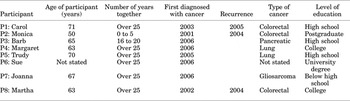
Seven participants were recruited from two local area hospices and one participant was recruited from a palliative home care agency (N = 8). One of the participants from the hospices was recruited from an out-patient program. Five of the eight spouses had advanced cancer at the time of their initial diagnosis, and this resulted in nearly direct transitions to end-of-life care. Participants' ages ranged from 50 to 71 years. The majority of participants had been with their spouses for over 25 years (n = 6), whereas one had been with her partner for 16 to 20 years and one had lived with her partner 5 years or less (Table 2).
Data Collection
Agency personnel from hospices approached potential participants with notices that explained the study purpose and what might be expected. Agency staff asked each interested woman if the researcher might call her. For the home care agency, a registered nurse in a supervisory position mailed potential participants a letter that provided the same information contained in the notices as above. A follow-up phone call was made by the contact person to ask each potential participant if she would like to take part in the study and if the researcher might call her. The procedure for the home care agency was modified so that home care nurses would not have to recruit their patients' partners for the study and thereby avoid any subtle coercion. The researcher contacted potential participants to arrange an interview at a comfortable location convenient to them. All participants from the hospice setting selected a quiet room that was set aside in the hospice for family members and was private and comfortable. One interview was conducted in a participant's home. All interviews were conducted between July 2006 and March 2007 and lasted approximately 60 to 90 minutes.
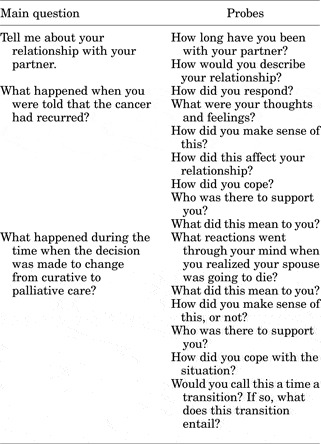
A sample of the questions and prompts used to conduct the study are shown in Table 1. All interviews were taped and transcribed. Participants' names and any identifying information were removed to ensure confidentiality and anonymity.
Sample questions from the interview guide

The participants

Data Analysis
An interpretive phenomenological approach was used based on Gadamer's (Reference Gadamer, Weinsheimer and Marshall1960/1975) philosophy of understanding. Gadamer claimed that tradition influences our sense of being and is expressed through language (Geanellos, Reference Geanellos1998). Thus, emphasis was placed on language to gain a deeper understanding. Gadamer's philosophy was applied within the framework of Fleming et al. (Reference Fleming, Gaidys and Robb2003), who outline methods highly consistent with Gadamer's philosophy.
Analysis was completed by the first author and included the following phases: interviews were read in their entirety to reveal the meaning of the text as a whole; the text was read in parts, line by line, to identify any emerging themes; dialogue with the text proceeded through the back-and-forth movement between the parts and the whole, while themes were categorized and reduced; and prejudices were continually confronted through reflective journaling. Data analysis continued until no new themes emerged (Sandelowski, Reference Sandelowski1995; Morse, Reference Morse2000; Patton, Reference Patton2003).
To support analysis, three experienced researchers reviewed portions of the data to corroborate interpretations. An audit trail was maintained that demonstrated development and reduction of themes and categories (Sandelowski, Reference Sandelowski1986; Fleming et al., Reference Fleming, Gaidys and Robb2003; Wolf, Reference Wolf2003). Participants' words were used to ensure that findings reflected their experiences (Sandelowski, Reference Sandelowski1986; Fleming et al., Reference Fleming, Gaidys and Robb2003).
RESULTS
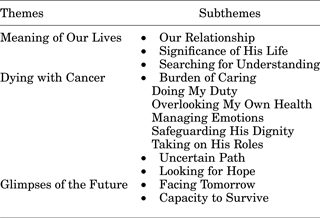
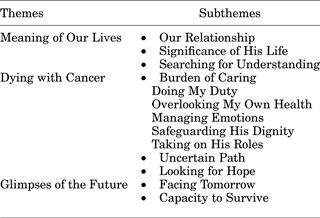
Three major themes emerged from analysis of the study results: (1) the Meaning of Our Lives, (2) Dying with Cancer, and (3) Glimpses into the Future. Table 3 provides an overview of the themes from the study.
Themes and subthemes for the meaning of being in transition to end-of-life care
The Meaning of Our Lives
Our Relationship
Participants reviewed their relationships with their spouses. Many participants found that, even though there had been challenges, overall their lives had been satisfactory. For example, Margaret and Ben had lived separate lives but arranged them in a way that suited both. Margaret said:
I'm always out somewhere doing something. Ben's a stick in the mud. He's a homebody and he putters in his garage all the time, and so I did my thing and he did his thing, but it worked for us.
Although Margaret showed she had some ambivalence about the arrangement, she had come to terms with the detached relationship she had with her husband.
Martha experienced an unhappy relationship with her spouse. She felt guilty that she did not confront her spouse or leave him, and she questioned her inaction:
I'm disappointed with the past. More disappointed with myself that I wasn't more assertive and didn't make demands in the situation. … I really regret that. … So, a lot of disappointments about the past. One good thing is I have two really good boys.
Later, Martha resolved that she did all she could within the unhappy marriage and that there were some positive outcomes that resulted from the relationship. Participants had found meaning as they sorted through regrets and acknowledged their imperfect lives with their spouses.
Some relationships became more intimate and cherished whether or not they had been close before. As an example, Margaret and her husband became closer after they acknowledged that death would occur due to the cancer. Margaret said,
We got a lot closer. … There's a lot more physical contact. … I've never seen the … soft, emotional side of Ben. [He] is … very good at suppressing or hiding emotions … [but] he has been a lot more open about [his] emotions … and things have really got a lot closer. And that's a sad thing to say [because] … we've been together for 31 years now. … It takes something like this to draw two people together.
Significance of His Life
Participants specifically reflected on the significance of their spouses' lives. They discussed how their spouses had contributed to their families through their many roles and how they had personally influenced the participants. For example, Sue acknowledged that the couple had a difficult marriage because her spouse was an alcoholic; however, he was seen as a good person:
He's had a hard life. He was taken into the army when he was 14 years old. He didn't find his parents for 2 years afterwards in [Europe]. … Then he came to Canada and worked a double contract so that when his parents and his brother came they wouldn't have to. So life has not been easy for him. … I didn't suffer the things he suffered … [like] being hungry.
As a result, Sue had a greater appreciation for life. She said, “He'd sort of ground me and give me little boosts … because his life [was] so much harder than mine.” Sue's spouse influenced the way she saw the world. She resolved that her spouse's life was worthwhile and she respected him.
Searching for Understanding
Participants searched to understand the reasons for their chaotic situations. They looked to spirituality and science to reconstruct their assumptive worlds. Some participants questioned and doubted the existence of God while searching for order. Carol said, “You do start questioning, ‘Where is God?’” Also, some questioned the scientific reason why the illness inflicted their families. Joanna said, “We never have cancer in the family. Where is the cancer coming from? Was it too much pollution when he was a painter?” It was as if a scientific explanation of the cancer's origins would prove to participants that the world did not run arbitrarily and that there was a reason why they and their families were experiencing this life-altering situation.
Dying with Cancer
Burden of Caring
Participants took on the burden of caring for their spouses because they saw it as a part of their role within their committed relationship, and, for most, it was also an expression of their love. Participants also took on additional emotional and physical burdens because it released their spouses from their burdens and meant that their spouses could die a peaceful and dignified death. The subtheme of Burden of Caring was classified into five categories: (1) Doing My Duty, (2) Overlooking My Own Health, (3) Managing Emotions, (4) Safeguarding His Dignity, and (5) Taking on His Roles.
In the category of Doing My Duty, participants wanted to support and care for their spouses and felt a sense of duty to care for them. The sense of duty was derived from spiritual, social, and moral obligations. For example, although Sue was physically disabled, she felt the need to justify her inability to care for her husband at home:
The doctor said you have to seriously think about moving [husband, Wayne, to hospice]. … [E]ven Wayne said “I'm going to have to go somewhere else. I'm going to get worse and I'm gonna need more care.” I can't provide the comfort in bed for him that he will get here. … I had to do what's best for him.
In the second category, participants overlooked their own health to care for their spouses because their sense of duty was so prevalent. Though Martha was in a troubled marriage and though she was physically and emotionally strained as a result of caring for her spouse, she vowed to continue on:
I've known many situations where caregivers … walked away. They couldn't deal with the pressure, the strain. … [H]e's a sick man and … I wouldn't abandon anybody, let alone him. No matter what.
In the next category, participants managed spouses' emotions. Sue accepted her spouse's anger and aggression because she understood and empathized with him: “He tends to get angry with what's happened to him. … He's pretty good with other people, but I see his anger because he is allowed to be angry with me.” Some initially avoided conversations and events. For example, Trudy refused to celebrate her own birthday because she knew that her husband would not reach his. She said, “They wanted to have a party [for my 70th birthday], and knowing that he wouldn't reach his 70th, I said no, because he won't be 70 till next year. … Same with anniversaries; passed them all, kept it quiet.” Trudy shielded her spouse from thoughts of a future that included his death.
In their weakened conditions, spouses were concerned only with survival and had lost the characteristics and qualities they had before their illnesses. Some participants ensured that their spouses' previous qualities were known by speaking of the person they knew or showing pictures of their once healthy spouses. It meant that they preserved their spouses' dignity, and yet at the same time, they also mourned their spouses' loss of personhood. For example, Barb described her husband, Peter, as having been a hard worker:
He had certain things that he was going to do … and I think it was too overwhelming for him … and that was not like Peter. … [but] he got weaker and more tired. … I hope it's not much longer. … I think his dignity is being taken from him.
In the last category of Burden of Caring, slowly taking over their spouses' roles was disturbing for participants because they had to engage in new activities or find other ways to carry out those functions while, simultaneously, they watched their spouses' lives diminish. As an example, Barb related how her husband Peter, who had made all the decisions in the past, gradually relinquished this role:
Peter was losing some of the control. … We worked quite [well] as a team … and then I felt like I was … taking over more and more. … But it's just mostly that feeling of him not feeling like he's the head of the household type thing.
Uncertain Path
Participants found it difficult to know how to behave or act because the future was so uncertain. As a result, they were left to watch and wait as the illness took its path. For example, the administration of palliative chemotherapy contributed to uncertainty about how the illness would progress. Monica said, “Waiting, there's lots of wondering. You wonder what will be …”
Carol's experience exemplified the daily unpredictability of the spouses' conditions:
It's like a roller coaster … because they are up one day, down the next. … You come in sometimes … and he says “Hi”. … Some days I thought “Is this it?” And then the next time I've come in and he is sitting at the dining room table.
It was difficult to live with the uncertainty and it meant that participants lived one day at a time.
Looking for Hope
Participants needed hope as Barb articulated:
We've got to have a little bit of hope and you hear everyday about these miracles … that do happen. And, I mean, I didn't think it was really going to happen. But you never want to give up hope until it's gone.
Participants continually sought hope, even though they knew it was unlikely that their wishes would come true. Carol explained, “You are always letting in hope. … You hope that one chemo he had maybe could have killed the cancer. … I know that's a long shot, but … one could have done.”
A different form of hope edged in for participants as their hopes for cure changed to more realistic expectations. Monica said, “I think the day that he found out from the result of the CAT scan, that's when the hope changed. I just said I wanted him to be comfortable, pain managed well, that his spiritual needs were met.”
Participants shouldered the responsibility of adjusting family members' hopes. Barb tried to remain optimistic about her husband's prognosis, but her family came to believe that she was in denial. Conversely, Margaret did not want her husband to go through excruciating treatments for no reason, and she encouraged her partner to face the reality of his impending death stating, “I would rather I have Ben here with quality time than some of the things that I've seen with the chemo.” Shortly after, Ben quickly deteriorated and Margaret believed that she contributed to his decline because she was the one who took away his hope.
Glimpses of the Future
Facing Tomorrow
Participants' physical separation from their spouses led them to experience feelings that foreshadowed a lonely existence. Carol said: “I am sitting at home in my little apartment. I think, ‘Oh my God! This is what it's going to be like! … me and my cat.’”
Participants worried about their lives without their spouses. They had personal, practical, and financial concerns, yet they felt selfish for thinking about these real issues. Margaret was apprehensive about the future, yet felt selfish for thinking about herself. She asked, “What am I going to do? … That is really a selfish way to think when it should be, ‘Oh my God, that poor person [dying with cancer].’”
Participants also thought about what family members and spouses would miss. Sue said:
We … have a little grandchild [crying] and she's only 15 months old. [It's] hard for [my husband] to reconcile that he's not going to see much of her growing up. I think that's the most difficult thing for him, and for me to see … him [upset].
Barb mourned for the future that her spouse would miss and the mutual future that they would both lose:
We would have been a very wonderful couple to be retired together. We both like to golf and we both love to walk, [and play] Scrabble and Canasta [with] good friends and family. We could have had a wonderful time. And damn, that's taken away from us totally.
Capacity to Survive
Most participants affirmed their capacity to survive without their spouses. Barb said of her situation: “I know I'll make it through, because I always have.” Joanna had to affirm to her spouse that she could survive alone. Joanna's husband felt remorse that he had moved her from Europe, and because of his impending death, he was going to leave her in a foreign country. Joanna said to her husband: “Don't be afraid to leave me over here because I know what I am going to do.” Carol relied on her family for support and was aware that she needed them to survive in the future. She affirmed: “We are going to be sad, but we will be okay.” After affirming their capabilities, participants were freed of worries regarding the future and could then focus on their dying spouses.
DISCUSSION
Study results revealed that participants made meaning of their lives while they cared for their dying spouses and caught glimpses of their futures. These three major themes shed light on female partners' experiences during their spouses' transition to end-of-life care. The results of the study centered on three major concepts from the literature: meaning making, anticipatory grief, and hope. Themes and subthemes that emerged from the results are couched in these three concepts and are discussed. Study implications are also addressed.
Meaning Making
Similar to the constructivist theory of loss (Neimeyer, Reference Neimeyer2001; Gillies & Neimeyer, Reference Gillies and Neimeyer2006), participants in this study made meaning of their situations. They questioned the world order, reviewed the lives they had lived with their spouses, found significance in their spouses' lives, and experienced positive changes in the recognition of their capacity to survive. Likewise, family members of cancer patients have reported new and positive world perspectives as a result of caregiving during their relatives' terminal cancers (Waldrop et al., Reference Waldrop, Kramer and Skretny2005; Jo et al., Reference Jo, Brazil and Lohfeld2007). It has also been noted that family members of cancer patients review their pasts with them (Davies et al., Reference Davies, Remier and Martens1990; Gray et al., Reference Gray, Fitch and Phillips2000; Nadeau, Reference Nadeau and Neimeyer2001). The concept of meaning making has been identified as a fundamental way in which bereaved individuals cope with loss after a loved one's death (Gillies & Neimeyer, Reference Gillies and Neimeyer2006); this study suggests that females partners made meaning of their situations before their spouses' deaths or, more specifically, during their spouses' transition to the end of life. Thus, female partners may benefit from emotional support through discussion with their health care providers. To sort through meanings and move forward in their situations, female partners should be encouraged to review their pasts and discuss their feelings about their relationships with their spouses.
Anticipatory Mourning
This study adds credence to the concept of anticipatory mourning as outlined by Rando (Reference Rando2000). Although the concept of anticipatory mourning has been espoused by many experts in the general field of bereavement (Fulton et al., Reference Fulton, Madden and Minichiello1996), limited research has been done on the concept. The little research that does exist focuses on the effects of anticipatory mourning and has been explored using quantitative methods (Fulton et al., Reference Fulton, Madden and Minichiello1996; Duke, Reference Duke1998; Kehl, Reference Kehl2005). This study is important because the qualitative design allowed participants to spontaneously describe their own experiences during their spouses' end-of-life transitions. Their experiences confirm and further validate the aspects of anticipatory mourning outlined by Rando (Reference Rando2000).
Anticipatory mourning can be experienced by the individual who is dying, family members, or health care providers and is not, as the name suggests, a premonition of mourning to be expected after death (Rando, Reference Rando2000). Rather, it is the mourning of a loss that has occurred, is occurring, or will occur (Attig, Reference Attig and Rando2000; Corr & Corr, Reference Corr, Corr and Rando2000; Rando, Reference Rando2000). Anticipatory mourning involves elements of coping, interacting, psychosocial reorganizing, planning, balancing demands, and facilitating death (Rando, Reference Rando2000). Moreover, an essential aspect of anticipatory mourning is finding meaning in one's life (Doka, Reference Doka and Rando2000).
Like anticipatory mourners, participants in the present study reviewed the relationships and the lives they had lived with their spouses. They continued to love and care for their spouses after sorting through remorse and regrets. Anticipatory mourners examine their relationships with their intimates to attend to unfinished business, redefine their relationships, and move forward in their situations (Attig, Reference Attig and Rando2000; Rando, Reference Rando2000).
In this study, participants made appraisals of the fullness of their spouses' lives. They spontaneously spoke of their spouses' unique qualities, characteristics, and accomplishments. The recalling of spouses' achievements helps mourners to create memories and learn to love their spouses in absence (Attig, Reference Attig and Neimeyer2001). Partners seek out the meaning and purpose in their spouses' lives through the telling of their stories (Doka, Reference Doka and Rando2000). The mourner's discernment of the dying individual's sense of fulfillment in life is a factor that affects the process of anticipatory mourning (Rando, Reference Rando2000).
Study results indicated that participants initially avoided discussing the implications of their spouses' illnesses. They protected their spouses by avoiding conversations and activities associated with death. Rando (Reference Rando2000) refers to Lazarus and Folkman's 1984 cognitive model of stress and coping to describe the generic operation of coping in anticipatory mourning. Avoidance and escape are emotion-focused coping methods used in situations in which individuals have little control (Folkman, Reference Folkman1997; Folkman & Greer, Reference Folkman and Greer2000). These findings are widely supported in the literature. Numerous studies that investigated spousal reactions to cancer reported the use of avoidant coping strategies (Spiegel et al., Reference Spiegel, Bloom and Gottheil1983; Wright & Dyck, Reference Wright and Dyck1984; Kalayjian, Reference Kalayjian1989; Mahon et al., Reference Mahon, Cella and Donovan1990; Germino et al., Reference Germino, Fife and Funk1995; Lewis & Deal, Reference Lewis and Deal1995; Pistrang & Barker, Reference Pistrang and Barker1995; Gray et al., Reference Gray, Fitch and Phillips2000; Winterling et al., Reference Winterling, Wasteson and Glimelius2004; Porter et al., Reference Porter, Keefe, Hurwitz and Faber2005; Hawes et al., Reference Hawes, Malcarne and Ko2006). These strategies were mainly used to avoid eliciting spouses' intense emotions regarding their deaths (Chekryn, Reference Chekryn1984; Germino et al., Reference Germino, Fife and Funk1995; Lewis & Deal, Reference Lewis and Deal1995; Winterling et al., Reference Winterling, Wasteson and Glimelius2004; Porter et al., Reference Porter, Keefe, Hurwitz and Faber2005).
Like anticipatory mourners, participants in this study experienced feelings of loneliness as they saw glimpses of the future without their spouses (Rando, Reference Rando2000). This is a positive way to rehearse their new way of living and anticipate problems, even though partners may not perceive it as such (Attig, Reference Attig and Rando2000; Rando, Reference Rando2000). Also common to anticipatory mourners, participants in the study did not want to look to their futures because they preferred to focus on their dying spouses (Rando, Reference Rando2000).
Factors that influence anticipatory mourning include situational uncertainty, communication patterns, the place in which the person dies, the mourner's health, the type of death, and role change (Rando, Reference Rando2000). In this study, participants lived one day at a time to deal with the uncertainty of their spouses' illness trajectories and treatment effects. Several studies also supported the notion that partners worry about spouses' uncertain futures and whether treatment will be effective (Chekryn, Reference Chekryn1984; Kalayjian, Reference Kalayjian1989; Lewis & Deal, Reference Lewis and Deal1995; Winterling et al., Reference Winterling, Wasteson and Glimelius2004).
Participants in this study were able to move forward after disclosing their feelings regarding spouses' upcoming deaths. It was the shared acknowledgement of their spouses' imminent deaths that allowed partners and spouses to focus on the remaining time they had together. Communication patterns between dying patients and their intimates affect anticipatory mourning (Rando, Reference Rando2000). Although open communication reveals the painful truth about the impact of the illness and forces partners and spouses to acknowledge the imminent death, it also permits them to resolve any past issues and determine the best way to proceed with spouses' remaining lives as well as their deaths (Rando, Reference Rando2000). One step in the process of mourning is acknowledging loss and attempting to understand it (Rando, Reference Rando2000), as was seen in the present study.
Findings suggest that partners' sense of duty to care for their spouse was ingrained to such a degree that they felt guilty when unable to care for their dying spouse at home. They felt the need to justify their spouses' move to hospice and were distressed at moving them, even though they were stretched beyond their capabilities. Likewise, Stajduhar (Reference Stajduhar2003) examined perspectives of family members who were caring for their relatives with cancer at home and revealed that caregivers felt a sense of failure and guilt when they were no longer able to care for their relatives.
In this study, participants cared for their spouses despite their own health problems and the physical and emotional burdens that they felt. Other studies confirm the finding that relatives of dying patients minimized their own health problems, were reluctant to seek medical attention for their physical ailments, reported their health problems as minor, and perceived that calling attention to their own health issues was inconsiderate when their relatives were so seriously ill (Jones et al., Reference Jones, Hansford and Fisk1993; Osse et al., Reference Osse, Vernooij-Dassen and Schade2006).
In the present study, new roles were assumed by participants as their spouses' diseases progressed and conditions deteriorated. Strain resulting from role dissonance and distress at seeing spouses relinquish their accustomed roles were common findings in the literature (Chekryn, Reference Chekryn1984; Davies et al., Reference Davies, Remier and Martens1990; Jo et al., Reference Jo, Brazil and Lohfeld2007). During anticipatory mourning, adjusting to new roles is a rehearsal to prepare mourners for a world without their dying relatives (Rando, Reference Rando2000).
Findings from this study validate the concept of anticipatory mourning as an experience that takes place among individuals facing a life-altering loss. Health care providers should be aware that partners are experiencing losses and encourage them to discuss their spouses, their futures, and uncertainties. Formal caregivers may also suggest ways for partners to express their suffering and concerns. Future research is needed to further explore and validate findings.
Hope
Findings from this study confirm the patterns of hope within the literature. Consistent with the present study, the literature indicates that hope is essential as a means of coping among family members and caregivers of cancer patients (Chekryn, Reference Chekryn1984; Proot et al., Reference Proot, Abu-Saad and Crebolder2003; Clayton et al., Reference Clayton, Butow, Arnold and Tattersall2005; Klemm & Wheeler, Reference Klemm and Wheeler2005). Other studies have observed that, in order to maintain hope, partners of cancer patients try not to dwell on negative emotions (Lewis & Deal, Reference Lewis and Deal1995; Winterling et al., Reference Winterling, Wasteson and Glimelius2004).
In this study, most participants at one time hoped for cure even though they knew this was unlikely. Similarly Winterling et al. (Reference Winterling, Wasteson and Glimelius2004) found that partners of patients diagnosed with advanced cancer knew that their spouses would die, yet continued to hope for a cure. Morse and Doberneck (2005) also found that patients hoped for cure even though they knew that death was possible and that they had to suffer as a result of treatment side effects.
Present findings indicate that there was a resurgence of hope even when spouses were undergoing palliative treatment. Similarly, on investigating the lived experience of hope in terminal cancer patients, Benzein et al. (Reference Benzein, Norberg and Saveman2001) found that patients experienced hope any time that treatment was offered. Morse and Doberneck (Reference Morse and Doberneck1995) further conceptualized a component of hope in which signs were continually assessed to maintain hopes for the future. Studies have indicated that hope often had to be modified by family members of dying relatives when negative signals became too great (Winterling et al., Reference Winterling, Wasteson and Glimelius2004; Clayton et al., Reference Clayton, Butow, Arnold and Tattersall2005).
Findings from this study also suggest that, despite facing discord and feelings of guilt, participants shouldered the responsibility to adjust spouses' and family members' hopes in order to help them to cope. No published studies were found that addressed partners' efforts to alter their spouses' and family members' hopes and the aftereffects of those actions.
Health care providers should recognize that hope is necessary despite the prognosis and that hope is modified as situations change. Finally, partners should be encouraged and supported in their discussions of hope.
Study Limitations
Samples in qualitative studies are typically small and, as a result, the findings are limited to the setting involved (Firestone, Reference Firestone1993; Patton, Reference Patton2003). In this study, most participants were recruited from an inpatient hospice. One was from a palliative home care service. The experience of the meaning of being in end-of-life care for female partners of spouses with cancer was the same across the two palliative care settings in this study; however, larger sample sizes involving other settings might have produced different results.
Similar to other palliative care research (Keller et al., Reference Keller, Henrich, Sellschopp and Baider1996; Morse & Fife, Reference Morse and Fife1998; Jo et al., Reference Jo, Brazil and Lohfeld2007), there was difficulty in recruiting this population because of patients' impending deaths and the stress this entails for their partners. It may be that front line health care providers attempt to protect their vulnerable patient population. Participants in this study shared their personal thoughts and feelings even though they were emotional during their interviews. One participant specifically expressed the positive and cathartic feelings that she experienced through the telling of her stories. It appeared that participants benefited from this experience and that the stress and sensitivity of the events involved during this life-altering situation should not hinder future research on end-of life issues. The problematic nature of end-of-life studies, however, underscores the significance of this study and the need for further, similar work.
CONCLUSION
The purpose of this interpretive phenomenological study was to understand the meaning of being in transition to end-of-life care for female partners of spouses with cancer. The themes from this study centered around three major concepts: meaning making, anticipatory grief, and hope. These three concepts are intertwined and important in understanding the female partners' experiences during their spouses' transition to end-of-life care. Health care professionals should be aware of these three concepts to better understand female partners' experiences so that they may approach and care for these individuals more effectively.
ACKNOWLEDGMENTS
Participants shared intimate and moving stories. I am grateful that they let me into their worlds during a sensitive time in their lives. I am also grateful to the palliative home care agency and hospices for opening their doors for me.
The research project was completed in partial fulfillment of the requirements for the degree of Master of Science at McMaster University, Hamilton, Ontario, Canada. I would like to specially thank my thesis committee members: Dr. Carolyn Ingram (supervisor), Dr. Jenny Ploeg, and Professor Barbara Brown.