

Livestock sector growth
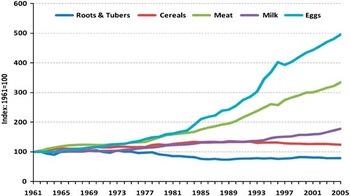
Global production of meat, milk and eggs has expanded rapidly during the last decades, in response to a rapid growth in the consumption of livestock products. This increase in demand which has been particularly strong in developing regions, has largely been driven by growing populations and incomes. Between the 1960s and 2005 (Figure 1) for example, annual per capita consumption of meat more than tripled, that of milk almost doubled, while per capita consumption of eggs increased fivefold in the developing world (FAO, 2009a).
Per capita consumption of major food items in developing countries.

Between 1980 and 2007, global production of meat, milk and eggs has increased at annual rate of 3%, 1.4% and 3.4%, respectively in the period 1980–2007. Growth in production has been fastest in developing countries where production of meat, milk and eggs has been growing at 5% and 4% and 6.3% p.a. during the period 1980–2007. In comparison, meat, milk and egg output in developed countries has been growing at only 0.8%, 0.1% and 0.2% p.a. over the same period. By 2007, the bulk of the global base of livestock production had shifted to developing countries; where meat and egg production has surpassed production in developed countries, as milk production levels rapidly converge with those in developed countries.
Among the different meat types, most of the increase in output has been from monogastrics with the poultry subsector exhibiting the fastest growth at 7% per annum in developing countries followed by pig meat at 5.4% over the period 1987–2007. Poultry output also grew more rapidly than other meat types in the developed world, but at a much slower rate of almost 2.4%. In contrast, total production for beef and meat from small ruminants actually declined in developed countries between 1987 and 2007. The rapid growth in meat from monogastrics can be explained by increased economies of scale, ease of transfer of capital intensive technologies enabling better disease control and greater efficiency in feed conversion. The growing concentration and integration of poultry and pig meat sectors, combined with innovation developments in specialization in production and processing, have favored lower prices for these two meats compared with beef. Low prices of poultry relative to other meats, wide spread consumer perceptions of poultry and its acceptability by most cultures and religions further pushed its share in global meat supplies from 19% in 1980 to 32% in 2007.
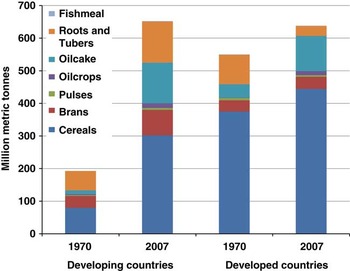
The growth and industrialization of the livestock sector would not have been possible without a concurrent increase in crop production. Until the mid-2000s, yield improvements resulting in grain surpluses and subsidy programmes played a key role in contributing to lower grain prices. As evidenced from the trends in consumption and production, the overall trend in the livestock sector has been a transition from land-based extensive ruminant systems to large-scale industrial non-ruminant systems that rely on concentrate feed. The shift towards industrialized monogastric production explains the increased use of concentrate feed by the sector. Figure 2 provides an overview of the use of concentrate feed in 1970 and 2007. While the amount of concentrate feed use decreased in industrialized countries, in developing countries, where livestock consumption and output growth have concentrated, the use of concentrate feed more than doubled; with their share of global concentrate feed use increasing from 26% in 1970 to 48% in 2007 (FAOSTAT, 2011).
International trade of both livestock products and feed-crops is also expanding; between 1980 and 2008, the total volume of meat exports almost quadrupled and exports of both dairy products and eggs more than doubled. The globalization and liberalization of markets, developments in transportation, cold chain, and meat processing and packaging technology, have made it possible to trade livestock products and feedstuffs over long distances. Livestock products now represent a growing proportion of agricultural exports with its share of global agricultural export value rising from 11 percent to 17 percent between 1961 and 2006 (FAO, 2009a). Globally, trade in livestock products as a share of total production has almost tripled during the past 30 years. This expansion of trade in livestock products and feed products has not only severed the link between production and consumption but has enabled the sector to overcome localized resource constraints consequently masking the environmental and resource costs associated with livestock production. For example, the increased global production of soybean concentrated largely in Latin America and its trade highlights this decoupling. Soybean exports are highly concentrated in United States (29 million tonnes), Brazil (23 million tonnes), Argentina (11 million tonnes), and Paraguay (3.5 million tonnes) while major import markets include the EU, China and increasingly Near East and North Africa. The global demand for soybean for feed has been a major driver of the expansion and conversion of arable land and natural habitats as well as the resulted in the intensification of production that requires use of inputs such as fertilizers, pesticides, and water. Trade in soybean has therefore not only made possible for countries that suffer from a deficit of feed to boost their domestic production but also traded with it the environmental impacts of production.
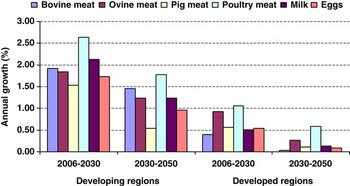
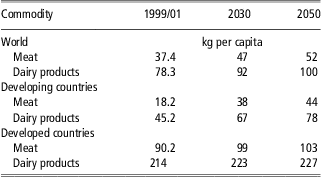
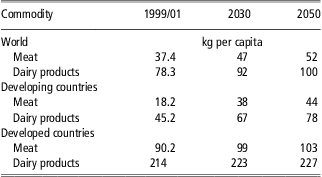
The factors that have driven growth in livestock product demand in the developing world – rising incomes, population growth and urbanization – will continue to be important over the coming decades, although the effects will be tempered (FAO, 2006; FAO, 2009a) (Figure 3). Projected slower population growth coupled with a decelerating consumption in the two countries that have mostly driven the upsurge in consumption (i.e. China and India) are major factors that will influence future aggregate demand. Excluding China and Brazil, per capita meat consumption in developing countries is expected to increase to 26 kg in 2030 and 32 kg in 2050. In terms of future consumption gains, it is projected that a marked gap will still exist between developing and developing countries (Table 1) highlighting the scope for further sectoral growth.
Past and projected trends in production of livestock production.

Trends in concentrate feed use in developing and developed countries.

In industrialized countries, near saturation, slow or negative population growth, coupled with increasing consumers’ health concerns point to limited future growth prospects. Per capita consumption of dairy products in developing countries is still relatively low. Rising incomes and urbanization in these countries are expected to drive further increases in per capita consumption and an overall increase in dairy consumption growth. OECD-FAO (2009) projections for developing countries suggest an expansion in growth and consumption over the medium term. Over the outlook period (2009–2018), dairy products are expected to remain among the agricultural commodities for which consumption will exhibit high growth rates – with per capita consumption increasing at an annual rate of 1.2 percent in developing countries.
Driven by demand, global production of meat is projected to more than double from 229 million tonnes in 1999/2001 to 465 million tonnes in 2050, and that of milk to increase from 580 to 1,043 million tonnes (FAO, 2006).
It should be highlighted that these projections are based on FAO estimates published in 2006 and therefore do not fully capture recent trends such as the economic crisis, climate change, rising grain and fossil fuel prices, and trends in consumption. These recent trends will undoubtedly have implications on how the sector develops and it can be expected that the projected supply and demand scenarios are likely to be slightly moderated.
Environmental impacts of livestock production
The livestock sector is a major user of natural resources such as land and water, using about 35% of total land and about 20% of green waterFootnote 1 for feed production (Deutsch et al., Reference Deutsch, Falkenmark, Gorden, Rockstrom and Folke2010). Livestock production also has direct and indirect impacts on the environment, ranging from land degradation due to overgrazing; through to biodiversity loss mainly brought about by land use and land-use change and ecosystem pollution; to air, water and land pollution from animal waste and noxious emissions and climate change.
Land use
Land is a key resource for the production of biomass to meet human demands for food, feed and fiber. Currently, human appropriation of biomass accounts for 16% of global terrestrial NPP, about 18.7 PG/yr in 2000. Krusmann et al. (Reference Krusmann, Erb, Gingrich, Lauk and Haberl2008) have estimated that animal food systems utilize about 58% of the economically used plant biomass (12 PG/yr) in contrast to 12% directly used as human food. The livestock sector is also the single largest anthropogenic user of land, occupying about 35% of the earth's terrestrial surface utilizing about 3.4 billion hectares for grazing and 0.5 billion hectares for feed-crop production (FAOSTAT, 2011). The extent and nature of dryland degradation is subject to considerable debate, livestock has been associated with pasture and rangeland degradation. Land use change is complex and is driven by a host of factors. In Latin America, for instance, livestock production has been cited as a major driver of deforestation in Amazon basin (Wassenaar et al., Reference Wassenaar, Gerber, Verburg, Rosales, Ibrahim and Steinfeld2007; Kaimowitz and Angelsen, Reference Kaimowitz and Angelsen2008; Barona et al., Reference Barona, Ramankutty, Hyman and Comes2010) although the trend has recently been dwindling. In the neotropics, there is rapid expansion of pastures for ranching which encroaches into valuable ecosystems, with 0.3 to 0.4 percent of forest lost to pasture annually (FAO, 2009b). Furthermore, the increasing demand for high quality protein feeds like soybean, particularly for monogastrics and dairy production, has been a key driver of the conversion of natural ecosystems for feedcrop production. Land use change has important knock-on impacts on biodiversity, climate change, and water cycles.
On a global scale, improvements in both crop productivity as well as livestock productivity (especially in monogastrics) driven by technological and economic factors as well as policy allowed a transition towards higher land-use intensity in livestock production. Consequently, the overall output of the sector has grown faster than its land requirements (Steinfeld et al., Reference Steinfeld, Gerber, Wassenaar, Castel, Rosales and de Haan2006).
Livestock and climate change
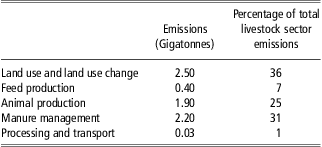
The livestock sector is a major contributor to climate change, generating significant emissions of carbon dioxide, methane and nitrous oxide throughout the production process. Livestock contribute to climate change by emitting GHGs either directly (e.g. from enteric fermentation and manure management) or indirectly (e.g. from feed-production activities, conversion of forest into pasture). Based on a Life Cycle Assessment (LCA) approach, it is estimated that the sector emits about 7.1 gigatonnes of CO2 equivalent, about 18% of the total anthropogenic GHG emissions (Steinfeld et al., Reference Steinfeld, Gerber, Wassenaar, Castel, Rosales and de Haan2006). Table 2 below illustrates the contribution along the livestock food chain.
Greenhouse gas emissions along the livestock food chain
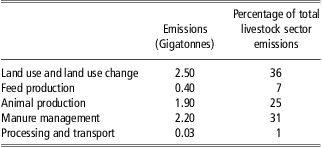
Source: Steinfeld et al. Reference Steinfeld, Gerber, Wassenaar, Castel, Rosales and de Haan2006
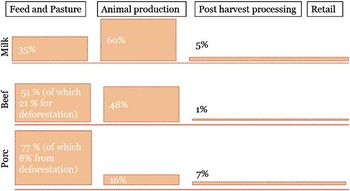
More recent and disaggregated FAO estimates on the sector's contribution to global anthropogenic GHG emissions highlights the differences between species with beef production contributing about 5.5% of total global anthropogenic emissions while milk and pork contribute 2.8% and 1.9%, respectively (Figure 4).
Greenhouse gas emissions along livestock food chains.

There are striking differences in global emission intensities among commodities. For example, on a global scale, the emission intensity of meat and milk, measured by output weight, corresponds on average to 60 kg CO2 eq/kg of CW and 9.4 kg CO2 eq/kg of CW, for beef and porkFootnote 2, respectively, and 2.4 kg CO2 eq/kg of milk (FAO, 2010). This analysis also found significant variability in emissions across the different world regions. For example, the FAO life cycle assessment of GHG emissions from the global dairy sector, found emissions per unit of milk product to vary greatly among different regions; with emissions from Europe and North America ranging between 1–2 kg CO2-eq per kg fat and protein corrected milk (FPCM) at the farm gate. The highest emissions are estimated for sub-Saharan Africa with an average of 7.5 CO2-eq per kg FPCM at the farm gate. GHG emissions for South Asia, West Asia and North Africa and Central and South America c range between 3 and 5 CO2-eq per kg FPCM at the farm gate. The global average is estimated at 2.4 kg CO2-eq (FAO, 2010). Results from the same study of the global dairy sector also found GHG emissions to be inversely related to productivity. At very low levels of milk production (200 kg/cow/year) emissions where found to be 12 kg CO2-eq per kg FPCM compared to 1.1 kg CO2-eq per kg FPCM (high production level of about 8000 kg of milk), reflecting the strong effect of livestock intensification on GHG emissions on a global scale (Gerber et al., Reference Gerber, Vellinga, Opio and Steinfeld2011).
Water pollution and depletion
Deutsch et al. (Reference Deutsch, Falkenmark, Gorden, Rockstrom and Folke2010) estimate that the livestock sector uses an equivalent of 11 900 km3 of water annually – or approximately 10% of the annual global water flows estimated at 111 000 km3. Although drinking and servicing might be the most obvious user of water, it constitutes only a minor share of the total water consumption; the bulk of consumption being associated to feed crop irrigation – about 7 percent of the water use globally (Steinfeld et al., Reference Steinfeld, Gerber, Wassenaar, Castel, Rosales and de Haan2006).
Livestock production systems differ in the amount of water used for animals, in how these requirements are met and consequently have diverse impacts on water resources. In extensive livestock production systems impacts are mainly through the compacting effect of grazing and hoof action on the soil (especially around watering points) which has important consequences for water infiltration and water erosion and water contamination through inflow of animal waste, whereas impacts from intensive production systems are mostly related to irrigation and waste management.
Nutrient flows from animal production systems are of particular environmental concern. Water quality can be affected by livestock as a result of the release of nitrogen, phosphorus and other nutrients, pathogens, drug residues and other substances into waterways, mainly from intensive livestock operations (Figure 5).
Impact on nutrient flows along livestock food chains.

Galloway et al. (Reference Galloway, Dentener, Burke, Dumont, Bouman, Kohn, Mooney, Seitzinger and Kroeze2010) estimated that globally, about 170 Tg of nitrogen enters croplands each year from manure and organic fertilizer, around 70% of which is lost to the environment and 30% is taken up by crop products. Of this 30%, around 20% is fed to animals and around 10% is consumed directly by humans. Of the 20% that is fed to animals, 17% is lost to the environment and only 3% enters the human food chain. Industrialization of the livestock sector, has severed the link between livestock production and the supporting land base consequently interrupting the nutrient flows between land and livestock, creating problems of depletion at the source (vegetation and soil) and problems of pollution at the sink (animal wastes, increasingly disposed of into waterways instead of back on the land).
Biodiversity erosion
Livestock have both direct and indirect impacts on biodiversity. Livestock production affects biodiversity in different ways through (Reid et al., Reference Reid, Bedelian, Said, Kruska, Rogerio, Castel, Olson and Thornton2010; MEA, 2005):
1. habitat change driven by deforestation for pasture and feedcrop production, intensification of agriculture and desertification and land degradation reducing species diversity and impacting on both terrestrial and aquatic ecosystems;
2. climate change: global warming can result in changes in species distributions and population sizes; timing of reproduction or migration events, and an increase in the frequency of pest and disease outbreaks; it also has an impact on ecosystem functions and services: e.g. climate regulating functions, impacts on water cycle;
3. introduction of invasive alien plant and animal species;
4. overexploitation of resources such as overfishing and competition with wildlife;
5. pollution and contamination of ecosystems with nutrients, drugs and sediments; and
6. impact on animal genetic resources driven by the rapid spread of intensive livestock production utilizing narrow genetic base, few commercial breeds that are highly productive.
As outlined above, the impacts of livestock on biodiversity are generally negative, although there are some positive impacts such as increased species diversity in moderately grazed pastures (e.g. in Europe) and ‘biodiversity protection’, where livestock has played a crucial role in slowing the conversion of land, particularly in the drylands of sub-Saharan Africa.
Addressing the environmental consequences of livestock production
Even with the growth that has occurred over the last three decades, further livestock production increase will be required to meet the projected future food demands. If demand for livestock products develops in consonance with the projections, livestock production is likely to expand substantially implying an amplification of the environmental risks and a need for major corrective measures aimed at minimizing the environmental impact of livestock production. Today, the livestock industry is making concrete steps towards sustainability, manifested by the several initiatives on sustainable livestock development such as the IDF Global Dairy Agenda for ActionFootnote 3, the Global Roundtable for Sustainable BeefFootnote 4, the EU roundtable on sustainable Production and ConsumptionFootnote 5 and the multi-stakeholder Global Agenda of Action in support of sustainable livestock sector developmentFootnote 6. In this section we consider, possible pathways and approaches for improving the environmental performance of livestock production focusing on improved resource use efficiency, reduction of waste, technological and policy measures targeted at diverse production systems.
Enhancing natural resource use efficiency
Given the current and future resource scarcity and in the face of projected demand for livestock products, there is considerable agreement that efficiency gains in resource use is a key component to improving the sector's environmental sustainability. More efficient use of natural resources is a key strategy to decouple livestock sector's growth from environmental impacts. Natural resource use efficiency is measured by the ratio between the use of natural resources as input to the production activities and the output from production, e.g. kg of phosphorus used per unit of meat produced, or ha of land mobilized per unit of milk produced. The concept can be extended to the amount of emissions generated by unit of output, e.g. GHG emissions per unit of eggs produced. Examples of opportunities that fall within this strategy are higher yields per hectare, higher water productivity, higher feed efficiency, improved management of manure and fertilizers and reduced losses along the food chain (Westhoek et al., Reference Westhoek, Rood, van den Berg, Janse, Nijdam, Reudink and Stehfest2011). Improving the feed-to-food conversion efficiency in animal production systems is a fundamental strategy for improving the environmental sustainability of the sector. A large volume of food is wasted even before it reaches the consumer – a recent FAO (2011) study suggests that about one-third of food produced is wasted. Reduction of waste along the animal food chain can therefore substantially contribute towards reducing demand for resources such as land, water, energy and other inputs such as nutrients.
Current prices of inputs such as land, water and feed resources used for livestock production often do not reflect true scarcities. This results in the over-utilization of resources by the sector and to inefficiencies in the production process. Any future policy to protect the environment will, therefore, have to introduce adequate market pricing for the main inputs. Ensuring effective management rules and liability, under private or communal ownership of the resources is a further key policy element to improve resource use.
Addressing negative environmental impacts in intensive production
An estimated 80 percent of total livestock sector growth comes from industrial production systems. The shift in animal production toward industrialized production model has important environmental and public health implications. As far as possible, industrial livestock production should be located where cropland is within economic reach so it can be used for waste disposal, without creating problems of nutrient loading – rather than being geographically close to areas offering market access, or feed availability. Policies are needed to counteract the current economic drivers of the peri-urban concentration of production units. In all cases, full waste management is necessary, adapted to local conditions. Policies that can help correct the negative effects of livestock production and re-establish the balance between livestock and crop production include a combination of pricing policies (e.g. fertilizer price), regulations (e.g. zoning/location policies, waste discharge and nutrient management standards) and policies in support of institutional and technological change. Policy intervention in this area requires close coordination and integration with other development activities like bio-energy, transport, urban and peri-urban development, forestry and others.
In parallel, the environmental impacts associated with production of feed grain and other concentrate feeds need to be addressed. Feed is usually produced by intensive agriculture characterized by mono-cropping and use of large quantities of agro-industrial products, and the principles and instruments designed to control related environmental issues need to be widely applied.
Diversifying extensive grazing with the provision of environmental services
In recent years, the recognition of environmental services and their value has led to efforts aimed at internalizing environmental services through the development of markets for ecosystem services based on direct payments for environmental services (PES). These schemes provide economic incentives to foster more efficient and sustainable use of ecosystem services. To-date most PES, have predominately focused on watershed, landscape and biodiversity protection. PES can result in more sustainable livelihoods through the provision of cash or in-kind benefits to participants, offering a diversification option, particularly among marginal rural populations.
Because of the extensive nature of grasslands, they hold enormous potential to serve as one of the greatest terrestrial sinks for carbon. According to IPCC (2007), the restoration of grasslands and good grazing lands management globally can store between 100 and 800 Mt CO2-eq per year for inputs ranging from 20 to 100 USD, respectively. Smith et al. (Reference Smith, Martino, Cai, Gwary, Janzen, Kumar, McCarl, Ogle, O'Mara, Rice, Scholes, Sirotenko, Howden, McAllister, Pan, Romanenkov, Schneider, Towprayoon, Wattenbach and Smith2008) have estimated that improved rangeland management has the biophysical potential to sequester 1.3–2.0 Gt CO2 eq. worldwide to 2030. Well managed grasslands can sequester up from 260 tonnes of carbon per hectare while providing important benefits for climate change adaptation (FAO, 2001). This suggests that there are substantial global potential for enhancing carbon sequestration in extensive systems and concomitantly contributing to increased productivity and food security, enhanced development opportunities as well as reduced impacts of climate change.
From a policy perspective, focus needs to be placed on improving incentive structures (e.g. subsidies, green labeling, taxes, easements) as well as institutional mechanisms to ensure the continued provision of these services. A range of limiting factors currently inhibits the widespread of application of PES. Important outstanding issues relate to the measurement and monitoring of the services, the scale at which they are managed, as well as the need for considerable institutional development.
Accelerating technological change and uptake
Improved and efficient production technologies exist for most production systems. However, access to information and technologies and capacity to select and implement the most appropriate are essential to achieve the above objectives. Interactive knowledge management, capacity building and informed decision making at policy level, need to be enhanced. Technology will be key in steering the agricultural sector on to a more sustainable path of intensification. Technological improvements need to be oriented towards the optimal integrated use of land, water, nutrients, animal and feed resources. Bridging the sustainable intensification among underperforming producers will require overcoming considerable technological, institutional, and economic barriers. In the livestock sector, the quest for optimizing efficiencies will be through feeding, breeding and animal health. Research and management of feed crop production needs to be aimed at higher yields in more locally adapted environmentally friendly production systems. Socio-economic research for rural development however needs to provide a better understanding of the constraints to technology transfer, uptake and upgrading and identify the adequate mechanisms to foster such developments, including novel setups in the sector, such as public-private partnerships.
Measuring environmental sustainability
As the question of the sustainability of future food systems takes root, there is a growing recognition of the need for comparative and standardized indicators to measure the sector's environmental performance and progress towards sustainability. The ability to measure improvements is critically dependent on establishing valid and comparable methods for measuring performance. Metrics, methods and indicators are required to not only measure the environmental performance but also to identify areas where benefits are greatest and also provide information important for the design of more efficient processes, decreasing resource use and environmental impacts. Monitoring the performance is a key element in evaluating and ensuring compliance of production processes hence the absence of recognized frameworks for monitoring environmental performance impedes the possibilities for improvements. As a result of the vast number of stakeholders engaged in the livestock food chain and the public good nature of the sector, there is a need for voluntary public and private sector partnership to advance continuous improvements through science, and multi-stakeholder engagement and collaboration and place the sector on the path of sustainable growth.
Conclusion
To keep pace with projected demands, the growth of the livestock sector is likely to continue, particularly in developing countries. Today, while being a major player in many economies, the livestock sector is a major source of stress on the natural resource base generating a host of externalities. Continued expansion of the livestock sector based on the current growth model will undoubtedly exacerbate the pressures on natural resources and the environment. The sector faces a challenge without precedent: meeting growing demand for animal protein, while concurrently reducing its resource demand and environmental footprint. Addressing these competing goals demands innovative approaches that will permit to decouple growth from environmental impact. This paper introduced some practical options, highlighting the great potential for improvement that the sector tap into. At the core of these strategies is the concept of natural resource use efficiency. Improving environmental performance is within reach but requires novel institutional mechanisms to foster the development, adaptation and dissemination of improved practices along livestock food chains. A number of initiatives and projects involving Governments, private sector and civil society are under development in this regard, addressing the overarching issue of resource use efficiency.