Implications
A study was conducted to quantify both the environment and animal response, when cattle had no shade access during summertime exposure or were given access to different shade materials. Distinct differences in the physical environments were measured under each of the shade materials. Animal responses to the different shade materials were also shown to be significantly different, and were not always in agreement with the physical environment. Based on body temperature, respiration rate, total blood count and cortisol, the 60% Aluminet shade cloth overall offered the best protection.
Introduction
Heat stress has a significant impact on all livestock and poultry species and costs an estimated $2.4 billion annually (Pierre et al., Reference Pierre, Cobanov and Schnitkey2003). Beef cattle are raised exclusively outdoors making it difficult to develop heat-abatement strategies. Feedlot cattle are particularly vulnerable to heat stress due to harsh summertime environments; dark soil surface of feedlot pens that can exceed 50°C (Brown-Brandl et al., Reference Brown-Brandl, Eigenberg and Nienaber2013), high-grain diets and overall cattle body condition. In addition, the preference for Angus beef has driven the market toward black cattle increasing further the need for heat abatement, as black cattle are impacted more by heat stress (Busby and Loy, Reference Busby and Loy1997; Hungerford et al., Reference Hungerford, Buhman, Dewell, Mader, Griffin, Smith and Nienaber2000; Brown-Brandl et al., Reference Brown-Brandl, Eigenberg and Nienaber2006).
Shade is one heat-abatement strategy that has received attention throughout the years. Incident solar radiation (SR) may exceed metabolic heat production by several times. A simple shade can reduce the animal’s radiant heat load by 30% or more (Bond et al., Reference Bond, Kelly, Morrison and Pereira1967). However, different types of materials provide different qualities of shade. Kelly and Bond (Reference Kelly and Bond1958) evaluated a series of 36 artificial shade materials for effectiveness. While theirs was a very comprehensive study, the types of shade cloths available today are very different from those tested in 1958 by Kelly and Bond. There are several major points that should be compared in a shade evaluation: (1) the effectiveness of the material to provide shade, (2) the response of the animal to the shade material, (3) the ability of the material to withstand the weather (i.e. wind, snow, ice, rain and sun) and (4) the cost of the shade (material and the structure).
Eigenberg et al. (Reference Eigenberg, Brown-Brandl and Nienaber2010) tested four different types of shade materials: plastic snow fence, 60% black shade cloth, 60% Aluminet shade cloth and 100% shade cloth. These tests were performed using instrumentation to predict the response of animals using two different cattle heat stress indices: estimated respiration rate (Eigenberg et al., Reference Eigenberg, Brown-Brandl, Nienaber and Hahn2005) and heat load index (Gaughan et al., Reference Gaughan, Mader, Holt and Lisle2008). These two indices were used to summarize the weather parameters into a single value as a predictor of animal stress. It was determined that all shade materials provided relief from heat stress by significantly reducing values of both indices for all hours between 1000 and 1800 h (the time period the structures provided shade). The 100% shade cloth had the greatest reduction in predicted stress, followed by 60% Aluminet shade cloth, 60% black shade cloth and finally plastic snow fence.
The objective of this study was to provide an animal response assessment of three different shade materials during a summertime exposure. Specifically, to determine changes in respiration rate, body temperature (BT), complete blood count (CBC) (as a measure of immunity) and plasma cortisol (as a measurement of stress response) when provided no shade access and access to different qualities of shade provided by snow fence, 60% Aluminet shade cloth and 100% shade cloth (silver on top, black toward cattle).
Material and methods
A study was conducted over the summer of 2010 (June to August) at the USDA-ARS U.S. Meat Animal Research Center (USMARC) feedlot in Clay Center, Nebraska (−98.055° W, 42.522° N). A total of 32 Black Angus heifers (476.9±27.6 kg) were assigned to one of the four pens each with a different treatment, eight animals in each treatment (No Shade, Snow Fence, 60% Aluminet and 100% Shade Material). Heifers were placed in pens so that weight was balanced across treatment. Treatments were applied in a 4×4 Latin square design using 2-week time period and pen as the control factors. The 1st day of each period was used as a washout period. Animals were placed in groups of eight before the experiment and remained in those same groups throughout the study to eliminate mixing stress. Shade quality was assessed by physiological measurements of BT, manually and electronically recorded respiration rates (RRm and RRe, respectively), CBC, and plasma cortisol measurements. In addition, the animals were weighed every 7 days throughout the experiment. All animal procedures were performed in compliance with federal and institutional regulations regarding proper animal care practices (Federation of Animal Science Societies, 2010).
Animal specifics
The heifers used in this study were Black Angus heifers born in the spring of 2009. All animals were born on the USMARC property, and had been in the USMARC feedlot for ~6 months before the initiation of the study. Heifers were implanted with Finaplix-H (Merck Animal Health, Summit, NJ, USA) before the study began. Finaplix-H is a growth promotant and was implanted in these animals to replicate US cattle industry procedures. Heifers were fed twice daily, at ~0800 h and after 1300 h, such that feed was not limited and were given free access to water throughout the study. The feed ration consisted of ~78% corn, 17.5% corn silage and 4.5% liquid supplement on a dry matter basis.
Pens and shade structures
The pens used in this study were 7.3×20.7 m containing a single feed bunk, 3.66 m in length and a single water tank with two 23×46 cm openings. Each pen was assigned a single treatment; three pens provided access to shade provided by one of the three shade materials, the fourth pen was used as a non-shaded control pen (No Shade). A single pen was left empty between each treatment pen to ensure shade treatments did not influence animals in adjacent pens.
Three different shade materials were evaluated: plastic snow fence, 60% Aluminet shade cloth and 100% shade cloth (silver on top, black toward cattle). The plastic snow fence was ~40% solid material (orange polypropylene mesh with oval opening ~5×7 cm openings). Each material was placed over an aluminum pipe structure, which had a peak height of 4.3 m and side height of 2.1 m. The shades were designed to provide shade from mid-morning (~1000 h Central Daylight Time (CDT)) to early evening (1800 h CDT). The shade covered ~40% of the pen so that each animal was provided 7.5 m2 of shaded space. The water tank was covered by the shade but the feed bunk was not. Animals had free access to the shaded space.
Environmental measurements
Weather data (dry-bulb temperature, relative humidity, wind speed and SR) were collected every 15 min using an automated weather station (Vantage Pro; Davis Instruments Corp., Hayward, CA, USA) in a central location. In addition, black globe temperature (BGT) and SR were monitored under each shade treatment throughout the study. The BGT was monitored using a 15-cm copper sphere that was painted flat black with a stainless steel thermistor probe (model PT916; Pace Scientific, Mooresville, NC, USA) mounted in the center of the sphere. Solar radiation was monitored using SR sensors (Davis Instruments, Hayward, CA, USA). Both BGT and the SR sensors were placed ~60 cm below the shade cloth. The BGT and SR for the No Shade treatment were placed in an empty pen identical to the Control/No Shade pen at ~1.3 m from the ground.
Soil surface temperatures were measured once a day at ~1400 h 5 days a week in each pen using an IR thermometer gun (Model ST80 ProPlus; Raytek Corporation, Santa Cruz, CA, USA). In each of the shaded pens, two surface temperatures were taken in each of the shaded and non-shaded areas of each pen.
Temperature humidity index (THI) was calculated using equation (1), where t db is the dry-bulb temperature (°C) and RH the relative humidity (%). The maximum THI was then used to categorize each day: Normal (THImax<74), Alert (74⩽THImax<79), Danger (79⩽THImax<84) or Emergency (84⩾THImax) (Livestock Conservation Inc. (LCI), 1970):
 $${\rm THI}\,{\equals}\, 0.8{\times}t_{{{\rm db}}} {\plus}{{{\rm RH}} \over {100}}{\times}\left( {t_{{{\rm db}}} {\minus}14.4} \right){\plus}46.4$$
Animal measurements
Body temperature was monitored using vaginal temperature probes as previously described (Hillman et al., Reference Hillman, Gebremedhin, Willard, Lee and Kennedy2009). The temperature probes (Onset water temp probe v2; Onset Computer Corporation, Bourne, MA, USA) were inserted and remained in place for 3 weeks. The insertion of the probes was staggered so that at least four animals in each treatment were monitored at all times. Body temperature was recorded on a 1-min basis. For the statistical analysis, the mean of each animal’s BT was determined over a 15-min period.
Respiration rate was monitored by both RRm and RRe means. Three animals in each treatment were outfitted with a respiration rate monitor (Eigenberg et al., Reference Eigenberg, Hahn, Nienaber, Brown-Brandl and Spiers2000). Animals were checked daily to ensure proper fit. Electronic respiration rate was recorded for 1 min every 15 min throughout the measurement period; yielding a single RRe value (breaths per min (bpm)) every 15 min.
Manual respiration rates were measured once a day at ~1400 h 5 days a week on every heifer by timing 10-flank movements. Approximately 2 weeks before initiating the experiments, cattle were preconditioned to observers. During the preconditioning period, one or two observers spent 1 h twice daily walking outside the pens. Weather data were recorded at the beginning and ending of each RRm collection period.
Animals were handled through a working facility once a week at ~0900 h during the project. During this time, respiration rate loggers were removed and different animals were equipped with new respiration rate loggers. Animal weights were taken and blood samples were obtained. Vaginal temperature probes were removed or inserted as required by the predetermined schedule. Every 2nd week, the animals switched treatments as part of the Latin square design.
Blood samples were acquired via jugular venipuncture into 9-ml Sarstedt Monovette blood collection tubes containing ethylenediaminetetraacetic acid (EDTA) as an anticoagulant (Sarstedt AG & Co., Numbrecht, Germany). Approximately 500 µl whole blood was transferred to a 2-ml screw cap vial and used for a CBC analysis on a HemaVet CDC Mascot (Drew Scientific Inc., Dallas, TX, USA). The remaining blood sample was centrifuged for 15 min at 1000×g to separate plasma from the blood cells. Plasma was transferred to sterile 5-ml polypropylene tubes and frozen at −80°C until assayed to determine concentration of cortisol in duplicate samples by radioimmunoassay as previously described (Curley et al., Reference Curley, Paschal, Welsh and Randel2006).
Statistical analysis
Electronic respiration rate and BT were analyzed using the Glimmix procedure in SAS (SAS Institute Inc., Cary, NC, USA) with the effects of shade treatment, hour, maximum THI category and their interactions. The model also included random effects of animal, period and animal×period. The RRe and BT data collected on the days animals were moved through the working facility were not used in the analysis. For this reason, a total of 2 days in each period were eliminated from the analysis: 1st day of each period and midway through each period. The LSMEANS statement with the pdiff option was used to determine differences between treatment, THI category and hour interactions.
The RRm was analyzed using the mixed procedure in SAS with the effects of shade treatment, maximum THI category, period and shade treatment×THI category. The model also included random effects of animal, period and the interaction. Julian date was included as a repeated factor. The LSMEANS statement with the pdiff option was used to determine difference between shade treatments, THI categories and the interaction (P<0.05). The interaction effects were limited to differences between shade treatments within THI category only (i.e. No Shade under Normal conditions compared with plastic Snow Fence under Normal conditions).
The CBC count and the cortisol measurements were analyzed using the mixed procedure in SAS with the effect of shade treatment. The model included random factors of animal, period and animal by period interaction. Week was included as a repeated-measure parameter. The LSMEANS statement with the pdiff option was used to determine differences between shade treatments.
Black globe and SR measured under each shade treatment was analyzed using the mixed procedure in SAS with the effects of shade treatment, hour and the interaction of shade treatment and hour. The model also included period as a random factor. The LSMEANS statement with the pdiff option was used to determine difference between shade treatments at each hour.
The relationship between soil surface temperatures measured in the open and each of the three shade treatments and ambient temperature was described using a linear model in Sigma plot analysis package (Systat Software, San Jose, CA, USA). Each shaded treatment was modeled independently.
Results
During Period I, the 100% shade cloth and structure were damaged during a thunderstorm. The shade cloth was replaced and the structure was repaired on day 1 of Period II. Therefore, the data collected on the cattle in the 100% shade treatment group during Period I was not used in the analysis.
Environment differences
Daily environment conditions were categorized using maximum THI values for each day and classifying days according to LCI (1970): Normal (THI<74), Alert (74⩽THI<79), Danger (79⩽THI<84) or Emergency (84⩾THI). During Period I, there was 1 day in the Normal category, 9 days in the Alert category, 2 days in the Danger category and 2 days in the Emergency category. During Period II, there were 2 days in the Normal category, 5 days in the Alert category, 3 days in the Danger category and 4 days in the Emergency category. Period III was the most stressful period, with no days in the Normal category, 3 days in the Alert category, 8 days in the Danger category and 3 days in the Emergency category. Period IV was similar in stress level to Period II, there was 1 day in the Normal category, 5 days in the Alert category, 4 days in the Danger category and 4 days in the Emergency category. Days in which cattle were moved were not used in the analysis – those days included 1 Normal day and 1 Alert day for Period I; 1 Normal day and 1 Emergency day for Period II; and 1 Alert day and 1 Danger day and 1 Alert day and 1 Emergency day for Period IV.
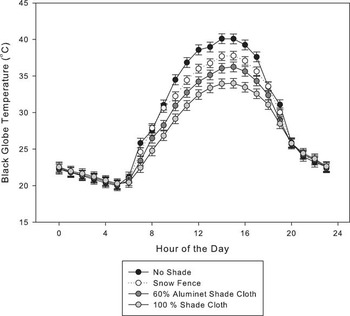
The environment under each shade was quantified by three measurements: BGT, SR and feedlot surface temperature. Black globe temperatures under each of the treatments are shown in Figure 1. Black globe temperatures differentiated between the treatments as the sun rose and remained different until the sun set at which point the temperatures converged. Each of the shade treatments yielded a reduction in BGT as compared with No Shade. The maximum reduction in BGT was observed under the 100% shade cloth−mean reduction (mean±SD) observed during day to light hours was 9.4%±2.7% and maximum reduction was 11.9%. The 60% Aluminet shade cloth had a mean reduction of 6.5%±2.0% and a maximum of 8.7%. The snow fence had a mean reduction of 3.7%±1.8% and a maximum reduction of 5.5%.
Black globe temperature measured 1.3 m above the soil surface in the No Shade treatment and 60 cm under each of the three different shade materials (Snow Fence, 60% Aluminet Shade Cloth and 100% Shade Cloth). Hourly data were averaged over the experimental period.

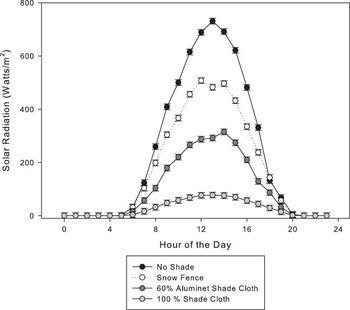
Solar radiation had a similar but more dramatic shift between treatments (Figure 2). Obviously, these differences only occurred during the daylight hours. The mean reduction (mean±SD) in SR was 21.8%±12.0% under the Snow Fence treatment, 54.6%±6.7% under the 60% Aluminet Shade Cloth and 86.8%±3.6% under the 100% Shade Cloth. Maximum reduction in SR compared with No Shade varied little from mean reduction and had a similar trend: 34.0% reduction under the Snow Fence, 61.1% reduction under the 60% Aluminet Shade Cloth and 89.4% under the 100% Shade Cloth.
Solar radiation measured 1.3 m above the soil surface in the No Shade treatment and 60 cm under each of the three different shade materials (Snow Fence, 60% Aluminet Shade Cloth and 100% Shade Cloth). Hourly data were averaged over the experimental period.

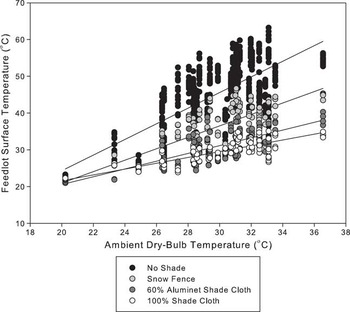
Soil surface temperature under the No Shade and in each of the shade treatment was recorded to further document the environment in each treatment (Figure 3). Soil surface temperature was directly related to ambient temperature. When no shade was provided, the soil surface temperature increased 2.1°C for each degree of ambient dry-bulb temperature rise (equation (2); R 2=0.4883, P<0.001). Under the Snow Fence an increase of 1.6°C was observed (equation (3); R 2=0.5491, P<0.001). The 60% Aluminet shade cloth lowered that increase to 1.1°C (equation (4); R 2=0.5334, P<0.001). The 100% Shade Cloth actually lowered that value to 0.8°C for each degree of ambient dry-bulb temperature rise (equation (5); R 2=0.6438, P<0.001):
 $$t_{{{\rm ss}{\minus}{\rm open}}} \,{\equals}\,2.1{\times}t_{{{\rm db}}} {\minus}18.1$$
 $$t_{{{\rm ss}{\minus}{\rm sf}}} \,{\equals}\,1.6{\times}t_{{{\rm db}}} {\minus}10.2$$
 $$t_{{{\rm ss}{\minus}60\,\%\,}} \,{\equals}\,1.1{\times}t_{{{\rm db}}} {\minus}0.5$$
 $$t_{{{\rm ss}{\minus}100\,\%\,}} \,{\equals}\,0.8{\times}t_{{{\rm db}}} {\plus}5.8$$
where t ss is the temperature of the soil surface (°C) under various shade treatments: (open=no shade, sf=snow fence, 60%=60% Aluminet shade cloth and 100%=100% shade cloth) and t db the ambient dry-bulb temperature (°C).
Relationship between feedlot surface temperatures and ambient temperatures taken throughout the experiment in the open and under Snow Fence, 60% Aluminet Shade Cloth and 100% Shade Cloth.

Eigenberg et al. (Reference Eigenberg, Brown-Brandl and Nienaber2010) examined the effectiveness of different types of shade material, similar to those used in this study. This paper reported similar results in BGT and SR. The Eigenberg study did not report soil surface temperature and did not use animals to characterize shade effectiveness.
Animal responses
The RRm, which was taken once a day in the afternoon of each of 35 days (5 days a week for 8 weeks minus days the animals were moved), was significantly affected by treatment and THI category. As expected, as RRm (mean±SE) increased with increasing THI category (P<0.0001) for all treatments from Normal (72.6±3.6 bpm), through Alert (102.7±2.7 bpm), Danger (112.5±2.6 bpm) and Emergency (121.6±2.6 bpm). Also as expected, RRm decreased (108.8±2.8, 103.0±2.8, 100.6±2.8 and 97.0±3.1 bpm) as shade quality increased (P<0.0001), No Shade, Snow Fence, 60% Aluminet Shade Cloth and 100% Shade Cloth, respectively, over all THI categories. There tended to be an interaction effect between shade quality and THI category (P=0.1033). In the Alert category, cattle with no access to shade or access to snow fence had higher RRm than either the 60% Aluminet Shade Cloth or the 100% Shade Cloth (P<0.01). In the Danger and Emergency categories, cattle with no access to shade (No Shade treatment) had a significantly higher RRm than any of the shade treatments (P<0.01). It was interesting that there were no significant differences in RRm between the different types of shade in the higher THI categories. Therefore, using RRm as an indicator, higher levels of shade (60% and 100%) provided better protection over all THI categories. However, at high THI categories any shade was sufficient to reduce stress.
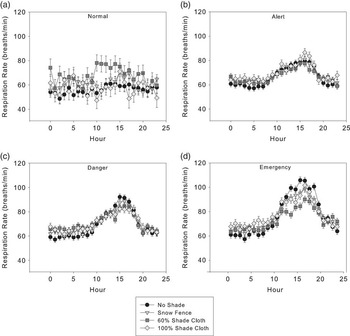
The RRe was significantly impacted by THI category, hour, interaction effects of treatment by THI category and treatment by hour by THI category (P<0.0001). The interaction effects of treatment, THI category and hour are shown in Figure 4. In the Normal THI category, by definition, cattle are not environmentally stressed. The differences in the RRe between the treatments in the Normal category were minimal and most likely due to activity or random artifacts instead of true treatment differences. The most significant of these differences were between 1000 and 1200 h; animals with access to the 60% Aluminet Shade Cloth had significantly higher RRe than the other treatments (P⩽0.05). In the Alert category, the ambient temperature is only a little higher than the Normal category and animal stress was still minimal. In the Alert category, there were only a few significant differences; in the late afternoon (1600 to 1700 h) animals with access to 100% Shade had higher respiration rates than those with access to 60% Aluminet Shade (P⩽0.05). This could be due to heifers not utilizing the shade as much as the other treatments, possibly as a behavioral response to the shade structure damage earlier in the experiment. In the Danger category, cattle having access to 60% Aluminet Shade Cloth or 100% Shade Cloth were less stressed in the early afternoon hours (1400 to 1600 h) (P⩽0.05). Shade provided by Snow Fence was not significantly different from 100% Shade Cloth or the No Shade treatment. However, RRe was significantly higher for animals with access to snow fence as compared with 60% Aluminet Shade Cloth at 1400 h (P⩽0.05). In the Emergency category, environmental conditions can be extreme, especially, if there is little wind to aid in cooling. All shade provided relief to cattle in the afternoon during emergency conditions (No Shade v. Snow Fence – 1300, 1500, 1800 h (P<0.05); No Shade v. 60% Aluminet Shade Cloth – 1200 to 1800 h (P<0.01); No Shade v. 100% Shade Cloth – 1300 to 1500, 1800 h (P<0.05)). It appears that 60% Aluminet Shade Cloth provided the most effective shade in the Emergency category. Cattle in this treatment had significantly lower RRe than other treatments (60% Aluminet Shade Cloth v. Snow Fence – 1200 to 1600, 1800 h; 60% Aluminet Shade Cloth v. 100% Shade Cloth – 1100 to 1300, 1500 to 1700 h).
Electronically recorded respiration rates collected on feedlot heifers exposed to summer conditions, categorized by temperature humidity index (THI) ((a) THI<74, Normal; (b) 74<THI<79, Alert; (c) 79<THI<84, Danger; (d) THI>84, Emergency). The heifers had access to either one of the three shade treatments (Snow Fence, 60% Aluminet Shade Cloth or 100% Shade Cloth) or a No Shade control treatment. Error bars are equal to the SE.

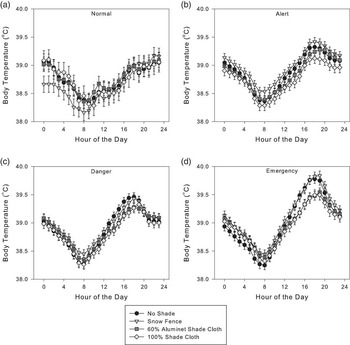
The BT was impacted by THI category, hour, and the interactions of THI category by treatment, treatment by hour and THI category by treatment by hour (P<0.0001). The three-way interaction effect of treatment by THI category by hour is shown in Figure 5. Under Normal THI conditions the temperature is low, and the cattle are not stressed; therefore, differences between treatments were minimal (snow fence is significantly lower than all other treatments at 0000 and 0100 h). During Alert conditions, animals with access to Snow Fence had the highest BT (Snow Fence v. No Shade between 0500 and 0800 h; Snow Fence v. 60% Aluminet Shade Cloth between 1100 and 1800 h; Snow Fence v. 100% Shade Cloth between 0000 to 0100 and 0500 to 2300 h). In the Danger category, the 60% and 100% Shade Cloth provided relief from the heat stress in the afternoon hours (heifers in the 60% Aluminet Shade Cloth treatment had significantly lower BT between 1400 and 1800 h and heifers in the 100% Shade Cloth treatment had significantly lower BT between 1300 and 1800 h compared with heifers with No Shade access). In the Emergency category, the differences were very distinct in the afternoon hours. Heifers in the No Shade treatment and Snow Fence treatment had significantly higher BT than animals in either the 60% Aluminet Shade Cloth or 100% Shade Cloth treatments. Heifers in the No Shade treatments had higher BT between 1400 and 1900 h than heifers in either the 60% or 100% Shade Cloth treatments. The heifers in the 60% Aluminet Shade Cloth treatment had lower BT between 1400 and 2000 h as compared with heifers in the Snow Fence treatment, whereas heifers in the 100% Shade Cloth treatment had lower BT between 1300 and 2100 h as compared with heifers in the Snow Fence treatment.
Vaginal temperatures collected on feedlot heifers exposed to summer conditions, categorized by temperature humidity index (THI) ((a) THI<74, Normal; (b) 74<THI<79, Alert; (c) 79<THI<84, Danger; (d) THI>84, Emergency). The heifers had access to either one of the three shade treatments (Snow Fence, 60% Aluminet Shade Cloth or 100% Shade Cloth) or a No Shade control treatment. Error bars are equal to the SE.

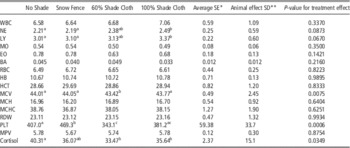
Blood samples were obtained from all the animals each week during the day set aside for handling the cattle. Hematocrit remained constant across all treatments. The values for each measurement obtained fell within normal ranges for adult cattle for all treatment groups. Specifically, for white blood cell populations, differences between treatments approached significance for lymphocyte (LY) and eosinophil (EO) counts (Table 1). Lymphocyte numbers were similar among the No Shade, Snow Fence and 60% Aluminet Shade Cloth (P>0.4). However, 100% shade was different than the No Shade treatment (P=0.01) and the Snow Fence treatment (P=0.05). Eosinophil numbers did not differ between No Shade, Snow Fence and 100% Shade Cloth (P>0.2), and as with LY, the 60% Aluminet and 100% Shade Cloth values were similar (P=0.0875). Differences between treatments were highly significant for mean corpuscular value (MCV). Mean corpuscular value was similar between the No Shade, Snow Fence and 100% Shade Cloth treatments (P>0.2); however, MCV was significantly lower in the animals in the 60% Aluminet Shade Cloth treatment group (P<0.01). Platelet (PLT) counts also differed significantly between treatments. The No Shade and 100% Shade groups had similar counts as did the Snow Fence and 100% Shade Cloth groups (P=0.39). The PLT count for the 60% Aluminet Shade Cloth treatment was the lowest among all treatments and was significantly different than any other treatment (P<0.05). The ratio between neutrophil (NE) and LY counts, a measure of stress, was not different among any of the treatments groups. Plasma concentration of cortisol differed (P=0.0349) among treatments (Table 1) with the highest concentration detected in the No Shade group. In contrast, plasma cortisol was 17% and 12% lower in cattle provided 60% Shade Cloth and 100% Shade Cloth, respectively. Plasma cortisol concentration for the Snow Fence group did not differ from that of the No Shade group or either of the Shade cloth groups.
Comparison effect of shade on complete blood count and plasma cortisol

WBC=white blood cell count (K/ml); NE=neutrophils (K/ml); LY=lymphocytes (K/ml); MO=monocytes (K/ml); EO=eosinophils (K/ml); BA=basophils (K/ml); RBC=red blood cells (M/ml); HB=hemoglobin (g/dl); HCT=hematocrit (%); MCV=mean corpuscular volume (fl); MCH=mean corpuscular hemoglobin (pg); MCHC=mean corpuscular hemoglobin concentration (g/dl); RDW=red cell distribution width (%); PLT=platelets (K/ml); MPV=mean platelet volume (fl); cortisol (ng/ml).
a,b,cColumns with differing superscripts are significantly different (P≤0.05).
* Average standard error of the four least-squares means estimates.
** Because the model included period and animal by period interaction as additional random effects and week as a repeated effect average least-squares means standard errors for some traits are larger than the animal effect SD.
Discussion
Summertime conditions can result in weather that can cause production losses and can be a major animal well-being concern. Feedlot cattle are particularly vulnerable to high temperatures because they are housed almost exclusively outdoors in pens with a dark soil surface, which can exceed 50°C (Brown-Brandl et al., Reference Brown-Brandl, Eigenberg and Nienaber2013), are fed a high-grain diet and have a high body condition score. Several heat-abatement strategies have been developed and tested. One such strategy is providing shade. Several studies have been conducted showing the benefits of shade (Bond et al., Reference Bond, Kelly, Morrison and Pereira1967; Blackshaw and Blackshaw, Reference Blackshaw and Blackshaw1994; Mitloehner et al., Reference Mitloehner, Morrow, Dailey, Wilson, Galyean, Miller and McGlone2001; Gaughan et al., Reference Gaughan, Bonner, Loxton, Mader, Lisle and Lawrence2010; Brown-Brandl et al., Reference Brown-Brandl, Eigenberg and Nienaber2013). One study determined the quantity of shade that was needed (Sullivan et al., Reference Sullivan, Cawdell-Smith, Mader and Gaughan2011). Shade quality has also been evaluated for a number of years (Kelly and Bond, Reference Kelly and Bond1958; Eigenberg et al., Reference Eigenberg, Brown-Brandl and Nienaber2010); but no study has documented the effects of the quality of shade on reducing animal stress in feedlot cattle. However, two studies were found that reported the effects of shade quality in pasture dairy cattle (Valtorta et al., Reference Valtorta, Leva and Gallardo1997; Tucker et al., Reference Tucker, Rogers and Schütz2008). A major difference between the pasture and the feedlot is the ground surface; the pasture environment in general has a lower surface temperature due to the evapotranspiration of the grass compared with the dark soil, which tends to heat up in the sun. In addition, Valtorta et al. (Reference Valtorta, Leva and Gallardo1997) compared artificial shade cloth (with about 80% coverage) to two types of trees; interestingly, there was little difference in the BGT between the shade treatments (trees and 80% shade cloth).
The environment under the different shade materials is dependent on four factors: (1) transmissivity and reflectivity of upper and lower surfaces, (2) thermal diffusivity, (3) porosity of the material itself and (4) solidness or percentage of the area that is open (adapted from Kelly and Bond, Reference Kelly and Bond1958). For example, both Kelly and Bond (Reference Kelly and Bond1958) and Eigenberg et al. (Reference Eigenberg, Brown-Brandl and Nienaber2010) compared a snow fence for shade materials. The snow fence described in Kelly and Bond (Reference Kelly and Bond1958) was 5.1-cm wood slates with 5.1-cm openings. The snow fence described in Eigenberg et al. (Reference Eigenberg, Brown-Brandl and Nienaber2010) was a plastic snow fence with about 30% coverage. Both types of snow fence offered some protection; however, as with this study the snow fence material was the least effective in reducing SR: 24.6% (Kelly and Bond, Reference Kelly and Bond1958) and 22.7% (Eigenberg et al., Reference Eigenberg, Brown-Brandl and Nienaber2010). In addition, Kelly and Bond (Reference Kelly and Bond1958) tested several types of shade cloth, two of which were 90% and 92% coverage; the SR under each of the shade cloths was reduced by 33.2% and 36.8%, respectively. Eigenberg et al. (Reference Eigenberg, Brown-Brandl and Nienaber2010) reported SR reductions of 52.3%, 42.2% and 92.2% for a 60% Aluminet, 60% black and 100% shade material. The shade materials have obviously changed over the years. The present study reports similar reductions in SR as Eigenberg et al. (Reference Eigenberg, Brown-Brandl and Nienaber2010) and also shows a reduction in soil surface temperature. In the present study, the mean reduction in SR was 21.8% under the Snow Fence treatment, 54.6% under the 60% Aluminet Shade Cloth and 86.8% under the 100% Shade Cloth, which were similar reductions as compared with Eigenberg et al. (Reference Eigenberg, Brown-Brandl and Nienaber2010). Comparing only the environment under the three materials, the 100% Shade Cloth clearly gives the best environment for the animals.
Although 100% Shade Cloth offers the greater environmental advantage, there are other factors that need to be considered. One of the main factors is animal responses under each of the shade materials. Interestingly, the animal responses did not perfectly line up with environmental measures and the different physiological responses did not always agree.
The RRm increases as the categories become incrementally more stressful. This response is commonly reported for cattle during summertime conditions (Blackshaw and Blackshaw, Reference Blackshaw and Blackshaw1994; Eigenberg et al., Reference Eigenberg, Hahn, Nienaber, Brown-Brandl and Spiers2000; Gaughan et al., Reference Gaughan, Holt, Hahn, Mader and Eigenberg2000; Scharf et al., Reference Scharf, Leonard, Weaber, Mader, Hahn and Spiers2011). The RRm response in the Alert category showed no difference in the response between the cattle in the No Shade and the Snow Fence treatments; however, the animals with access to the 60% Aluminet and 100% Shade Cloth had a positive response with the animals in 100% Shade treatment having the lowest RRm. However, in the Danger and Emergency categories it was shown that any quality of shade had a positive response and there was no significant difference between qualities of shade.
The RRe provided measurements throughout the day, instead of just a single point in time value. The responses were slightly different between RRm and RRe. The responses of the heifers in the Normal category were random with little diurnal or treatment effect. Under all other conditions, the diurnal effect was evident. The treatments also play a larger role as the environment gets more stressful. Brown-Brandl et al. (Reference Brown-Brandl, Eigenberg, Nienaber and Hahn2005) reported similar responses between 100% shade material and non-shaded cattle, as shown in the present study. Although the responses between the two studies were similar, the differences between shaded and non-shaded cattle were more distinct in the study by Brown-Brandl et al. (Reference Brown-Brandl, Eigenberg, Nienaber and Hahn2005).
When considering the BT response, it appears that there is a strong diurnal effect in each of the four THI categories. The maximum BT steadily increases as the THI becomes more stressful. The highest maximum temperature occurs in the Emergency category as expected. The minimum BT is similar in all THI categories suggesting that the cattle had ample time to recover from the heat stress that occurred during the day. The diurnal pattern found in this study is similar to those previously reported (Mader et al., Reference Mader, Holt, Hahn, Davis and Spiers2002; Brown-Brandl et al., Reference Brown-Brandl, Eigenberg, Nienaber and Hahn2005; Scharf et al., Reference Scharf, Leonard, Weaber, Mader, Hahn and Spiers2011). The effect of shade has been shown to reduce BT (Blackshaw and Blackshaw, Reference Blackshaw and Blackshaw1994; Brown-Brandl et al., Reference Brown-Brandl, Eigenberg, Nienaber and Hahn2005; Gaughan et al., Reference Gaughan, Bonner, Loxton, Mader, Lisle and Lawrence2010). Under the Danger and Emergency categories, the type of shade provided was important. Tucker et al. (Reference Tucker, Rogers and Schütz2008) also found that cattle with access to a higher quality of shade had a lower minimum BT. The shade provided by snow fence did not provide much protection. It appears that to reduce BT in hot temperatures there is a minimum quality of shade that is needed.
Physiological values such as breed, sex, recent activity and stress have an impact on hematological values in cattle (Wood and Quiroz-Rocha, Reference Wood and Quiroz-Rocha2010). To minimize variation caused by breed, sex and activity, Angus heifers of similar age were used in this study in a 4×4 Latin square design. This design should have allowed us to measure differences in blood values caused by the response to shade under various THI conditions. In cattle, a stress leukogram consisting of mild mature neutrophilia, lymphopenia, eosinopenia and variable monocytosis is frequently present in animals exposed to endogenous or exogenous glucocorticoids (Anderson et al., Reference Anderson, Watson and Colditz1999; Tornquist and Rigas, Reference Tornquist and Rigas2010). In addition, the most frequent cause of lymphopenia in ruminants is the corticosteroid-induced stress response (Tornquist and Rigas, Reference Tornquist and Rigas2010). The ratio of NE : LY numbers is often used as a measure of stress. By 2 weeks of age, cattle have reached the baseline values for NE : LY ratio of 0.5 (Wood and Quiroz-Rocha, Reference Wood and Quiroz-Rocha2010). Under stressful conditions, such as transportation, neutrophilia combined with lymphopenia results in a transient increase in NE : LY to >1 lasting for up to 24 h (Lomborg et al., Reference Lomborg, Nielsen, Heegaard and Jacobsen2008). In our study, differences between the shade treatments approached significance for NE, LY and EO. Although all of these values were within normal physiological ranges, the number of NE increased as shade quality increased counter to what we would expect; however, the number of LY also increased with increasing shade quality, as we would expect. The number of EO followed a similar pattern to the NE with values for the No Shade or Snow Fence treatments being higher than for the two treatments with 60% Aluminet and 100% Shade also counter to what we had expected. Mean corpuscular volume, the mean volume of red blood cells, was lower in animals from the 60% Aluminet Shade treatment, and was significantly different from the other three treatment groups. This also followed the trend of cortisol and possibly indicates that animals in the 60% Aluminet Shade treatment experienced the lowest levels of stress. Platelet values were also lowest in the animals in the 60% Aluminet Shade treatment. With regard to the adrenal axis response to heat stress, Roman Ponce et al. (Reference Roman Ponce, Thatcher, Collier and Wilcox1981) reported that onset of elevated ambient temperature was associated with increased blood concentration of cortisol in dairy cows maintained outdoors. In contrast, blood concentration of cortisol was reduced in dairy cows maintained at air-conditioned indoor facility (Wise et al., Reference Wise, Armstrong, Huber, Hunter and Wiersma1988). Provision of shade rather than air-conditioning is a more feasible method to mitigate heat stress in feedlot cattle. The physiological responses of lactating Dutch-type Friesian cows to provision of a shade structure that provided coverage of 4.1 m2/cow in a dry lot was studied over three successive summers by Muller et al. (Reference Muller, Botha, Coetzer and Smith1994). The mean plasma concentration of cortisol was 12% to 26% less in the cows (sampled once daily by jugular venipuncture) provided access to shade relative to the cows that were not provided shade. This reported reduction in concentration of cortisol in the shaded lactating Friesian dairy cows is comparable with the 12% to 17% reduction in serum concentration of cortisol observed in the Angus heifers provided shade (7.5 m2 of shaded space/animal) and sampled once weekly in our study. The mean cortisol concentration and variation within treatment group in our study are similar to observations reported by others who also collected weekly blood samples via jugular venipuncture of beef cattle in feedlot facilities (Gupta et al., Reference Gupta, Earley, Ting and Crowe2005; Cockrum et al., Reference Cockrum, Speidel, Salak-Johnson, Chase, Peel, Weaber, Loneagan, Wagner, Boddhireddy, Thomas, Prayaga, DeNise and Enns2016). Our observation of a diminution of cortisol concentrations in shaded beef heifers were comparable with the observations that cortisol concentrations is lower in thermally acclimated dairy cows (Collier et al., Reference Collier, Dahl and VanBaale2006). Provision of shade appears to be beneficial to dark-hided beef feedlot beef heifers based on the physiological responses measured in our study. Because the stress response may not extend beyond 24 h and because we only handled the cattle and obtained blood samples once each week, we may have missed the optimum sampling times to measure differences due to temperature extremes. Taken together, the hematology data indicate that 60% Aluminet Shade material provided conditions that alleviated the most heat stress.
In summary, based on animal responses, the 60% Aluminet was the best shade material used during this study. Some of the data suggest that any amount of shade is beneficial to the animals. However, Snow Fence may not offer adequate protection to reduce BT. For some of the parameters (CBC and cortisol), 60% Aluminet and the 100% Shade Cloth offered similar protection. The 60% Aluminet lowered the RRe the most during the extreme conditions. The 60% Aluminet may have had the best response because the 60% was permeable, thus allowing air to move through the material thus increasing natural ventilation. The second and possibly more important factor is the 100% may have affected the animal’s behavior due to noise or movement of the 100% shade in strong wind.
Although the Snow Fence improves the thermal environment by lowering the SR, the BGT and the soil surface temperature under the shade – it is clear that it does not offer much protection to the animals under the shade in the two highest stress THI categories (Danger and Emergency). Although heifers in the Snow Fence treatment had lowered RR as compared with heifers in the No Shade treatment for a few afternoon hours in the emergency zone (1300, 1500 and 1800 h), the BT of the heifers in this treatment was no different than the No Shade treatment. The long-term effects of each of the treatments can be seen in the CBC – in the significant effects it appears that the No Shade and the Snow Fence are generally the same with the best protection from the elements being offered by the 60% Aluminet Shade Material.
Acknowledgments
The authors thank Dale Janssen, John Holman and Todd Boman for helping with data collection, members of the USMARC feedlot crew for caring for the cattle during this study and Jan Watts for her help in preparing the manuscript.
Mention of trade names or commercial products in this article is solely for the purpose of providing specific information and does not imply recommendation or endorsement by the US Department of Agriculture (USDA). The USDA is an equal opportunity provider and employer.