Introduction
In 2018, Louisiana produced 27,510 kg ha−1 sweetpotatoes on 3,109 hectares, which had a total value of $94.5 million and ranked fourth in domestic production behind North Carolina, Mississippi, and California (Anonymous 2019). There are two main cultivars used in sweetpotato production in the United States: ‘Beauregard’ and ‘Covington’ (Smith et al. Reference Smith, Stoddard, Shankle, Shultheis, Loebenstein and Thottappilly2009). According to the North Carolina SweetPotato Commission (K. McIver, personal communication), ‘Covington’ accounts for 91% of the hectares grown in North Carolina, whereas ‘Beauregard’ has remained an industry standard in other parts of the United States (Smith et al. Reference Smith, Stoddard, Shankle, Shultheis, Loebenstein and Thottappilly2009). In Louisiana, field production costs are approximately $9,884 to $11,367 ha−1 for fresh market sweetpotatoes, whereas processing sweetpotatoes cost an average of $5,683 ha−1 before storage (Anonymous 2019). Given the high value and production costs, a small amount of herbicide injury could cause a severe economic loss.
Sweetpotato is a low-growing vine crop in the Convolvulaceae (Smith et al. Reference Smith, Stoddard, Shankle, Shultheis, Loebenstein and Thottappilly2009). It is commercially propagated asexually by what is referred to as seed stock from the previous year’s harvest (Smith et al. Reference Smith, Stoddard, Shankle, Shultheis, Loebenstein and Thottappilly2009). Maximum yield production requires adventitious roots to effectively produce lateral roots that swell and produce mature potatoes (Villordon et al. Reference Villordon, Ginzberg and Firon2014). Previous container studies have indicated that at approximately 5 to 15 d after transplanting (DAP), 80% of the final yield is determined by adventitious roots that progressively grow and produce lateral roots. These actions all depend on the internal auxin signaling of the plant (Villordon et al. Reference Villordon, Ginzberg and Firon2014). Villordon et al. (Reference Villordon, LaBonte and Firon2009) differentiated storage root development into a three-stage phenology scheme, storage root 1 (SR1), storage root 2 (SR2), and storage root 3 (SR3). SR1 consists of the presence of at least one adventitious root longer than 0.5 cm in at least 50% of transplanted slips. SR2 consists of the presence of anomalous cambium in at least one adventitious root on 50% of the plants. SR3 consists of at least one visible storage root, an adventitious root that is swollen 0.5 cm at its widest point, in at least 50% of the plants. Storage root formation begins between 13 and 20 d in the field. Lateral root development is fundamentally dependent on auxin signaling, and anything that interferes with this process interferes with storage root formation. This is the precise window for targeting negative impacts, such as herbicide injury, to determine maximum potential to reduce yield due to reduction in storage root number (A. Villordon, personal communication).
With increasing populations of weeds resistant to glyphosate, crop genetic development has shifted focus to developing new technologies with older herbicides to combat such populations. A new technology has been commercialized that allows application of a new formulation of 2,4-D (in combination with glyphosate) over the top of crops that were previously intolerant to this herbicide. 2,4-D controls most dicotyledonous plants, including morningglory (Ipomoea spp.) (Siebert et al. Reference Siebert, Griffin and Jones2004), Palmer amaranth [Amaranthus palmeri (S.) Watson] (Norsworthy et al. Reference Norsworthy, Griffith, Scott, Smith and Oliver2008), and marestail [Erigeron canadensis (L.) Cronquist] (Bruce and Kells Reference Bruce and Kells1990), and therefore is more commonly used in monocotyledonous crops, such as pastures, turf, corn, and small grains.
The transgenic technology that has enabled crops to tolerate over-the-top applications of 2,4-D is marketed as the Enlist® cropping system. A new choline salt of 2,4-D has been developed for application in these cropping systems. This formulation is marketed as being much less volatile than ester and amine formulations and sold in combination with glyphosate as Enlist Duo® or alone as Enlist One®. Enlist® corn (Zea mays L.) exhibits tolerance to Enlist Duo as well as aryloxphenoxyproprionate herbicides, whereas Enlist soybean [Glycine max (L.) Merr.] and cotton (Gossypium hirsutum L.) are tolerant to applications of Enlist Duo and glufosinate. This new technology uses modified plant genetic resistance to these products so applications may be made directly to the transformed crops.
Merchant et al. (Reference Merchant, Sosnoskie, Culpepper, Steckel, York, Braxton and Ford2013) found that morningglories exposed to 2,4-D at 532, 798, or 1,064 g ha−1 were completely controlled. Glyphosate applied at 1,120 g ai ha−1 controlled 2- to 5-cm entireleaf (I. hederacea L.) and pitted morningglory (I. lacunosa L.), whereas the same species at 8 to 10 cm were controlled 84% and 88%, respectively (Corbett et al. Reference Corbett, Askew, Thomas and Wilcut2004). Because sweetpotato is also an Ipomoea species, off-target movement of 2,4-D and glyphosate is a major cause for concern for sweetpotato producers. Previous research has shown that 1/4 of the recommended rate of 2,4-D applied at 27 d after transplanting (DAP) resulted in complete kill of ‘Beauregard’ sweetpotato within 2 wk (Clark and Braverman Reference Clark and Braverman1998). 2,4-D at 1/4 and 1/10 of the recommended use rate resulted in complete yield loss, whereas 2,4-D applied at 1/100 the use rate resulted in intermediate yield reduction. In a separate study, Clark and Braverman (Reference Clark and Braverman1998) also reported that glyphosate applied at 1/2, 1/4, and 1/10 the use rate 27 DAP reduced ‘Beauregard’ U.S. no. 1 and total marketable yield. When 2,4-D was applied at 41 DAP, yield reduction was observed only with the 1/2× and 1/4× rates. Meyers et al. (Reference Meyers, Jennings and Monks2017) also indicated that when sweetpotato was exposed to simulated glyphosate drip rates (usually encountered in wick weed control applications) 4 to 8 wk after planting, there was 65% to 26% injury, respectively. They also observed up to a 300% yield loss when compared with the nontreated plants (Meyers et al. Reference Meyers, Jennings and Monks2017).
To our knowledge, no research has been conducted on the potential negative impacts of 2,4-D on sweetpotato in the Enlist cropping system. Sweetpotato injury from off-target movement or sprayer contamination of 2,4-D and glyphosate is a substantial concern, given the high cost of inputs required to produce the crop. To compound this issue, corn, cotton, soybean, and sweetpotatoes are all grown in close proximity. With these concerns in mind, research was conducted in Louisiana to evaluate and quantify potential negative impacts of reduced rates of this hormonal herbicide and glyphosate applied at reduced rates during storage root formation and development on growth and yield of sweetpotato.
Materials and Methods
Two field studies were initiated in 2014 at the Sweet Potato Research Station near Chase, LA (32.1°N, 91.71°W) and repeated in 2015. Each study was differentiated on the basis of the timing of herbicide application: one at storage root formation (10 DAP) and the other at storage root development (30 DAP). In each study, ‘Beauregard’ sweetpotato was mechanically transplanted at a population of 32,292 plants ha−1 into a 5.8 pH Gigger silt loam (fine-silty, mixed, active, thermic Typic Fragiudalfs) with an organic matter content of 1.5% to 1.8%.
Each study was conducted in a randomized complete block experimental design where treatments were placed in a three-by-six factorial arrangement with four replications. Factor 1 consisted of herbicide (glyphosate; Durango DMA®, Dow AgroSciences LLC, Indianapolis, IN) alone, 2,4-D choline (Enlist One®; Dow AgroSciencesLLC) alone, or 2,4-D choline in combination with glyphosate (Enlist Duo®; Dow AgroSciences LLC); and factor 2 consisted of herbicide rate (1/10, 1/100, 1/250, 1/500, 1/750, and 1/1,000 of the 1× use rate of each product). The 1× use rates of herbicides used for fractional rate calculations were the anticipated labelled rates for soybean and cotton and were as follows: 2,4-D at 1.05 kg ha−1, glyphosate at 1.12 kg ha−1, and 2,4-D in combination with glyphosate at aforementioned rates. Each study included a nontreated control for comparison.
Plots consisted of three rows, and plot dimensions were 3-m wide by 7.62-m long. Two rows of each plot were treated leaving the third as a border row. In all studies, one row was harvested for yield. Herbicide treatments were applied at a constant 187 L ha−1 carrier volume using a compressed-air, tractor-mounted multi-boom sprayer, with each boom consisting of four Teejet AI11003 nozzles (Spraying Systems Co. Wheaton, IL) spread evenly to cover two rows and were run at 138 kPa, producing ultracoarse droplets.
To eliminate weed interference, flumioxazin (Valor SX®; Valent USA, Walnut Creek, CA) at 71.4 g ai ha−1 pretransplant followed by S-metolachlor at 1.4 kg ai ha−1 immediately post-transplant were applied to all plots. Subsequent applications of clethodim (Select Max®; Valent USA) at 170 g ai ha−1 were made throughout the growing season for grass control in addition to hand weeding for broadleaf weed control. Plants were monitored during the growing season to assist with timing of insect control and irrigation.
In both studies where application occurred at storage root formation stage, five plants were excavated at 10 d and 30 d after treatment (DAT) from nonyield record rows and roots were examined for storage root development. This evaluation included determining storage root number, diameter, and weight. From all studies, visual rating of plant injury, based on a scale of 0 (no effect) to 100 (plant death), was recorded at 7, 14, and 28 DAT. A single row from all plots was mechanically harvested and sweetpotatoes separated into U.S. no. 1, canner, or jumbo categories to determine yield. These grades are determined according to U.S. Department of Agriculture standards (USDA 2005).
Data were subjected to ANOVA using SAS PROC GLIMMIX (SAS, version 9.3; SAS Institute Inc., Cary, NC) considering the factorial treatment arrangement. Data from each study were analyzed separately because of the limitation of experimental design in that separate field studies were conducted for each application timing. All data were checked for homogeneity of variance before statistical analysis by plotting residuals. Fixed effects included herbicide, herbicide rate, and their interaction. Year and replications within year were included as random effects. Treatment means were separated by Fisher protected LSD at a significance level of 0.05. When significant main effects were determined, the LINES option of the LSMEANS statement was used to perform Fisher protected LSD means separation. When significant interactions were determined, the SLICEBY and LINES options of the SLICE statement were used to perform Fisher protected LSD means separation of effects within the interaction.
Furthermore, crop injury and yield data were subjected to regression analysis using linear and quadratic models in R (version, 3.2.1; R Foundation for Statistical Computing, Vienna, Austria). The relative goodness of fit was determined using Akaike Information Criterion. The model with lower Akaike Information Criterion was selected:
 $${\rm{Y = a + bX }}\,\left( {{\rm{linear}}} \right)\ {\rm{ or\ Y = a + bX + c}}{{\rm{X}}^{\rm{2}}}\,\left( {{\rm{quadratic}}} \right){\rm{,}}$$
where Y is crop injury or sweetpotato yield by grade; a, b, and c are constants; and X is the herbicide rate transformed as log10. The nontreated check was not included in sweetpotato injury analysis, because crop injury was 0% and had a variance of 0, but it was included in root measurement and yield analysis.
Results and Discussion
Because of a lack of treatment-by-year interaction, data were combined across years for each study. Additional analysis indicated that the two-way interaction between herbicide and herbicide rate was significant (P < 0.05) for all parameters except root measurement data; therefore, results are presented with respect to significance of either main effects or their interaction.
Crop Injury
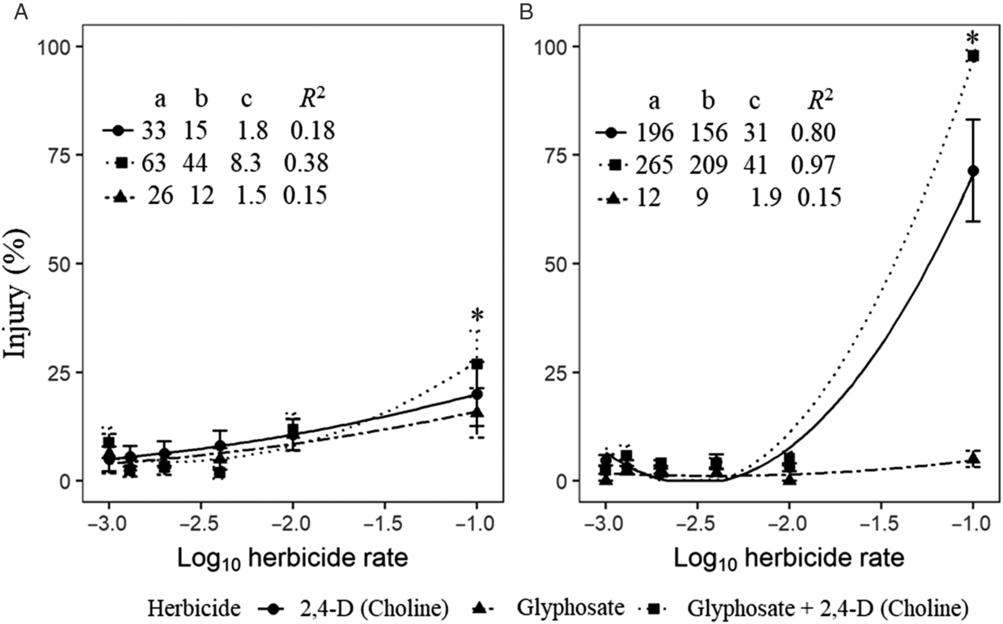
For herbicide application at storage root formation at 7 DAT, no significant difference was observed for crop injury with respect to herbicide for each herbicide rate, and crop injury ranged from 16% to 38% (data not shown). At 14 DAT, greatest injury (46%) was observed after application of 2,4-D plus glyphosate at the 1/10× rate (data not shown). This injury was greater than that observed for glyphosate (23%) and 2,4-D (34%) applied alone at the same rate. At all other herbicide rates, the combination and individual component herbicides resulted in similar injury at 14 DAT (data not shown) and 28 DAT (Figure 1A).
Sweetpotato injury from reduced rates of glyphosate and/or 2,4-D at 28 days after application when applied at (A) storage root formation or (B) storage root development at Chase, LA, in 2014 and 2015. *Statistically significant difference between herbicide type within an application rate based on Fisher protected LSD at α = 0.05. See the text for the equation used.

For herbicide application at storage root development, the effect of herbicide rate was not significant for glyphosate (P > 0.05) and resulted in 1% to 22% crop injury regardless of evaluation timings (Figure 1B). However, a quadratic increase in crop injury was reported with increase in herbicide rate for 2,4-D alone or 2,4-D plus glyphosate at all evaluation intervals. Initially, at 7 and 14 DAT, more injury from 2,4-D alone (14% to 74%) or in combination with glyphosate (18% to 93%) was observed when compared with glyphosate alone (3% to 22%). This was true for all rates, with the exception of the lowest (data not shown). However, this difference in injury with regard to herbicide was only observed for 1/10× rates at 28 DAT (Figure 1B).
In North Carolina, cotton exposed to 1/8 the recommended use rate of 2,4-D or dicamba exhibited injury between 40% to 60% and 60% to 80% for 1 and 2 wk after treatment, respectively (Johnson et al. Reference Johnson, Fisher, Jordan, Edmisten, Stewart and York2012). When exposed to 1/50 the normal use rate of 2,4-D, pepper (Capsicum spp.), tomato (Solanum lycopersicum L.), and squash (Cucurbita pepo L.) had injury rates of 35%, 41%, and 49%, respectively (Merchant et al. Reference Merchant, Culpepper, Sosnoskie, Prostko, Richburg and Webster2012). Similar injury responses were observed with sweetpotato in the current study. Greater injury at the later application timing could simply be due to the plants being larger and having greater leaf and stem surface area to intercept more of the herbicide spray solution.
Root Development
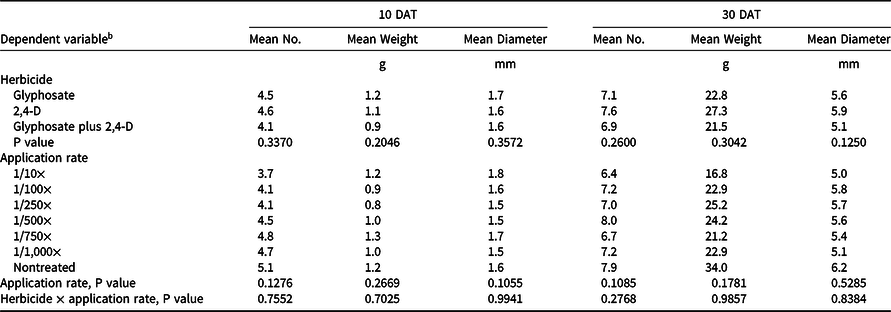
At both 10 and 30 DAT, all root measurements, including storage root number, weight, and diameter, were not influenced by herbicide or herbicide rate after application at storage root formation (Table 1).
The effect of reduced rate application of glyphosate and/or 2,4-D on sweetpotato storage root measurements taken at 10 and 30 d after treatment when herbicide application was made at storage root formation stage at Chase, LA in 2014 and 2015. a

a Data were combined over years.
b Abbreviation: DAT, days after treatment.
Sweetpotato Yield
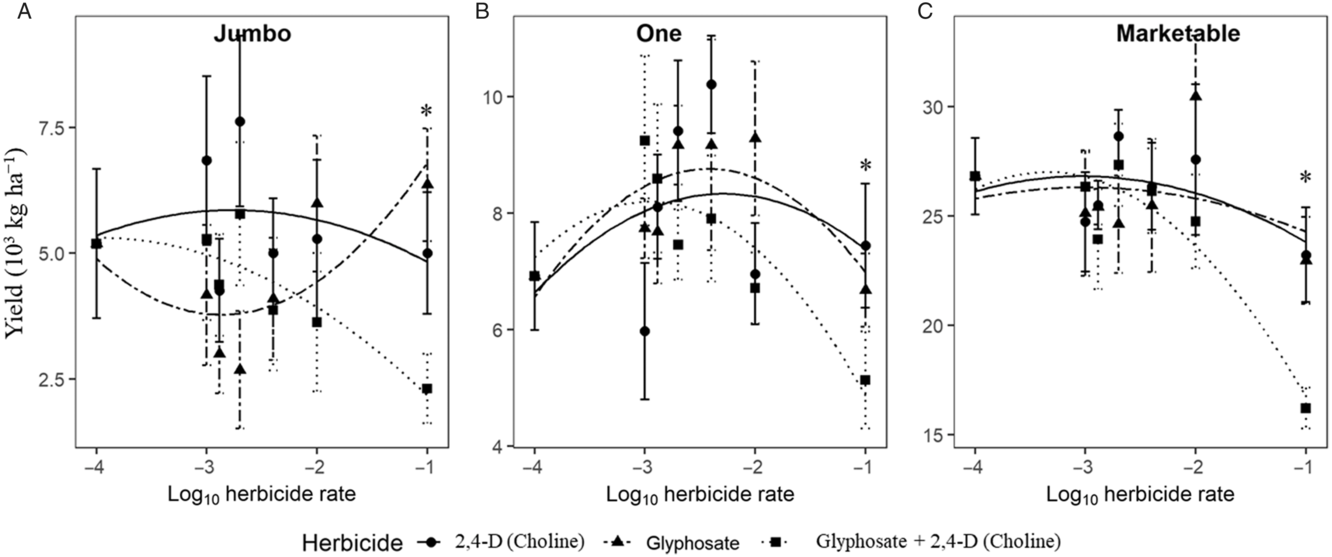
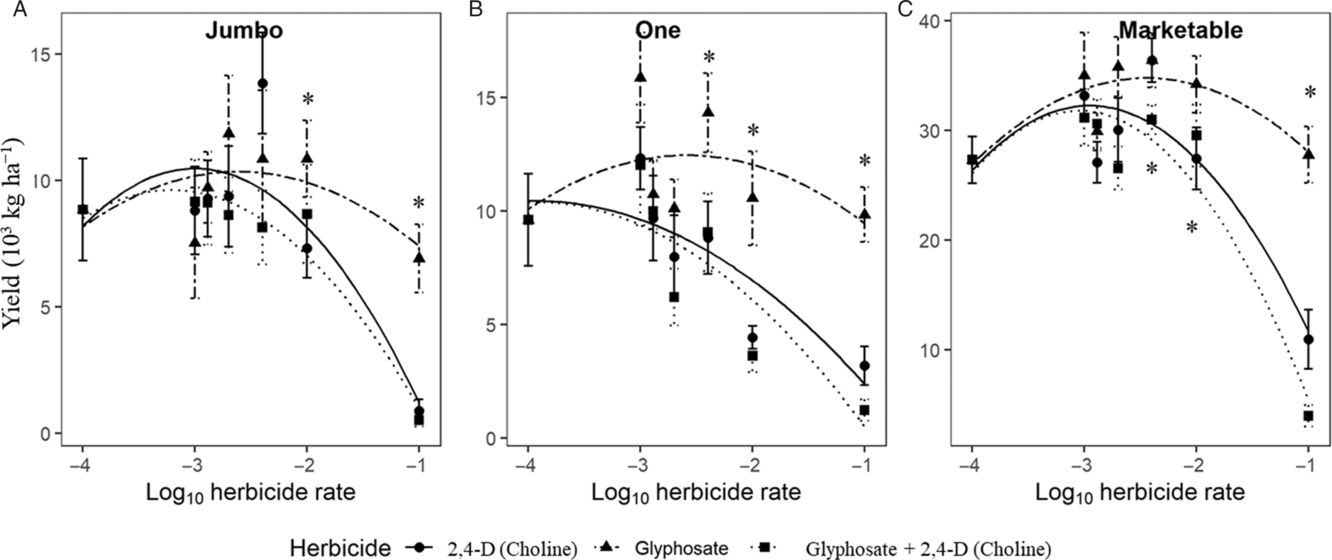
For storage root formation applications, the effect of herbicide rate was not significant for any herbicide for all yield grades except for marketable yield (sum of U.S. no. 1, canner, and jumbo grade) for 2,4-D plus glyphosate (Figure 2A–2C). At 1/10× the herbicide rate, significantly reduced yield of jumbo, U.S. no.1, and marketable grade were observed after application of 2,4-D plus glyphosate, compared with 2,4-D– or glyphosate-only treatments. For application at storage root development, the effect of herbicide rate was not significant for glyphosate alone and resulted in 7 to 12, 10 to 16, and 27 to 36 ×103 kg ha−1 of jumbo, U.S. no.1, and marketable grade yield, respectively (Figure 3A–3C). However, a quadratic yield decrease for all grades was reported with increase in application rate of 2,4-D alone or 2,4-D plus glyphosate. At rates of at least 1/100×, 2,4-D alone and 2,4-D plus glyphosate resulted in 36% to 86% and 18% to 86% yield reduction, respectively, in jumbo grade yield as compared with glyphosate (Figure 3A). This was primarily due to the rate increase from 1/100× to 1/10×. With respect to U.S. no.1 and marketable grades, this reduction was reported at all rates of at least 1/250× (Figure 3B and 3C).
The effect of reduced rate application of glyphosate and/or 2,4-D on sweetpotato yield when applied at storage root formation at Chase, LA, in 2014 and 2015. *Statistically significant difference between herbicide type within an application rate based on Fisher protected LSD at α = 0.05. (A)  Y = 3.3 −1.8X − 0.3X2 (R
2 = 0.01),
 Y = 10.9 − 5.0X + 0.9X2 (R
2 = 0.08),
 Y = −0.3 − 2.8X − 0.4X2 (R
2 = 0.07); (B) Y = 5.3 − 2.6X − 0.6X2 (R
2 = 0.04), Y = 3.6 − 4.3X − 0.9X2 (R
2 = 0.08), Y = 0.6 − 5.2X − 0.9X2 (R
2 = 0.14); (C) Y = 20.1 − 4.4 X − 0.7X2 (R
2 = 0.03), Y = 21.7 − 3.0X − 0.5X2 (R
2 = 0.01), Y = 6.1 − 12.5X − 1.9X2 (R
2 = 0.31).

The effect of reduced rate application of glyphosate and/or 2,4-D on sweetpotato yield when applied at storage root development at Chase, LA in 2014 and 2015. *Statistically significant difference between herbicide type within an application rate based on Fisher protected LSD at α = 0.05. (A) Y = −10.4 −13.9X − 2.3X2 (R
2 = 0.29), Y = 2.6 − 5.9X − 1.1X2 (R
2 = 0.04), Y = −8.6 −11.4X − 1.8X2 (R
2 = 0.3); (B) Y = −4.1 −7.4X − 0.9X2 (R
2 = 0.25), Y = 4.5 − 6.2X − 1.2X2 (R
2 = 0.05), Y = −7.4 − 9.0X − 1.1X2 (R
2 = 0.28); (C) Y = −14.8 − 31.9X − 5.4X2 (R
2 = 0.49), Y = 15.5 − 15.8X − 3.2X2 (R
2 = 0.15), Y = −26.5 − 38.3X − 6.3X2 (R
2 = 0.67).

Negative yield impacts with hormonal type herbicides have also been observed in other crops. In Kansas, research has shown that at 1/3 the use rate, dicamba can cause dead soybean shoot tips at 20 DAT and recovery by 45 DAT, as well as a minimum 75% yield reduction when applied to two to three trifoliate soybean (Al-Khatib and Peterson Reference Al-Khatib and Peterson1999). Potato (Solanum tuberosum L. ‘Norland’) exhibits phytotoxic symptomology after application of dicamba ranging from 2.8 g ai ha−1 to 22.2 g ai ha−1 (Wall Reference Wall1994). Wall (Reference Wall1994) also found that at 22.2 g aiha−1, marketable yield loss equaled 70% to 75%. When exposed to 1/50 the normal use rate of 2,4-D, pepper (Capsicum spp.), tomato (Solanum lycopersicum L.), and squash (Cucurbita pepo L.) yield was reduced by 51%, 23%, and 27%, respectively (Merchant et al. Reference Merchant, Culpepper, Sosnoskie, Prostko, Richburg and Webster2012). In addition, Merchant et al. (Reference Merchant, Culpepper, Sosnoskie, Prostko, Richburg and Webster2012) demonstrated that rates as low as 1/400 the use rate resulted in a 14.5% yield reduction of pepper.
Injury with 2,4-D alone or in combination with glyphosate was generally equal or greater than with glyphosate applied alone at equivalent herbicide rates, indicating that injury is mostly attributable to 2,4-D in the combination. Similarly, Braverman and Clark (Reference Clark and Braverman1998) reported that the effects of glyphosate at low rates on ‘Beauregard’ sweetpotato were not as pronounced as those observed with hormone herbicides 2,4-D, dicamba, and triclopyr. Even though the statistical analysis was not conducted to directly compare herbicide application timings, because of limitation of experimental design, in general, the negative impact of 2,4-D on crop injury and yield was greater when application was made at storage root development than storage root formation. There was quadratic increase in crop injury and quadratic decrease in crop yield (with respect to most yield grades) with increased herbicide rate of 2,4-D applied alone or in combination with glyphosate at storage root development. However, neither the results of this relationship nor the significance of herbicide rate was observed on crop injury or sweetpotato yield when herbicide application occurred at storage root formation, with a few exceptions.
Although injury observed at lower rates (especially toward the upper end range) was a concern after initial observation by sweetpotato producers, in general, crop injury and yield reduction were greatest at the highest rate (1/10×) of 2,4-D applied alone or in combination with glyphosate. However, in some cases, yield reduction of no. 1 and marketable grades was also observed after 1/250×, 1/100×, or 1/10× rates of 2,4-D alone or with glyphosate when applied at storage root development. Braverman and Clark (Reference Clark and Braverman1998) reported that 2,4-D applied at a 1/10× rate resulted in almost no yield, whereas the 1/100× rate of 2,4-D, the 1/10× and 1/100× rates of dicamba, and the 1/10× rate of glyphosate resulted in intermediate yield reduction when herbicides were applied 27 DAP. These data suggest injury and subsequent total yield reduction concerns from the herbicide combination are valid with sublethal rates as low as 1/10× rate that may be encountered in sprayer contamination events and off-target spray applications during storage root formation or development. Therefore, producers with multicrop farming operations are cautioned to thoroughly follow all sprayer cleanout procedures when previously spraying the combination herbicides evaluated or to devote different equipment to spraying Enlist crops.
In addition, proper consideration should be given to planting these crops in close to sweetpotato production fields and making herbicide applications under environmental conditions that are not conducive to off-target spray movement. The information provided by this study can also aid producers in determining if replanting of the crop is warranted and perhaps aid regulatory agencies in determining if label-change considerations are needed with respect to applications in near sweet potato production areas.
Acknowledgements
Partial funding was provided by the Louisiana Sweetpotato Commission and is greatly appreciated by the authors. No conflicts of interest have been declared.