1. Introduction
This paper focuses on multilingual practices of Jewish speakers of German and Low German during the interwar period of the 1920s and 1930s. It discusses three different strands of research on the topic: Anne Betten's (Reference Betten2000a,Reference Bettenb) hypothesis of a standard-oriented supralect (“Weimarer Deutsch”) spoken by the Jewish minority, Jacob Toury's observation of supraregional dialectal varieties used by Jews in Swabia, and David L. Gold's notion of Ashkenazic German as a successor lect of Western Yiddish. Studies of Yiddish–Low German language contact have been sporadic, but the discovery of new sources indicates that the use of remnants of Western Yiddish in contact with Low German has been underestimated (Reershemius Reference Reershemius2007, Reference Reershemius2008).
This article is based on data gathered from fieldwork questionnaires completed for the Language and Culture Atlas of Ashkenazic Jewry (LCAAJ), specifically all the interviews conducted with speakers originally from the Low German-speaking areas. The fieldwork questionnaires produced by Uriel Weinreich and his team between 1964 and 1972 are a unique resource, helping to gain an understanding of linguistic practices in relation to Western Yiddish, standard German, and regional varieties of German that prevailed before the expulsion and murder of the Jewish population in Germany. The extension of LCAAJ fieldwork into the western part of the Yiddish-speaking areas was initially only a by-product of the main research (see Lowenstein Reference Lowenstein2008). It had been assumed even by eminent linguists in the field of Yiddish that in the Dutch- and German-speaking areas, the Jewish minorities had been linguistically assimilated to the dominant contact languages by the late 19th century. However, it later became apparent that many Jewish emigrants from these areas still had knowledge of Western Yiddish or its successor lects, so that in addition to the main LCAAJ questionnaire, the “Western Questionnaire” (WQ) was designed and fieldwork was thus extended (Lowenstein Reference Lowenstein, Marvin Herzog and Weinreich1969, Reference Lowenstein1979, Reference Lowenstein2008).
The main research questions for this article are:
(i) Did Jews in the Low German-speaking areas still have access to remnants of Western Yiddish during the 1920s and 1930s?
(ii) Did they speak Low German?
(iii) Did they speak a form of standard German that distinguished them from their non-Jewish neighbors?
During the interwar period in Germany, many Jewish speakers of German had a multilingual repertoire consisting of remnants of Western Yiddish, standard German, and German dialects.Footnote 1 Theoretically, this article is based on the sociolinguistic notion of the individual repertoire of bilingual speakers as agents of language change, shift, or maintenance in a multilingual context (see, for example, Matras Reference Matras2009, Blommaert & Backus Reference Blommaert and Backus2011, Busch Reference Busch2012). The notion of linguistic repertoires is a central term in sociolinguistics. It was introduced by John J. Gumperz (Reference Gumperz1982:155), who defined it as “the totality of distinct language varieties, dialects and styles employed in a community.” The concept has come to the fore again recently as a way of developing approaches to the study of language and communication that are usage-based and focus on the linguistic practices of speakers as agents. Language is studied not as a system in structural terms, but as a means of communication in specific situations and circumstances for specific speakers and listeners. The term repertoire is generally used to highlight “the total complex of communicative resources that we find among the subjects we study” (Blommaert & Backus Reference Blommaert and Backus2011:3). These subjects are people whose biographies determine what exactly their individual linguistic repertoires contain—for example, the varieties, genres, styles, words, sounds, and grammar of one or more languages. For multilingual repertoires, it can be assumed that in the majority of cases they are not balanced, and that they are in a constant process of development and change. Analyzing the sociolinguistic circumstances of Jews in the German-speaking countries during the 1920s and 1930s by applying the notion of repertoires allows account to be taken of the complex factors that determine communication for the individual and the various communities of practice with which she or he is involved (Holmes & Meyerhoff Reference Holmes and Meyerhoff1999, Harshav Reference Harshav2008).
What is known about the linguistic repertoires of Jews in the German-speaking areas during the first forty years of the 20th century? There are two aspects to this question. First, Jews in the German-speaking countries had experienced a process of language shift from Western Yiddish to German that started toward the end of the 18th century.Footnote 2 This process, though in its later phases, was still ongoing in the 1920s and 1930s in some parts of the German-speaking area (see, among others, Guggenheim-Grünberg Reference Guggenheim-Grünberg and Weinreich1954, Reference Guggenheim-Grünberg1958, Reference Guggenheim-Grünberg1961, Reference Guggenheim-Grünberg1966, Reference Guggenheim-Grünberg1973; Weinberg Reference Weinberg1973; Matras Reference Matras1991; Reershemius Reference Reershemius2007). How did this impact upon Jewish linguistic repertoires in the period? Second, what varieties of German did Jews shift to? Did they speak the dialects of the regions they lived in? Were they recognizable as Jews by the way they spoke German? This paper outlines some interesting insights into these matters provided by the fieldwork questionnaires of the LCAAJ.Footnote 3
The structure of the paper is as follows: Section 2 gives an overview of three different research strands that deal with the question of Jewish linguistic practices and language choices in the German-speaking areas during the first decades of the 20th century. Section 3 introduces the data examined for the study. Sections 4 and 5 present and analyze the findings. Section 6 is a conclusion.
2. Dialects, Weimarer Deutsch, and Remnants of Western Yiddish
From the middle of the 18th century, in a long and often painful process of acculturation lasting well over a hundred years, the Jewish minority living in the German-speaking areas gradually gained access to most of the social domains of the majority society. This process came at a price, which was the loss of Western Yiddish varieties. When the young Moses Mendelssohn moved from Dessau to Berlin in 1743, he did not speak German, either the emerging standard language or any of the regional dialects—the languages he grew up with were Hebrew, Aramaic, and Western Yiddish. Within two to three generations during the 19th century, many members of the Jewish minority shifted from varieties of Western Yiddish to German.
Language shift is a form of contact-induced change that eventually leads to the partial or complete disappearance of one of the languages involved. Uriel Weinreich (Reference Weinreich1953:68) defines it as “the change from the habitual use of one language to that of another.” Sociolinguistic research since the 1970s has shown that in most cases language shift is a gradual process rather than an abrupt act of wholesale abandonment (see, among others, Gal Reference Gal1979), and that it usually takes three generations to complete the transition from Language A to Language B (see, for example, Fishman Reference Fishman1989, Reference Fishman1991; Clyne Reference Clyne2003). Language shift originates in changed linguistic practices of the individual and the group, normally triggered by changed socioeconomic or political circumstances such as migration or, in the case of the Jewish minorities in the German- and Dutch-speaking areas, the gradual modernization of traditional societies within an emerging nation state.
From a macrolinguistic point of view, language shift can have various linguistic outcomes, including increased borrowing, language loss, or even the emergence of new varieties or successor lects. These phenomena can also be observed in the case of Western Yiddish language shift: Jews in the German-speaking countries—both individuals and communities—started to use standard German, but for a long period they could still be recognized as former Western Yiddish speakers, mostly by prosodic and phonological features (see, for example, Toury Reference Toury1983:84–85, Jacobs Reference Jacobs1996:184–85). A growing body of research also indicates that language shift from Western Yiddish to German did not happen as quickly and as comprehensively as has been suggested (Gold Reference Gold1984; Römer Reference Römer1995, Reference Althaus2002; Jacobs Reference Jacobs1996; Lässig Reference Lässig2000). During the first decades of the 20th century, Jews in many parts of the German-speaking areas were still using elements of Western Yiddish in their day-to-day vernaculars, particularly for in-group communication in the family and the community (Guggenheim-Grünberg Reference Guggenheim-Grünberg and Weinreich1954, Reference Guggenheim-Grünberg1958, Reference Guggenheim-Grünberg1961, Reference Guggenheim-Grünberg1966, Reference Guggenheim-Grünberg1973; Lowenstein Reference Lowenstein, Marvin Herzog and Weinreich1969; Weinberg Reference Weinberg1973; Toury Reference Toury1983; Matras Reference Matras1991; Fleischer Reference Fleischer2004, Reference Fleischer2005; Reershemius Reference Reershemius2007). This phenomenon has to do with the fact that during the process of language shift, languages may be transformed into emblematic styles. Matras (Reference Matras2010) and Matras et al. (Reference Matras, Gardner, Jones and Schulman2007) identify the development of such a style as the result of language contact between English and Romani, or, more specifically, as a result of language shift from Romani to English during the 19th century. Former Romani speakers preserved a repository of Romani words, phrases, and structures that could be implemented into English:
Once the old language was lost as a result of its shrinking domains of use, emblematic language mixing became exploited as a discourse-level device that we call an “emotive mode”… The principal feature of the emotive mode is its explicit appeal to a very particular domain of values, attitudes, and cultural knowledge that is shared between speaker and hearer. Use of the emotive mode triggers the activation of special, intimate knowledge and its integration into the utterance, creating the effect of a special bond between speaker and hearer.
(Matras et al. Reference Matras, Gardner, Jones and Schulman2007:149)
The emerging variety known as Anglo-Romani can be described as a stable successor lect of Romani.
Based on remnants of Western Yiddish varieties, new styles or registers emerged that were used by parts of the Jewish communities, especially outside the urban centers in the rural fringes of the German-speaking regions. Those styles and registers could be observed well into the second half of the 20th century and even beyond. There have been debates as what to call these successor lects of Western Yiddish: Weinberg (Reference Weinberg1973) suggests the term Jüdischdeutsch ‘Jewish German’, whereas Gold (Reference Gold1984:89) uses Ashkenazic German.Footnote 4 Research also suggests that the lines of demarcation between varieties of Western Yiddish, Western Yiddish in the process of shift toward varieties of German, and potentially more stable successor lects are extremely fluid (see, for example, Jacobs Reference Jacobs1996:186).
At the same time, a different line of research has suggested that during the 1920s and 1930s, Jews in the German-speaking countries predomi-nantly spoke a supralectal form of German (Freimark Reference Freimark1979, Lowenstein Reference Lowenstein1980, Betten Reference Betten1995, Betten & Du-nour Reference Albert2000). Whereas the majority of German-speakers spoke a dialect and wrote standard German, which they only learned when they started to attend primary school, the Jewish communities modeled their spoken language on the written standard during and after the shift away from Western Yiddish.
On the basis of 170 semistructured interviews conducted with Israeli German-speakers between 1989 and 1994, Betten (Reference Albert2000a,Reference Althausb) remarks on the high level of adherence to syntactic standard norms in these interviews, although they were conducted in mostly informal settings, many resulting in lively discussions and storytelling. Betten's main hypothesis is that in Israel, immigrants from German-speaking countries preserved forms of spoken German from the 1920s that allow one to draw conclusions about the way Jews spoke German before emigration. Many of Betten's informants asserted that the German their families used back in the German-speaking countries was “gutes Deutsch” [excellent German], oriented on the written standard without any traces of Yiddish or German dialects (Betten Reference Betten2000a:174–75). These claims were generally supported by the linguistic analyses conducted on the data collected (Albert Reference Albert2000, Betten Reference Betten2000b, Kossakowski Reference Kossakowski2000, Mauser Reference Mauser2000, Weiss Reference Weiss2000), confirming Betten's main hypothesis of the standard-orientation of the spoken language applied in the interviews. These findings are backed up by the extensive transcriptions from the interviews, published in Betten Reference Betten1995 and Betten & Du-nour Reference Albert2000.
The question remains, however, of whether Betten and her team interviewed a representative sample of speakers. Betten contacted her informants by publishing advertisements in two small German-language newspapers in Israel (Israel Nachrichten [www.israel-nachrichten.org] and Mitteilungsblatt des Irgun Olej Merkas Europa), outlining her research project and asking for volunteers to be interviewed. It is likely that the roughly 200 respondents to this call were part of the same social segments among Israelis with a German-language background, originating from the liberal, highly educated, secular, and predominantly urban middle classes (“Bildungsbürgertum”).
A closer look at Betten's informants shows that 53 percent of them came from cities with more than 50,000 inhabitants, 20 percent from towns with a population between 5,000 and 50,000, and 27 percent from villages and small towns with fewer than 5,000 inhabitants (Betten Reference Betten1995). In 1910, 53 percent of the overall Jewish population in Germany lived in cities with more than 100,000 inhabitants; 31.8 percent in towns with fewer than 20,000 (Lowenstein Reference Lowenstein1983, Schmelz Reference Schmelz1989:24). This indicates that Betten and her team interviewed a roughly representative sample of speakers from both the urban centers and more rural environments.
What is known about the linguistic repertoires of Jews living outside the urban centers? While Betten came to the conclusion that Jews spoke a supralectal form of German, other researchers have suggested that Jews in rural areas actually did speak a dialect, albeit in a form distinct from the varieties of their immediate neighbors. Referring to the example of rural Swabia, Toury (Reference Toury1983:87) states that Jewish Swabians used a specific version of the local dialects: For communication beyond their immediate small towns and villages, they had developed a Koiné version situated between the local dialects and standard German.Footnote 5 According to Jeggle Reference Jeggle1969 and Toury Reference Toury1983, the fact that Swabian Jews spoke this variety indicates a greater degree of physical mobility compared with local farmers. Many Jews in rural Swabia earned their living in the cattle and horse trade, a profession that required mobility (at least within a limited range). In his study on remnants of Western Yiddish in rural Swabia, Matras (Reference Matras1991) was able to verify and substantiate these observations by analyzing Jewish and non-Jewish speakers from the Swabian villages of Rexingen and Buttenhausen.
A picture rather different from the Swabian case has emerged from research on the linguistic repertoires of Jews in rural East Frisia, a peninsula in northwest Germany bordering the Netherlands (Reershemius Reference Reershemius2007). There, Jews seem to have been completely assimilated to the regional sociolinguistic setup, with Low German as their spoken language and standard German as their written language and the high variety, not acquired until primary school age. In addition, many East Frisian Jews still had access to a variety based on remnants of Western Yiddish and used for in-group communication.
This brief overview of studies on the question of which varieties of German and Yiddish Jews did or did not speak during the 1920s and 1930s reveals a complex and somewhat fragmented situation. Jews were speakers of supralectal German, of supraregional dialects, and of regional dialects, depending on where they lived, and their social and cultural circumstances. At the same time, it seems that fragments of Western Yiddish continued to play a role in in-group communication throughout the first decades of the 20th century (Jacobs Reference Jacobs1996).
Further light can be shed on the bilingual linguistic practices of Jews in the German-speaking countries by examining the LCAAJ fieldwork questionnaires. In the following, I present findings from research conducted in the LCAAJ archive at Columbia University, New York. The article focuses on those LCAAJ informants originally from towns and villages in northern Germany where linguistic contact with Low German can be assumed. Western Yiddish–Low German contact has been an under-researched area, mainly due to a lack of sources.Footnote 6 More recent findings (Reershemius Reference Reershemius2007, Reference Reershemius2008, Reference Reershemius2014) have illuminated the linguistic and sociolinguistic situation in the rural town of Aurich in East Frisia, where remnants of Western Yiddish were still in use for in-group communication during the 1920s and 1930s.
The Aurich sources also indicate that a more complete variety of Western Yiddish seems still to have been used by at least parts of the Jewish population during the last decades of the 19th century. They furthermore suggest that most East Frisian Jews were predominantly Low German speakers, thus mirroring the linguistic setup of the majority community around them, where Low German served as the spoken language and the vernacular of day-to-day communication, whereas standard German was acquired as part of formal education from primary school onward, and was used mainly for writing and institutional purposes. The sources strongly indicate that the Aurich Jewish variety showed signs of language contact with Low German, mainly in the lexicon and morphology. Since all the sources come from the small rural town of Aurich, it remains unclear whether remnants of Western Yiddish existed in other parts of the Low German-speaking areas as well.
The Aurich findings contrast markedly with Betten's “Weimar German” hypothesis, and deserve closer scrutiny. The LCAAJ fieldwork questionnaires to be analyzed in the following sections confirm the view that the linguistic situation of the Jewish minorities in the German-speaking countries might have been more complex and less homogeneous than Betten's work suggests.
3. Data: Fieldwork Questionnaires from the LCAAJ
The interviews conducted for the LCAAJ are a rich source of information on the sociolinguistic setup of Jews in the Low German speaking areas. The LCAAJ was designed as the first large-scale survey of bilingual dialectology by Uriel Weinreich in the late 1950s. Weinreich aimed to create a dialectological overview of the language areas of Yiddish in Europe that had been destroyed by war and the Holocaust, and to provide empirical data for research on Yiddish language in relation to its former coterritorial contact languages (Weinreich Reference Weinreich1962, Kiefer & Neumann Reference Gertz2008). The survey originally aimed to cover only the historic Ashkenazic areas of Eastern Europe, which were subdivided for this purpose by a geographical grid based on longitude and latitude. The investigators hoped to find at least one informant for each square degree. The requirement for interviewees was that they should have grown up in the town of their birth and that at least one parent should have been a native of the same town. In 1959, Weinreich designed “a topically organized questionnaire from a pool of 7,000 questions on such aspects of Yiddish language and Jewish folk culture as were known or suspected to be geographically differentiated” (LCAAJ Reference Herzog, Baviskar, Kiefer, Neumann, Puschke, Sunshine and Weinreich1992:6). The resulting “Stabilized Master Questionnaire” (SMQ) consisted of 3,245 questions, and it usually took fifteen hours to work through them with one informant.
Between 1959 and 1972, 603 informants were interviewed. The recorded interviews, adding up to 5,700 hours of audio files, focus on the interviewees’ biographies, their sociolinguistic background, and their dialect of Yiddish (Gertz Reference Gertz2008). During fieldwork in the early 1960s, the LCAAJ team were rather surprised to observe that remnants of Western Yiddish could still be found among speakers originally from the Netherlands, Switzerland, and Germany (see, for example, Lowenstein Reference Lowenstein2008). The geographical scope of the Atlas was broadened accordingly to include the Western territories, and a separate questionnaire, the WQ, was developed on the basis of the SMQ.
While Yiddish in Eastern Europe was a fully functioning language covering all communicative domains of daily life, the situation in the West was different. There, remnants of older Western Yiddish varieties had survived as repositories for in-group communication among Jewish speakers, often in close linguistic contact with regional varieties of Dutch or German. Thus, the questionnaire had to take into account that these “fossilized fragments” (LCAAJ Reference Herzog, Baviskar, Kiefer, Neumann, Puschke, Sunshine and Weinreich1992:10) were probably connected mostly with Jewish traditions and folklore. With interviewees originally from the German-speaking countries, interviews were conducted in German, not in Yiddish. Steven M. Lowenstein (Reference Lowenstein2008:234) observed:
[N]one of our informants had a conscious sense of speaking Yiddish. All considered themselves to be German-speaking … and there was great variation in the degree to which their speech was influenced by local German dialects or by old Jewish linguistic habits… Some, but not very many, also spoke German with traces of the old Western Yiddish pronunciation.
The WQ consisted of two parts: the original version of the Western Questionnaire and an “ethnographic supplement” that was added later (LCAAJ Reference Herzog, Baviskar, Kiefer, Neumann, Puschke, Sunshine and Weinreich1995:77–87). It was considerably shorter than the SMQ, and took on average only two hours to go through with each informant. Approximately 137 interviews were conducted on the basis of the WQ.Footnote 7
The original plan for disseminating the processed and partly analyzed data was a ten-volume publication (LCAAJ Reference Herzog, Baviskar, Kiefer, Neumann, Puschke, Sunshine and Weinreich1992:16). Thus far, the first three volumes have been published, in 1992, 1995, and 2000. The original sound files and fieldwork questionnaires are hosted by the LCAAJ archive at Columbia University in New York. Sound files have been digitized and in some cases made available to the general public via the EYDES website (www.eydes.de). There are also plans to publish the fieldwork question-naires online, but at present they can only be accessed in the LCAAJ archive at Columbia University.
For the purpose of the present study, I looked at the fieldwork questionnaires and sound files for those LCAAJ interviews conducted with informants who were originally from the Low German-speaking areas in what used to be northern Germany before the Second World War.Footnote 8 As well as providing ample information on the lexicon and to a certain extent on phonology, the interviews also offer some interesting sociolinguistic insights, as shown in table 1.
Sociolinguistic categories in the WQ.

In addition to gender and date of birth, the LCAAJ categories provide an approximation of the level of “authenticity” and “fluency” of each informant as regards their knowledge of Western Yiddish, drawing to a certain extent on subjective impressions, but also on the interviewers’ considerable experience. The categories can only be used as indicators, since they are not based on systematic evaluations.Footnote 9 Further on in the questionnaire, informants were asked four concrete questions related to language contact with regional dialects: Question 001040, “Welche Mundart haben die Bauern in Ihrer Gegend gesprochen?” [Which dialect did farmers speak in your region?]; Question 225003, “Haben die Juden die Mundart gesprochen?” [Did Jews speak this dialect?]; Question 225004, “Hat man können [sic] einen Juden seiner deutschen Aussprache nach erkennen?” [Were Jews recognizable by the way they spoke German?]. Finally, Question 225005 asks how informants would translate the word mooscheln or mauscheln, which was sometimes used to describe Jewish speech, often with a pejorative meaning. As explained in detail in Althaus Reference Althaus2002, the word mauscheln has a complex semantic history. Although widely thought to be of Yiddish origin, it is far more likely to have been derived from a derogatory German term for Jews, Mauschel, which can be traced back to the 18th century. The word was used mainly in a negative sense as doing something in a secretive way or as speaking the Jewish tongue. There are, however, many examples of Jews using mauscheln or Mauschelsprache in a neutral or positive sense, as the Aurich sources indicate.
4. Evaluation of LCAAJ Data for the Low German-Speaking Areas
The LCAAJ team conducted 25 interviews with speakers from the Low German language areas (map 1). As an initial result, the map shows that remnants of Western Yiddish were still present across the Low German-speaking regions. Originally, the LCAAJ researchers had only expected potential speakers from the southwestern parts of the German-speaking language areas still to have some knowledge of Western Yiddish (Lowenstein Reference Lowenstein2008, LCAAJ Reference Herzog, Baviskar, Kiefer, Neumann, Puschke, Sunshine and Weinreich1995:6).
LCAAJ interviews in the Low German-speaking areas.

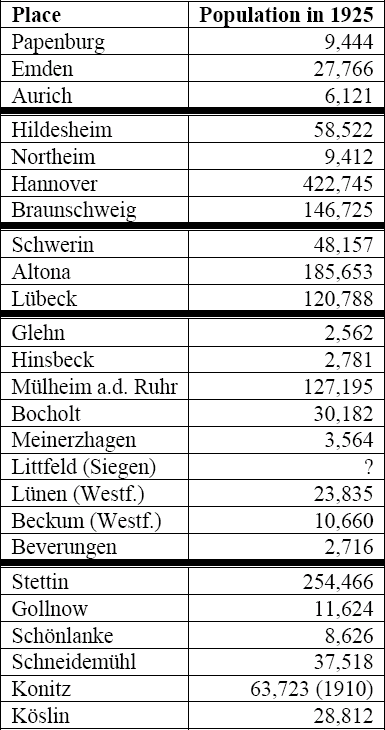
Second, the map indicates that speakers came not only from villages and small towns, but also from larger towns such as Schwerin, Stettin, or Lübeck, and cities such as Hanover. Table 2 shows the overall population numbers of the LCAAJ informants’ places of origin, according to the census of 1925. On the basis of the LCAAJ interviews, in the Low German-speaking areas remnants of Western Yiddish were known in eight villages with a population larger than 1,000, in eleven towns with more than 10,000 inhabitants, and in six cities with more than 100,000 inhabitants. Thus, the LCAAJ fieldwork questionnaires show that knowledge of remnants of Western Yiddish was not restricted to rural or smaller Jewish communities.
Populations according to the census of 1925.Footnote 10

Third, the map shows that the interviews cluster in certain regions such as Westphalia, parts of Lower Saxony, and parts of Pomerania. It is not entirely clear how these clusters came about. Was it because more Jews lived in these regions than in others? Are these places where remnants of Western Yiddish were still in use, or are the clusters due to the (perhaps necessarily) unsystematic way that the interviewers for the WQ sampled their interview partners? Lowenstein (Reference Lowenstein2008) recalls how potential informants were recruited first from among the interviewers’ family members, then from their friends, neighbors, acquaintances, and so on. In the following, the clusters are examined in more detail.
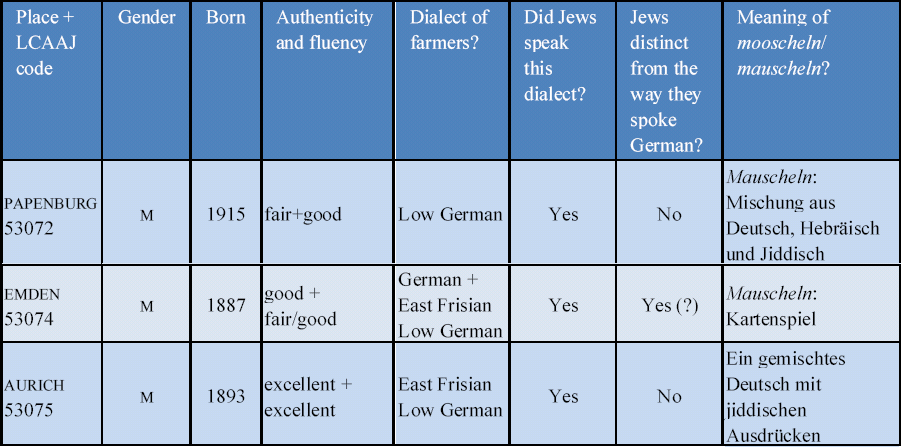
The three interviews reported in table 3 below were conducted in East Frisia and Emsland with speakers originally from Emden, Aurich, and Papenburg. The interviewers categorize all three speakers as “fair” and “good” as regards the authenticity and fluency of their Western Yiddish; the interviewee from Aurich features as “excellent” in both categories, confirming the observations of Reershemius (Reference Reershemius2007) that Aurich was a close-knit, traditional rural Jewish community in which remnants of Western Yiddish still played an important role for intra-group communi-cation in the 20th century.
According to the three interviewees, Jews spoke Low German. Sources describing Aurich in Reershemius Reference Reershemius2007 go even further. They make it quite clear that Jews did not only speak Low German when dealing with Low German-speaking neighbors or potential clients: Low German was the main spoken language for most of them. A survivor of the Aurich community remembers: “Many Jews couldn't speak standard German well; they were more likely to speak Low German.”Footnote 11
East Frisia and Emsland (based on LCAAJ questionnaires).

Whereas the LCAAJ informants from Aurich and Papenburg claim that Jews did not speak a distinct form of standard German, the informant from Emden, only 20 miles away from Aurich, says that they did. It is not clear whether this informant wants to indicate that Jews among themselves might use a variety not accessible to their non-Jewish neighbors, or that they spoke German with a distinct Western Yiddish accent. The informant from Emden was 80 years old when interviewed, and had left Emden aged 15. The interview was conducted in standard German, which he spoke with traces of Low German prosody and some phonological features of Low German, such as apical [r], as the LCAAJ sound file indicates. For most questions, he could not supply his answers actively but had to be prompted by the interviewer. He is also not quite sure what the word mauscheln means; after some hesitation he remembers a card game called Mauscheln. The informants from Aurich and Papenburg relate mauscheln to the way Jews spoke: a mixed form of German with Yiddish elements (Aurich) or a mixture of German, Hebrew, and Yiddish (Papenburg).
The scarcity of sources does not allow one to draw conclusions beyond the level of hypothesis: The Emden interview could indicate either that the sociolinguistic setup in Emden was remarkably different from that in Aurich and Papenburg, or that the interviewee could not quite remember the situation that had prevailed sixty-five years earlier.
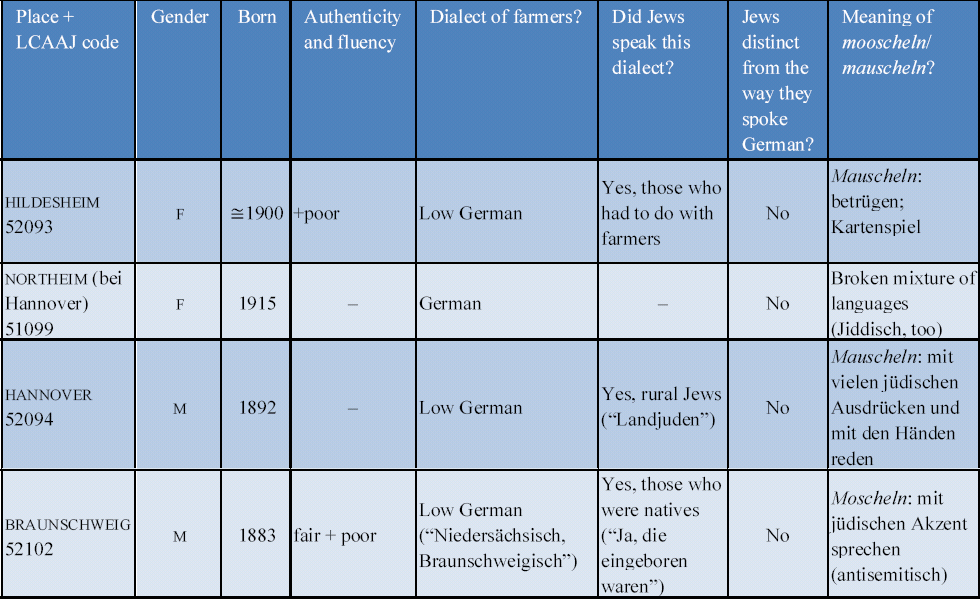
The next cluster of interviews was conducted in Southeastern Lower Saxony. In the 25 LCAAJ interviews conducted with speakers from the Low German-speaking areas, Braunschweig and Hanover are among the larger cities, with more than 100,000 inhabitants in 1925; Hildesheim had more than 50,000. For the two informants from Hildesheim and Braunschweig, the levels of fluency and authenticity are assessed as low; for Northeim and Hanover they are not indicated. Speakers from Hildesheim, Hanover, and Braunschweig mention Low German as the local dialect and indicate that Jews could speak it, but only those who had contact with farmers or rural Jews. It appears that the informants are not talking about themselves or their immediate families but about others.
Southeastern Lower Saxony (based on LCAAJ questionnaires).

Low German does not seem to have been the dominant spoken language for the local Jewish communities, as was the case for speakers in East Frisia. Rather, competence in Low German seems to have been a requirement for work, for example as cattle traders dealing with local farmers. All informants in this cluster agree that their German was no different from non-Jewish speakers’ German. As in the previous cluster, there is one informant who knows the word mauscheln only as the name of a card game and three for whom mauscheln is related to a form of speaking among Jews, although with more negative associations than for speakers in the East Frisian cluster.
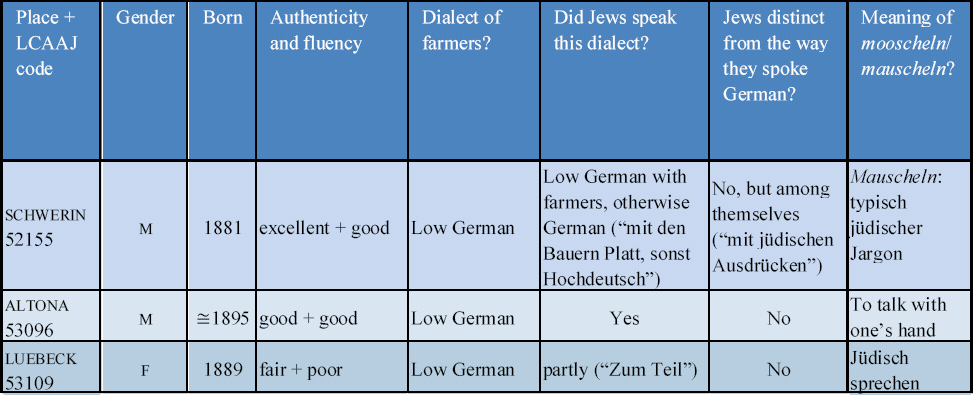
Levels of authenticity and fluency are mixed for the cluster of interviews conducted in Altona, Schwerin, and Lübeck, as shown in table 5. Whereas the informant from Schwerin is assessed as having “excellent + good” knowledge of Western Yiddish, it is only “good” for the interviewee from Altona and “fair + poor” for the informant from Lübeck. Also mixed are this cluster's responses to the question whether Jews spoke Low German, varying between “Yes” (Altona), “partly” (Lübeck), and “with farmers” (Schwerin). As in all the questionnaires, it is not possible to tell whether the informants are referring to their communities as a whole, to what they perceived as a majority within their community, or to themselves and their immediate families. They agree, however, that all Jews spoke standard German no differently from their non-Jewish neighbors, unless they specifically chose to speak mit jüdische Ausdrücke [sic] ‘with Jewish phrases.’ The interviewees from Schwerin and Lübeck recognize the term mauscheln as signifying a typical form of Jewish speech, while the informant from Schwerin translates it as “talking with one's hands.”
Altona, Schwerin, and Lübeck (based on LCAAJ questionnaires).

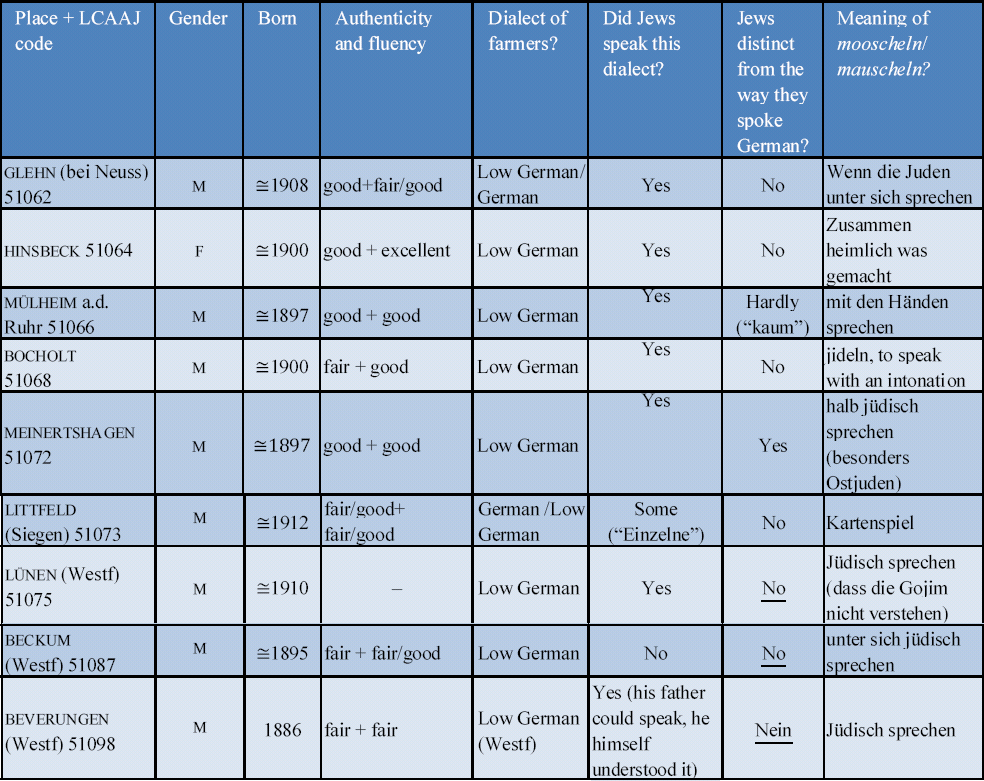
LCAAJ interviews from Westphalia form the largest cluster, with nine places where remnants of Western Yiddish were still known during the 1920s and 1930s (see table 6). Levels of authenticity vary between “good” and “fair,” fluency between “excellent” and “fair.” Six out of nine informants indicate that Jews spoke Low German, one answers that they did not, and two state that only some did. Seven out of nine state that Jews spoke standard German no differently from their non-Jewish neighbors, one answers “hardly differently,” and one “yes.” In the latter two cases it is not clear whether the different way of speaking German refers to the ability to use elements of Western Yiddish for communication among Jews, or to a Western Yiddish accent or prosody that was not applied consciously. Six speakers associate the term mauscheln with the way Jews could communicate among themselves by referring to remnants of Western Yiddish or to Yiddish (Meinerzhagen). The informant from Lünen says the possible motivation for using remnants of Western Yiddish was as a secret language: dass die Gojim nicht verstehen ‘so that the goyim don't understand’; two informants indicate that mauscheln is a means of communication for Jews among themselves, although it is not clear whether it is a pejorative term used by the non-Jewish population or a neutral or even positive one used by Jews themselves, as it was in Aurich, for example.
Westphalia (based on LCAAJ questionnaires).

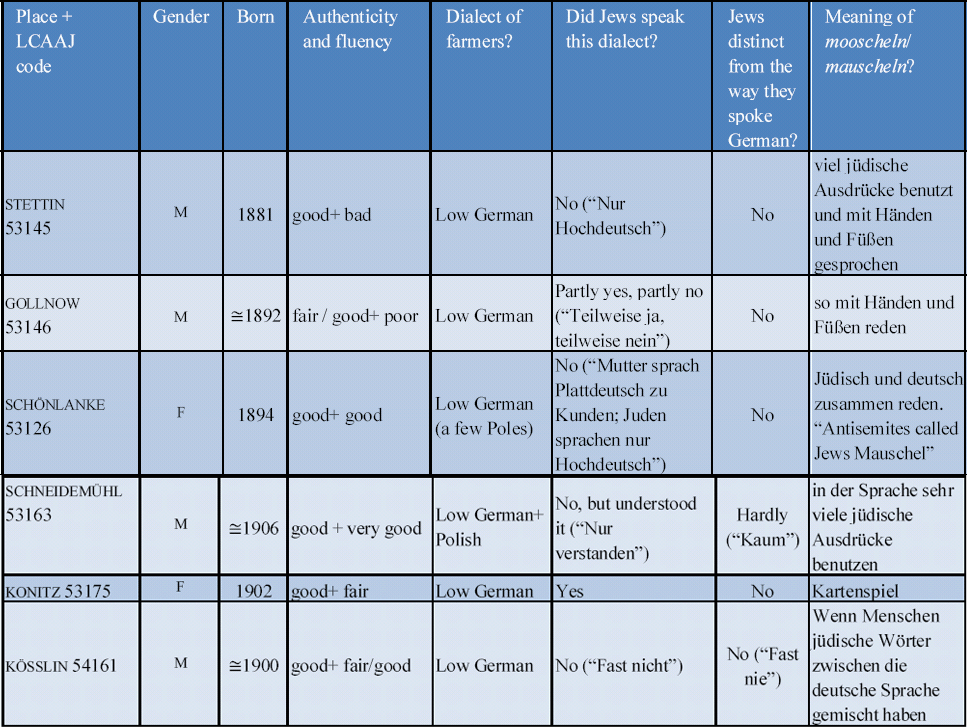
Pomerania (based on LCAAJ questionnaires).

In interviews from what was then Pomerania, the levels of authenticity are generally categorized as “good,” whereas fluency is assessed between “very good” (Schneidemühl) and “poor” (Gollnow) or “bad” (Stettin) (see table 7). In marked distinction to the other clusters, Jews in Pomerania generally do not seem to have spoken Low German, although, according to the informants, some understood Low German or used it with customers. According to four out of six interviewees, Jews spoke standard German indistinguishably from their non-Jewish neighbors, but two others modify this perception slightly: fast nie, kaum ‘hardly ever.’ Five out of six associate the word mauscheln with the way Jews communicate by adding “Jewish” words to their German.
5. Discussion
The analysis of all 25 LCAAJ fieldwork questionnaires from the Low German-speaking areas has revealed a complex picture. The fact that these interviews could be conducted at all shows that remnants of Western Yiddish were still part of the linguistic repertoires of Jews in the Low German-speaking areas in the 1920s and 1930s. The geographic distribution of the places of origin indicates that multilingual practices involving remnants of Western Yiddish were more widespread than has previously been thought, covering regions such as Pomerania in the east, East Frisia in the north, and Westphalia in the west. A comparison of the population sizes of these places of origin shows that knowledge of Western Yiddish was not restricted to villages and small towns. At the same time, the LCAAJ interviewers assessed the level of fluency of their informants as “excellent” only in three cases—two men and one woman born between 1893 and 1906, from three different clusters. In many interviews, the level of fluency is assessed as “fair” or “good”, although most of the answers had to be prompted by the interviewer, as the sound files indicate. This rather low overall level of active competence makes it impossible to compare different pronunciations of the words and phrases elicited by the LCAAJ interviews.
According to the questionnaires, the majority of Jews living in the Low German-speaking areas spoke Low German, either as their first language (in the case of East Frisia and probably parts of Westphalia) or as a language they used with neighbors and clients (for example, in southeastern Lower Saxony). Only in Pomerania do the majority of Jews seem to have used Low German in a rather limited form or not at all. This diversity might be explained by the different levels of language shift that Low German itself had been undergoing since the second half of the 19th century, which varied according to region: In East Westphalia, speakers started to shift from Low German to spoken varieties of standard German earlier on, whereas in some northern parts, such as East Frisia, Low German remained stable well into the 20th century. Low German was more widely used in rural than in urban communities (see, for example, Peters Reference Peters1998).
The data held by the LCAAJ archive do not include examples of Low German, either in the fieldwork questionnaires or in the sound files, so it is not possible to examine whether Jews used Low German in the same ways as their non-Jewish neighbors. The majority of informants—19 out of 25—state that Jews did not speak standard German differently from their non-Jewish neighbors, and in many cases they put special emphasis on this particular answer.Footnote 12 Of the remaining six informants, three answer “hardly”, two confirm that they did speak differently, and one elaborates, “no, but among themselves”. It is not clear whether these answers refer to the conscious ability of Jews to apply their multilingual repertoire in addition to their excellent knowledge of standard German, or whether they indicate that some Jews still spoke German with a Western Yiddish accent. The majority claim suggests that language shift to German—or in the case of East Frisia to Low German—had been completed, an observation confirmed by listening to a sample of the LCAAJ sound files. However, the interviews also show that shifting to another language does not necessarily mean completely abandoning the language from which the speaker has been shifting. The 25 LCAAJ interviews prove that knowledge of remnants of Western Yiddish in the 1920s and 1930s was still more widespread than has often been assumed.
Some interviewees also mention what motivated the use of Western Yiddish in a form of speaking they referred to as mauscheln: The answers “when Jews speak among themselves” (Glehn) or “so that the goyim don't understand” (Lünen) indicate that a multilingual repertoire including elements of Western Yiddish was accessed for in-group communication or as a cryptolect. The majority of interviewees—21 out of 25—are familiar with the term mauscheln as signifying a form of Jewish speech in the widest sense. Many interviewees are aware of the antisemitic connotations of the term mauscheln or moscheln, but the design of the question does not allow them to say whether the term was used by Jews themselves or by others.
The level of variation in the answers, even within the individual cluster, underlines the fact that processes of language shift seem to have been in their later stages. Western Yiddish elements still formed part of many Jews’ multilingual repertoires, but even within clusters it is not possible to assume a stable successor lect comparable with Anglo-Romani, for example. This does not mean that such successor lects did not exist at a local level. From what is known so far, the Aurich community in East Frisia comes closest to a variety of this kind. A survivor from Aurich remarks that the Jewish variety was spoken only in Aurich (Reershemius Reference Reershemius2007:77), at the same time stressing that many Jews did not use it at all (see also Weinberg Reference Weinberg1973:13). For Westphalia, Weinberg (Reference Weinberg1973:20) observed that the pronunciation of the Western Yiddish elements of Jewish linguistic repertoires varied from place to place and sometimes from family to family.
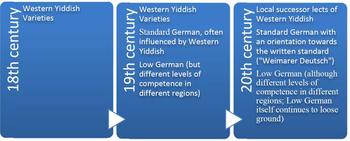
Generally speaking, the LCAAJ data for the Low German regions support the view that language shift from Western Yiddish varieties since the late 18th century meant, in the first instance, a widening of varieties, choices, and possibilities. This allowed the individual multilingual repertoires of Jews in the German-speaking countries to incorporate both local dialects and varieties oriented on standard German, depending on geographical location, profession, social class, and religious or cultural inclinations. During the final stage, roughly speaking the 20th century, spoken forms of standard German seem to have stabilized, whereas Low German varieties began to decline, and remnants of Western Yiddish fossilized into local or even individual repositories. Figure 1 summarizes the developments for spoken languages in the repertoires of Jewish speakers in the Low German areas since the 18th century.
Language shift from Western Yiddish in Low German-speaking areas.

Figure 1 gives an overview of a linguistic reality that was evidently highly diverse and fluid, depending on the linguistic and social opportunities and constraints of the individual speaker (see, among others, Busch Reference Busch2012). The data from the LCAAJ questionnaires have shown that it would be over-hasty to make generalizing statements about “the language” or “languages” spoken by the Jewish population in the Low German-speaking areas. It is, nevertheless, possible to see trends and tendencies.
6. Conclusion
The present study has yet again confirmed that the LCAAJ is an important source of data for the study of the history of Yiddish. For the study of remnants of Western Yiddish in the Low German-speaking areas the LCAAJ sound files are the only sources available that allow researchers to listen to speakers pronouncing parts of their Western Yiddish based repertoires, albeit under the constraints of an interview situation, with highly structured questions that focus on single words and phrases. The next step of analysis therefore needs to be a closer examination of the interviews on the basis of fully transcribed sound files in order to complement the existing sources.