INTRODUCTION
Juveniles of canopy tree species grow from the low-light conditions in the understorey towards the high-light environment of the forest canopy, but actual height growth trajectories remain unknown for tropical trees (Clark & Clark Reference CLARK and CLARK2001). Height growth is essential for reaching the canopy, but investment in stem diameter is also needed to maintain mechanical stability and hydraulic functioning (Cannell & Dewar Reference CANNELL and DEWAR1994). Stem diameter growth and height growth of juvenile trees are likely coupled, such that both growth in stem diameter and in height increase at more favourable high-light levels, but are suppressed at low-light levels (Beaudet et al. Reference BEAUDET, BRISSON, GRAVEL and MESSIER2007, Clark & Clark Reference CLARK and CLARK1992, Lilles & Astrup Reference LILLES and ASTRUP2012). However, investment in diameter growth and height growth may shift in response to changes in light conditions, as allocation to height growth has priority over allocation to diameter growth (Assman Reference ASSMAN1970, Bormann Reference BORMANN1965, Oliver & Larson Reference OLIVER and LARSON1996). Thus, height growth may remain constant under low-light conditions, while there is insufficient assimilate available for diameter growth. Trees indeed decrease diameter, or lateral, growth more than height growth in low-light conditions, causing stems to become slender (Bonser & Aarssen Reference BONSER and AARSSEN1994, Henry & Aarssen Reference HENRY and AARSSEN2001).
How trees partition growth in stem diameter and tree height is still poorly understood, particularly for tropical tree species. Traditionally, investment in height growth and stem diameter growth is inferred from static, allometric relations between diameter and height (Kooyman & Westoby Reference KOOYMAN and WESTOBY2009, Niklas Reference NIKLAS1995, Sterck & Bongers Reference STERCK and BONGERS1998, but see Coomes & Grubb Reference COOMES and GRUBB1998, Hara et al. Reference HARA, KIMURA and KIKUZAWA1991). Height/diameter-ratios, however, reflect the total accumulation of height and diameter growth over the lifetime of a tree, but do not capture shorter-term responses to fluctuations in light levels (Bongers & Sterck Reference BONGERS, STERCK, Newbery, Prins and Brown1998, Henry & Aarssen Reference HENRY and AARSSEN1999, Kohyama et al. Reference KOHYAMA, HARA and TADAKI1990). In contrast, simultaneously comparing growth rates in height and in stem diameter would enable a comparison of actual investment in height growth and diameter growth.
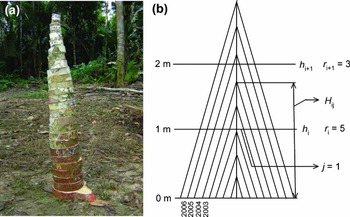
In this study, we test the hypothesis that growth in stem diameter and growth in height of juvenile tropical trees are positively related. We apply a technique new to tropical forest ecology: historical height-growth reconstruction (Figure 1). Lifetime height growth rates can be reconstructed by counting tree rings at various heights along the stem (Gutsell & Johnson Reference GUTSELL and JOHNSON2002, Sumida et al. Reference SUMIDA, ITO and ISAGI1997). Using tree-ring analysis, we evaluate investment in height growth and diameter growth of juvenile trees of <0.5 to 11 m height for three tree species from a tropical moist forest in Bolivia.
Reconstruction of height growth from tree-ring counts on discs collected at various heights. Discs collected every metre along the stem of a Clarisia racemosa tree. Photo credit: Danaë Rozendaal (a); Height growth reconstruction. h i is the height of the tree at the ith disc, r i is the number of rings at the ith disc, j is the number of the ring and H ij is the estimated total tree height for a certain year (b).

METHODS
Study area and species
Fieldwork was conducted in a semi-deciduous, old-growth, moist forest area, ‘Los Indios’ (10º26′S, 65º33′W, 270 m asl), in the department of Pando, Bolivia. Mean annual precipitation is 1660 mm (Riberalta), with a dry season (<100 mm mo−1) from May until September. The forest has an average canopy height of 33 m and stem density of 423 stems ha−1 (of stems >10 cm diameter at breast height, dbh; Toledo et al. Reference TOLEDO, POORTER, PEÑA-CLAROS, LEAÑO and BONGERS2008), which represent conditions before selective logging took place.
Three canopy tree species, Cedrelinga cateniformis (Ducke) Ducke, Clarisia racemosa Ruíz & Pavón and Peltogyne cf. heterophylla M.F. Silva, were included. All species tolerate shade, but C. cateniformis is more light-demanding than C. racemosa and P. cf. heterophylla (Soliz-Gamboa et al. Reference SOLIZ-GAMBOA, SANDBRINK and ZUIDEMA2012). Cedrelinga cateniformis has large, compound leaves, and can be considered a species of the ‘height-growth’ type, whereas C. racemosa and P. cf. heterophylla tend to the ‘lateral-growth’ type based on their morphology (Kohyama & Hotta Reference KOHYAMA and HOTTA1990). Height-growth species predominantly invest in height growth by avoiding investment in branching and crown development, particularly in gap conditions. Lateral-growth species, in general, invest more in stem diameter growth, and branches (Coomes & Grubb Reference COOMES and GRUBB1998, Takahashi et al. Reference TAKAHASHI, SEINO and KOHYAMA2001, but see Aiba & Nakashizuka Reference AIBA and NAKASHIZUKA2007). All species form annual rings in the juvenile stage due to low precipitation during the dry season, which was confirmed with 14C bomb-peak dating and correlations with precipitation (Soliz-Gamboa et al. Reference SOLIZ-GAMBOA, ROZENDAAL, CECCANTINI, ANGYALOSSY, VAN DER BORG and ZUIDEMA2011). Details on the methodology for evaluating periodicity of growth-ring formation, and a description of the wood anatomy for the three study species are provided in Soliz-Gamboa et al. (Reference SOLIZ-GAMBOA, ROZENDAAL, CECCANTINI, ANGYALOSSY, VAN DER BORG and ZUIDEMA2011).
Sample collection and ring measurements
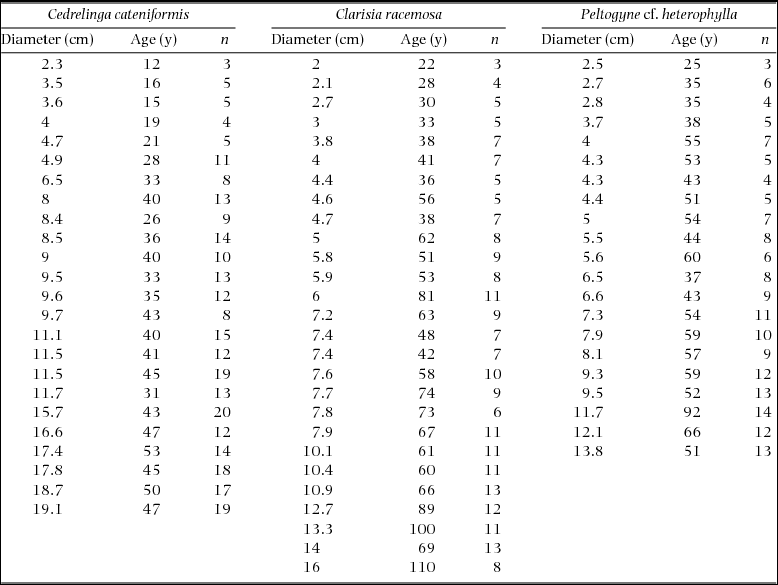
For each species, we randomly selected 21–27 trees from an area of 170, 400 and 2500 ha for P. cf. heterophylla, C. racemosa and C. cateniformis, respectively (Appendix 1). A minimum distance of 20 m between two trees of a species was maintained to minimize effects of spatial autocorrelation in growth rates. Light levels at the moment of sampling were not measured, as light levels were altered through selective logging of the area in 2006, just before fieldwork was conducted in 2006 and 2007. Trees ranged in size from 1–15 cm dbh for C. cateniformis, and from 1–10 cm dbh for C. racemosa and P. cf. heterophylla. Trees with signs of damage to the stem or crown were not included, as damage results in low growth rates (Clark & Clark Reference CLARK and CLARK1991), which otherwise could be erroneously interpreted as an effect of low light. We expect that the included trees spanned a range of light levels in our sample, as for two of our species, C. cateniformis and P. cf. heterophylla, on average 15–20% of the trees experienced a growth release every 10 y in forests in the same region (Brienen & Zuidema Reference BRIENEN and ZUIDEMA2006).
Discs were collected at multiple heights along the stem of the selected trees (Figure 1). The lowest disc was collected at the stem base (0 m), and subsequent discs were taken at 1-m intervals over the entire height of the tree. We measured fresh disc area for all collected discs, using calliper measurements in two directions for small discs and digital pictures for large discs. Discs were air-dried and sanded with progressively finer sandpaper until a grit of 1000. Rings were marked in three radii using a stereomicroscope (6.3–40×). Every tenth ring was connected among the three radii, over the whole disc, to control for errors in ring identification and partial rings. Ring widths were measured perpendicular to the ring boundaries using a LINTAB 5 (Rinntech, Heidelberg, Germany) measurement device. Ring widths of all radii were averaged and corrected for desiccation and irregular growth using the fresh-disc radius. For C. cateniformis, the size of the pith was taken into account, because of its large size we assumed a non-zero diameter at the start of the first year of growth of each tree. We visually cross-dated discs within a tree for C. cateniformis, but for the other two species this was not possible. Thus, there may be some dating errors as a consequence of missing rings, especially in the first 2 m of height growth. This could mean that we slightly overestimated height growth rates for trees 0–2 m height. Diameter growth was calculated from the disc at the stem base, above the root collar, thus at 0 m height.
Calculation of annual height growth
Height growth was reconstructed using the ring counts of discs collected at 1-m intervals over the entire height of the tree (Figure 1b). Annual height growth was estimated using Carmean's method (Carmean Reference CARMEAN1972), which assumes that height growth is constant within a stem segment between two consecutive collected discs and that, on average, a disc is collected at the middle of the height growth of a year. Estimated tree height H ij in a certain year was calculated as (Dyer & Bailey Reference DYER and BAILEY1987):
 \begin{eqnarray}
{H_{ij}} &=& {h_i} + {\rm{ }}\left( {{h_{i + 1}}-{h_i}} \right)/\left[ {2\left( {{r_i}-{r_{i + 1}}} \right)} \right]{\rm{ }} \nonumber\\
&&+\, \left( {j-1} \right)\left( {{h_{i + 1}}-{h_i}} \right)/\left( {{r_i}-{r_{i + 1}}} \right)
\end{eqnarray}
In which h i = height in the stem at which the ith disc was collected, r i = number of rings at the ith disc and j = ring number, counted from the innermost ring in a disc. Carmean's method gives an accurate estimation of annual height growth (Dyer & Bailey Reference DYER and BAILEY1987). In case of an equal number of rings in two consecutive discs, i.e. height growth >1 m y−1, we used longer segments for the reconstruction of annual height growth until a difference in ring number between two discs was obtained. The rings formed in the last, incomplete 1-m segment in the top of the tree (the most recent years of growth), were excluded, as we did not measure the total height of the tree.
Statistical analysis
We divided the dataset into height classes, which enables comparison of trees at the same height, as growth generally increases with tree size (Claveau et al. Reference CLAVEAU, MESSIER, COMEAU and COATES2002, Rozendaal et al. Reference ROZENDAAL, SOLIZ-GAMBOA and ZUIDEMA2011, Williams et al. Reference WILLIAMS, MESSIER and KNEESHAW1999). Height classes coincided with the 1-m segments used for height growth reconstruction over the entire height of the tree: 0–1 m height, 1–2 m, 2–3 m, 3–4 m, etc. We included only height classes that had at least 10 individuals for each species. For each individual tree, we calculated the average annual diameter growth and height growth per height class. Height growth rates that exceeded 1 m y−1 for a given height class were assigned to the lower height class.
We related average annual height growth to average annual diameter growth using linear mixed-effects models. Both height growth and diameter growth were log10-transformed prior to analysis to enhance normality and homoscedasticity. Diameter growth was included as a fixed effect, and we included a random intercept for each height class. Including a random slope per height class did not improve model fits. We compared the model with diameter growth as a fixed effect with a model with just an intercept using maximum likelihood estimation. The two models were compared based on Akaike's Information Criterion (AICc), corrected for small sample size. We considered both models as equally supported if the difference in AICc between the two models was less than two units (Burnham & Anderson Reference BURNHAM and ANDERSON2002). We performed the same model comparison for three height categories separately, 0–2 m high, 2–5 m high and >5 m high, to assess whether the relationship between diameter growth and height growth changed across tree height categories. Similarly, we included diameter growth as a fixed effect, and a random intercept per height class. We calculated the marginal R2 (based on fixed effects only) for models with diameter growth as a fixed effect (Nakagawa & Schielzeth Reference NAKAGAWA and SCHIELZETH2013). All analyses were conducted in R 3.0.3. Linear mixed-effects models were performed using the ‘lme4’ package.
RESULTS
Lifetime reconstructed growth in diameter and height
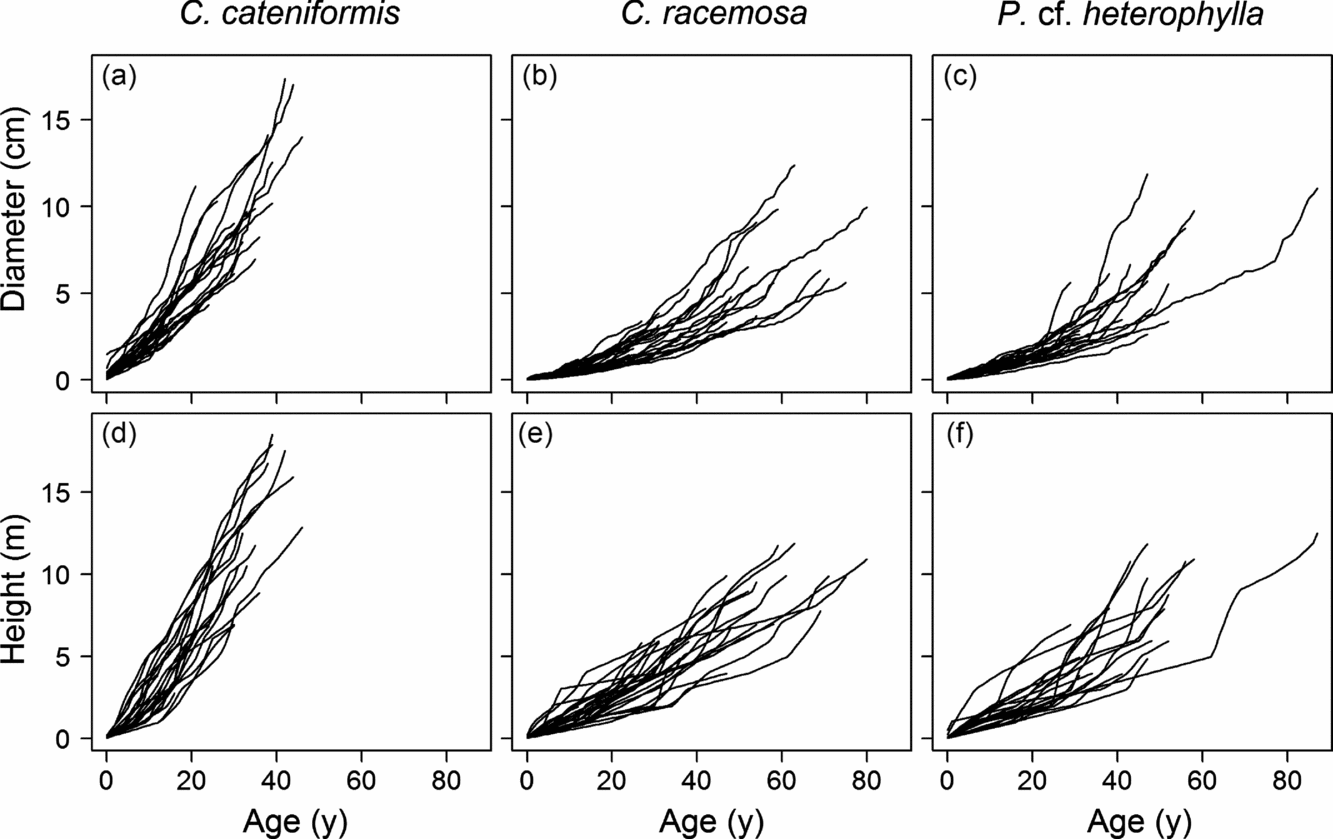
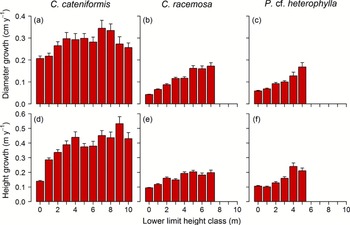
Growth in diameter and height varied strongly among and within tree species (Figures 2–4). Cedrelinga cateniformis grew faster in stem diameter and height than Clarisia racemosa and Peltogyne cf. heterophylla. Cedrelinga cateniformis attained a stem diameter of 3 cm in 15 y on average, while C. racemosa and P. cf. heterophylla took on average 43 and 34 y, respectively, to reach the same diameter (Figure 2a–c). Similarly, C. cateniformis attained a tree height of 3 m in 12 y on average, while C. racemosa and P. cf. heterophylla needed on average 25 and 27 y, respectively (Figure 2d–f). Within species, the time needed to grow until 3 cm diameter varied from 9–20 y in C. cateniformis, from 26–55 y in C. racemosa and from 17–49 y in P. cf. heterophylla (Figure 2a–c). Within species, the time needed to reach a height of 3 m varied two- to fivefold among individuals. For C. cateniformis time needed to reach a height of 3 m varied from 6–19 y among individual trees, for C. racemosa from 8–39 y and for P. cf. heterophylla from 13–43 y, respectively (Figure 2d–f). Growth rates in diameter and height generally increased across height classes, only in C. cateniformis diameter growth was highest in the intermediate height classes (Figure 3).
Growth patterns of individual juvenile trees of three tropical tree species from a moist tropical forest in Bolivia. Diameter-age trajectories for Cedrelinga cateniformis (a); Clarisia racemosa (b); Peltogyne cf. heterophylla (c). Height-age trajectories for C. cateniformis (d); C. racemosa (e); P. cf. heterophylla (f).

Average growth (±SE) in diameter and height per height class for juvenile trees of three tropical tree species from a Bolivian tropical moist forest. Diameter growth for Cedrelinga cateniformis (a); Clarisia racemosa (b); Peltogyne cf. heterophylla (c). Height growth for C. cateniformis (d); C. racemosa (e); P. cf. heterophylla (f).

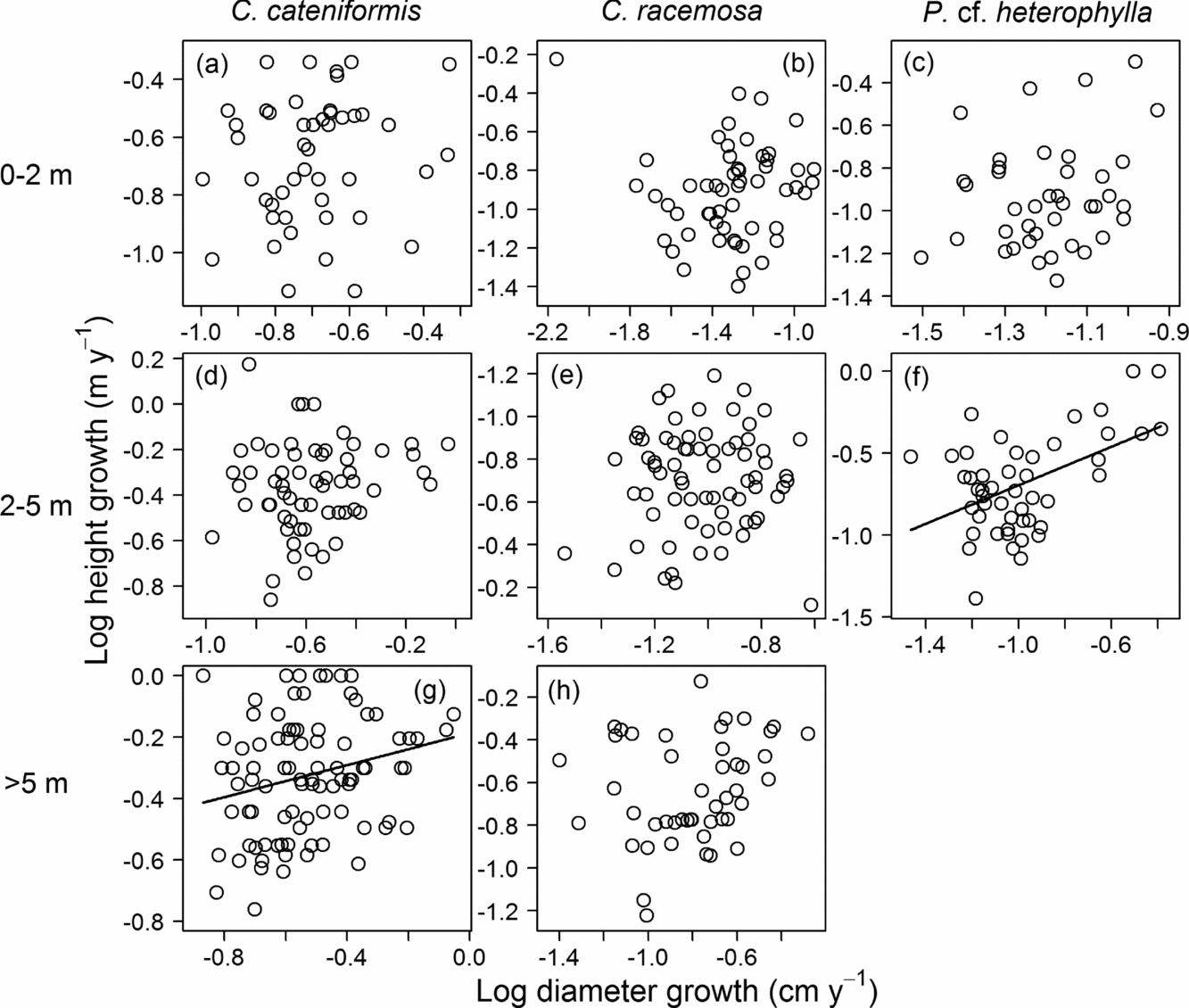
Relationship between diameter growth and height growth of juvenile trees of three tree species from a Bolivian tropical moist forest for three tree height categories. Average diameter growth (log10-transformed) and height growth (log10-transformed) were calculated per tree, per height class. Predicted height growth from the mixed-effects model is indicated, if diameter growth and height growth were significantly related. Trees 0–2 m high for Cedrelinga cateniformis (a); Clarisia racemosa (b); Peltogyne cf. heterophylla (c). Trees 2–5 m high for C. cateniformis (d); C. racemosa (e); P. cf. heterophylla (f). Trees > 5 m high for C. cateniformis (g); C. racemosa (h).

Relationship between growth in diameter and height
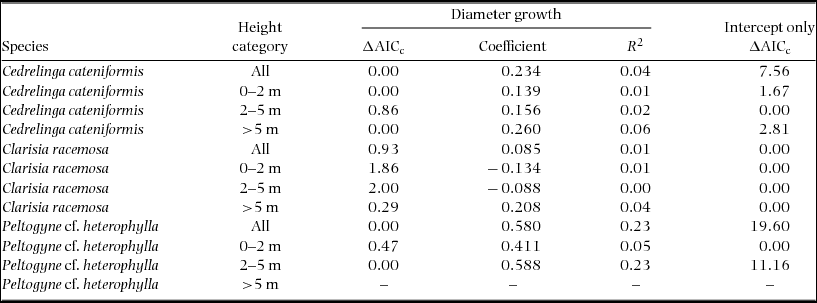
To evaluate the relationship between diameter growth and height growth, we used linear mixed-effects models (Table 1). In C. cateniformis, height growth was significantly, positively related to diameter growth when considering all height categories together, as well as for trees in the >5 m height category separately, but relationships were weak (Table 1; Figure 4). Diameter growth and height growth were not significantly related for trees of 0–2 m, and of 2–5 m high. For C. racemosa, height growth was not significantly related to diameter growth for all height categories together, nor for separate height categories, as the intercept-only model and the diameter growth model were equally supported (Table 1, Figure 4). In P. cf. heterophylla, in contrast, height growth increased with increasing diameter growth across all height categories, as well as for trees from 2–5 m high (Table 1, Figure 4). For smaller trees (0–2 m high), height growth and diameter growth were not related.
Modelling results of height growth as a function of diameter growth for juvenile trees of three species from a Bolivian tropical moist forest in three height categories, and for all height categories together. We compared a linear mixed-effects model with diameter growth as fixed effect with an intercept-only model, to assess significance of the effect of diameter growth. The deviation in AICc (Akaike's Information Criterion) units from the best model (ΔAICc) is indicated. The estimated coefficient for diameter growth (slope) is indicated. R 2 is based on the fixed effects only.

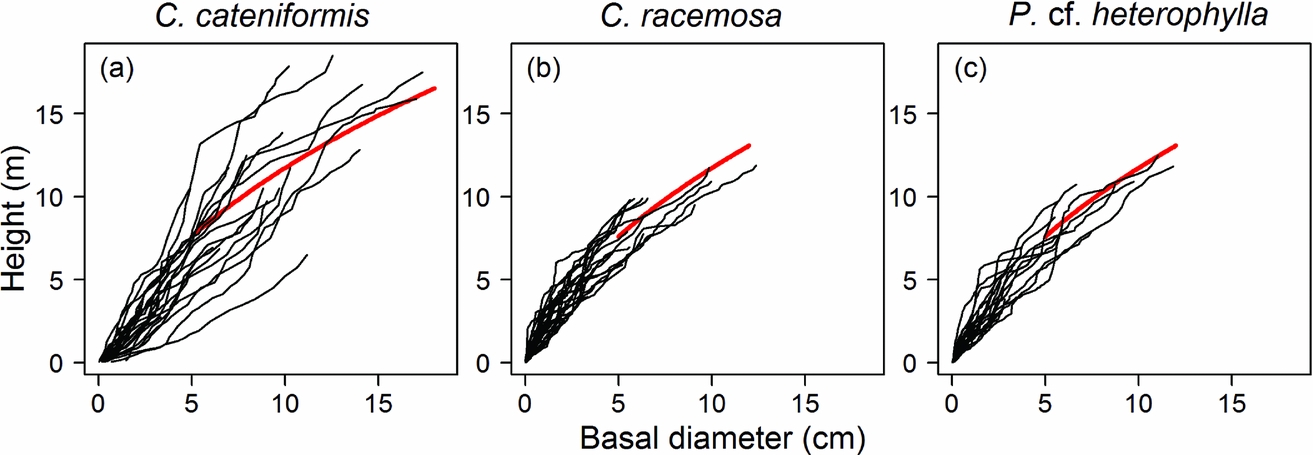
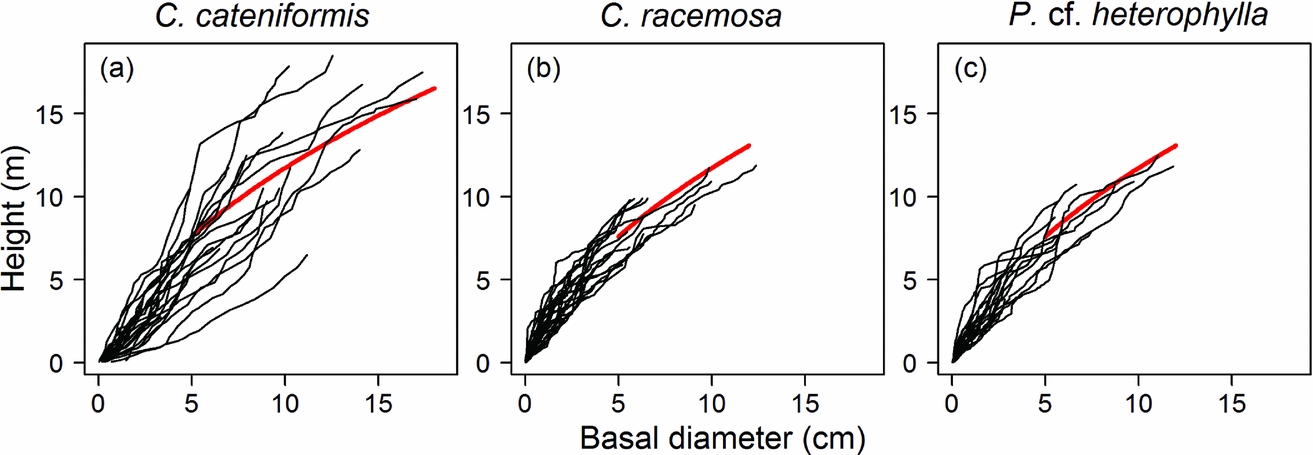
The relationship between stem diameter and height of individual juvenile trees remained relatively constant with increasing tree size for all three species, but did, particularly for C. cateniformis, not follow a fixed, allometric relationship between diameter and height (Figure 5). Thus, individual juvenile trees did not strongly shift investment in stem height and stem diameter over time, but slight within-tree fluctuations were common (Figure 5). Variation in height-diameter ratios across individual trees was large for all three species, but strongest for C. cateniformis (Figure 5). For C. cateniformis, trees of 5 m height ranged in stem diameter from 2.2–10 cm, while for C. racemosa and P. cf. heterophylla, trees of 5 m height displayed diameter ranges from 1.4–5.4 cm and 1.6–4.7 cm, respectively (Figure 5).
Growth trajectories in basal diameter and height for individual juvenile trees of three tree species from a tropical moist forest in Bolivia. The red line indicates predicted height based on a pantropical relation between tree diameter (at 1.3 m) and height, including an adjustment for local environmental conditions, from Chave et al. (Reference CHAVE, RÉJOU-MÉCHAIN, BÚRQUEZ, CHIDUMAYO, COLGAN, DELITTI, DUQUE, EID, FEARNSIDE, GOODMAN, HENRY, MARTÍNEZ-YRÍZAR, MUGASHA, MULLER-LANDAU, MENCUCCINI, NELSON, NGOMANDA, NOGUEIRA, ORTIZ-MALAVASSI, PÉLISSIER, PLOTON, RYAN, SALDARRIAGA and VIEILLEDENT2014). Cedrelinga cateniformis (a); Clarisia racemosa (b); Peltogyne cf. heterophylla (c).
DISCUSSION
We reconstructed historical diameter growth and height growth to compare long-term juvenile growth in diameter and height among and within three tropical tree species. As expected, growth was fastest in Cedrelinga cateniformis, a fast-growing species with unbranched saplings, thus with efficient height growth, and slower in the two shade-tolerant species, Clarisia racemosa and Peltogyne cf. heterophylla. Our results indicate that both diameter growth and height growth vary within species. Strong, long-term, within-species variation in diameter growth was also found in previous tree-ring studies (Brienen & Zuidema Reference BRIENEN and ZUIDEMA2006, Groenendijk et al. Reference GROENENDIJK, SASS-KLAASSEN, BONGERS and ZUIDEMA2014, Rozendaal & Zuidema Reference ROZENDAAL and ZUIDEMA2011) and agrees with findings from permanent plots (Clark & Clark Reference CLARK and CLARK1992, Reference CLARK and CLARK1999). Variation in growth rates is likely driven by differences in light availability. Our approach, however, does not allow for directly linking growth to light levels, as it is not possible to reconstruct historical light levels.
The positive relationship between height growth and diameter growth in P. cf. heterophylla, and for larger trees of C. cateniformis, is consistent with the idea that both diameter growth and height growth increase with light availability. This result agrees with findings for temperate forest trees, where height growth and diameter growth (Beaudet et al. Reference BEAUDET, BRISSON, GRAVEL and MESSIER2007, Duchesneau et al. Reference DUCHESNEAU, LESAGE, MESSIER and MORIN2001, Lilles & Astrup Reference LILLES and ASTRUP2012, Petritan et al. Reference PETRITAN, VON LÜPKE and PETRITAN2009), or height growth and lateral branch growth (Beaudet & Messier Reference BEAUDET and MESSIER1998, Canham Reference CANHAM1988, Williams et al. Reference WILLIAMS, MESSIER and KNEESHAW1999), simultaneously increase with light availability. However, the weak relationships between height growth and diameter growth in our study suggest that trees tend to shift investments in diameter and height growth. Juvenile trees may decrease relative investment in diameter growth more than investment in height growth in low-light conditions (Jaouen et al. Reference JAOUEN, FOURNIER and ALMERAS2010, Kooyman & Westoby Reference KOOYMAN and WESTOBY2009, Poorter & Werger Reference POORTER and WERGER1999, but see King Reference KING1997, Kohyama Reference KOHYAMA1980). Such changes in investment would be expected if height growth has priority over diameter growth, implying that diameter growth is only realized if sufficient resources are available (Assman Reference ASSMAN1970, Bormann Reference BORMANN1965). Thus, investment in height growth and diameter growth may be decoupled.
Fluctuations in the relationship between stem diameter and height for all three species, both among individual trees, as well as within individual trees over their lifetime (Figure 5), were likely a result of shifting investments in growth in stem diameter and height. Strong within-species variation in height/diameter-ratios, thus large variation in stem diameter for trees of the same height, was also found for Australian rain-forest species (Kooyman & Westoby Reference KOOYMAN and WESTOBY2009). Variation in stem diameter at a certain tree height was strongest for the light-demanding species C. cateniformis that maximizes height-growth efficiency through its unbranched architecture. Light-demanding species typically respond more strongly to fluctuations in resource levels than shade-tolerant species (Bazzaz Reference BAZZAZ1979, Catovsky et al. Reference CATOVSKY, KOBE and BAZZAZ2002), but we cannot exclude the possibility that the included juvenile trees of C. cateniformis experienced a greater range of light levels across all individuals (and over their lifetime) than the two more shade-tolerant species.
An important limitation of our approach is the lack of information on historical light conditions. Light conditions likely governed growth differences across individual trees in our study, and shifts in investment in stem diameter and height, but we cannot exclude other possible causes. Architectural differences among trees may also drive growth differences (King et al. Reference KING, LEIGH, CONDIT, FOSTER and HUBBELL1997, Sterck et al. Reference STERCK, MARTÍNEZ-RAMOS, DYER-LEAL, RODRÍGUEZ-VELAZQUEZ and POORTER2003). Leaf area, for example, varies among individual trees in response to light levels (King Reference KING1994, Sterck Reference STERCK1999, Takahashi et al. Reference TAKAHASHI, SEINO and KOHYAMA2001). In addition, crowding in the high-light environment of canopy gaps results in juvenile trees with small crowns that prioritize height growth with the low amount of photosynthate available, leading to juvenile trees with slender stems (King Reference KING1981, Kohyama et al. Reference KOHYAMA, HARA and TADAKI1990, van Breugel et al. Reference VAN BREUGEL, VAN BREUGEL, JANSEN, MARTÍNEZ-RAMOS and BONGERS2012). In our study, we were unable to separate effects of crowding and shading, as it is not possible to trace historical densities and sizes of neighbouring trees. To assess whether shifts in investment between height growth and diameter growth are related to variation in light conditions, measurement of stable isotopes in tree rings may be helpful (van der Sleen et al. Reference VAN DER SLEEN, SOLIZ-GAMBOA, HELLE, PONS, ANTEN and ZUIDEMA2014).
Our study shows that historical height growth reconstruction is a promising approach for evaluating growth patterns in diameter and height for tropical tree species that form annual growth rings. The large within-tree fluctuations in investment in stem diameter and height (cf. Figure 5) suggest that studies based on static height/diameter-ratios will not accurately reflect long-term growth in diameter and height. Although we did not include trees that attained the canopy, and therefore our sample may not be entirely representative of trees that made it to the canopy, we likely sampled the faster-growing part of the population for at least C. racemosa and P. cf. heterophylla by including trees >1 cm dbh that survived until the moment of sampling (Rozendaal et al. Reference ROZENDAAL, BRIENEN, SOLIZ-GAMBOA and ZUIDEMA2010). Overall, our results indicate that variation in height growth across and within species is large, but that height growth and diameter growth are not necessarily related. Investment in height growth and diameter growth may not be synchronized, as investment in height growth has priority over investment in diameter growth (Assman Reference ASSMAN1970, Bormann Reference BORMANN1965). Even in the juvenile phase where both diameter growth and height growth still increase with tree size, long-term juvenile height growth cannot be inferred from data on diameter growth. Thus, our results support the notion that tree height should be incorporated into allometric equations for estimating tropical tree biomass from stem diameter (Chave et al. Reference CHAVE, RÉJOU-MÉCHAIN, BÚRQUEZ, CHIDUMAYO, COLGAN, DELITTI, DUQUE, EID, FEARNSIDE, GOODMAN, HENRY, MARTÍNEZ-YRÍZAR, MUGASHA, MULLER-LANDAU, MENCUCCINI, NELSON, NGOMANDA, NOGUEIRA, ORTIZ-MALAVASSI, PÉLISSIER, PLOTON, RYAN, SALDARRIAGA and VIEILLEDENT2014, Feldpausch et al. Reference FELDPAUSCH, LLOYD, LEWIS, BRIENEN, GLOOR, MONTEAGUDO MENDOZA, LOPEZ-GONZALEZ, BANIN, ABU SALIM, AFFUM-BAFFOE, ALEXIADES, ALMEIDA, AMARAL, ANDRADE, ARAGÃO, ARAUJO MURAKAMI, ARETS, ARROYO, AYMARD, BAKER, BÁNKI, BERRY, CARDOZO, CHAVE, COMISKEY, ALVAREZ, DE OLIVEIRA, DI FIORE, DJAGBLETEY, DOMINGUES, ERWIN, FEARNSIDE, FRANÇA, FREITAS, HIGUCHI, HONORIO, IIDA, JIMÉNEZ, KASSIM, KILLEEN, LAURANCE, LOVETT, MALHI, MARIMON, MARIMON, LENZA, MARSHALL, MENDOZA, METCALFE, MITCHARD, NEILL, NELSON, NILUS, NOGUEIRA, PARADA, PEH, PENA CRUZ, PEÑUELA, PITMAN, PRIETO, QUESADA, RAMÍREZ, RAMÍREZ-ANGULO, REITSMA, RUDAS, SAIZ, SALOMÃO, SCHWARZ, SILVA, SILVA-ESPEJO, SILVEIRA, SONKÉ, STROPP, TAEDOUMG, TAN, TER STEEGE, TERBORGH, TORELLO-RAVENTOS, VAN DER HEIJDEN, VÁSQUEZ, VILANOVA, VOS, WHITE, WILLCOCK, WOELL and PHILLIPS2012). To assess the generality of our results, similar studies should be conducted that include both understorey and canopy individuals, and that focus on more species.
ACKNOWLEDGEMENTS
We are grateful to Claudia Soliz-Gamboa for help with field work and discussion on the methodology. We thank Nazareno Martínez, Miguel Cuadiay, Adhemar Saucedo and many others for help with field work. We are grateful to staff and personnel of PROMAB-UAB for logistic support. Logging company ‘Maderera Boliviana Etienne S.A.’ is acknowledged for permission to work in their concession and for logistic support. Marinus Werger, Niels Anten and two anonymous reviewers provided constructive comments on earlier versions of the manuscript. DMAR was supported by grant W 84–608 from the Netherlands Organisation for Scientific Research (NWO); PAZ was supported by ERC grant 242955.
Sample size and characteristics of the included juvenile trees for three tropical tree species from a tropical moist forest in Bolivia. Basal diameter (cm) is indicated, as well as the age of the tree at the moment of sampling, and the number of discs (n) collected at 1-m intervals, starting at the stem base (0 m height).