INTRODUCTION
Tropical rain forests provide habitats for many primate species which may associate with each other (Beaudrot et al. Reference BEAUDROT, STRUEBIG, MEIJAARD, VAN BALEN, HUSSON, YOUNG and MARSHALL2013, Haugaasen & Peres Reference HAUGAASEN and PERES2008). The duration and frequency of associations vary with geographic location and time (King & Cowlishaw Reference KING and COWLISHAW2009, Rose et al. Reference ROSE, PERRY, PANGER, JACK, MANSON, GROS-LOUIS and VOGEL2003, Stensland et al. Reference STENSLAND, ANGERBJÖRN and BERGGREN2003), which is determined by both ecological and historical factors (Beaudrot & Marshall Reference BEAUDROT and MARSHALL2011, Kamilar Reference KAMILAR2009). Interspecific associations in primates may facilitate predator detection and/or improve foraging efficiency (Chapman & Chapman Reference CHAPMAN and CHAPMAN1996, Haugaasen & Peres Reference HAUGAASEN and PERES2008, Struhsaker Reference STRUHSAKER1981) or could be incidental because of converging travel routes (Haugaasen & Peres Reference HAUGAASEN and PERES2009, Struhsaker Reference STRUHSAKER1981, Waser Reference WASER1982). Information on interspecific interactions after forming associations is important in understanding interspecific relationships. Two species may be involved in a neutral interaction when interactions between them are insignificant (Bronstein Reference BRONSTEIN1994, Tsujino & Yumoto Reference TSUJINO and YUMOTO2014).
Associations are formed when two or more social groups of different primates are within 20 m of one another (Struhsaker Reference STRUHSAKER1981). However, the biological significance of an association is not explained by merely the frequencies of associations within this distance as these could just be incidental (Hutchinson & Waser Reference HUTCHINSON and WASER2007, Struhsaker Reference STRUHSAKER1981). Waser's ‘ideal gas model’ approach (Waser Reference WASER1982, Reference WASER1984, Reference WASER, Smuts, Cheney, Seyfarth, Wrangham and Struhsaker1987) is a generalized approach to understanding whether associations are formed due to chance or whether they have any biological significance. Several studies have used this approach to study mixed-species associations in primates (Chapman & Chapman Reference CHAPMAN and CHAPMAN2000, Cords Reference CORDS1987, Holenweg et al. Reference HOLENWEG, NOË and SCHABEL1996, Whitesides Reference WHITESIDES1989). However, these studies have used an erroneous formula to calculate the encounter rate and encounter duration. But, the qualitative conclusions of these studies would not have been affected by these errors (Hutchinson & Waser Reference HUTCHINSON and WASER2007). Recently, the formula was corrected and modified by Hutchinson & Waser (Reference HUTCHINSON and WASER2007) to calculate encounter rate and encounter duration. Only one study on interspecific associations of Cercopithecus campbelli and C. petaurista with C. diana is published using the modified formula (Buzzard Reference BUZZARD2010).
Primate communities in tropical forests are greatly affected by habitat loss and forest fragmentation which may lead to local extinction resulting in drastic alterations in the community structure (Laurance et al. Reference LAURANCE, LAURANCE and HILBERT2008, Rangel-Negrín et al. Reference RANGEL-NEGRÍN, COYOHUA-FUENTES, CANALES-ESPINOSA and DIAS2014). The lion-tailed macaque (Macaca silenus (Linnaeus, 1758)), endemic to the Western Ghats of south India, is a habitat specialist of rain forests (Kumar Reference KUMAR1987, Molur et al. Reference MOLUR, BRANDON-JONES, DITTUS, EUDEY, KUMAR, SINGH, FEEROZ, CHALISE, PRIYA and FEEROZ2003, Umapathy et al. Reference UMAPATHY, HUSSAIN and SHIVAJI2011). However, due to anthropogenic disturbances in the Western Ghats over the past century, the habitats of this macaque have become a mosaic of forest fragments with few stretches of contiguous forest (Singh et al. Reference SINGH, SINGH, KUMAR, KUMARA, SHARMA and KAUMANNS2002). Habitat fragmentation has affected several aspects of behaviour (Kumara et al. Reference KUMARA, SASI, SUGANTHASAKTHIVEL, SINGH, SUSHMA, RAMACHANDRAN and KAUMANNS2014, Singh et al. Reference SINGH, KUMARA, KUMAR and SHARMA2001), distribution patterns (Singh et al. Reference SINGH, SINGH, KUMAR, KUMARA, SHARMA and KAUMANNS2002), diet and activity (Singh et al. Reference SINGH, KUMARA, KUMAR and SHARMA2001) and demography (Singh et al. Reference SINGH, SINGH, KUMAR, KUMARA, SHARMA and KAUMANNS2002). Forest fragments also differ in vegetation structure compared with the more contiguous forests and respond differently to seasonality. Changes in phenology and plant distribution have been shown to affect interspecific associations in free-living mammals (Dinerstein Reference DINERSTEIN1979). We studied interspecific associations of the lion-tailed macaque with the other sympatric primates and calculated the expected frequency and duration of these associations using the Waser gas model. Previous studies on Asian primates (Rodman Reference RODMAN1973, Struhsaker Reference STRUHSAKER1981) show that primate species avoid each other. We, therefore, hypothesized that the observed frequency and duration of lion-tailed macaque associations with other primate species would be less than expected by chance.
METHODS
Our work conformed to the ethical guidelines for animal treatment of the University of Mysore, Mysore, India. Further, our work adhered to all the legal requirements for conducting wildlife research in India. Valid permits were obtained from the Forest Departments of Kerala and Tamilnadu states for fieldwork.
Study animals
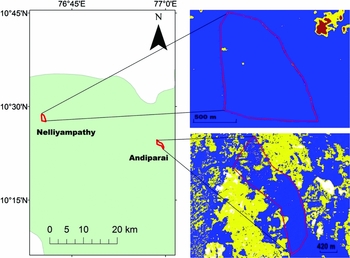
We collected the data for interspecific associations from two study regions, Nelliyampathy Reserve Forest and Anamalai Tiger Reserve (Figure 1).
Map of the study area. The red polygons show home range of each of the study groups of the lion-tailed macaque in Nelliyampathy and Andiparai forests of the Western Ghats, India. All interspecific interactions occurred within these home ranges. Green depicts Western Ghats ranges; blue depicts rain forests; yellow depicts plantations; white depicts built up area; brown depicts montane formations.

About 200 lion-tailed macaques in 14 groups inhabit Nelliyampathy Reserve Forest (10°25′–10º30′N, 76°35′–76°45′E) (Kumara et al. Reference KUMARA, SASI, SUGANTHASAKTHIVEL, SINGH, SUSHMA, RAMACHANDRAN and KAUMANNS2014). We selected a group named Victoria group (40 individuals, 23 individuals km−2) for the present study. The group was mainly arboreal (>95%). The study location is at about 1000 m asl and receives an average annual rainfall of about 3378 mm. The total area covered by Nelliyampathy Reserve Forest is 206 km2. The other primates present in this area were Nilgiri langur (Semnopithecus johnii (J. Fischer, 1829)) and bonnet macaque (Macaca radiata (E. Geoffroy, 1812)) with a density of 41 individuals km−2 and 17 individuals km−2 respectively. More details about the study site and study group are given in Erinjery et al. (Reference ERINJERY, KAVANA and SINGH2015).
In Anamalai (10°12–10°32′N, 76°49′–77°22′E), the study was conducted at Andiparai. Andiparai is a rain-forest fragment of about 4 km2 at an altitude of about 1250 m asl, located inside the Indira Gandhi Tiger Reserve, bounded by rain forests on one side and tea gardens on three sides. About 30 lion-tailed macaques in one group inhabit Andiparai (15 individuals km−2). The group was mainly arboreal (> 95%). Nilgiri langur (20 individuals km−2) and bonnet macaque (8 individuals km−2) were the other primates found here. The common predators of the lion-tailed macaque in all these habitats were serpent eagle (Spilornis cheela (Latham, 1790)), dhole (Cuon alpinus (Pallas, 1811)) and leopard (Panthera pardus (Linnaeus, 1758).
These study groups, therefore, represented two different habitat types of the lion-tailed macaque including a relatively contiguous reserve forest adjoining tea/coffee gardens (Nelliyampathy) and a rainforest fragment inside a protected area surrounded by rain forests and tea gardens (Andiparai).
Observation methods
We obtained the data for this study through ‘all-occurrences’ sampling (Lehner Reference LEHNER1998) by maintaining detailed notes on interspecific associations as and when they occurred. Data were collected on: date, time, study species followed during the day, associating species, activity of the study species during the encounter, activity of the associating species during the encounter, type of interaction, aggressor and the recipient, displacement (if any), species displaced, and duration of the association. The activity of a group was determined by recording the activity of the majority of individuals during the association. Usually when the lion-tailed macaques were travelling, the majority of individuals travelled, when resting, the majority of individuals rested and while feeding, the majority of individuals fed. The observations were made between 08h00 and 16h00. The sampling time was calculated from the total number of days during which we systematically followed the monkeys for 8 h. We took continuous observations on the group throughout the day and we only considered the associations in which we observed the beginning and end of each association.
We considered a species to be engaged in an association only if we observed it within 30 m of lion-tailed macaques. We considered 30 m as the detection distance since this was the farthest distance we observed two species to interact. Two observers followed the group, and while the lion-tailed macaque group was travelling, one of the observers used to go further ahead in the direction of travel to check the occurrence of other species. Also, while lion-tailed macaques rested, one of the observers used to check around the group for the presence of another species within the detection distance, every 10 min. We discarded the observations where an association had already started or where we could not observe it till the end (N = 12). We only considered the presence/absence of species within 30 m and did not consider the number of animals involved in an association. We considered every association to be dyadic, although some triadic and tetradic associations were observed. The other primate groups in the study sites were also habituated and hence human presence was not the likely cause for associations.
We divided the types of interaction after forming associations with other primates into two different categories: (1) Neutral interactions – lion-tailed macaques tolerated the other species without obvious behavioural interaction, and (2) non-neutral interactions – lion-tailed macaques were aggressive in the presence of another species. We considered the beginning and end of an association to be the beginning and end of an interaction. The initiator species of an interaction in the present study was the species which travelled and entered the detection distance of another species when the other was resting. When, both species were travelling we could not identify the initiator. During an association, if lion-tailed macaques became aggressive at any time, we considered it as an aggressive interaction. After all aggressive encounters, the other species was displaced. We did not observe any affiliative interactions (grooming, play etc.), nor did we observe any interactions in which lion-tailed macaques were submissive during this study. Aggressive interactions involved fighting, chasing and displacing other species. Usually, a few male and sub-adult male lion-tailed macaques were involved in the aggressive interactions. It was usually targeted at all members of the Nilgiri langur group.
Study period
The study period was divided into three sub-periods, based on rainfall: monsoon/wet season (June–September), post-monsoon (October–January) and dry season (February–May). The pattern of rainfall in Nelliyampathy (Erinjery et al. Reference ERINJERY, KAVANA and SINGH2015) and Anamalai (Sushma Reference SUSHMA2004) was similar.
In Nelliyampathy, the study was conducted from December 2011 to October 2012, with 280 h, 300 h and 265 h of observations in monsoon, post-monsoon and dry season respectively. We systematically (8 h d−1) followed the group for 92 d and only these data are used for calculation of observed associations (monsoon = 30 d, 240 h; post-monsoon = 33 d, 264 h; dry season = 29 d, 232 h).
In Anamalai, the study was conducted from September 1996 to August 1997. We systematically (8 h d−1) followed the group for 89 d. The amount of time spent on observation in monsoon, post-monsoon and dry season at Andiparai was 136 h (N = 17 d), 256 h (N = 32 d) and 320 h (N = 40 d) respectively. The total number of hours of observation spent in Anamalai was equal to the total duration of full-day follows.
Waser gas model
We used the corrected Waser gas model (Hutchinson & Waser Reference HUTCHINSON and WASER2007) to test a null model of random encounter for the lion-tailed macaque with the Nilgiri langur and the bonnet macaque. An encounter was considered to be the initiation of an association. The formula used for calculating the expected encounter rate was:
 $$\begin{equation*}
{\rm Expected\, rate\, of\, encounter = 2}\rho {\rm D(}\sqrt {{\rm \bar u}^{\rm 2} + \bar v^2 } {\rm),}
\end{equation*}
$$
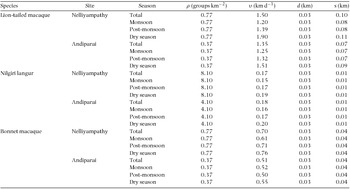
where, ρ = group density of the other primate species which interacts with the lion-tailed macaque, D = ½ the lion-tailed macaque group spread + ½ the group spread of the other primate species + detection distance d,  $\bar u$ = the mean travelling speed of the lion-tailed macaque,
 $\bar v$ = the mean travelling speed of the other primate species (Table 1). The home range of the lion-tailed macaque at all sites had a total overlap with the Nilgiri langur and the bonnet macaque groups. Arboreality and habitat use of lion-tailed macaque was similar to that of Nilgiri langur in both sites. The parameters used for the lion-tailed macaque in Nelliyampathy were obtained from Erinjery et al. (Reference ERINJERY, KAVANA and SINGH2015). The remaining parameters were obtained from the detailed study conducted by our research group, both in Nelliyampathy and Andiparai during the span of the present study. We calculated the mean travelling speed of all species by connecting GPS points taken every 30 min when the species was observed for complete days. We calculated mean group spread from the group spread data collected every 30 min for all species when we observed them for complete days. For calculating travelling speed and group spread, we systematically followed a Nilgiri langur group for 30, 27 and 28 d in monsoon, post-monsoon and dry season in Nelliyampathy and 15, 22 and 28 d in Andiparai. We followed bonnet macaques for 15, 18 and 20 d in monsoon, post-monsoon and dry season respectively in Nelliyampathy and 12, 14 and 16 d in Andiparai.
The parameters of lion-tailed macaque (Macaca silenus), Nilgiri langur (Semnopithecus johnii) and bonnet macaque (Macaca radiata) used for calculating encounter rate using Waser gas model at different study sites and in different seasons in the Western Ghats, India. ρ – group density, υ – mean travelling speed of the species, d– detection distance, s – mean group spread of the species.

After calculating the expected encounter rate, we calculated the expected mean duration spent in an association by using the formula:
Expected mean duration of an association =  $\frac{{\pi \times D}}{{2\left({\sqrt {\bar u^2 + \bar v^2}} \right)}}$.
Data analysis
We statistically compared the expected frequencies of encounters (Hutchinson & Waser Reference HUTCHINSON and WASER2007) derived from the Waser gas model with the observed frequencies using the formula for a Poisson distribution:
Probability of ≤ i encounters (P) = 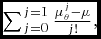 $\sum\nolimits_{j = 0}^{j = 1} {\frac{{\mu ^j _\theta - \mu }}{{j!}}},$
where μ = expected encounter rate and j = observed encounter rate. This test may overestimate significance since paths are not straight (Hutchinson & Waser Reference HUTCHINSON and WASER2007). However, the study on mangabeys has shown that it does not overestimate significance (Hutchinson & Waser Reference HUTCHINSON and WASER2007). We statistically compared the observed duration and expected duration using a one-sample t-test when the data were normally distributed. We treated each association as an independent replicate to compare between observed and expected mean. We used a non-parametric one-sample Wilcoxon signed rank test to compare between observed and expected median when the data were not normally distributed.
For associations with the Nilgiri langur, we performed a binomial logistic regression to compare the frequencies of type of interaction (dependent variable) with respect to site and season (independent variables). We used Mann–Whitney U-test to compare the time spent on different types of interactions to analyse whether lion-tailed macaques spent more time on neutral interactions than aggressive interactions. We did not do this for the associations with the bonnet macaque since all interactions were neutral. We set alpha at 0.05 for all statistical analyses and used SPSS 20 for analysis.
RESULTS
Associations between lion-tailed macaque and other primates
Lion-tailed macaques spent 4.6% and 2.6% of their total time in associations with other primates in Nelliyampathy and Andiparai respectively. In Nelliyampathy, lion-tailed macaques spent 1.9% (0.08 associations h−1) of the time associating with Nilgiri langurs and 2.7% (0.02 associations h−1) with bonnet macaques. In Andiparai, 2.4% of the time (0.08 associations h−1) was spent with Nilgiri langurs, whereas only 0.2% (0.01 associations h−1) time was spent with bonnet macaques.
Associations between lion-tailed macaque and Nilgiri langur
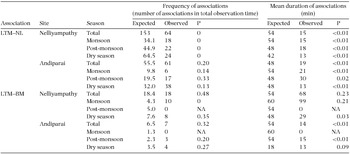
The ideal gas model approach revealed that in Nelliyampathy, but not in Andiparai, the lion-tailed macaque–Nilgiri langur encounter rate was significantly lower than expected (P < 0.001) (Table 2). This was true during all seasons (Table 2). In Andiparai, in all seasons the observed encounter rate was not significantly different from that expected (Table 2). However, in both Nelliyampathy and Andiparai, the observed mean duration of association was significantly lower than that expected during all seasons (Table 2).
Expected (as per the Waser gas model) and observed frequencies and durations of between-species interactions between the lion-tailed macaque and the Nilgiri langur, and the lion-tailed macaque and the bonnet macaque in different study sites and seasons in Nelliyampathy and Andiparai forests of the Western Ghats, India. P = Probability, LTM = lion-tailed macaque, NL = Nilgiri langur, BM = bonnet macaque.

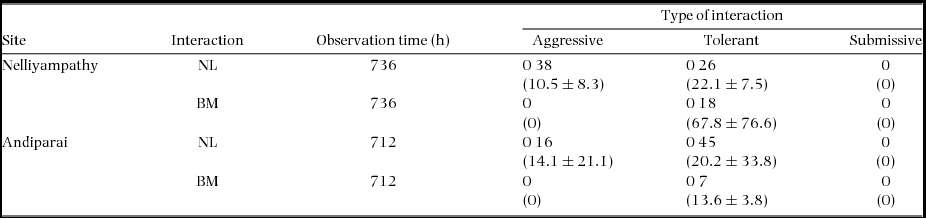
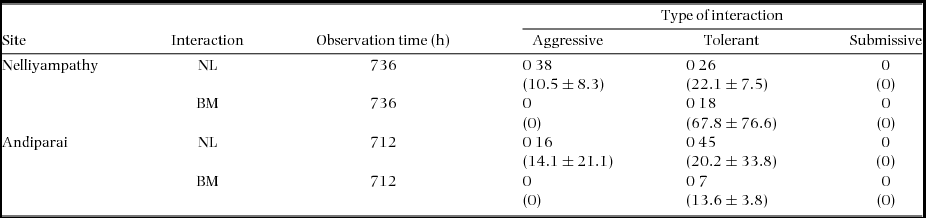
The logistic regression showed that an association at Nelliyampathy was significantly more likely to include aggressive interactions than the one in Andiparai (Wald's Z = 13.4, df = 1, P < 0.001). The model did not show any difference between seasons (Wald's Z = 0.6; df = 1, P = 0.44). The macaques spent more time in association with Nilgiri langurs when the interaction was neutral than when it was aggressive (Mann–Whitney U test: U = 1256, P = 0.001) (Table 3). In most interactions where lion-tailed macaques were aggressive towards Nilgiri langurs, the former were travelling across the Nilgiri langur ranges, both in Nelliyampathy (90%) and Andiparai (94%). Nilgiri langurs were submissive to lion-tailed macaques in most of the interactions. Even a single aggressive individual of lion-tailed macaque could displace the whole Nilgiri langur group. When langurs were submissive, they made threat calls and moved out of association.
Frequencies (number of interactions in total time) and duration (min) of interactions of lion-tailed macaque with other primate species in Nelliyampathy Reserve Forest and Andiparai in the Western Ghats, India. NL = Nilgiri langur; BM = bonnet macaque; values in parentheses denote mean duration of interaction ± SD (min). All associations between lion-tailed macaque and Nilgiri langur were initiated by lion-tailed macaque travelling through Nilgiri langur home ranges.
Associations between lion-tailed macaque and bonnet macaque
The ideal gas model approach revealed that in Nelliyampathy and Andiparai the observed association rate was similar to that expected when considering the year as a whole (Table 2). In Nelliyampathy, bonnet macaques associated with lion-tailed macaques only in monsoon and dry season, and the observed encounter rate was as predicted in dry season. The observed encounter rate in monsoon was significantly higher than expected (P = 0.01). In Nelliyampathy, mean duration of an association in monsoon was similar to that expected (P = 0.21). In Andiparai, lion-tailed macaques had associations with bonnet macaques only in post-monsoon and dry season and the observed encounter rate was similar to the expected rate. In Andiparai, mean duration of an association in dry season was similar to that expected (P = 0.09).
All interactions between lion-tailed macaques and bonnet macaques were neutral interactions, both in Nelliyampathy and Andiparai (100%). In Nelliyampathy, in dry season, associations occurred only when the species were travelling. However, in the monsoon, only 30% encounters after initiating an association were when the species were travelling (neutral). They were also neutral during the other associations that occurred when they were either feeding or resting near each other (70%). We observed seven co-feeding interactions between lion-tailed macaques and bonnet macaques in monsoon and the average duration per interaction was 128 min. There was no significant difference between the expected mean in monsoon and the observed mean of co-feeding interactions (t = 1.91; df = 6; P = 0.10). In Andiparai, whenever the two species encountered each other, they were travelling (100%). Neutral interactions indicated no dominance between lion-tailed macaques and bonnet macaques.
DISCUSSION
The lion-tailed macaque, an endangered primate, inhabits the evergreen forest patches in the Western Ghats of southern India and it is an important species in this community since it is endemic to the region and its numbers are declining (Singh et al. Reference SINGH, SINGH, KUMARA, KUMAR and D’SOUZA1997). In the present study, we analysed the interspecific associations of the lion-tailed macaque with other primates, using longitudinal data at different sites, to understand the community ecology of this species. The lion-tailed macaques spent less time than expected with Nilgiri langurs in all seasons and at all study sites. In Nelliyampathy, the frequency of associations between lion-tailed macaques and Nilgiri langurs was less than expected, in contrast to Andiparai where associations were similar to expected. The lion-tailed macaques were more aggressive towards Nilgiri langurs in Nelliyampathy, in contrast to Andiparai. This was probably due to the higher density of Nilgiri langur groups in Nelliyampathy than in Andiparai. The gas model has shown that Nilgiri langurs actively avoid lion-tailed macaques in Nelliyampathy, probably due to more aggressiveness shown than in Andiparai.
Primate-primate associations is a common phenomenon amongst primates in Africa and South America (Struhsaker Reference STRUHSAKER1981). The guenons in Kakamega forest were found to spend 74% (Cercopithecus ascanius) and 49% (C. mitis) of their time in mixed-species associations with other primates (Cords Reference CORDS1990). The tamarins Saguinus fuscicollis and S. mystax of Amazonian forests in South America formed associations in 98.6% of the total observation period (Peres Reference PERES1992). No study of Asian primates has reported a high percentage of time spent in associations. The primates in south-east Asia and Madagascar have been observed to avoid each other without forming associations, and this has been attributed to lower densities, smaller group size and lesser predator pressure (Rodman Reference RODMAN1973, Struhsaker Reference STRUHSAKER1981). This may have been the reason for fewer reports of primate-primate associations from Asia. Studies on associations of five Bornean primates (Rodman Reference RODMAN1973) showed that presence of one species had a negative effect on the presence of the other species. Also, the studies on macaque interspecific associations are rare in primate literature. Macaques may not be forming associations with other species of primates because of their temperament. In the present study also, it was seen that lion-tailed macaques do not associate with other primates in most instances. This pattern probably was due to the avoidance of one primate species by the other. This is the first study on Asian primates using ideal gas approach to show that primates actively avoid each other. Other studies (Rodman Reference RODMAN1973, Struhsaker Reference STRUHSAKER1981) have indeed shown that associations are rare, but not that they are actually avoided.
The frugivorous lion-tailed macaque associated with the folivorous Nilgiri langur (Oates et al. Reference OATES, WATERMAN and CHOO1980) more often than with the frugivorous bonnet macaque. The niche overlap between a folivorous and frugivorous primate will be very low, as observed between lion-tailed macaques and Nilgiri langurs (Sushma & Singh Reference SUSHMA and SINGH2006) and lion-tailed macaques and Hanuman langurs (Singh et al. Reference SINGH, ROY and SINGH2011). Hence associating need not mutually benefit or harm either species in foraging efficiency. However, we found Nilgiri langur to feed on some fruits which were also consumed by lion-tailed macaques (e.g. Artocarpus heterophyllus, Ficus exasperata) during the absence of the macaques. Most of the interactions, when lion-tailed macaques were travelling across the Nilgiri langur ranges, were aggressive. It has also been shown that Nilgiri langurs modify their behaviour in the presence of lion-tailed macaques by lowering their feeding substratum and increasing passivity (Singh et al. Reference SINGH, SINGH, ANANADA KUMAR, KUMAR, SHARMA and SUSHMA2000).
The other primate species that lion-tailed macaques formed associations with was bonnet macaques. In Nelliyampathy, bonnet macaques were observed to associate with lion-tailed macaques in monsoon, when jackfruits, the main food of both macaque species during that season, were abundant (Erinjery et al. Reference ERINJERY, KAVANA and SINGH2015). This was also the period during which the infants were small and both species ventured into adjoining coffee plantations for feeding. It has been observed that the red-tailed monkeys associated more frequently with conspecifics when they were more frugivorous, feeding on clumped fruits, than when they were more folivorous (Bryer et al. Reference BRYER, CHAPMAN and ROTHMAN2013). However, in the present study, when the resources were scarce in dry season, the associations were just due to chance of converging travelling routes. In Andiparai, the associations were chance associations and occurred while bonnet macaques travelled across the lion-tailed macaque ranges. Andiparai is a small fragment inside the Tiger Reserve but surrounded by tea gardens on three sides. Bonnet macaques and lion-tailed macaques may not have associated for foraging in Andiparai due to the scarcity of resources in the fragment. In another site at Anamalai, the Waterfalls Shola, bonnet macaques were aggressive towards lion-tailed macaques (Sushma & Singh Reference SUSHMA and SINGH2006). These aggressive interactions happened when there was a high niche overlap between these species. Also, these species did not frequently encounter predators in both sites. However, these species reacted to the alarm calls of the other species whenever they formed associations.
Among the three primate species, the Nilgiri langur is larger than the two macaque species (Rowe Reference ROWE1996). However, both macaque species chased Nilgiri langurs during an aggressive interaction. This indicates that the species-specific temperament and group size, rather than the body size (French & Smith Reference FRENCH and SMITH2005) determines interspecific dominance in these primates.
Lion-tailed macaques and Nilgiri langurs were more likely to be involved in aggressive interactions in Nelliyampathy where the density of Nilgiri langur groups was higher than Andiparai. Hence, we hypothesize that the primates in fragmented habitats which hold high densities of primates will be more subjected to aggressive interactions. The future studies of interactions in other fragmented sites with high densities of primates using the same methodology can be used to test this hypothesis.
ACKNOWLEDGEMENTS
We thank the Chief Wildlife Warden and the officials of the Kerala and Tamil Nadu Forest Departments for permission to conduct this study and for their field assistance; J.M.C. Hutchinson from Senckenberg Museum of Natural History for help in data analysis, editing and critically commenting; Ram, Ranjith and Subiah for helping us with the fieldwork. This study was supported by a Department of Science and Technology, India Ramanna Fellowship to MS. We are grateful to the reviewers for their valuable comments that have helped enhance the quality of this article.